







Abstract
Bereavement and mourning are arguably one of the research interests of psychologists, psychoanalysts, and psychiatrists since Freud’s publication of Mourning and Melancholia. This paper is a qualitative case study that sought to examine the mourning experience of the participant from childhood until his adolescence. For theoretical foundation, the four tasks of mourning primarily developed by James Worden was utilized for the proper direction of the research inquiry; namely: a.) accepting the reality of death; b.) experiencing the feeling of grief; c.) adjusting and creating new meanings in the post-loss world; and d.) reconfiguring the bond with the lost person. The paper finds that the participant’s cognitive attitude, emotional experiences, and personal observations of the environment enable him to overcome actively (in an overlapping manner) the three tasks of mourning. However, the failure to find an enduring connection with his deceased parents is not a result of strong attachment but with the absence of personal belief about the meta-existence of God.
From an evolutionary sociological perspective, family relation is manifestly characterized by primary (face-to-face) interaction. Identified as the basic unit of society, mutual recognition and attachment (between parents and children) are considered to be the fundamental forces among family members that make the social link and bond within the social structure of family enduring. However, a sudden disappearance of parental care in childhood is profoundly influential in the context of developmental principles. Researchers have pointed out that parental loss has profound implications on a child’s life and development either long-term or short-term (Bergman et al., 2017; Cerniglia et al., 2014; Kailaheimo-Lönnqvist & Erola, 2020; Schonfeld & Demaria, 2016). Though parental death – the end of physical existence – is a natural phenomenon in which every human being is consciously aware of, it still presents a “shocking effect” on family relatives and children. Rostila and Saarela (2011) contend that parental death is disturbing among children and without the existential presence of a secure relationship, social and emotional development are unlikely to happen.
Personal triumph and failure in overcoming these implied negative corollaries are interdependent with the ensuing important psychological terms: grief, mourning, and bereavement. Regarding their phraseologies, these words are often used interchangeably. Hence, a precise and clear distinction must be established. First, grief is the personal experience of loss and the person’s reaction to bereavement which includes thoughts and feelings that change over time (Gerhardt et al., 2009; Worden, 2009, 2018). Next, mourning is the process that occurs after the loss as the bereaved come into terms with the loss. Lastly, bereavement is a wide-ranging term referring to the total experience of a person following death. Bereavement comprises an individual internal adaptation, mourning processes, grief experiences, and changes in living arrangements and relationships (Christ et al., 2003). These differentiations imply that grief and mourning take place within the bereavement period.
Historically, since the publication of Freud’s Mourning and Melancholia, many researchers have tried to examine the psychological and familial issue of mourning relative to the strong social attachment and relationship between humans (Baker, 2001; Yousuf-Abramson, 2020). The introduction of the concept of mourning generates division among scholars whether children are capable of such activity and process (Brickell & Munir, 2008). In locating the reference of the psychological enigma, the problem is that it exclusively focused on the ability of a child to perform adult-like mourning rather than on a definition of childhood mourning. Christina Sekaer, as cited in Ebrahim, Fouché, and Walker-Williams (2019) defined childhood mourning as the process wherein a child optimally reacts to death and continues with comparatively normal development. The more neutral manner to approach a child’s mourning is to provide some adequate support from an adult caretaker (e.g., older siblings, grandparents, relatives) who can help meet the needs of the child and allowing him or her to communicate his or her feelings towards parental death (Garber, 2008). In taking this third position, Worden (2009) avowed that children can mourn with some form of a model of mourning (not an adult-based) that considers the nature of children since their cognitive levels may not be sufficient to understand the situation. Within a phenomenological context, a disturbing circumstance to surmount the pain and emotional sorrow amid parental death through the mourning process would highly result in a developmental disturbance in later stages of life.
Contrary to the phases-based theory of mourning of Bowlby and Parkes (Mallon, 2008; Worden, 2018), Worden (2009) consistently depicts mourning as a process, not a state. That is to say, it is a gradual flow of adaptation towards the reality of parental loss and one cannot predict or set a definitive date for the culmination of this process. He also believed that mourning is finished the moment the mourning tasks have been carried out and if a mourner can think about death without pain anymore. The non-determination about the boundary of mourning and the possible changes that may occur in the life of the bereaved indicates that the whole (mourning) process is developmental (see Kavaler-Adler, 2000, 2003, for examples). In a nutshell, observation of the early mourning tasks is possible in early childhood. During adolescence, in which a person’s personality and maturity are directed towards integration, the fuller process might be seen which might even extend to adulthood.
The developmental approach to the ‘mourning process dilemma’ provided to some degree a satisfactory explanation and led to the shift of the inquiry’s scope (Garber, 2008). A review of the literature suggests different perspectives. Some focused their works on the therapeutic mechanisms of a surviving parent in guiding younger children in their mourning activity (Parens, 2001). One can also refer to the therapeutic intervention for children who have undergone traumatic grief (Compton et al., 2003; Sklarew et al., 2004). Indeed, recent clinical and empirical findings contributed to the record of parental death literature (Akhtar, 2001; Cournos, 2001; Miller, 2006). Accordingly, one can infer the innovative inquisitiveness of academic researchers to explore the wide spectrum of mourning.
The novelty of the paper reflects the application of James William Worden’s Four Tasks of Mourning to map out the participant’s mourning case experience from childhood until his adolescence. The researcher endeavored to examine from a first-person perspective if the methodological utilization of Wordenean tasks has been positively achieved by the participant and if there are interconnections between the tasks under which the participant can actively make decisions and actions. Moreover, notwithstanding the voluminous works concerning mourning, the majority of scholarships were mostly completed outside the country particularly in American and European settings. Consequently, the researcher sought to present psychological knowledge within the context of a Filipino existential condition and experience. Gire (2014) believed that people’s conceptions and responses to the issue of death and dying vary across cultures. Initially, Filipino children’s ideas of death are either concrete or abstract which evolves towards maturity via socialization, observation, and experiences (Macabulos, 2015). Though the case experience of the participant from childhood to adolescence is within the general category of children, it is still a distinctive effort to examine and assess such issue to get an analytical discussion as to the developmental changes of the participant’s idea of death relative to the psychological tasks of mourning. Categorically speaking, Gire concluded that understanding the complexities of the issue (death and dying) will prepare anyone to respect and respond to people meaningfully while enriching both of our lives during the process.
Theoretical Framework: Worden’s Four Mourning Tasks and Its Mediators
In his book, Grief Counseling and Grief Therapy, James William Worden (2009) formulated four tasks of mourning. Tasks, within the context of this paper, must be understood as distinct from stages and phases. Some theorists commonly used stages and phases in theorizing and understanding the psychological process of mourning. To view the mourning process as a form of stages often failed to realize that individuals do not pass through a series of consecutive stages (Worden, 2009). On the other hand, although Worden does not disagree with the idea of theoretical phases since one phase may overlap with others but phases entail passivity which a mourner simply passes through. On the contrary, mourning tasks present to some degree a valid understanding of the mourning process. The tasks-based approach offers some hope and sense of leverage on the mourner to actively do something to adapt to the death.
Task One. Accept the Reality of the Loss
This task of mourning invites and encourages the mourner to face the actuality of death. By acceptance, the mourner must acknowledge that the person is dead and will never come back (Worden, 2009). Insofar as meeting the deceased is concerned, family members should accept, at least in this world, that reunion is impossible. Both cognitive and emotional acceptances of death are necessary components of the mourning process, however, a mourner must first accept death before confronting the emotional reality (Worden & Winokuer, 2011). Nonetheless, not everyone immediately recognizes the death of their loved ones by denying or not believing. This causes them to be stuck in the first task of mourning. Some examples may include the denial of the meaning of the loss and mummification of the deceased body.
Task Two. Experience the Feelings of Grief
The experience of physical, emotional, and behavioral pain is typically linked to the loss. The bereaved must acknowledge the pain and avoid suppressing it (Khosravi, 2021). The intensity of pain amid the death of family members varies among human beings, yet it is almost entirely impossible not to experience some level of pain. Under this task, the negating behavior and action are being impervious or not feeling. Some people use avoidant-dismissing styles for them not to experience much pain after death (Bonanno, 2004; Kosminsky & Jordan, 2016). Others may prevent this task by using drugs and evading reminders of the deceased. These alternative acts evidently attempt to overthrow or subdue the need to grieve.
Task Three. Adjust to a Changed Life: Creating New Meanings in the Post-Loss World
In this task, Worden enumerates three areas of adjustment as the mourner continues his or her life after the death: external adjustments, internal adjustments, and spiritual adjustments.
External Adjustments
Adjustments to a new environment are diverse that almost depend on what relationship one has with the deceased. Performing the new duties and developing different skills which are not previously practiced by other members of the family could ground for resentment that would gradually be accepted later. One’s coping strategy after the death can bring some benefits to the mourner which indicates the successful completion of task three (Worden, 2009).
Internal Adjustments
The personal system and sense of self of a bereaved person have to adjust to the parental loss and death. Internal adjustments are comprised of self-definition, self-esteem, and self-efficacy (Worden, 2009). Self-identity is sometimes connected through someone’s relationship with other people. In this task of mourning, an adjustment amid bereavement aims to make one feel like a ‘one’ rather than part of a duality. Attachment is also a key feature in understanding the self-esteem of a person before and after death. Those who are deeply attached may suffer from depression and great damage. This mourning scenario challenges the self-efficacy of the mourner, the degree to which he or she has control over himself or herself and his or her actions.
Spiritual Adjustments
Death, whether due to personal or natural suffering, appears to question and shake the worldview of anyone including God’s role in the universe and one’s life (Neimeyer, 2000; Worden & Winokuer, 2011). Among other things, three basic assumptions are often confronted, namely: the world as a benign place, the world is senseful, and the worthiness of a person. These are dependably to occur on death which is sudden and untimely as opposed to some expected and natural loss (Worden, 2009).
With the three types of adjustments mentioned, task III is negated by failure to adapt to the loss. People tend to accept their state of helplessness and do not develop new skills and strategies to cope with environmental requirements and demands.
Task Four. Reconfigure the Bond with the Lost Person
Modern psychologists and recent studies suggest that people develop continuing bonds with the dead (Klass et. al., 1996, as cited in Worden, 2009). This bond enables a mourner to have some degree of connection with the deceased that does not prevent him or her to continue living. Therefore, it is impossible to truly lose one’s time with the deceased including the memories, inspirations, influences, and values he or she shared with them and that one can still integrate these into his or her new way of living (Attig, 2011).
During the fourth task of mourning, the process is hindered by not living. For many, it seems for them that their lives have stopped and will no longer resume. In addition, Worden submits that for thoughtful consideration of the case, the four tasks must be accompanied by their mourning mediators since people handle the mourning process differently. The Seven Mourning Mediators are the following: Mediator 1. Who the person who died was (e.g., family members, friends) Mediator 2. The nature of the attachment (e.g., strength of the attachment, conflicts with the deceased) Mediator 3. How the person died (e.g., proximity, suddenness, or unexpectedness) Mediator 4. Historical antecedents (e.g., mental health history) Mediator 5. Personality variables (e.g., age and gender, assumptive world) Mediator 6. Social variables (e.g., ethnic expectations, religious resources) Mediator 7. Concurrent stresses (e.g., life-changing events after death)
Deviating from literal death studies, Curasi et al. (2004) studied women’s mourning and grief experiences in empty nest households. Empty-nest mothers faced double loss: on the one hand, the loss of the emotional and physical presence of the child and, on the other hand, the loss of certain tasks significant to the motherhood role. Consumptions (e.g., phone calls, care packages, things for a child’s apartment) become a vital strategy for mothers to negotiate with the loss of their identities as loving and caring adults. In the course of transition periods, major readjustments to mothering roles took place within the life-long project of identity formation. They concluded that there is no single meaning of being a mother and of the mourning and grief experiences following the loss of a child from the family home. Similarly, the shift from couple to widowhood necessitates reconfiguration of self-concept and a new way to be conceived by other people (Carr & Jeffreys, 2011). Normally, grieving spouses will experience pain as they adjust to new circumstances but grief is not just limited to the pain of the loss. For Yousuf-Abramson (2020), grief ranges from very painful feelings to the most positive feelings of happiness, hope, and pride that may occur as the mourner find ways to incorporate the deceased in his or her life. Worden’s tasks of mourning are also among the two dominant models in grief therapy together with Robert Neimeyer’s ‘meaning reconstruction.’ According to Robak (2002), the two models allow a person to redefine oneself by observing one’s responses to the questions derived from the urgent encounter of loss. The strengths of Worden’s model lie in its emphasis on the feeling experience of the mourner. Mourning tasks provide self-control and self-determination over the lives of grieving persons.
In a prima facie synthesis, the mourning tasks and their mediators appear to be theoretically valid and logical. However, researchers’ continuous case applications are significant contributions to see whether Worden’s conditions in each task including the negating reactions consistently reflect the reality of a mourner's behaviors and reactions and/or if there are new theoretical implications or findings that can help further investigate and improve the psychological theory.
Methodology
Research Design
The theoretical application of Wordenean tasks of mourning and the complimentary usage of the seven mediators was to set out the real context of mourning under the personal case experiences of the participant. On top of the research objective to properly investigate the germaneness of the framework, the researcher was also committed to practically understand the situation of the participant as he deals with the reality of death and parental loss. Understanding from a subjective and personal viewpoint, it is valid that the paper was examined from a qualitative basis. Specifically, a descriptive case study as a type of qualitative design was used for careful and reflective analysis. A descriptive case study is a detailed and focused approach by which the propositions and research questions about the issue are carefully scrutinized. The significance and promise of a descriptive study is its potential to reveal connections and patterns relative to theoretical construction that can advance theory development (Tobin, 2010). Using this design with the aid of the theoretical framework, the researcher engaged in a careful study of the participant’s mourning experience and considering the possibility for the theory’s improvement.
Participant
A Filipino senior high school student served as the participant of the study. There were two central reasons why the participant was chosen which largely contributed to the novelty of the research. First, both of his parents died during his childhood and he is now under the custody and care of his paternal uncle. His childhood experience gave a different impression since some studies, which also took the same interest, focused only on the psychological understanding of either paternal or maternal death or both but not in terms of its long-term implications or after the long years of death. That is, only a small number of studies discuss the (specific) long-term impact of early parental loss (Li et al., 2014; University of Pittsburg, 2018). Also, there are small data (if any) that explore how a person or informant constructs the importance of bereavement experiences in the context of his or her life (Ellis et al., 2013). Second, being a student in the latter years of adolescence and after several years since the death of his parents, personal narrative enriched the interpretation and discussion of the four tasks of mourning. Furthermore, on the issue of confidentiality and validity, he openly expressed and agreed to share his private experience and background relative to the bounds and range of the study. Although he is religiously affiliated with Roman Catholicism on paper, he classified himself as a nonbeliever or atheist and mainly interested in mathematics and science courses.
Sampling Technique
Using a purposive sampling, the participant was chosen based on his ability to clarify and articulate a specific theme, concept, or phenomenon (Robinson, 2014). The identification and selection of the informant are grounded on his knowledge and experience with regards to the phenomenon of interest (Lewis & Sheppard, 2006; Palinkas, 2015). Succinctly, the participant exhibited a personal willingness to engage in data gathering while taking into account his knowledge and relevant experiences. Hence, it can be deduced that the participant met the aforesaid purposeful criteria.
Research Instrument
As the world faces the negative consequences of the COVID-19 pandemic, so too the research community undergoes the process of “new normal” and modifications of its conduct. Government protocols such as physical distancing precluded the researcher to interview the participant as a frequent form of data gathering for a qualitative study. Online interview, as an alternative for face-to-face dialogue, was removed as well from the options due to the slow internet connection in the geographical location of the researcher. Instead, a questionnaire was sent via online to the participant for him to answer within three to four weeks. In detail, the questionnaire is divided into two parts: the initial questionnaire and the research questionnaire proper. The initial questionnaire was constructed based on the seven mediators identified by Worden. This helped to identify the fundamental personal background and related information about the participant’s parental death. On the other hand, the research questionnaire proper was made following the four tasks of mourning that aim to explore the case in a much deeper illustration. Apart from the questionnaire, the questionnaire also contains a concise explanation of each task and mediator concerning the mourning process to guide the participant in answering the questions. Finally, an online question-and-answer dialogue (or messages) between the researcher and the participant was used to deepen the discussion of the study.
Method of Analysis
The gathered data both from the questionnaire and the online question-and-answer-dialogue were analyzed using thematic analysis. This qualitative method is understood as the identification, analysis, and reporting of patterns (or themes). By themes, it means something important about the data derived from research instruments (e.g., survey interview) and represented through patterned responses. Hence, a researcher organizes and describes the data in rich detail. Braun and Clarke’s (2006) six processes of conducting thematic analysis were strictly followed. First, the familiarization with the data. The researcher read and re-read the responses of the participant and highlighting the initial concepts. Second, to generate initial codes which require extracting significant ideas across the entire data set. Next, the search for themes. This was done by collecting all relevant data for the identification of themes. The fourth is the review of themes. In this process, the researcher checked if the themes work with the extracted code and the whole data set. Afterward, defining and naming the themes were performed. Lastly, the researcher produced the report through a selection of compelling examples and relating the analysis and discussion to the related literature and research objective and question. Nowell et al. (2017) argued that even though Braun and Clarke’s method involves six processes or phases, it is also an iterative and reflective process in which a researcher constantly moves back and forward between phases.Moreover, to ensure the quality of the paper, Lincoln and Guba’s (1985) criteria for trustworthiness – credibility, transferability, dependability, and confirmability – were incorporated during each phase of thematic analysis. Korstjens and Moser (2018) added reflexibility as a primary part for the insurance of transparency and quality in qualitative studies. Credibility aims to establish whether the research presents reasonable information drawn from the original data and is a correct interpretation of the participant’s views. From phase 1 to phase 5, the researcher used the strategy called persistent observation – a constant reading and rereading of the data, analyzing and theorizing the data set, and revising the concepts correspondingly. Transferability refers to the applicability and generalizability of the study (Korstjens & Moser, 2018; Nowell et al., 2017). To facilitate this criterion, a strategy known as the thick description was employed in phase 6. Throughout the discussions of each theme, the context of the participant’s case experience was explored to become meaningful to readers and persons with the same circumstance. Dependability denotes consistency in checking the analysis process with accepted standards, while confirmability is concerned with how the researcher’s findings and interpretations are derived from the data set (Korstjens & Moser, 2018; Nowell et al., 2017). To guarantee the two conditions, an audit trail was used wherein the researcher described the steps from the beginning of the research to the development and reporting of the findings. The methodology section of the paper can serve as a concise and thoughtful illustration of the research audit trail. Reflexibility means the process of critical self-reflection of the researcher about his or her assumptions, values, and preconceptions, and in what forms these influence the data analysis. To do this, the researcher made a brief bulleted journal highlighting the presuppositions before and during the conduct of the study, the aspects of the questionnaire that were noted, and the researcher’s relationship with the participant. The journal is deemed important as it set the things that should be considered in analyzing the data to maintain neutrality and impartiality. These qualitative criteria of trustfulness are critical and essential supplementary components for the acceptability and usefulness of the research for numerous stakeholders related to the issue of mourning and parental death.
Results and Discussion
Findings and Discussion
Acceptance and Innocence: Towards Realizing the Death
In children’s level of rational thinking and recognition, it is easy for them to just accept the events and things without an in-depth comprehension. To be exact, children may show grief-like behavior but they may also be incapable and lack cognitive features to understand death: “Back then, I cannot feel any pain within me. For me, I’m like an emotionless kid. What I mean is, I know that my parents died but I don’t have the sensitivity and care about the things around me.” Some of the cognitive concepts that are essential for a child to fully apprehend death are causality, concrete operations, finality, inevitability, irreversibility, and transformation (Hopkins, 2014; Poltorak & Glazer, 2006; Worden, 2009, 2018). From the developmental outlook discussed in the previous pages of this paper, children are capable of mourning but are also mediated by their cognitive and emotional development and other factors.
Furthermore, the proximity of death of the participant’s parents was a crucial mediator on how he accepted the loss (see Table 1). When his mother died at the school where she was teaching, he was not aware and was doubtful whether the former will still wake up. But witnessing in front of him his father who was about to die, he did not know how he should have responded. Worden (2009) had stressed that deaths that occurred from a distance might lead someone to perceive the condition as unreal – assuming that the person/s or parent/s is/are still there. In the COVID-19 crisis, the nature of attachment between the mourner and the deceased (e.g., depth of love towards the deceased) and how the latter died (e.g., remoteness from the family) have tremendous implications on the mourner and the entirety of the mourning process (Khosravi, 2021; Wallace et al., 2020). Apropos to the participant, after a few days and weeks without the presence of his parents, he came to fully accept their disappearance. Therefore, the consistent absence of communication with the deceased had led to the acceptance of their death. Well, as a child at that time and a few days after their death, I automatically accepted the event, not because I fully understood the situation, rather I could not find any reasons to ask. Aside from the fact that I was a child during those times, it was also difficult for me, even this time, to remember the memories with them, that’s why I felt okay with their deaths. In other words, my mind experienced an automatic alteration so that I would never feel lonely. Though I’m aware that they are gone at that time I’m still innocent and naïve about the situation such as the meaning of death. Besides, despite the basic needs given to me by my family and relatives, they did not try to fully explain to me the real situation back then.
Initial Data about the Mourning Mediators.
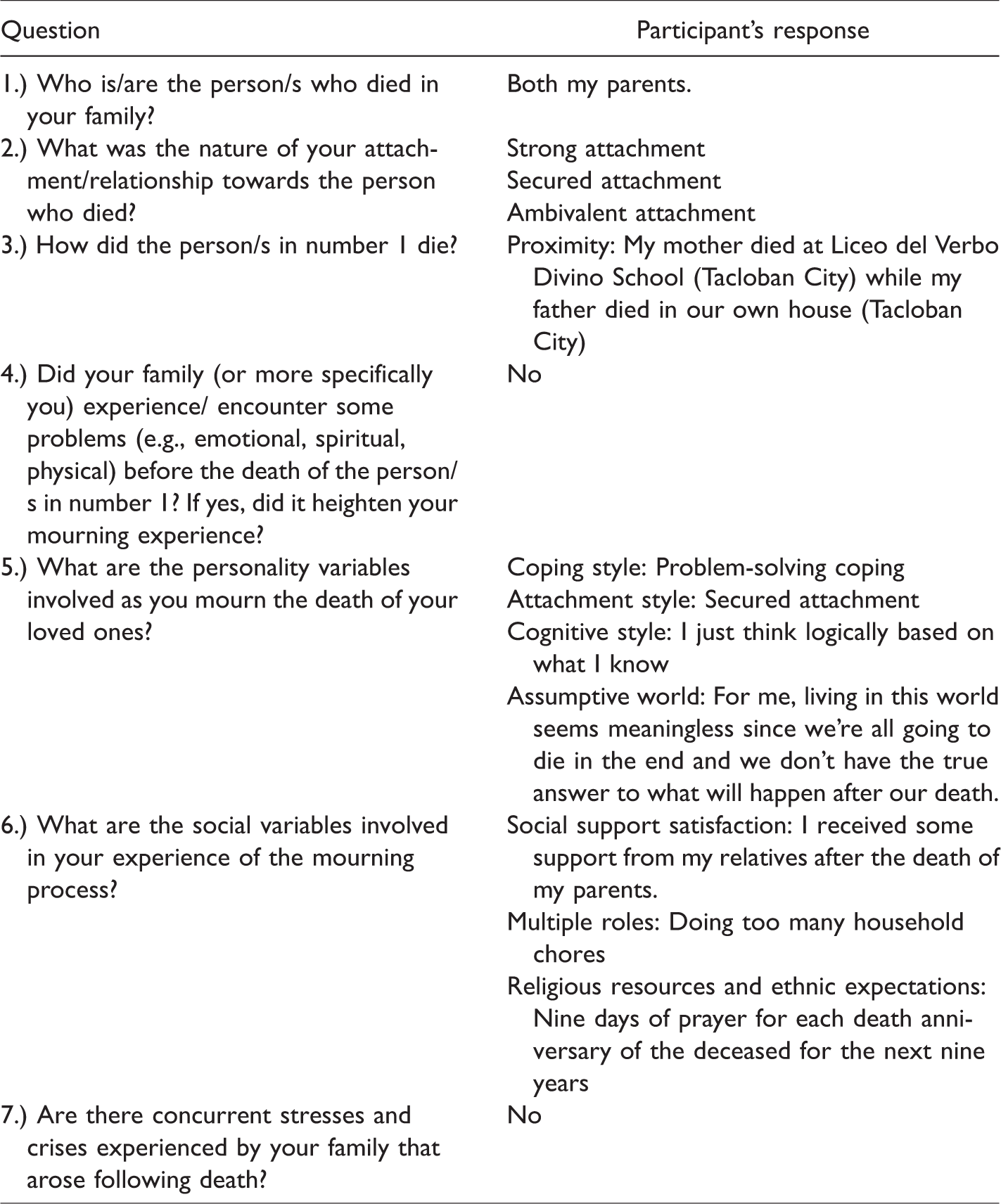
The participant’s experience was quite different because instead of making alternative and child-make solutions and answers, his acceptance (without adequate knowledge), according to him, was because “…there was nothing I can do to change the event. So because of that, I thought about their deaths as normal and fine.” Sufficient realizations and insights came as the participant reached the age of adolescence, a typical time and stage for one’s total cognitive and emotional maturation. The number of years that have passed did not, in any aspect, remove his recognition of the existential ending of his parents. Even if he cannot disinter the memories he shared with them, but the sheer fact that they are gone triggers an emotional pain in his mind: “Now that I am fully aware of my living condition, I feel sad sometimes as I start remembering their death.” Again, as a matter of illumination, it is not the memories that make him feel this way, rather it is the external regret about their early demise as a young child and the possible prospect to be with them in a much longer time. From this, it gives us a twofold reality. On the one hand, the conceived reality (to be with his parents) that is impossible to happen and, on the other hand, the actual reality that cannot be discounted.
On the matter of time and age preference vis-a-vis remaining as a child to escape the disturbing pain and intricacy to process the parental loss, the participant admitted that he would choose to be a teenager than go back (even though it is impossible) as a child: “When you are a child, your vision of reality is limited.” Realization together with (negative) emotional feedback can cause poignancy yet it will widen your grasps of everything: “… it is much better to become a teenager because you would start to have more realizations and become knowledgeable.” This reflects the developmental explanation of the mourning process – a mourner progresses towards maturation and acceptance concerning the death of his or her loved ones from childhood to the next stages of life. Nevertheless, personal responses are affected by age, limited experiences, ability to comprehend things, and emotional ties with the dead. It also ranges from mild to an astonishing sense of loss (Stephens, 2007). Presently, the participant is basically in the line of such a sense of loss.
Endurance and Sacrifice: A Personal Struggle
Individual differences may not only cover the intelligence of a person but also the emotional diversity in dealing with distinct personal problems. The question of endurance and sacrifice in dealing (with) the mourning conditioning of the bereaved is a relativistic inquisition based on the context of a personal experience, adjustment, and biographical life. External and internal adjustments, in this case, can be framed up by looking into the secondary losses, the changes that accompany the death of a person/s in the family. If the primary loss is the non-appearance of the parent’s existence in the child’s life, secondary losses, on the other hand, include indirectly related shifts like loss or changes in the family following the death of a loved one (Gire, 2014). In the study, the participant revealed that he is now living in his paternal uncle’s house to support his needs. They (his siblings) need to be separated from each other since they have no biological parents anymore who can provide and give their necessities. Familial brokenness due to parental loss is profoundly painful and a great challenge, yet choices are limited and adaptation to another environment must be established for the purpose of survival (at least in a physiological sense). Before the pandemic, we were away from each other. Today, we are now living together and despite our situation before COVID-19, and until now, they still love me. I consider our relationship not only as a family but also as friends.
In his new custody, the participant self-required himself, as a matter of gratitude, in doing various household chores in return for his paternal uncle’s family’s generosity. Since elementary until now, my paternal uncle and maternal auntie always support my studies. Therefore, as a form of gratitude and appreciation on my part, I need to be good in my academics. I even perform household activities upon arrival from school before I can have time for myself.
Behind this veil of external or outward impression, a hidden reality is needed to be uncovered. The passage of time may solve the problem of understanding and acceptance of death (including its causes and mediators), however, the emotional torture and longing of the surviving offspring and members of the family are other dimensions that must be a concern. Participant expressively writes (in several times) that… It is not the disappearance of my parents’ physical existence that makes me feel the pain or sadness at some point; rather it is the loss of parental care and love that I’m seeking for. It’s still hard to think that I cannot anymore experience the feeling of being loved and cared for by my parents as I grow. As a result, during the early years as a teenager, I hoped that they are still alive but then right now I feel happy since they will no longer experience the problems and sufferings of life.
General and popular belief holds that time heals the wounds, and then a person could face the future with an optimistic vision. Pessimists may not be the only ones to challenge this proposition but also those individuals who are shaped and modified by (un)expected circumstances. The life of the participant offers novel insights, if not complete, about the dynamic and complex conditions in post-parental loss.
World’s Meaninglessness and God’s Non-Existence: A Psychophilosophical Account
Suffering is a great enemy of the psychological state of humans. Emotions sometimes overthrow and alter one’s rational thinking and worldview. In consequence, the breakdown and discontinuity of the familial and parental connection produce a qualm and uncertain response from the surviving party of a certain social group. Believers of God (e.g., the monotheistic God of Christians), occasionally, if not often, experience a spiritual crisis. Equally, some psychological theories suggest that youths are more susceptible to emotional disturbance during the period of adolescence. As applicable to theists, pain and misery normally cause suspicion and skepticism about the benevolence of God which often result in the dismissal of His existence.
In the case of the participant, once people talk about God, he cannot help himself to ask about the early demise of his parents: “Sometimes when I hear some people talking about their God I often question myself why does it have to be too soon for my parents.” Yet, the participant does not essentially blame God for the death of his parents. He rather discards the idea of the meta-existence of the Divine including miracles. This lucid response from an adolescent is a clear manifestation of the overwhelming influence of suffering and death (especially by someone’s closest relative and person) on one’s emotional and psychological apprehension and moral and spiritual conviction. He then writes that the death of his loved ones causes him to critically observe and change his worldview. He even admits that he finds himself living in a meaningless world due to different factors including parental loss. Nevertheless, it was the natural deaths of the participant’s grandparents who were just waiting for their time to come that made him hold such an existential perspective. Suffering and pain are seen as worthless and empty that cannot give some sense and value to human life. Personally, considering the case of my grandparents, it seems meaningless and empty to me that while they were very old at that time, they were just living and waiting for their death. Witnessing these things seems meaningless and brings to the question – What is the purpose of living if we are going to die? …as I keep on hearing about the death of my parents and other people, I came to realize that everything works or evolves on its own (science) and that there is no God. For me, life is meaningless and I can’t find at some point a purpose why we are here. For me, most people are toxic.
Some scholars stressed the importance and significance of suffering and death on one’s entire existence. However, on these literary and philosophical assumptions, the participant is somewhat autonomous in depicting the meaning of these terms. According to him, it would rather be good, in his situation, if he does not exist to avoid all forms of suffering. Yet, ironically, he tends to develop his very own value and meaning as a preordained consequence of denunciating the concept of transcendence: “I cannot end my life at this moment despite how toxic my surrounding is and how meaningless my life also. I am still finding that meaning.” Although death is a release from innumerable living hells to which humans are vulnerable, it is remarkable how resistant humans typically are to death even when that aversion perpetuates their misery. (Benatar, 2017, p. 93; emphasis added)
Conclusion
Any attempts to examine the broad gamut of the psychoanalytical concept of mourning require careful and considerate observation and analysis. The paper’s contextual investigation provides sustainability for a thorough and well-defined understanding of the mourning process. Unambiguously, the theoretical application of Worden’s Four Tasks of Mourning acts as a helpful tool to analyze from a psychological account. The active overlapping nature of theoretical tasks, as opposed to the sequential stages and passive phases, meaningfully induced the interrelated relationship of each task on one another. Categorically, unlike the passive nature of theoretical phases, tasks, on the other hand, allowed the participant to actively do something such as self-reflection, social adjustments, and so on after the death of his parents. Based on the discussion, it is clear that the three tasks were attained by the participant, although some minor issues remain (e.g., search for love and personal longing). Nonetheless, the number of years that have passed is not enough to overcome and fully achieve the mourning process. The participant is still on his way to a personal struggle to find an enduring connection with his parents. The impossibility for an answer is even heightened via the participant’s meaninglessness worldview. If this is so, mourning, described as a process and developmental activity, may even extend until adulthood and the old age years of the participant. But the researcher, however, is not committed to the idea that the participant will never have a meaningful life without the integration of his parents’ influences, inspiration, and values. According to the participant, there is nothing he can integrate or internalize because his inadequate mental memory makes it improbable for him. This suggests that even though Worden’s mourning tasks is theoretically valid and sound, the study’s empirical application of the theory shows new insight to the negating activity of the fourth task, namely, he can freely (as a sign of activeness) choose to continue his life with or without any kind of link with his parents. Yet, future studies (specifically within a Filipino family setting) may sketch and extend or even challenge the findings of this paper for enrichment and reflection.
Footnotes
Declaration of Conflicting Interests
The author(s) declared no potential conflicts of interest with respect to the research, authorship, and/or publication of this article.
Funding
The author(s) received no financial support for the research, authorship, and/or publication of this article.
