







Abstract
This study aimed to investigate the relations among perceived chronic social adversity, hope and suicidal ideation among Chinese college students. 535 college students completed the Perceived Chronic Social Adversity Questionnaire (PCSAQ), the Suicidal Ideation Scale (SIS), and the Revised Adult Dispositional Hope Scale (RADHS). The results showed that perceived chronic social adversity was positively associated with suicidal ideation, and hope was negatively associated with suicidal ideation. The results also confirmed that hope negatively moderated the relationship between perceived chronic social adversity and suicidal ideation. Further study showed that there was a significant positive relation between perceived chronic social adversity and suicidal ideation under the low hope level, however, there was a non-significant relation between perceived chronic social adversity and suicidal ideation under the high hope level.
With the development of medicine, suicidal ideation has gradually become a hot topic. In the field of mental health, medicine can help individuals reduce or stop suicidal ideation through medication (e.g., ketamine, clozapine, lithium), physical therapy (e.g., electroconvulsive therapy, neuromodulatory treatments), and psychotherapy (e.g., cognitive behavioral therapy, dialectic behavioral therapy). (Fink et al., 2014; Hadley et al., 2011; Tang et al., 2018; Turecki & Brent, 2016; Zalsman et al., 2016; Zhang et al., 2019). Therefore, researches on suicide is not only recognized as a medical problem, but also as a psychological challenge. Suicidal ideation is referred to the thoughts and opinions about how to commit suicide, which is an inevitable mental process before the suicidal behavior. A large number of studies have shown that suicidal ideation is a risk factor of suicidal behavior (An et al., 2016; Brezo et al., 2007; Deykin & Buka, 1994; Liu et al., 2005). Suicide is the 11th leading death cause in the USA, as well as the 5th in China (Li et al., 2012; Troister & Holden, 2010). According to the previous studies, 12.1% adults who reported being exposed to social trauma admitted that they had had suicidal ideation the whole life (Beristianos et al., 2016). The suicidal rates in Chinese college students is 21.9%, and the number of adolescents is 12.0% (Feng et al., 2016; Li, 2016). Additionally, some factors have been linked to suicidal ideation, including negative life events, psychace, distress, anxiety, brooding, depression and so on. Those negative factors may induce to suicidal attempt or behavior (Abdollahi & Talib, 2015; Campos et al., 2017; Carr et al., 2013; Huang et al., 2016; Lamis et al., 2016; Polanco-Roman et al., 2016). Thus, to understand the acceleration mechanisms of suicidal ideation, it is necessary to explore which factors influence suicidal ideation in Chinese college students. At the same time, we need to find out which factor buffers against the negative effects of suicidal ideation that can help prevent suicide. Accordingly, this study is conducted to understand the acceleration and buffer mechanisms of suicidal ideation among Chinese college students.
Perceived Chronic Social Adversity and Suicidal Ideation
Perceived chronic social adversity is defined as a series of negative encounters (e.g., unfair treatment, discrimination, bullying, being ignored) happens in daily life that people personally perceived as stressful and even potentially overwhelming and it likely to lead to physical and mental illness (Tafet & Smolovich, 2004; Zhang, Cody, et al., 2017; Zhang, Ding, et al., 2017). Social adversity includes three subtypes. The first one is social exclusion which means individuals aren’t valued or respected in real social situations. They perceive much discrimination, rejection and abandonment. The second one is over-control which means the relations with friends, spouses or colleagues are unequal. The last one is weakness in social competition which means individuals always encounter a series of failed or negative events, such as social competition for opportunities of learning, job and status and so on (Zhang, Ding, et al., 2017). Exposed to these social adversities can prolong stress and anxiety, people can experience repeatedly and accumulatively negative mood, and finally it can chronically affect one’s cognitive and mood control ability (Charles et al., 2013). Some studies showed that repeated stress could lead to allostatic load and be perceived as less present and future control. That is to say, people perceive high level social adversity may end up with physical and mental difficulties (Mcewen, 2010; Zhang, Cody, et al., 2017). Additionally, it was found that when people perceived chronic social adversity, they always go through terrible emotions, and it could weaken their self-esteem, damage stable value belief and even reduce self-control ability (Mccann et al., 1988; Zhang, Ding, et al., 2017). Perceived chronic social adversity was also shown to be correlated with depression, security and sense of control significantly, and it could predict one’s PTSD symptoms significantly (Zhang, Cody, et al., 2017; Zhang, Ding, et al., 2017). According to the standpoint of general strain theory (GST), individuals who experience social adversity always become desperate and tend to perform deviant behaviors which refers to the ones that violates social norms and behavioral standards, or triggers negative reactions from others (Chan, 2019). In other words, social adversity is a direct factor for deviant behavior (Agnew, 1992, 2017; Yang, 2003). Therefore, based on general strain theory and the previous studies, we can speculate that suicidal ideation, as a special form of deviant behavior, will be positively correlated with perceived chronic social adversity, and perceived chronic social adversity is a key predictor of suicidal ideation. Therefore, this paper proposes the following: H1. Perceived chronic social adversity will positively predict suicidal ideation among Chinese college students.
The Moderation Effect of Hope
With the development of positive psychology, hope is regarded as a protective factor for human mental health, which can buffer against the negative effects on human beings (Bryant & Cvengros, 2004; Xiao et al., 2013). Also, it is considered as a positive personal trait that can guide humans to pursuit goals better and deal with challenges and risks positively (Snyder, 1994). Hope consists of two components: agency thoughts and pathway thoughts. Pathway thoughts indicate one’s routes and plans to meet goals, while agency thoughts suggest one’s determination on particular goals (Snyder et al., 1991). Positive psychology studies show that human with high level of hope will be likely to succeed and achieve his or her goals in life (Snyder, 2011). Moreover, hope can buffer negative effects on human mood and body (Liu & Huang, 2013; Tucker et al., 2013; Xiao et al, 2013; Zhou et al., 2014).
Most researches on hope have found that it is negatively correlated with stress, depression, rumination and suicidal ideation (Geiger & Kwon, 2010; Li & Feng, 2014; Ni et al., 2016; Tucker et al., 2013), whereas positively correlated with subject well-being, posttraumatic growth (PTG), real well-being and life satisfactory (Hu et al., 2011; Satici, 2016; Yang et al., 2016; Zhou, 2013; Zhou et al., 2017). For individuals with higher level of hope, they achieve his or her goals more easily, are more self-confident when facing failure, and usually with higher self-efficacy level compared with those with lower level of hope. The lower level hopers are always pessimistic, low self-confident, and depressed easily. They ruminate more, and can’t achieve goals and get success (Liu & Huang, 2013; Xiao et al., 2013; Zhou et al., 2014). Previous research indicated that hope protected adolescents from the negative effect of depression (Geiger & Kwon, 2010; Li & Feng, 2014). Also, most studies showed that hope could be the moderator to moderate the relation between circumstance and human mental health. Furthermore, hope moderates the relation between rumination and depression, social support and life satisfaction, stress and mental health, and perceived stress and social anxiety (Geiger & Kwon, 2010; Hu et al., 2011; Ni et al., 2016; Sun et al., 2014). Additionally, hope has been found to be negatively correlated with suicidal ideation. It can moderate the relation between negative life events, rumination, entrapment and suicidal ideation. For the individuals with lower level of hope, the prediction is much stronger (Liu et al., 2014; Tucker et al., 2016; Zhang & Chen, 2013). Therefore, based on previous foundations and studies, the hypotheses are: H2. Hope will be negatively correlated with suicidal ideation among Chinese college students; H3. Hope will moderate the relation between perceived chronic social adversity and suicidal ideation among Chinese college students.
Thus, we aim to investigate the relations between perceived chronic social adversity and suicidal ideation among Chinese college students, as well as the moderating effect of hope between them.
Methods
Participants
Participants were recruited from several universities in Inner Mongolia of China. All students would receive a detailed information letter about the questionnaires, and passive consent was obtained. Then a paper-pencil questionnaire was completed during the class under the supervision of a researcher or teacher. After completion, we compensated them a gift to show our gratitude. We received 550 questionnaires in total, and deleted 15 invalid ones. The valid sample without missing data included 535 Chinese college students, which was made up of 296 females and 239 males. Participants’ age ranged from 18 to 26 years with a mean age of 19.61.
Measures
Perceived Chronic Social Adversity Questionnaire (PCSAQ)
Perceived chronic social adversity was measured by Perceived Chronic Social Adversity Questionnaire (PCSAQ; Zhang, Ding, et al., 2017), which is designed to assess one’ negative daily social encounters. The PCSAQ consists of 28 items, and is divided into three dimensions: social exclusion, overcontrol, weakness in social competition. The PCSAQ is rated on 5-point Likert scale (1 = completely disagree, 5 = completely agree). In the current study, Cronbach's alpha for the three dimensions was 0.81, 0.85 and 0.87 separately. Cronbach's alpha for the whole scale was 0.90.
Suicidal Ideation Scale (SIS)
Suicidal ideation was measured by Suicidal Ideation Scale (SIS; Fu & Zheng, 2009), which is designed to assess one’s ideation about suicide. The SIS consists of 14 items, and is divided into three dimensions: suicidal desire, suicidal motivation, suicidal plans. The SIS is rated on 5-point Likert scale (1 = not at all, 5 = extremely). In the current study, Cronbach's alpha for the three dimensions was 0.87, 0.92 and 0.94 separately. Cronbach's alpha for the whole scale was 0.95.
Revised Adult Dispositional Hope Scale (RADHS)
Hope was measured by Revised Adult Dispositional Hope Scale (RADHS; Chen et al., 2009; Snyder, 2011), which is designed to assess hope of college students of China. The RADHS consists of 12 items, and is divided into two dimensions: agency thoughts and pathway thoughts. The RADHS is rated on 7-point Likert scale (1 = definitely false, 7 = definitely true). In the current study, Cronbach's alpha for the two dimensions was 0.81 and 0.87 separately. Cronbach's alpha for the whole scale was 0.90.
Data Analysis
Firstly, SPSS22.0 was employed to calculate descriptive statistics, correlations, common method variance, reliability of key variables. Secondly, structural equation model with AMOS21.0 was used to test the moderation of hope between perceived chronic social adversity and suicidal ideation among Chinese college students. We used unconstrained approach to build interaction, two product indicators were created (int1, int2) in the current study (Marsh et al., 2004; Wen & Wu, 2010). In order to get stable estimates, we used bootstrap techniques to calculate each estimate’s 95% confidence intervals. Lastly, to further explore the significant moderations, we used plot regression lines to calculate different level of hope and its relation between perceived chronic social adversity and suicidal ideation: the mean of the variable and points one standard deviation above and below the mean.
Results
Test of Common Method Variance
In the current study, we used self-reported method to calculate all variables, and all of them belongs to negative factors, that is, we need to test whether the common method variance exists. We used Harman's single factor test to test common method variance, and then, we made all of measurement items with unrotated exploratory factor analysis. The results show that there were 9 common factors being extracted and the first common factor explained 24.7% of the total variance, it was less than 40% (Podsakoff et al., 2003). Thus, serious common method variance didn’t exist in the current study.
Descriptive and Correlation Statistics
Descriptive statistics and Pearson correlations were conducted to examine the relationships among main variables (see Table 1). The results showed that perceived chronic social adversity was positively correlated with suicidal ideation (r = 0.38, p < 0.01); perceived chronic social adversity was negatively correlated with hope (r = –0.33, p < 0.01); suicidal ideation was negatively correlated with hope (r = –0.27, p < 0.01).
Two-Tailed Correlations, Means, and Standard Deviations of Study Variables.
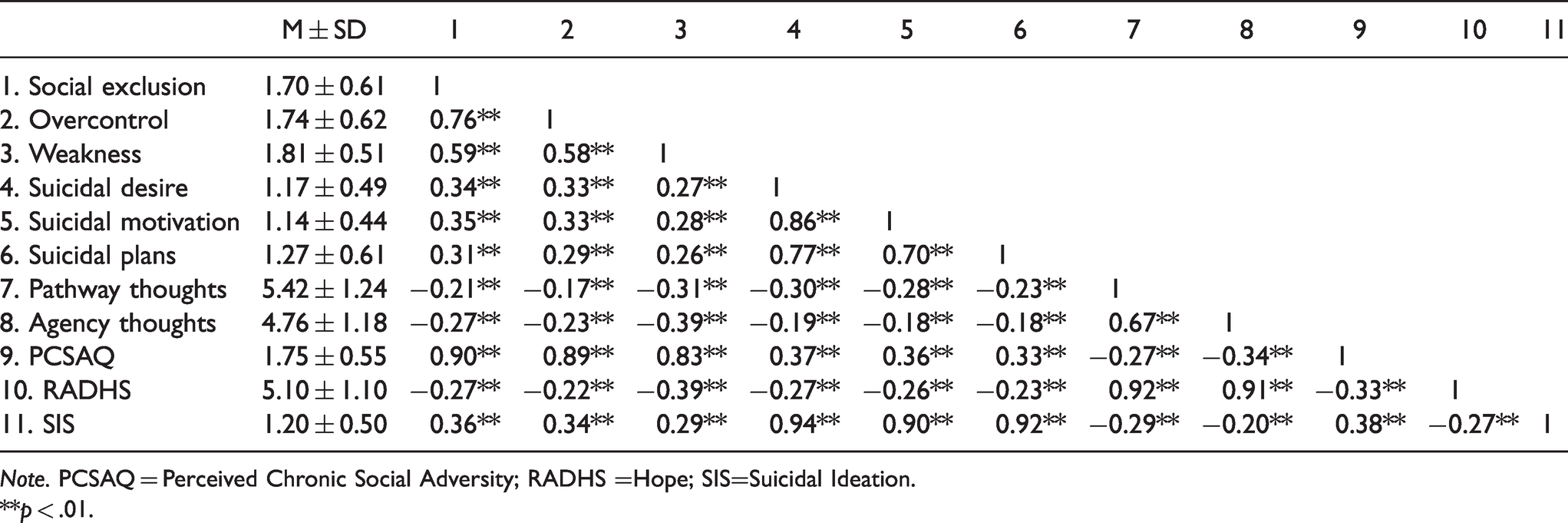
Note. PCSAQ = Perceived Chronic Social Adversity; RADHS =Hope; SIS=Suicidal Ideation.
**p < .01.
Moderating Model Analyses
We used unconstrained approach to test the moderation of hope with AMOS 21.0. Two product indicators were created, and we also used bootstrap techniques (Repeated sample = 2000 times) to calculate estimates’ 95% confidence interval. The result suggested the model fitted to the data well (χ2/df = 2.56, CFI = 0.92, NFI = 0.90, GFI = 0.97, IFI = 0.93, RMSEA = 0.06).
Then, the data results showed that: (1) Perceived chronic social adversity could predict suicidal ideation positively (Β = 0.42, SE = 0.05, t = 7.34, p < 0.001, 95%CI: [0.30, 0.55]); (2) Hope could predict suicidal ideation positively (Β = –0.25, SE = 0.07, t = –4.47, p < 0.001, 95%CI: [–0.44, 0.48]); (3) Interaction (perceived chronic social adversity × hope) could predict suicidal ideation positively (Β = –0.24, SE = 0.05, t = –4.93, p < 0.001, 95%CI: [–0.41, –0.11]), which revealed that the moderating effect of hope between perceived chronic social adversity and suicidal ideation among Chinese college students.
To examine how hope influences the relationship between perceived chronic social adversity and suicidal ideation, simple slopes were plotted for the values of high hope (1 SD above the mean) and low hope (1 SD below the mean), as shown in Figure 2. The results revealed that, for the group with low level of hope, there was a significant positive relationship between perceived chronic social adversity and suicidal ideation (Β = 0.48, p < 0.05), but this relationship was not significant for group with high level of hope (Β = 0.15, p > 0.05).
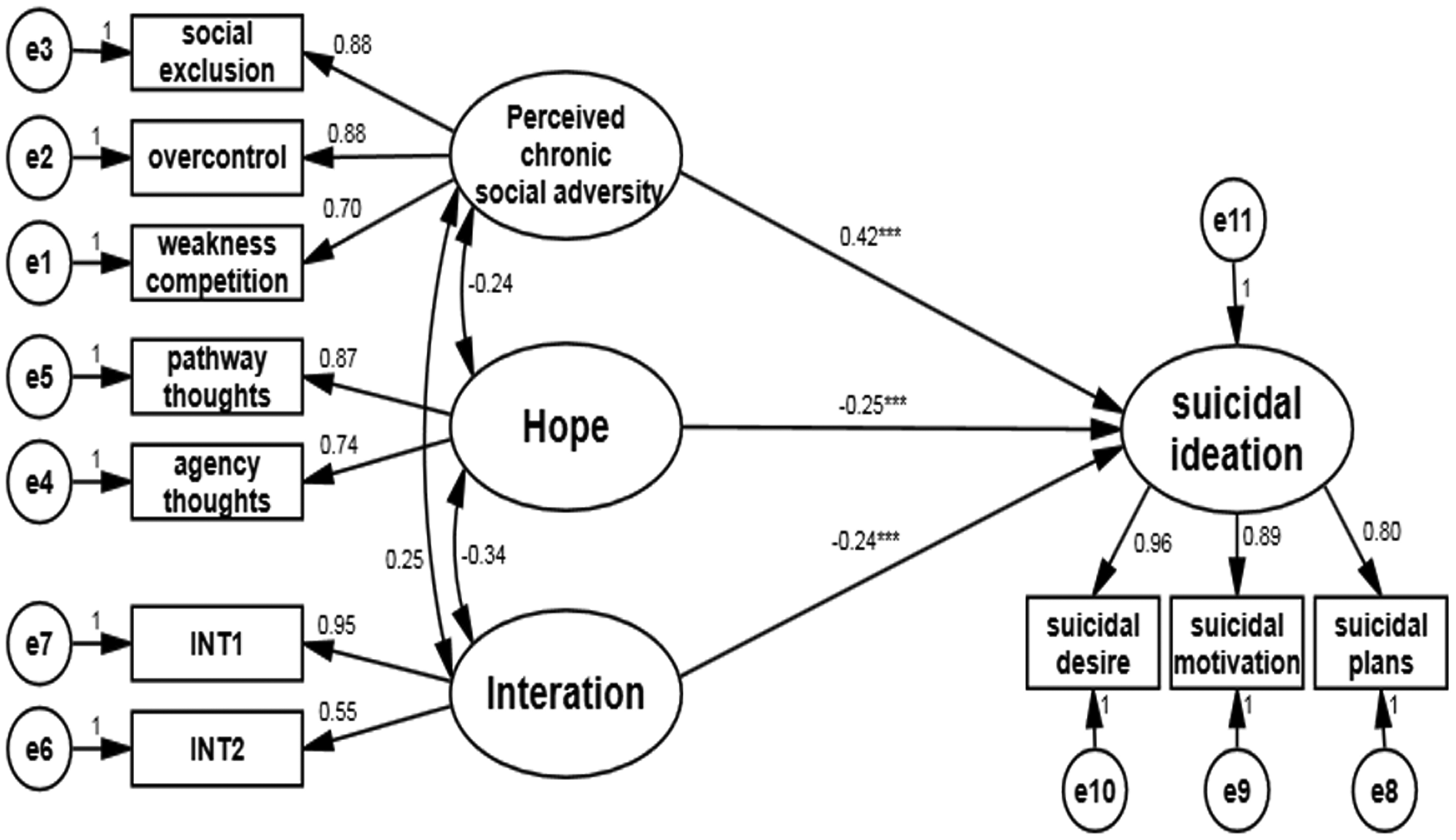
The moderation of hope between perceived chronic social adversity and suicidal ideation. ***p < .001 .
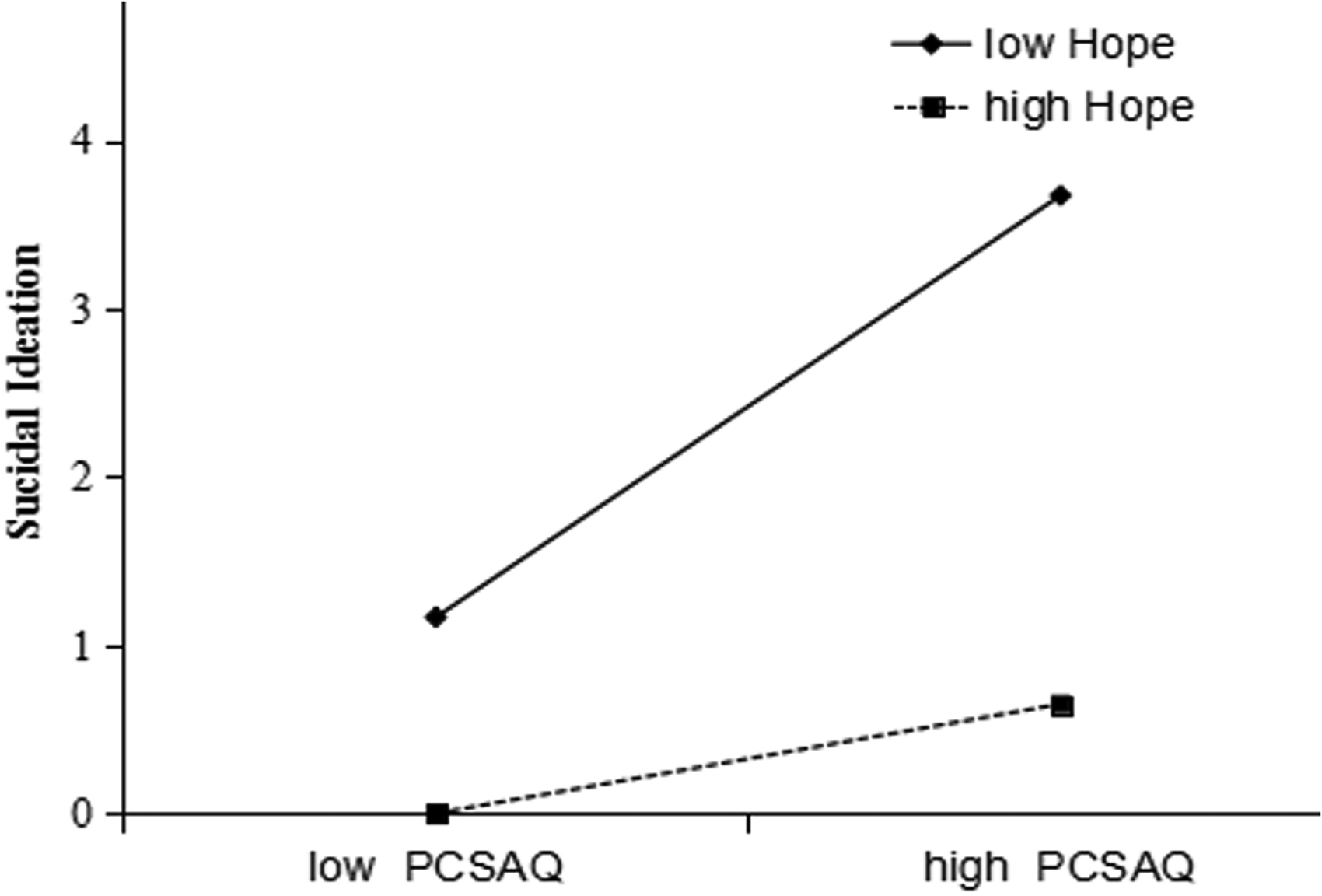
The plot of simple slopes of Hope.
Discussion
Perceived Chronic Social Adversity and Its Relation to Suicidal Ideation
As hypothesized H1, the current study shows that perceived chronic social adversity has a positively effect on suicidal ideation among Chinese college students. This finding is in line with considerable previous studies regarding the perceived chronic social adversity and negatively emotions (Zhang, Cody, et al., 2017; Zhang, Ding, et al., 2017). Our findings also prove the standpoints of General Stress Theory (GST). According to the theory, the appearance of deviant behavior (e.g., suicidal ideation, suicidal behavior, aggression) is related to the experience of tension of individuals (Agnew, 1992, 2017; Yang, 2003). When college students meet some negative life events, they may feel depressed, anxious, even disgusted or desperate, then, they will ruminate those negative life events over and over again, and those negative emotions may induce tension and stress. At Last, much tension and stress will break the balance of cognition and behavior. Additionally, when college students perceived chronic social adversity for a long time, they would experience much negative emotion, and it may induce some psychosomatic diseases. If so, they must be able to take some measurements to avoid those negative emotion as to restore balance. During that process, some extreme ideals or behaviors will appear among them, such as suicidal ideation, aggression, even suicidal behavior (Jin et al., 2016).
The Moderation Effect of Hope
As previous hypothesized H2 and H3, the current study shows that hope has a negative effect on suicidal ideation and it moderates the relation between perceived chronic social adversity and suicidal ideation among Chinese college students. In addition, our findings further suggest that those who are in lower levels of hope will experience a greater level of suicidal ideation than those who are in higher levels of hope. They are consistent with previous researches (Geiger & Kwon, 2010; Liu et al., 2014; Satici, 2016; Tucker et al., 2013, 2016; Zhang & Chen, 2013). When college students respond to negative or stressful life events, a series of negative emotion will appear, then they will experience chronic social adversity. At the same time, however, the personality trait of hope began to work. Specifically, high level of hope served as a buffer against the suicidal ideation effects of perceive chronic social adversity. The college students who have confidence in life can overcome the setbacks, even if they were experiencing a negative mood, they could adapt to the negative circumstances and adjust his or her physical and mental state quickly. Negative circumstance can’t have a terrible influence on them, so the deviant ideals or behaviors are unlikely to appear. In contrast, low level of hope exacerbates the outcomes of suicidal ideation associated with perceived chronic social adversity. Those college students who are in low hope always experience failure, frustration, paranoid, low self-esteem and pessimism. They can’t achieve goals and get success. When they perceive chronic social adversity, a series of adverse physical and mental symptoms would appear. To put it simply, suicidal ideation or deviant behaviors appear easily under adverse situation.
The current study has potential implications for our understanding of suicidal ideation. In particular, these findings highlight the potential moderation role of hope which may help people to avoid suicidal behavior. Additionally, the current study may show the relation between perceived chronic social adversity and suicidal ideation, and it enables us to deal with negative life events better.
Limitations and Implications
There are several limitations of the current study. Firstly, the sample of current study is college students. Results should be generalized to other populations with caution, future work should select other samples (e.g., farmers, workers) to test whether the model fits well. Secondly, the current study uses cross-sectional design, results can’t reveal the causal relationship strictly, future work should use longitudinal design to test the relationship among perceived chronic social adversity, hope and suicidal ideation. Lastly, the current study tests the moderation of hope between perceived chronic social adversity and suicidal ideation, however, we can’t confirm whether other moderation or mediation mechanism exists in the relationship between perceived chronic social adversity and suicidal ideation, future work should explore that more comprehensively.
Footnotes
Declaration of Conflicting Interests
The author(s) declared no potential conflicts of interest with respect to the research, authorship, and/or publication of this article.
Funding
The author(s) disclosed receipt of the following financial support for the research, authorship, and/or publication of this article: This research was supported by the National Social Science Foundation of China (Grant No. BMA170035) and Natural Science Foundation of Inner Mongolia Autonomous Region of China (Grant No. 2021MS03061).
