






Abstract
Ethical bonds transformation is a cultural phenomenon in Taiwanese bereaved families. When the death event occurs, the absent status of the deceased invokes spontaneous change in whole family to cope with the irreparable loss. In the present study, 283 bereaved individuals were recruited to develop the ethical bonds transformation scale. Exploratory factor analysis has generated two factors: ethical bonds and symbolic bonds. Partial correlation has shown that ethical bonds was positively correlated with post-grief growth and negatively correlated with most of the grief related symptoms, indicating that ethical bonds might be a protective factor in the family grief process.
Introduction
Losing a loved one is an extremely painful experience. Although mainstream psychology often considers grief to be a personal emotion and an individual-level reaction, the impact of bereavement is more than a personal issue. When someone passes away, his or her relationship network in the living world also vanishes at that moment. For survivors, figuring out how to rebuild and re-engage in a world without the deceased is crucial to their grief adaptation. In a recent review article, Breen et al. (2019) has highlighted the importance to map the landscape of grief into family context. In the present study, we conceptualized grief as a family affair encompassing the dynamics and structure of family reorganization during the bereavement process in order to deal with new challenges and responsibilities. We labeled this process ethical bonds transformation to capture the phenomena of relational reorganization within the bereaved family.
Revisiting continuing bonds theory
During the last decade, a revolutionary change in Western grief theory was the introduction of the concept of continuing bonds (Klass et al., 1996), which highlights the importance of continuing the relationship with the deceased and is used in grief therapy. Contemporary Western grief researchers developed continuing bonds theory after witnessing ongoing conversations with the deceased in Japanese ancestor worship. They constructed continuing bonds theory to describe relationships that continue after death. Continuing bonds theory challenges the traditional grief work perspective because it demonstrated that the breaking of bonds between the bereaved and the deceased is unnecessary (Stroebe & Shut, 2005). In contrast to traditional medical intervention, which views insistence on continuing a relationship with the deceased as pathological, continuing bonds theory represents a normative view of grief. Continuing a relationship with the deceased may be an adaptive behavior in the grief process.
Stroebe, Shut, and Boerner (2010) subsequently proposed a hypothetical integrated theory of continuing bonds. The construction of this theory is based on Bowlby’s (1980) attachment theory, object relation theory, and recent empirical findings on continuing bonds. Stroebe et al. (2010) declared that bereaved sufferers with different types of attachment styles express continuing bonds with the deceased in different ways. The goal of grief therapy is to modify those continuing bonds so as to help the bereaved maintain an adequate relationship with the deceased. Field and Wogrin (2011) pointed out that continuing bonds re-establish a sense of felt security that is lost as a result of the death. Expressions of continuing bonds involve the legacy of the deceased, such as his or her function as a role model and source of inspiration, which live on in the mind of the bereaved.
The original continuing bonds theory model characterized continuing bonds as an attachment between the bereaved and the deceased. Recently, Klass and Steffen (2017) reviewed continuing bonds theory studies across different cultures during the last decade, and raised the issue that continuing bonds should be considered intersubjective--much more than an attachment style between two separate entities. He also suggested that researchers reconsider grief as a community-based phenomenon instead of as an individual reaction. The transformation of continuing bonds emerges in the intersubjective space created by the grief process.
According to grief studies conducted in Taiwan, it is clear that continuing bonds often take place in a family context. For example, Hsu et al. (2004) pointed out a cultural aspect of healing that maintains a sense of wholeness in Taiwanese families despite the absence of the deceased. Another study showed that when continuing bond transformation occurred in bereaved families it had the power to maintain a sense of familial-identification (Tsai, 2009). Furthermore, a recent qualitative study found that the transformation of ethical bonds is a unique cultural aspect of bereaved Taiwanese families (Lee et al., 2017). The concept of ethical bonds indicates that bereaved spouses continue ethical actions after the spouse passes, including maintaining the deceased’s status quo, reinventing bonding with other family members, and strengthening the identity of the bereaved in the family. The term “ethics” here is rooted in Confucian ethics, which emphasizes the bereaved people’s wisdom to maintain harmony and balance of interpersonal order after their beloved has passed away. These findings in Taiwanese grief research are consistent with Klass and Steffen’s (2017) viewpoint, and they underscore the necessity of revising continuing bonds theory to encompass a socially-extended mind framework.
Although the Western concept of continuing bonds is relatively mature, the concept of ethical bonds transformation is still in its infancy. Moreover, there is no existing assessment tool to measure the quality and development of ethical bonds in families during the bereavement process. In order to clarify the phenomenon of ethical bonds transformation in bereaved Taiwanese families, we turned to Taiwanese indigenous psychology. Since 2004, there has been a new wave of theory development in Taiwanese indigenous psychology called ethical turn healing. In the next section, we discuss this theoretical framework and delve into the after-death transformation of relationships in bereaved Taiwanese families.
The ethical turn healing of the mourning process: The primacy of encounters in suffering experiences
In a series of studies conducted in 2004, Yee et al. proposed ethical turn healing, which is an ethical experience embedded in Taiwanese culture that constitutes a healing factor for people who are suffering. The word ethical indicates the unspoken suffering experiences of people trapped in interpersonal ordering. For example, a person who has been maltreated in childhood might feel pain when confronting the cultural expectation that children should always be filial to their parents. Contrary to some paradigms that suggest the goal of psychotherapy is to eliminate emotional pain, Yee et al. (2004) pointed out that healing occurs only when people are able to establish their own ways to create ethical relatedness in their lives.
Based on Yee et al.’s theory, Lin (2005) proposed the ethical turn healing perspective (ETHP) to describe the experiences of earthquake survivors’ mourning processes. The ETHP suggests that ethical suffering in mourning is silent, and that it is almost impossible to capture with scientific language or concepts. Using Aristotle’s rhetorical tradition (logos, pathos, and ethos), Lin identified new metaphors to highlight the existential aspects of survivors’ mourning processes. According to survivors’ narratives, they did not want to get rid of the emotional pain of grief. In fact, they lived with grief to remember the deceased and struggled to establish new ethical relationships in their lives after the disastrous loss. Ethical recathexis, the phenomenon that survivors transfer the original emotional bonding with the deceased to other family members, or even strangers, is a critical healing factor in Taiwanese earthquake survivors’ narratives. In a more recent study, Lin and Kao (2019) suggested that a family member’s grief is a process of becoming and being-in-the-home. Phenomenological dyadic analysis revealed that children were initially stuck in an uncanny feeling, a subjective feeling of not-being-in-the-home when they were in their house, after their father’s death. Six months after the first interview, they eventually faced the changes, and the absence in their home, and they were able to embrace outside experiences.
According to the review just presented, we hypothesize that ethical bonds transformation is a cultural phenomenon in which bereaved family members try to establish new ethical relationships in their lives. Although the absence of the deceased invokes a dynamic change in the whole family, ethical bonds may be a distinct concept that cannot be fully explained by continuing bonds theory. Despite the rich research evidence for an individual’s continuing bonds with the deceased, little is known about the dynamic transformation of bereaved families. Furthermore, previous assessment tools, such as the continuing bonds scale (Field, 2006), ignore the family aspect of relationship transformation.
In the present study, we investigate the culture-specific aspect of ethical bonds transformation, and construct the scale that includes family dimensions of relational transformation after death. To build on previous qualitative indigenous findings, we chose to develop a quantitative, empirically-derived measurement tool to provide further evidence of ethical bonds transformation and to highlight its cultural uniqueness by comparing the present findings with the original continuing bonds theory.
Method
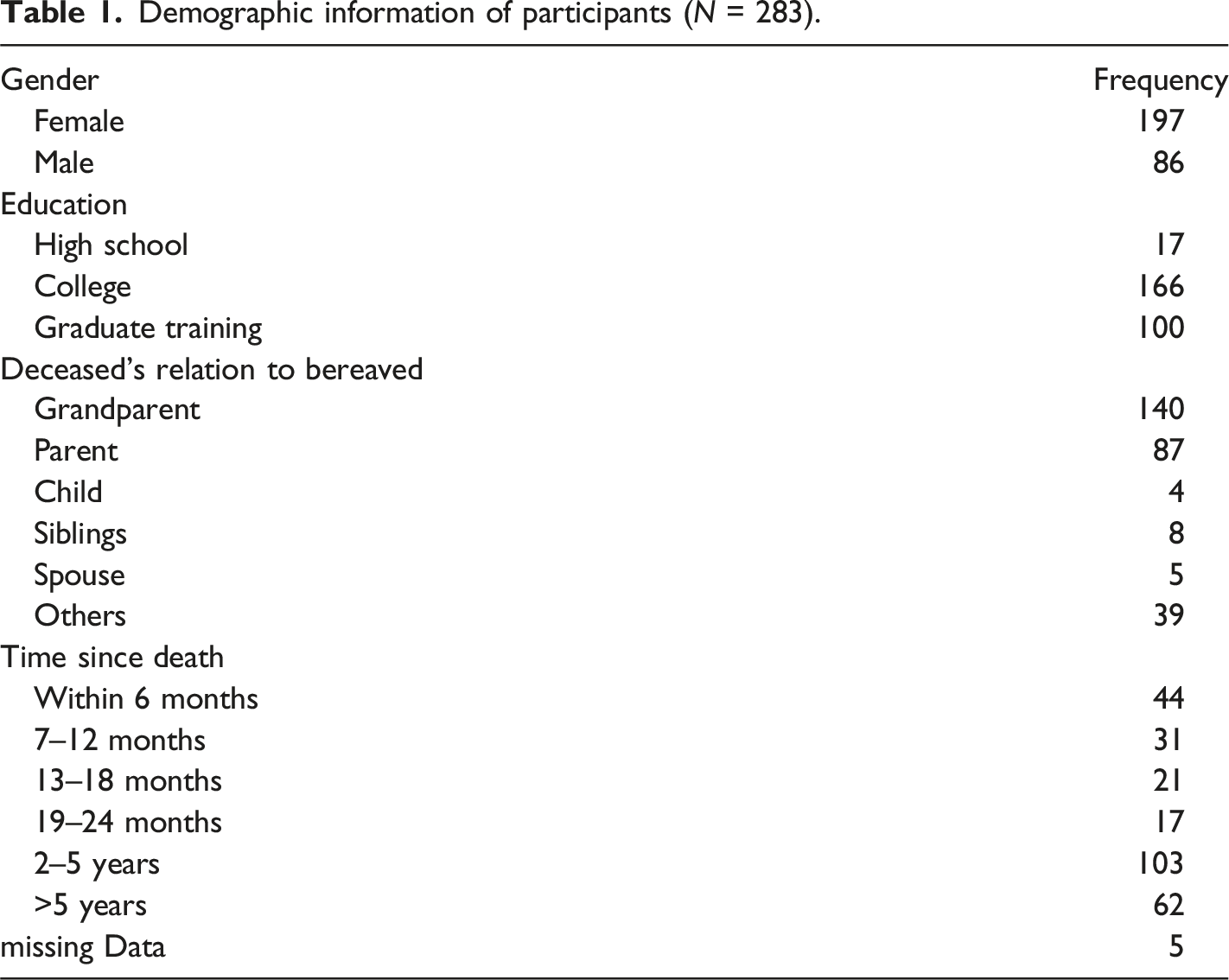
Participants
Demographic information of participants (N = 283).
Measures
The Chinese version of the Hogan Grief Reaction Checklist (C-HGRC)
Ethical bonds transformation scale.

Ethical Bonds Transformation Scale (EBTS)
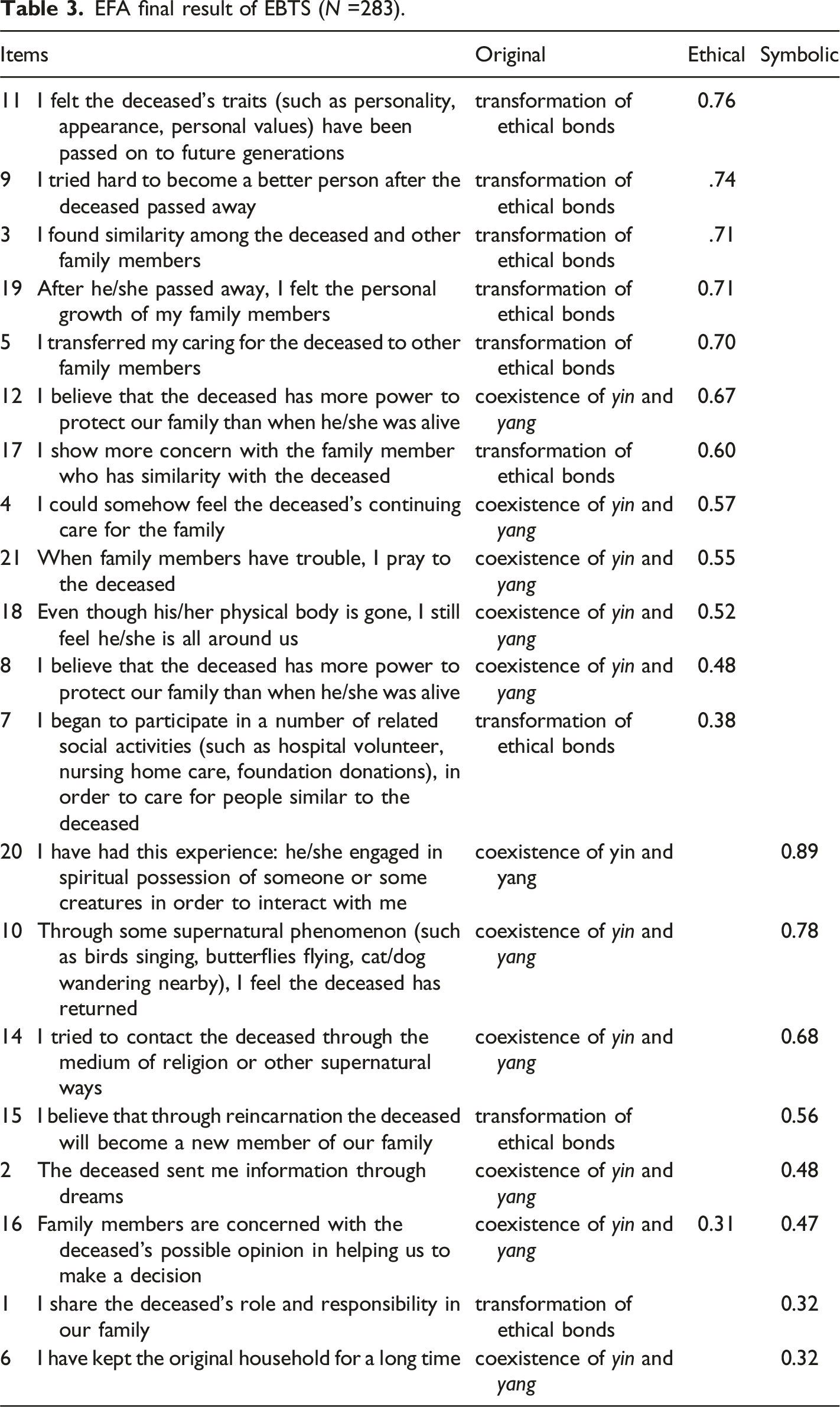
Based on the Taiwanese indigenous research result of Lee et al. (2017), there are two culture-specific themes about family dimensions of relational transformation after death: “transformation of ethical bonds”, which captures the phenomenon of ethical relationship transformation in bereaved family contexts, and “coexistence of yin and yang”, which describes use of some culture-specific, religious, or supernatural-related behaviors to connect with the deceased. We developed 10 items related to “transformation of ethical bonds” and 11 items related to “coexistence of yin and yang” Table 2. Most of the item descriptions were quoted or modified from narrative texts of Lee et al. (2017). These items were measured on a 5-point Likert-type scale. These items had showed reasonably good internal consistency: the Cronbach’s alpha of “transformation of ethical bonds” was .83, and “coexistence of yin and yang” was .87.
The Chinese Continuing Bond Scale (C-CBS)
The original continuing bond scale (Field, 2005) is a 16-item measure to capture the ongoing relationship with the deceased. The CBS is a 4-point Likert scale, ranging from 0-3, with respect to the respondent’s status in the previous month. The CBS includes two subscales. The externalized CB scale measures illusionary and hallucinatory experiences with the deceased. These experiences indicate unresolved loss. The internalized CB scale measures the degree to which the bereaved respondent uses the deceased as an internalized secure base. In present study, we adopted the Chinese version developed by Ho et al. (2013). According to Ho’s finding, the Cronbach’s alpha of the total C-CBS was .92, and the reliability alpha of internalized and externalized CB subscales was .92 and .84, respectively. Because C-CBS has 19 items, in present study we only included the 16 items overlapping with the original English version. In order to compare with the newly developed ethical bonds transformation scale, we modified C-CBS into a 5-point Likert-type scale (score from 1-5).
Chinese Post-Traumatic Growth Inventory (CPTGI)
The PTGI (Tedeschi & Calhoun, 1996) is a 21-item, 6-point Likert-type self-report inventory assessing personal growth after a traumatic event. The items on the PTGI comprise five factors: Relating to Others, New Possibilities, Personal Strength, Spiritual Change, and Appreciation of Life. The internal consistency for the PTGI is α = .90, and the Cronbach’s alphas for the five subscales are: New Possibility (α = .84); Relating to Others (α = .85); Personal Strength (α = .72); Spiritual Change (α = .85); Appreciation of Life (α = .67). According to Tedeschi and Calhoun (1996), the PTGI has good concurrent and discriminant validity and construct validity. We applied the Chinese version of PTGI developed by Ho et al. (2004). The CPTGI also has five subscales and with a high internal consistency of α = .93. Cheng et al. (2017) showed that the Chinese Post-Traumatic Growth Inventory could predict hope and positive coping, but not anxiety. Generally speaking, the CPTGI can help practitioners identify meaningful health outcomes for Chinese chronic disease patients.
Chinese version of the Impact of Event Scale-R (CIES-R)
The Impact of Event Scale (Horowitz, Wilner, & Alverez, 1979) measures subjective stress related to unwanted and uninvited thoughts, images, and feelings intruding into consciousness. The Intrusion subscale contains items that represent an individual’s preoccupation with a traumatic event. The Avoidance subscale measures conscious efforts by an individual to avoid thinking about the event and to actively stay away from reminders of the event. The reliability of the IES has been reported with an alpha coefficient of .87 for the total test score, .89 for Intrusion, and .79 for Avoidance. Validity testing has shown that the instrument can detect changes in clinical status over time and distinguish between different populations of individuals experiencing a similar event (Horowitz et al., 1993). We adopted the Chinese version of the IES-R (Kung, 2005). The Chinese version also shows good reliability and had associations with other PTSD symptoms within a sample of earthquake survivors such as over-general autobiographical memories and a high level of emotional disturbance.
Inclusion of Other in the Self scale (IOS)
The Inclusion of Other in the Self scale (Aron et al., 1992) is a diagram-like measurement presenting seven pairs of overlapping circles with each pair overlapping slightly more than the preceding pair. Each of overlapping circle represents a different level of psychological closeness with the significant other. Because of the metaphorical and universal feature of human relations, the IOS scale presents neither language nor culture barriers. We used the IOS to measure bereaved participants’ psychological closeness with the deceased before and after the death.
Beck Hopelessness Scale (BHS)
The Beck Hopelessness Scale (BHS) (Beck et al., 1974) was specifically designed to capture depressive hopelessness. The BHS has a high degree of internal consistency (α = .82–.93) and shows high correlation with clinical ratings and other self-report measurements, and so has good convergent and construct validity. We adopted the BHS to measure hopelessness related to grief reactions in order to measure pathological depressive symptoms in the bereaved participants.
Procedure and ethical considerations
The survey was constructed using Google documents. Participants answered the questions on the Internet. An informed consent page and instructions were shown at the beginning of the survey. Once the participants submitted their responses, they were provided a NT$100 (US$3.60) dollar gift card, and some debriefing information on the study and on grief and bereavement in general, as well as links to grief and bereavement-related resources.
This study is part of a multiyear research project sponsored by the Ministry of Science and Technology. The main purpose of the project is to develop culture-specific grief theory and measurement tools for Taiwanese bereaved people. The entire project received approval from one cancer center institutional ethics review board in 2015 by protocol number KFSYSCC-IRB-20150402A.
Result
Ethical Bonds Transformation Scale: Item Analysis and Factor Structure
First, we conducted item analysis using half of the overall participants (n = 159) to examine each item’s statistical distribution and whether these items could appropriately differentiate participants’ responses. These participants were recruited during the first phase of data collection between December 2015 and April 2016. The analysis showed that items belong to “coexistence of yin and yang” (e.g., item 10 “I have had this experience: he/she engaged in spiritual possession of someone or some creatures in order to interact with me”, item 14 “I tried to contact the deceased through the medium of religion or other supernatural ways”, and item 20 “I have had this experience: he/she engaged in spiritual possession of someone or some creatures in order to interact with me”) had significantly skewed distributions (skewed distribution >1). However, these items were all from “coexistence of yin and yang” dimensions, which usually have a lower rate of occurrence, so we decided to retain these items and continue with the next step of item analysis. Item discrimination analysis showed that the item 13 (“I started to refocus myself after his/her death”) did not discriminate well between the high- and low-score participants (p = .34), so this item was deleted.
We used SPSS 23 to conduct an EFA with the data for all 283 participants to extract potential factors using principal component analysis. Because the two factors were expected to be correlated (see Field & Filanosky, 2009), we chose promax rotation. The KMO value was .91 and the Bartlett’s sphericity test was 2435.63 (p < .001), indicating that the sample was suitable for factor analysis. The initial result showed that four factors emerged with eigenvalues greater than 1, but we also considered the results of the scree-plot and theoretical base. The scree-plot and qualitative research result of Lee et al. (2017) both suggested that extracting two factors is sufficient and that each would have a clear meaning.
EFA final result of EBTS (N =283).
The correlations among ethical bonds transformation, grief severity, and symptoms
Using the scores calculated by the total 242 participants, the correlation between the ethical bonds and symbolic bonds subscales is r = .6 (p < .001). The correlations between total EBTS score and ethical bonds and symbolic bonds subscales are .94 and .83, respectively. The correlation also supported the two subscales were related but separate constructs.
Correlation among CBs, EBTS and other questionnaires (N=242).
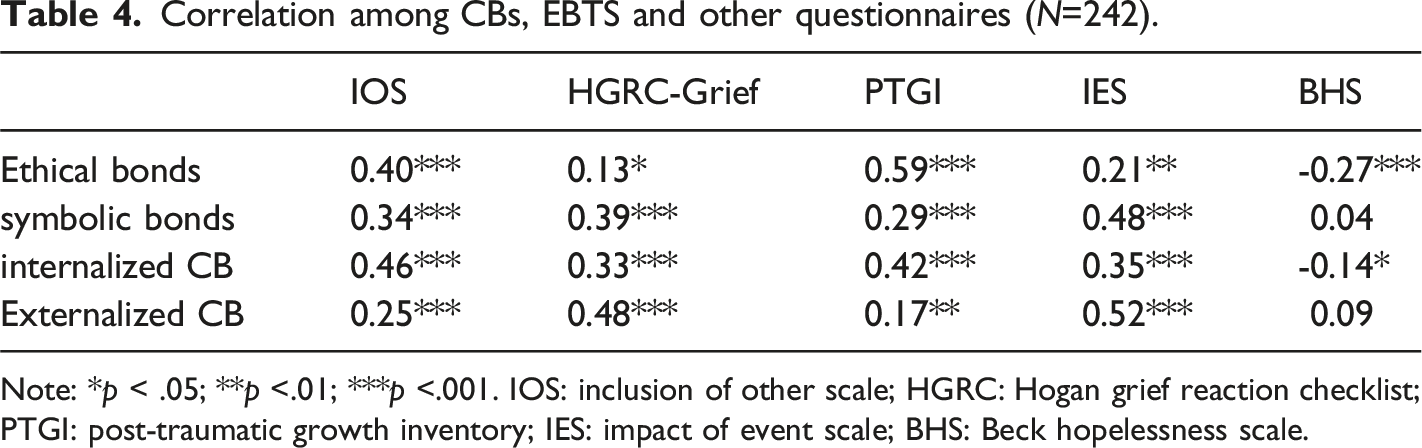
Note: *p < .05; **p <.01; ***p <.001. IOS: inclusion of other scale; HGRC: Hogan grief reaction checklist; PTGI: post-traumatic growth inventory; IES: impact of event scale; BHS: Beck hopelessness scale.
Partial correlations among types of bonds, grief symptoms and personal growth (N=242).
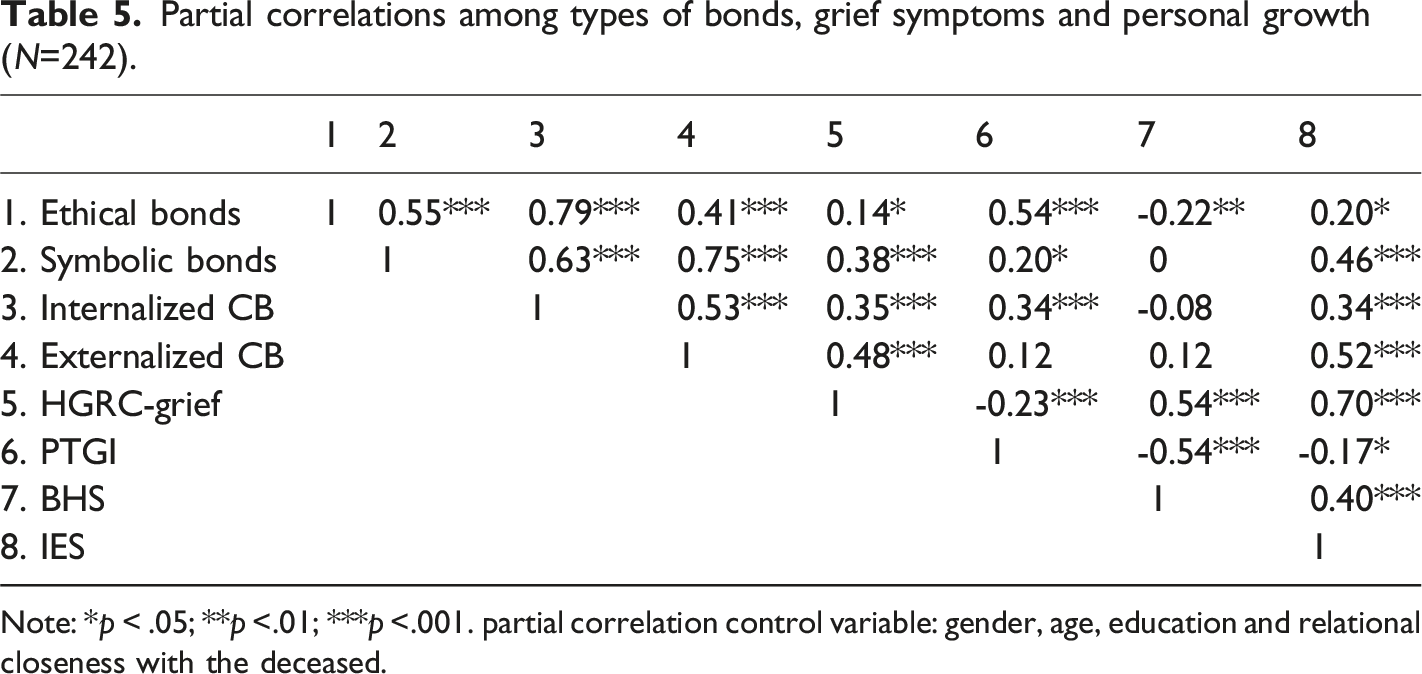
Note: *p < .05; **p <.01; ***p <.001. partial correlation control variable: gender, age, education and relational closeness with the deceased.
Partial correlations among ethical bonds, grief symptoms, and personal growth (N = 242).
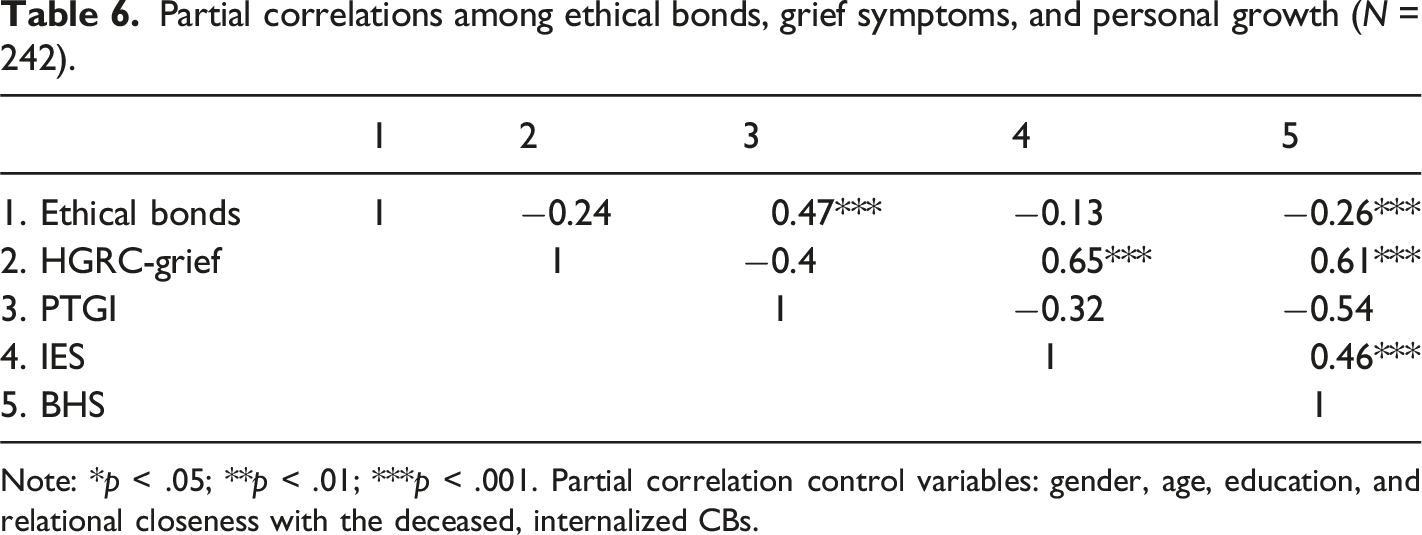
Note: *p < .05; **p < .01; ***p < .001. Partial correlation control variables: gender, age, education, and relational closeness with the deceased, internalized CBs.
Discussion
Our main focus was to investigate the phenomenon of ethical bonds transformation in bereaved Taiwanese people. Based on previous findings and grief narrative texts collected in Taiwan, we constructed several culturally-specific items related to ethical bonds transformation and coexistence with the deceased. Then, we investigated the factor structure and psychometric properties of Ethical Bonds Transformation Scale and examined the psychometric properties of this newly developed instrument.
The main results were: (1) The EFA analysis revealed meaningful findings. The result supported a two-factor structure of the EBTS with good internal consistency (overall Cronbach’s α = .91; ethical bonds = .89; symbolic bonds = .81). After reviewing each item belonging to the two factors, factor 1 was labeled as “ethical bonds” to indicate a culture-specific phenomenon in which bereaved family members try to establish new ethical relationships and interpersonal order after the deceased has passed away, and factor 2 was named as “symbolic bonds” to depict how bereaved Taiwanese people use religious or supernatural ways to contact with the deceased. (2) After controlling for demographic variables and relational closeness, ethical bonds was positive correlated with post-grief growth and negatively correlated with most of grief-related symptoms, while symbolic bonds, internalized CB and externalized CB were both positively correlated with grief symptoms and growth. (3) After controlling for internalized CB, demographic variables, and relational closeness, ethical bonds was still significantly positively correlated with post-grief growth and negatively correlated with all grief-related symptoms. The overall result supported the hypothesis that ethical bonds might be a culturally-specific protective factor for bereaved Taiwanese people’s adaptation process.
In the previous qualitative study, Lee et al. (2017) derived two culture-specific factors to describe indigenous grief phenomenon in bereaved Taiwanese spouses. The first was ethical bonds transformation, defined as “bereaved spouses display ethical acts in the living world, including maintaining the status quo, reinventing bonding with other family members, and strengthening the identity of the bereaved in the family.” (Lee et al., 2017, p1899); The second was coexistence of yin and yang, conceptualized as “to eliminate the boundary between life and death, serving as a way of being-in-the-world with the deceased”. Before the present study, which aimed at developing the items to conduct the EFA and other statistical analyses, these two cultural-specific factors were merely descriptive phenomenon for which the underlining processes and mechanisms remained unknown.
The result of partial correlation analysis showed that symbolic bonds was significantly correlated with both adaptive and maladaptive grief outcomes. Continuing bonds theory (Field, 2006) hypothesized that an internalized continuing bond is an adaptive way to maintain a relational bond with the deceased, whereas an externalized continuing bond is a maladaptive indicator of the refusal to say goodbye to the deceased. According to the definition of Field (2006), symbolic bonds could be considered as one type of externalized CB that captures the religious or supernatural behaviors Taiwanese people use to connect with the deceased. Contrary to the prediction of continuing bonds theory, our present result implied that the coexistence of yin and yang might not be categorized as adaptive or maladaptive coping style of bereavement process. This result may indicate that Taiwanese culture provides the context for allowing a blurred boundary between life and death. Contrary to Western continuing bonds theory, in Taiwanese culture both internalized and externalized continuing bonds are normal and acceptable ways to situate the deceased in the living world. The correlations and partial-correlations displayed in Tables 5 and 6 provide further support: internalized and externalized continuing bonds were significantly correlated both with grief symptoms and post-grief growth, suggesting that both are double-edged swords of grief adaptation.
Ho and Chan (2017) pointed out the controversy in categorizing continuous bonds in terms of an internalized/externalized dichotomy. Although it is appealing to link internalized continuous bonds with an adaptive coping style and to label externalized continuous bonds as pathological expressions of grief (Field & Filanosky, 2009), research has shown inconsistent results (Ho et al., 2013). Ho and Chan (2017) suggested that there might be no one-to-one relationship between the type of continuous bond and bereavement adaptation. Future studies should consider other possible mediators or moderators to explain the mechanisms underlying continuous bonds and grief outcomes.
Our study echoes Ho and Chan’s (2017) findings, but we would like to emphasize the containing and comforting aspects of continuous bonds that cultural elements provide. In Taiwanese culture, it is natural and acceptable to remain bonded with a loved one who has passed away. There are various ways to keep this bonding. For example, one might keep the house furnished as if the deceased were still alive (Yee et al., 2004), wear a necklace with the deceased’s ashes (Lin, 2005), or keep their social media account and update it regularly as if the deceased is still active on the internet. Each bereaved person has his/her own way to memorialize and situate the deceased in the world, and the cultural context provides the means and materials for the bereaved to create their own way to maintain bonding with the deceased. This observation offers a possible explanation for the finding that internalized and externalized continuous bonds were both significantly positively correlated with grief levels and post grief growth.
Contrary to internalized and externalized continuous bonds, ethical bonds was significantly correlated with post-grief growth and negatively correlated with most grief-related symptoms, indicating that ethical bonds may serve as a protective factor when facing the impact of bereavement. This finding supports Yee et al. (2004) and Lin’s (2005) ethical turn healing approach, highlighting the potential healing ability that bereaved Taiwanese people have to establish their own ways to create new ethical relatedness in their families. The presupposition of ethical bonds transformation might be a cultural tolerance for living with the deceased. Since Taiwanese people believe that the deceased is still taking care of them, they can also continue to take care of the deceased. The transformation of ethical bonds might be a way to reserve and inherit the deceased’s values, wishes, and expectations for the next generation.
Our findings also revealed the issue of cultural differences. Contrary to continuing bonds theory, which emphasizes a dyadic relationship between the bereaved and the deceased, bereaved Taiwanese people are more concerned with the dynamic changes in family relationship due to the impact of the death. In other words, instead of focusing on personal ego strength and emotional status during the bereavement process, the primary concern of bereaved Taiwanese people is the stability and safety of their families. In their grief narrative, “My family is broken” is more painful than “My heart is broken”. This is the reason that maintaining the status quo (Tsai, 2009), and maintaining a sense of wholeness in the family (Hsu et al., 2004) are so important for bereaved spouses. Cultural differences issue has become the focal point of continuing bonds research in recent years. For example, Simon (2021) has analyzed the ethnopsychology and ethnopsychiatry of the Kanaké healer in Paic-Camuki country. Based on this indigenous finding, Simon (2021) has summarized several local criteria to evaluate grief; Keser and Işikli (2021) have investigated the relationship between continuing bonds and adjustment after loss in Turkish culture. The factor analysis result of Multidimensional Continuing Bonds Scale (MCBS) has suggested a four-factor structure of Turkish version. Echoing the above continuing bonds studies with cultural consideration, our findings have provided further evidence of ethical bonds transformation in Taiwanese culture and raised the issue of modifying continuing bonds theory by focusing on culturally-related concerns.
This study has some limitations. First, the cross-sectional design is not sufficient to answer causal effect questions, such as whether ethical continuing bonds have a direct positive influence on grief adjustment. Therefore, it is necessary to conduct longitudinal studies in order to clarify the underlying causal relation between ethical continuing bonds and grief outcomes. Second, the variety of demographic characteristics in the present study may have produced a confounding effect. In future studies, it may be useful to investigate particular groups of participants (for example, interviewing bereaved caregivers of terminally ill patients) to examine the external validity of the ethical continuous bond concept. Third, we only conducted EFA to examine the two-factor structure of the EBTS. To improve construct validity of the EBTS, confirmatory factor analysis and other path model analyses are needed.
The present study has several clinical implications. First, this is the first study to conceptualize ethical bonds transformation in bereaved families, highlighting the importance of the family’s dynamic transformation in grief therapy. Second, our findings highlighted a cultural aspect of Taiwanese bereavement. Based on these findings, we recommend that the focus of grief work in Taiwanese culture should be more family-based rather than limited to individuals. Helping bereaved people to maintain the stability of their inner psychological family might be more important than successfully promoting the internalization of the deceased.
Footnotes
Declaration of Conflicting Interests
The author(s) declared no potential conflicts of interest with respect to the research, authorship, and/or publication of this article.
Funding
The author(s) received no financial support for the research, authorship, and/or publication of this article.
