







Abstract
The article focuses on practice of secular eulogistic rhetoric in communist Czechoslovakia (1948–1989), specifically it investigates references to “afterlife” used in eulogies, which is generally conceived as allowing the bereaved to positively reappraise the death of the loved one. However, in secular eulogies, the use of “afterlife” in religious interpretation (“resurrection”, “heaven”) is explicitly excluded. Based on the thematic analysis of 61 secular eulogies, 2 secular interpretations of “afterlife” are identified: symbolic continuity (continuity of memory of the deceased, through his/her legacy/work done, as a part of Nature, through children/future generations, or continuity of the deceased’s love) and factual (but deprived) continuity (death is presented as a sleep, journey, or pain relief).
Introduction
The eulogy, the speech that is part of a funeral ritual, can serve many purposes, but its primary goal is to console the audience of the bereaved that can be characterized as experiencing feelings of loss and grief over the death of a close member of the community (cf. Ochs, 1993; Kent, 1997; Kunkel & Dennis, 2003; Campbell & Jamieson, 1978). According to researchers in rhetoric as well as thanatology and psychology (cf. Foss, 1983; Jamieson, 1978; Campbell & Jamieson, 1978; Davis et al., 2016; Benore & Park, 2004), referring to the “afterlife” of the deceased in the eulogy can be a successful strategy of consoling the audience. It enables the bereaved to deal with the emotions triggered by the death of their loved one. However, it seems that the audience is supposed to be generally open to the idea of an “afterlife” for this strategy to be successful, which is not the case of non-religious or atheistic (segments of) audiences. In front of this audience, we can expect the eulogizer to modify or specifically interpret the concept of “afterlife” in accordance with the demands of the audience or to develop alternative strategies to console it.
In this paper, I focus on a specific historical version of the eulogy, known as the secular eulogy: the funeral speech that was historically established in Czechoslovakia 1 during the communist period (1948–1989). It is a speech delivered typically by semiprofessional or professional eulogizer during secular funeral ceremony. It is intentionally secular, despite also being intended to have an ideological function: to bring the audience to accept the Marxist scientific-materialist point of view (cf. Nešporová, 2013a; 2013b; Nešporová & Tóth, 2021; Škvarka, 1975; Sošková, 1984).
In the study, I draw from thematic analysis of 61 eulogies from Eulogy Manuals that were issued in Czechoslovakia, focusing on the character of the reference to “afterlife”. I investigate (a) to what degree there is a reference to “afterlife” of the deceased and (b) what specific secular interpretations of the “afterlife” occur in secular eulogies.
The structure of the paper is as follows. In the first part of the paper, I briefly explain the character of eulogistic rhetoric, introduce the rhetorical topos “afterlife”, and present some current thanatological, psychological and linguistic explanations of its consoling effect. I briefly discuss its different versions for religious and non-religious audiences. The second part is devoted to the introduction of secular eulogy. I present the historical circumstances of the emergence of secular eulogies in communist Czechoslovakia. I show that secular eulogies are associated with specific obstacles in the rhetorical situation: a renunciation of religious, especially Christian, and idealistic topoi, including the concept of “afterlife” in the terms of the narrative of resurrection immortality and the presence of a specific ideological point of view. In the third part, I present the methods of data selection and thematic analysis chosen for the purposes of this study. In the fourth part, I present and illustrate the specific concepts of “afterlife” that occur in secular eulogies. Based on thematic analysis of the sample of secular eulogies, I describe and illustrate how the topos “afterlife” is interpreted and specifically modified in two concepts: symbolic and factual (but deprived) continuity of the deceased.
Eulogistic Rhetoric: Consolation of the Audience
The eulogy is a speech that is traditionally classified as epideictic or ceremonial rhetoric: it is prepared in advance for a special occasion, corresponding to the demands and expectations of the audience created by this opportunity (cf. Aristotle, The Art of Rhetoric, I.II.22.iii; Campbell, 1982, p. 161). The opportunity that gives rise to the rhetorical situation is a funeral or memorial service following the death of an individual – a beloved friend, family or community member – which affects the audience. The audience is a community of survivors that can be characterized as experiencing varying degrees of disorientation, uncertainty, and insecurity (Ochs, 1993, p. 27) Although the authors distinguish several functions that can be fulfilled by eulogies, 2 Kunkel and Dennis (2003, p. 4; cf. Dennis & Kunkel, 2004; 2006) argue that most functions of eulogies, except for honoring the deceased, can be subordinated to the function of consoling the audience, which they believe is the eulogizer’s major goal and responsibility.
Consolation can generally be defined as a type of communicative behavior that primarily aims to relieve the addressees in their difficult emotional states. According to Kent (1997), the term consoling refers to “a communicative, social, process whereby the emotional distress of another is allayed through words, deed, or behaviors.” (p. 41) Burleson and Samter (1985) define consolation similarly as “the type of communicative behavior having the intended function of alleviating, moderating, or salving the distressed emotional states of others” (p. 64; cf. Kent, 1997, p. 40).
From a rhetorical point of view, a eulogizer can implement consoling communication by using certain topoi: he/she can utilize the repertoire of thoughts and words that usually have a comforting effect on the audience. The authors define such a repertoire in different ways. According to the traditional Aristotelian model, one of the consoling topoi is to ask audience members to live according to the values and deeds of the deceased (cf. Kent, 1991, p. 110). According to modern approaches, the consoling topoi include suggestions for actions, reference to the afterlife, appreciation of time spent with the deceased, appreciation of lessons and traits learned from the deceased and his/her good life (cf. Kunkel & Dennis, 2003; Hewett, 2008).
Consoling Effect of Reference to Afterlife
One consoling topos, whose consoling function is shared by researchers in the field of rhetoric as well as thanatology, is to claim to the bereaved that the deceased lives on: by referring to the deceased’s afterlife, pointing to the deceased’s continuing existence, or a “better place”, where the deceased is now, or by describing its specific form, e.g. bodily resurrection, placement in heaven, reincarnation, etc. (cf. Foss, 1983, p. 187; Campbell & Jamieson, 1978, p. 147; Jamieson, 1978; Kunkel & Dennis, 2003, p. 13; Benore & Park, 2004, p. 6). According to Campbell & Jamieson, 1978, the eulogizer turns to the bereaved to “console them by arguing that the deceased lives on.” (p. 147) Foss (1983) connects the consoling effect of the reference to the “afterlife” with the reduction of the survivors’ fear of death. According to her, the eulogizer is trying to “lessen personal fears of mortality with the descriptions of how the deceased ‘lives on’.” (p. 187)
However, the explanation of the consoling effect of the reference to the afterlife is offered rather by thanatologists and psychologists, who understand the idea that the deceased “lives on” as part of the survivors’ efforts to deal with emotional distress, which is triggered by the death of the individual. According to Kunkel and Dennis (2003, p. 5), death of the loved one triggers emotional distress, which results from the individual’s cognitive evaluation or interpretation of a situation. Thus, the emotional distress that results from unalterable circumstances can best be alleviated through an alteration of its antecedent cognitive evaluation. Reference by the eulogizer to the afterlife allows the bereaved to implement what is called emotion-focused coping – i.e. regulating and dealing with the emotion that surrounds the stress. The eulogizer provides a “positive spin” that offers a more acceptable understanding of an unalterable event. The idea that the deceased “lives on” allows survivors to positively reappraise the stressful event (Kunkel & Dennis, 2003, p. 13). Similarly, according to Benore and Park (2004, p. 8), the idea of the sustained existence of the deceased after his/her death may help people to confront death’s inevitability more hopefully, and thus to decrease the initial stress engendered by the death of a loved one. Offering a specific idea of the afterlife can also have a consoling effect. Empirical research shows that associating the afterlife with a reward and envisioning the deceased as being “in a better place” without suffering have been found to decrease distress among the bereaved (cf. Schoenrade, 1989; Schuchter, 1986; Benore and Park (2004, p. 8).
Research from a linguistic perspective can also shed light on the consoling effect of the topos “afterlife”. Authors consider that death is a taboo, in which psychological, religious and social interdictions coexist. Therefore, people usually feel reluctant to deal with the topic of death in straightforward terms and resort to euphemism, i.e. “the semantic or formal process thanks to which the taboo is stripped of its most explicit, offensive or obscene undertones” (Crespo Fernández, 2006, pp. 101–102). Since euphemisms omit or mitigate negative connotations, they must be either positive or at least neutral (cf. Kuczok, 2016, p. 128). Authors consider that euphemisms for death can have various functions. Firstly, they function as a mark of respect for the dead. Secondly, they enable the speaker to create a distance between reality and the name given to reality, and therefore provide a protective shield against the feared, fearful, and unpleasant reality. Thirdly, they also serve to reinvent reality through words: they help to make sense of non-sense (cf. Gross, 1985, p. 205; Allan & Burridge, 1991, p. 3; Jamet, 2010, p. 173; Kuczok, 2016, p. 128). In this respect, a reference to some form of afterlife can be understood as one of the linguistic mechanisms used to create a euphemism for death, a conceptual metaphor (cf. Crespo Fernández, 2006; 2007; Jamet, 2010; Kuczok, 2016). It is conceived as a way of dealing with, perceiving, and making real unfamiliar and unknown death, by mapping it to a known domain of experience, very often with positive connotations. The metaphors used in the euphemisms for death are very often “consolatory” metaphors, i.e. “highly poetic and connotative metaphors aiming at evading death-related linguistic taboos” (Crespo Fernández, 2007, p. 11). Metaphorical conceptualizations of death include a number of mappings that correspond with the topos “afterlife”, e.g. death as a joyful life, death as the beginning of a journey, or death as a rest/sleep (cf. Crespo Fernández, 2006).
Consoling Religious and Non-religious Audiences by Reference to Afterlife
The use of the topos “afterlife” is typically a part of religious, especially Christian, eulogies. Murray (1994), based on an analysis of the official Christian documents for conducting funerals, proposes a general scheme of a Christian eulogy in which reference to the afterlife is an integral part: (…) She died [how] and [in what circumstances]. But we believe in the Resurrection. We believe she is with God. We believe that we will one day be with her. (…).” (Murray, 1994, p. 4, italics I.S.) Hendricks and Hendricks (1973) based on a sample of eulogies from predominantly Christian denominations show that reference to the afterlife is a common part of eulogies even for the deceased of different lifestyles. Kent (1997), based on interviews with eulogizers, claims that the topoi “God” and “afterlife” are “thought by many clergy to be central aspects, or strategies, for dealing with emotional distress.” (p. 61)
Although it may be a common perception that a non-religious 3 audience rejects any notion of the afterlife, MacMurray and Fazzino (2017, p. 289) show that it is rather incorrect. They show that only the concept of afterlife in terms of theistic death discourse, i.e. supernatural afterlife, rendering spiritual and resurrection immortality stories, is invalid. They identify two reasons among participants of their focus group interviews. 4 The first is the inadequacy of religion as a means to cope with death for non-religious people (MacMurray & Fazzino, 2017, pp. 286–287; cf. Bakker & Paris, 2013; Vail III et al., 2012). The second reason is the perception that religion, as a means of coping with death and loss, is conceived as “a cop-out”. To their informants, acceptance of the belief that death is the final end to life is more important than mitigating the negative emotions from an existential threat (cf. MacMurray & Fazzino, 2017, p. 287).
According to MacMurray and Fazzino (2017), however, non-religious people are willing to conceive of the “afterlife” of the deceased in terms of symbolic immortality through the deceased’s legacy: “in the contributions that person makes, big and small, in the lives of all those who go on living. Any notion of an eternal life lives only in the memories of loved ones and in how they hold the deceased in their memory, or in other words, is a social legacy.” (p. 290) Similarly, in their study of science-oriented Finns’ views on afterdeath, Haimila and Muraja (2021, pp. 16–17) show that non-religious science-oriented people often endorse concept of secular continuity, specifically continuity in natural laws, i.e. some version of afterdeath existence is conceived as law of nature, and social continuity, i.e. humans or some part of them exists after death socially – in other humans or communities.
At the level of the rhetoric, the concept of symbolic immortality in the form of memories, through deeds and legacy or through children, is admitted theoretically. Campbell & Jamieson, (1978, p. 16) approach the concept of symbolic immortality, arguing that a consoling effect in terms of facilitating the audience’s confrontation with mortality may have a reference to various forms of the afterlife: survival of the deceased in memories, through deeds, family, or history. Similarly, according to Campbell et al. (2014), the eulogy shifts the relationship between the survivors and the deceased by suggesting that “although dead in the flesh, the deceased lives on in spirit – in children, good deeds, or in principles – reassuring the living that a kind of immortality exists for all of us.” (p. 327)
However, empirical research into the specific interpretations of the topos “afterlife” has not yet received systematic attention. In this paper, I attempt to fill this gap by a case study. I focus on a specific type of eulogies: secular eulogies, which were developed in Czechoslovakia in the historical context of 1948–1989, when it was ruled by the communist regime. During this period, eulogizers were required not to use any religious topoi, including reference to the afterlife. This demand was placed on eulogizers “from above” by the communist regime, as part of its efforts to diminish the power of the Church and religion in the socialist society (cf. Nešpor, 2021; Nešporová & Tóth, 2021, p. 2). However, we can also expect that this was also the demand by a significant segment of the audience, which could also be conceived as non-religious. We can assume that eulogizers developed specific strategies to deal with this demand, while maintaining the effort to console the audience.
This paper also fills a gap in the research of the character of eulogistic rhetoric regarding its geographical, historical, and cultural contexts. To date, researchers have focused predominantly on the empirical character of eulogies occurring in the context of the United States or Western Europe (cf. Kent, 1991; 1997; Kunkel & Dennis, 2003; Campbell & Jamieson, 1978; Davis et al., 2016). This paper offers an insight into the eulogies developed in Central Europe in a specific historical as well as cultural context. Literature on funeral rituals under the socialist regimes of Eastern and Central Europe is quite rare, especially in English. Most of the research has been conducted with reference to the Soviet Union (cf. Binns, 1982; Lane, 1981; Merridale, 2000; Smolkin, 2018). Schulz (2013) offers a study of the impact of Marxist ideology on the funeral culture in East Germany, Nešporová and Tóth (2021) offer a comparative analysis of communist funeral reform in Czechoslovakia and Hungary. Information on funeral culture and rituals in Czechoslovakia is offered by Nešpor (2021) and Nešpor (2013; 2021), who also provide insight into the character of secular eulogies.
The authors’ research shows that during the communist period, within the Soviet Union, East Germany and Hungary, the model of trained professional or semi-professional eulogizers utilizing model speeches, often disseminated through Eulogy Manuals, was promoted (cf. Lane, 1981, p. 84; Schulz, 2013, pp. 192, 200, fn. 34, 35; Nešporová & Tóth, 2021, pp. 6, 13). The Czech case can thus be seen as generally representative of the eulogistic practice in Eastern and Central Europe. At the same time, it should be emphasized that the spread of secular funerals in Czechoslovakia was by far the most successful within the Soviet bloc: at the expense of religious, mostly Roman Catholic, funerals: approximately 25% of all funerals in the 1950s were secular, rising to approx. 60% of all funerals in the 1980s (Nešporová, 2013a, p. 165). However, systematic research into the character of eulogistic rhetoric in this cultural context has not been conducted. The present case study of Czechoslovakia can therefore provide a new vantage point and open up the path for future comparisons.
A case study: Secular eulogy as part of the secular funeral in Czechoslovakia (1948–1989)
The possibility of having a secular funeral ceremony arose in Czechoslovakia at the beginning of the 20th century as an alternative to the Roman Catholic ceremony, when a new method of burial, the cremation, was introduced. Initially, this option was used relatively rarely – especially by those who had left the Roman Catholic Church 5 or whose church funeral ceremony for a relative was rejected because of the choice of cremation. The cremation had initially been forbidden to members of the Roman Catholic Church. The course of the ceremony was designed and promoted by the Crematorium Association (Spolek Krematorium) and the Society of Friends of Cremation (Společnost přátel žehu) and was based on the ideas of the anti-clerical Free Thought movement (Volná myšlenka) (cf. Nešporová, 2013a, pp.158–159; Nešpor, 2013; 2021, pp. 146–147). The secular funeral ceremony took place in a funeral (“ceremonial”) hall, or crematorium, before the cremation. The service was shorter and simpler than a church ceremony, and included a secular eulogy, typically without traditional religious motifs and with an emphasis on praising the life of the deceased (Nešporová, 2013a, p. 160, Volná myšlenka, 1930).
The number of secular funerals in Czechoslovakia grew during the communist era (1948–1989), when secular funerals were planned, propagated, and supported by the communist regime to weaken the power of religion and churches in the socialist society and to expel them from the public as well as private spheres 6 (cf. Nešpor, 2021, p. 148). A contribution to the expansion of secular funerals in Czechoslovakia was made by the Municipal Committees for Civic Issues (Sbory pro občanské záležitosti), i.e. local organizational units created throughout Czechoslovakia as part of local government. Their main purpose was to organize and arrange civic ceremonies and celebrations (cf. Nešporová, 2013b, p. 193).
According to Nešporová (2007; 2013a; 2013b; Nešporová & Tóth, 2021), the character of the secular funeral ceremony in the communist period was directly related to the antecedent secular funeral ceremony introduced at the beginning of the century. However, it was also inspired by the Soviet anti-religious model, which systematically replaced the traditional Orthodox funeral practice in the Soviet Union, introducing cremation as a method of the disposal of the dead. In secular eulogies, emphasis is placed on the life, deeds and work of the deceased, with regard to the Marxist scientific-materialist worldview: the work of the deceased is conceived as a contribution to building a socialist society. Eulogies were meant to have an ideological (“educational”) function: in addition to information about the deceased, they contained “more general worldview ideas based on a materialistic and Marxist point of view.” (Nešporová, 2013b, p. 195) Regarding this ideological background, references to the afterlife disappeared from the speeches. Death was conceived as the absolute end of life (cf. Nešporová, 2013b, p. 195; Nešporová & Tóth, 2021, p. 8). 7
Secularization of the Eulogy
The secular eulogy can be considered as a special type of eulogy combining eulogistic and some deliberative goals. 8 These goals are explicitly thematized and formulated in the theoretical articles issued in propagandistic journals, e.g. in the Atheism journal (Ateizmus, cf. Škvarka, 1975; Sošková, 1984) and in the ideologically tuned introductions of funeral and Eulogy Manuals (cf. Bartošek, 1982; 1988; Spoločnosť priateľov žehu, 1968; Vavroušek, 1974; Körber, 1963). Two goals of the secular eulogy are explicitly considered. The primary eulogistic goal is to bid a farewell to the deceased in the sense of traditional eulogistic functions: to praise the deceased and to console the audience. The secondary deliberative goal of the eulogy is based on the emphasis on the ideological function of the eulogy and can be provisionally formulated as to bring the audience to accept and implement the Marxist scientific-materialist worldview:
Therefore, when considering a funeral in terms of its focus and scope, we must take into account two interdependent aspects. It is above all a farewell to the deceased and then an equally important educational impact of the ceremony (its reflection in the consciousness of the participants). (Škvarka, 1975, p. 356, italics in original)
The successful fulfillment of the deliberative goal is considered to be dependent on two circumstances. Emphasis is placed on (a) a dignified realization of the ceremony and (b) the reorientation of the ideological starting points of the speech, in terms of Marxism and scientific materialism (cf. Škvarka, 1975, p. 357).
Ad (a): The dignified realization of the ceremony is considered crucial, given that secular funerals are trying to succeed over the more widespread Roman Catholic funerals. The undignified or ridiculous performance of a secular funeral could lead to a loss of confidence on the part of the audience and, according to the communist ideologist Škvarka (1975), also to “cause considerable damage to the prestige of the organizers and ultimately damage the efforts of our entire society to promote a materialistic worldview.” (p. 358) The responsibility for the dignified course of the ceremony is taken over by the Municipal Committees for Civic Issues and results in the professionalization of eulogizers: the eulogizer is typically a professional or a semi-professional, usually a member or representative of the Municipal Committees for Civic Issues.
To reach the dignified realization of the ceremony, Eulogy Manuals with model eulogies are issued by local Municipal Committees for Civic Issues or by the Society of Friends of Cremation to adequately conduct and facilitate the formulation of specific eulogies that have the required qualities. Model eulogies take the form of model speeches for standardized deceased. The types of the deceased are differentiated according to age (a farewell to a “child”, “young person”, etc.), gender (“woman, mother, grandmother”, “middle-aged man”), social status (“significant public official”, “teacher”), the special circumstances of the death of the deceased (“tragic death”, “suicide”, etc.). There are model eulogies including more complex types (“tragically deceased public official”), as well as eulogies that are general (“impersonal farewell”).
Ad (b): The ideological function of the ceremony consists of the reorientation of ideological starting points, in the sense of presenting a Marxist scientific-materialist worldview as an alternative to the traditional religious, i.e. in most cases Roman Catholic worldview. This alternative consists mainly of the secularization of speech. The communist regime explicitly demands that a eulogy not use religious and generally idealistic motifs to console the audience: In terms of content, the speech (…) should in any case have a socialist character, consistently enforce progressive social and natural laws and not fall into non-Marxist philosophical thinking. Therefore, in a secular eulogy, consolations in the form of eternal life, idealistic ideas about life and death, etc. should not appear. The speaker should not end the speech with the word “goodbye”
9
etc. (Bartošek, 1982, p. 23; cf. also Škvarka, 1975; Sošková, 1984)
This demand is typically reflected in the rejection of the eschatological construction of the deceased’s identity, in the sense of the continuation of his/her existence after death in an “afterlife” or in a “better place” and its replacement by a retrospective construction of the deceased’s identity that emphasizes celebrating the deceased’s ended life. However, we may still ask whether the topos “afterlife” in fact disappears from the eulogies, or is somehow creatively transformed (e.g. in the form of symbolic immortality) to be part of the consolation.
Materials and Methods
Considering the secular eulogy as demanding the absence of religious topoi, allows us to examine how the topos “afterlife” is transformed or replaced. The research questions are formulated as follows:
(Q1) To what degree do the reference to the “afterlife” of the deceased appear in secular eulogies?
(Q2) What specific secular interpretations of the “afterlife” appear in secular eulogies?
In the study, I focus on the model eulogies included in Eulogy Manuals. The methods of the sample selection are presented in Section Sample Selection: Model eulogies from Eulogy Manuals. I identify specific interpretations of the “afterlife” and alternative strategies of consoling the audience, by using a combination of structural and inductive thematic analyses. The methods of data analysis are introduced in Section Data Analysis.
Sample Selection: Model eulogies from Eulogy Manuals
I chose the eulogies from Eulogy Manuals as data for analysis. We can assume that the manuals most probably served as one of the important sources for creating specific eulogies for the everyday deceased (cf. Nešporová & Tóth, 2021, pp. 12–13), and we can thus understand them as repertoires of commonly used rhetorical means. Furthermore, since the manuals can be conceived as collections of model speeches written by experienced and ideologically approved speakers, we can conclude that they capture the communist regime-approved and, from the regime’s perspective, desirable types of rhetorical means reflecting the specific deliberative goal of secular eulogies. Thirdly, the manuals are – in contrast to the historical eulogies for the individual deceased – relatively easily accessible data.
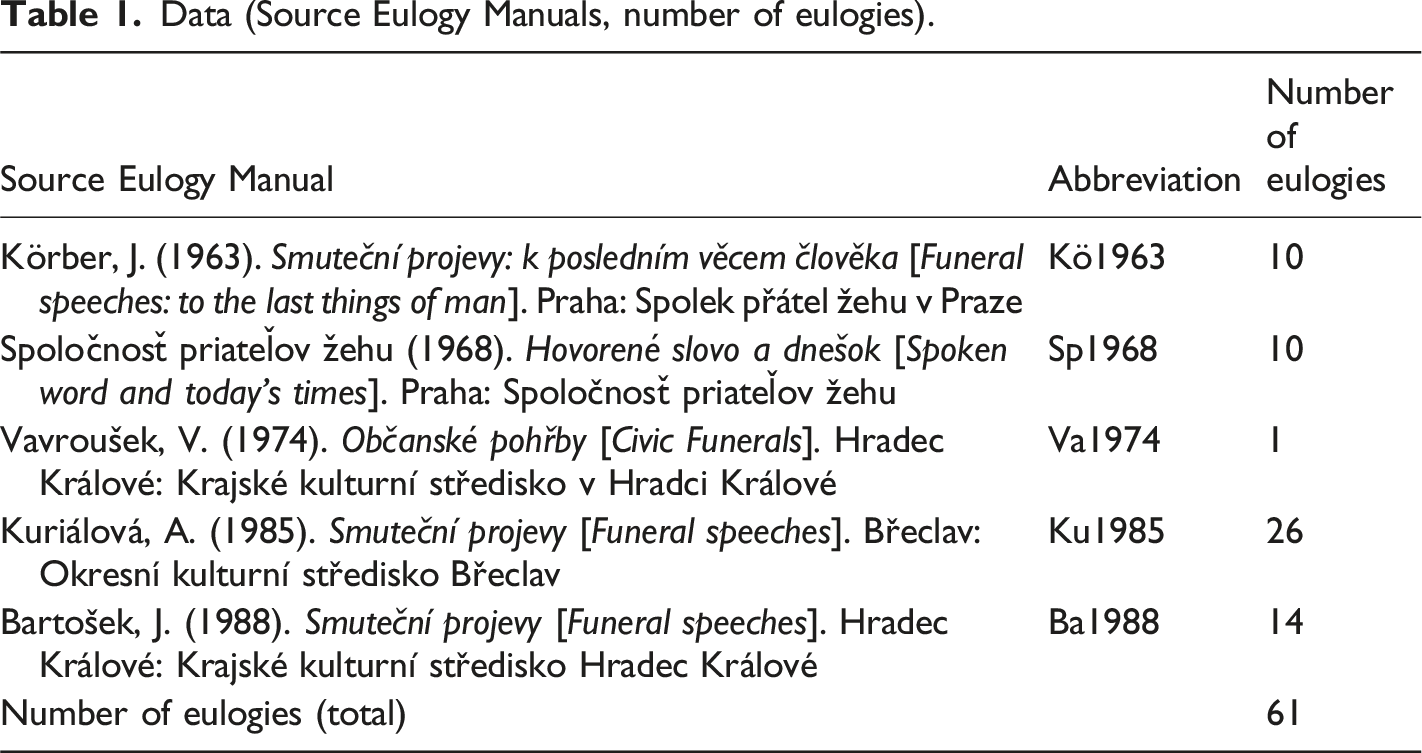
I identified suitable manuals based on a search in the National Library database 10 by searching for Czech phrases for funeral speeches. 11 In the paper, I work with 61 eulogies coming from 5 Eulogy Manuals published during the period 1963–1988. The manuals were published either by local publishers affiliated to the local Municipal Committees for Civic Issues or by the Society of Friends of Cremation. 12
Data (Source Eulogy Manuals, number of eulogies).
Data Analysis
I used thematic analysis (Braun & Clarke, 2006; Saldaña, 2016) to identify and analyze the topos “afterlife” in model eulogies. The analytical procedure consisted of the implementation of the following six steps: (1) Data preparation: All eulogies were prepared in a uniform format. Eulogy texts were transcribed into one Word document, marked with a specific number, and information about the source (text order in the manual, abbreviation of the manual). All eulogy texts were transcribed in Czech, which meant the translation of 10 eulogies from one Slovak manual (cf. Spoločnosť priateľov žehu, 1968) into the Czech language. The specific names of the deceased used in eulogies were replaced by uniform ones (Josef Novák/Jana Nováková),
15
grammatical errors were corrected to reach an uniformity of data.
16
The uniformity of data enabled the researcher’s preconceptions to be limited, which may have occurred as a result of acquaintance with the texts of eulogies prior analysis. The process of the transcription of eulogy texts also served as the first familiarization with the data. (2) Data immersion: Eulogy texts were read and re-read for familiarity with their contents. (3) Coding: As a first step in the analysis, I used structural coding (cf. Saldaña, 2016, pp. 98–101), which “generally results in the identification of large segments of text on broad topics; these segments can then form the basis for an in-depth analysis within or across topics” (MacQueen et al., 2008, p. 125, cf. Saldaña, 2016, p. 100). I focused on the identification of passages that correspond to the topos “afterlife”. When identifying fragments as belonging to this topos, I considered any mention of the deceased’s continued existence. I was guided by some linguistic indicators evoking the continuation of the deceased’s existence (e.g. verbs: “žije dál” [he/she lives on], “nezemřel” [did not die], “bude dál s námi” [will be with us], “zůstává” [remains] etc.; adjectives: “živý” [alive], “nesmrtelný” [immortal], “věčný” [eternal] etc.; adverbs: “navždy” [forever], etc.). I arranged these fragments in one table for the purposes of further analysis. (4) First cycle of inductive analysis at the level of the individual topos: In the next phase of the analysis, I focused on fragments classified under the topos “afterlife”. By re-reading them, I became more familiar with their contents. I performed an inductive analysis, using open-coded tags, which are based on the procedure of descriptive coding. I assigned codes to individual fragments that “summarizes in a word or short phrase – most often a noun – the basic topic of a passage of qualitative data.” (Saldaña, 2016, p. 102) The master coder approach was used in the coding process, when one individual codes all themes in a data set and another member of the research team serves as the reliability coder, who codes a subset (typically 20%) of the total data set (cf. Syed & Nelson, 2015, p. 379). In the process of coding, I acted as the master coder, coding the entire data set. During the process of coding, I developed the coding scheme. I shared the transcripts of eulogies and coding scheme with two independent coders. First, the coders were ask to conduct structural coding (i.e. to identify the passages referring to the continued existence of the deceaseds) in three speeches. Thereafter, we discussed the process of coding, which led to refining the coding scheme. Then the coders were asked to conduct structural coding of another 12 speeches (ca. 20% of a total of 61 speeches). After that, we compared how we had interpreted each sentence in the text and calculated our level of concordance at the sentence level. Because of the structure of the data in a binary variable that contains a majority of cases falling into one category (0) and a minority of cases falling into the other (1), the percentage of agreement of the master coder with both coders was used. The 96% and 92% agreement shows a high reliability of coding. (5) Second cycle of inductive analysis at the level of the individual topos: Moving recursively between step (4), second-cycle coded data were categorized, using constant comparison and critical reflection, and the themes were reviewed. In this way, I obtained specific themes that are associated with the reference to “afterlife” (see Table 2). A bottom-up approach was used to establish themes. The themes were developed and named by me, however, their appropriateness was also discussed with two independent coders. The coders were given a set of 27 excerpts identified in eulogies as referring to the deceaseds’ continued existence (ca. 20% of a total of 136 excerpts). They were asked to create open-coding tags, using the procedure of descriptive coding. After conducting this phase of coding, we shared our results, and discussed the appropriateness of naming the themes, as well as their content. This led to refining the description of the content of the themes within the coding scheme. We also investigated the interrater reliability of matching already created themes on a new subset of 27 excerpts. The value of Krippendorff Alpha for nominal data for the three coders was 0.93 (LL 95% CI 0.83, UL 95% CI 1.0), which shows a high agreement of coding (Krippendorff, 2004). (6) Significance of themes: I focused on the number of occurrences of the specific themes used in eulogy texts. This allowed me to distinguish between significant and less significant interpretations of “afterlife”.
17
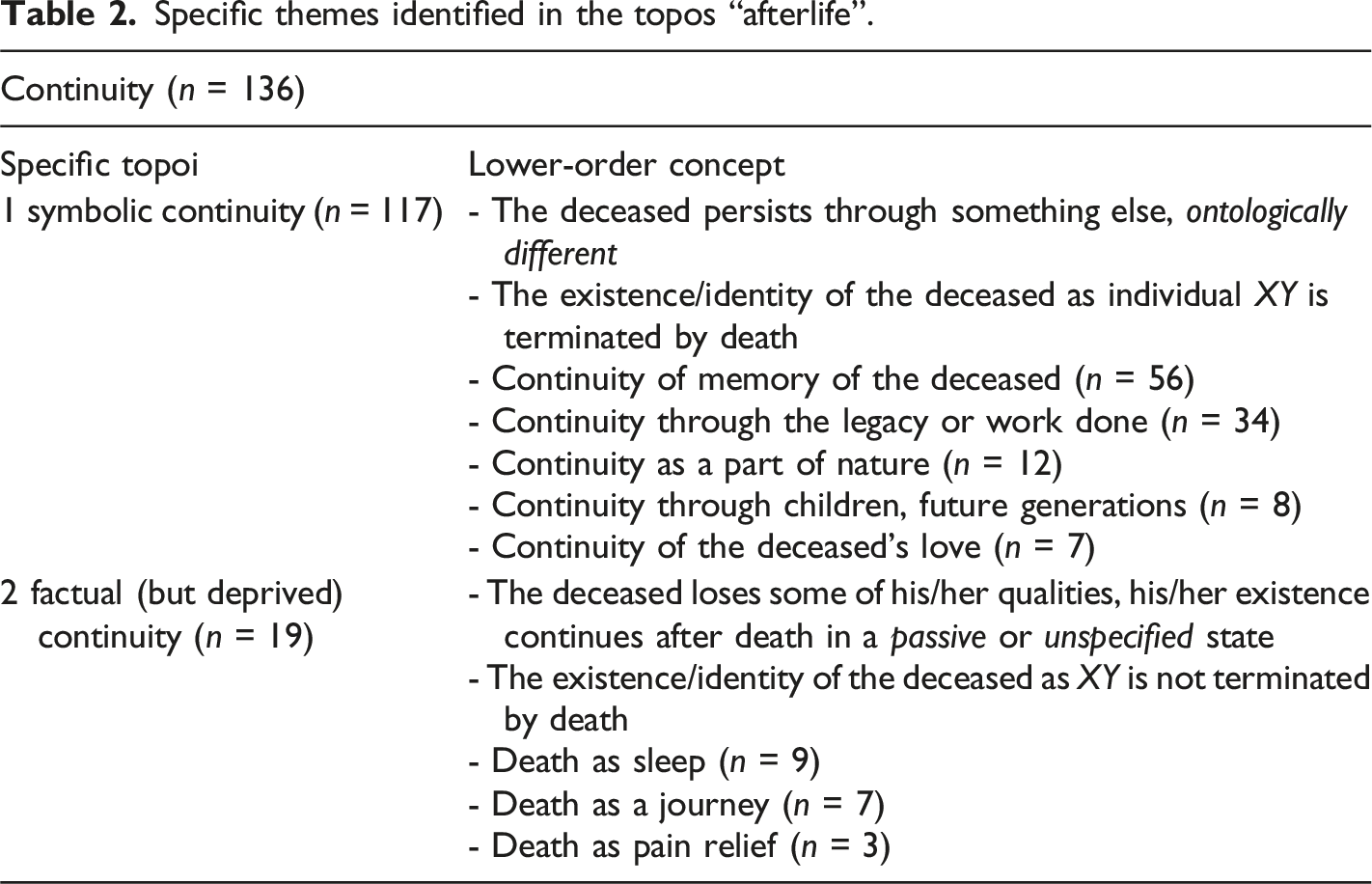
Specific themes identified in the topos “afterlife”.
Alternative Interpretations of “Afterlife”
In secular eulogies, reference to the afterlife in terms of the eschatological construction of the deceased’s identity is directly forbidden, due to the ideological demand to avoid any religious topoi. In Eulogy Manuals, however, this obstacle is dealt with creatively. The afterlife in its theistic interpretation, i.e. in the terms of “heaven”, “better place”, “salvation”, etc. is not referred to in any case, but is systematically referred to as the continuity of the deceased’s existence in a symbolic and also factual sense.
In the sample of eulogies, reference to some version of the continuity of the deceased frequently occurs (n = 136). The vast majority of references to the continuity of the individual can be identified as belonging to symbolic continuity (n = 117). In this case, the existence or identity of the deceased as individual XY is conceived as being terminated by death; he/she no longer continues to live. However, he/she continues through something else, ontologically different: in the form of a memory through remembrance, through his legacy/work done, as part of Nature, through children or future generations, and the deceased’s love can continue.
In a smaller number of cases (n = 19), the actual continuity of the deceased’s existence or his/her identity as individual XY after death is presented. In this case, however, it is not an afterlife in the theistic sense, but rather a continuation, even if in fact already passive, deprived, or unspecified. The death of the deceased is conceived as sleep, a journey, or relief from pain.
Symbolic continuity
In the topos symbolic continuity (n = 117), five specific concepts of continuity occur. Here, I describe them in detail and illustrate them with relevant fragments from the sample of eulogies.
The most frequently recurring concept of a deceased’s symbolic existence is continuity of the memory of the deceased (n = 56): the deceased is conceived as persisting in the hearts of the bereaved or in their memories: “We must be comforted by the knowledge that the dear man lives and will live in our hearts, in our beautiful memories.” (/1/Sp1968). 18 Quite often (n = 10), the metaphor of a monument, which the deceased built in the hearts of the bereaved, is present: “In the hearts of his former students, he [the teacher] built a monument of the most beautiful stone.” (/14/Ku1985) The memory is usually conceived as permanent: “We say goodbye to Jan forever, he leaves, but in the hearts of all who loved him, in them he will stay permanently.” (/2/Ku1985). In several cases (n = 5), however, it is indicated that the continuity of the deceased through remembrance is not eternal and ends with the death of those who remember: “Grandma – this is always something for us that no one can replace, she will also remain in our memories until our last days.” (/11/Ku1985) In some cases (n = 3), it is also indicated that the continuity of the memory of the deceased depends on the active role of the bereaved: “She will live with you as long as you take care of her memory.” (/16/Ku1985)
The second most common theme is continuity through the legacy or work done (n = 34). In this case, the continuity of the deceased is conceived as being permanent; the deceased is “immortal” in his/her work or legacy: “(…) he remains among the living even if he dies, remains among the living by his work.” (/2/Sp1968) “Sooner or later, a man leaves, but the work he has done remains here. Man is immortal in work.” (/1/Va1974) The work or a piece of work of the deceased is evaluated by general positive adjectives: good work, honest work. In five cases, however, the work is specified as the work of the deceased’s hands: “If we look around, we will find everywhere in deeds an expression of his noble efforts, stimuli, the contribution of his unfading hands.” (/1/Kö1963) In some cases (n = 3), the work/piece of work of the deceased is conceived as a contribution to the collective work, but mostly only in general: “(…) he leaves traces of his participation in the collective work.” (/9/Kö1963) In two cases, the work or legacy is concretized directly as a contribution to the building of communism or a socialist society: “(…) that his legacy may become a guide for us, so that, like him, we may work for a society which has its goal in communism, a society in which everyone can enjoy the fruits of his own labor peacefully and in peace.” (/2/Sp1968) “Through her work, her actions and deeds, she has contributed a reasonable part to the growth of our society. (…) Her life, the life that has ended, will continue in exactly what she left behind.” (/10/Ku1985) If there is a broader reference to the deceased’s legacy, then it does not have to be just a work or piece of work, the deceased can also persist through the positive example or trait he/she left: “Although his life is irreplaceable, his legacy, his heroism, his dedication remains.” (/3/Sp1968) “Her departure is not a farewell, because love, bravery and devotion are eternal. This is also the biggest legacy that comrade Jana Nováková leaves us.” (/6/Ba1988)
The theme continuity as a part of Nature (n = 12) is probably the motif that was the original frequent motif in eulogies of Free Thought (cf. Volná myšlenka, 1930). The deceased returns to the lap of Nature through cremation – through fire or as ashes – or becomes a part of the eternal cycle: “The mother herself – returns through the pure flame of fire, in which the whole life of the world naturally begins and dies out – into the lap of her great noble companion-nature – the mother of all mankind.” (/2/Kö1963) In such a case, it is possible to meet the deceased symbolically in Nature, because Nature will remind the bereaved of the deceased: “May the bright flame of fire scorch the sadness and accompany the memory that will return to us (…) from the treetops, in the raindrops – in the rays of the sun and the smell of flowers.” (/4/Kö1963) “The pure heart of your child will be accepted by eternal Mother Nature. Therefore, look for the memory of your Jana (…) at home and in Nature: in flowers, in the blue summer morning and in the white winter evening.” (/1/Ba1988)
In cases that continuity through children, future generations (n = 8) is referred to, the deceased is presented as immortal through the life he/she gave to his/her children: “he remains alive by the life he gave” (/8/Ku1985) “you will be with us (…) in children” (/3/Ku1985) “After all, her heart really continues to beat in her children, and its every trembling guards her blood.” (/2/Kö1963) The death of an individual deceased is conceived as a necessary part of an endless change of generations: “And that’s why it was worth being a light and the warmth for someone, it was worth continuing what the mother put into her children. From this fact, it can be seen that there is no extinction. Generations just change.” (/7/Sp1968)
The continuity of the love of the deceased (n = 7) can also be referred to, by which the deceased had a positive effect on his loved ones, and which has a positive (but unspecified) effect on the bereaved, even after his/her death: “A man, even though his heart has stopped, (…) he is embodied in the love he has given and planted in the hearts of his loved ones as a good grain.” (/8/Ku1985) “Such love can rarely be destroyed by saying goodbye to his body. Such love is alive and strong. It will manifest in your hearts as well as everywhere around you, in Nature and in your surroundings. Love will remain even if the body is transformed into ashes by the flame.” (/4/Ba1988)
Factual continuity
In the topos factual continuity (n = 19), three themes of continuing the deceased’s existence after death are presented.
Death as sleep (n = 9) is the most frequently recurring theme in the case of factual continuity. It is not described in detail, it is conceived as the last sleep, rest, or eternal dream; the deceased rests, sleeps, or sleep took over his/her life: “So let’s remember a little about the one who lies here quietly, sleeping her last sleep.” (15/Ku1985) “But still – such a life cannot completely disappear. And she also did not die for those she loved. She just left for a quiet rest, left after a good life.” (/20/Ku1985) If it is specified in any way, then only in connection with the place (n = 5): the deceased rests in a quiet, beautiful, or fragrant place, in the cemetery or in Nature: “Also I – dead, under the roses I want to sleep forever…” (/11/Ku1985) “The cemetery is a garden full of fragrant breezes, carefully and lovingly grown flowers. Our loved ones come here to sleep their eternal dream.” (/11/Ba1988)
Death as a journey (n = 7) is described in eulogies as “a journey from which there is no return” without any further specification or in one case a journey “behind the veil of eternal silence” (/6/Ba1988). In this case, the continuation of the deceased’s existence is not seen as something positive, but rather inevitable: “She has gone on a journey from which there is no return, on a journey that every one of us will take one day, even if he has the most faithful hearts around himself.” (/15/Ku1985) “It may seem harsh and uncompromising, yet it does not change the fact that our dear one has gone on a journey that is the same for all of us, the journey we will take one day.” (/12/Ku1985) In two cases, the journey is even described in negative terms, as a journey to darkness: “The journey ends and no one passes back through the gate of death. After all, even the journey to eternal darkness is the journey forward…” (/19/Ku1985) “He goes forever into the darkness where no star shines.” (/2/Ba1988)
The theme death as pain relief (n = 3) occurs in speeches intended for the deceased who have suffered physical or mental pain. In this case, the life of the deceased or his/her last moments are described as extremely painful, and death is interpreted primarily as a state of the elimination of pain, which in this contrast is conceived as a welcome state. The character of the deceased’s continuation after death is not specified, its only emphasized trait is the absence of the pain – mental or physical – that can be also connected with the absence of other cognitive traits of the deceased: “Her hand will no longer caress anyone, she will never say a kind word to you again. There is no tear of joy or pain in her eye either, because she is freed from everything, she no longer knows anything, she no longer hurts.” (/11/Ku1985) “However, [death] also means the end of the suffering and pain of a sick body, sometimes even a sore soul. Then ‘… all afflictions, sorrows and all disappointments seem easier.’” (/2/Ba1988).
Limitations
The results of this study are limited, however, by the character of the sample of eulogies, as well as by the cultural context of their production. The study concerned speeches from Eulogy Manuals based on their availability, which may result in an incomplete representative sample of eulogies published in Czechoslovakia, therefore the generalization is limited. It should also be emphasized that the study presents an analysis of “standardized” model eulogies, not historical eulogies for specific deceased. This limits to some extent our statements on the empirical character of Czechoslovak funeral rhetoric practice. We have no information about which manuals were used more frequently by eulogizers as a source for the preparation of specific speeches, to what extent model speeches were used, which specific model speeches were preferred, whether (and how) they were modified by eulogizers, etc. Expansion through the use of in-depth interviews with professionals who worked in the Czech funeral industry before 1989, so as to fully explore the character of eulogizersʼ practice as well as the process of speech preparation would add valuable insight to this field.
A limitation of the chosen sample of Eulogy Manuals may also be seen with respect to their linguistic character and the cultural context of their usage. Four Czech and one Slovak manual were conceived in this study as uniformly representing Czechoslovak eulogistic practice. The Slovak manual was included in the sample in order to represent the practice of eulogizers in the Slovak part of Czechoslovakia. However, it should be acknowledged that there may be differences between the character of funeral rhetoric in the Czech and Slovak parts of Czechoslovakia. In fact, we can detect some demographic differences between the Czech and Slovak lands in Czechoslovakia, which may be relevant in the case of civil funerals. As Nešporová (2013b, p. 192) points out, the proportion of cremations was significantly higher in the Czech lands, as compared to Slovakia. This probably corresponds to the higher level of religiosity of Slovaks. In 1950, only 0.3% of Slovaks categorized themselves as “non-believer” (compared to 6% of Czechs). In 1991, it was 9.7% of Slovaks (compared to 59% of Czechs) (cf. Mládek et al., 2006). Thus, future research could include a larger number of Slovak manuals, and thematize the differences between Czech and Slovak eulogistic practice. A more in-depth comparison focusing on the character of the choice of themes, or on specific linguistic differences at the level of word choice, etc. could also be a valuable contribution to this field.
Conclusion
In this section, the answers to the two main research questions of the paper are offered.
(Q1) To what degree do the reference to the “afterlife” of the deceased appear in secular eulogies?
In secular eulogies intended for non-religious survivors in the historical context of communist Czechoslovakia, references to “afterlife” in the traditional religious interpretation (“heaven”, “better place”, “salvation”, etc.) are completely absent. The only interpretation of “afterlife” identified in the sample of eulogies that comes close to the rather broader theistic concept of afterlife as continued existence in “another place” is the concept of death as a journey (n = 7). However, a significant difference is the negative description of such a place in secular eulogies (“the journey to eternal darkness”, “darkness where no star shines”), which probably cannot be connected with hope or optimism. These findings can have various interpretations: one of them could be that it is the result of the eulogizer’s efforts to emphasize the positive value of the life, deeds and work of the deceased (as opposed to the death of the deceased), which is required in terms of the ideological function of the eulogy (cf. Nešporová, 2013b, p. 195), while maintaining the traditional idea of an “afterlife”. Future research may add information to this puzzle. However, along with this one theistic-oriented interpretation of “afterlife”, we can observe in the data the relatively frequent occurrence of the topos “afterlife” (n = 136 in a total of 61 eulogies), in a wide range of interpretations.
(Q2) What specific secular interpretations of the “afterlife” appear in secular eulogies?
In secular eulogies, the specific concepts of “afterlife” are developed in terms of two different interpretations of the deceased’s continuity: symbolic and factual. The analysis therefore confirms MacMurray and Fazzino’s claim that the non-religious audience is willing to accept a specific concept of the afterlife in the sense of symbolic immortality (cf. MacMurray & Fazzino, 2017). At the empirical level, it also confirms the theoretical considerations of Campbell and Jamieson about the consoling effect of various concepts of afterlife that approach the concept of symbolic immorality (cf. Campbell, 1982; Jamieson & Campbell, 1982). In addition to the concept of symbolic continuity, however, the analysis also shows an occurrence of the interpretation of the deceased’s continuity in a factual sense, which was not theoretically expected.
The analysis demonstrates that not all secular interpretations of afterlife are equally common. The concept of symbolic continuity is used significantly more often in eulogies (n = 117 out of a total of 136), while the concept of factual continuity is used rather rarely (n = 19 out of a total of 136). In the case of symbolic continuity, reference to the continuity of the memory (n = 56) and work/legacy of the deceased (n = 34) far exceeds the other three identified types of symbolic continuity (continuity of the deceased as a part of Nature, through children, future generations, and continuity of the deceased’s love) which occur rather rarely (n = 27 in total).
The analysis provides us with information about the character of eulogies in the historical and cultural context of communist Czechoslovakia. Although we can agree with Nešporová (2013a; 2013b; Nešporová & Tóth, 2021) that secular eulogies in communist Czechoslovakia emphasize the life, deeds, and work of the deceased and that death is presented in eulogies as the absolute end of life, it cannot be concluded that references to the afterlife disappear from the speeches. On the contrary, based on the analysis, we can observe that the demand of the communist regime to secularize eulogies in the sense of not using traditional religious and idealist motifs including the afterlife, is specifically and creatively dealt with in eulogies by designing and developing a specific secular topical repertoire of regime-permitted concepts of afterlife, to serve as an alternative and a replacement of a theistic concept, also having the assumed consoling effect on the audience.
We can estimate that this type of creative dealing with the demand of the secularization of eulogies can also be expected outside the historical context of communist Czechoslovakia, in those – historical as well as current – contexts where the audience or its segment is non-religious and can therefore be expected to share the demand to avoid a theistic interpretation of the afterlife (cf. MacMurray & Fazzino, 2017). These contexts can be addressed in future research. A comparison with this study can offer us information about the character of secular eulogistic rhetoric, as well as the specific concepts of afterlife in other cultural and historical contexts.
At the same time, the results of the study can be used for a diachronic comparison of different forms of eulogistic rhetoric in Czechoslovak society. The character of secular eulogy can be compared both with older form of eulogy promoted by Free Thought (cf. Volná myšlenka, 1930), but also with modern form of eulogy developed in the post-revolutionary Czech Republic and Slovakia, where the removal of the ideological component can be expected (cf. Nešporová, 2013b, p. 197). This kind of study could show us how the secular topical repertoire is transformed during the time with respect to the changing historical context.
Footnotes
Acknowledgements
I wish to thank my coders Tomáš Ondráček and Denis Kubíček for their great help in the phase of creating coding schemes and in the phase of coding reliability testing. I would also like to thank Petra Vodová for her help in the statistics processing. I also wish to thank the anonymous reviewer for providing helpful comments on earlier versions of this paper.
Declaration of conflicting interests
The author(s) declared no potential conflicts of interest with respect to the research, authorship, and/or publication of this article.
Funding
The author(s) received no financial support for the research, authorship, and/or publication of this article.
