







Abstract
This study looks at the evolution of the nonfiction English language near death experience (NDE) book genre over the past 50 years. The key research aim was to identify subgenres of NDE books to better understand how the epistemology of NDEs has been shaped by the popular literature. The study employed a qualitative methodology and was both inductive and deductive. World Cat and Library of Congress databases were used to identify printed and digital books, as well as textbooks, published on the NDE topic. Each book was coded to classify it within a specific subgenre. Findings showed that the largest subgenre of English language NDE books has been the experiencer account, whether written in an autobiographical or biographical format. Other large subgenres have included scientific investigations, religiously oriented books (especially Christian), and books exploring the personal aftereffects of NDEs. Subgenres that have emerged in recent decades include compilations of “lessons” from NDEs, books written by neuroscientists, and books written by medical practitioners about patient experiences. The author concludes that public knowledge about NDEs has been greatly shaped by experiencer accounts published in books. Furthermore, the emergence of new subgenres of NDE books, and the growth of others, signals ongoing change in the epistemology of the phenomenon. Reflexive practice was central to the development of the final manuscript. Reflexivity is seamlessly integrated throughout the paper and demonstrates how the author’s familiarity with the book genre, and the NDE subject in general, shaped the development and conduct of this study.
Keywords
During the 1980s a new genre of books on “near death experiences” emerged after Dr. Raymond Moody’s seminal work, Life after Life (1975), introduced the phenomenon to millions of English language readers. Prior to the 1980s a handful of personal accounts and other books had been published about the near-death phenomenon, but after publication of Life After Life public and research interest in the phenomenon grew exponentially. Additionally, Moody’s publication stimulated the emergence of the field of near-death studies. At first, the NDE book genre was dominated by experiencer accounts and books with a religious orientation, but starting in the 1990s the NDE book genre grew and diversified.
The author’s acceptance of the NDE phenomenon as subjectively true for experiencers, and her familiarity with the NDE genre of literature, are embedded in the development and conduct of this study. The author does not believe NDEs to be a figment of the imagination for the vast majority of people who report them, nor does she believe they are the product of oxygen deprivation or hallucination. While the subjective experience cannot be observed, the aftereffects can be objectively studied and these after affects reflect a profound experience. The mere volume of experiencer accounts also lends credence to the veracity of the phenomenon as so many are moved to tell their stories and are undeterred by the possibility of ridicule. NDEs are also veridical in the sense that experiencers have described events and objects in their physical environment that they could not possibly have seen while unconscious.
Purpose of this Study
The purpose of this study was to classify English language, nonfiction NDE books published over the past 50 years into subgenres to better understand how the popular literature has shaped the epistemology of NDE knowledge. It appears that cataloging and classifying nearly every NDE book ever published was a novel endeavor. During the literature review, one study was located that analyzed every peer reviewed journal article published on the NDE topic to date (Sleutjes et al., 2014) but no studies were found that cataloged and classified NDE books. In fact, no studies were located that examined the epistemology of NDE knowledge, nor the evolution of the NDE book genre in general.
This study only included books written in English, and there were several reasons for this. First, interest in NDEs has grown enormously in western cultures over the past 50 years. Second, Moody’s seminal work was in English. Third, most of the academic literature on NDEs has been published in English with most research coming out of the U.S., UK, and Australia (Sleutjes et al., 2014). None of these factors, however, suggest that near death experiencers are more prevalent in western English-speaking societies, and a review of the non-English popular NDE literature is needed.
This study aimed to provide useful descriptive material about the types of books that have been written about this topic, as well as to analyze changes in the genre. But the aims were not merely to provide descriptive information. The author’s aim also was to learn more about the phenomenon itself by examining the types of books that have been published over time and in the present. Classifying the books into subgenres can also lend insight into how the epistemology of the near death experience – i.e. how the reading public has come to know about and understand NDEs - has been shaped by the popular literature.
By identifying and examining the subgenres of NDE book genre we can better understand, e.g., the limits of public knowledge about NDEs, whether facets of the phenomenon have been neglected in the popular literature. An analysis of subgenres can also illuminate whose voices, and whose knowledge, is conveyed to the reading public, e.g., which scientific disciplines are writing about the subject and framing scientific knowledge?
Particularly prior to the internet age, and arguably still today, books have been powerful epistemological agents of new ideas and realities. Today, public knowledge about NDEs also comes from movies, documentaries, audiobooks, videos, and podcasts; but before YouTube, Netflix, and podcasts, there were only books. Since the 1980s, numerous articles on the NDE subject have been published in popular magazines and periodicals, and with advent of the internet, in online publications and on websites. But despite the proliferation of information on NDEs via different mediums today, this study found that the number of NDE books published did not decrease with the arrival of the internet and digital media. Books have been a leading source, if not the major source, of comprehensive publicly accessible information on NDEs since the phenomenon first gripped the public’s imagination in the 1970s.
Furthermore, there is little reason to believe that the reading public is getting much of its information about NDEs from the academic literature. Most non-academics are unfamiliar with the scientific literature, academic research databases, and Google Scholar. Furthermore, academic literature is often barricaded behind a paywall. Thus, there are a multitude of reasons why one should look to books to understand the epistemology of NDE knowledge in the public domain.
The author’s curiosity about the evolution of the NDE book genre was borne from a lifelong interest in the subject. She has read numerous accounts of NDEs including those that focus on the effects of the NDEs on experiencers, as well as scientific investigations, spiritual explorations, and other subgenres of NDE books. Having read the seminal works published early in the genre, the author sought to learn how the genre has evolved, and what that evolution means about public knowledge on the subject and the phenomenon itself.
The author should also disclose that this book genre has shaped many of her beliefs about life after death. From an early age, she was fascinated by the similarity of accounts and doubted that so many ordinary people, despite the potential for ridicule, would fabricate their accounts. She also believed the common core aspects of the experiences lent additional credence to the stories and allowed for systematic study. Also, despite the common perceptual elements of the experience, she also was intrigued by the unique interpretations each experiencer conveyed through their states. The author also acknowledges that in some rare instances NDE accounts could be fabricated in the interest of garnering attention, making money, or disinforming the public, or they could be a hallucination stemming from a physical or mental disorder.
Research Questions
Subgenres of NDE books have emerged and grown since the 1980s due to the varied interests of writers and investigators, as well as the growing willingness of experiencers to share their stories. Undoubtedly, publishers have had something to do with the growth of subgenres of NDE books. Towards the goals of better understanding the evolution of the NDE book genre and the epistemology of public knowledge on this topic, this study aimed to answer the following key research questions: 1. Which subgenres of English language NDE books have been most prominent? 2. Which new subgenres of NDE books have emerged in recent decades? 3. Did the scientific investigation subgenre grow in recent decades, and if so, which academic disciplines were most actively publishing books for a general audience?
As an adjunct to the main aims of the study, the author was also interested in learning the following: 4. Has there been an increase in books for mental health or medical professionals about NDEs that convey the importance of listening non-judgmentally to patients’ stories?
The following hypotheses were made: 1. The largest subgenre of NDE books is personal accounts of near-death experiences. 2. The following subgenres have emerged: (1) medical personnel sharing patient experiences, and (2) inspirational books featuring “lessons” from NDEs for individuals and society at large. 3. The scientific investigation subgenre has grown and now includes research by a wider cross-section of fields such as neuroscience and sociology. 4. In recent decades more books have been published aimed at educating mental health and medical professionals about the NDE phenomenon and the importance of listening to patient NDE accounts with empathy and nonjudgement.
The author’s experience as a consumer of NDE literature, both academic and popular, informed development of the above research questions and hypotheses. She noticed in recent years that more books were being published that conveyed “lessons” for all of us from NDE accounts. This piqued her curiosity about whether this subgenre was proliferating, aside from the few books she was aware of. Furthermore, she wondered if more scientifically oriented explorations of the topic were reaching the general reader, and if so, which disciplines were most actively sharing knowledge. Coming from a social science background, she was particularly interested in learning whether disciplines like social work and sociology were involved in creating public knowledge about NDEs.
Finally, informed by her PhD in social work, she also wondered if a half century of learning about NDEs was finding its way into textbooks on bereavement and grief, or more sociology texts on death on dying. This final query was not central to the overall aims of the study since textbooks are written for a specialized audience. However, since she was analyzing all subgenres she thought this might be an interesting additional area of exploration. She acknowledges that content on NDEs in textbooks would shape mental health and medical professionals’ knowledge of NDEs rather than shaping public knowledge.
Background
Before Moody published Life After Life, NDE accounts were relayed in historical texts or through word of mouth, but these experiences were not yet called near death experiences. Moody shared experiencers’ personal stories and studied commonalities between them, signifying the beginning of the scientific investigation subgenre. According to Amazon.com, thirteen million copies of his book have been sold since it was first published. Other scientists followed Moody’s landmark book with their own investigations of the NDE phenomenon including psychiatrist Bruce Greyson (1984) and psychologist Kenneth Thomas Ring (1992).
By the late 1970s, and the ensuing decade, more personal accounts were being published. NDE accounts were shared by everyday people as well as specific groups such as child experiencers, physicians, Christians, military veterans, and people with vision impairment. For example, Sudman (2012) wrote about an NDE she had in combat. Her story provided insights into military life, the experiences of war, and her personal transformation following the NDE. Additionally, Drs. Mary Neal (2012) and Eben Alexander (2012) shared their accounts of experiencing an NDE from the points of view of skeptical physicians with medical knowledge of the brain and neurology.
Some NDE books feature more than one personal account. Compilations of NDE accounts often expose commonalities between experiencers’ stories or help the author explore a specific theory or aspect of the phenomenon. For example, The Spirit World Talks to Us (Foster, 2016) featured twelve near death experiences used by the author to describe what he believed the afterlife is like. Additionally, P.M.H Atwater not only published several books about her own experiences (e.g., 2011), but also authored books that featured multiple NDE stories to explore the NDEs of children (e.g., 1999) and the aftereffects of NDEs (2001). By the 1980s, information about the NDE phenomenon was also being included in multitopic format books or book series that explored various “paranormal” phenomena such as out of body experiences (OBE), telekinesis, UFO abductions, after death communication (ADC), and hauntings.
Another subgenre of NDE books uses spiritual or religious principles and beliefs to try to make sense of the phenomenon. Some of these books attempt to align the features of near-death experiences with specific religious or spiritual beliefs. There has been no dearth of religiously oriented, often Christian books, on the NDE subject including Pastor John Burke’s (2015), Imagine Heaven: Near-Death Experiences, God’s Promises, and The Exhilarating Future That Awaits You.
This is just a sample of the subgenres many avid readers of the NDE genre will recognize, but there are many other NDE subgenres that have emerged over the past fifty years. Knowing which subgenres have dominated the market, and which continue to do so, tells us a lot about public interest, the epistemology of public knowledge of NDEs, and the phenomenon itself.
Methods
This qualitative study employed thematic content analysis (Braun & Clarke, 2006) to classify NDE books into subgenres. Triangulation increased the validity of the coding process by using the author’s prior knowledge and several sources of information (i.e., abstracts, keywords, research) from the records to create initial codes. The codes were used to develop a list of subgenres, which was refined as new themes emerged during the coding process. Triangulation also was used to increase the validity of the conclusions by analyzing data using descriptive tables and visual analysis, as well as statistical analysis. The study was both deductive and inductive during the coding process, deductive in evaluating the research questions, and inductive in recommending areas for further study.
Reflexive practice (Olmos-Vega, et al., 2023) was central to the study process of drafting the final manuscript. Reflexivity is evident throughout the paper where the author embeds her subjective experiences as a consumer of NDE literature, and as someone interested in the topic, into the research process. Rather than claiming objectivity in the research process, the author explains how her interests and knowledge in the topic impacted development of the research questions and hypotheses and informed the coding and classification process.
Data Gathering Process
The first research goal was to compile a comprehensive list of all the nonfiction English language books ever published on the NDE subject. Trade paperbacks, hard cover books, textbooks, and eBooks were included. Exclusion criteria included fiction books, juvenile books, non-English language books, dissertations, and books on coming close to death that did not actually describe an NDE. Any book that included substantial content relevant to the NDE phenomenon was included. To compile the list, the author used two databases to search for publications: the Library of Congress and World Cat. Using Endnote, the author connected to the Library of Congress database and imported all books with the phrase “near death experience” in any field. No date parameters were entered to ensure books predating the 1970s were included. The same procedure was used to search the World Cat database, but the phrase was searched for by subject, keyword, or title. Again, no date parameters were entered so that books from any year would be included in the list.
The total number of records imported into EndNote was 1,984. Duplicate references, including the same title in two different languages or different editions of the same book, were removed using the Endnote duplicate removal procedure leaving 1,503 references. An additional manual review of the database resulted in 500 more duplicates being removed due to the same book being published in different formats (e.g., print books also published as audiobooks) or books that were not included in the parameters of the study such as fiction books, children’s books, and dissertations. Books not directly relevant to the NDE phenomenon (e.g., stories of people who came close to death but did not have a classic NDE) were also removed. An additional 38 references were added in April 2022. After that date, an additional 136 records were later removed during the coding process mostly due to books not being directly related to the NDE phenomenon upon closer review of the abstract or book description. The final number of books included in the study was 903. Records were exported from EndNote into an excel spreadsheet for coding.
The Coding Process
The coding process was both inductive and deductive, which is a key feature of thematic analysis (Braun & Clarke, 2006). First the author used an inductive process to develop the preliminary list of codes. In addition to writing down subgenres she believed existed based on her personal knowledge of the genre, she also completed a cursory scan of the compiled list of books, including titles and keywords, to develop a list of potential subgenres. Each code was meant to correspond with a potential subgenre of NDE books, but during the final round of coding by the author certain codes were merged to correspond to a single subgenre.
The author hired two research assistants to assign codes to each book using a list of 35 possible codes. This was a deductive process as the coders did not develop additional codes. The author has extensive knowledge of the NDE and has read many books on the topic, but interestingly the coders had never heard of the phenomenon. This was surprising to the author and she wondered if there might be a generational gap in knowledge of, or interest in, the topic; however, it was viewed as a positive development that the coders had no knowledge of the NDE genre, which in the author’s opinion, lent this stage of the coding process a degree of objectivity.
The coders were provided with a brief overview of the NDE topic and instructed to choose one primary and one secondary code for each book. Most exported records included a title, year published, authors, keywords, publisher, notes, and abstract, although some lacked keywords and/or an abstract. Each of these details was in a separate column in the spreadsheet. Two additional columns were created to enter primary and secondary codes entitled code 1 and code 2. The research assistants were instructed to enter a primary code (code 1) for each book and a secondary code (code 2) if it was deemed the book could be classified into a second subgenre.
The coders were instructed to use the keywords column to help them select codes. If the code/subgenre was not clear based on the keywords, or the keywords were missing, they were asked to review the notes and/or abstract columns to learn more about the books. If it was still unclear which codes to assign based on keywords, notes, and the abstract, the coders were instructed to read more about the book on Amazon or Google Books then assign a code to the best of their ability.
After the entire list of books was assigned a code by either research assistant, the author manually reviewed each record and agreed or disagreed with the codes assigned. If the author believed there was a more appropriate primary and/or secondary code, the codes were changed. Although, a more traditional process of agreeing on final codes did not take place, the author was deemed to be a competent final arbiter for assigning codes due to her extensive knowledge of the popular NDE literature. The author observed that some codes were erroneously assigned by the research assistants due to their unfamiliarity with the subject.
At this point in the process all codes were translated into subgenres. Essentially, the coding process was used to analyze themes within the universe of NDE books and create a list of subgenres based on these themes. During this final coding process, codes found to convey the same subgenre were combined to form a new theme/subgenre category (e.g., autobiographical and bio both became “experiencer story”). The final subgenre names were entered into the code columns by the author.
Data Analysis
The analysis began with counting the occurrences of the codes which now represented distinct subgenres. First, separate counts were conducted of the primary and secondary codes. Then the primary and secondary code counts were combined to produce a total count of each subgenre (code). Subgenre counts were additionally produced by decade. This was accomplished using the pivot table function in Excel to select years within each decade, then all primary and secondary code occurrences under that decade were entered into a table. Occurrences of each code, either as a primary or secondary code, were counted to produce a final total for each code, by decade.
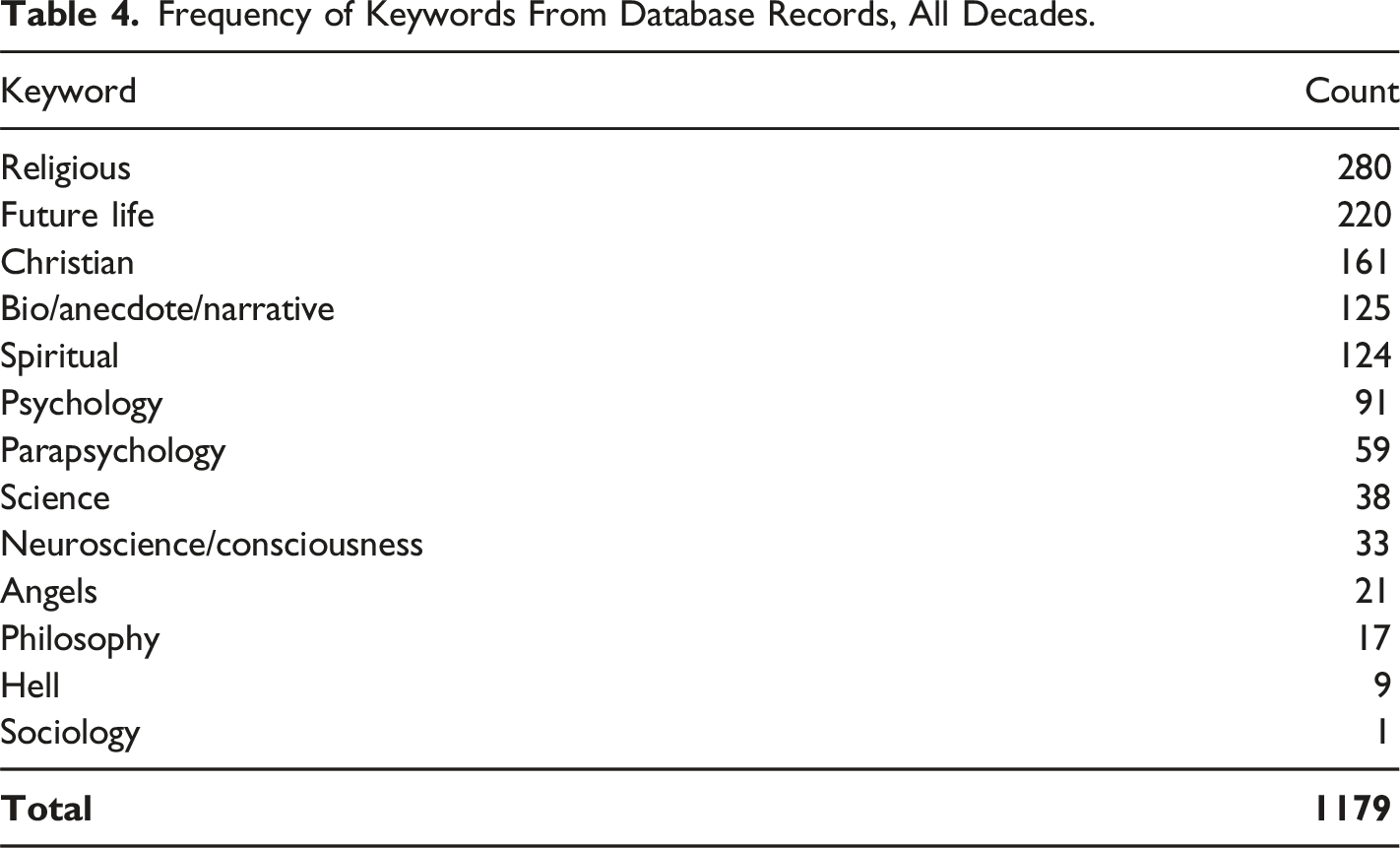
Keywords were also counted to observe whether keyword frequencies were generally aligned with relevant primary code frequencies. This was deemed important since the research assistants had been instructed to use the keywords column to assign appropriate primary and secondary codes.
Finally, the most frequent subgenres for each decade of the 1990s, 2000s, and 2010s were entered into R for a chi-square analysis to determine if there were differences by decade. This analysis was redone in SPSS to double check the results. Subgenre counts from prior decades and the current decade were not included in the analysis due to low frequencies. The ten codes with largest frequencies across all three decades (codes 1 and 2 counts combined) were entered into the analysis.
Results
Code Frequencies
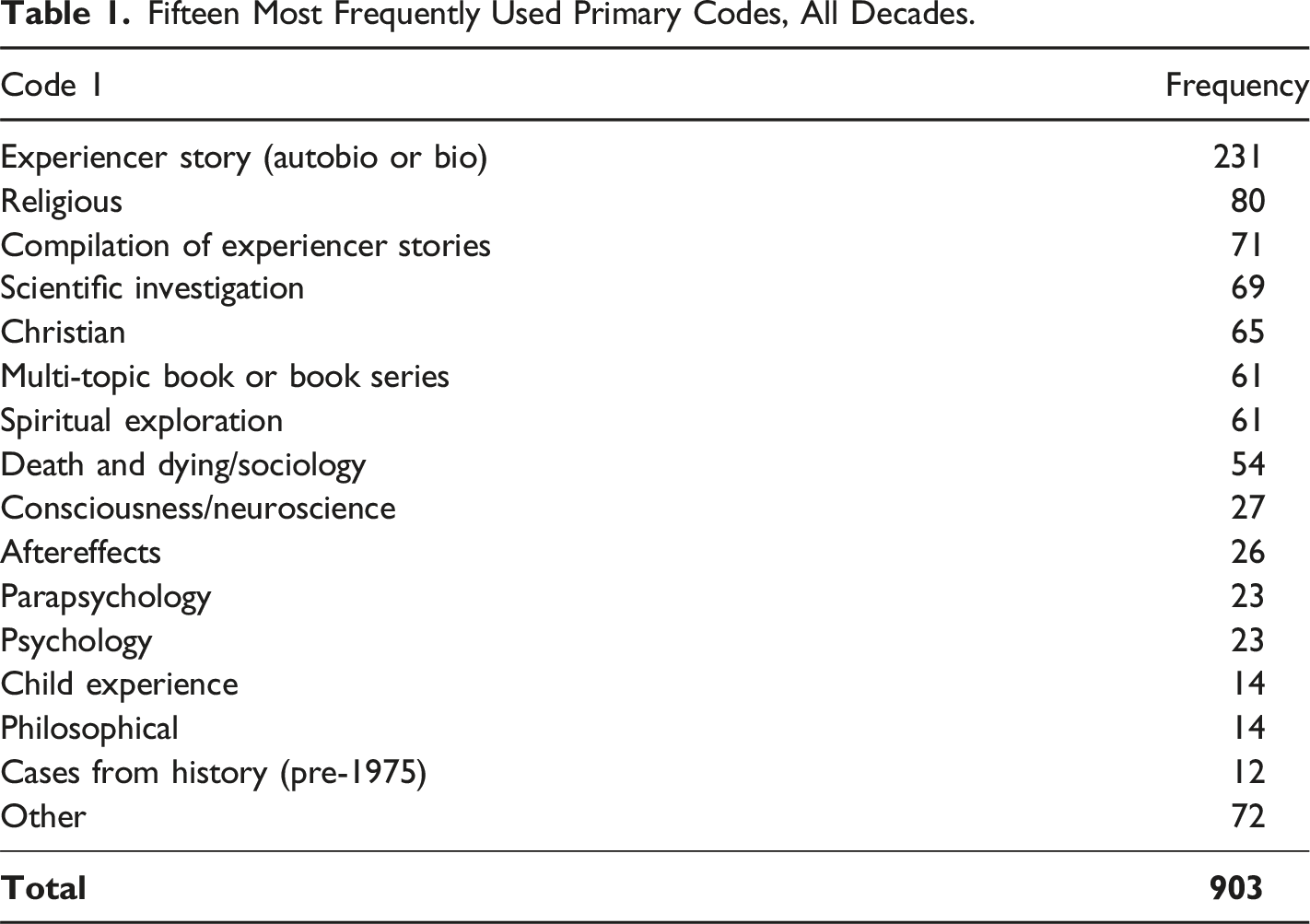
Fifteen Most Frequently Used Primary Codes, All Decades.
Ten Most Frequently Used Secondary Codes, All Decades.
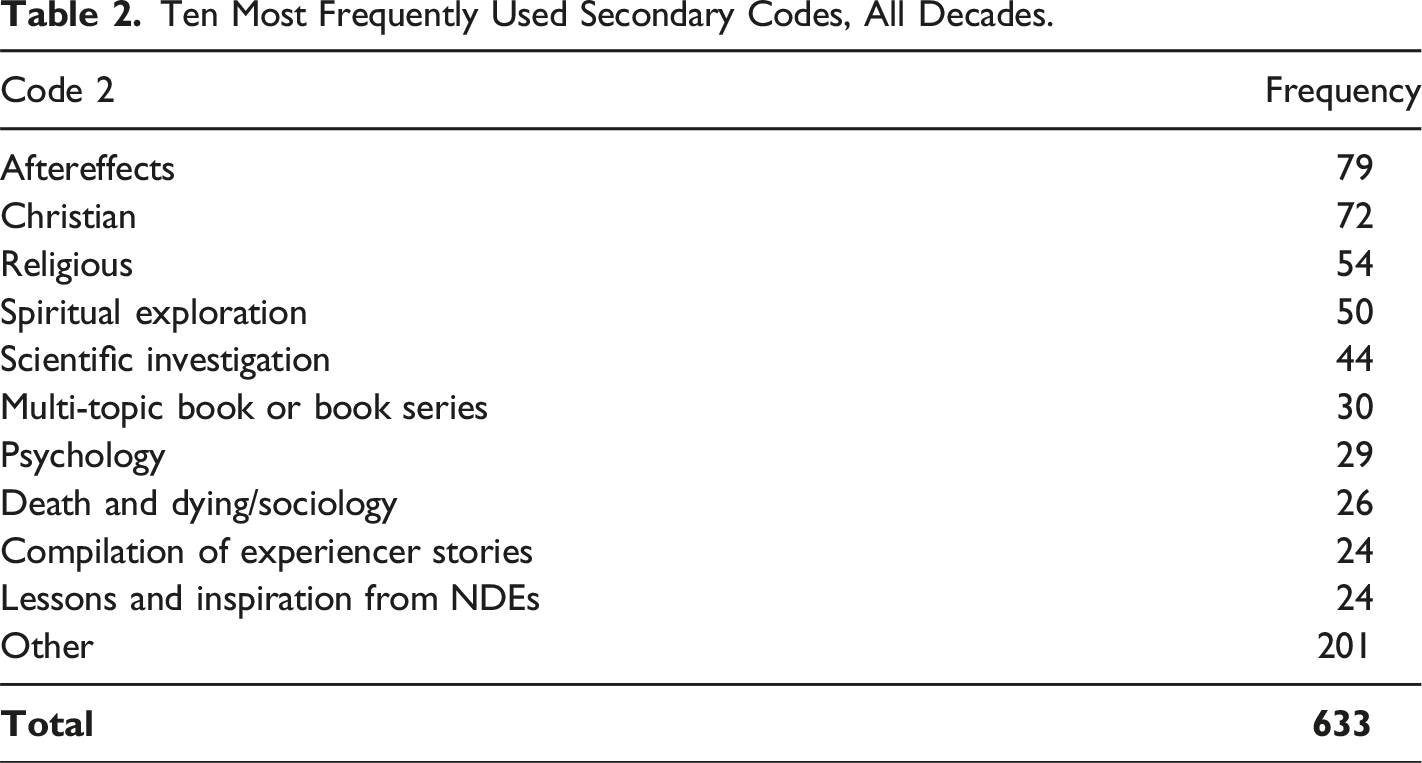
There was some overlap in the most frequent primary and secondary codes assigned, with a few exceptions. ‘Lessons/inspiration from NDEs’, ‘psychology,’ and ‘aftereffects’ books were more frequently assigned as secondary codes, while ‘experiencer stories’ and ‘consciousness/neuroscience’ books were more frequently chosen as primary codes. ‘Scientific investigation’ was a common primary and secondary code, but specific scientific disciplines such as ‘psychology’ were more often entered as secondary codes.
Combined Totals for All Codes (Primary and Secondary) Used, All Decades.
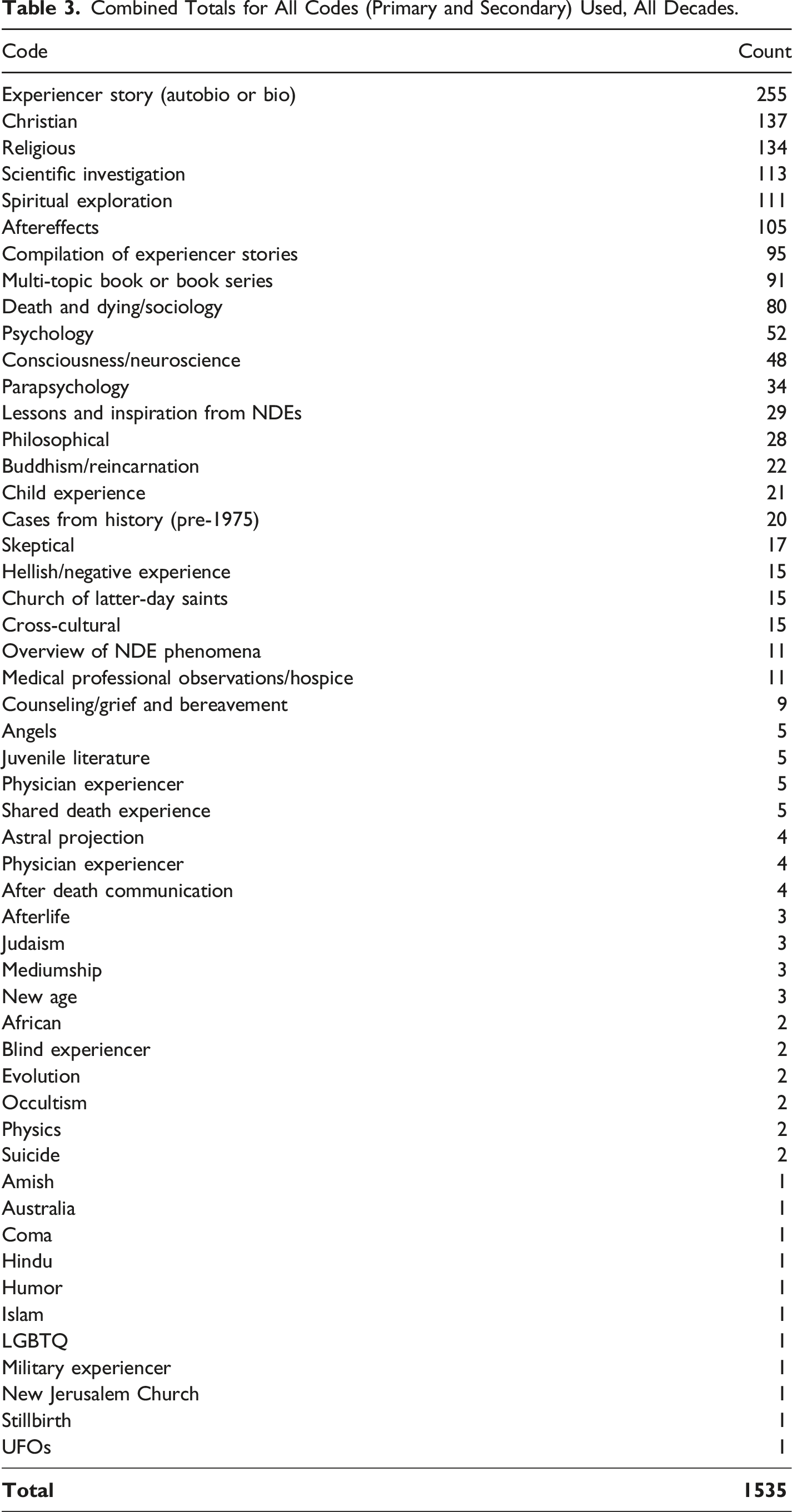
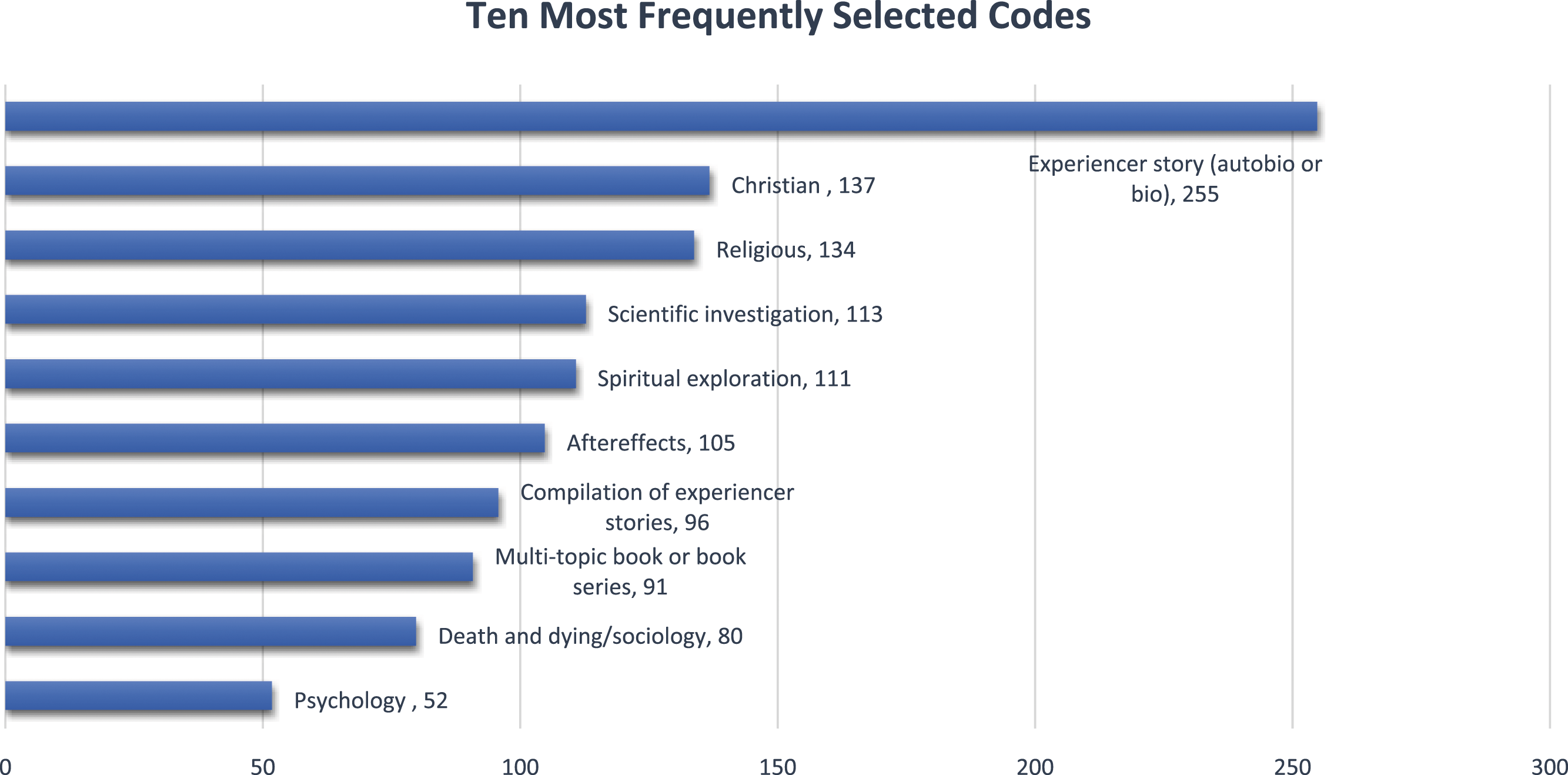
Primary and secondary code counts were combined to determine code totals. See Table 3 for complete list of combined code totals.
Eighty books were coded ‘death and dying/sociology.’ These two codes were combined since death and dying books are often written by social scientists and relate to societal culture and experiences. Fifty-two books were coded ‘psychology’ which meant the book was written by a psychologist, featured a study carried out by psychologists, or the books used psychology as the overall framework for discussing the phenomenon. The codes ‘parapsychology,’ ‘consciousness/neuroscience,’ ‘lessons and inspiration,’ and ‘philosophy’ represented fairly large subgenres as well.
Frequency of Keywords From Database Records, All Decades.
Differences Over Time
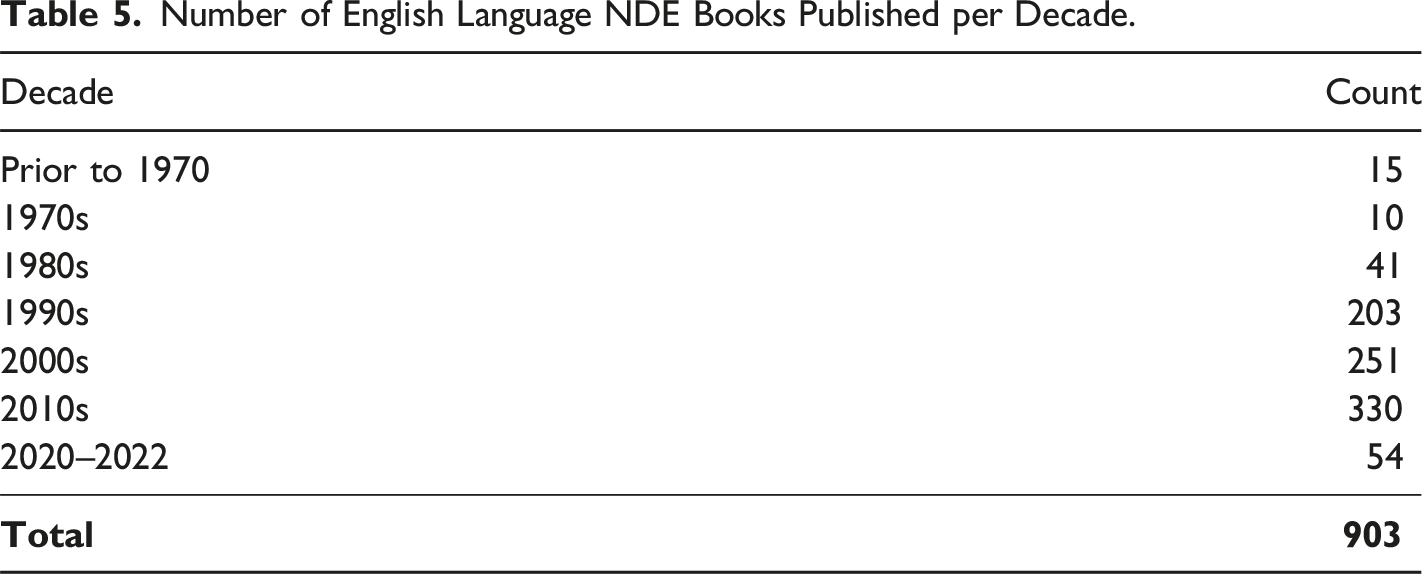
Number of English Language NDE Books Published per Decade.
NDE Books Published Prior to the 1970s
Several personal NDE accounts were published prior to the 1970s, with one dating back as far as the 17th century. These accounts are fascinating because they are from an era before there was a NDE “phenomenon.” It is possible that NDE stories were shared orally for centuries in Western cultures and throughout the world, but popular knowledge about NDEs was not widespread (in the U.S. as least) until the1970s.
One of the earliest written accounts located was featured in a four-page pamphlet published in England in 1683 (Atherton). The pamphlet described the story of a 14-year-old girl who was extremely sick and fell into “a trance like state for seven days.” She encountered “angels and saints” in a heavenly setting and was told by the beings that “she must go back for a while.” The experience was described as leaving the girl with great assurance of what waited for her on the “other side” at the time of her death. News from the Dead (Duell, 1740) described the experience of a prisoner who was hanged but survived his execution then went on to describe an otherworldly experience he had when he was unconscious.
A New Nonfiction Book Genre Emerges
Close to a dozen NDE books were published in the 1970s. Several NDE books published subsequent to Life After Life (1975) had a religious bent (Ritchie, 1978; Wilkerson, 1977) either featuring the NDEs of Christians or exploring NDEs from a Christian point of view. The first researchers to publish their work and thoughts about the NDE phenomenon in the 1970s were psychiatrists, psychologists, parapsychologists, and social scientists.
The NDE book genre emerged in the 1970s alongside the publication of popular books about death, dying, and grief. Founding mother of the death and dying movement, psychologist Elizabeth Kubler-Ross, mentioned the NDE phenomenon in her classic work, On Death and Dying (1997). She also published details about her own near-death experiences close to 40 years later (2008). Communications professor Robert Kastenbaum, one of the leading death and dying scholars of the late 20th century, was the editor of another early death and dying book, Between Life and Death (1979).
Emergence of NDE Subgenres
Thirty-nine books on the NDE subject, or featuring information on NDEs, were published in the 1980s. Books with a religious bent, especially from a Christian perspective, represented one of the first and largest subgenre of nonfiction NDE books to emerge. For example, Placebo (Pittman, 1983) described a Baptist minister’s NDE and its influence on his ministry. Pittman would later also write The Veil (1989), which was a religious exploration of NDEs. Two NDE books were written from a Mormon perspective (Heinerman, 1988; Sorensen, 1988) during this decade. Authors from the Church of Latter-Day Saints would later publish more than a dozen books on the NDE subject.
During the 1980s, more experiencers came forward to share their stories in books. One such experiencer was P.M.H Atwater who self-published I Died Three Times in 1977 – The Complete Story in 1980. Atwater would go on to write dozens of books on the subject in the ensuing decades. The first compilations or series of case studies of NDEs were published in the 1980s as well. Furthermore, the NDE subject was often included in multi-topic books alongside other “paranormal” subjects such as ghosts, UFOs, and telekinesis. The first skeptical books were published during this decade as well (e.g., Kurtz, 1985).
In the 1980s several more medical professionals and scientists, including psychiatrist Greyson (1984) and physician Sabom (1982), published investigations of NDEs. Furthermore, the near death phenomenon was seriously discussed in several more death and dying books including a second by Katenbaum (1986), Is there Life After Death, and Kamerman’s (1988) Death in the Midst of Life: Social and Cultural Influences on Death, Grief, and Mourning.
Bivariate Analyses
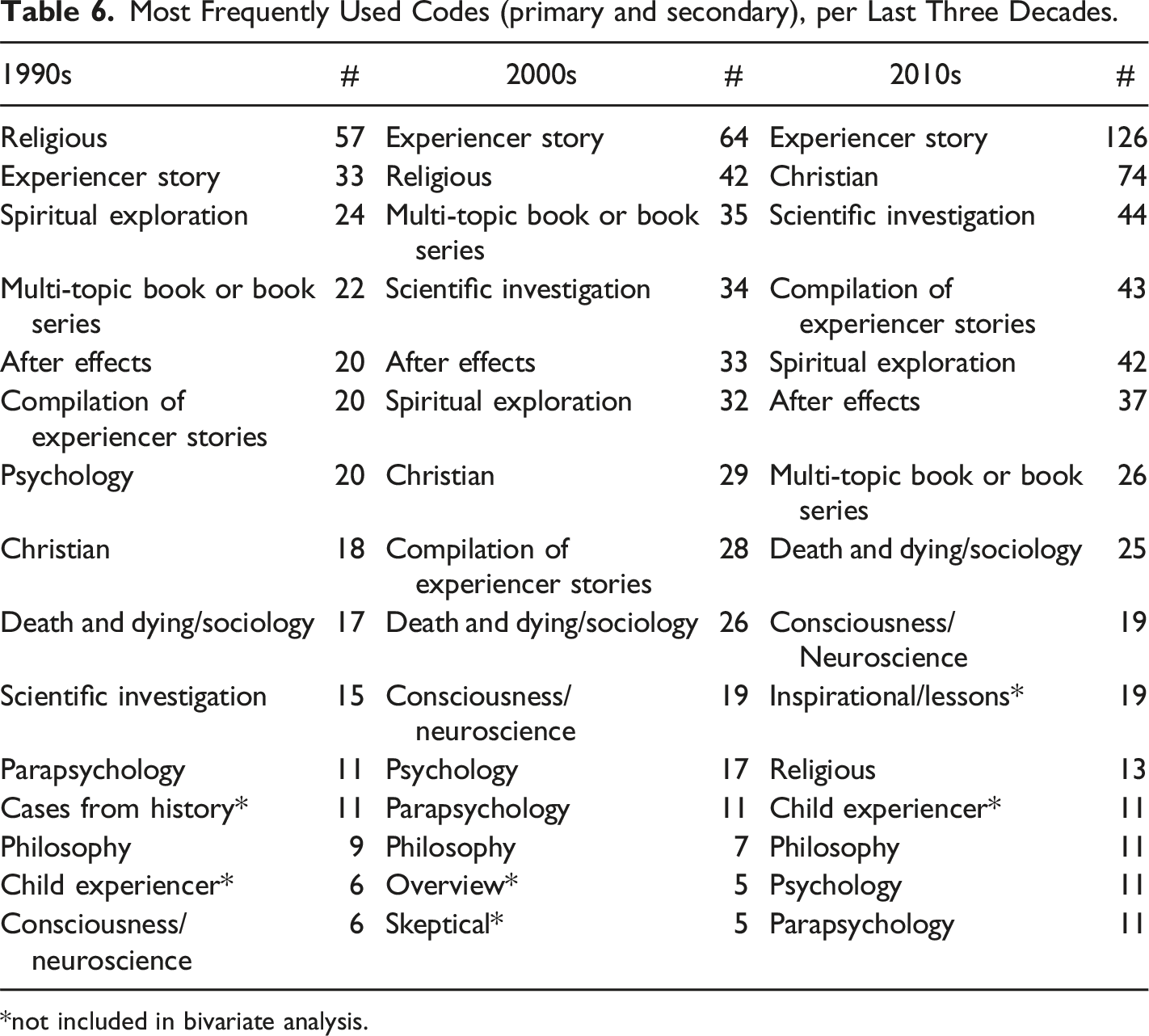
Most Frequently Used Codes (primary and secondary), per Last Three Decades.
*not included in bivariate analysis.
Use of the code ‘Christian’ was less prevalent (than statistically expected according to the bivariate analysis) in the 1990s and 2000s compared to the 2010s, while the reverse was true of ‘religious’ books. Fewer than expected ‘experiencer stories’ were published during the first two decades analyzed while the reverse was true of the 2010s. ‘Psychology’ books were published more often than expected in the 1990s and less often than expected in the 2010s. There were also fewer scientific investigations in the 1990s compared to a larger number than expected in the 2010s.
Primary codes were analyzed separately since they were expected to more accurately describe the subgenre a book belongs to. There was a difference in the top ten primary codes by decade, χ2 (18, N = 650) = 82.576, p < .001. The ‘experiencer story’ code, more commonly used as a primary code (it was used 231 times for the primary code and 23 times for the secondary code), was used less often than expected for books published in the 1990s and 2000s while the reverse was true for the 2010s. This is consistent with the total code analysis reviewed above.
Also consistent with the total code analysis, fewer books were assigned the ‘religious’ code as a primary code in the 2010s while more than expected were assigned this code in the 1990s. ‘Multitopic’ books were less prevalent in the 2010s in congruence with the total codes analysis as well. Books on ‘aftereffects’ were not evenly distributed across the three decades as this subgenre appeared more often than expected in the first two decades and less often than expected in the 2010s. Finally, there were more neuroscience books than statistically expected in the 2010s.
Smaller Subgenres
Several observations can be made about smaller subgenres not included in the bivariate analysis. By the 2010s, a new subgenre of NDE books had emerged that focused on what medical professionals - such as hospice workers, nurses, doctors, and EMTs - were being told by their patients about otherworldly journeys out of the body while in surgery, unconscious in an ambulance, or in hospice. Many of these books included descriptions of the profound aftereffects, including joy, hope, and peace, that their patients reflected after their experiences.
Another observation that can be made is that the number of books about hellish or negative experiences increased from only a handful in the 1990s and 2000s to eight in the 2010s, (and two books from this subgenre have already been published this decade). The number of skeptical books remained consistent across the three decades examined, while books featuring children’s experiences increased from four published in the 2000s to eleven in the 2010s.
Current Trends
The current decade (2020s) was not included in the bivariate analysis due to the small code counts; however, it is evident from looking at the types of books published thus far that certain subgenres continue to dominate. For example, the largest subgenres currently are ‘experiencer stories,’ ‘Christian’ books, and ‘scientific investigations.’ Books on aftereffects and books by neuroscientists continued to be quite prevalent in the 2020s as well. It also appears that the inspirational/lessons subgenre of NDE books is continuing to grow as it is already the fifth largest genre.
Discussion
This study examined the existence and emergence of subgenres of popular English language NDE literature published over roughly half a century. This study produced some unexpected findings, but most of the hypotheses were confirmed through a deductive research process. Research question one asked which subgenres of English language nonfiction NDE books were most prevalent over the past fifty years. It was hypothesized the largest subgenre would be personal “experiencer stories” and this was found to be accurate. The following reflections derive from the author’s own experience reading numerous NDE accounts and it is assumed that she is not the only reader who has been so moved by these stories.
Experiencer Stories
Experiencer stories are the largest subgenre of NDE books, and this subgenre has continued to grow in recent decades. The experiencer story, whether written by the experiencer themselves, a family member or professional author, is one of the most widely recognized and influential subgenres of popular NDE literature. The ability of personal accounts to convince the reader the experience was ‘real,’ stems from the ineffable and powerful nature of the stories themselves. Authors, when writing about their own experiences, often convey to the reader that it is simply difficult to find words to describe the experience. The public learns much of what they know about NDEs from these personal accounts. The moving and transcendent nature of the NDE not only profoundly impacts the experiencer themselves, as described in most accounts, but also has the potential to transform the reader as well.
Readers likely relate to the everyday people who have had an NDE as they read their stories. They are people like themselves – parents, doctors, persons with disabilities, skeptical, or religious. Readers may empathize with the experiencer’s initial discomfort of being judged, not believed, or outright rejected for sharing their experiences. If the reader takes away anything from the story, it is that the NDE was more ‘real’ to the experiencer than everyday life and that the writer is certain it was not a dream, hallucination, nor fantasy. The part of the story that describes the aftereffects of an NDE, such as personal growth, greater empathy, and or changes in relationships, has the potential to vicariously transform the reader as well.
There has always been great power in telling extraordinary personal stories through books, whether it’s a story of triumph, heroism, defeat, or trauma. These types of books are powerful because the author is sharing their truth. Likewise, the NDE is sharing their extraordinary truth to the best of their ability. As noted by Chapman (2019), stories told about near-death experience have an almost mythical quality. “The NDE is first and foremost, a story, of an incredible journey, complete with peril and pathos, finally arcing into a gratifying denouement in which the tale, and by extension its teller, is given credence by others” (p. 57).
Furthermore, NDE stories told by certain types of people are particularly fascinating due to the difficulty of debunking such stories. Physicians’ NDEs are difficult to dismiss because these professionals are highly respected in society (generally) and are regarded as skeptical by nature. Dr. Eben Alexander (2012), for example, was skeptical of the NDE phenomenon before he had his own experience. NDEs described by military personnel, blind persons, and children are also particularly compelling. Service members and veterans would tend to be quite reticent to share an NDE due to the potential for stigma or ridicule. Most children have never learned what an NDE is. Additionally, there are sight impaired experiencers who share their stories with incredibly vivid visual details. It is difficult to surmise why someone would want to fabricate a hellish or negative NDE, just as it is difficult to fathom why someone who survived a suicide attempt might want to share their story.
In recent years there has been controversy surrounding the accuracy or authenticity of some NDE accounts shared in print. In 2000, Moody said he was troubled by personal knowledge that some accounts appearing in the popular literature were fabricated (Chapman, 2019, p. 57). There is a risk in any genre of biographical books that some false or inaccurate stories will be told, and that the vetting of certain stories has not been thorough. But this does not mean that the majority of personal accounts shared within the NDE genre, or the majority of stories told in any autobiographical or biographical book genre, are fabrications.
Organizations like NDERF or IANDS play an important role in countering skepticism that can emerge when false NDE stories are published. These sites provide experiencers with another medium for sharing their stories, which thousands take advantage of. It is quite difficult to argue that these short, often anonymous accounts, are motivated by money or fame. They further suggest the phenomenon is pervasive.
Experiencer stories in the NDE genre get a disproportionate amount of media attention, but the briefer accounts shared online must be carefully examined for commonalities as well (as they have been). Between the hundreds of experiencer stories published in books, and the thousands of short anecdotes shared online, interested members of the public have ample material from which to form an opinion on the subject. Arguably, the very detailed personal accounts found in books, however, have played a leading role in shaping public knowledge and opinions about NDEs over half a century.
Religious Subgenre
The codes ‘Christian’ and ‘religious’ were among the top five most frequently assigned primary codes. When the primary and secondary codes were counted in aggregate, these two codes were among the top five as well. These are subgenres that some members of the reading public may gravitate to based on their own preexisting beliefs. These two subgenres include personal accounts, philosophical books, general overviews, and interpretations that take a religious bent. The vast majority of religious books took a Christian viewpoint, while those that used a Buddhist framework to explore the phenomenon were the second largest group of religious.
The number of Christian oriented NDE books was larger than statistically expected in the 2010s. In raw numbers, the Christian subgenre was second only to ‘experiencer stories’ in the 2010s (in the 1990s Christian books were the eight largest subgenre). This suggest that perhaps Christian interest in the NDE phenomenon has grown. Christians constitute the largest religious group in the U.S. (Public Religion Research Institute, 2021); therefore, it is unsurprising that the Christian subgenre, among NDE books with a religious viewpoint, is prominent. At the same time, the author expected there to be more English language NDE books written from the perspective of Judaism, Hinduism, Islam, Native American spiritual traditions, and other religions.
Interestingly, within the Christian subgenre, fifteen books explored the phenomenon from a Mormon perspective. In a journal article, Lundahl (1979) identified eleven historical Mormon accounts of NDEs which had similar elements to those identified by Moody (1975). Lundahl and Widdison (1983) described the Church of Latter-Day Saints’ interest in and comfort with the NDE phenomenon as stemming from Mormon doctrinal beliefs related to “(1) the nature of the non-physical body, (2) the nature of the out-of-body experience, including the transition from life to death, the spirit world, and the occupants of the spirit world, and (3) the return to the body” (p. 99).
The author is interested in whether the growth of the Christian subgenre, within the overall NDE book genre, is the product of increasing interest among more religious readers in the NDE phenomenon. At one time, paranormal-like events such as NDEs were considered deviant and evil by many Christians. The author wonders if increasing interest in NDEs by Christians conveys greater acceptance of the phenomenon or a desire to fit the phenomenon into a Christian framework. An examination of the Christian subgenre along is a worthwhile research project.
Aftereffects
Over 100 books published specifically examined the aftereffects aspect of NDEs. ‘Aftereffects’ was the most frequent secondary code selected and was most often combined with the primary code of ‘experiencer story.’ The transformative aftereffects of NDEs discussed in these books include personality changes, changes in one’s moral compass, relationship changes, increased empathy, and career upheaval. Most of the books in the ‘experiencer story’ subgenre, as noted, explored the centrality of aftereffects to the overall story; it is this aspect of the story that can be as riveting for readers, as the NDE story itself.
The ‘aftereffects’ subgenre also had some overlap with the ‘scientific investigation’ subgenre. For example, Moody’s 1989 book, The Light Beyond, examined the aftereffects of NDEs. Researchers are interested in the psychological and physical aftereffects of NDEs because they can be readily measured and analyzed using highly reliable instruments. Also, while subjective descriptions and interpretations of an NDE can be studied, and commonalities identified, aftereffects can be directly observed by researchers, physicians, counselors, friends, and family. As Dr. Greyson explained in After (2021): My assessments of what near death experiences mean for how the mind relates to the brain and for what ultimately happens after death are based on decades of research, but they are only my opinion of what the evidence shows. Although I think I’ve got pretty good evidence to support my assessments, I know that some people may interpret that evidence differently……….But there is one thing about which I am certain, about which the evidence is overwhelming – and that is the aftereffects of NDEs on people’s attitudes, beliefs, and values (p. 164).
New Subgenres
Research question number two asked which new NDE subgenres have emerged in recent decades. It was hypothesized that newer subgenres would include books by medical personnel sharing what they have observed and learned about NDEs from their patients. Another new subgenre hypothesized to have emerged was inspirational books that convey lessons for individuals or society from NDEs. Both subgenres did, in fact, emerge in the 2010s.
The number of books written by, or about, the observations of hospice nurses, psychologists, psychiatrists, emergency room physicians, surgeons, nurses, and EMTs has increased. These books are often written by the professionals themselves and describe NDEs and other transpersonal or spiritually transformative experiences their patients have had. It was surprising this subgenre only recently emerged, but one possible reason is that patients are increasingly comfortable sharing their experiences with doctors, nurses, and others. This could be explained by a decrease in patients fearing ridicule due to the proliferation and commonality of experiencer stories and increased open mindedness and empathy from medical professionals.
This subgenre is notable because medical personnel are generally respected in society, and if they believe and honor their patients’ experiences, why shouldn’t everyone else? Doctors are regarded as skeptical by nature; therefore, the observations, and the weight they give their patients’ stories, is difficult to ignore or marginalize. Their interest in NDEs simply lends more credence to the phenomenon. Many of these medical professionals describe changes in their own thinking about death, dying, and the afterlife, after hearing numerous stories not only abouts NDEs, but also about pre-death experiences, after death communication, out of body experiences, and other transpersonal phenomena.
A subgenre of books that offer inspiration and lessons from NDEs also emerged in the 2010s. Despite there being one such book published in the decade prior- there were close to 20 in the 2010s. Only two years into the 2020s, eight inspirational books were already published. This subgenre may have emerged more recently since there are now 50 years of writing about the subject to draw lessons and inspiration from.
Scientific Investigations
Research question number three asked whether the ‘scientific investigation’ subgenre grew over the past 50 years, and if so, which academics were most active in sharing their findings with the public. It was hypothesized that the subgenre had evolved to include a wider cross-section of disciplines such as neuroscience and sociology. This subgenre has, in fact, grown steadily since the 1980s, and neuroscience has become more active in the subgenre over the past 20 years. Books written by sociologists were limited, but books on the societal implications of the NDE phenomenon, as well as death and dying books that included information about the NDE phenomenon, were common. In fact, death and dying books that included content on the NDE phenomenon, and books written by neuroscientists, were two of the largest subgenres two years into the current decade.
Sleutjes et al. (2014) in their review of the academic literature found there were limited rigorous empirical studies of the NDE phenomenon. Nonetheless, the current study has shown that scientists and researchers are increasingly interested in sharing their scientific explorations and perspectives on NDEs with the public. Science based NDE books can provide a counterbalance to the popularity of experiencer accounts. Scientific investigations typically do not solely look at one experience nor one aspect of the phenomenon but more typically build evidence that the phenomenon is “real” based on the identification of common elements of the experience and verifiable information gathered.
The pioneers of research based NDE studies were largely psychologists such as Kübler-Ross (1997) and Ring (1992), psychiatrists such as Moody (1975) and Greyson (1984) and physicians such as cardiologist Sabom (1982). They found their research worthy of sharing with the reading public. In the coming decades, more physicians would join the field and publish books for non-academic readers including psychiatrist Grof (2006), and physicians Parnia (2005) and Long (2011). Nurses have also published scientific studies including Sartori (2017) and McKenzie (2014).
Whereas psychology dominated the subgenre in earlier decades, neuroscience was producing more books for the reading public by the 2000s. Interestingly, the number of books coded as parapsychology remained steady at 11 per decade after the 1980s, indicating that the field of NDE research has expanded beyond the laudable scientific pioneers from the field of parapsychology.
The author expected sociologists would be at the forefront of producing books for the public about the effects of public NDE knowledge on religious or spiritual beliefs as well as on attitudes towards death and dying; however, she was surprised to discover very few books written by sociologists. One of the few books located that was written by a sociologist was Constance Jones’ (1997) R.I.P.: The Complete Book of Death and Dying. Many of the books classified under the ‘death and dying/sociology’ subgenre were written by psychologists (Grof, 2006), social scientists from various backgrounds (e.g., Assante, 2012), and even an economist (Coppes, 2013). Sartori, who is a PhD level medical researcher and former nurse, wrote a book on the societal implications of the NDE phenomenon in her 2017 book, The Transformative Power of Near-death Experiences: How the Messages of NDEs Positively Impact the World.
Books coded as consciousness, cognitive science, or neuroscience typically examined the mind/brain aspect of the NDE. The growth in NDE books written by neuroscientists has occurred in tandem with an increase in scientific papers on the mind-brain aspect of the phenomenon by neuroscientists (Sleutjes et al., 2014). Key questions posed by neuroscientists in their research, as shared with the public, include whether the mind and brain are separate entities, what neurological changes there are at death, and does the mind survive physical death?
The author believes growth in the scientific investigation subgenre of NDE books is central to understanding the current epistemology of public NDE knowledge. Despite the outsized influence of experiencer stories, scientifically oriented books have the potential to be equally influential in creating public knowledge about NDEs. There will always be readers who, despite how passionate and authentic a story seems, will not be able to fully endorse the phenomenon as “real” unless they experience it themselves. It is this segment of the reading public that may be more persuaded by scientific evidence presented in books written by neuroscientists, psychologists, or social scientists.
It appears that most of the scientific investigation books affirm the veracity of NDEs. The skeptical subgenre of books was found to be very small (fewer than 20 books identified over 50 years). One might argue that NDE books that use a scientific framework for evaluating the phenomenon are written by researchers already convinced of the veracity of NDEs. But upon closer examination, it appears that personal beliefs have not diluted the very important scientific evidence presented in these books. Simply presenting NDEs as events that can objectively evaluated through evidence moves the phenomenon out of the realm of conjecture and into the realm of science. This change is undoubtedly impacting public knowledge of, and thinking on, the subject.
Books for Medical and Counseling Professionals
Research question number four asked if there was an increase in books for mental health and medical professionals about the NDE phenomenon and the importance of listening non-judgmentally to patients’ stories. It was hypothesized there would be a growing number of books and manuals aimed at medical and helping professions. Results showed there was not a marked increase in this subgenre of books over the decades studied, but there was evidence that the NDE topic is increasingly mentioned in books on grief and bereavement.
This is an important development, because as Foster and Miner (2014) found, simply reading NDE accounts can help some individuals suffering from intense grief. Students reading grief and bereavement texts that treat NDEs and other transpersonal experiences, such as after death communications, seriously can influence the incorporation of this knowledge into future practice. The marked increase in NDE information in death and dying books is an encouraging development for increasing understanding of the phenomenon among psychology, sociology, counseling, medical students, and other professionals.
In total nine books for counseling or medical professionals, or texts on grief and bereavement, all of which incorporated information about NDEs, were identified. Examples include Orbach (1999) Life, Psychotherapy, and Death: The End of Our Exploring; Quill (2001) Caring for Patients at the End of Life: Facing an Uncertain Future Together; and Foster and Miner (2017) Connecting Soul, Spirit, Mind, And Body: A Collection of Spiritual and Religious Perspectives and Practices in Counseling.
The author hopes to see this subgenre of books grow as the number of medical professionals encountering such stories increases with advances in medical technology that save more lives. Therapists may be hearing more stories about NDEs in practice as well (a good topic for another study). The field of social work is especially primed to take more interest in the near-death phenomenon and should include information about these experiences in clinical texts and classes on the integration of spirituality in counseling.
Limitations
Most books could adequately be described using two codes, but there were some books that could have been classified under more than two subgenres. For example, a very multifaceted book might include spiritual exploration, scientific material, personal stories, and cross-cultural information. With multifaceted books, two codes that best classified the book were used, but this may have resulted in certain codes being underused.
Furthermore, many records included useful keywords, but many others did not (see methods section). Therefore, this could have impacted the research assistants’ assignment of codes. The author’s final arbitration of codes should have reduced this threat to validity, however. However, the potential to miscode when a keyword was misleading, or if other sources of information are not helpful, is present when reviewing a long list of records such as the one produced for this study.
The author has extensive knowledge about NDEs based on a lifelong interest in the topic and reading up to 30 or 40 books on the list; however, the author, naturally was not familiar with every book on list and therefore some of her final coding decisions may not be fully accurate Also, it became evident during the coding process that the databases did not pick up every single nonfiction NDE book ever published in English. Some omissions were found, and those books were added later in the study, but there is the possibility that some NDE books were missing from the final list. Nonetheless, the list is quite comprehensive, and efforts may be made to continue to update it for future use by researchers and the public.
It should be noted again that the author’s viewpoints and knowledge of the NDE subject were not viewed as limitations or liabilities to this study. Rather, they were critical to developing and carrying out a comprehensive study. The NDE is still, to a degree, a controversial topic in academia and not fully embraced by all “mainstream” academics or disciplines, but it is becoming more accepted as a legitimate area of inquiry with each passing year. As with any research about a traditionally marginalized phenomena or feared idea, sometimes a bit of subjectivity is needed to move the discussion forward.
Future Research
Future research questions emerged during the inductive process of developing final codes and reviewing the list of books. The author would like to see the following areas explored further: How many personal NDE accounts written in books have proven to be inauthentic? How does the English language literature differ from literature published in other languages? What are the predominant ethnic backgrounds of experiencers who share their stories in books? Which subgenres of NDE books have been most profitable for publishers? Are scientifically oriented books on the phenomenon accessible to the average reader?
A worthwhile area of inquiry also would be to learn directly from readers whether and how the NDE literature has impacted their health, spirituality, expectations around death, bereavement processes, religious beliefs, etc. It would also be worthwhile to study whether there are differences in the NDE book subgenres people are most interested in based on religious background, age, education, and other demographics.
Another recommendation for future research about the NDE book genre is focused on young people. A study might look at whether people under the age of 30 have heard of NDEs, and if so, where they gained their knowledge. Young English readers were born after the publication of Life After Life and other groundbreaking books in the genre, therefore, the author wonders if there is now a generational gap in familiarity with near death experience. Such research might ask young book readers which subgenre of NDE books are they most interested in, or would they be most interested in, based on a list presented to them?
A final recommended area of research is to learn whether other media are overtaking books in shaping public knowledge of NDEs. As people learn more, or learn for the first time about NDEs, are they getting their information outside the bookstore or library. If so, which media do they use to learn about NDEs (e.g., YouTube, social media, movies, etc.)
Conclusion
This is the first effort, known to the author, to classify into subgenres every nonfiction English language book published on the NDE topic. This study has illuminated the presence of diverse NDE book subgenres. Learning which subgenres are most prominent also aids in understanding how the interested reading public is learning about NDEs. In looking at the breadth and depths of the diversity of books available, it appears the public can receive a well-rounded education on the subject.
But the question remains, are more readers gravitating toward books that align with their preconceived notions of the phenomenon, or are they open minded. Also, are books still the dominant media shaping public knowledge about NDEs? It should be noted that being spiritual or religious, and seeking out information about NDEs, does not preclude also being scientifically minded, and based on the findings of this study it appears that the public has ample access to scientifically oriented books as well. The public has been provided a window into the potential for science to “prove” the veracity of the NDE phenomenon.
Public knowledge of NDEs continues to be shaped by personal accounts, scientific studies, spiritual or religious interpretations, compilations of stories, and many other subgenres discussed in this study. Importantly, within the NDE book genre there is greater potential, compared the academic literature, to bring closer together the seemingly distant subgenres of the religious/spiritual/personal experience and the scientific investigation. The NDE book genre is a place where science and the subjective “transpersonal” experience are not necessarily incompatible. This is perhaps one of the most exciting aspects of the NDE genre, and how it can shape public perception and knowledge of the NDE subject.
NDEs will continue to fascinate English language readers for decades to come, and the genre will undoubtedly take some interesting turns, including the emergence of new subgenres. In understanding where we have been, and what we know as a collective about the NDE topic through books, not just as literary or academic elites but as members of the public, we can better understand the meaning of this phenomenon for society at large. Perhaps the persistent and consistent interest of readers in the NDE topic is enough to suggest that NDEs not only profoundly impacts experiencers, but also those who read about them. The NDE book genre is here to stay, and it has the potential to impact society in ways we can only yet imagine.
Footnotes
Declaration of Conflicting Interests
The author(s) declared no potential conflicts of interest with respect to the research, authorship, and/or publication of this article.
Funding
The author(s) received no financial support for the research, authorship, and/or publication of this article.
