







Abstract
Inmates’ own voices at the moment of execution remain comparatively underexplored in death and dying scholarship. Drawing on a corpus of 198 last statements published by the Texas Department of Criminal Justice between 1984 and 2021, this study examines how American death row inmates articulate emotion and moral meaning in an extreme end-of-life context. Findings indicate that emotional expressions, particularly love, gratitude, apology, and forgiveness, constitute approximately 76% of all identified expressions and dominate the communicative landscape of final statements. These utterances are characterized by predominantly positive emotional orientations, frequently reflecting moral reflection, repentance, religious reference, and concern for loved ones. Evaluative remarks further illuminate how inmates position themselves in relation to justice, responsibility, and mortality, revealing both acceptance of and tension with legal authority. By foregrounding affective positioning in institutionalized death, this study contributes to interdisciplinary research on end-of-life meaning-making within penal contexts.
Keywords
Introduction
Capital punishment remains one of the most morally and legally contested forms of state punishment in contemporary society. While many jurisdictions worldwide have abolished the death penalty, it continues to be practiced in several countries, most notably the United States (Garland, 2010). Scholarly debates have examined its deterrent value, arbitrariness, racial disparities, and ethical legitimacy (Sarat, 2001; Steiker & Steiker, 2016). The present study does not seek to adjudicate the moral validity of capital punishment. Rather, it approaches execution as a socially and emotionally charged event in which language becomes a key medium through which individuals confront mortality, responsibility, and meaning at the end of life. While many jurisdictions have abolished capital punishment on ethical grounds, this study does not seek to justify or normalize its legitimacy. Instead, it focuses on communicative practices that emerge within jurisdictions where execution remains legally institutionalized. This study proceeds with full awareness of the ethical controversy surrounding capital punishment and does not presume normative endorsement of the practice.
As Karstedt (2002) argues, penal law is deeply embedded in the emotional culture and moral imagination of societies. Public reactions to crime are shaped not by universal moral instincts but by historically and culturally specific emotional regimes. Within this perspective, execution can be understood as an emotionally charged penal practice, whose meaning extends beyond its formal legal function.
In the context of capital punishment, the final moments before execution represent an extreme and highly institutionalized end-of-life situation. While extensive scholarship has examined the legal, ethical, and political dimensions of the death penalty, far less attention has been paid to the voices of condemned prisoners at the moment of execution. Recent scholarship has emphasized that the death penalty should be understood not only as a legal sanction but also as a moral and emotional practice embedded in broader social and institutional contexts (Debat, 2024; Garland, 2012).
Last statements, delivered under the authority of the state and in the presence of witnesses, offer a rare window into how individuals facing imminent death express emotions, reflect on moral responsibility, and negotiate relationships with loved ones and society. Examining these final utterances provides valuable insight into how meaning and emotional orientation are constructed at the end of life within penal institutions, where dying occurs under conditions of institutional control and public scrutiny (Walter, 1996).
Within this broader penal landscape, the United States occupies a distinctive position, characterized by both high incarceration rates and the continued use of capital punishment. Drawing on an affect-oriented analytical perspective outlined below, this study focuses on inmates categorized as White by the Texas Department of Criminal Justice. As Rossmanith (2018) suggests, justice is often experienced relationally and affectively rather than purely procedurally. Building on this insight, the present study explores how individuals facing execution express emotion and construct meaning in their final statements, and examines the social, moral, and relational factors that shape these expressions in an end-of-life context.
Literature Review
Previous research in linguistics and discourse studies has long recognized that speakers use language to express emotions, attitudes, and evaluative orientations toward events and propositions. Early pragmatic studies noted that linguistic devices such as hedges allow speakers to signal degrees of commitment or reservation in communication (Brown & Levinson, 1978). Subsequent work on evidentiality further demonstrated that adverbials not only convey epistemic judgment but also reflect speakers’ attitudinal positioning toward what is being said (Chafe, 1986).
Building on these insights, previous research has shown that attitudes, feelings, and judgments are systematically expressed through lexical and grammatical choices (Biber et al., 1999; Biber & Finegan, 1988). In particular, studies highlight that evaluative and affective expressions serve as important indicators of speakers’ psychological and emotional orientations toward the external world. Rather than adopting a formal linguistic framework, the present study draws on prior research to treat emotional and evaluative expressions as observable resources through which individuals articulate emotions, moral reflection, and relational meaning in specific communicative contexts.
As socio-legal scholarship suggests, affect in legal contexts is not reducible to propositional meaning but emerges through relational and embodied judgment (Rossmanith, 2015). Previous research has shown that emotional expression and evaluation constitute two central dimensions through which individuals convey psychological and moral orientations in communication. Emotional expressions typically involve lexical items that denote feelings such as love, anger, sorrow, or gratitude, while evaluative expressions reflect judgments about events, actions, or personal responsibility (Xu, 2019). These two dimensions have been widely employed as analytical entry points in studies of discourse, including research informed by appraisal-oriented and corpus-based approaches.
However, existing work has often treated emotional expression and evaluation as separate or primarily semantic categories, with limited attention to how they jointly reflect individuals’ underlying psychological states. Scholarship in discourse and communication suggests that emotion and attitude are deeply intertwined: emotions may remain implicit, while attitudes often function as their more explicit manifestation in language. From this perspective, emotionally expressive utterances and evaluative remarks can be analytically interpreted as linguistic manifestations of psychological and moral positioning in specific contexts. Accordingly, the present study examines emotional expressions and evaluative remarks in last statements as complementary dimensions through which death-row inmates express psychological and moral orientations at the end of life.
Sociological perspectives on interaction and ritual further illuminate the communicative significance of last statements. Goffman’s dramaturgical approach conceptualizes social life as a series of performances in which individuals present themselves before real or imagined audiences while adhering to socially shared norms and expectations (Goffman, 1959). Within this framework, moments of moral judgment or failure often give rise to remedial practices-such as confession, apology, or justification-aimed at repairing social order and moral identity.
In the context of death-row executions, last statements can be understood as highly ritualized forms of end-of-life communication in which inmates reflect on their lives, confront mortality, and respond to legal judgment. Through emotional expressions and evaluative remarks, inmates may signal acceptance of responsibility, seek reconciliation with others, or articulate tension with the judicial process. These communicative choices shape how inmates position themselves morally and relationally in relation to punishment, authority, and society at the moment of execution.
Empirical research on death-row last statements provides further insight into the emotional and moral dimensions of communication at the moment of execution. Analyses of final utterances consistently reveal a predominance of positive emotional language, including expressions of love, gratitude, forgiveness, and spiritual belief, even under conditions of extreme stress. Recent computational and psycholinguistic studies suggest that while emotions such as fear and anger are present, serenity and positive affect frequently emerge as dominant features of these statements (Mehra et al., 2024).
These findings indicate that last statements are not merely spontaneous expressions of fear or regret, but socially and emotionally meaningful forms of end-of-life communication through which individuals affirm social bonds, articulate spiritual commitments, and seek moral reconciliation. Qualitative and discourse-oriented studies further demonstrate that last statements can be grouped according to recurrent expressive orientations, such as contrition, defiance, or philosophical reflection (Atmaca & Uysal, 2016). Together, this body of research underscores the patterned and purposeful nature of last statements as sites where emotion, evaluation, and meaning converge in the face of imminent death.
Research on punishment, ritual, and end-of-life communication provides additional perspectives for understanding the significance of death-row last statements. Expressive accounts of punishment emphasize that legal sanctions, including the death penalty, communicate moral meanings and societal values beyond their instrumental functions. Within this view, executions constitute symbolic and emotional rituals, and inmates’ final statements form an integral part of this communicative process by articulating remorse, reconciliation, or moral positioning (Bandes, 2018).
Studies of legal and institutional discourse further suggest that offenders’ speech plays an important role in the construction of identity and evaluation in interaction with legal authority (Tabbert, 2013). From a broader cultural perspective, anthropological research highlights the ritualized and socially meaningful nature of death-related discourse, emphasizing how cultural norms shape practices surrounding dying and mourning. Recent work on death literacy and end-of-life communication similarly demonstrates that individuals’ understandings of death and their communicative practices are deeply embedded in social, cultural, and religious contexts (Johansson et al., 2024). Together, these perspectives underscore that last statements are not merely personal utterances, but culturally and institutionally situated forms of end-of-life communication.
Taken together, these strands of scholarship converge on a shared insight: emotional expression in institutional contexts cannot be reduced to either individual sentiment or purely linguistic form. Rather, affect, evaluation, ritual performance, and moral positioning operate as interconnected dimensions through which individuals negotiate responsibility, identity, and relational meaning under conditions of institutional authority. Research across discourse studies and socio-legal scholarship further demonstrates that emotional and evaluative expressions are deeply intertwined. Emotions may remain implicit, while evaluative language often renders affect visible in socially recognizable form. Across diverse communicative settings—from everyday interaction to highly institutionalized contexts—these dimensions are conveyed through lexical choice, syntactic framing, and broader discourse organization (Biber et al., 1999; Biber & Finegan, 1988; Chafe, 1986).
In the context of capital punishment, where death unfolds within a highly regulated institutional framework, these affective and evaluative dimensions become particularly intensified. Last statements thus constitute a distinctive communicative site in which emotional expression, moral positioning, and ritualized performance intersect. Rather than treating such statements as transparent reflections of inner psychological states, the present study approaches them as socially situated acts of meaning-making, embedded in broader moral, cultural, and institutional structures. It is within this integrated theoretical frame that the analysis of death-row last statements is situated.
Methodology
Theoretical Framework
Emotional experience plays a significant role in shaping how individuals perceive events, make judgments, and engage in communicative behavior. Research in psychology and communication demonstrates that emotions influence not only cognitive appraisal and decision-making, but also how speakers express attitudes, commitments, and evaluations through language, particularly in situations involving heightened emotional stakes (Barrett, 2017; Damasio, 1994). Rather than functioning as irrational interference, emotional expression often guides meaning-making and interpersonal orientation in interaction.
In institutional contexts, emotional expressions are not merely personal disclosures but socially interpretable acts evaluated against normative expectations. Scholarship on emotion in legal settings shows that displays of remorse, calmness, or defiance are subject to interpretive scrutiny and may be culturally mediated or misread (Bandes, 2018). Emotional language therefore does not provide transparent access to interior psychological states; rather, it constitutes a discursive resource through which speakers position themselves in relation to responsibility, authority, and moral judgment. Emotional signals may be both expressive and action-oriented, shaping how individuals orient themselves toward accountability and social meaning (Scarantino, 2017).
Emotionally charged expressions frequently arise in contexts marked by moral tension, institutional pressure, or impending judgment. Rather than being communicative “errors”, such expressions may function as efforts to articulate responsibility, negotiate relational positioning, and construct moral orientation. From this perspective, emotional expressions and evaluative remarks operate as closely interconnected dimensions. While emotional language conveys affective orientation, evaluative language articulates judgments concerning actions, responsibility, or social order. Examining these dimensions together enables a more nuanced understanding of how individuals construct moral positioning within constrained communicative environments.
Recent socio-legal scholarship further demonstrates that the recognition of remorse in legal contexts often exceeds purely semantic interpretation. Rossmanith (2015) shows that judicial assessments of remorse operate not only at the level of textual claims but through affective and relational perception. Although the present study does not analyze live courtroom interaction, this insight underscores that emotional meaning in legal contexts is socially mediated rather than textually self-evident.
On this basis, the present study adopts an affective analytical perspective to examine emotional expressions and evaluative remarks in the final statements of death-row inmates. Rather than treating such statements as direct evidence of stable psychological traits or interior states, the analysis approaches them as contextually situated acts of moral positioning within a highly institutionalized execution setting. In doing so, the study remains attentive to Bandes’ (2016) caution that interpretations of remorse are inherently contingent and culturally mediated.
Research Data
The data for this study consist of last statements made by inmates executed in the state of Texas, collected from the publicly accessible website of the Texas Department of Criminal Justice (TDCJ, n.d.), which maintains archival records of executed offenders’ last statements (https://www.tdcj.texas.gov/death_row/dr_executed_offenders.html). The dataset includes 575 last statements produced between 1984 and 2021. These statements comprise both oral utterances delivered at the time of execution and written statements prepared in advance. The present study focuses on inmates categorized as White.
The racial classification “White” in this study follows the official designation used by the Texas Department of Criminal Justice (TDCJ). The analysis does not assume any biological or essentialist interpretation of race; rather, it examines statements produced by inmates categorized as White within the institutional framework of U.S. capital punishment. Focusing on this group allows for a more controlled interpretive frame for examining emotional patterns within capital punishment discourse.
Based on publicly available demographic information, 256 statements attributed to White prisoners were initially identified. After excluding blank entries and statements containing only formulaic responses such as “none,” “no,” or “no statement,” the final analytical sample consisted of 198 valid last statements. The corpus contains approximately 22,900 words in total. This focus does not imply that emotional expression is uniform across racial groups, nor does it presume racial homogeneity. Rather, the decision is methodological, aimed at reducing variability associated with socially mediated perceptions of emotional expression across racial categories.
To gain an initial overview of recurring emotional expressions, the corpus was examined descriptively with attention to the frequency of emotion-related lexical items. This preliminary exploration indicates that expressions of love occur most frequently in the data, followed by expressions associated with gratitude, apology, and desire. These patterns provide contextual background for the subsequent qualitative and quantitative analyses of emotional expression and evaluative meaning in inmates’ final statements (see Figure 1). High-frequency words in the last statements of White inmates in Texas, USA
Emotional and Evaluative Expressions in the Last Statements of White Inmates Executed in Texas 1
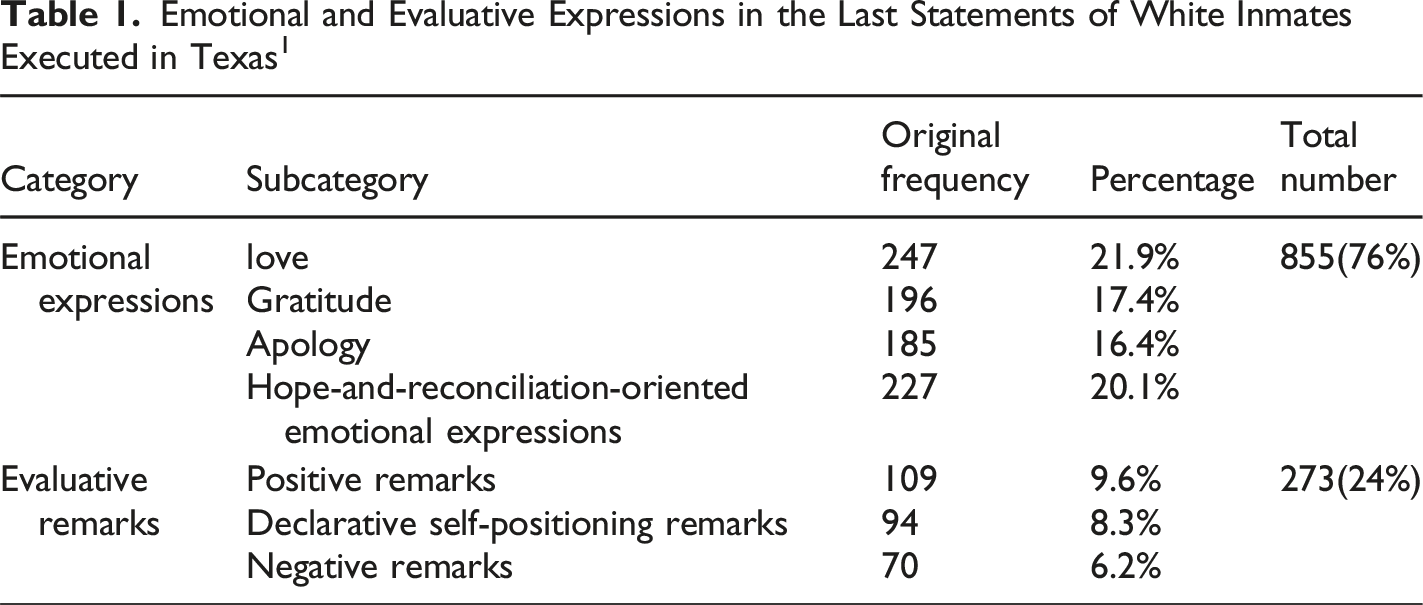
Table 1 summarizes the distribution of emotional expressions and evaluative remarks identified in inmates’ last statements. As shown in it, emotional expressions constitute the majority of communicative content in the last statements of White inmates in the United States, accounting for approximately three-quarters of all identified expressions, while evaluative remarks make up the remaining quarter. Among emotional expressions, references to love, gratitude, and apology are particularly prominent, together comprising more than half of all emotional content.
Regarding evaluative remarks, positive evaluations occur more frequently than negative or declarative self-positioning remarks. Given that scholarship has suggested that interpretations of remorse may vary across social contexts (Bandes, 2016), limiting the present analysis to inmates categorized as White provides a more controlled interpretive frame for examining dominant emotional norms within capital punishment culture.
The data analyzed in this study are drawn from publicly accessible archival records maintained by the Texas Department of Criminal Justice (TDCJ). As the statements were officially published and are part of the public record, the study did not involve interaction with human participants or access to confidential materials. According to institutional guidelines, research based exclusively on publicly available documents does not require formal human subjects review. Nevertheless, given the sensitive nature of capital punishment and the harm experienced by victims and their families, the analysis has been conducted with attention to respectful representation and scholarly responsibility. It is also acknowledged that incarcerated populations include individuals with varying levels of communicative capacity and cognitive functioning. The present analysis focuses on textual patterns rather than inferring stable psychological traits.
Findings and Analysis
Taken together, these patterns suggest that inmates’ final statements appear more frequently oriented toward positive emotional expression and affirmative evaluation than toward hostility or despair. Expressions of connection, appreciation, and moral reflection appear prominently across the corpus, indicating a recurrent relational focus in the face of imminent death.
Analysis of the corpus indicates that religious references, particularly those drawing on Christian language and imagery, appear frequently across the statements and accompany expressions of gratitude, repentance, and relational concern. References to God, Jesus, prayer, forgiveness, and salvation recur across numerous statements, often appearing alongside expressions of gratitude, repentance, and concern for loved ones. These religious references provide a framework through which inmates interpret death, suffering, and moral responsibility at the end of life.
These themes are not exclusive to Christianity, but Christian language appears as the most culturally available idiom within this specific context. Rather than indicating theological uniformity, these references reflect the cultural availability of Christian narratives as a resource for meaning-making at the end of life. Within particular historical and cultural contexts in the United States, Christian narratives have shaped moral discourse surrounding punishment, repentance, forgiveness, and redemption, including debates related to capital punishment. When articulated in last statements, Christian language appears to serve not merely as a declaration of belief, but as a means of coping with imminent death, seeking moral reconciliation, and affirming hope beyond execution.
Two recurrent and dominant forms of expression structure the communicative landscape of the last statements. One involves emotional expressions through which inmates convey feelings such as love, fear, gratitude, or remorse. The other involves evaluative remarks, through which inmates articulate judgments about themselves, others, death, and the justice process. Together, these two dimensions structure how inmates communicate emotional and moral orientations in their final statements.
In the following analysis, this study examines how White inmates articulate emotional and evaluative orientations in their final statements, with particular attention to how these expressions draw upon culturally available Christian-inflected language and moral frames.
Emotional Expressions in Final Statements
Analysis of the last statements reveals that emotional expression constitutes a central feature of inmates’ final communications. In the moments preceding execution, inmates frequently articulate emotions as a way of addressing loved ones, reflecting on relationships, and making sense of impending death. These emotional expressions appear not as isolated utterances, but as meaningful attempts to maintain connection, convey care, and affirm relational bonds at the end of life.
Expressions of Love
Expressions of love emerge as the most prominent emotional feature across the dataset. Nearly all last statements contain at least one reference to love, and many include multiple expressions directed toward different recipients, such as family members, partners, children, or friends. The phrase “I love you” appears repeatedly, often serving as a closing remark or a focal point of the statement.
In the context of imminent execution, expressions of love function as more than simple declarations of affection. They serve to reaffirm enduring relational ties in the face of irreversible separation, shifting attention from the self toward loved ones who will continue living after death. Such expressions also appear to provide comfort, mitigate anticipated grief, and sustain a sense of moral and relational continuity at the end of life. Example (1) I love you Mom and Dad, and all my family. (S: Hopper, G: Male, A:49, C: rape and murder of an employer, I: 13 years)
2
Example (2) In the name of Jesus Christ I love you. (S: Wilkens, G: Male, A:39, C: shooting of an ex-girlfriend’s husband and son, I: 13 years). Example (3) I love all of you very much. I am going to be face to face with Jesus now. (S: Tucker, G: Female, A: 38, C: participation in a home invasion and murder, I: 13 years)
In Example (1), Hopper’s final statement reflects an acute awareness of impending death, accompanied by expressions of fear and emotional vulnerability. In this context, the repeated use of the phrase “I love you” addressed to his parents and family can be understood as an attempt to reaffirm relational bonds at the moment of irreversible separation. Rather than focusing on himself, Hopper’s attention is directed toward those who will continue living after his death, suggesting a shift from self-oriented concern to relational connection.
From an end-of-life perspective, expressions of love may be interpreted as performing a consolatory role within the communicative setting of execution for both the speaker and intended recipients. By articulating love toward family members, Hopper seeks emotional comfort and continuity, reaffirming ties of kinship and care that extend beyond biological death. From an affect-centered perspective, these expressions do not merely signal doctrinal belief but enact a relational orientation toward forgiveness and moral repair under conditions of institutional finality, which often provide a framework for meaning-making at the end of life.
In this sense, Hopper’s statement goes beyond conveying affection to affirm moral identity and relational belonging in the face of death. The expression of love situates the self within enduring social and moral relationships, enabling the speaker to confront death with a sense of connection rather than isolation.
In Example (2), Wilkens invokes Christian language immediately prior to execution. In Example (3), Tucker references imminent union with Jesus. Both inmates explicitly express love in the name of Jesus, drawing upon culturally available Christian language of love and compassion. These expressive acts not only reflect affinity with Christian doctrine but also serve broader communicative purposes, including articulating relational and moral positioning, affirming religious commitment, and expressing hope for divine guidance at the end of life.
From an affective perspective, these expressions do not merely convey affection but enact relational alignment under conditions of institutional finality. Love can be understood as performative orientation toward relational continuity within the highly institutionalized context of execution.
Expressions of Gratitude
Expressions of gratitude constitute another prominent emotional feature in inmates’ final statements, second only to expressions of love. Inmates frequently thank family members, friends, spiritual advisors, or correctional staff for emotional support or assistance during incarceration, often through brief and direct utterances such as “thank you” or “thanks”, typically positioned near the conclusion of the statement.
In the context of imminent execution, expressions of gratitude may be interpreted as acknowledgments of relational support and affirmations of moral and social connectedness at the end of life. By thanking others, inmates symbolically reciprocate the care they have received, reinforcing bonds of appreciation and mutual recognition in a moment defined by loss and finality Example (4) Dear Heavenly Father, I come to you today, Lord, and thank You for this opportunity to be with You in paradise. (S: Mays, G: Male, A: 42, C: murdering two daughters of a neighbor, I: 7 years) Example (5) Thank you, Warden, Thank you Chaplain, Thank you God, I am ready to go. (S: Varga, G: Male, A: 41, C: participation in a robbery-homicide case, I: 10 years) Example (6) Thank you Lord Jesus Christ for coming to my life. (quiet singing) Thank you Lord Jesus for coming into my life, you walked me through prison. Thank you Lord Jesus because you died for me. Thank you Lord Jesus for remembering me... (S: Kelly, G: Male, A: 57, C: participation in a premeditated murder case involving three victims, I: 17 years)
In Examples (4), (5), and (6), the final statements of Mays, Varga, and Kelly include repeated expressions of gratitude directed toward God or Jesus. These utterances, most often realized through phrases such as “thank you”, suggest that religious language provides an interpretive resource through which these inmates articulate their impending execution. Rather than expressing gratitude toward human interlocutors, the speakers orient their final messages toward a divine audience, suggesting a shift in focus from earthly relationships to spiritual meaning at the end of life.
Within a Christian interpretive framework, expressions of gratitude toward God or Jesus are closely linked to themes of repentance, forgiveness, and salvation. When articulated in last statements, such expressions extend beyond appreciation to affirm faith and to seek moral acceptance, spiritual reassurance, and continuity beyond death. Such expressions draw upon Christian narratives of repentance and forgiveness, situating the speaker within a culturally recognizable framework of moral and spiritual meaning.
In Examples (5) and (6), gratitude is articulated through repeated formulations of “thank you”, which intensifies the emotional tone of the statements. This rhetorical repetition underscores the salience of faith at this moment and can be understood as intensifying the discursive salience of faith at the moment of execution.
Expressions of Apology
Expressions of apology constitute a central emotional component of inmates’ final statements. In the context of imminent execution, apologies are commonly directed toward victims’ families, loved ones, or broader social audiences, reflecting acknowledgment of past harm and moral responsibility. Such expressions often co-occur with references to remorse, regret, and self-blame, underscoring the emotional weight of apologetic language at the end of life. In last statements, apologies may extend beyond conventional politeness and be interpreted as morally charged attempts to confront wrongdoing, seek forgiveness, and address unresolved relational or ethical concerns. Inmates’ apologetic expressions may be read as forms of moral positioning, using language to symbolically repair damaged relationships and articulate responsibility in the face of irreversible consequences.
Apologies in the last statements are directed toward a range of audiences, reflecting the relational and moral complexity of inmates’ end-of-life reflections. These apologies must be read within a legal culture that historically equates remorse with moral worth. Many inmates address apologies to victims or victims’ families, expressing remorse and acknowledging the profound harm caused by their actions. Others apologize to their own family members, recognizing the emotional pain, stigma, and disruption their crimes have brought to loved ones. In addition, some apologies are oriented toward God or a broader moral order, situating personal wrongdoing within a religious or spiritual framework at the end of life.
Scholarship in law and emotion has shown that remorse occupies a powerful yet unstable position within criminal justice. Bandes (2016) argues that expressions of remorse are frequently treated as indicators of moral transformation, yet the criteria for evaluating sincerity remain culturally and institutionally mediated. From this perspective, apologetic expressions in last statements cannot be understood solely as spontaneous emotional reactions; they also operate within a broader legal and moral framework that historically associates remorse with redemption and deservingness.
From an affective analytical perspective, apologetic expressions in last statements can be understood not only as linguistic admissions but as attempts to position the self within a moral-affective field. Even in the absence of embodied courtroom interaction, these utterances attempt to produce an affective orientation toward victims, families, and imagined audiences.
Taken together, these apologetic expressions suggest that apologies serve multiple, interrelated purposes when individuals confront imminent death. Through apologizing, inmates engage in moral self-reflection and may contribute to the discursive construction of accountability, articulating a self that remains accountable and potentially forgivable. Apologies also function as a form of emotional release, allowing speakers to articulate responsibility and regret before death, and, when framed in religious terms, as appeals for divine mercy and spiritual reconciliation. In Goffman’s (1959) terms, these utterances can be understood as remedial performances enacted under conditions of intensified moral exposure, where the condemned individual speaks before real and imagined audiences at the threshold of death.
At the same time, apologetic expressions contribute to the presentation of a morally responsible self and the construction of a final moral impression at the end of life. The repetition of phrases in some last statements intensifies the emotional force of the apology, underscoring the depth of remorse expressed under the extreme pressure of imminent execution. Prior research on death row apologies suggests that expressions of remorse immediately before execution may be shaped by temporal constraints and relational expectations (Eaton, 2022). Overall, apologetic expressions in execution statements extend beyond simple regret. They represent emotionally and morally charged efforts to confront wrongdoing, regulate overwhelming emotions, and articulate responsibility in the face of death. Through apologizing, inmates engage in a form of moral reckoning, using language to negotiate accountability, seek reconciliation, and shape how they are remembered at the end of life. Example (7) In the name of Jesus, I am sorry for the pain I caused you all. I am sorry. Gilbert didn't deserve to die and I want you all to know I am sorry. (S: Zimmerman, G: Male, A: 42, C: involvement in a fatal stabbing case, I: 13 years) Example (8) I am here because I took a life and killing is wrong by an individual and by the state, and I am sorry we are here but if my death gives you peace and closure then this is all worthwhile. (S: Herman, G: Male, A: 39, C: robbery, harassment, and shooting of a hostess at an entertainment venue, I: 6 years)
Christian beliefs commonly emphasize repentance, confession, and forgiveness as central pathways for addressing moral wrongdoing. Within this broader moral and religious framework, apologies articulated at the end of life often draw on Christian language as a resource for meaning-making rather than as formal theological declarations.
In Example (7), Kevin explicitly frames his apology “in the name of Jesus”, directing it toward those he acknowledges having harmed. This religious framing suggests an effort to situate personal wrongdoing within a Christian moral horizon, where remorse and forgiveness are understood as interconnected. Rather than merely expressing regret, Kevin’s apology situates the apology within a Christian moral vocabulary that links wrongdoing with forgiveness.
In this context, apologizing appears to function as a way of addressing both emotional distress and moral accountability. By invoking Christian language, Kevin draws on familiar religious themes of repentance and forgiveness to cope with shame, seek reconciliation, and articulate a final moral self-presentation at the end of life.
Similarly, in Example (8), Herman explicitly apologizes for his past actions and acknowledges the harm he has caused. In his final statement, he expresses acceptance of his execution, stating that if his death can bring peace to the victim’s family, he is willing to accept this outcome. This formulation shifts the focus from self-defense or self-pity to the suffering of others, foregrounding responsibility and concern for those affected by his actions.
In the context of imminent execution, such expressions can be understood as an attempt to confront wrongdoing and to articulate moral accountability at the end of life. By linking his apology to the hope of peace for the victim’s family, Herman frames his death in relational terms, linking it to the hoped-for peace of the victim’s family, articulating a gesture toward reconciliation in the face of death. From this perspective, apology operates not only as admission but as affective positioning, through which inmates negotiate responsibility within a moral field structured by legal authority and anticipated judgment.
Hope-And-Reconciliation-Oriented Emotional Expressions
In addition to expressions of love, gratitude, and apology, inmates’ final statements also include a range of other emotionally charged utterances, such as references to last wishes, preparations for execution, and farewells. These expressions reflect inmates’ continued engagement with life, relationships, and anticipated consequences even as they confront imminent death.
Among these, statements containing expressions of hope are particularly noteworthy. Phrases such as “I hope” are often used to articulate wishes for the well-being of others, peace for victims’ families, or spiritual reassurance beyond death. In the context of execution, such expressions highlight how inmates project concern, meaning, and aspiration into a future beyond their own lifespan, underscoring the complex emotional orientation toward both life and death at the end of life. Example (9) And I regret what happened and I want you to know that I’m sorry. I just ask and hope that sometime down the line that you can forgive me. (S: Corwin, G: Male, A: 40, C: perpetrator of three serial rape-murder cases, I: 8 years) Example (10) I want everybody to know that I hold nothing against them. I forgive them all. I hope everybody I’ve done anything to will forgive me. I’ve been praying all day for Carl Levin’s wife to drive the bitterness from her heart because that bitterness that’s in her heart will send her to Hell just as surely as any other sin. (S: Barefoot, G: Male, A: 39, C: rape of a young girl and shooting of a police officer, I: 6 years) Example (11) I hope that someday this absurdity that humanity has come to will come to and an end. Life is too short. I hope that anyone that has negative energy towards me will resolve that. Life is too short to harbor feelings of hatred and anger. (S: Cobb, G: Male, A: 29, C: participation in a case involving the shooting of a man and the rape-murder of a woman, I: 9 years) In Example (9), Corwin reflects on the imminence of his execution and explicitly acknowledges both his wrongdoing and the harm it has caused. His final statement combines expressions of regret and apology with an articulated hope for forgiveness. By voicing this hope, Corwin shifts attention away from his own fate and toward the possibility of reconciliation, framing forgiveness as a possible response to wrongdoing at the end of life.
A similar orientation appears in Example (10). Barefoot invokes forgiveness and expresses hope for reconciliation in relation to those affected by his crimes. While the structure of his statement is lexically measured, the theological warning directed toward the victim’s family introduces a morally charged dimension. The juxtaposition of forgiveness and spiritual admonition produces an affective ambivalence, positioning the speaker in a manner that appears both conciliatory and judgment-inflected. This oscillation between reconciliation and moral positioning complicates any singular reading of the statement’s tone and underscores the layered character of emotional expression at the moment of execution.
While the theological language appears controlled in structure, the invocation of damnation introduces a morally charged orientation. As Rossmanith (2015) argues, remorse and moral positioning in legal contexts often operate through affective intensities rather than explicit semantic claims. Similarly, Bandes (2016) notes that assessments of remorse frequently rely on perceived demeanor and affective presentation rather than propositional content alone. In this light, Barefoot’s statement, while invoking forgiveness, may be heard as conveying moral condemnation. This ambivalence illustrates how affective expression in execution contexts may blend reconciliation with moral positioning in ways that resist simple classification, thereby complicating straightforward categorization.
In Example (11), Cobb’s final statement also centers on hope, but with a broader social orientation. By describing human hostility as “absurdity,” he frames conflict in generalized terms and expresses a desire for the resolution of hatred directed toward him. This formulation may be read both as an appeal for reconciliation and as a reframing of hostility that may shift attention away from the specificity of victims’ suffering. The statement thus performs a complex affective positioning between self-reflection, social commentary, and moral distancing.
Across these examples, expressions of hope for forgiveness are embedded within inmates’ reflections on death, responsibility, and relational repair. Rather than asserting entitlement to forgiveness, speakers articulate hope in cautious and reflective terms, acknowledging uncertainty while nonetheless seeking moral and emotional resolution in the face of imminent execution.
Taken together, these patterns indicate that final statements frequently foreground relational and moral themes in proximity to execution. Rather than being dominated by anger or hostility, final statements are characterized by emotionally oriented expressions, particularly love, gratitude, and apology, through which inmates articulate concern for others, acknowledge past harm, and pursue emotional and moral reconciliation. These expressions may be interpreted as emphasizing relational and ethical engagement, often drawing on familiar cultural and religious frames to make sense of death, responsibility, and reconciliation.
While Christian-inflected language is prominent in many statements, not all inmates frame their reflections in explicitly religious terms. These expressions resonate with a broader moral imagination shaped by Christian-inflected penal culture in the United States, without implying theological homogeneity among inmates. They can be understood in light of a meaning reconstruction perspective, which suggests that individuals facing profound loss or imminent death actively seek to reaffirm or reconfigure sources of meaning, identity, and relational connection (Neimeyer, 2016). From this perspective, emotional expressions in last statements need not be understood as spontaneous reactions, but part of a broader process through which inmates interpret mortality, responsibility, and the possibility of reconciliation at the end of life.
Evaluative Remarks
In their final statements, inmates not only express emotions but also offer evaluative remarks about people, experiences, and beliefs that have shaped their lives. These remarks offer insight into how individuals facing execution articulate relationships, assess the past, and make sense of moral or spiritual values at the end of life. Rather than abstract judgments, such evaluations are embedded in personal reflection and closely intertwined with emotional and relational concerns.
Evaluative remarks include not only explicitly valenced judgments (positive or negative) but also declarative self-positioning statements, in which speakers articulate identity claims or reinterpretations of responsibility without overt affective intensification. For clarity, these are descriptively labeled as positive and negative remarks.
Positive Remarks
Positive remarks constitute the most prominent form of evaluation in the last statements. These remarks typically express appreciation, affirmation, or admiration, and are most frequently directed toward family members, close friends, and religious figures such as God. Through such remarks, inmates acknowledge emotional support, affirm meaningful relationships, and highlight sources of comfort or guidance that remain significant at the end of life.
In praising family and loved ones, inmates often emphasize care, loyalty, and enduring bonds, underscoring the centrality of interpersonal relationships even in the face of execution. Positive remarks directed toward God or religious belief similarly reflect reliance on faith as a source of reassurance, moral grounding, or hope beyond death. In this way, positive evaluations may be understood as articulations of gratitude, attachment, and affirmation that help inmates articulate meaning and connection at the end of life. Example (12) No man in this world has had a better family than me. I had the best parents in the world. I had the best brothers and sisters in the world. I've had the most wonderful life any man could have ever had. (S: Beathard, G: Male, A: 42, C: participation in a case where a friend murdered family members, I: 14 years) Example (13) Our god is an awesome God. Lord, I lift your name on high. (S: Ries, G: Male, A: 29, C: participation in a home-invasion robbery-homicide case, I: 9 years)
Positive remarks in the final statements rarely address death directly; instead, they reveal how inmates reflect on life, relationships, and sources of meaning as execution approaches. Such remarks often convey a tone of acceptance and affirmation, suggesting an effort to focus on valued connections rather than on the punitive nature of the moment.
In Example (12), Beathard describes his parents and siblings using strongly affirmative language, referring to them as “the best,” and characterizes his past life as “the most wonderful.” These expressions foreground familial bonds and positive memories, foregrounding love and appreciation in proximity to execution. By emphasizing the goodness of his family and life experiences, Beathard affirms relational attachment and emotional connection, without referencing the violent circumstances associated with his conviction.
In Example (13), Ries directs positive evaluation toward God, describing God as “awesome.” This expression of praise highlights the central role of faith in his final reflections and draws upon religious language as a source of reassurance and meaning at the end of life. Rather than reflecting doctrinal conformity, such positive remarks can be understood as personal affirmations of faith, through which inmates articulate hope, attachment, and emotional orientation beyond the immediacy of execution.
A small number of final statements address death itself in explicitly positive terms, portraying execution as a form of release from suffering rather than as a purely punitive event. Example (14) Today is a day of joy. Today is the day I’ll be set free from all this pain and suffering. Today I’m going home to HEAVEN to live for all eternity with my HEAVENLY FATHER JESUS CHRIST. (S: Belyeu, G: Male, A: 38, C: robbery and related offenses, I: 11 years)
In Example (14), Belyeu refers to his impending execution in explicitly positive terms, describing the day of his death as “a day of joy,” “the day I’ll be set free,” and “going home to heaven to live for all eternity.” Through this language, death is portrayed not as a source of fear, but as an anticipated release from prolonged suffering and confinement.
By characterizing execution as freedom and homecoming, Belyeu reframes death as a transition rather than an end, drawing on religious imagery to articulate hope, relief, and continuity beyond earthly life. Such remarks may be interpreted as positioning execution within a narrative of spiritual continuity, emphasizing relief and transcendence within a religiously inflected vocabulary.
Declarative Self-Positioning Remarks
In addition to positive and negative evaluations, some final statements contain declarative self-positioning remarks that are not overtly marked by strong affective language. These remarks are less overtly marked by emotional intensity and instead take the form of assertions of identity, responsibility, or interpretation, adopting a restrained and matter-of-fact tone.
In the context of imminent execution, such declarative self-positioning remarks may be read as forms of emotional distancing, allowing speakers to assert identity claims without intensifying affect. This mode of expression may be interpreted as adopting a restrained stance toward responsibility and judgment, through which speakers navigate the tension between personal responsibility and the finality of judicial punishment at the end of life. Example (15) I have been in prison 8½ years and on Death Row for 7, and I have not gotten into any trouble. I feel like I am not a threat to society any more. (S: Green, G: Male, A: 36, C: castrating and killing a man, I: 7 years) Example (16) I am innocent of this crime and God knows I am innocent and the four people that was murdered know I am innocent. (S: Joiner, G: Male, A: 50, C: rape-murder of a neighbor, I: 12 years) Example (17) I did not deliberately shoot James Mitchell. (S: Hafdahl, Sr, G: Male, A: 48, C: participation in a case involving the shooting of a police officer, I: 16 years)
In several cases, declarative self-positioning remarks appear in final statements as restrained self-descriptions that do not uniformly align with the judicial characterization of responsibility. These remarks often emphasize personal character, contested interpretations of events, or perceived changes over time, adopting a relatively measured and descriptive tone.
In Example (15), Green describes himself as “not a threat to society,” articulating an identity framed in terms of reform and personal change. Rather than directly challenging the sentence, this statement highlights how he wishes to be understood at the end of life, foregrounding a sense of self that contrasts with the image implied by execution.
In Example (16), Joiner repeatedly refers to himself as “innocent,” emphasizing this claim multiple times in his final statement. The repetition underscores the importance of this self-characterization and constructs a moral identity that diverges from the outcome of the judicial process. By asserting innocence without extended elaboration, Joiner adopts a restrained declarative tone while clearly asserting an alternative moral identity that diverges from the judicial verdict, situating his self-understanding alongside, but not fully reconciled with, the verdict he faces. Although not accompanied by overt affective intensification, the repeated assertion of innocence constitutes a clear counter-position to the judicial verdict.
Similarly, in Example (17), Hafdahl Sr. offers a restrained account of his actions by qualifying the intentionality attributed to him. Through this partial reframing of responsibility, he positions himself in relation to, rather than fully aligning with the legal characterization of the offense, thereby potentially moderating the moral weight attributed by the judicial narrative without explicitly mounting a direct challenge to the sentence.
Taken together, these declarative self-positioning remarks can be understood as contributing to the discursive construction of a coherent self under conditions of imminent death. By presenting moderated self-evaluations and alternative interpretations of past actions, these statements illustrate the tension between personal identity and judicial judgment, setting the stage for more explicitly critical or negative remarks that follow. These declarative forms demonstrate that affect need not be overtly emotive to be operative. Even restrained assertions can operate as forms of affectively charged acts of moral positioning within a highly evaluative institutional context.
Negative Remarks
Negative remarks appear in a smaller number of final statements and are typically marked by expressions of dissatisfaction, regret, or criticism. These remarks often address either the speaker’s own past actions or aspects of the legal process surrounding punishment and execution. In contrast to positive, declarative self-positioning, negative remarks foreground tension, conflict, and unresolved moral judgment at the end of life.
Some are directed inward, focusing on self-criticism and acknowledgment of wrongdoing. In these cases, inmates express regret, shame, or remorse regarding their past behavior, often framing themselves as deserving of punishment. Such remarks articulate responsibility and can be read as engaging with moral failure in the face of death. Others are oriented outward, expressing dissatisfaction or criticism toward elements of the judicial process, punishment, or law enforcement. Rather than functioning as comprehensive legal challenges, these statements often articulate frustration, perceived injustice, or emotional distress associated with incarceration and execution. Through such remarks, inmates voice tension between personal experience and institutional authority, illustrating how punishment is discursively interpreted and emotionally negotiated at the end of life. Example (18) I am the sinner of all sinners. I was responsible for the ’75 and ’79 cases. My trial was not just; it was not fair; they lied against me. (S: Duff-Smith, G: Male, A: 46, C: contracting a killer to murder his foster mother and his sister’s family, I: 11 years) Example (19) Not one of my sell out lawyers would use this evidence, because they all work as a conspiracy with the court. (S: Mason, G: Male, A: 48, C: shooting of his mother-in-law, I: 8 years)
In Example (18), Duff-Smith’s final statement combines self-directed condemnation with criticism of the judicial process, revealing the coexistence of moral accountability and unresolved conflict at the end of life. On the one hand, he openly characterizes himself as “the sinner of all sinners,” assuming responsibility for two criminal cases and offering a harsh moral assessment of his past actions. This language articulates strong self-condemnation and resonates with Christian moral themes of sin and repentance, situating wrongdoing within a Christian-inflected vocabulary of sin in the face of death.
At the same time, Duff-Smith’s statement also includes explicit criticism of the trial process. By asserting that the “trial was not just” and that “they lied against me,” he challenges the fairness of judicial judgment and implies dissatisfaction with the fairness of judicial judgment. These remarks convey frustration and emotional resistance to execution, indicating unresolved tension and dissatisfaction with institutional authority. Together, the juxtaposition of self-condemnation and judicial criticism illustrates the complex and sometimes contradictory ways inmates negotiate responsibility, survival, and moral meaning in their final moments.
A similar pattern appears in Example (19). In Mason’s case, the factual circumstances of the crime remain uncertain, yet his final statement centers on perceived injustice within the legal process. Mason directs negative evaluation toward judicial personnel, claiming that his lawyer “worked as a conspiracy with the court”. Such remarks express distrust and resentment toward legal authority and suggest dissatisfaction associated with perceived procedural unfairness. Rather than constituting a systematic legal argument, these statements can be understood as expressions of resistance articulated at a moment of institutional finality as inmates confront the finality of execution.
From an affective perspective, negative remarks directed at the self and at judicial institutions reveal how inmates oscillate between accepting moral responsibility and contesting the legitimacy of punishment. These expressions underscore the emotional complexity of last statements, in which acceptance, resistance, and moral questioning coexist under the extreme pressure of imminent death. Example (20) If my words can persuade you to discontinue this practice of executing people, please do so. If the citizens don’t do away with the death penalty, Texas won’t be a safe place to be. I have no revenge because hate won’t solve anything. (S: Kinnamon, G: Male, A: 53, C: fatally shooting a man while intoxicated, I: 9 years) Example (21) The death penalty is an unnecessary punishment for society who has other means to protect itself. (S: Gribble, G: Male, A: 36, C: rape and strangulation of a woman, I: 11 years)
In Example (20), Kinnamon directs his negative evaluation toward the death penalty itself, describing it as fundamentally wrong and warning that, if it is not abolished, “Texas won’t be a safe place to be.” Rather than focusing on personal guilt or responsibility, his remarks shift attention to the broader moral implications of capital punishment. By framing execution as a social and ethical threat, Kinnamon articulates opposition to the death penalty as an institution, expressing resentment and distress associated with the place and system responsible for his impending execution.
Similarly, in Example (21), Gribble characterizes capital punishment as “an unnecessary punishment,” explicitly questioning its legitimacy. This statement conveys dissatisfaction with the rationale underlying execution and reflects emotional resistance to the finality of death. Rather than advancing a structured political or legal argument, Gribble’s remark functions as an expression of moral objection and personal distress, voiced at a moment when opportunities for appeal or survival have been exhausted.
In both cases, negative remarks directed at the death penalty reveal how inmates facing execution engage with punishment at a systemic level. These statements reflect not only opposition to capital punishment but also broader emotional responses to impending death, including resentment, fear, and the desire to assert moral meaning in circumstances marked by powerlessness and finality.
Overall, positive, declarative self-positioning, and negative remarks in inmates’ final statements vary in orientation but converge around shared concerns with moral responsibility, relational meaning, and ethical evaluation at the end of life. Closely intertwined with emotional expressions, these evaluative remarks form a coherent pattern through which inmates reflect on wrongdoing, relationships, faith, and punishment as execution approaches.
While many inmates acknowledge past harm, express remorse, and emphasize gratitude or religious reliance, others articulate ambivalence or dissatisfaction with aspects of the judicial process, including the fairness of trials or the legitimacy of capital punishment. Together, these patterns underscore the complexity of end-of-life reflection, in which acceptance, repentance, resistance, and moral questioning coexist under the pressure of imminent death. By foregrounding affective positioning rather than solely propositional meaning, this study suggests that end-of-life communication in institutional settings cannot be reduced to verbal content alone. Even within the procedural rigidity of execution, inmates’ speech reveals a layered negotiation of identity, responsibility, and relational belonging. This insight extends death and dying scholarship by demonstrating that state-administered death remains deeply embedded in emotional and moral meaning-making.
Conclusion
Criminological scholarship has increasingly emphasized that emotions are not peripheral to criminal justice but embedded in its moral culture. Karstedt (2002) argues that penal systems are shaped by collective emotions such as shame, anger, and moral indignation. If emotions in criminal justice are not primordial moral instincts but socially embedded indicators of shared values (Karstedt, 2002), then the last statements of death row inmates provide insight into the moral-emotional framework within which capital punishment is enacted and remembered.
Viewed in this light, execution is not only a legal sanction but also an emotionally charged ritual in which the condemned individual’s final speech becomes part of a broader affective economy. Rather than seeking to resolve the enduring moral controversy surrounding capital punishment, this study illuminates how individuals confront and narrate mortality within its institutional frame. Quantitative analysis shows that emotional expressions occur far more frequently than evaluative remarks in the last statements of White inmates executed in Texas, with expressives appearing at roughly three times the rate of remarks. This pattern underscores the centrality of emotion at the end of life and lends partial support to existential perspectives that emphasize affective experience as fundamental to human existence.
Qualitatively, inmates’ final statements frequently articulate themes of vulnerability and relational concern, and a strong orientation toward connection and reconciliation. These expressions illuminate how individuals facing execution grapple with moral responsibility, relational repair, and the search for meaning. Although emotion is often framed as a source of criminality in legal discourse, the findings also suggest that emotional language may accompany reflection, remorse, and ethical self-assessment in moments of extreme finality. In a contemporary context increasingly shaped by technological rationalization, these findings underscore the enduring significance of human emotion in shaping judgment, behavior, and moral experience. Even within highly institutionalized systems of punishment, affective life remains central to how individuals understand themselves and others.
By systematically examining prisoners’ last statements, this study addresses a notable gap in legal and institutional discourse research, offering insight into the emotional and evaluative dimensions of end-of-life communication among White inmates executed in Texas. As Karstedt (2002) argues, penal laws are embedded in emotional culture. Adopting an affect-oriented analytical perspective, the study demonstrates how expressions of love, gratitude, and apology convey moral reflection, relational concern, and reliance on religious belief as inmates confront execution.
Beyond its theoretical contribution, the study also has practical implications. Understanding how emotional expression interacts with religious belief and cultural context in inmates’ final statements may inform more sensitive approaches to psychological support, pastoral care, and rehabilitative practice within correctional settings, highlighting the importance of emotional and moral experience alongside legal judgment in discussions of capital punishment. If remorse in legal settings is often recognized through embodied affect (Rossmanith, 2015), then the archived textual traces of execution statements represent a mediated and institutionalized form of that affective encounter.
It is important to underscore that the findings of this study are historically and culturally situated. The last statements analyzed here were produced within a specific socio-legal context, namely, the administration of capital punishment in Texas, United States, between 1984 and 2021. The emotional and moral patterns identified in this corpus reflect not only individual expression but also the broader penal culture, religious landscape, and institutional norms that structure execution practices in this setting. In particular, the prominence of Christian-inflected language should be understood within the historical entanglement of American penal discourse and Protestant moral frameworks, rather than as a universal feature of end-of-life communication.
Accordingly, the findings should not be generalized beyond this specific cultural and institutional configuration. Jurisdictions without capital punishment, or those shaped by different religious, legal, and historical traditions, may exhibit distinct emotional repertoires and moral narratives at the end of life. The present analysis therefore offers insight into a historically contingent form of institutionalized dying, while inviting further comparative research across diverse penal and cultural contexts.
At the same time, by situating execution within the broader field of end-of-life communication, this study extends death and dying scholarship beyond medicalized or familial settings to include state-administered death. It demonstrates that even under conditions of institutional finality, individuals continue to engage in processes of meaning-making, relational repair, and moral positioning. In this sense, the emotional culture of capital punishment exceeds its juridical function, illuminating more fundamental questions about how human beings orient themselves toward mortality, responsibility, and relational belonging within structures of institutional power.
Footnotes

Funding
The authors disclosed receipt of the following financial support for the research, authorship, and/or publication of this article: This work was supported by the Humanities and Social Science Fund of Ministry of Education of China: “A Comparative Study of Sino-US Metapragmatic Stances in National Discourses (2013-2023)” (23YJC740099).
Declaration of conflicting interests
The authors declared no potential conflicts of interest with respect to the research, authorship, and/or publication of this article.