







Abstract
Carceral settings prevent individuals from engaging in supportive grief processing and contribute to compounded and disenfranchised grief. This is particularly relevant for individuals sentenced to life or long prison sentences during childhood. Relying on qualitative interviews, this study explored death-related loss and grief experiences, before, during, and after incarceration, within a sample of 46 individuals resentenced and released from prison following a long sentence in their youth. Study findings emphasized the lack of grief spaces in carceral settings, often prompting deferred grief. Grief deferred until post-release addressed death losses that began accumulating prior to incarceration and were further compounded by losses that occurred during incarceration. Grief processing was further obstructed during incarceration through delayed death notifications, barriers to death rituals, and dehumanizing expectations for funeral attendance in shackles and/or a jumpsuit. Findings highlight the need for humane policies establishing carceral grief spaces and support for incarcerated grievers.
Introduction
With a total of 1.8 million prisoners, the U.S. has the largest incarcerated population in the world (Fair & Walmsley, 2024). There is an overrepresentation of mental illness within U.S. carceral populations (Canada et al., 2022). Given this and the potential increased risk of clinical depression, suicidality, anxiety, substance abuse, self-harm, and post-traumatic stress disorder when faced with bereavement (Fahmy et al., 2024), experiencing the death of a loved one while incarcerated can be severely detrimental to the health and well-being of bereaved carceral populations.
Incarceration often obstructs those both inside and outside carceral settings from engaging in shared experiences that support psychosocial well-being. Such disenfranchisement, particularly related to death losses, is likely compounded for those serving long sentences. Disenfranchised grief is considered “grief that persons experience when they incur a loss that is not or cannot be openly acknowledged, publicly mourned, or socially supported” (Doka, 1989, p. 4). For individuals who entered into a carceral setting at a young age to serve long sentences, these compounded experiences of disenfranchised grief can have a lasting impact on people’s psychosocial well-being, namely grief adjustment, long after they are released. The United States is the only country in the world that sentences children to die in prison. Given the tens of thousands of people who have spent decades in prison starting in childhood, and the nearly 1,300 who have come home from those sentences (Campaign for the Fair Sentencing of Youth, 2026), a focused exploration of death losses and grief experiences among this population is warranted.
Literature Review
Dual Process Model
The Dual Process Model of Coping with Bereavement (DPM; Stroebe & Schut, 2010) offers a grief framework that details how individuals cope with the loss of a loved one. The DPM identifies that grief requires both confrontation and avoidance as a means of emotional regulation when coping with a significant loss. Key components of the DPM include loss-orientation, restoration-orientation, and oscillation (Stroebe & Schut, 2010). Loss-orientation addresses the needed focus on aspects of the loss itself; we often think of this as “grief work.” Conversely, restoration-orientation focuses on the consequences of the loss that do not address the loss itself, such as adjusting to life changes or engaging in new activities. Oscillation is the regulation that occurs post-loss that enables health adaptation. This entails continuously moving back and forth between loss- and restoration-oriented concerns (Stroebe & Schut, 2010). Too great a focus on either component can lead to poor grief outcomes. A lack of attention towards restoration, with extensive focus on loss, creates potential for chronic grief (Wilson, 2023). Alternatively, an excessive focus on restoration with too little attention given to loss can result in absent or blocked grief (Wilson, 2023). Although it is an irregularity, poor grief outcomes can reach the point of clinical intervention through a diagnosis of Prolonged Grief Disorder (PGD) when grief is identified as persistent and disabling (Burke & Neimeyer, 2013; Eisma et al., 2020). As incarcerated populations have limited opportunity to focus on loss-oriented concerns, the potential for poor grief outcomes, including depression and PGD, is alarming (Fahmy et al., 2024; Wilson, 2023).
Disenfranchised Grief
Concerns of poor grief outcomes among incarcerated individuals increase when considering the prevalence of disenfranchised grief in the population. When grief is disenfranchised, individuals may not have access to the sources of support they might otherwise expect to rely upon in the face of a loss, which can contribute to poor grief adjustment (Corr, 1999). For incarcerated individuals, this is especially relevant as simply being within a carceral setting creates disenfranchisement for grievers (Wilson et al., 2020). As a result, incarcerated individuals are at greater risk for complicated grief reactions and PGD (Fahmy et al., 2024; Wilson et al., 2020).
Social Support and Grief
Social support is known to support health and well-being across a range of indicators, including grief indicators (Cacciatore et al., 2021). Particularly, social support can enable proactive coping with grief, may buffer from psychological distress that results from a loss, and reduce the severity of depression symptoms (Cacciatore et al., 2021; Scott et al., 2020). This relationship holds true within carceral populations, as research demonstrates that positive family ties and social capital, such as a spouse or employment, can improve mental health for incarcerated individuals (Fahmy et al., 2024). However, individuals from lower socioeconomic backgrounds or those entering carceral settings at young ages may be at a disadvantage and unable to access the same benefits of social support (Fahmy et al., 2024; Vaswani, 2018). One UK-based study of young men, aged 16-20, identified that the shame and stigma of incarceration challenged and disrupted relationships, with some participants being altogether rejected by their family (Vaswani, 2015). The separation from friends, family, and social supports that occurs during incarceration may interfere with the positive relationship between social support and grief outcomes, and heighten the risk for bereavement-related depression, a symptom of PGD, among incarcerated individuals (Burke & Neimeyer, 2013; Fahmy et al., 2024).
Grief in Prison Populations
Multiple studies have contributed substantially to the body of literature examining grief experiences within incarcerated populations (Hunt, 2021; Vaswani, 2014; Ward & Dewey, 2024; Wilson et al., 2020). Hunt (2021) examined disenfranchised grief within prison using a sample of 21 bereavement, religious, and criminal justice professionals in the UK. The study emphasized the many losses that incarcerated individuals face and noted the ways in which prison protocols often prevented ritual action considered supportive for grieving. Hunt (2021) highlights that these barriers to healthy grief have implications for successful community reintegration and ongoing offending behaviors.
Relying on a sample of bereaved prisoners and staff members in a UK-based male prison, Wilson et al. (2020) explored the concept of institutional thoughtlessness and the resulting effect on bereaved prisoners. The study identified that institutional thoughtlessness, acts of omission that arise from institutional procedures, can “enable and disable the course of grief experienced in prison” (Wilson et al., 2020, p. 165). An unintended consequence of many policies and procedures within prisons is that grief is blocked or delayed for bereaved prisoners.
Ward and Dewey (2024) introduced the concept of incarceration-related cumulative grief in their U.S. study of 74 paroled individuals. Though this study did not address death losses, the attention on the cumulative effect of losses within incarcerated populations is noteworthy. The study highlighted the many non-death losses that are grieved among carceral populations. The types of losses identified included positive losses, like detrimental behaviors and relationships, negative losses, such as freedom or supportive relationships, and transformative losses, which encompassed improvements in relationships, self-worth, and advocacy skills.
Drawing on data from a UK-based study of young men, Vaswani (2014) explored bereavement experiences within a sample of 33 young men between the ages of 17 and 20 sentenced to a Youth Offenders Institution. The study identified the tension of funeral attendance within the sample as participants identified funerals as a socially acceptable setting to express grief in a way they are not able to in prison, yet they also noted that attending a funeral in handcuffs was both embarrassing and disrespectful to the deceased and their family. While participants could attend funerals for immediate family, participants noted their inability to attend funerals for extended family networks or less formal death rituals, such as activities of remembrance on death anniversaries.
Collectively, these studies create a foundation for grief-related research within carceral populations (Hunt, 2021; Vaswani, 2014; Ward & Dewey, 2024; Wilson, 2023; Wilson et al., 2020). These studies identify that grief within prison is disenfranchised and cumulative (Hunt, 2021; Ward & Dewey, 2024), and institutional policies and procedures can lead to delayed or blocked grief (Wilson et al., 2020). Amongst these policies are those relevant to attending and participating in death rituals, such as funerals (Vaswani, 2014). Missing from these studies is a focus on the unique population of individuals incarcerated at young ages and sentenced to serve life or long sentences within adult prison populations. Given the complexities of becoming incarcerated at such a young age and growing into adulthood within such a restrictive environment (Bennett et al., 2024), research is needed to understand grief experiences within this population, particularly with a focus on the accumulation of death losses prior to, throughout, and following incarceration.
Study Purpose
Guided by the Dual Process Model of Coping with Bereavement and an understanding of disenfranchised grief, this study explored the cumulative death-loss and grief experiences of people released after being sentenced to life or long prison sentences when they were children. The study examined death loss experiences beginning prior to incarceration, throughout incarceration, and following release. This study acknowledges the substantial impact of non-death losses. However, given the prevalence of loss experiences within this population and the range of time (i.e., pre to post incarceration) addressed in this study, death losses were the central focus of this study to enable a deeper exploration.
Method
As part of a cross-sectional study, one-time semi-structured interviews were conducted with people home after being resentenced from life or long prison sentences starting in childhood (N = 46). Participants were recruited in partnership with the Campaign for the Fair Sentencing of Youth (CFSY), a national organization advocating for the end of extreme sentences for children. CFSY had contact information for 218 of the more than 900 people who had returned from a life or long sentence as of May 2022, which they shared with the first author. Potential participants were contacted through CFSY’s network via email. Participants had to meet the following study inclusion criteria: have been incarcerated for at least 10 consecutive years starting when they were 17 or younger; not be incarcerated or residing in a halfway house at the time of the study; and have a valid email address.
Participants who completed a quantitative survey (N = 78) could opt into the qualitative interview portion of the study (N = 46). Qualitative interview participants received a $50 electronic Tango gift card in addition to the $25 electronic Tango gift card given to quantitative survey participants. Qualitative study participants received a consent form via email prior to the interview and gave verbal consent to the first author, who was the sole interviewer. Lasting an average of 90 minutes (SD = 22), interviews were conducted via Zoom, recorded, and transcribed verbatim. Field notes and memos were written during and following interviews. Participants chose their own pseudonyms to ensure confidentiality. In order to provide an additional level of confidentiality, participants were given the opportunity to review the transcript after their interview, during which point they could choose to delete, edit, or clarify any part. None of the participants opted to do so. University of Maryland Baltimore Institutional Review Board approval was received.
Qualitative study participants were incarcerated in one of 18 US states or Washington, DC. They had been out of prison for an average of 37 months (SD = 34), though some participants had been released as recently as one month prior or as much as 192 months (16 years) prior. Of qualitative participants, 39 (84.8%) identified as men, 7 (15.2%) identified as women. Almost three-fifths (58.7%) identified as Black and a quarter (26.1%) identified as White.
The qualitative component of the study utilized a semi-structured interview guide to delve into the role of relationships for people released from prison following life and long sentences that began during childhood. Interview questions were open-ended, and participants shared what they found most important. The first author adapted and refined the interview guide as interviews progressed, developing preliminary themes through a constant comparative method (Glaser, 1965) and based on integrating insights from the ongoing analysis of quantitative data. Member checking was done with people who served life or long sentences starting in childhood and others who have worked with this population during the data analysis, data merging, and result interpretation stages.
Using NVivo, we conducted a largely inductive thematic analysis, combining open, selected, and axial coding. The first author identified codes that arose from the interviews, which included the theme grief and loss. Although this was not the focus of the study, the first author was struck by how often participants brought up loss and grief experiences, leading to the author’s creation of a grief and loss code report. Using the grief and loss code report that the first author had created from all interview data, the first and second author used thematic analysis to further examine themes. Thematic analysis, which aims to identify patterns and themes, was done using Braun and Clarke’s (2021) process. The phases in their process include familiarizing oneself with the data, generating codes, searching for themes, reviewing themes, defining themes, and writing up findings, with prior phases revisited as needed (Braun & Clarke, 2021). The first and second author generated codes separately, met to discuss and define those themes, then returned to the code report to conduct another round of coding. This process was done repeatedly, with frequent and lengthy meetings used to refine themes, return to the original transcripts and recording to ensure interpretations aligned with participant accounts, and consider our own biases, training, and experiences.
Positionality Statement
The first author is a social work professor with substantial qualitative research experience. Prior to her PhD, the first author worked extensively in different capacities with individuals involved with carceral systems. Her experience includes leading a reentry program; collaborating with agencies that support individuals returning from juvenile life without parole sentences; working in a residential treatment center; and teaching a GED class for incarcerated men. At the time that she conducted this study’s interviews, she was a social work PhD candidate with a masters of social work (MSW) and years working at the intersection of social work and criminal legal systems. The second author is a social work PhD candidate with prior experience conducting qualitative research. Her research centers bereavement within a social justice framework. The second author’s primary research focus is on barriers to death rituals. Both authors acknowledge their positions of privilege in their identity as white women who have rarely interfaced with carceral settings and systems outside of their professional lives. Through extensive debriefing and reflexive practice, the authors approached the present study with an open recognition of their power in relation to the study topic and participants.
Findings
Qualitative Themes
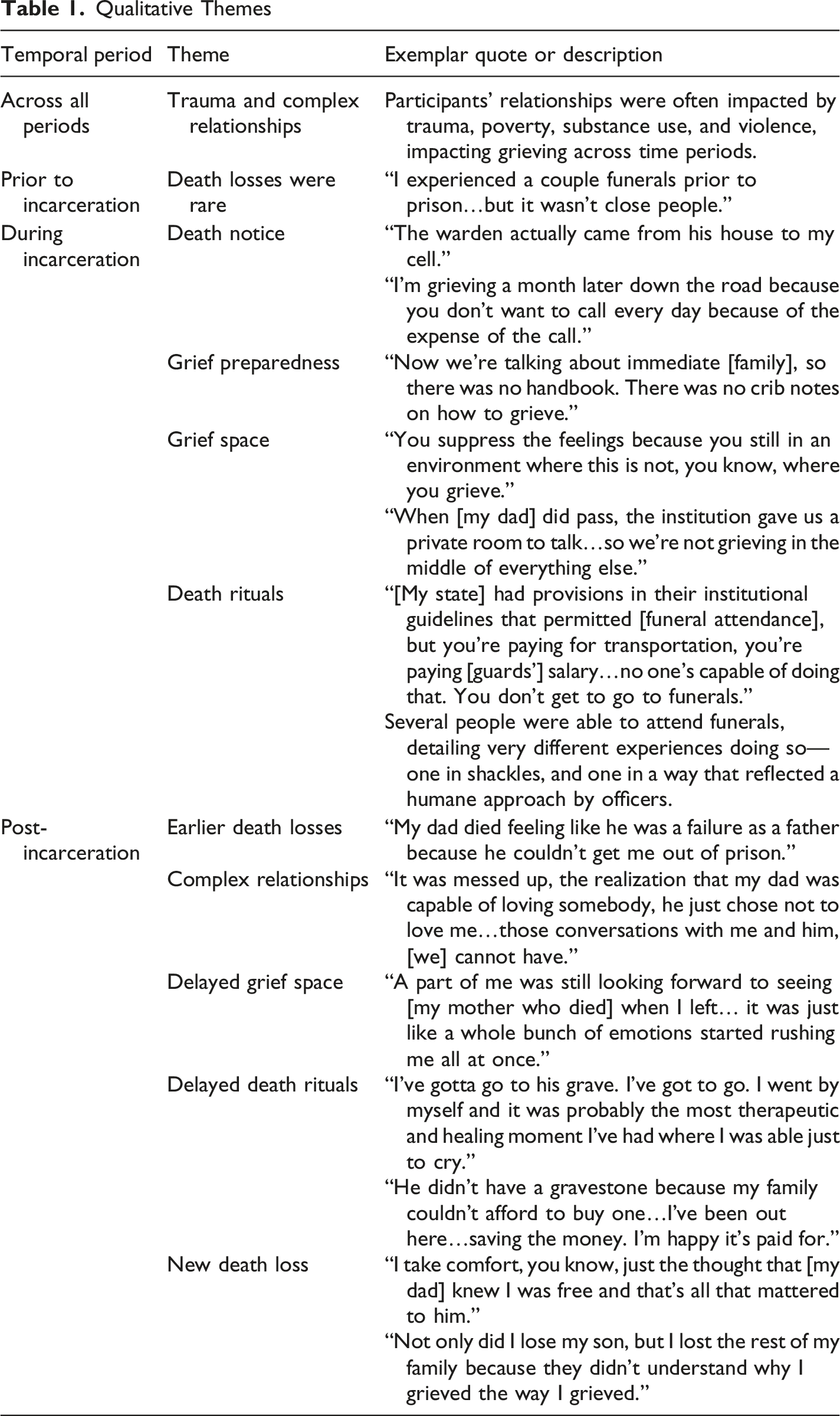
Understanding the Context: Trauma and Complex Relationships
Participants’ relationships, even before their incarceration, were often marked by trauma, poverty, substance use, and violence, all of which played influential roles in the bereavement experiences of the participants. Many described extensive histories of physical abuse and neglect from their parents and other adults tasked with their care. Participants often described adopting parentified roles to take care of their parents and siblings. Prior to over 20 years in prison, starting at the age of 17, Brian Groovy’s
1
family “lived in poverty, we didn’t have lights in the house…sometimes we didn’t have a house.” He explained, “that was my life growing up, always being a breadwinner,” starting at the age of seven or eight when he helped carry strangers’ groceries to the car for tips and continuing on to selling drugs at the age of 13. By selling drugs, Groovy provided money for housing, food, and even his cousin’s education. Caretaking roles were also a major part of Jay’s childhood. Before he went to prison for almost a quarter century, he left the relative comfort of his grandmother’s home to move back in with his mother: I missed my mother. I wanted to be with her no matter what she was dealing with. That's what happened. I started taking care of my little brothers, I had three younger brothers, so I was taking care of them as best as I could, which also made it hard for me to go to school because every time I went to school, I was worrying about them. I started cutting class. I started working in different little odd jobs, trying to make a little bit of money to help them out. In the meantime, my mom, she was doing all she could but she was a drug addict, so her focus most of the time was on drugs. That's how I started selling drugs.
Parental or guardian substance use complicated relationships for participants and made the pains of poverty more pronounced. Sometimes parental substance use was exacerbated or triggered by participants’ incarceration. Rafiq, who spent 27 years in prison, explained that his mother’s crack addiction and isolation escalated when “her 17-year-old son got life without parole, he killed somebody…I felt the guilt of knowing that I pushed her over the edge. That’s something I still live with.”
Navigating the inevitable challenges of grief and loss were made more complicated by these trauma histories and complex relationships. Adapting caretaking or non-traditional roles was quite common for qualitative participants. Asm noted that, “my father was so much trying to be my friend as opposed to trying to be my father.” With these complex relationships and lack of support systems, imagining what healthy relationships looked like seemed nearly impossible. Nikki, who was incarcerated for 10 years starting when she was 15, explained: I didn't know no different. Nobody had taught me what a relationship, a healthy relationship was supposed to look like. And then, as I got older, and started understanding things, I started seeing patterns everywhere, you know? …Even thinking back to my parents, my parents used to fight all the time. My mom would cut her wrist up, dad would beat her up with a hammer. And it's just stuff like that. You know what I mean? But I didn't think it was abuse. That was normal to me.
Understanding experiences of grief and loss for this population must be framed in the acknowledgment that trauma and complex relationships were the norm for many study participants.
Prior to Incarceration
Because of the young age at which the participants became involved with carceral systems (12 to 17), there are few examples of individuals having experienced death losses prior to incarceration. Idris, who was incarcerated for 35 years, noted, “You know, as a 17 year old, I experienced a couple funerals prior to prison. But it wasn’t immediate family. It wasn’t close people.” The lack of exposure to such losses while living in an environment where grief processing could be modeled left participants without the tools to navigate losses during incarceration, in spaces less than ideal to grieve. Most notable examples of death losses that occurred prior to incarceration were due to violence in the community. One participant, Alex, explained, “I was hanging out in that environment where a lot of the people I knew, they get in trouble with the law, they end up, you know, in juvenile detention, prison, you know, some of them were even killed in the streets.”
During Incarceration
Compounded by losses experienced prior to incarceration, participants faced many death losses while incarcerated. Spaces to grieve these losses while incarcerated were few and far between. Due to the long periods of incarceration experienced by participants, death losses of family and friends accumulated. Responses to these death losses were complicated by the timeframe and manner in which participants became aware of their loss. El explained: Naturally you going to grieve, you a person, your mother, your father, whoever it is. That's a loss, but you experience it differently because oftentimes in prison you get things delayed. You don't get them as they happening, you get them after they happen. Depending on how well of communication you have, determine on how soon you get it.
Death Notice
While some participants received notice of the death of their loved one directly from a prison official, other participants were notified during paid phone calls from family members. Rafiq reflected on his experience of receiving compassionate notice of the death of his mother: I remember it was 3:30 in the morning. The warden actually came from his house to my cell, opened my door, sat on my bed. I'm like, “What's up?” I knew. He's like, “Your mom passed away.” He said, “I wanted to come tell you myself. I wanted to tell you myself. You're one of my guys here in the prison.”
In contrast, Nikki experienced delayed grief when the cost of phone calls created a barrier to death notification: I’d call home and, and they'll be like, ‘No, we ain't been answering your call, but so and so passed and we had gone to the funeral and blah, blah, blah.’ And I’m like, ‘Why am I just now like…?!’ You know, and I’m grieving a month later down the road because you don’t want to call every day because of the expense of the call.
Grief Preparedness
Once participants became aware of their loss, navigating their grief was not always feasible within carceral settings. Given the young age at which participants entered prison, some participants did not feel equipped for grieving the loss of their loved ones. Idris shared his struggle with navigating grief, having only experienced the death of more distant relatives prior to his incarceration: “now we’re talking about, you know, immediate [family], so there was no handbook. There was no crib notes on how to grieve, how to how to deal with this.”
Grief Space
Adding to the lack of understanding and experience of how to grieve, many participants expressed that prison was not a safe space to be as vulnerable as required for grieving. Idris explained: I had to survive. Sometimes you know, you suppress the feelings because you still in an environment where this is not, you know, where you grieve… inside you'll get hit hard and then you man up. Okay, okay, I got to deal with this. I got to deal with my daily interactions, I got to not become a victim, not become preyed upon. And you don't want anybody seeing you that vulnerable and in your weakness.
Without a safe space to attend to grief, participants spoke at large about the need to defer grief until post-release. Describing how he avoided the vulnerability of grief, Bryan, who was incarcerated for 26 years starting when he was 16, shared, “You just push it in, you suppress it.” Julian Ignatius, who also spent more than a quarter century in prison, detailed a similar experience after losing several close loved ones: “I allowed myself a moment, a very brief moment and I could compartmentalize it and bury it in me and put my mask on for this hit and keep going.”
Without a natural safe space to grieve during incarceration, several participants found ways to create those spaces in prison. Bryan, speaking about his experience grieving the death of his grandfather, shared, “I remember actually crying for the first time in my bed. I’m putting up my cover [mimes holding something over his head], and I’m just crying.” Another participant, Bobby, shared his approach to creating space for grieving the loss of his mother: They had a guy that I vaguely knew in the prison that I would see and I would speak to, he looked like a cool guy. And I went to his bed area, just walked up to his bed–and I still was worrying about the game… I told him my name. I said, “Listen, I need you to do a favor.” Like, “what's that?” I said, ''I just need you to just hear me out for a second. I don't need you to comment. I don't need you to try to sway me one way or the other. Just listen.” So he said, “Alright, cool.” And I broke down and I cried and I cried… And after I finished, I shook his hand, I told him thank you, and we hadn't talked about that until 12 years later.
Though most people lacked grief space or had to create grief space themselves, there was one unique circumstance in which a participant whose father died of cancer had a grief space created for him. Troy, who was incarcerated alongside his brother for nearly two decades, explained: The institution knew us relatively well… When [my dad] did pass, the institution gave us a private room to talk to mom, and my brother and myself and mom to have a visit in that room that's isolated, so we're not grieving in the middle of everything else.
Troy’s positive relationship with his father, the fact that he felt that he had found closure in prior conversations with his father, and the institution providing a private grief space all helped Troy and his family to grieve and support each other.
Death Rituals
One way in which some participants could find space for grieving while incarcerated was to temporarily leave prison to attend the death rituals (e.g., funeral) for their loved ones. However, death ritual attendance was not made available to all participants and was often dependent upon the type of carceral setting that the participants were in. Marcus explained, “If someone passed away in a regional [jail], nine time out of 10, you would be able to go to the funeral. Like a state, maybe even a private [prison], it’d be harder to try to go to a funeral or something like that.”
When in carceral settings that allowed participants to attend a death ritual, participants faced financial barriers to attendance as they were required to cover the costs associated with transportation and supervision during the trip to and from the prison. While explaining his inability to attend his father’s funeral, Bill Castle shared the barriers he faced: [My state] had provisions in their institutional guidelines that permitted it, but you're paying transportation, you're paying their salary for that, you're required to have X number of this and that and so on and so forth. Even though it's built in there to do it, no one's capable of doing that. You don't get to go to funerals. They're just not going to do that.
In cases where participants were able to overcome the financial burden of attendance, participants’ experiences varied based on the compassion demonstrated by individual officials. Meemaw, who was incarcerated for more than 30 years, recounted the lengths her lawyer and police transports went to in order for her to attend her dad’s funeral: My attorney… arranged for two officers to transport me. He went and actually sat down and had a personal meeting with them and told them about me. After the officer had signed the custody receipt that he had custody of me, the major at the correctional facility I was at told him that he had to handcuff me, and he told her he wasn't going to. He said, “She's in my custody now and I’m not going to do that.” She said, “Well, my tower says that you didn't check in any weapons.” He said, “I didn't bring any.” She said, “So you're going to transport a prisoner that has a life sentence without any weapons, and you're not going to restrain her?” He said, “No.” She said, “Well, I'm not going to let her go.” He said, “You don't have a choice at this point.” He said, “I've already signed custody for her.” There was a big issue with it but I walked out without handcuffs, wearing regular clothes instead of the prison uniform. I rode in the front seat of a personal vehicle, not a marked car, and when we got to the funeral they told me, “This is your time. We're not here, be ready to go at such and such time,” and they faded into the background and I was really super appreciative of the way they treated me, but also the fact that they dressed so that they would fit into the scenery. They were dressed like they were going to a funeral, not like they were cops. That was huge and how they allowed me to just be me with my family on a day like that.
Meemaw’s lawyer’s advocacy and the humanity shown by the individual officers allowed Meemaw to be fully present at her father’s funeral, giving her space to grieve. In contrast, Bobby detailed his appearance while giving the eulogy for his mother’s funeral: But it was in an orange jumpsuit. Trust me. It was not anything–it was a sight to behold. Orange jumpsuit with a big old box [mimes being in handcuffs]. You know, it just looked like Charles Manson coming through. But I did go and gave the eulogy.
The compassion extended to Meemaw during her father’s funeral provided space to grieve alongside her family without the added stigma of a prison uniform or shackles. Whereas in Bobby’s experience, being required to wear a jumpsuit and shackles drew attention to his carceral status, separated him from others in attendance at the funeral, and impeded his access to a safe space for grieving the loss of his mother.
Post-Incarceration
Earlier Death Losses
Decades of incarceration almost inevitably meant having loved ones die while participants were locked away. As King said, “you look at the average juvenile who go in, nine times out of ten, he’s coming home and his parents are deceased, grandparents, maybe even some of his offspring and his siblings.” This was simply the norm with the passing of time. Death losses were exacerbated by the fact that deceased family members were never able to see them leave prison. Junior had already been incarcerated for 20 years starting at the age of 12 when his dad died. He explained, “I wanted my dad to see me free. My dad died feeling like he was a failure as a father because he couldn’t get me out of prison.” Rafiq’s mother died seven years before his release and he “still cope[s] with it every day.” He said: I would go back in prison for the rest of my life, just to see her on the outside. I wanted her to see what I'm doing now, to see that your son is successful, your son is doing some good things… She said to me before she died, she was like, “I feel at peace now.” I said, “What you mean?” “My son, I know you're coming home, I know you got someone in your life [who] love you as much as I love you.”
Even though Rafiq was still seven years from his release at the time of her death, Rafiq found solace in knowing that his mother would be proud of who he is and all that he has accomplished since returning home. Funk, whose mother had cancer while he was incarcerated and is still alive, described her living to see him come home as “a prayer answered,” explaining, “I just prayed to God to let one of my parents live to see me come home…I'm happy and at peace.”
Complex Relationships
For some participants, grief experiences were complicated by the nature of their relationships with loved ones. Drew was incarcerated for 23 years, starting at age 15; his father was sentenced to life in prison when Drew was an infant. After Drew was released, he discovered that his father, who had been released years prior and had another family for whom he was present and supportive, had recently died. Drew explained that learning all of this simultaneously “was messed up, the realization that my dad was capable of loving somebody, he just chose not to love me and my brother.” Though it led to a lot of “sleepless nights” that “hurt a lot,” Drew says, “let him rest in peace and leave him there because those conversations with me and him, [we] cannot have.” Processing the death of loved ones while also processing the amount of harm those loved ones had caused participants led to complex emotions, sometimes with nowhere to put those emotions.
Delayed Grief Space
For participants, having their physical freedom often meant also having the freedom to fully engage with their grief, beyond the prison walls where vulnerability was often unsafe. During the 31 years El was incarcerated, his mother died. He explained processing this deferred grief: Even though consciously I knew my mother was dead, a part of me was still looking forward to seeing [her] when I left. I don't know, it was like somebody hit a button and it was just like a whole bunch of emotions started rushing me all at once.
People who were not able to find safe ways to fully process death losses of loved ones within the confines of prison found that coming home often meant having grief spaces.
These grief spaces were often in less traditional, more mundane locations. Bryan, who spent 26 years in prison starting at age 16, described his experience: I could be in the store or in a car somewhere. All of a sudden I start crying. And I equate that to the fact that it's you allowing yourself to mourn…So now that you're out here, it's almost like your body and your mind automatically know that you're no longer confined. And so it knows that you no longer have to suppress those emotions, that it's okay for those emotions to come out. It's just that when they do come out, at times, you don't have control of them. They just come out. But you know, like for me, I learned to respect that process, and so when it happened, I allowed it to happen. And because of it, I'm better off today because of it, you know?
Delayed Death Rituals
For many participants, especially those unable to participate in death rituals like funerals while incarcerated, connecting to death rituals by visiting grave sites was crucial. Meredith talked about the importance of visiting her father’s grave nearly 20 years after his death: I've gotta go to his grave. I've got to go. I went by myself and it was probably the most therapeutic and healing moment I've had where I was able just to cry and just like, get things out that, you know, I'd had this moment where I didn't know if I'd ever get out of prison really. And so, I'm looking at his grave and I'm just like seeing the date on the tombstone. I lost it.
When Funk came home from his 30-year incarceration, his priority was to visit his father’s grave and pay for a tombstone: I just went to the graveyard and visited my father's grave site. He didn't have a headstone because my family couldn't afford to buy one. I just said and told my mom, “The next time I come back, you'll have a headstone.” For the two years I've been out here, I've just been working, saving the money. It was $3,500. I just went up there in May last month and gave them $3,500. I'm happy it's paid for. It'll take like 10, 11 weeks for them to make it and they'd be putting it there and I'll be able to go up there because he have a headstone.
Being able to participate more fully in death rituals related to his father’s death facilitated a sense of closure, connection, and pride that was inaccessible during his incarceration.
New Death Loss
On top of processing death losses that happened when participants were incarcerated were new death losses that occurred post-release. Participants described the “blessing” of being able to spend time with loved ones outside of prison before the loved ones died, something they did not expect during their decades of incarceration. Alex explained: “I take comfort, you know, just the thought that [my dad] knew I was free and that’s all that mattered to him.” Numerous other participants described coping with a parent’s death after their release. Burger explained that his mom died a year after he came home: “good thing for me, she passed while I was right there next to her. That was good. It was sad, but at least I was there with her.” Participants found solace in being physically present with loved ones at the time of death and in loved ones knowing they had been released from prison. Some of these deaths happened during the COVID-19 pandemic. Boricua and his mother were both hospitalized because of COVID, but his mother died: “I didn’t expect my mother to pass, you know? I knew she was coming outta the hospital with me, you know?” After Boricua and his mom survived his many years of incarceration, her dying so suddenly during a global pandemic seemed unfathomable.
Two of the female participants described the heartbreak of post-release death loss involving young children. Nikki left prison and was able to have biological children, an impossibility for many women who spent many decades behind bars. Nikki explained how one of her children died: I got out and because of the drug addiction in my family, my aunt ended up killing my son. So that was hard on me. She put a Fentanyl patch on his back and it killed him and he was a week from being two years old and so that was horrible. And then not only did I lose my son, but I lost the rest of my family because they didn’t understand why I grieved the way I grieved. They thought something was wrong with me because I wasn’t crying and I wasn’t doing this and doing that. They thought I was fucked up, excuse my language. They thought I was a fucked up person but it wasn’t that. It was, that’s the way I learned how to deal with stuff in prison, like, you compartmentalize and you move that shit to the side and you keep it moving. You know what I mean?
After years of not having the space to process loss and grieve while incarcerated, Nikki used the coping skills she had learned inside to survive. Sunshine had a similarly heartbreaking experience. For the first three years after her release, Sunshine was “happy” and working “such a fulfilling job that I never felt like I was working.” She was involved in her large family’s lives and took care of her cousin’s infant son for the first year of his life, until the cousin asked Sunshine to bring the child home. The baby died less than a week later, after he consumed drugs he found at his mother’s home. Sunshine said that the one-year-old “was the first man to ever show me genuine love” and “he was my chance” at having children. In the three years since his death, Sunshine explained, “now I’m back in jail in my own house. I don’t go out. I don’t know how to, you know, do a lot of things independently. Like I still eat commissary food.” For both Sunshine and Nikki, the coping skills that once allowed them to persevere through loss and trauma during incarceration no longer serve them the way they once did.
Discussion
Participants in this study, all of whom spent decades of their lives in prison starting before their eighteenth birthday, reported experiencing immense, complex death loss and disenfranchised grief. This is an important consideration for the tens of thousands of people sentenced to life and long sentences starting in childhood, and the nearly 1,300 who have come home from those sentences. Without grief spaces in carceral settings, incarcerated people lack opportunities to fully grieve and process their myriad, cumulative death losses. The lack of grief space inhibits grief processing, delaying it until after their release from prison, if release ever comes.
To fully understand these losses, we must acknowledge the complex nature of many of the relationships incarcerated people have, many of which are further complicated by their incarceration (Pettus-Davis, 2014). While family ties and social support can enable coping with grief, buffer psychological distress, and alleviate depressive symptoms (Cacciatore et al., 2021; Fahmy et al., 2024), the impact of this relationship often diminishes in the face of poverty (Fahmy et al., 2024). Unfortunately, relationships for people who are currently or previously incarcerated are often situated within broader systems of poverty and trauma (Kazemian & Travis, 2015). For those returning from life or long sentences, many challenges and relationship strains are amplified (Franke, 2023), making experiencing death losses more complicated to navigate. For this population, grief may more closely mirror the grief that often accompanies drug-related deaths, in which relationship strain, disenfranchisement, stigma and erasure, and conflicting feelings about the deceased and the death (including guilt, shame, and grief) combine, leading to “The Special Grief” for the bereaved (Dyregrov et al., 2020). Adding to the complicated relationships many participants described is the concern that, given decades of incarceration that started at an early age, people returning from juvenile life and long sentences may have a smaller network of support. Without the buffering role positive social supports can play in reentry and grief, participants may experience diminished well-being and grieving (Cacciatore et al., 2021; Fahmy et al., 2024; Scott et al., 2020).
On top of those complexities is the accumulation of loss experiences from before, during, and after decades of incarceration. Ward and Dewey (2024) discussed the cumulative grief experiences from non-death losses stemming from the period of incarceration itself. However, our findings highlight how death losses accumulate starting prior to incarceration and stretching into post-release life. We see the compounded effects of cumulative grief across these different stages of carceral life.
Despite the slow and steady accumulation of loss over time, this study shows how, for many participants, grieving was delayed until after they were able to leave prison. This is due in large part to the lack of grief spaces inside prison. Participants who were able to find grief space inside (such as with Troy, who was given a private place to grieve with his family) could more actively engage in “grief work,” attending to loss-oriented concerns, an essential requirement of the Dual Process Model of Coping with Bereavement (Stroebe & Schut, 2010). Finding grief space was so fundamental for grieving that several participants risked making themselves vulnerable by finding creative ways to construct temporary grief spaces for themselves. The way that people learned to grieve while incarcerated, often experiencing death losses for the first time, impacted how they grieved losses that occurred during or following incarceration. For some, freedom meant having the physical and emotional space to oscillate between the restoration-orientation and loss-orientation necessary for healthy grieving (Stroebe & Schut, 2010). However, Sunshine and Nikki, who experienced the sudden drug-related death losses of children under the age of two, reverted back to coping skills and isolation that served them in prison but further ostracized them as they experienced “The Special Grief” associated with drug-related deaths (Dyregrov et al., 2020).
While incarcerated, participants’ ability to process grief was further complicated by experiences of stigmatization and disenfranchisement within the very few grief spaces that do exist. This was illustrated in the delayed notice of the death of loved ones, logistical and financial barriers to engage in funeral rituals, the dehumanizing experience of attending funerals in shackles and/or a prison jumpsuit, and judgment from other non-incarcerated grievers. Disenfranchised grief often exacerbates the grief, further isolating the mourner and requiring more intentional systemic support (Doka, 1989).
The unique loss-related and broader needs of people who received life and long prison sentences beginning at an early age are often forgotten or ignored within carceral systems. This is a population who reports feelings of fear, anger, loneliness, and hopelessness (Nellis, 2012)--general and grief-related needs that prison programming could address but does not. Prisons often exclude or deprioritize people with life sentences from participating in any programming (Nellis, 2012; Taylor, 2023). Instead, people home after juvenile life and long sentences face systemic and social support-related hurdles (Huppert et al., 2025), making grief processing more difficult.
Though there are some resources to support incarcerated people who are grieving (Taylor & Ferszt, 2001), this study showed that the existence of grief space almost always hinged upon a single administrator at a particular prison deciding to approach a prisoner’s loss and grief with humanity. Much more often, incarcerated people were met with “institutional thoughtlessness” (Crawley & Sparks, 2005; Wilson et al., 2020), in which their grieving was simply ignored and even exacerbated by typical prison life and carceral systems. Given the profound and cumulative losses inherent in the traumatic environment of carceral systems and the ubiquity of long sentences, providing intentional, accessible grief spaces within prisons should be considered the minimum standard of care.
Strengths & Limitations
This study addresses an understudied topic in an overlooked population, prioritizing the words of those with lived experiences in investigating how people sentenced to life and long sentences starting in childhood navigate death loss and grief before, during, and following their incarceration. It was done with a high level of rigor and trustworthiness by having regular peer debriefing and multiple coders engaged in the qualitative data. Additionally, member checking was done throughout the research process with people home after serving a life or long sentence starting in childhood. Findings stemmed from interviews with 46 participants from 18 states or DC, highlighting a variety of experiences across different state policies.
There are several important limitations. Study participants were recruited from a convenience sample, leading to questions of representativeness. Participants were contacted via email and had to be connected to CFSY’s network, which may have systematically excluded certain people. There may have been selection bias. Another important limitation is that this study addresses the experiences of people who had served life and long sentences that started during childhood, but may not be applicable to individuals who entered carceral systems later in life.
Implications
Implications from this study cross temporal spaces, highlighting the need to address challenges unique to life in prison and post-release, across systems and jurisdictions, rather than just on a state-by-state basis. Individuals working within carceral systems should endeavor to provide safe spaces for those grieving within carceral settings, create policies to support timely and thoughtful death notifications, and coordinate opportunities for bereaved persons to attend funeral services in humane, caring ways. These changes should be made across federal, state, and local systems to allow equitable access to grief spaces, rather than arbitrary distinctions by jurisdiction. Those working in post-release settings should assess the need to address unresolved or complex grief and provide or connect people with grief-specific services.
Conclusion
Incarceration creates and exacerbates compounded and disenfranchising loss and grief experiences, which can affect psychosocial well-being and grief adjustment over time. Study findings highlight that death loss is not just accumulated while in carceral settings, but is compounded with losses experienced prior to and after incarceration. Due to an absence of safe spaces for grieving within carceral settings, grief reactions among the study sample were often delayed until post-release. Beyond a lack of space to attend to grief needs while incarcerated, carceral settings further disenfranchise grievers in the study through delayed death notices, as well as barriers to funeral attendance and engagement. Carceral systems must enact humane policies that better support the grieving people living within prison walls. Given the lack of support for grief adjustment and psychosocial well-being for incarcerated individuals, we must also be ready to holistically support people coming home from prison as complex human beings and grievers.
Footnotes
Acknowledgements
This research was possible through the generosity of the University of Maryland Baltimore Grand Challenges of Social Work Dissertation Award.

Ethical Considerations
The University of Maryland Baltimore IRB approved this study
Consent to Participate
All participants received a written informed consent form and provided verbal consent to ensure confidentiality.
Funding
This research was done through an internal University of Maryland Baltimore School of Social Work, Grand Challenges of Social Work Dissertation Award.
Declaration of Conflicting Interests
The authors declared no potential conflicts of interest with respect to the research, authorship, and/or publication of this article.
Data Availability Statement
Data are not shared publicly due to ethical and privacy reasons. Any data requests should go through first author.