






Abstract
Grief is a universal human experience that extends well beyond the death of a loved one to encompass a broad range of everyday losses including job loss, relationship dissolution, identity disruption, and the ending of significant friendships. Despite its pervasiveness, grief remains largely absent from mainstream communication discourse, leaving individuals who feel unseen, unsupported, and without the language to express their experience. This article introduces grief-conscious communication as a novel theoretical construct and proposes a multilevel framework designed to address this critical gap. Drawing on foundational grief theories including disenfranchised grief (Doka, 1989, 2002), ambiguous loss (Boss, 1999), and the Dual Process Model (Stroebe & Schut, 1999), the proposed framework is organized across three interconnected tiers: personal consciousness, relational practice, and systemic transformation. The framework offers a comprehensive lens through which individuals, practitioners, and organizations can cultivate more empathic, authentic, and culturally responsive communication about grief. Implications for clinical practice, organizational policy, and future research are discussed.
Keywords
Introduction
Grief is among the most universal yet least acknowledged dimensions of the human experience (Corr, 1999; Stroebe et al., 2017). While a growing body of scholarship has examined grief as a psychological and social phenomenon (Worden, 2009; Doka, 2002, Stroebe & Schut, 1999; Boss, 1999), comparatively little attention has been devoted to the communicative dimensions of grief, how grief is expressed, received, silenced, and shaped by language, interaction, and institutional practice (Basinger et al., 2016; Cohen & Samp, 2018; Corless et al., 2014). The result is a pervasive cultural silence around grief that leaves individuals navigating their losses without the vocabulary, permission, or interpersonal support needed to do so meaningfully.
This silence is not inconsequential. Research consistently demonstrates that the social expression of grief-related emotion contributes significantly to both psychological and physical health outcomes (Bonanno & Papa, 2003; Eisma et al., 2023).When individuals are unable to speak about their grief—whether due to social stigma, inadequate support, or institutional indifference—the consequences can include prolonged distress, social isolation, and complicated grief trajectories (Cacciatore et al., 2021; Doka, 2002).
The problem is compounded by a narrow cultural understanding of what constitutes grief. Dominant cultural scripts have historically centered on death and dying, leaving the vast landscape of non-death losses—job loss, divorce, the dissolution of friendship, miscarriage, the loss of a home or community—largely without name or social recognition (Attig, 2004; Boss, 1999; Cesur-Soysal & Arı, 2024; Doka, 1989; Lang et al., 2011; Robak & Weitzman, 1995). When grief lacks a culturally sanctioned name, it also lacks a culturally sanctioned language, leaving those who experience it without meaningful communicative resources.
These observations give rise to the central questions guiding this paper: How can communication about grief be expanded to recognize and support the full range of human losses, including those that lack cultural name or social sanction? What communicative orientations, practices, and structural conditions are necessary to facilitate grief expression across individual, relational, and institutional contexts? And how might a multi-level communication framework account for the systemic forces that determine whose grief is recognized and whose remains invisible? This article proposes grief-conscious communication as a theoretical framework designed to address these questions.
Grief-conscious communication is defined as a mindful, empathic, and intentional approach to expressing, receiving, and creating space for grief across individual, relational, and systemic levels. Drawing on foundational grief theory and supportive communication research, this article introduces a multilevel framework organized across three interconnected tiers: personal consciousness, relational practice, and systemic transformation. The article proceeds as follows. First, the conceptual landscape of grief is reviewed, with particular attention to theoretical developments that broaden the understanding of grief beyond death and dying. Second, the communicative dimensions of grief are examined, identifying a critical gap in the existing literature. Third, grief-conscious communication is formally defined and distinguished from related constructs. Fourth, the three-tier theoretical framework is presented in full. Finally, implications for practice, policy, and future research are discussed.
Situating Grief: Beyond Death and Dying
Grief, in its most commonly cited definition, refers to the natural psychological, emotional, and physical response to the loss of something or someone of personal significance (Worden, 2009). For much of the twentieth century, scholarly and clinical attention to grief was organized primarily around bereavement following death. Seminal works by Lindemann (1944), Bowlby (1980), and Kübler-Ross (1969) established grief as a stage-based or phase-based process through which individuals navigate the aftermath of a significant death, laying a foundational vocabulary that continues to shape both professional practice and popular understanding.
Yet this death-centric framing, while generative, has also been limiting. A substantial body of scholarship beginning in the late twentieth century began to challenge the boundaries of grief, proposing that loss—and the grief it generates—extends far beyond biological death. Boss (1999) introduced the concept of ambiguous loss to describe experiences of loss that lack the clear demarcation of physical death: the loss of a family member to dementia, the grief of a parent whose estranged child remains alive, or the dissolution of a marriage in which one partner feels as though they are mourning someone who remains physically present. Ambiguous loss, Boss argued, is among the most difficult forms of loss precisely because its legitimacy is so frequently unrecognized.
Perhaps no theorist has done more to broaden the conceptual terrain of grief than Doka (1989, 2002), whose theory of disenfranchised grief identifies the social and relational processes by which certain losses—and the grief they occasion—are rendered invisible or illegitimate. Disenfranchised grief occurs when “the relationship is not recognized, the loss is not acknowledged, or the griever is excluded” from the social and symbolic rituals of mourning (Doka, 2002, p. 160). Losses such as miscarriage, the death of a pet, the end of a non-normative relationship, or the grief of a close friend who is not considered next-of-kin are among the most commonly disenfranchised. Critically, disenfranchisement is not merely a personal experience but a social one—it is produced through cultural norms, institutional policies, and communicative practices that implicitly determine whose grief counts and whose does not.
The Dual Process Model proposed by Stroebe and Schut (1999) further complicates the linear stage models that had previously dominated the field, offering instead a dynamic account of grief in which individuals oscillate between loss-oriented coping—attending directly to the grief itself—and restoration-oriented coping—attending to the life changes and secondary losses that accompany bereavement. The model introduced restorative coping as a legitimate and necessary grief process, acknowledging that individuals do not grieve in one direction or at one pace, and that the work of building a new life is itself a form of grief work.
More recently, scholars have situated grief within the context of everyday life and its ordinary disruptions. The loss of a job, the aging of a social identity, the dissolution of a friendship circle, the experience of chronic illness, and the grief of cultural displacement are losses that people carry largely without social acknowledgment or institutional support (Harris, 2019; Harvey, 2002; Jordan & Neimeyer, 2003; Milman, 2021). What unites them, beyond their emotional weight, is their communicative invisibility: these are losses for which we often do not have words, rituals, or socially sanctioned spaces in which to grieve.
The Communication Gap in Grief Literature
Despite the breadth and richness of grief theory, the communicative dimensions of grief remain comparatively underexplored. Existing grief models have largely attended to the internal psychological processes of the bereaved individual, or to the clinical and therapeutic relationship, with less attention to the everyday communicative contexts in which grief is expressed, received, or suppressed (Stroebe & Schut, 2010). This constitutes a significant gap, given that grief is experienced not only inwardly but relationally—it is shaped, facilitated, and sometimes foreclosed by the communicative environments in which grieving individuals find themselves.
This is not to suggest that grief theorists have ignored its relational dimensions entirely. The continuing bonds framework (Klass et al., 2014) reframed grief as an ongoing relational process between the bereaved and the deceased, challenging stage-based models that presumed a terminus to grief. Neimeyer’s (2001) meaning reconstruction model situated grief within narrative and social contexts, understanding loss as a process of meaning-making that is fundamentally shaped by one’s relational world. Rubin’s (1999) two-track model similarly incorporated the bereaved person’s ongoing relationship to the deceased as a central dimension of grief adaptation. These frameworks have collectively deepened understanding of grief as something that occurs in and through relationship. Yet even within these relational accounts, the focus has remained primarily on the psychological dimensions of the bereaved individual’s relationship to what was lost — the internal reorganization of attachment, the reconstruction of meaning, and the continuation of bonds. Comparatively little theoretical attention has been paid to the communicative practices through which grief is expressed, received, facilitated, or foreclosed in everyday social life, whether across friendships, workplaces, families, and institutions. It is precisely this communicative dimension that the present framework proposes to address.
Research on supportive communication offers some relevant groundwork. Burleson and MacGeorge (2002) identified person-centered comforting behavior—communication that acknowledges, legitimizes, and explores the distressed other’s feelings—as significantly more effective in supporting emotional recovery than advice-giving, minimizing, or redirecting responses. Studies of grief support have similarly found that the quality of interpersonal communication around loss is among the most significant predictors of grief outcomes, with listeners who demonstrate empathy, presence, and non-judgment producing measurably better adjustment in bereaved individuals (Cacciatore et al., 2021; Morley, 2023).
Yet despite this evidence, social communication about grief is frequently characterized by avoidance, minimization, and cliché. Well-meaning but unhelpful responses—“they’re in a better place,” “everything happens for a reason,” “you need to stay strong”—are among the most commonly reported communicative experiences of bereaved individuals, and they function to foreclose rather than facilitate grief expression (Doka, 2002; Goodrum, 2008). This communicative inadequacy reflects not merely individual discomfort, but a broader cultural deficit: a lack of grief literacy that leaves even caring individuals without adequate tools to be present with another person’s loss.
The workplace context is particularly illustrative of this gap. Despite the near-universality of grief, organizational policies and cultures have been slow to create conditions in which employees can grieve openly and receive meaningful support. In the United States, no federal bereavement leave policy exists, and what leave is available is typically narrow, brief, and structured around a death-centric understanding of loss that renders non-death losses invisible (Hanson, 2022). The implicit communicative message of such policies is that grief is a private matter, bounded in time, and not the proper concern of the workplace—a message that compounds the suffering of those who must perform wellness while carrying loss.
Taken together, this evidence suggests that what is needed is not merely better individual communication skills but a more comprehensive framework—one that addresses grief communication at the level of personal awareness, relational practice, and systemic design. It is precisely this need that grief-conscious communication is proposed to address.
Defining Grief-Conscious Communication
Building on the working definition introduced above, grief-conscious communication is defined herein in fuller theoretical terms as a mindful, empathic, and intentional orientation towards the expression, reception, and facilitation of grief across individual, relational, and institutional contexts— one that is constituted by three foundational commitments that together distinguish it from adjacent constructs: an expanded understanding of grief that encompasses the full range of human losses beyond the death of a loved one; a relational ethic of presence and non-judgment that centers the experience of the grieving individual; and a recognition that communication about grief is not merely personal but structural—shaped by and in turn shaping the policies, cultures, and institutions in which it occurs. Each of these commitments reflects a dimension of grief communication that existing frameworks have address incompletely or not at all.
Several features distinguish grief-conscious communication from adjacent constructs. It is related to, but distinct from, grief counseling or grief therapy, which are clinical interventions delivered by trained professionals in formal settings. Grief-conscious communication, by contrast, is proposed as an orientation—a set of dispositions, practices, and principles applicable by any person in any relational context, including those without clinical training. It is also distinct from general models of empathic or compassionate communication (e.g., Nonviolent Communication; Rosenberg, 2003), in that it is specifically theorized around loss and its particular communicative demands, including the tolerance of ambiguity, the legitimation of non-death losses, and the capacity to hold space when language fails entirely.
Grief-conscious communication is further distinguished by its multilevel architecture. It does not locate the problem of inadequate grief communication solely in individuals—in their discomfort, their clumsiness, or their avoidance—but situates communicative inadequacy within a larger systemic context that actively shapes what can and cannot be said about grief. This systemic dimension, largely absent from existing communication frameworks, is central to the present proposal.
A Theoretical Framework for Grief-Conscious Communication
The proposed framework for grief-conscious communication is organized across three interconnected tiers: personal consciousness, relational practice, and systemic transformation. These tiers are conceptually distinct but functionally interdependent: personal consciousness provides the interior foundation from which relational practice becomes possible, while relational practice, enacted at scale, creates the conditions for systemic transformation. Together, the three tiers constitute a comprehensive account of what it means—and what it takes—to communicate consciously about grief (Figure 1). The Grief-Conscious Communication frame work. The Three Interconnected Tiers Progress From Individual Awareness (Inner) to Systemic Transformation (outer)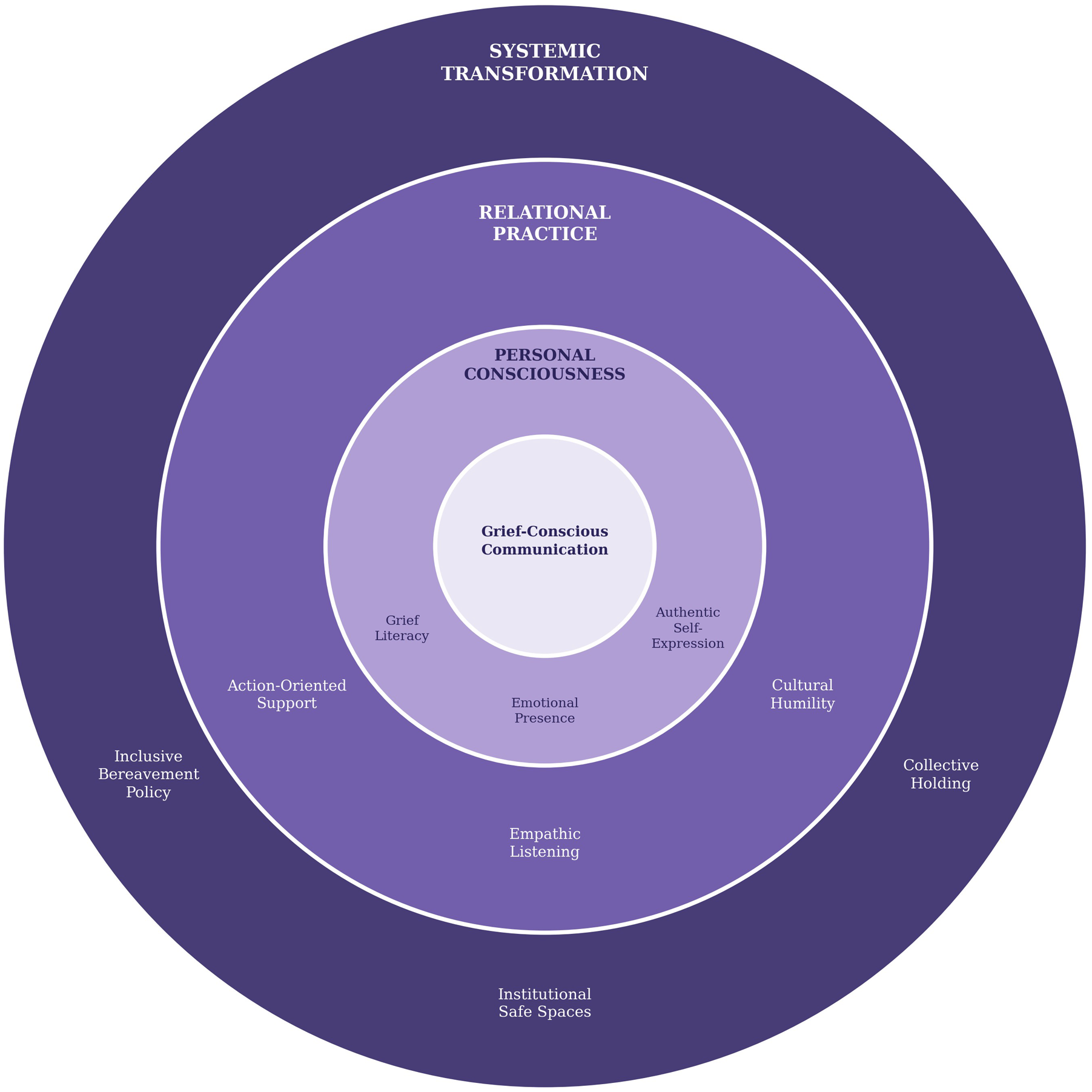
Tier 1: Personal Consciousness
The first tier of the framework addresses the inner capacities and orientations of the individual grief-conscious communicator. Before one can engage meaningfully with the grief of another, one must develop a relationship with grief itself—an informed, reflective, and emotionally available stance toward loss in all its forms. This tier encompasses three core principles: grief literacy, emotional presence, and authentic self-expression.
Grief literacy — the foundational first principle of personal consciousness — refers to what Breen et al. (2022) define as “the capacity to access, process, and use knowledge regarding the experience of loss” (p. 427). First proposed by Clark (2003) as a means of enabling the general public and professionals to identify grief more readily and adopt appropriate supports, grief literacy has since been theorized as a multidimensional construct comprising three integrated components: knowledge, skills, and values (Breen et al., 2022). The knowledge component encompasses recognizing grief in its diverse expressions, understanding its varied trajectories, and appreciating how grief is shaped by cultural, social, and personal context. The skills component includes empathic listening, the ability to ask questions sensitively, and knowing how to connect grieving individuals with appropriate resources. The values component encompasses an ethics of care, community, and connection — a recognition that we live in webs of relationships with responsibilities to one another (Breen et al., 2022).
Critically, Breen et al. (2022) argue that grief literacy extends beyond the individual, reflecting “the capacity and values of a community and society” (p. 427). This communal dimension is particularly significant in a cultural context that Macdonald (2020, as cited in Breen et al., 2022) characterizes as “grief-denying.” In such a context, bereaved individuals report that friends, colleagues, and health professionals offer insensitive platitudes, disappear, or avoid them altogether — not out of indifference, but because they simply do not know how to offer support. A grief-literate individual, and by extension a grief-literate community, recognizes that grief arising from non-death losses — job loss, friendship dissolution, miscarriage, displacement — is equally deserving of acknowledgment and response, and that the absence of grief literacy at the community level compounds the suffering of those who cannot find language or witness for their loss (Breen et al., 2022). Grief literacy, in this sense, is not merely informational; it is the cognitive, affective, and moral foundation upon which all grief-conscious communication rests.
Emotional presence refers to the capacity to remain available—physically, emotionally, and relationally—in the face of another’s grief without retreating into discomfort, premature advice-giving, or reassurance-seeking. It is informed by the mindfulness literature (Kabat-Zinn, 1990) and by theoretical accounts of compassion fatigue and vicarious grief (Figley, 1995), and it acknowledges that being present with grief is itself a skilled practice that requires deliberate cultivation. Emotional presence does not require the absence of discomfort; rather, it requires the willingness to remain in that discomfort without prematurely resolving it. This is especially important given that grief communication is frequently marked by silence—by moments when language fails entirely—and the capacity to sit with silence without filling it is among the most powerful forms of grief support available (Cacciatore et al., 2021).
Authentic self-expression refers to the individual’s capacity and permission to name, wear, and communicate their own grief openly, without shame or suppression. Drawing on Walter’s (1996) biography model of grief, which understands grieving as the work of integrating loss into one’s ongoing life narrative, authentic self-expression recognizes that individuals who grieve openly—who allow their grief to be visible, named, and witnessed—are better positioned to process their losses and to model grief-conscious communication for others. It is also an act of resistance against cultural scripts that demand premature recovery, emotional containment, and the performance of wellness in the face of loss.
Tier 2: Relational Practice
The second tier of the framework addresses the interpersonal behaviors and communicative dispositions through which grief-conscious communication is enacted in relationships. It encompasses three core principles: empathic listening, action-oriented support, and cultural humility.
Empathic listening describes a mode of communicative engagement characterized by full attentiveness, emotional availability, and the deliberate suspension of judgment, advice, and interpretation. Drawing on person-centered communication theory (Burleson & MacGeorge, 2002) and the grief support literature (Cacciatore et al., 2021), empathic listening in grief-conscious communication involves attending not only to the content of what is said but to the emotional register in which it is expressed—including silence, fragmented speech, tears, and other non-verbal forms of grief communication. Critically, empathic listening involves resisting the cultural impulse toward resolution: the instinct to find the silver lining, to minimize the loss, or to reassure the griever that they will feel better. Such responses, however well-intentioned, communicate to the griever that their experience is too uncomfortable to be held and that emotional resolution is expected on a timeline that serves the listener more than the grieving individual.
Action-oriented support recognizes that grief-conscious communication extends beyond language to encompass the full range of behavioral and material ways in which care is communicated. Research on grief support has consistently found that practical, concrete support—covering responsibilities, preparing food, facilitating logistics—is among the most meaningful forms of assistance that bereaved individuals receive, precisely because it communicates care without requiring the griever to perform emotional readiness or manage the discomfort of the supporter (Cacciatore et al., 2021; Corless et al., 2014; Cutrona & Suhr, 1992; Harris, 2010). Action-oriented support also acknowledges the limits of language, recognizing that grief communicates through behavioral and somatic registers that language alone cannot capture (Corless et al., 2014). The cultural privilege afforded to verbal and emotional expression has, in fact, functioned to marginalize other equally meaningful forms of grief communication (Harris, 2010).
Cultural humility refers to the disposition to approach grief—in oneself and in others—with an awareness of and respect for the cultural frameworks through which loss is experienced, expressed, and mourned. Grief is not culturally uniform: the rituals, timelines, emotional registers, and social practices through which people grieve vary enormously across cultural contexts, and what constitutes appropriate or supportive grief communication in one cultural setting may be experienced as invasive, dismissive, or inadequate in another (Laurie & Neimeyer, 2008; Rosenblatt, 2008). Such differences are not trivial variations but reflect fundamentally distinct ontological frameworks for understanding loss, relationship, and community (Lalande & Bonanno, 2006; Laurie & Neimeyer, 2008). Even well-intentioned support can inadvertently reinforce dominant cultural assumptions when practitioners operate from a posture of competence rather than humility (Madni et al., 2022). Cultural humility in grief-conscious communication involves not only intellectual knowledge of cultural variation but a relational orientation—an active attentiveness to the specific cultural context of the grieving individual and a willingness to follow their lead rather than impose culturally dominant grief scripts. It stands in contrast to cultural competence, which implies a fixed body of knowledge that can be acquired and applied, in favor of an ongoing, reflexive, and relational stance toward cultural difference (Tervalon & Murray-García, 1998).
Tier 3: Systemic Transformation
The third tier of the framework addresses the organizational, institutional, and policy contexts in which grief communication is embedded. It proceeds from the recognition that individual and relational grief communication does not occur in a vacuum but is shaped by structural conditions that either enable or constrain it. Systemic transformation involves redesigning these conditions to better support grief-conscious communication at scale (Dewhurst et al., 2025). This tier encompasses three core principles: inclusive bereavement policy, institutional safe spaces, and collective holding.
Inclusive bereavement policy refers to the development of workplace and institutional policies that recognize the full range of grief-inducing losses and respond with flexibility, compassion, and individual attentiveness rather than rigid, time-limited protocols. The current landscape of bereavement leave in the United States is illustrative of systemic grief disenfranchisement: in the absence of federal policy, leave entitlements are determined by individual employers and state laws, typically privileging death-related losses and close biological or legal relationships while leaving non-death losses and non-normative relationships unaddressed (Hanson, 2022). Inclusive bereavement policy, as envisioned within the grief-conscious communication framework, would begin not with a standardized leave allotment but with a conversation—a direct inquiry into what the grieving employee or community member actually needs, conducted with empathy and without the implicit pressure to minimize the loss or accelerate recovery. Such a policy orientation reflects the foundational principle that grief does not conform to organizational timelines and that the most supportive institutional response begins with listening.
Institutional safe spaces refers to the cultivation of organizational and community climates in which grief can be acknowledged, expressed, and supported without fear of stigma, judgment, or professional consequences. Drawing on the organizational communication literature on psychological safety (Edmondson, 1999), institutional safe spaces for grief are environments in which individuals feel sufficiently secure to disclose their losses, to request support, and to express grief-related emotions without the fear that doing so will be interpreted as weakness, instability, or professional inadequacy. Such spaces are not created by policy alone but through the cumulative communicative practices of leaders, peers, and institutions—the ways in which grief is named or avoided in organizational discourse, the degree to which leaders model emotional presence and grief literacy, and the extent to which grief-related disclosures are met with empathy rather than discomfort.
Collective holding refers to the communal or organizational practices through which grief is acknowledged and supported as a shared, rather than solely individual, responsibility. Drawing on communal coping theory (Lyons et al., 1998), collective holding recognizes that grief—particularly in the context of organizational or community loss—is not only an individual psychological event but a relational and collective one. It encompasses practices such as community rituals of acknowledgment, peer support structures, and the deliberate cultivation of grief-conscious organizational cultures in which loss is named, honored, and held together rather than privatized and concealed. Collective holding also constitutes a form of social justice practice, insofar as it ensures that the weight of grief is not borne disproportionately by those with the fewest social and institutional resources.
Discussion and Implications
The grief-conscious communication framework has broad implications across individual, clinical, organizational, and policy contexts. For individuals, the framework offers a practical orientation for engaging with the grief of others—whether in the context of a close friendship, a family relationship, or a professional interaction. Grief literacy, emotional presence, and empathic listening are cultivable skills, and the framework suggests that their development is not only personally meaningful but socially significant. When individuals communicate more consciously about grief, they contribute to a broader cultural shift away from the taboo and silence that currently characterize grief discourse.
For practitioners—including grief counselors, mental health clinicians, healthcare providers, grief coaches, and organizational consultants,—the framework provides a comprehensive lens through which to assess and address the communicative dimensions of grief in their clients and organizations. The three-tier structure suggests that effective grief support requires attention not only to the bereaved individual but to the relational and systemic contexts in which that individual is embedded. A practitioner working with a client who is grieving a job loss, for example, might attend not only to the individual’s psychological processing of the loss but to the workplace communications that may be compounding or relieving their distress, and to the policy environment that may or may not be providing adequate support.
For organizations and policymakers, the framework provides a theoretical foundation for the redesign of bereavement policies and workplace cultures. The shift from standardized leave policies to conversation-first, need-based approaches represents a meaningful structural response to the full diversity of human loss. The cultivation of institutional safe spaces and collective holding practices represents an investment in organizational health, employee wellbeing, and human dignity that extends well beyond the immediate bereavement period.
Limitations and Future Directions
The grief-conscious communication framework makes a deliberate and bounded theoretical contribution: it introduces a new construct, grounds it in established grief theory and supportive communication research and proposes a multilevel architecture for understanding how grief communication operates across individual, relational, and institutional contexts. As a theoretical framework paper, it intentionally prioritizes conceptual development over empirical testing—a necessary first step in building a foundation from which future inquiry can proceed.
Several productive directions for future research emerge directly from the framework. First, future research should extend the framework’s cultural scope. While cultural humility is incorporated as a principle within the relational tier, the framework itself has been developed primarily within a Western, English-language scholarly tradition. Future theoretical and empirical work should engage scholars and communities whose grief traditions differ substantially from those upon which the present framework is built, examining how its core principles translate, require modification, or are productively challenged across non-Western cultural contexts (see Laurie & Neimeyer, 2008; Rosenblatt, 2008). Second, the framework does not yet fully account for digital and mediated communication as a context for grief expression and support—an increasingly significant domain given the proliferation of grief-related community building, memorialization, and support-seeking on social media platforms (Walter et al., 2012). Future theoretical development should examine how grief-conscious communication principles translate to, and are complicated by, online environments. Finally, future work might extend the framework’s scope to the communicative experiences of those who work professionally with grief—including grief counselors, hospice workers, and funeral professionals—examining how grief-conscious communication practices might better support their wellbeing alongside those they serve.
Conclusion
Grief is not an aberration. It is a constant, if often unacknowledged, presence in human experience—woven into the ordinary fabric of everyday life, present in the first days following a job loss, in the quiet dissolution of a friendship, in the moment a marriage ends, or when a beloved family member receives a devastating diagnosis. And yet, for all its ubiquity, grief remains largely invisible in our communicative lives—hushed, minimized, and unsupported by the cultural scripts, relational practices, and institutional structures that shape how we speak and listen to one another. Grief-conscious communication is proposed as a response to this invisibility. By expanding the scope of what counts as grief, deepening the relational practices through which it is received and held, and transforming the systemic conditions that enable or foreclose its expression, the grief-conscious communication framework offers a vision of human interaction in which loss is not a private burden to be managed alone, but a shared dimension of the human condition—to be named, held, and honored together. The work of becoming a grief-conscious communicator is not a destination but an ongoing practice. It asks individuals to develop new literacy, new relational skills, and a new willingness to be present with discomfort. It asks institutions to reexamine the structural messages they send about whose grief counts and how much time it deserves. And it asks all of us—as individuals, practitioners, and citizens—to resist the cultural impulse to look away, and instead to turn toward one another in grief with the full presence that our shared humanity demands.
Footnotes

Funding
The author received no financial support for the research, authorship, and/or publication of this article.
Declaration of conflicting interests
The author declared no potential conflicts of interest with respect to the research, authorship, and/or publication of this article.