






Abstract
Despite the profound social significance of mass bereavement, the psychological processes underlying collective bereavement remain theoretically underdeveloped. This article proposes a dynamic process model grounded in Intergroup Emotions Theory (IET) and Self-Categorization Theory (SCT), arguing that collective bereavement is a qualitatively distinct, group-based phenomenon emerging through four interconnected stages: appraisal of an event as a group-relevant loss, activation of social identity salience, group-based emotional experience, and collective coping responses. The model identifies four core functions of collective bereavement -enhancing solidarity, sensitizing society, sustaining collective memory, and strengthening belongingness- and specifies the psychological mechanisms through which these functions operate. Drawing on evidence from intergroup emotions, collective trauma, and social movements, this article advances theoretical propositions concerning the intensity, scope, and consequences of mass grief.
Why do we weep for the loss of a stranger? Despite the individualizing forces of the modern world, the collective reflexes triggered by large-scale tragedies remind us of an unbreakable web of human sorrow. When a private loss transforms into a societal wound, we are no longer observing mere individual grief, but a “collective bereavement” process. Whether it is the 301 miners lost in the Soma mine disaster of 2014, the global outcry and Black Lives Matter mobilization that followed the murder of George Floyd in 2020, or the nationwide mourning for 8-year-old Narin Güran murdered in Turkey in 2024, these events demonstrate that grief is not always confined to the private sphere. It transcends personal acquaintance to encompass entire communities, nations, and sometimes humanity itself. While traditional bereavement literature has long focused on the individual’s internal struggle to adapt to loss (Stroebe & Schut, 1999; Worden, 2009), these frameworks often fall short of explaining why millions who have never met a victim experience profound, visceral grief.
Collective bereavement is more than a sum of individual sorrows; it is a group-based emotional phenomenon where the “self” that grieves is not the “I”, but the “we”. This transition from private pain to shared sorrow marks a psychological shift where a loss is evaluated not as a personal tragedy, but as a threat to the collective identity and moral fabric of a group. As seen in the three-decade-long vigil of the Saturday Mothers in Istanbul’s Galatasaray Square, who are the relatives of people forcibly disappeared in state custody in Turkey, ritualized collective mourning can sustain memory, demand justice, and transform private grief into enduring political resistance. Despite its ubiquity and social significance, the psychological processes underlying collective bereavement remain theoretically underdeveloped. Psychological theory has largely focused on individual grief processes, yielding important insights into personal loss but failing to explain why some losses generate widespread collective mourning while others do not. While the extensive literatures on collective trauma (Alexander, 2004) and collective memory (Halbwachs, 1992) have addressed related phenomena, a comprehensive psychological model specifying the processes through which collective bereavement emerges and operates remains absent. This theoretical gap carries significant consequences. Understanding collective bereavement has implications for public health responses to mass casualty events, for social movements that emerge from shared grief, and for intergroup relations shaped by historical losses. The COVID-19 pandemic, which claimed millions of lives while disrupting traditional mourning practices, made the need for such understanding acutely urgent (Stroebe & Schut, 2021). Similarly, movements emerging from collective grief over racial injustice or gender-based violence demonstrate the transformative potential of shared mourning (Proust, 2024). In this article, I address this gap by developing a process model of collective bereavement grounded in two complementary theoretical frameworks: Intergroup Emotions Theory (IET; Mackie et al., 2000; Smith, 1993) and Self-Categorization Theory (SCT; Turner et al., 1987). I argue that collective bereavement is fundamentally a group-based emotional phenomenon that emerges when individuals categorize themselves as members of a group affected by loss and appraise events from their group’s perspective. This model makes three contributions that distinguish it from existing accounts. First, unlike macro-level cultural trauma theories (Alexander, 2004) or collective memory frameworks (Halbwachs, 1992), it specifies the micro-level psychological mechanisms -appraisal, identity salience activation, group-based emotional experience, and collective coping-through which private sorrow becomes genuinely shared. Second, unlike accounts of emotional contagion or social sharing of emotions (Rimé, 2009), it explains why grief becomes collective even among those with no personal tie to the deceased, by identifying group-based appraisal as the decisive mechanism. Third, unlike prior applications of IET to anger or guilt, it extends the intergroup emotions framework to bereavement as a distinct group-based emotion, specifying its antecedents, intensity moderators, and functional consequences. The present model proceeds as follows. First, I review existing approaches to bereavement and identify their limitations for understanding collective phenomena. Second, I introduce the theoretical foundations drawing on IET and SCT. Third, I present the Dynamic Process Model, detailing the stages through which collective bereavement emerges: (1) appraisal of group-relevant loss, (2) activation of social identity salience, and (3) the transformation of emotional pain into collective action through coping responses. Fourth, I elaborate on the functions of collective bereavement -enhancing solidarity, sensitizing society, sustaining memory, and strengthening belongingness. Finally, I develop theoretical propositions and discuss implications for future research and practice.
Yet, before proceeding, a brief terminological note is warranted. Throughout this article, bereavement refers to the objective condition of having experienced a loss; grief refers to the internal psychological and emotional response to that loss; and mourning refers to the behavioural and culturally shaped expression of grief (Stroebe et al., 2001). While these terms are often used interchangeably in everyday discourse, maintaining their conceptual distinction is essential for a process model that seeks to specify the psychological mechanisms through which loss is experienced, expressed, and transformed at the collective level. The term collective bereavement is used as an umbrella concept, encompassing all three dimensions as they operate at the group level.
Summary of Collective-Bereavement Cases Referenced in This Article
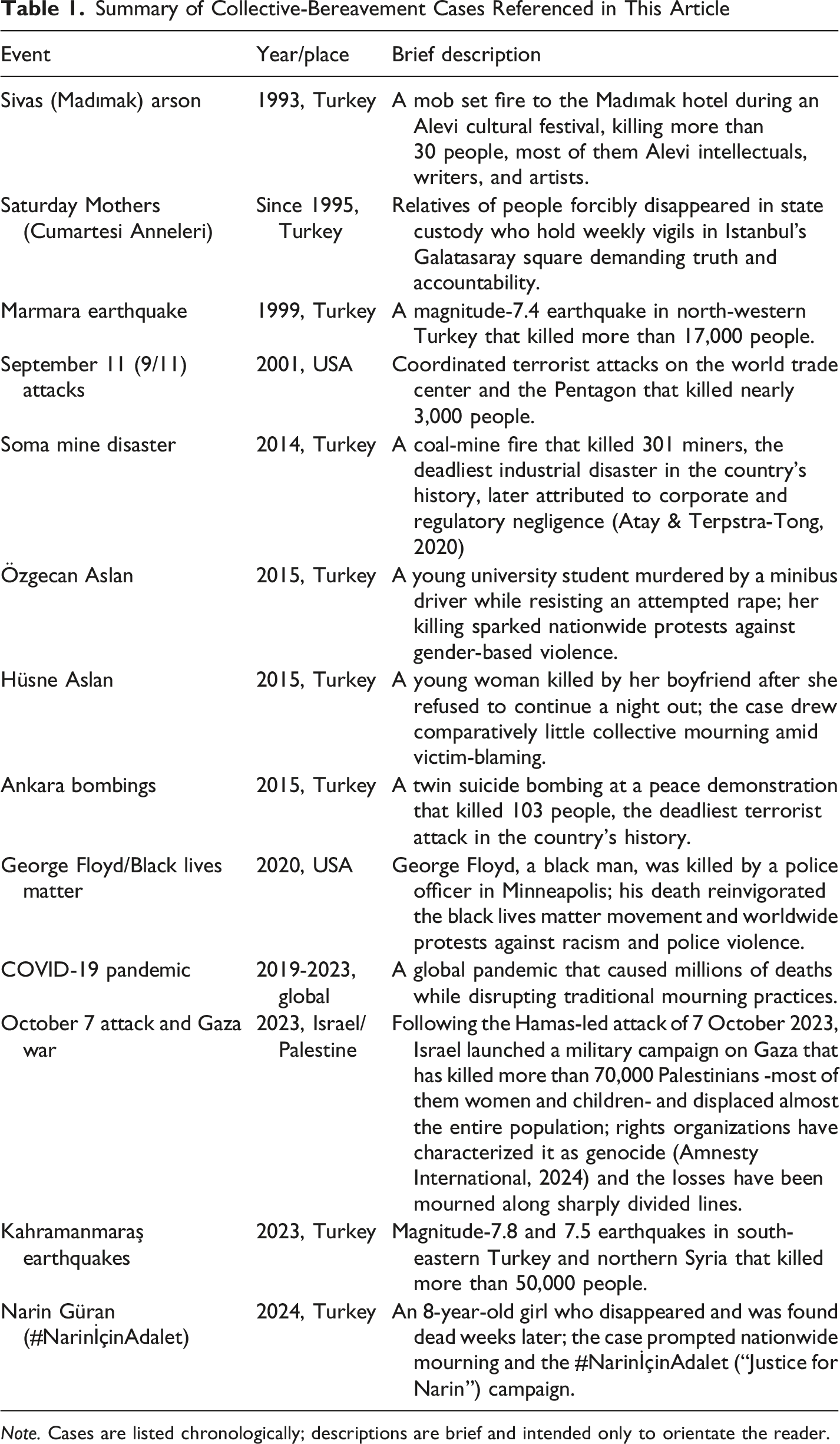
Note. Cases are listed chronologically; descriptions are brief and intended only to orientate the reader.
The Limits of Individual-Level Approaches to Bereavement
Models focused on individual intrapsychic processes have dominated contemporary bereavement research. The influential Dual Process Model (DPM; Stroebe & Schut, 1999, 2010), for instance, conceptualizes grief as an oscillation between loss-oriented and restoration-oriented coping. Similarly, Continuing Bonds Theory (Klass et al., 1996) emphasizes the adaptive maintenance of symbolic connections with the deceased, while task-based models (Worden, 2009) identify specific psychological challenges the bereaved must navigate. While these approaches have significantly advanced our understanding of individual grief and informed clinical practice, they face critical limitations when applied to collective phenomena.
First, individual-level models assume that grief stems from personal attachment, a direct relationship of kinship, acquaintance, or emotional closeness. Collective bereavement, however, frequently involves mourning for individuals whom the mourner has never met. The traditional attachment framework cannot readily explain why the death of a distant stranger should evoke a profound and visceral grief response. Second, these models focus on intrapsychic dynamics, largely neglecting the social and intergroup mechanisms that transform grief into a shared reality. While they acknowledge that grief occurs within a social context, they do not theorize how it becomes thoroughly shared at the group level. Third, they treat bereavement primarily as a distressing state to be resolved or integrated, rather than as a potentially transformative social force capable of mobilizing collective action, reshaping group identities, and altering intergroup relations.
To be sure, some scholars have recognized the social dimensions of loss. Walter (1996) biographical model emphasizes meaning-making through social conversation, and research on disenfranchised grief (Doka, 1989, 2002) highlights how social norms dictate the legitimacy of mourning. Furthermore, studies on collective trauma (Alexander, 2004) and collective memory (Halbwachs, 1992) examine how communities construct shared narratives around catastrophic events. From a cultural psychological perspective, Wagoner and Brescó de Luna (2022) argue that collective grief is not merely aggregated individual sadness but is experienced in the “first-person plural”, a “we grieve” mediated through rituals and memorial sites.
Yet, while valuable, these approaches lack a systematic account of the specific psychological mechanisms through which private pain translates into collective experience. They describe that collective grief exists, but they do not specify how it operates at the intersection of individual cognition and group membership. What is required is a framework that can specify: (a) how losses are appraised as group-relevant rather than merely personal; (b) the mechanisms through which private sorrow transforms into a shared emotional reality; (c) the phenomenological distinction between collective bereavement and aggregated individual grief; and (d) the unique functions that shared mourning serves for both the individual and the collective. I propose that IET and SCT provide the necessary conceptual resources to build such a framework.
Theoretical Foundations: From Social Identity to Collective Emotions
Social Identity and Self-Categorization
Social Identity Theory (SIT; Tajfel & Turner, 1979) and its cognitive elaboration, Self-Categorization Theory (SCT; Turner et al., 1987), provide foundational insights into how individual psychological processes become collective. SIT proposes that individuals derive a significant portion of their self-concept from social group memberships, imbuing these identities with emotional and evaluative significance. Consequently, the motivation to maintain a positive social identity shapes how individuals perceive and respond to both in groups and outgroups. SCT further specifies the cognitive mechanisms of this process, noting that individuals categorize themselves at varying levels of abstraction, ranging from the unique individual (personal identity) to specific groups (social identity) and even to humanity as a whole (superordinate identity). The salience of a particular identity depends on contextual factors that render group membership psychologically prominent, leading to depersonalization. This shift does not imply a loss of self; rather, it represents a cognitive transition where the individual perceives themselves through the lens of the group’s defining attributes (Turner, 1985). Depersonalization is central to understanding collective phenomena. When depersonalized, individuals see themselves as interchangeable exemplars of the group rather than unique persons, assimilating their thoughts, feelings, and motivations to group norms (Turner et al., 1994). For collective bereavement, the implication is profound: when a social identity is salient, a loss affecting the group is experienced as a loss affecting the self. This mechanism explains how people can genuinely grieve for strangers who share their group membership; the deceased is not a “stranger,” but a fellow member of the “we.”
Intergroup Emotions Theory
Intergroup Emotions Theory (IET; Mackie & Smith, 2015; Smith, 1993; Smith & Mackie, 2015) extends these principles into the affective domain, suggesting that emotions can be experienced on behalf of a group. According to IET, when individuals identify with a social group, they appraise events not only for their personal implications but also for their consequences for the group. These group-based appraisals generate affective experiences that arise from, and are directed toward groups, namely intergroup emotions. IET distinguishes these group-level emotions from mere aggregated individual emotions through four criteria (Smith et al., 2007): (a) they are distinct from an individual’s personal emotions regarding the same target; (b) they depend on the strength of group identification; (c) they are socially shared and converge among group members; and (d) they motivate and regulate specifically group-level behaviours, such as collective action.
While research has documented group-based anger, guilt, and pride (Mackie & Smith, 2018), the specific dynamics of group-based grief (named as collective bereavement in this article) remain under-explored. I propose that collective bereavement is a distinct group-based emotion that emerges when individuals appraise a loss as relevant to a shared identity. This conceptualization offers several theoretical advantages. First, it explains the “grief for strangers” paradox through the lens of group-relevant appraisal. Second, it predicts that the intensity of collective bereavement will fluctuate according to the strength of group identification. Third, it frames collective bereavement as a motivational force for collective action. Last, this perspective distinguishes collective bereavement from concurrent individual grief by identifying the group-level appraisal and identification processes that make sorrow genuinely shared.
Collective Emotions: Conceptual Clarifications
Recent scholarship has sought to clarify the diverse varieties of collective emotional experience (Goldenberg et al., 2020; von Scheve & Ismer, 2013). Thonhauser (2022) proposes a taxonomy distinguishing among several modes: emotional sharing (jointly feeling an emotion from a collective perspective), emotional contagion (the automatic spread of affect), emotional matching (similar emotions without shared intentionality), emotional segregation (separating personal from collective experience), and emotional fusion (the merging of self and collective in affect).
Collective bereavement, as conceptualized here, primarily involves emotional sharing in Thonhauser’s sense: group members jointly experience grief regarding a loss they collectively appraise as significant to their group. This grief is “shared” in a robust sense; it arises from a collective evaluative perspective by appraising the loss from the standpoint of the group rather than being merely parallel individual reactions.
However, collective bereavement is a dynamic process that may incorporate other elements of this taxonomy. Emotional contagion often amplifies and accelerates the spread of grief through social networks and digital media. Conversely, some individuals may engage in emotional segregation, acknowledging the collective tragedy while compartmentalizing it from their private emotional lives. In particularly intense cases, emotional fusion may occur, where the boundaries between personal sorrow and collective mourning dissolve entirely. Specifying these nuances is essential for understanding how collective bereavement emerges, intensifies, and is sustained over time.
The Originality of the Present Framework
The present model advances beyond existing scholarship in four specific ways that existing theories cannot accomplish individually. First, cultural trauma theories (e.g., Alexander, 2004; Smelser, 2004) explain how communities construct shared narratives around catastrophe, but they operate at the macro level of cultural discourse and cannot specify the individual-level psychological mechanisms -appraisal, identity salience, group-based emotion-through which private pain becomes shared sorrow. The present model fills this explanatory gap. Second, theories of collective memory (Halbwachs, 1992) and “chosen traumas” (Volkan, 1997) address long-term mnemonic consequences of loss but do not specify the immediate emotional and motivational dynamics through which grief first becomes collective. The present model foregrounds these proximal processes as a prerequisite for understanding any downstream memory effects. Third, accounts of the social sharing of emotions (Rimé, 2009) and collective effervescence (Collins, 2004) describe how affect spreads and intensifies, but they cannot explain the “grief for strangers” paradox: why individuals who had no personal relationship with the deceased nonetheless experience genuine, intense grief. The present model resolves this paradox through the concept of group-based appraisal, which shifts the unit of loss from the personal to the collective. Fourth, while IET has been applied extensively to intergroup anger and guilt (Mackie & Smith, 2018), bereavement has not been theorized as a group-based emotion within this framework. By doing so, the present model both extends IET to a new emotional domain and integrates it with the bereavement literature in ways that enrich both fields. Together, these advances mean the present model does not merely synthesize existing accounts but identifies mechanisms that none of the existing frameworks individually specifies.
A Dynamic Process Model of Collective Bereavement
Collective bereavement is not merely the aggregation of individual grief responses (Stroebe & Schut, 1999), nor can it be reduced to emotional contagion or momentary collective sadness (von Scheve & Ismer, 2013). Rather, it represents a qualitatively distinct process in which loss is experienced, interpreted, and responded to through a salient social identity (Mackie & Smith, 2015; Turner et al., 1987). What distinguishes collective bereavement is the transformation of private grief into a group-based emotional experience oriented toward a shared “we,” accompanied by collective meaning-making and coordinated social responses (Páez et al., 2015). Unlike coincident individual mourning, collective bereavement entails normative expectations about how group members should feel, remember, and act, thereby linking emotional experience to social identity, moral judgment, and collective action (van Zomeren et al., 2008).
Building on these foundations, I propose a model identifying four sequential and interacting stages: (1) event appraisal as group-relevant loss, (2) social identity salience activation, (3) group-based emotional experience, and (4) collective coping responses. While the stages follow a general sequence, they interact dynamically, with later stages providing feedback that reinforces or reshapes earlier ones. Figure 1 provides a schematic representation of the model. A dynamic process model of collective bereavement. Note. Solid arrows = primary process pathways. Dashed arrow = conditional feedback mechanism (Stage 4 reinforces Stage 1)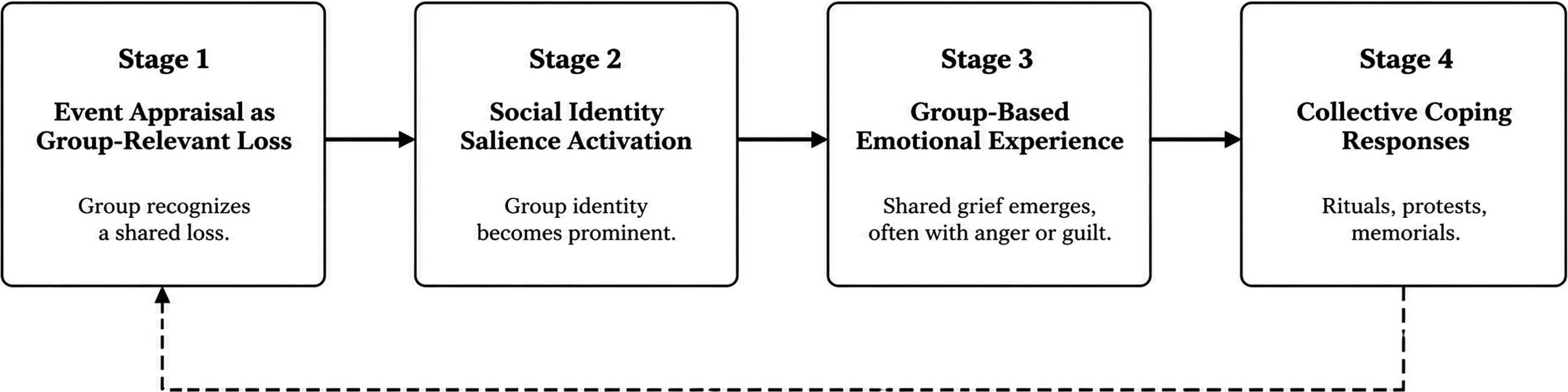
Stage 1: Event Appraisal as Group-Relevant Loss
Existing bereavement models assume that grief requires personal acquaintance with the deceased, and thus cannot explain mourning among strangers. This stage addresses that gap by specifying how loss is appraised at the group rather than personal level. The process begins when an event is appraised as a loss relevant to a social group. Not all deaths trigger collective bereavement; the appraisal process acts as a “gatekeeper” involving three interrelated components. First, the event must involve the perception of significant loss, which includes not only mass death but also symbolic losses such as the destruction of cultural sites or the erosion of collective rights. The COVID-19 pandemic, for instance, involved not only loss of life but also the disruption of social rituals and the erosion of communal life itself (Stroebe & Schut, 2021).
Second, the loss must be perceived as affecting a group rather than merely isolated individuals: a single death may trigger collective bereavement if the deceased is perceived as representing a meaningful social category, where “one of us” has been lost.
Third, the appraisal process involves causal attribution and perceived injustice. Drawing on appraisal theories of emotion (Lazarus, 1991; Smith & Ellsworth, 1985), I propose that how a loss is explained shapes the emotional response it evokes: losses attributed to identifiable outgroup agents, or perceived as preventable and unjust, evoke more intense collective grief mixed with anger.
This is vividly illustrated by the differential responses to femicides in Turkey. The murder of Özgecan Aslan, a young woman killed while resisting a sexual assault, generated unprecedented collective grief because she was appraised as an “innocent” victim. In contrast, cases like that of Hüsne Aslan who was killed shortly after by her boyfriend, received minimal collective response due to victim-blaming attributions that violated conservative norms (Lerner, 1980). This highlights how moral framing functions as a gatekeeping mechanism for collective mourning.
Media plays a crucial role in shaping these appraisals. Extensive media coverage constructs events as nationally or globally significant, frames deaths as affecting particular communities, and provides narratives attributing causality and assessing justice. Social media has amplified these dynamics, enabling rapid dissemination of information and collective sense-making in real time (Proust, 2024). The framing of losses as affecting “us”, whether through nationality, identity category, or shared humanity shapes which social identities become relevant to the bereavement response.
Stage 2: Social Identity Salience Activation
Prior accounts of collective emotion have not specified the conditions under which group membership becomes psychologically active during bereavement. This stage provides that specification. When a loss is appraised as group-relevant, the corresponding social identity becomes salient. Following Self-Categorization Theory (SCT), this salience depends on accessibility (the readiness of the identity) and fit (how well the identity accounts for the current context). Identity salience is intensified when the loss involves intergroup dimensions, such as a perceived threat from an out-group.
Importantly, multiple identities may be activated simultaneously. A single tragedy might activate national, religious, or superordinate human identities. The specific configuration of these identities determines who is included in the grieving “we” and who remains an outsider (Reicher & Hopkins, 2001).
Stage 3: Group-Based Emotional Experience
This stage is what distinguishes genuine collective bereavement from mere emotional contagion or coincident individual sadness: the grief is experienced not as personal sorrow that happens to be shared, but as an emotion arising from and directed toward a collective “we.” Once social identity is salient, individuals experience grief as group members. Consistent with IET, this experience is shared -individuals feel they are mourning “with” others, creating a phenomenology of sharedness even when alone. It is also modulated by identification, meaning those with stronger group identification experience more intense collective grief. Finally, the mourning becomes group-oriented, directed toward “our” dead rather than “my” dead. This group-based grief is often a “cluster emotion,” accompanied by anger toward the responsible party, fear of future threats, or collective guilt.
Stage 4: Collective Coping Responses
Individual bereavement models identify coping responses, but do not theorize their collective analogues or the feedback loops through which coping reconstitutes group identity. This stage provides a novel group-level account of coping that individual models cannot offer. Collective bereavement motivates coordinated responses. Adapting the Dual Process Model to a group level, I distinguish between two orientations. Collective Loss-Orientation encompasses shared rituals such as vigils and moments of silence, as well as the construction of memorials that establish the meaning of the loss. Wagoner and Brescó de Luna (2022) argue these artifacts re-integrate the deceased and the bereaved into the social order. Collective Restoration-Orientation, on the other hand, involves political mobilization, advocacy, and social movements that transform grief into action. The Black Lives Matter movement, reinvigorated by the murder of George Floyd, exemplifies how collective grief motivates sustained action toward systemic change (Proust, 2024). Crucially, these responses create a feedback loop: participating in a ritual reinforces identity salience, which in turn intensifies the emotional experience. This recursive dynamic distinguishes collective bereavement from a one-off emotional reaction, positioning it as an evolving social process.
Functions of Collective Bereavement
I propose that collective bereavement serves four primary functions: enhancing solidarity, sensitizing society, sustaining collective memory, and strengthening belongingness. These functions are interrelated and operate through specific psychological and social mechanisms, explaining why collective bereavement persists as a robust social phenomenon even when the losses are distant in time or space.
Enhancing Solidarity
Following Durkheim, 1965 observation that shared emotional experiences reinforce social cohesion, I argue that collective bereavement enhances solidarity through three key mechanisms. First, shared grief creates perceived similarity among group members. The experience of mourning together signals common values, attachments, and vulnerabilities. Recognizing that others share one’s emotional response reinforces the sense of belonging to a meaningful collective. Second, collective mourning rituals bring people into physical and symbolic proximity, reinforcing awareness of group membership. Vigils, memorial services, and moments of silence create contexts in which group identity is enacted and experienced. Third, the vulnerability exposed by loss may motivate increased interdependence and mutual support among group members. Awareness that “we” are at risk may strengthen bonds of mutual obligation.
Empirical evidence supports this: research following the September 11, 2001 terrorist attacks on the United States (9/11), documented significant increases in national unity and identification (Li & Brewer, 2004; Moskalenko et al., 2006). This solidarity involves both cognitive effects (heightened awareness of shared identity) and motivational effects (a desire to protect group bonds in the face of threat).
Sensitizing Society
Collective bereavement functions as a powerful mechanism for sensitizing society to issues that might otherwise remain invisible or marginalized. By transforming private tragedies into public concerns, this function operates through several pathways. Sustained attention keeps the causes of loss salient long after the immediate event, as media and public discourse continue to engage with the underlying issues. Affective persuasion draws on the emotional intensity of shared grief, which can overcome cognitive barriers to attitude change, since emotions focus attention and motivate action more effectively than dispassionate information (Lerner & Keltner, 2000). Finally, shared grief can reveal structural injustices by unmasking systemic failures or differential vulnerabilities across groups.
The Black Lives Matter movement illustrates this dynamic, where shared grief over police killings transformed individual losses into a global reckoning with systemic racism (Lebron, 2017). Similarly, in Turkey, the Özgecan Aslan case sensitized the nation to femicide, while the more recent Narin Güran tragedy drew attention to failures in child protection. These cases show how shared sorrow translates into heightened awareness of structural vulnerabilities, placing neglected issues at the center of the public agenda.
Sustaining Collective Memory
Collective bereavement contributes to the formation of collective memory -shared representations of the past that define a group’s identity (Halbwachs, 1992; Wagoner & Brescó de Luna, 2022). Brescó de Luna and Wagoner (2019) further show that memorial sites affectively intertwine personal and collective memories, functioning as cultural and historical artifacts that mediate these processes and give meaning to the past in light of present and future challenges. Through mourning rituals, commemorations, monuments, and narrative construction, collective bereavement inscribes losses into the group’s history.
This function is critical because collective memories of loss provide “templates” for interpreting new events. As Volkan (1997) suggests with “chosen traumas,” certain losses become central to identity across generations. In Turkey, annual commemorations of the Soma mine disaster or the 1999 Marmara earthquake serve as occasions where collective remembrance connects past loss to present political demands for accountability and preparedness. However, this function is often a site of struggle; whose deaths are remembered and how they are framed remains a matter of ongoing political negotiation (Schwartz, 2000). Malkinson and Witztum (2000) illustrate this through Israeli bereavement culture, showing how the national mourning narrative evolved from idealization toward individualized grief as the perceived legitimacy of war shifted -a transformation driven by growing tension between official commemoration and personal loss.
Strengthening Belongingness
Finally, collective bereavement can strengthen individuals’ sense of belonging to the group. Participating in shared mourning affirms membership, connects individuals to something larger than themselves, and provides meaning in the face of loss. Research following September 11 found that university students reported increased identification not only with their nation but also with their university, family, and ethnic group (Moskalenko et al., 2006), suggesting that collective bereavement activates and strengthens multiple levels of group belonging.
This belongingness function may be particularly important for marginalized groups: when LGBTQ + or Indigenous communities collectively mourn victims of hate crimes or historical injustices, grief serves as an assertion of group existence and worth. Collective bereavement thus serves an identity-affirming function that may be especially significant for groups facing ongoing marginalization or threat.
Theoretical Propositions
The proposed Dynamic Process Model generates several testable propositions regarding the emergence, intensity, and consequences of collective bereavement. This section outlines these propositions, supported by preliminary evidence from intergroup emotions, social movements, and collective memory research.
Propositions on Emergence and Intensity
Events framed as
group-
relevant
losses elicit stronger collective bereavement than those framed as isolated individual tragedies.
Theoretical basis: IET predicts that group-based appraisals, not personal attachments, are the proximal cause of collective emotion-a claim that individual bereavement models, focused on attachment bonds, cannot make. Evidence for this proposition suggests that group-based portrayals intensify emotional responses (Gordijn et al., 2001). In Turkey, the 2024 murder of Narin Güran was rapidly framed as a national loss affecting “all our children,” generating widespread mourning that transcended regional boundaries. This aligns with findings that perceiving harm as group-level rather than personal is a stronger predictor of collective reaction (van Zomeren et al., 2008).
Higher social identity salience at the time of loss exposure amplifies the intensity of collective bereavement.
Consistent with SCT, subtle category priming triggers group-level emotions (Seger et al., 2009), and the Soma mine disaster illustrates how heightened working-class and national identities united a politically divided public in shared sorrow.
Strength of identification with the affected group positively predicts intensity of collective bereavement, independent of personal ties to victims.
Identification modulates group emotions across contexts (Smith et al., 2007), including post-9/11 grief (Moskalenko et al., 2006) and fan mourning for celebrities (Radford & Bloch, 2012). Identification with “Turkish womanhood” similarly predicted stronger grief after Özgecan Aslan’s murder, and parental/national identification drove responses to Narin Güran in 2024.
Perceived injustice and victim innocence intensify collective bereavement, particularly its anger and outrage component.
Unjust, preventable losses threaten just-world beliefs (Lerner, 1980), heightening moral outrage among identified group members. The contrast between the nationwide mourning for Özgecan Aslan and the minimal response to Hüsne Aslan (whose death was moralized and subjected to victim-blaming) illustrates how innocence appraisals act as a “gatekeeper” for collective grief: having a boyfriend outside marriage enabled victim-blaming that suppressed mourning. Similarly, following the 2023 earthquakes, grief was selectively regulated: deaths attributed to structural negligence evoked outrage, while those associated with rule violations were often moralized and normalized.
Extensive, emotionally evocative media coverage expands the scope and intensity of collective bereavement.
Digital mourning hashtags, such as #NarinİçinAdalet (“Justice for Narin”), nationalize regional grief through emotional contagion (Proust, 2024). Social networks facilitate massive-scale affective spread (Kramer et al., 2014), transforming local tragedies into global or national phenomena. This dynamic is perhaps most strikingly illustrated by the global spread of collective bereavement following the events in Gaza, where hashtags such as #GazaGenocide and #FreePalestine mobilized hundreds of millions of users across platforms, transforming geographically distant suffering into a globally shared emotional experience (Amnesty International, 2024). These cases collectively demonstrate that digitally mediated mourning can transcend national boundaries, though the scope of collective bereavement remains shaped by whose losses are deemed visible and grievable in the first place (Butler, 2009).
Propositions on Functions and Consequences
Collective bereavement temporarily enhances ingroup solidarity and prosocial behaviour.
SCT predicts that shared identity-relevant experiences increase perceived ingroup similarity; IET further predicts that co-experienced group emotions create motivational convergence toward prosocial action. Shared grief reinforces social bonds through emotional synchrony. Post-9/11 research documented short-term increases in trust and prosociality (Putnam, 2002), and symbolic expressions of national solidarity (Skitka, 2005), while ritual studies show shared emotional arousal strengthens cohesion (Collins, 2004; Páez et al., 2015). For example, in Turkey, major tragedies like Soma mine disaster briefly bridged political divides through common mourning rituals.
Collective bereavement following preventable or systemic losses increases support for structural change.
Grief combined with injustice appraisals motivates demands for reform. Social movement research links moral emotions to collective action (Jasper, 2011; van Zomeren et al., 2008). In Turkey, collective grief over the 2015 Ankara bombings (the deadliest terrorist attack in the country’s history, killing 103 people at a peace demonstration) fuelled demands for security reforms, while the 2023 earthquakes transformed shared sorrow into protests against negligent building codes and disaster preparedness, which is consistent with international examples like Black Lives Matter.
Participation in collective mourning rituals sustains collective memory and strengthens
long-
term
group identification.
Mourning practices preserve memories of “chosen traumas” (Volkan, 1997) which are losses that become central identity anchors across generations. Several cases illustrate this dynamic. The Saturday Mothers, holding weekly vigils in Istanbul since 1995, have transformed private grief into enduring political resistance, sustaining memory despite official silence. Historical traumas such as the Holocaust, the Srebrenica genocide, and the Alevi community’s commemorations of the Sivas Madımak arson (the killing of more than 30 people, most of them Alevi intellectuals, in a hotel fire in 1993 in Turkey) exemplify how ritualized mourning keeps historical losses alive, fostering intergenerational vigilance and solidarity. In contemporary conflict, the Israel-Palestine case illustrates how recent events, such as the events of October 7, 2023 Hamas-led attack on Israel and the destruction in Gaza, reactivate historical traumas like the Holocaust and the Nakba, cementing collective memory through ongoing mourning rituals.
Contemporary Applications: COVID-19 and Digital Mourning
The COVID-19 pandemic and the rise of digital mourning practices provide critical contexts for applying and extending the present model. The pandemic created a condition of mass bereavement that simultaneously disrupted traditional mourning rituals, with several consequences the model helps illuminate. Framing the pandemic as a global crisis activated identities at multiple levels (local, national, and human) such that those with higher identity salience experienced these deaths not as individual tragedies but as collective losses. At the same time, restrictions on gatherings impaired the collective coping stage: the inability to perform funerals or wakes disrupted the mechanisms through which bereavement enhances solidarity and sustains memory, contributing to higher rates of prolonged grief (Eisma et al., 2021). Perhaps most strikingly, political polarization produced fragmented grief and emotional segregation (Thonhauser, 2022), with divergent appraisals of the virus’ severity generating incompatible mourning narratives, and deaths sometimes met with schadenfreude rather than sorrow by opposing ideological groups.
Digital platforms have increasingly become sites of collective bereavement, enabling what Proust (2024) terms “digital mourning”. They facilitate each stage of the present model: enabling rapid dissemination of loss-related information, activating social identities through hashtags and shared imagery, allowing expression and observation of others’ grief without physical co-presence, and supporting collective coping through virtual memorials and coordinated action campaigns. Yet digital mourning also carries distinctive risks. As Sontag (2003) cautions, the circulation of images of suffering does not necessarily generate moral engagement; repeated exposure may instead foster distance or compassion fatigue. The architecture of social media may create echo chambers that limit collective bereavement to like-minded communities, while the performative aspects of online mourning introduce further complications. Digital platforms thus present a paradox: they enable unprecedented scale and speed of grief mobilization while simultaneously risking the transformation of profound loss into fleeting, consumable spectacle.
General Discussion
I have proposed a process model of collective bereavement grounded in Intergroup Emotions Theory and Self-Categorization Theory. The model specifies how collective bereavement emerges through sequential stages: group-relevant appraisal of loss, social identity salience, group-based emotional experience, and collective coping responses. It identifies four functions – enhancing solidarity, sensitizing society, sustaining collective memory, and strengthening belongingness – and specifies mechanisms through which these functions operate. It develops theoretical propositions regarding conditions, intensity, and consequences of collective bereavement, supported by preliminary evidence from diverse research domains.
To recapitulate its distinctive contributions, whereas cultural trauma theory (Alexander, 2004) describes collective narratives but not psychological mechanisms, whereas collective memory theory (Halbwachs, 1992) addresses mnemonic outcomes but not proximal emotional processes, and whereas social sharing of emotions (Rimé, 2009) describes affective transmission but not why grief becomes collective for those without personal ties, the present model uniquely specifies the appraisal-identity-emotion-coping sequence that transforms private pain into shared sorrow. It is the only framework that simultaneously addresses the “grief for strangers” paradox, predicts intensity variation as a function of group identification, and specifies functional consequences at the group level. This framework further contributes to psychological theory. First, it provides theoretical grounding for understanding collective bereavement as a distinct phenomenon rather than merely aggregated individual grief. By conceptualizing collective bereavement as a group-based emotion emerging from social identity processes, I specify what makes grief genuinely collective and distinguish it from coincidentally similar individual responses. This addresses the fundamental question of why people grieve for strangers with whom they share group membership.
Second, the model integrates insights from bereavement research with advances in understanding collective emotions and intergroup processes. This integration is bidirectionally valuable: bereavement research gains theoretical resources for understanding collective phenomena, while intergroup emotions research gains a substantive domain -grief and loss-that is both socially significant and emotionally intense. The model thus contributes to both literatures while demonstrating their potential for productive integration.
Third, by specifying mechanisms and developing propositions with preliminary evidentiary support, the model provides a foundation for cumulative empirical research. Rather than simply describing collective bereavement, it identifies testable claims about processes and outcomes that can be examined in diverse contexts. This generativity is essential for a theoretical contribution to advance the field.
Practical Implications
The model has implications for practice in several domains. For public health, understanding collective bereavement processes can inform responses to mass casualty events, including pandemics. Interventions that facilitate collective mourning rituals, validate group-based grief, and channel collective emotion into constructive collective action may promote community resilience and recovery. The pandemic’s disruption of collective mourning underscores the importance of these practices.
For social movements, the model illuminates how collective grief can become a resource for mobilization. Movements emerging from shared loss transform bereavement into collective action. Understanding the processes through which this transformation occurs can inform movement strategy and sustainability.
For intergroup relations, the model suggests both opportunities and risks. Collective bereavement can bridge divides when losses are framed as affecting shared humanity, but it can also deepen divisions when losses are attributed to outgroups or when grieving communities are defined narrowly. How collective losses are commemorated shapes collective memory and identity in ways that affect intergroup relations for generations.
A further implication concerns how societies accommodate collective bereavement. Contemporary societies have increasingly privatized mourning, yet the present model shows that collective bereavement serves vital functions private grief alone cannot fulfill: solidarity, sensitization, memory, and belongingness. Effective collective grief spaces require accessibility, ritual structure, and public visibility; resources that marginalized groups, whose losses often go unrecognized in official commemorations, must frequently create for themselves. Recognizing collective bereavement as distinct from individual grief should move practice beyond therapeutic individualism toward shared spaces for mourning that serve both healing and social transformation.
The “Dark Side”: Selective Grievability and Conflict
Collective bereavement, while serving adaptive functions, also carries significant risks that warrant explicit attention. First, it can foster selective mourning: certain victims may be deemed more “grievable” (Butler, 2004, 2009) based on perceived innocence, group membership, or alignment with dominant norms, rendering other losses invisible or illegitimate. The Israel-Palestine conflict exemplifies this asymmetry: while the October 7, 2023, attacks generated widespread global mourning for Israeli victims, the subsequent military operations in Gaza, resulting in tens of thousands of Palestinian deaths, have received markedly less collective recognition in many Western contexts, reinforcing hierarchies of whose lives are deemed publicly grievable (Amnesty International, 2024; Butler, 2009, 2015).
On both sides, collective grief has been instrumentalized politically as fueling hostility, moral polarization, and the justification of violence illustrating how unresolved and unequal recognition of collective bereavement can perpetuate intergroup conflict rather than enable reconciliation or healing (Alexander, 2004; Bar-Tal et al., 2014; Volkan, 2001). This selectivity reinforces social hierarchies and marginalizes already vulnerable groups. Second, when intertwined with attributions of outgroup responsibility, collective grief can escalate into intergroup hostility, scapegoating, or retaliatory violence which are the dynamics observed in post-trauma intergroup relations (e.g., Bar-Tal, 2007). Third, collective bereavement is vulnerable to political instrumentalization: leaders and movements may exploit shared grief to mobilize support, justify repressive policies, or deepen societal polarization, transforming sorrow into a tool for division rather than healing. Finally, prolonged or unresolved collective bereavement may contribute to societal-level emotional exhaustion or “compassion fatigue,” hindering constructive responses to ongoing crises.
Acknowledging these dark sides underscores the need for theoretical and empirical work examining boundary conditions under which collective bereavement becomes maladaptive or divisive.
Limitations and Future Directions
Several limitations merit acknowledgment. First, while grounded in well-established theories and supported by preliminary evidence, the present model requires direct empirical testing. The propositions I have developed need examination through diverse methodologies—experimental studies, longitudinal surveys, qualitative investigations of natural instances of collective bereavement, and computational analyses of collective mourning in digital contexts.
Second, the model has been developed primarily with reference to Western cultural contexts. Research in diverse cultural settings is needed to assess generalizability. Cultures vary considerably in grief expression norms, collective identity structures, and the social functions of mourning (Rosenblatt, 2008). While I believe the basic processes the present model specifies are general, their specific manifestations likely vary across cultural contexts in ways requiring investigation.
Third, I have focused primarily on bereavement following death. Extension to other collective losses such as destruction of valued places, loss of collective rights, symbolic defeats warrants investigation. While I expect similar processes to apply, the specific dynamics may differ for non-death losses.
Future research should examine neurobiological correlates of collective versus individual grief, cross-cultural variations in mourning practices, the role of collective bereavement in social movements, and the design of interventions to support adaptive collective grief processing. The continued evolution of digital mourning practices also demands sustained empirical attention.
Conclusion
From pandemics to systemic violence, collective bereavement shapes social life. Understanding the psychological processes through which private pain becomes shared sorrow is essential for theory, research, and practice. The process model I have proposed offers a framework for such understanding, one that honours both the deeply personal experience of grief and its irreducibly social dimensions. In an interconnected world where losses are increasingly visible and shared, where social media broadcasts suffering globally in real time, and where collective identities remain powerful forces in human psychology, the psychology of collective bereavement will only grow in significance. I hope this framework provides a foundation for the theoretical and empirical work needed to understand this fundamental human phenomenon.
Footnotes

Consent to Participate
Not applicable. This article is a theoretical review and does not involve the collection of empirical data from human participants.
Funding
The author received no financial support for the research, authorship, and/or publication of this article.
Declaration of Conflicting Interests
The author declared no potential conflicts of interest with respect to the research, authorship, and/or publication of this article.