






Abstract
Grief is a widespread issue that negatively impacts millions of people each year, necessitating effective grief interventions. Both grief counseling and physical activity have demonstrated benefits for individuals experiencing grief. However, integrating these interventions creates a multidimensional approach that addresses the complexity of grief more holistically. Healing Strides builds upon this concept by combining structured grief counseling with 5K race training. The purpose of this research was to evaluate the impact of the Healing Strides combined grief group counseling and 5K race training intervention on women’s grief-related symptoms and overall well-being. Results post-intervention and at three-month follow-up demonstrated statistically significant increases in grief-related personal growth, coping strategies, and meaning reconstruction as well as statistically significant decreases in grief impairment. This research supports the development of programs that thoughtfully combine bereavement group support with structured physical activity training.
Introduction
Approximately 3.4 million people die in the United States (U.S.) each year, leaving behind millions of family members and friends who must navigate the complex emotional and psychological challenges of loss (Murphy et al., 2024). That amounts to nearly 8,342 people who die each day in the U.S., making grief a widespread experience that affects a significant portion of the population (World Population Review, 2024). Some of the negative outcomes of grief include mental health issues such as depression, anxiety, and suicidal ideation (Crunk et al., 2017). With such a high number of grieving individuals, there is a critical need for grief-focused programs and resources to help people cope in healthy and productive ways and to mitigate the lasting impact of loss on mental and emotional well-being.
Guilt and shame are frequent effects of grief, made worse by social isolation (LeBlanc et al., 2020). The therapeutic value of bereavement support groups has been well-established in reducing social isolation and promoting peer connections among grieving individuals (Burke & Neimeyer, 2013). These structured interventions provide participants with opportunities to share experiences, normalize their grief responses, and develop meaningful relationships with others who understand their journey. Research demonstrates that the effectiveness of bereavement groups largely depends on skilled facilitation and evidence-based counseling techniques integrated into group processes (Johannsen et al., 2019).
Participants in grief support groups report several key benefits, including finding normalcy through connection with other bereaved individuals, receiving and providing emotional support, learning practical coping strategies from peers, and developing hope for their continued grief journey (Dyregrov et al., 2013). The power of mutual aid in grief counseling emerges through shared experiences that provide significant emotional comfort and reduce feelings of isolation (Knight, 2014).
Unfortunately, bereavement groups are not always effective. The effectiveness of bereavement groups varies, with small to moderate short-term effects on reducing grief symptoms and depression, though these benefits may diminish over time without continued intervention (Maass et al., 2020). However, grief outcomes for bereaved individuals can be positively influenced by engaging in physical activities, particularly those conducted outdoors and within a team setting (Williams et al., 2021). These activities foster mindfulness, relaxation, emotional expression, and social support. Furthermore, team-based physical activities enable grieving individuals to build friendships and strengthen their social support networks. For many, physical activity also contributes to a reduction in the emotional and physical burdens associated with grief (Williams et al., 2021, 2024). Such activities also help alleviate grief’s physical and emotional burdens, enhance resilience, and promote positive emotions (Grimby et al., 2008; Li et al., 2016; Williams et al., 2021).
The Healing Strides program is unique in its design as structured grief counseling with 5K race training. The program incorporates best practices in grief counseling by emphasizing social connection, physical well-being, and psychological growth and is grounded in theoretical frameworks including the Integrated Process Model (IPM; Guldin & Leget, 2023), the Dual Process Model of Coping with Bereavement (Stroebe & Schut, 1999), and Worden’s Tasks of Mourning (Worden, 2018). Group facilitators and mentors in Healing Strides receive specialized training, led by a Fellow in Thanatology, with receipt of a training handbook, a two-hour session focused on grief theory and practice, and observation of all group counseling sessions. The program emphasizes group cohesion and feedback while integrating physical activity with grief processing to support emotional and physical well-being. This type of approach holds promise as an effective alternative to individual therapy and is a unique multidimensional approach to grief support.
Literature Review
Healing Strides was developed with several elements in mind: (1) physical activity as a therapeutic intervention for grief, (2) the adaptation of mindfulness-based interventions to grieving populations, and (3) integrating group support with physical activity.
Physical Activity as a Therapeutic Intervention for Grief
Emerging research highlights the significant role of physical activity in supporting individuals through the bereavement process. Williams and colleagues (2021) identified six key therapeutic benefits of exercise for grieving individuals: providing emotional escape and mental clarity, serving as an outlet for processing difficult emotions such as anger and frustration, fostering social connections and community support, building confidence through goal achievement, helping individuals reconnect with their identity and establish routine, and improving overall physical and psychological health.
The impact of physical activity on bereaved populations extends beyond immediate emotional benefits. A longitudinal study of elderly widows revealed that those who maintained regular walking habits experienced better physical health outcomes, stronger immune responses, and preserved social networks compared to sedentary counterparts (Grimby et al., 2008). Similarly, widows who engaged in regular physical activity, including brisk walking for 15–30 minutes daily, experienced improved mental health, better sleep quality, reduced dependence on psychoactive medications, and decreased risk of depression (Li et al., 2016). Remarkably, physically active widows demonstrated a 14% mortality advantage over inactive married women, adding approximately four years to their life expectancy (Li et al., 2016).
The therapeutic mechanisms of physical activity in grief recovery appear multifaceted. Exercise provides a distraction from acute grief symptoms while simultaneously facilitating emotional processing and offering opportunities for cathartic release of negative emotions (Williams et al., 2023). Physical activity also promotes neurobiological changes that support emotional regulation, mindfulness, and resilience, which are critical components in adapting to loss (Williams et al., 2021).
The Adaptation of Mindfulness-Based Interventions to Grieving Populations
The integration of mindfulness practices with bereavement support requires careful adaptation to meet the unique needs of grieving populations. Loucks and colleagues (2022) developed a comprehensive framework for adapting mindfulness-based programs (MBPs) to specific populations and contexts, emphasizing the importance of systematic modifications that maintain evidence-based effectiveness while addressing population-specific requirements. This framework supports the development of interventions that combine mindfulness training with other therapeutic modalities, such as physical activity and peer support (Loucks et al., 2022).
Yoga is a physical activity that incorporates mindfulness and meditation. Research on yoga interventions for bereaved individuals shows mixed but promising results. Women with PTSD following stillbirth who completed 150 minutes of weekly yoga practice over 12 weeks demonstrated significant symptom improvement (Huberty et al., 2020). However, other studies combining mindfulness and yoga with traditional grief counseling have shown less consistent results, particularly among geriatric populations (O'Connor et al., 2014).
Integrated Approaches: Combining Group Support With Physical Activity
The combination of structured bereavement support with physical activity training addresses multiple dimensions of grief recovery. This integrated approach leverages the social support benefits of group participation while incorporating the emotional regulation and resilience-building effects of exercise. The progressive nature of training programs, such as those that gradually build from walk-run intervals to sustained running or brisk walking, provides participants with achievable goals and measurable progress markers that can enhance self-efficacy during a period often characterized by feelings of helplessness and loss of control (Plateau et al., 2022).
The timing and structure of combined interventions are critical to their effectiveness. Research suggests that technique-based interventions, including grief support groups and physical activities, demonstrate more consistent effectiveness in alleviating grief symptoms compared to theory-based approaches alone (Asgari et al., 2022). This finding supports the value of programs that integrate peer support with active, goal-oriented physical training.
Description of the Healing Strides Program
The Healing Strides program incorporates a comprehensive, holistic approach to grief support by combining group counseling with 5K race training, emphasizing the interconnectedness of mental and physical well-being. The program spans a duration of seven weeks, and each session includes 1 hour of grief counseling facilitated by a Fellow in Thanatology (the study of death, dying, and bereavement) and 1 hour of structured race training led by an experienced running coach, supported by volunteer mentors. The training and group therapy components address both the physical and emotional dimensions of grief while honoring the participants’ loss. This dual approach offers participants therapeutic tools and physical activity to navigate their grief journey while fostering resilience and personal growth.
In the group counseling component of the program, counselors create a supportive and confidential setting where participants can openly share stories of their deceased loved ones, process emotions, and participate in therapeutic discussions. Counselors use evidence-based approaches to help individuals navigate their grief, build effective coping strategies, and tackle the emotional and relational challenges associated with loss.
Healing Strides addresses the multidimensional nature of grief, aligning closely with the Integrated Process Model (IPM), which conceptualizes grief through physical, emotional, cognitive, social, and spiritual dimensions (Guldin & Leget, 2023). In addition, the program aligns with contemporary grief frameworks, which move beyond the limitations of stage-based theories. Healing Strides draws its conceptual foundation from established grief theories, including the Dual Process Model of Coping with Bereavement (Stroebe & Schut, 1999) and Worden’s Tasks of Mourning (Worden, 2018), which guide the program’s integrated approach to grief management.
The Healing Strides program incorporates key existential tensions described in the IPM (Guldin & Leget, 2023): • Physical Dimension: Training for a 5K race helps participants regulate stress, restore energy, and engage in physical routines, aligning with the task of “finding ground again (p.742).” • Emotional Dimension: Group therapy sessions provide a space for emotion regulation, where participants process grief-related feelings and develop self-compassion. • Cognitive Dimension: Through psychoeducation and reflective practices, participants reconstruct their understanding of loss and their relationship with the deceased. • Social Dimension: Structured group sessions and camaraderie built through shared training reduce isolation and foster connection, balancing the tension between aloneness and connectedness. • Spiritual Dimension: Rituals and meaning-making exercises encourage participants to find purpose and transcendence, addressing the existential tension between meaning and meaninglessness.
The Dual Process Model, developed by Stroebe and Schut (1999), emphasizes oscillation between loss-oriented and restoration-oriented processes. Loss-oriented processes focus on the emotional and cognitive aspects of grief, such as confronting the pain of loss and processing difficult emotions. Restoration-oriented processes involve focusing on rebuilding life after loss, such as adjusting to new roles, routines, and a future without the deceased. The structure of the Healing Strides program reflects these components by integrating both aspects of the Dual Process model into the program.
During group counseling sessions, participants engage directly with loss-oriented processes by engaging directly with their grief, sharing their stories, reflecting on their relationships with the deceased, and exploring the impact of their loss on all areas of their life. These sessions create a safe and structured environment for exploring the emotions of their loss, promoting emotional regulation, and offering coping strategies to process the sadness, anger, and other emotions that accompany grief.
The physical activity component of Healing Strides is rooted in the restoration-oriented processes of the Dual Process Model (Stroebe & Schut, 1999), encouraging participants to focus on goal setting, routine development, and enhanced physical well-being. As they prepare for the 5K race, participants engage in activities that promote physical health, mental well-being, and personal growth. The physical training fosters a sense of accomplishment, empowering participants, enhancing self-confidence, and providing a structured way to redefine their lives in the face of loss.
Worden’s model outlines four tasks in which grieving individuals engage (Worden, 2018). Healing Strides integrates these tasks into its program structure: (1) Accept the Reality of the Loss: Group counseling sessions create a supportive environment where participants can share their experiences, openly confront the reality of their loved one’s death, and receive validation from others who are grieving. (2) Process the Pain of Grief: Therapeutic discussions, guided imagery, and mindfulness exercises, incorporated into each session, allow participants to explore and express the emotional aspects of their grief. (3) Adjust to a World Without the Deceased: The physical activity component promotes the development of new routines and coping mechanisms, encouraging participants to adapt to a life reshaped by loss. Goal setting and the physical challenges of preparing for a 5K race empower participants to build a life that acknowledges their loved one’s absence and adapt to the changes they experience. (4) Find an Enduring Connection with the Deceased While Moving Forward: On race day, participants wear racing bibs on the backs of their shirts that state, “In every step I take, I make in memory of [name],” honoring the memory of their loved one. Completing the 5K race serves as a powerful metaphor for personal growth and resilience, allowing participants to celebrate their achievements while maintaining a meaningful connection with the deceased.
Following the grief counseling portion of each session, participants transition into the 5k race training component of the program. Under the guidance of an experienced running coach supported by volunteer mentors, participants engage in a structured training program designed to prepare them physically and mentally for a 5k race. The training includes exercises to improve cardiovascular endurance, strength, flexibility, and overall fitness. The training program was roughly 1 hour each week, during which time participants engage in stretching/warm-up and then progressively longer spans of exercise, similar to most couch to 5k programs. Participants may engage in interval training, walking, and other running techniques tailored to their individual abilities and fitness levels, and were encouraged to do additional run/walk training on their own.
Integrating physical activity through 5k race training serves multiple purposes within the Healing Strides program. It provides a practical outlet for releasing emotional tension, promotes the production of endorphins and other mood-enhancing chemicals, and offers a sense of accomplishment and empowerment. The physical activity component also encourages participants to set and achieve goals, fostering a positive mindset and promoting overall well-being.
At the culmination of the seven-week program, participants come together to complete a 5k race as a group. This shared experience reinforces the camaraderie and support among participants and symbolizes their progress and resilience in the face of grief. The completion of the race serves as a tangible achievement and a powerful metaphor for the journey of healing and transformation.
The physical activity component of the program includes education and practice on key topics to ensure participants develop a well-rounded approach to their fitness and well-being during 5K race preparation. These topics include: • Good Form Running: Teaches participants proper running techniques, including posture, stride, and foot placement, to enhance efficiency and reduce the risk of injury. • Mindful Movement: Encourages participants to move with awareness, connecting physical activity to their emotional state. • Nutrition: Provides guidance on balanced eating to support physical and emotional resilience. • Hydration: Highlights the importance of staying hydrated for optimal physical performance and mental clarity. • Cross Training: Incorporates various exercises to build overall strength and reduce the risk of injury. • Sleep: Addresses the role of rest in recovery and emotional health.
Methods
The purpose of this research study was to evaluate the impact of the Healing Strides combined grief group counseling and 5K race training intervention on participants’ grief-related symptoms and overall well-being. It was hypothesized that Healing Strides would result in a significant reduction in grief-related symptoms and a significant increase in overall well-being in participants both post-intervention and at three-month follow-up.
Participants
Participants of Healing Strides included 24 women ages 31-65, with a mean age of 50, who have experienced the death of a loved one. Participants were required to physically be able to participate in the 5K training program. 92% of participants self-identified as White and 8% Hispanic. 25% had lost a parent, 17% a spouse, 50% a child, 4% a sibling, and 4% an extended family member. 44% had experienced the death within the past 6 months, 30% within 6–12 months, and 26% within 1-3 years. 96% of participants owned pets (either dogs, cats, or both) and 83% lived with others and 88% had children, with a mean of 2.2 children, while 17% lived alone and 12% had no children. 67% of participants were married or dating, and 33% single. 67% of participants received mental health counseling, beyond Healing Strides, while 33% did not. 50% held spiritual or religious beliefs while 50% did not. 75% reported having a strong social network while 25% did not. 75% worked full time, 4% part-time, and 21% were unemployed/retired.
IRB approval was granted through the first author’s University. Written consent was obtained from subjects interested in participating in the study at the first group counseling session when other program paperwork was completed. The consent form made it clear that participants could quit the study at any time and/or choose not to complete some assessment questions without penalty or it affecting their participation in the Healing Strides program or their relationship with any Healing Strides therapists, coaches, or mentors. The link to 3-month assessments were emailed to subjects and completed via Google Forms, with the same consent forms and assessments included.
Instruments
A repeated measures design was used in order to determine if the intervention had an effect on participants’ grief-related symptoms. Participant progress was assessed using pre- and post-test assessments. The CABLE (Grief Experience Questionnaire; Crunk et al., 2017), Grief Impairment Scale (GIS; Lee & Neimeyer, 2023), and Grief and Meaning Reconstruction Inventory (GMRI; Gillies et al., 2015) were utilized to measure grief-related symptoms, sense of meaning-making and reconstruction, and other relevant outcomes. Assessments were completed prior to the program start as well as at the end of the program and at three months post-program. Data were exported to excel, and analyzed qualitatively, using qualitative coding, and quantitatively, using SPSS. The effect of Healing Strides on reducing grief-related symptoms and increasing overall well-being was evaluated using two-tailed paired-samples t-tests.
Results
Difference in Grief Assessment Scores Pre and Post Healing Strides Intervention (n = 24)
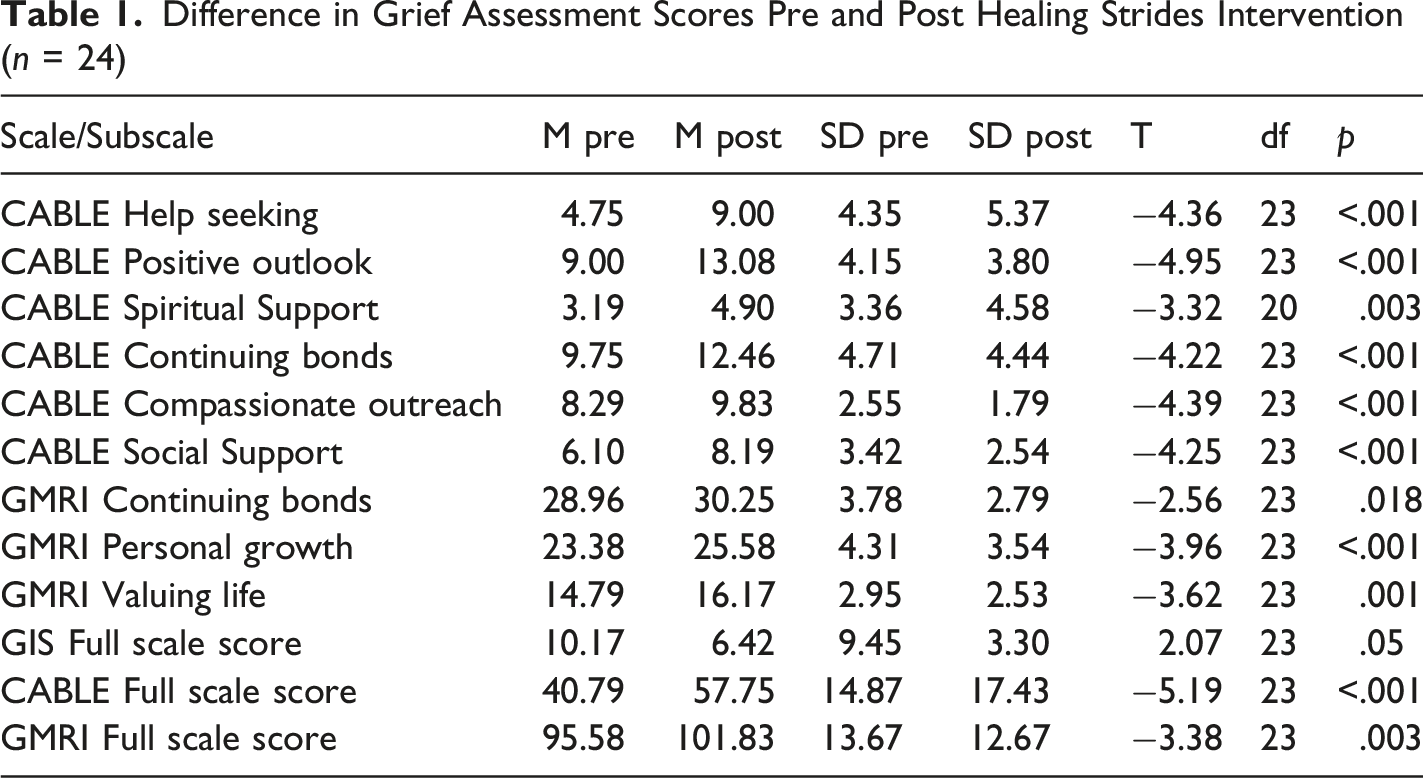
At 3-month follow-up, there was a significant decrease in GIS overall scale scores (t (7) = 2.83, p = .026), as well as a significant increase in the GMRI overall scale score (t (7) = −2.42, p = .046) and the GMRI Personal Growth subscale (t (7) = −2.67, p = .032). These results demonstrate that the impact of Healing Strides persisted through follow-up, with sustained decreased grief impairment and increased grief meaning-making and personal growth at three month-follow-up. These follow-up results are very promising, particularly with a small sample size of participants who have completed the three-month follow-up assessments thus far.
Themes from qualitative coding and analyses indicated that participants found connecting with others, sharing in a group setting, and receiving instruction in mindfulness, grief education, and fitness instruction to be invaluable. For the most salient theme, 65% of participants reported that connecting with others while sharing in a group setting and being able to listen to other participants and know they are not alone in their grief was helpful. Participants noted that “While participants shared their stories it was comforting to know I wasn’t alone,” “It was very helpful to be in a supportive group of others who understood grief,” and “It helped to hear other people’s stories.” When asked what they would take from their experience at Healing Strides and continue to use on their own, the most common themes were using exercise to cope with grief, mindfulness exercises/meditation, self-care, and practicing gratitude. Some participants wrote: “I will continue to use physical activity/exercise to cope with my grief” and “I plan to keep running. I will stay connected with others. I plan to keep in mind some of the lessons about being mindful and kind to myself.”
Discussion
A repeated measures design was used to determine the impact of the Healing Strides intervention on grief-related symptoms. Results of two-tailed paired samples t-tests indicate that Healing Strides significantly improved overall scale scores all measures.
The Coping Assessment for Bereavement and Loss Experiences (Crunk et al., 2017) assessment is a measure of strategies people utilize to cope with their grief, with higher scores indicating more coping strategies utilized. Healing Strides participants demonstrated a statistically significant increase in CABLE scores, thus indicating that their ability to utilize coping strategies to manage their grief increased as a result of the intervention. The Grief and Meaning Reconstruction Inventory (GMRI; Gillies et al., 2015) is a measure of how those experience a loss make meaning of the death and their relationship with the loved one. The GMRI assesses continuing bonds (with deceased person), personal growth, sense of peace, meaningfulness of life, and valuing life with higher scores showing higher grief-related personal growth. High scores on the GMRI indicate significant meaning reconstruction through grief. Healing Strides participants demonstrated statistically significant increase in GMRI scores, indicating that their ability to make meaning of their loss increased as a result of the intervention. The Grief Impairment Scale (GIS; Lee & Neimeyer, 2023) is a brief 5-item scale that measures the impact of grief on everyday life, with questions regarding cognitive and health issues, unhealthy activities, fulfilling responsibilities, and positive engagement with others. High scores on the GIS indicate significant grief impairment. Healing Strides participants demonstrated statistically significant decrease in GIS scores, indicating that their level of grief impairment decreased as a result of the intervention.
At 3-month follow-up, there was a significant decrease in GIS overall scale scores as well as a significant increase in the GMRI overall scale score and the Personal Growth subscale score. These results demonstrate the long-term impact of Healing Strides, with sustained decreased grief impairment and increased grief meaning-making and personal growth at three month-follow-up.
Comparison to Existing Grief Interventions
When compared to traditional grief interventions, Healing Strides demonstrates several advantages. Meta-analyses of grief counseling interventions typically report small to moderate effect sizes (Currier et al., 2008), with many showing limited long-term maintenance. The combination approach in Healing Strides appears to produce effects comparable to or exceeding those reported for individual grief therapy, while potentially offering greater cost-effectiveness through the group format.
Unlike purely cognitive or emotion-focused interventions, Healing Strides addresses the somatic dimensions of grief often overlooked in traditional approaches. The physical symptoms of grief, including fatigue, sleep disturbance, and immune dysfunction, are directly targeted through the exercise component, potentially explaining the broader improvements observed across multiple domains of functioning (Williams et al., 2021).
The structured, time-limited nature of the program (seven weeks) also offers advantages over open-ended grief groups, which research suggests can be problematic due to continuous membership changes and lack of clear progression (Dyregrov et al., 2013). The concrete goal of completing a 5K race provides a tangible achievement that symbolizes progress and resilience, elements often missing from traditional grief interventions.
Implementation Considerations
The Healing Strides research findings support the development of programs that thoughtfully combine bereavement group support with structured physical activity training. Such interventions should incorporate evidence-based counseling techniques, skilled facilitation, progressive physical training protocols, and mindfulness-based stress reduction elements. The social support inherent in group training formats may enhance the individual benefits of both grief counseling and physical activity, creating synergistic effects that address the multidimensional nature of grief recovery.
The translation of Healing Strides to real-world settings requires attention to several implementation factors. Staff training emerges as critical, requiring facilitators skilled in both grief counseling and group dynamics, as well as coaches experienced in working with beginners and who are sensitive to trauma responses that may arise during physical exertion.
Venue considerations include access to both indoor spaces for counseling sessions and safe outdoor areas for training. Partnerships with local running clubs, community centers, or healthcare systems could provide necessary resources while building sustainability. The volunteer mentor model offers scalability advantages but requires careful recruitment, training, and ongoing supervision to ensure appropriate boundaries and support.
Adaptation for different populations will likely be necessary. Men may respond differently to group formats and physical challenges, potentially requiring modified approaches that address masculine grief norms. Cultural adaptations might include incorporating different forms of physical activity, adjusting group structure to accommodate varying comfort levels with emotional expression, and integrating culturally relevant meaning-making frameworks.
Economic considerations favor the group format’s cost-effectiveness compared to individual therapy. However, the dual-staff model (counselor and coach) and equipment needs (running gear, timing systems, etc.) represent implementation costs that must be balanced against potential healthcare savings from improved grief outcomes and reduced service utilization.
Study Limitations
While the initial findings of this study are promising, several limitations must be acknowledged that impact the interpretation and generalizability of results.
Sample Selection and Bias: The study utilized a convenience sampling approach with self-selected participants, introducing potential selection bias. Individuals who chose to participate may have been more motivated to engage in physical activity, more open to group interventions, or possessed characteristics that predisposed them to positive outcomes. This self-selection process may have excluded individuals who could benefit from the intervention but were reluctant to participate in group settings or physical activity programs. Additionally, the requirement for physical capability to participate in 5K training created an inherent selection bias that excluded bereaved individuals with mobility limitations or severe chronic health conditions.
Lack of Control Group: The absence of a control or comparison group limits the ability to attribute observed changes specifically to the Healing Strides intervention. Participants may have experienced natural improvement in grief symptoms over time, benefited from concurrent individual therapy (67% were receiving additional mental health counseling), or been influenced by external factors unrelated to the program. Without a randomized controlled design, it remains unclear whether the observed improvements resulted from the specific combination of grief counseling and physical activity, either component alone, or non-specific factors such as increased social support and structured activities.
Limited Demographic Generalizability: The sample demonstrated significant demographic homogeneity that restricts the generalizability of findings. All participants were female, predominantly white (92%), and had relatively high rates of employment (75% full-time) and social support (75% reported strong social networks). The exclusion of male and nonbinary individuals, racial and ethnic minorities, and those with limited socioeconomic resources limits understanding of how gender, culture, race, ethnicity, and socioeconomic status may influence program effectiveness. Different cultural approaches to grief, varying comfort levels with group participation and physical activity, and diverse spiritual or religious frameworks for understanding loss could impact intervention outcomes.
Confounding Variables: Several uncontrolled variables may have influenced outcomes. The high rate of concurrent individual therapy among participants makes it difficult to isolate the effects of Healing Strides. Additionally, baseline fitness levels, previous experience with running or group exercise, quality of social support systems, and concurrent life stressors were not systematically assessed or controlled for in analyses.
Sample Size: With 24 participants, the study was likely underpowered to detect smaller but potentially clinically meaningful effects.
Measurement and Follow-up Limitations: The three-month follow-up data included a small number of participants (n = 8, 33% retention), severely limiting the power to detect long-term effects and raising questions about sustained benefits. Additionally, the study relied solely on self-report measures, which may be subject to social desirability bias, particularly given the group nature of the intervention, where participants developed relationships with researchers and staff.
Future research should continue to examine the optimal duration, intensity, and structure of combined interventions, as well as their long-term effectiveness in supporting bereaved individuals across different types of loss and demographic characteristics. Additionally, investigation into the mechanisms underlying the therapeutic effects of integrated approaches will inform evidence-based program development and implementation.
Conclusion
Healing Strides offers a promising new model for grief intervention. By addressing grief’s physical, emotional, cognitive, social, and spiritual dimensions, the program offers participants tools for navigating their grief journey while fostering resilience and meaning. Results are consistent with research indicating that running therapy fosters a positive mindset (Markotic et al., 2020; Oswald et al., 2020). Combining emotional and physical support allows participants to integrate grief into their lives while fostering resilience, reducing grief symptoms, and improving well-being.
Footnotes

Funding
The authors received no financial support for the research, authorship, and/or publication of this article.
Declaration of conflicting interests
The authors declared no potential conflicts of interest with respect to the research, authorship, and/or publication of this article.