






Abstract
The purpose of this research is to explore how bereaved adults in Greece experienced pandemic-related disruptions to funerary bodily care and rituals, and how these impediments shaped their mourning. Thirteen adults who lost a loved one between May 2020 and June 2021 participated in semi-structured interviews, and the data were subjected to Reflexive Thematic Analysis (RTA). The participants described their experiences of health restrictions, their psycho-emotional reactions to the loss, underscoring aggravating and protective factors during mourning. The prohibition of taking care of the deceased person’s body was experienced by some as a rupture, contributing to a sense of unfinished business, and highlighting the crucial importance of the body in honoring the dead. Nevertheless, some participants described private, relational, and spiritual efforts to honor their dead and restore meaning. These findings are discussed as a culturally positioned account of ritual disruptions within the Greek cultural context, having implications for grief support and public-health responses in cases of sanitary crises.
The COVID-19 pandemic was a major event that disrupted not only the circumstances of dying and bereavement, but also the culturally meaningful practices through which the deceased are honored and the bereaved are supported (Batista et al., 2024). Although a growing literature has underscored heightened grief distress during the pandemic, less attention has been paid to how the infection-control measures reshaped the symbolic and ritual dimensions of mourning within specific cultural contexts. This question is important in instances where funerary practices are embedded in religious and communal traditions, where mourning is a source of cultural meaning, and where the body carries moral and spiritual significance (Bayod, 2020). The present study explores how these impediments were experienced in Greece and how they shaped mourners’ ritual, relational and emotional responses to loss.
The psycho-emotional effects of loss can be effectively studied when proper definitions are delineated. Grief refers to the subjective experience triggered as a response to a significant loss, manifesting itself through emotional, cognitive, and behavioral reactions, and may also affect the individual’s physical health (De Stefano et al., 2021; Vara & Thimm, 2020; Zisook & Shear, 2009). In contrast, mourning refers to the various ways grief is externalized, through sociocultural rituals such as funerary practices (Gamad et al., 2022; Zisook & Shear, 2009). Mourning contributes to the broader process of accepting the loss, by providing meaning and context for it (Erbiçer et al., 2023). In this study, grief is understood as an integral part of mourning, since the grief-related emotional processes are examined within the context of mourning rituals.
Literature Review
Grief and Mourning Processes
Grief as a response to the loss of beloved persons is a common human experience, and may involve emotional, cognitive, behavioral, relational, and physical reactions, varying in terms of timing, intensity, and acceptance. (Bonanno & Kaltman, 2001; Diolaiuti et al., 2021). Grief processes have been studied from various theoretical perspectives; some describe grief in terms of stages (Mortazavi et al., 2023; Worden, 2018), while others emphasize personal meaning-making after the loss (Bonanno & Kaltman, 2001).
Mourning refers to the socially and culturally mediated ways through which grief is expressed. Funerary rituals can provide a context for emotional expression, communal recognition, support; they also help the mourner negotiate the changed relationship with the deceased person and their internal representations of them (Diolaiuti et al., 2021; Shear et al., 2007). Their disruption may not only create the foreground for pathological forms of grief - a condition clinically described as complicated or prolonged grief (APA, 2022; Bacqué, 2024; WHO, 2018) - but also interrupt culturally meaningful ways of accompanying the dead, honoring the body, and situating death within a spatial, temporal, and symbolic framework.
Externalization of mourning can promote its successful metabolization in a process which is culturally specific (Diolaiuti et al., 2021; Nakajima, 2018; Varshney et al., 2021). According to Mantala-Bozos (2003), cross-cultural studies underscore that mourning tends to be more adaptive in societies encouraging its externalization. This may be related to the opportunity for closure and continuity provided by culturally designated rituals that facilitate the metabolization of loss beyond the mere disposal of the deceased person (Mantala-Bozos, 2003).
In addition to being emotionally and culturally shaped, mourning is also experienced in space and time. Bereavement unfolds across physical and virtual spaces. Maddrell (2016) emphasizes that the bereavement and remembrance are regulated by access to objects, places, bodies, spiritual frameworks, or even digital environments. The spatial and temporal arrangement of dying, bodily care, burial, and memory may become integral to the experience and negotiation of loss.
The Meaning of Funerary Rituals in the Greek Orthodox Church
Beliefs and funerary traditions are cross-culturally variant in terms of their nature and meaning (Hoy, 2013; Mystakidou et al., 2005). According to Erbiçer et al. (2023), the underlying function of these rituals is to provide a context for meaning, emotional expression, and community support, to assist the bereaved in the grieving process and loss acceptance; this can attenuate feelings of isolation, anguish and uncertainty facing death (Bosley & Cook, 1993; Mantala-Bozos, 2003). These rituals consolidate death as an irreversible event and sanctify the deceased (Mystakidou et al., 2005).
In societies where religious traditions play a central role, rituals concerning burial are crucial for engendering cultural meaning and facilitating the experience of loss (Erbiçer et al., 2023; Hamid & Jahangir, 2022; Ostadhashemi et al., 2022). On the contrary, a disruption of these practices is not just a logistical disruption but can also be a cultural and moral discontinuation. Greece is a characteristic example; there 81-90% of the population self-identifies as Orthodox Christians (United States Department of State, 2023), and funerary practices are shaped by religious doctrines. In the Greek Orthodox tradition, death affects only the body, whereas the soul is granted eternal living, and expected to be united with the body in the afterlife (Anastasopoulos, 2009; Georgiadou & Pnevmatikos, 2019). However, in this tradition, rituals around the body are essential; the eschatological reunion requires the body to be respectfully treated during funeral rituals, to honor the dead and metabolize the loss. In fact, the Greek word “κηδεία” (kideia), which means “funeral”, refers itself to the care of the body (Anastasopoulos, 2009), underlying the culturally crucial function of honoring the body as the material vessel of the soul. Likewise, the Latin word funus (<funeral), also denotes the dead body (Harper, nd). The main Christian rituals around death include the vigil over the body, the funeral service, the burial, the consolation coffee-meal, and several memorial services (Mantala-Bozos, 2003; Ramshaw, 2010). These make mourning a communal event which strengthens its cultural function and spiritual significance.
Anthropological scholarship has also emphasized the fundamental relationship between rites and the material aspects of loss. From this viewpoint, this emphasis on the dead body, rather obvious in Greek culture, resonates with Hertz’s argument (1960) on mortuary rites. Hertz stressed that the treatment of the dead body, the symbolic transition encapsuled in death, and mourning are interrelated dimensions of social processes. Practices surrounding the body are not mere practical preparations, but they express moral, relational, and spiritual obligations toward the deceased and give communal form to the transition (Hertz, 1960).
Funerary rituals have centered on caring for the body of the deceased in Greek culture. In antiquity, these practices included washing, anointing, dressing, adorning, displaying, carrying the body to burial, and offering gifts (Retief & Cilliers, 2010). Denial or obstruction of proper burial was considered a grave moral violation, as reflected in Greek tragedy (e.g. Antigone or Medea, Hame, 2008). In modern Greece, the deceased is dressed and adorned, watched over by family the night before burial, often displayed in an open casket, and kissed before its closure. Ritual acts at the grave such as pouring wine and throwing soil over the casket are also common (Chatzinikolaou et al., 2024).
COVID-19 Pandemic Restrictions in Greece and Globally, and Mourning Processes
During the pandemic, restrictions in health facilities and funerals brought significant changes to how patients were cared for and farewelled (Diolaiuti et al., 2021; Galazzi et al., 2023). Especially in cases of COVID-related hospitalizations or death, the body was treated as a health hazard. Like other countries, Greece adhered to international directives: official protocols imposed the bodies’ isolation during hospitalization, and concealment at burial: the body had to be packed in a bag, the casket to be sealed, and handlers to wear protective gear (WHO, 2020).
This fact introduced numerous stressors for relatives, widely documented in the literature (Diolaiuti et al., 2021; Erbiçer et al., 2023; Gómez-Salgado et al., 2020; Kentish-Barnes et al., 2021; Patel et al., 2024). The inability to participate in anticipated preparation, funeral, and burial practices destabilized the cultural and religious points of reference that used to provide support for the bereaved (Menzies et al., 2020), a situation named as “anthropological breakdown” by Kentish-Barnes et al. (2021, p. 10). Turner’s work on liminality (1969) provides an additional perspective on these disruptions, especially how liminal moments, such as death and hospitalization, require ritual mediation to facilitate transition and restore social order (Turner, 1969). From this perspective, pandemic restrictions may be understood as disruptions in these organic processes, potentially leaving the mourners without the symbolic means through which loss is socially acknowledged and integrated.
As key components in the farewell process were omitted, this experience has been linked to the concept of unfinished business in bereavement, a situation involving mourners’ unresolved issues with the deceased (Klingspon, 2015), as well as feelings of despair, and disbelief about the death (Bacqué et al., 2024). Combined with unexpected deaths, lack of religious or spiritual meaning, and inadequate support from health care providers, dying during the pandemic “presents a perfect storm of converging forces that greatly exacerbate the likelihood of complicated grief” (Menzies et al., 2020, p. 113).
In other countries, due to stricter public health restrictions, alternative mourning practices emerged: people turned to digital tools, especially social media, to bid farewell to their dying loved ones, share their grief with others, and even conduct virtual funerals (Carr et al., 2020; Corpuz, 2021; MacNeil et al., 2023).
Given the importance of funeral rituals in processing grief, the impediments imposed on these practices during the COVID-19 pandemic cannot be solely perceived as logistical inconvenience. Specifically in the cultural context of Greece, where mourning is primarily intertwined with Orthodox-inflicted practices and the care and burial of the physical body is of pivotal cultural and theological importance, these restrictions can alter how loss is experienced, expressed, and acquires meaning. The present study explores how adults in Greece experienced bereavement during the pandemic, with particular focus on the disruption of customary rituals of bodily care and their symbolic significance, and how these disruptions shaped reactions to grief. This endeavor seeks to extend existing COVID-bereavement literature by providing a culturally situated perspective of how the dead are honored, how ritual rupture is experienced, and how mourners attempt to restore meaning, within a context of public health restrictions.
Method
Design
This study is the Greek qualitative component of the international mixed-method longitudinal research project COVIDEUIL, led by the University of Strasbourg in collaboration with the International Center for Death Studies (CIEM), aiming to investigate the impact of pandemic-related restrictive measures on funeral rituals and mourning experiences of participants who lost a loved one since March 2020. The present study focuses specifically on semi-structured interviews with bereaved adults in Greece, aimed at an in-depth, culturally sensitive, verbatim recording and study of participants’ narratives regarding their grief experience in the context of disrupted customary rituals.
The present study aimed to explore the grief process with particular attention to how it was reshaped in the context of disrupted embodied farewell rituals, both for the dying and for the deceased in the Greek cultural context. The specific goal of this effort is essentially circumscribed around the following question: How did bereaved people in Greece experience the disruptions to care of the dying patients and customary preparations of deceased bodies and funeral rituals during the COVID-19 pandemic, and how did these disruptions shape their response to grief?
Participants
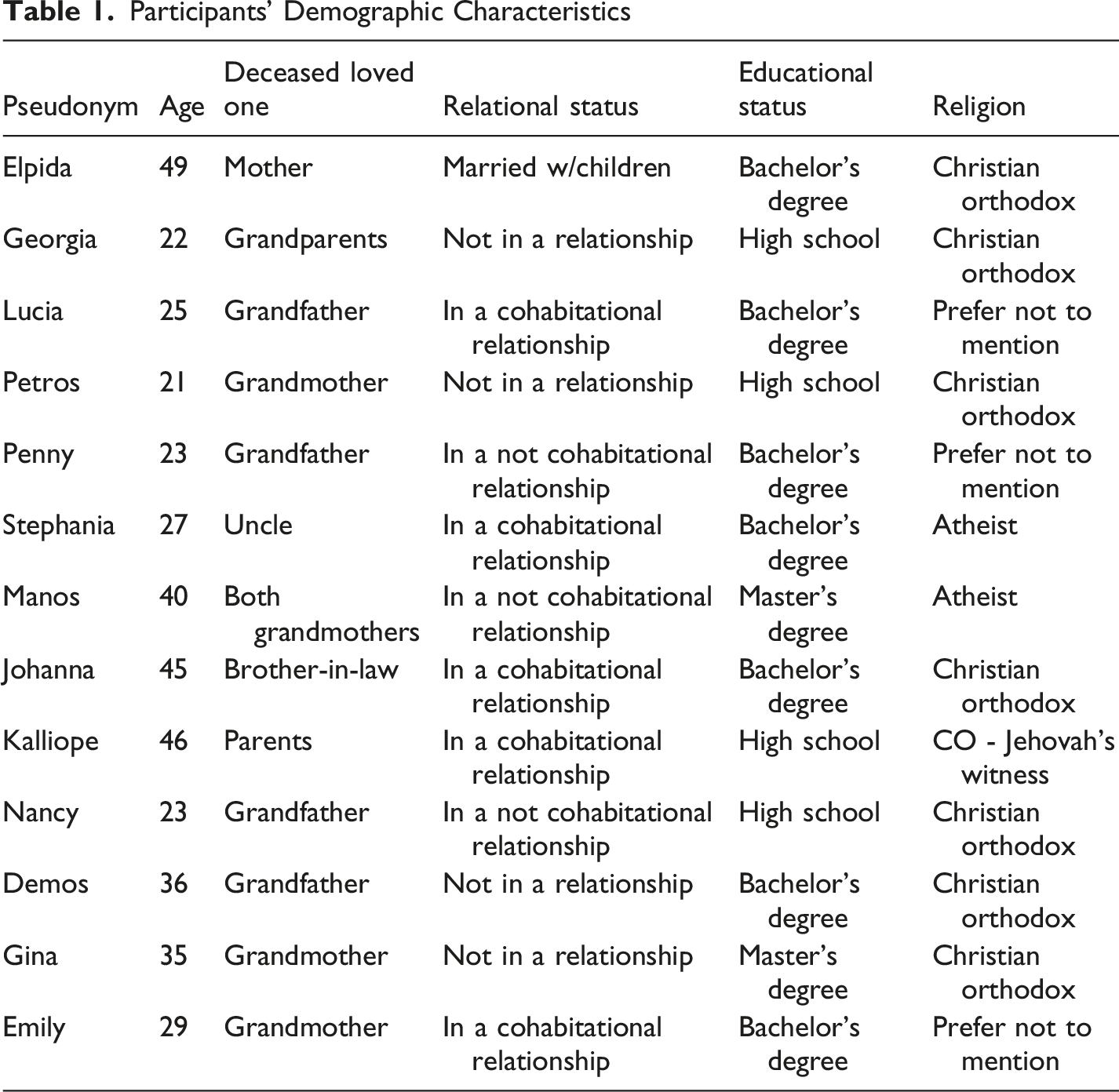
Participants’ Demographic Characteristics
Data Collection
Semi-structured qualitative interviews were conducted from June until October 2022, with a mean duration of 60 minutes (30 – 90 minutes). These interviews were conducted by the authors of this study, and took place virtually, on Zoom, Skype, Viber, and Webex applications.
To formulate the interview questions, the authors drew upon the original inquiries developed in the COVIDEUIL project. The interview script was utilized following official authorization from the University of Strasbourg, and after appropriate translation into Greek. The questions were primarily open-ended, to avoid imposition of interviewers’ assumptions onto the participants, and they were developed around four axes: (1) Death cause and conditions, (2) Details and experiences from the restrictions and funerary rituals, (3) Grief and mourning processes, and psycho-emotional reactions, and (4) Experiences and/or attitudes about virtual ceremonies (e.g., “Have you ever shared/expressed your grief online?”, “Could you please share some of your thoughts about virtual funeral practices?”). The interviews transcriptions were carried out by the authors, with additional support of undergraduate student assistants from the Department of Psychology of the National and Kapodistrian University of Athens. These assistants had previously signed a Confidentiality Agreement. Upon receiving the audio file electronically and preparing the transcript, they permanently deleted the files from their computers.
Data Analysis
We employed Reflexive Thematic Analysis (RTA) as our methodological approach, a qualitative strategy designed to identify, interpret, and report patterns of meaning within the data (Braun & Clarke, 2006, 2019; Byrne, 2022). Our process was not strictly inductive or data-driven; rather, it was shaped by the researchers’ prior knowledge, theoretical perspectives, familiarity with relevant literature on grief and ritual disruptions, and interpretive engagement with participants’ narratives. Themes were not discovered passively but actively understood and constructed through interpretative work.
The process of data analysis was collaborative. The aim of this collaboration was not to merely attain inter-rater agreement, but to enrich reflexive and iterative engagement with the data and deepen the interpretive development of thematic material. All authors began by thoroughly engaging with the transcribed data, which had been transcribed with care and precision. During this initial phase of familiarization, they took notes and composed memos reflecting on striking participant statements and emerging ideas relevant to participants’ experiences of bodily care, rituals and grief. Initial coding was led by the first two authors, while all authors further contributed to memoing, discussion and thematic refinement. The developing codes were discussed in analytic group discussion not to concretely establish inter-rater reliability but to encourage reflexive engagement and novel interpretations. Through these iterative discussions, patterns of shared units of meaning across participants’ accounts were delineated and were subsequently organized into candidate themes.
This iterative process allowed for the preservation of participants’ unique perspectives while gradually moving toward from candidate themes to thematic synthesis. Candidate themes were iteratively reviewed with attention to internal coherence and consistency across the dataset, and their ability to answer our research question. Theme names, content overlapping, and narrative emphasis were revised repeatedly until a finalized thematic structure was attained. The finalized themes were then named and defined. The final stage involved the composition of the analytical narrative, with particular attention paid to ensuring that participants’ voices and lived experiences were authentically represented (Braun & Clarke, 2006, 2019). Our analysis represents a collaborative and interpretive endeavor rather than a pursuit for a unique and objective coding solution.
Ethical Considerations
This study was approved by the Scientific Ethics Committee of the Department of Psychology of the National and Kapodistrian University of Athens. Participants provided their written consent to participate through electronic signatures on the informed consent forms. They also provided consent for a potential publication of this research. Before the start of each interview, they were asked to give their verbal consent. They were also informed of their right to skip any question that might cause them discomfort, as well as their right to withdraw from the interview or the study at any point, without being required to provide a justification and without facing any consequences. Given the sensitive nature of the research topic and the potentially distressing emotions that questions about the deceased might evoke, participants were offered the option to contact a clinical psychologist upon completion of the interview process, should they feel the need for support. Finally, to ensure confidentiality and anonymity, participants’ real names were removed and replaced with pseudonyms, which are used in this study, and the audio recordings of the interviews were destroyed immediately after transcription.
It is important to note that the present study shares its methodological framework and interview guide with a previous investigation conducted by the same research team. While both studies employed Reflexive Thematic Analysis (RTA) of semi-structured interviews, data collection for the current article took place between June and September 2022, whereas the earlier study was conducted from March to April 2022. Despite the methodological consistency, the participant samples differed in demographic composition. The earlier sample consisted predominantly of Orthodox individuals with a mean age of 37 years, while the present sample was younger on average (M = 27 years) and exhibited greater diversity in religious affiliations and beliefs.
Findings
The analysis explores how participants experienced bereavement during the COVID-19 pandemic in relation to disrupted hospitalization, funerary and mourning practices. Through their narratives, three overarching themes were identified. The first theme highlighted how sanitary restrictions in care imposed the relational rupture of dying in separation. The second theme emphasized how restrictions in customary rituals and burial-related bodily care disrupted the moral aspect of honoring the deceased. The third theme centered on the emotional and relational consequences of disrupted grief due to impeded rituals. Participants reported their responses of shock and sadness, emphasizing the factors that hindered their ability to mourn—such as isolation and lack of physical contact. They also stressed their efforts to restore meaning, with personal, interpersonal, and spiritual practices.
Dying in Separation
Death did not happen in all cases during hospitalization. However, in instances where there was any contact with the hospital setting - whether in the emergency room, in regular admission, or in the ICU - participants underscored an early rupture in the mourning process: their inability to be physically present in their loved one’s final moments. This separation was relationally fractured, medically mediated, and marked by uncertainty and helplessness before the incapacity of institutions to contain such distress. This theme is composed of two subthemes “When Death was Deserted” and “When Relatives were Helpless Before Institutions”.
When Death was Deserted
A key element of the health protocol was restrictions in the number of visitors. In many cases, one relative was allowed to accompany the patient, and visits were permitted typically on a designated day each week following prior arrangements and an antigen test. However, in cases of COVID-19 diagnosis or ICU admissions all visits were strictly prohibited, resulting in patients’ isolation. In some cases, relatives lost track of them, relying solely on in frequent phone updates by the staff. Moreover, due to protocol directives, even the suspicion of a COVID-19 infection could delay diagnosis and treatment. For example, Penny lost her grandfather, who was classified as a COVID case due to a positive antigen test, and that delayed medical intervention. The patient was placed in isolation, although it was later confirmed that the illness was not COVID-related.
Finally, Elpida described with emotional distress that her mother died alone, despite having described how much loneliness frightened her and that she would never have wanted such an end. Other participants emphasized how distressing it was for them not to be able to contact the patient and say goodbye, and how agonizing the experience must have been for the patients themselves: dying alone. “(…) I was losing my mind when thinking that my brother-in-law was lying there, naked, intubated in a freezing room, in an unfamiliar room, with no one by his side. It felt like madness. That thought shocked me, that someone you deeply love could just vanish” (Johanna) “I remember I was also very angry – I mean they can’t just take my grandfather away from me” (Nancy)
When Relatives Were Helpless Before Institutions
Participants also emphasized the challenges they faced during their contact with medical staff. Due to the healthcare system overload, any updates were given in a rush and were sometimes perceived as harsh. Elpida, who lost her mother to COVID-19 with concurrent physical deterioration due to cancer, felt that the doctors treated her mother’s cases with cynicism and lack of sensitivity, something that was deeply shocking for her (“They think I’m made of stone”). Similarly, Johanna reported that she sensed her mother’s attending physician was trying to remain emotionally detached, describing them as cold. Furthermore, three participants referred to “critical remarks” and a “punitive tone” from medical staff, both towards them and towards unvaccinated patients. They expressed the view that such patients were treated “discriminatorily”, without respect.
Communication between relatives and medical staff became even more challenging in cases where crucial medical decisions (e.g., to proceed or not with intubation) were delegated to the family instead of being made by the physicians. Furthermore, the coexistence of underlying medical conditions with COVID-19 created ambiguity regarding the official cause of death that was eventually communicated to the relatives. The following participants describe these confusing experiences: “The cause [of death] that was announced was different from the one written down. When the hospital called, they said it was cardiac arrest, but what was recorded was ‘COVID shock’… For me, the COVID protocol was the reason my brother-in-law died.’” (Johanna) “The doctor told me over the phone: ‘What do you want us to do, do you want us to intubate him?’ [referring to her father]. I told her, ‘I trust you, whatever you recommend, that’s what we’ll do; I don’t understand why you’re asking me such a question’. Two days later, my father passed away”. (Kalliope)
The Absent Body in Ritual Rupture
For many participants the disruption of funerary practices which would honor the deceased were challenging. They indicated that the body of the deceased occupied a core role in the experience of their mourning. Restrictions regarding participation in funerals and the preparation of the body transformed the process into an event of rupture, especially in a cultural and religious context where communal participation and bodily care have crucial spiritual significance. When customary contact with the deceased body became impossible, mourning was shaped by a sense of indignity. This theme consisted of two subthemes: “When Honoring the Body Became Impossible” and “When Virtual Mourning Was Not Enough”.
When Honoring the Body Became Impossible
Regarding the funeral ceremonies, most participants referred to the restricted number of attendees, the requirement for a closed casket and the omission of the customary gatherings after the ritual. “Due to the measures, we had to be around 10 persons present in the church, and have placed chairs in distance, and the rest of them had to just light a candle and leave. We were not allowed to open the casket, even when wearing masks etc.” (Nancy)
For most participants, these restrictions were associated with frustration and anger, as they deprived them of experiencing the rituals and the burial. In addition, the prohibition of physical contact did not allow the participants to give and receive consolation and support as much as they wanted. “(…) with the mask, I couldn’t even wipe my nose—I had to step back, pull the mask down, wipe it outside. (…). It kind of threw me off, like it took away some of the respect the moment should have had. I couldn’t say goodbye to her the way I wanted to, couldn’t hug my loved ones, and so on…”. (Demos) “These rituals exist for a reason, right? What really gets me is that something so natural, with millennia of tradition and such an important role, was suddenly covered by a veil of illegality.” (Stephania)
In cases of COVID-related deaths, restrictions were much more extensive and stricter compared to general restrictions imposed on every funeral regardless of the cause of death. The most significant change, however, concerned the handling of the body from preparation to its burial. Coffins had to be sealed airtight, transported with heightened protective measures, and contact with the body by the mourners or the preparation team had to be minimal. As a result, the body could not receive the customary care, which in many cases was experienced as a disgrace toward the deceased. “All coffins were wrapped in black plastic bags…Of course the casket couldn’t be opened or anything like that…we couldn’t dress her as she had asked, so we gave the clothes to the funeral home, and the clothes were put in a plastic bag. We just wanted to at least honor her wish to wear those clothes. Obviously, this would never have happened in a normal funeral…it reminded me of when they used to throw out the bodies of people with HIV in bags…” (Gina) “It was awful when those ‘astronauts’ showed up, with a coffin completely sealed in cellophane…as if taking away a kind of defilement […] They couldn’t [referring to the funeral home employees] wash her, anoint her, comb her hair, put some makeup… So how is a person honored when they’re shut inside a sack? (Elpida)
Additionally, two participants referred to difficulties in finding a burial plot for the body of a deceased person due to COVID, as many cemeteries designated special areas for such burials because of the restrictions.
When Virtual Mourning Was Not Enough
In other countries, due to transportation restrictions or funeral practices prohibition, other alternatives for participating to grief were observed, like live streaming broadcasts of these ceremonies. Our participants were asked about their potential participation in virtual funerals and their experience with them. It was apparent that most of them were unfamiliar with these practices and expressed a negative stance about them. They emphasized they would not choose them, as they did not consider them appropriate for honoring the deceased or providing the support the mourners need. “I would never participate; I don’t think this counts as a participation. I think it’s more of a joke. I’d rather make a phone call if I couldn’t attend. What would I even do online?” (Johanna) “It feels so foreign to me, what could I say…I would feel very uncomfortable saying goodbye to a loved one through a screen!” (Emily)
Other participants, though they would not attend such rituals, they recognized them as a facilitating condition, in cases when in person presence would be impossible. Manos reported that when his grandmothers died, he made some posts with their photos on social media, because of the wider presence of the internet during the pandemic. However, he referred to the distinct symbolic role that each traditional funerary stage fulfils (the Wake, the Funeral, the Procession to the cemetery and the Burial, and the Mourning Reception), and to the importance of the community in sharing of the grief - emphasizing that this function cannot be replaced by any digital tool. Only one participant stated that she was familiar with virtual ceremonies, as these are included in the practices of her religious denomination.
Restoring Meaning After Ritual Rupture
Participants indicated that in the aftermath of disrupted and incomplete rituals, their grief carried a feeling of incompleteness (Subtheme 1: “When Disruption Left Farewell Incomplete”). Their inability to accompany their dead, honor their body, and participate in communal customary rituals aggravated feelings of sadness, anger, guilt and incompletion. However, mourners sought to restore the disrupted meaning; through personal, relational and spiritual acts they tried to honor their deceased loved ones in different ways (Subtheme 2: “When Ritual Meaning Was Restored”).
When Disruption Left Farewell Incomplete
Our participants described the ways of experiencing their grief through a dynamic psycho-emotional process that involved both themselves and their relatives. Many participants expressed great difficulty in realizing their beloved person’s absence from their daily lives, experiencing a state of shock and denial. This state accompanied not only sudden deaths, but also unexpected hospitalizations, which may or may not have coexisted with COVID-19. “I was lost! At first, I kept experiencing that question – why? Why was it so sudden? Even now, the realization hasn’t set in.” (Lucia) “Meanwhile, all of this hit me like a hammer to the head (…) How can we accept it? I hope that one day I’ll be able to realize that COVID came to save her from the pain of cancer.” (Elpida) “At first, I was in a state of denial.” (Georgia)
Participants also shared feelings of intense sadness and longing, expressed in the form of persistent thoughts and memories of the deceased, due to the void the loss left in their lives. Both sadness and initial denial were independent of the cause of death, whereas they were associated with the unique role the deceased held in each participant’s life. Several participants reported their difficulty visiting the personal space of the deceased and being in contact with their personal belongings. These elements made the beloved ones’ absence more tangible, intensifying our participants’ sorrow. However, over time, this contact became less painful, serving as a source of pleasant memories, and sometimes was sought after, partially reviving the once shared connection. “I didn’t want to go to her house, although my grandfather was still living there, because I intensely felt her absence, when entering the house (…) Now, I can remember both with pleasant memories. It’s like we live together.” (Georgia) “We recently went to sort some things, like some objects, furniture and so on, and I saw some items, little gifts, crafts, some notes, and all these things somehow got to me. I didn’t know I would take them back, that they would come to my possession again, while I had given them as gifts.” (Demos)
For some participants who lost their grandparents, the loss was accompanied by reflections about mortality as a general human condition, rather than a difficulty in accepting the absence of the deceased themselves. In some cases, this triggered a concern for the eventual loss of their own parents, regardless of the cause of death. Within this process, the pandemic context was another factor of anxiety for the potential infection of other relatives and the participants themselves, provoking or exacerbating already existing fears of contagion and death. In addition, Kalliope in specific referred to the intense guilt her sister felt, who transmitted the virus to both their parents, who died a few days later. “It was one of the very few times I didn’t see my mother strong, so that made me wonder: if she is not strong, how could I react in such a situation, when it’s her, when it’s us in that position? I mean, when I lose her.” (Petros) “The list is getting shorter. that is, the grandparents are gone, next are the parents. And I was thinking about how all this would be manageable.” (Manos) “Now it’s more stressful for me, having seen that things can change at any moment, that something bad can happen, you never know, even for us, and for other people too. So, clearly there is a fear of death.” (Gina)
The omission of care for the body that was once taken for granted, both before and after death, seemed to have longer-term consequences for some participants, beyond the experience of general restrictions per se. In fact, these consequences were associated with a perceived sense of unfinished business toward the deceased. This was especially evident in cases involving hospitalization for COVID-19 illness, where the body was treated as a potential source of infection. As a result, participants experienced this altered handling of the body as a form of disrespect toward the deceased. This situation appeared to have made accepting and processing the loss much more difficult, and was linked to feelings of guilt, anger, and injustice—especially when the mandated procedures forced relatives to bypass the wishes of the deceased. “She had to fight cancer and COVID, all alone…that’s what shocks me…and she had always said how much loneliness bothered her, she didn’t want to die alone. And, at the end, she died alone. We also felt responsible for that. we weren’t, but we felt that way. That’s what saddens me, that her body wasn’t honored….” (Elpida) “I couldn’t say a final goodbye…I think that’s finally the hardest part in all this.” (Nancy)
For one participant, who was hospitalized with depression at the time of the interview, being unable to attend her grandfather’s funeral due to the restrictions was particularly distressing, prolonging and intensifying her grief. “I would have liked to go to his funeral, it was a final goodbye I wanted to say. and I feel I was deprived of that in a painful way. And of course, that resulted to it affecting me for longer than it did for the others.” (Penny)
When Ritual Meaning Was Restored
Many participants referred to various actions and material interventions they made to honor their lost loved ones. These actions mainly included placing objects or engaging in activities that reminded them of the deceased and appear to be an important part of managing grief—an effort to compensate for the restrictions imposed on ceremonial practices. “I wrote a eulogy and handed it out—I couldn’t leave my mother without writing something for her. (…) I put up photos I liked … I lit a lamp instead of a candle. (…) A very nice, warm space—to have something to remind me of her… as if I’m honoring her. I felt I had to create a little corner in her memory.” (Elpida) “I played a song she really liked. I might have talked to her a bit, you know, an internal dialogue – or even out loud, I don’t recall – and I also go in her room, so to speak, where there is a photo of her. I’ve done it a few times” (Gina)
Most participants emphasized the support they received from loved ones mitigated their grief and alleviated the pain of loss. Mutual care and sharing memories of the deceased even strengthened family and social bonds in some cases. In addition, five participants mentioned the empowering role of personal psychotherapy for them. “(…) I feel some respect and show my children a kind of continuity. That’s what I aim for. And when I talk about him, even if I end up crying, it fulfills me too, because I see that other members want it as well. Like memories. (…) In fact, I see that it helps the other open up emotionally, that’s where I understand if my nephews are okay” (Johanna)
Finally, two participants spoke about the strength they draw from their religious faith, which assisted them accept the loss through the promise of afterlife. This gave meaning to deaths they perceived as unfair and relieved their own anxiety about death. “It’s very clear to me what Jesus said: that there will be a Resurrection, that the dead will live again…in this, spirituality is a very important part of my life. When I have certain thoughts, it gets a bit easier” (Kalliope) “Spirituality always helps me, and when he was hospitalized, I thought: God will comfort him, and that was enough for me. I can’t conceive that my life ends here. I don’t think it’s fair that soul wouldn’t carry on. So, yes, this whole Orthodox doctrine supports me, it gives me strength” (Johanna)
Discussion
This study examined how bereavement during the COVID-19 pandemic was experienced and shaped by disruptions to culturally meaningful practices of caring for the deceased, preparing their bodies, and mourning, within the specific Greek context. Our findings suggest that pandemic-related restrictions did not only entail logistical impediments on hospitalization and funerary practices, but also disrupted practices invested with moral and communal significance. Participants’ accounts reveal a shift from separation and ritual rupture toward efforts to restore meaning through personal, relational, and spiritual practices.
The impediments our participants faced during their beloved ones’ hospitalization primarily concerned the restriction of visits and communication with medical personnel. These obstacles seemed to engender feelings of sadness, unrest, and guilt, especially when thinking that their relatives felt abandoned in their final moments, something consistent with other findings on the dying process during the pandemic (Fernández & González-González; Kentish-Barnes et al., 2022; Torrens-Burton et al., 2022). When it came to communication with medical staff, participants emphasized limited and vague updates, reluctance to make critical medical decisions, and lack of sensitivity. Similar features are underscored in the study by Torrens-Burton et al. (2022). In line with the findings of Kentish-Barnes et al. (2021), and Hanna et al. (2021), poor communication was associated with feelings of anger, injustice, and mistrust among participants, hampering their acceptance of the loss, especially in cases where hospitalization conditions or the cause of death were uncertain. This finding reveals the relatives’ need for interaction in the face of imminent death. However, in the absence of other people due to the restrictions, this need was directed at medical staff, who in turn, were overburdened and unable to respond. Finally, these experiences may also be perceived from Turner’s perspective on liminality (1969), in which death is socially mediated. In the pandemic hospitalization circumstances, however, participants were deprived from their loved ones at the liminal threshold of death and were deprived of the relational and ritual means to mediate this painful transition.
In the case of funeral ceremonies, the general measures reported by all participants included limitations on the number of attendees, the use of masks, the requirement for a close casket, as Erbiçer et al. (2023) have also emphasized. The restrictions disrupted customary practices through which the deceased would be honored, and mourning would be collectively metabolized, especially in a context with a strong communal and Orthodox-inflicted significance. In essence, the prohibition of physical contact both with the deceased and other mourners, evoked feelings of frustration and anger among most participants, and the sense that rituals lost the dignity that would normally carry. Mourners could not be comforted by loved ones, while the funeral did not take place according to the cultural traditions in Greece, where it is customary to touch and kiss the body.
Restrictions were more severe in cases of COVID-19 infection, where additional prohibitions regarding the handling of the body contributed to the sense that the bodies of the deceased had been “dishonored”, treated as something impure. This stood in stark contrast to the body’s ritual significance, especially within the relative religious context, contributing to an experience of moral rupture by some participants. Hertz’s (1960) understanding of mortuary rites is useful here: mourning is a social process and thus the inability to wash, dress, anoint, view, touch, or kiss the deceased disrupted culturally meaningful practices through which care, dignity, and relational obligations toward the deceased would ordinarily be expressed. Similar narratives of bodily care and funerary practices are reported in other cultural contexts by Hamid and Jahangir (2022), and Sani et al. (2025) during the pandemic.
In many countries, the imposed restrictions in transportation and number of attendees allowed in ceremonies led mourners to seek alternative ways of participating. One such method was the live streaming of funerals, as also described by Carr et al. (2020), and MacNeil et al. (2023). In contrast, most of our participants reported being unfamiliar with such practices, considering them as impersonal and insufficient to honoring the deceased and supporting the bereaved, a finding aligned with the study of Koliouli et al. (2024). Virtual ceremonies were perceived as a necessary solution, only in cases when physical attendance was impossible. Given that physical intimacy is absent from virtual ceremonies, participants’ negative attitude could be interpreted within the Orthodox Christian ritual, where physical contact with the body of the deceased is necessary to pay respect (Georgiadou & Pnevmatikos, 2019). Indeed, the only participant who had experience with virtual ceremonies belonged to a different religious denomination and explained that her familiarity stemmed from that fact.
The psycho-emotional processes that were activated during mourning included, for most participants, an initial reaction of shock and denial, as well as feelings of sadness and longing, which are typical after loss (Bonanno & Kaltman, 2001). Their intensity was increased especially when hospitalization and death were associated with the context of the pandemic. These responses were intertwined with the disruption of culturally meaningful funerary practices. The heightened intensity of grief reactions among those bereaved during the lockdown was also reported by Sani et al. (2025). Given the sudden nature of many hospitalizations and deaths during the pandemic, this finding is consistent with a portion of related literature, where unexpected deaths are highlighted as one of the risk factors associated with complicated grief (Corpuz, 2021; Johns et al., 2020). A key change during the initial period after the loss was that old habits associated with the deceased (e.g., visiting their personal space or contact with their belongings) were particularly painful and made their absence more apparent. As a result, participants avoided them or sorrowfully endured them, something consistent with the findings of Koliouli et al. (2024). However, in our study, it appeared that over time these activities became more tolerable or even desirable, progressively serving as a source of pleasurable memories and reflecting a positive development of their mourning.
Additionally, regardless of the cause of death, thoughts regarding mortality emerged. The pandemic context further exacerbated death and contamination anxiety, both for participants themselves and for their relatives. These fears are also reported in the Torrens-Burton et al. (2022) study, and are associated with feelings of guilt among the bereaved who happened to transmit the virus to beloved ones, who consequently passed away.
In cases where a COVID-19 infection or hospitalization regardless of cause preceding death, the consequences on bereavement seemed to be more long-lasting. Although our participants, except for one, could attend the funerals, the special handling of the body before and after death evoked a sense of unfinished business in bereavement, a kind of moral rupture accompanied by guilt and sadness, as also underscored by Klingspon et al. (2015), and Menzies et al. (2020). Treating the bodies as potential sources of infection and sealing them stood in stark contrast with the significance of the body in Orthodox Christian rituals, where proper farewell includes careful taking care of the body, to facilitate the release of the soul (Menzies et al., 2020; Mystakidou et al., 2005). Hence, as in some cases the deceased persons’ last wishes could not be fulfilled, these restrictions were understandably perceived as an affront to the dead, in line with the findings of Fernández and González-González (2022). This seemed to apply even to participants who were not particularly religious, as, according to Georgiadou and Pnevmatikos (2019), religious beliefs and practices both influence and are shaped by cultural norms, and vice versa. For example, in ancient Greek thought, caring for the dead was considered a sacred duty that upheld honor and respect. Conversely, any mistreatment of the body was seen as a grave dishonor and a violation of moral and divine law (Mantala-Bozos, 2003). For one participant who was unable to attend her grandfather’s funeral the consequences intensified grief and exacerbated a pre-existing depressive state that led to her hospitalization. This finding, albeit not generalizable, illustrates how the inability to participate in culturally meaningful farewell practices may intensify feelings of incompleteness and unresolved grief (Bonanno & Kaltman, 2001; Klingspon et al., 2015).
The omission of the customarily taking care of the body appeared to have been compensated for, at least by some participants, with alternative actions and rituals, something also underscored in the study by Mitima-Verloop et al. (2022). In studies from other countries, these alternatives primarily included virtual funerals (MacNeil et al., 2023), but in our study these actions involved placing commemorative items, like photos, engaging in activities that reminded the participants of the deceased, or creating a space dedicated to their memory. Such material interventions were presented as a way for their beloved ones to be honored in retrospect, serving as personal rituals. At the same time, through their materiality, they might indirectly refer to the body itself, whose importance was highlighted in many narratives, as it became the focal point of sanitary restrictions. This finding is consistent with a study by Cherblanc et al. (2025) who underscored that the thing which appeared to influence grief management was the unique subjective meaning each mourner attributed to the rituals, depending on mourners’ expectations for their function. Hence it is the perceived sense of satisfaction from the ultimately performed rituals that determined whether these functions were fulfilled. Indeed, as Cherblanc et al. (2025) reported, public health restriction may impose alternations in the grieving process, without necessary leading to complicated grief. This may explain why some of our participants, who spoke of “dishonor”, sought personal ways to honor their loved ones. In essence, these rituals might have allowed them to restore the “sacredness” and meaning they were deprived of, protecting themselves against a pathological trajectory of grief (Cherblanc et al., 2025; O’Rourke et al., 2011).
These findings also resonate with anthropological constructs. Particularly, viewed through Bloch and Parry’s (1982) perspective, these personal commemorative practices may also be understood as attempts to restore or regenerate forms of symbolic continuity. Although the practices did not replace collective rituals, they enabled participants to reaffirm ongoing bonds with the deceased. Furthermore, the material character of those personal practices and interventions resonates with Maddrell’s conceptualization (2016), in which she underlines the embodied, temporal, and spatial dimensions of bereavement, highlighting the embodiment as an organic element of grief and mourning.
Furthermore, emotional support from family and friends, contributed to strengthening social bonds through the mutual sharing, mitigating grief and alleviating the pain. This finding is also confirmed by Koliouli and Canellopoulos (2021) and refers to the phenomenon of post-traumatic growth, as described by Tedeschi and Calhoun (1996). Finally, for religious participants, their faith played a significant role in addressing existential concerns, as for most religions, biological end is not equal to the ceasing of existence per se (Menzies et al., 2020). Hence, as Georgiadou and Pnevmatikos (2019) emphasize, religion offers a framework of meaning, something also aligned with our findings.
Limitations
An endeavor was made to precisely follow the qualitative interview script, however participants’ sorrow and emotional agitation allowed for using questions in a different order, which may have affected the data homogeneity but simultaneously revealed the flexibility and fruitfulness of the utilized methodology. Another limitation concerned the sampling duration, as participants’ informed consent for the qualitative part had to be confirmed and interviews to be scheduled for a rational number of participants. Hence, this timing led our participants to retrospectively reflect on their mourning experience, as they had lost their beloved once during the two Greek lockdowns (2020-21). Finally, there was an overrepresentation of (1) individuals who represented themselves as females, and (2) individuals who had lost one or both of their grandparents. In the latter case, age difference and the special relationship of grandchildren with their grandparents in the Greek cultural context may have influenced the content of our results.
Although the present findings resonate with broader literature on pandemic bereavement globally and grief reactions in Greece (see Koliouli et al., 2024), the current study contributes a more specified delineation of ritual disruption, moral rupture, and the symbolic significance of bodily care within the Greek cultural context. Such convergence also underlines continuity in psycho-emotional responses and enhances the transferability and credibility of the findings. It suggests that certain emotional and psychological reactions may be more universally experienced within the broader population under study, regardless of demographic variability.
Epilogue, and Suggestions for Further Study
In this study, we tried to demonstrate that the pandemic condition in Greece left a significant mark on our participants. The findings revealed a cultural component: the disruption of culturally meaningful practices of honoring the deceased and their body, and collectively experiencing grief contributed to a loss of symbolic continuity. The inability to care for the body of the deceased and to accompany the dying, brought forth a significant sense of unfinished business, underlining the importance of rituals as personal and communal supports, as well as the special significance of the body itself. This significance is partly influenced by its position within the dominant Greek Orthodox religious and cultural framework. This context contributed to participants’ challenging experiences during the hospitalization and death of their loved ones, and their intense emotional and psychological responses involved in the grieving process, such as shock, sadness, guilt, and fear of death. Nevertheless, our participants managed to process their grief through private, personal practices and the support of their loved ones - but not using virtual ceremonies, which they regard as irrelevant.
As COVID continues to re-emerge in our country with periodic low-intensity outbreaks and the health risk has not been eliminated, it is useful to study grief reactions in the present time in relation to the pandemic years, always considering the specific cultural context at stake. At the same time, variables such as socioeconomic status and place of residence may offer richer insights into illness and grief. Finally, part of our findings could contribute to the discussion around burial protocols in cases of infectious diseases, so that the wishes of the deceased and their relatives may be considered.
Footnotes
Author Note
Α portion of this work was presented at the 19th Panhellenic Conference of Psychological Research (May 2025, Ioannina, Greece).
Acknowledgements
We would like to wholeheartedly thank those who participated in this study, trusted us, and wanted to share their experiences about these crucial events, during a difficult and perplexing period for Greece and the whole world. Furthermore, we would like to extend our gratitude to the student research assistants who helped us with transcribing the interviews audio files: Daphne Chrysoula Dimopoulou, Chrysoula Mandamadioti, Eleni Papadakis, Anna-Maria Pavlopoulou, Virginia Tsigarida. These non-author contributors provided their written consent via email for their names to be included.
ORCID iDs

Ethical Considerations
The Research Ethics Committee of the Department of Psychology at National and Kapodistrian University of Athens has approved our research project (Protocol no. 19/11/2021) on February 2nd, 2022.
Consent to Participate
Participants provided informed consent for their participation electronically through an online platform prior to participation. They also provided their oral informed consent for participating in the qualitative interview and its recording.
Consent for Publication
Participants provided their written consent electronically for publication of this research. Pseudonyms were utilized to ensure anonymity and protect participants’ confidentiality.
Funding
The authors received no financial support for the research, authorship, and/or publication of this article.
Declaration of Conflicting Interests
The authors declared no potential conflicts of interest with respect to the research, authorship, and/or publication of this article.