







Abstract
Irrigated agriculture has brought major socioeconomic benefits to many of the more arid areas of the world, but has simultaneously impacted the underlying groundwater in a variety of ways. This paper overviews this frontier, stressing that unregulated and uncontrolled waterwell irrigation widely results in groundwater resource overexploitation accompanied by negative impacts for all groundwater users and dependent environments. Most types of intensive irrigated agriculture result in the leaching of excess nutrients and pesticides to groundwater, and in some settings progressive aquifer salinisation. Groundwater resource degradation can, in turn, significantly impact food production. Few governments have made adequate parallel investments in water resource management, and a paradigm shift is needed in the approach to groundwater with greater emphasis on farmer education about sustainable use, clear incentives for water-resource saving and agricultural land-use planning to conserve groundwater. Of particular importance is that farmers should bear the full energy cost of their pumping as an incentive for water saving, with metering of power consumption allowing its combined invoicing with groundwater use.
Keywords
Overview of groundwater-agriculture interactions
Benefits of groundwater irrigation for agriculture
Agricultural irrigation with groundwater has delivered major socioeconomic benefits to many areas of the world with more arid climates and/or extended dry seasons. The wealth generated by large numbers of irrigated fields from the waterwells, under direct farmer control. has been remarkable and transformed many previously very poor regions.
National governments have been able to provide finance to support the construction of irrigation waterwells, but have only rarely accompanied this by investments in management institutions and monitoring infrastructure. Thus, the development of irrigated agriculture has produced great economic benefits but simultaneously presented challenges for groundwater resource management (Garduño and Foster, 2010; Garrido et al., 2006; Molden, 2007).
Groundwater resource impacts of irrigated agriculture
Irrigation technology exerts a differing effect on underlying groundwater systems, and in more arid climatic settings certain technologies can become the predominant control (Figure 1). Thus, irrigated agriculture can have a range of potentially important impacts on underlying groundwater, some of which are widely overlooked by the agricultural sector and poorly accounted in water resource management:
Irrigation with surface water invariably increases groundwater recharge rates, and can result in rising water-tables and land drainage problems that severely impede crop production and require major infrastructure investment. Irrigation with groundwater widely results in resource overexploitation with declining waterwell yields, increased energy costs for pumping, interference with domestic waterwells, and in some cases negative environmental side-effects.
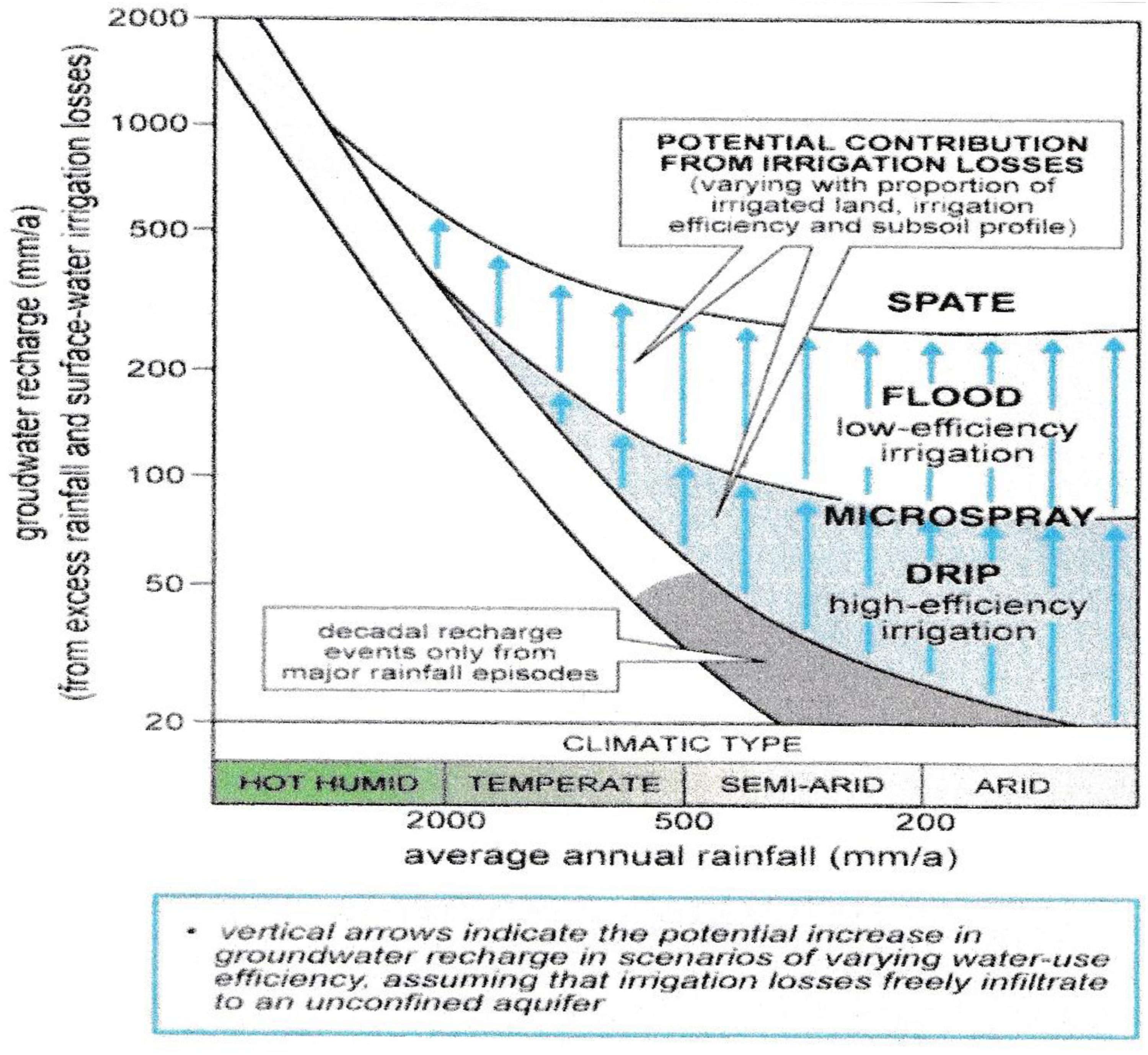
Influence of type of irrigation technology on groundwater recharge rates.
The intensive use of groundwater for agricultural irrigation can also have incidental institutional complications, since it tends to concentrate groundwater use rights in the hands of a few more affluent land and waterwell owners (for example producing high-value crops for export markets), which can destroy indigenous farming and displace traditional communities from their land.
Increasing groundwater resource availability
Historically, the level of irrigation-canal lining was very low and the application of surface water to irrigated land was by periodic land flooding (or even ‘spate irrigation’) techniques. This accidentally resulted in applications greatly in excess of plant requirements and a major increase in groundwater recharge rates. In the long run, this tended to cause rising water-tables, which in some settings led to associated land drainage problems and required management by promoting conjunctive use of groundwater with surface water.
In Pakistan, large lenses of fresh groundwater have accumulated from losses along major surface-water canals, and extensive land drainage and salinisation issues have arisen causing impacts of huge cost (Qureshi A et al., 2008). In other forms of irrigation, water applications will be smaller, but farmers often over-irrigate at certain times of the year to ‘clean the soil’. On the North China Plain, for example, even with modern improvements in canal lining and field application, the current irrigation efficiency with surface water averages 60%.
Causing groundwater resource overexploitation
Groundwater irrigation now accounts for about 40% of the total global irrigated area, with notable levels in North America (59%), South Asia (58%), West Asia (45%) and Western Europe (41%). However, the development of groundwater-irrigated agriculture has almost everywhere been achieved without adequate groundwater evaluation and the monitoring of groundwater use, levels and quality (Garduño and Foster, 2010). The marked increase in productivity in areas under groundwater irrigation tends to motivate farmers to expand their areas of irrigated cultivation, regardless of long-term groundwater availability, and use in horticultural irrigation, in particular, is highly profitable for the farmers involved. The only exception is Sub-Saharan Africa at only 5%, because of various factors including limited rural electrification, lack of investment funds and very limited farmer experience of irrigated agriculture.
In most climatic settings where groundwater irrigation is practiced the annual required irrigation application and the land area available for irrigated cultivation greatly exceeded groundwater resource availability. Serious groundwater resource overexploitation widely results (Manzano et al., 2005), often accompanied by reductions in stream baseflow, degradation of wetlands, upconing of saline water and land subsidence.
The utilisation of groundwater for irrigation is all too frequently completely unregulated. Waterwells under direct farmer control are widely over-pumped in attempts to maximise crop production, regardless of the abstraction rates authorised by regulatory agencies. Moreover, current investments in groundwater monitoring are almost everywhere far from adequate. The quantification of volumes abstracted requires metering of individual waterwells and aquifer water-levels need continuous monitoring, which is often beyond the capacity of regulatory agencies.
India has an estimated 20 million waterwells and 92% of its groundwater abstraction is used for irrigation (245,000 Mm3/year) of about 39 Mha, which poses a tremendous challenge for sustainable groundwater management (Gandhi and Namboodiri, 2009; Kapoor and Anand, 2024; Neenakshi, 2026).
Irrigated agriculture degrading groundwater quality
Nutrient leaching
The large-scale and/or ill-timed application of nitrogen fertilisers to agricultural crops in search of increased yields has widely led to their leaching to groundwater and has been especially marked in areas under intensive horticultural multi-cropping, such as Almeria-Spain (Figure 2). The WHO drinking-water guideline concentration of 50 mg NO3/l has very frequently been exceeded in areas of irrigated agriculture (Foster and Custodio, 2019).
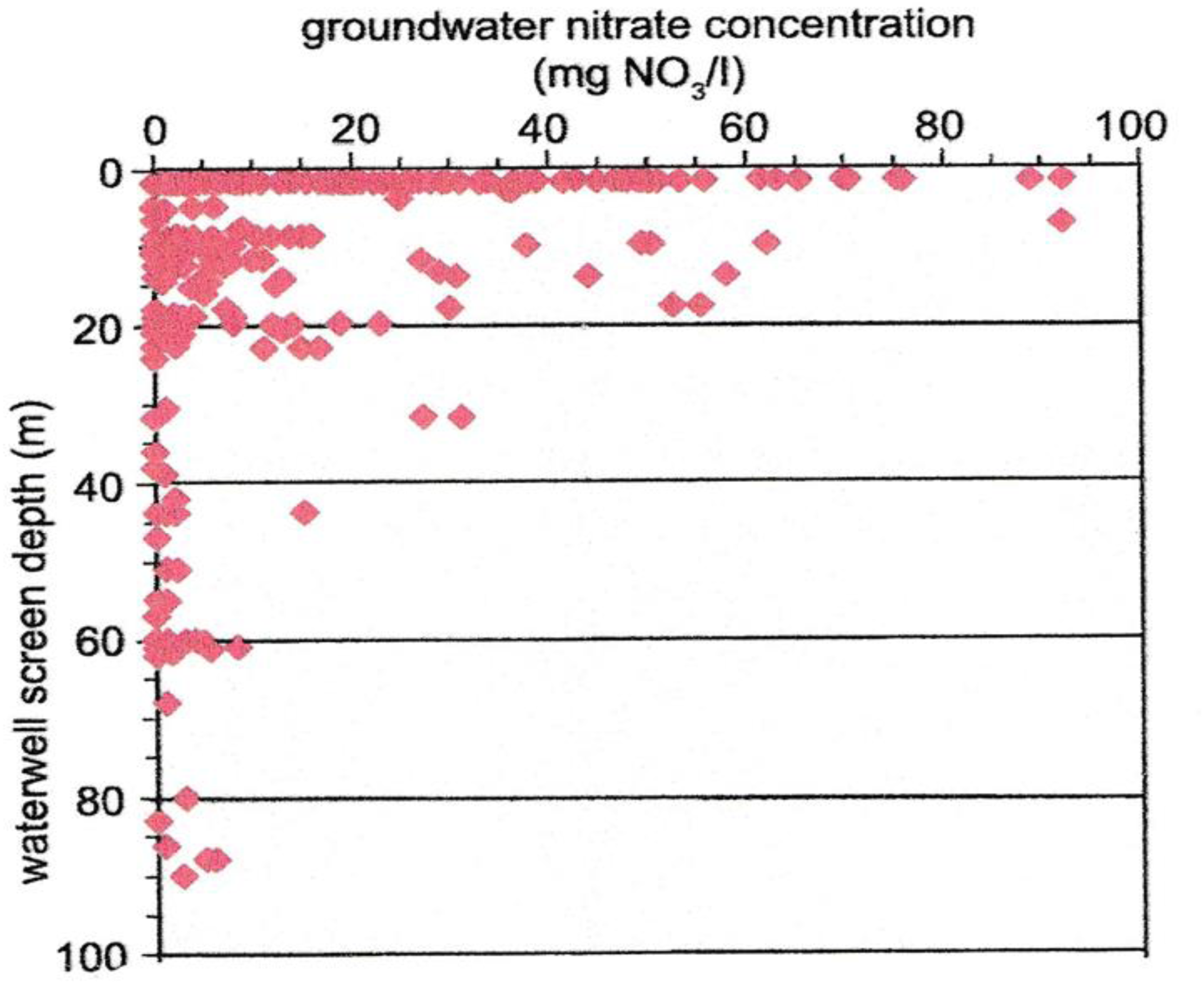
Groundwater nitrate beneath intensively cultivated irrigated land in almeria-Spain.
For example, a recent study of the piedmont area of the North China Plain (Han and Currell, 2022), with an average water-table depth of 45 m, revealed that 6600 kgN/ha were held in the unsaturated zone and being slowly transported down to the water-table at about 0.6 m/a to impact groundwater quality in future decades. In Spain, the ecological functioning of the Mar Menor (a shoreline lagoon on the Mediterranean coast) has been radically modified as a result of the input of nutrient leaching from intensive agriculture that has caused three severe eutrophication episodes with dramatic fish mortality (Jiménez-Martínez et al., 2016).
Pesticide leaching
Globally the application of pesticides to agricultural crops has been increasing rapidly in recent years. Many of these compounds are relatively mobile in soil solution and subject to leaching to groundwater, and while they have relatively short halflives in fertile soil are extremely persistent in groundwater (Araya et al., 2024; Jung and Lee, 2024). These compounds and their partial breakdown products (metabolites) present a major complication to the use of groundwater for potable water-supply. For example, in the North China Plain various organophosphorus pesticides, notably dimethoate, dichlorvos and malathion, have been detected in groundwater (Wang et al., 2022).
Progressive salinisation
Extensive groundwater irrigation runs the risk of accumulating salts in the soil zone and farmers usually apply an excess irrigation layer to leach this to greater depths, eventually reaching groundwater. This has widely impacted shallow groundwater quality to depths of about 100 m, and has been researched in detail in Mendoza-Argentina (Figure 3) and Almeria-Spain (Foster et al., 2018). Uncontrolled groundwater pumping for agricultural irrigation in coastal zones often results in depleting groundwater to below sea-level with consequent large-scale encroachment of saline water, and have been monitored in detail, for example in China. Moreover, in areas of surface-water irrigation excessive applications can lead to rising water-table and phreatic evaporation, with soil salinisation as a consequence.
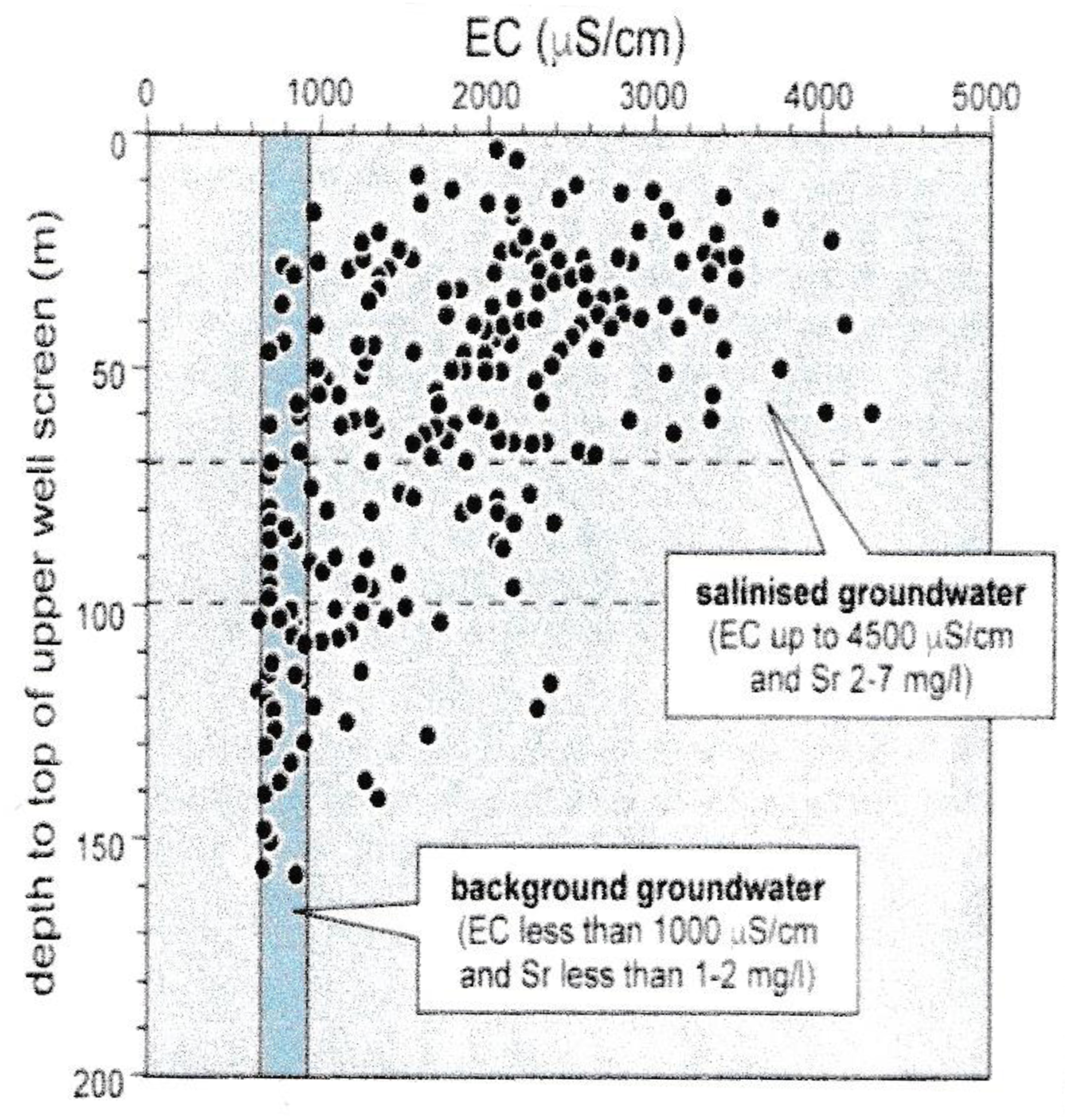
Salinisation of the carrizal aquifer in mendoza-Argentina due to many decades of groundwater irrigation.
Microplastic pollution
In and around intensively used agricultural land the soil is often found to be polluted by micro-plastics (MPs). These compounds can enter groundwater recharge, although knowledge of their occurrence is still limited. High MP concentrations have been detected in cultivated soils as a result of the use of plastic mulching film (Huang et al., 2021).
Effect of groundwater degradation on food productivity
Since food production relies heavily on crop irrigation it is critical that the water used for irrigation purposes is of high quality. Groundwater degradation, including both resource depletion and quality pollution, thus can severely impact food production by reducing crop yields and increasing farming costs (Cole et al., 2018; Irfeey et al., 2023; Machado and Serralheiro, 2017).
The greatest impact of groundwater degradation occurs where its salinity has increased, which can occur as a result of resource overexploitation and saline intrusion or up-coning, saline-water returns from irrigation practices, and locally from pollution by road salt. Groundwater irrigation with excessive Na and Cl concentrations is directly hazardous to plants, stunting their growth and drastically reducing their yield and food production.
Improving groundwater use sustainability
Promoting conjuctive water use
The integrated use of groundwater and surface-water resources should give much greater flexibility to farmers to cover the water demand of their crops, and ease the pressure to further increase waterwell abstraction. Artificial recharge of shallow aquifers in areas on groundwater stress should also be actively promoted.
Where appropriate consideration should be given to the trading of partially treated urban wastewater for irrigation instead of using fresh groundwater, since this could then be conserved for domestic watersupply.
Focusing on irrigation efficiency
Irrigation water-use efficiency is an important issue that requires greater efforts to optimise, distinguishing irrecoverable irrigation water losses from those that simply return to groundwater systems. Moreover, there is considerable scope for irrigation water saving by using drought-resistant crop strains, improving crop planting schedules and introducing crops of lower irrigation water demand (Kosanke, 2019).
Realistic power pricing
In some areas over-pumping has been stimulated by government energy subsidies to promote agricultural production, and such ‘perverse subsidies’ must be eliminated or reduced (Langarita et al., 2017). In some cases, progress on groundwater resource conservation has been made through:
more realistic power pricing, such that farmers bear the full cost of their energy use which serves as a powerful incentive for water saving improved measurement and charging for waterwell abstraction by metering rural power consumption as an indirect indication of pumping, and then combined invoicing of power consumption and groundwater use.
Moreover, the introduction of solar-powered waterwell pumps, if appropriately planned, can aid the regulation of groundwater abstraction, if farmers are provided with attractive incentives to sell-back power to rural electricity grids rather than using it to over-pump groundwater.
Farmer education and action
Improving farmer education on the need to modify cropping patterns and to improve irrigation-water scheduling in areas of groundwater resource stress is a high priority. In some cases, it may also be necessary to subsidise farmers to reduce their irrigated areas leaving more land fallow during years of low rainfall, to provide land for managed aquifer recharge with excess rainfall and to replace groundwater by appropriately treated wastewater where feasible.
Introducing glasshouse cultivation
Glasshouse cultivation results in significantly lower evapotranspiration rates and thus reduces the demand for irrigation water. Moreover, encouraging farmers to abandon cultivation of the lowest-value crop in the annual multi-cropping cycle can save significant groundwater.
Irrigation planning and techniques
The agricultural sector can greatly assist the task of groundwater management through:
preparing agricultural land-use management plans that identify groundwater resource sustainability as an issue and target funding to reduce agricultural water demand through precision irrigation technologies implementation of best land-use management practices with farmers that aim to conserve groundwater resources and protect groundwater quality.
Farmer use of mobile phone apps for weather forecasting can much improve irrigation scheduling and reduce leaching losses. Other types of useful guidance on agricultural cultivation are also available by this route. The application of satellite imagery can aid the quantification of crop water-demand and track consumptive crop water-use, which in turn can enable the development of efficient seasonal irrigation schedules.
Constraints on use of non-renewable groundwater
The special case of using essentially non-renewable groundwater for agricultural irrigation (now occurring at large-scale in parts of the deserts of North Africa and the Middle East) requires much more careful management including such additional measures as:
using groundwater only to cultivate high-value and/or low water-demand crops, avoiding irrigated cropping in the summer months employing pressuried irrigation systems (such as drip or micro-sprinkler) which are more efficient and allow close control of water application
Concluding remarks
Much greater emphasis needs to be put by the agriculture sector on the regulation of groundwater abstraction in areas of waterwell irrigation, including improved irrigation technology, measurement of pumping rates and groundwater level monitoring. In the long run this will be vital to secure sustainable groundwater use and avoid serious negative impacts on food production. The perverse subsidy of waterwell pumping cost by governments must be progressively eliminated with farmers bearing the full cost of their energy use as an incentive for water saving, with metering power consumption to allow its combined invoicing with groundwater use to individual farmers. The introduction of solar-powered waterwell pumps requires parallel action on electrical grid buy-back arrangements rather than using all the power generated for pumping.
Footnotes

Funding
The author received no financial support for the research, authorship, and/or publication of this article.
Declaration of conflicting interests
The author declared no potential conflicts of interest with respect to the research, authorship, and/or publication of this article.