







Abstract
The present study addressed whether a spatial matching task relying on inter-sensory judgments might be influenced by the transition between egocentric and decentered mode of thinking. Thirty-six children aged 5, 7, or 9 years performed a paramedian correspondence task with conditions requiring inter-sensory integration (visual-proprioceptive) and a problem-solving task. The visual information was given through a mirror that perturbed the sensory judgments in the paramedian correspondence task. The results did not corroborate the hypotheses; nevertheless, the increasing importance of proprioception in the perceptual judgments for older children suggests that although younger children may be body centered (egocentric mode of thinking), older children seemed more able to use body to mediate their perceptual judgments.
Introduction
From a developmental point of view, there are at least three possibilities to account for situated embodied cognition (cf. Overton, Müller, & Newman, 2007): (a) embodied knowledge underlies symbolic knowledge; (b) symbolic knowledge emerges from embodied knowledge; (c) knowledge is bodily grounded. The second alternative leads to a developmental reasoning and it dates back to Jean Piaget and his notion that knowledge about something implies acting upon it (Piaget, 1952). Symbolic knowledge would depend upon sensorimotor transformations (Spencer & Schönner, 2003) making with that knowing and doing are complementary setting the ground for reasoning, memory, and language, among other aspects of mental life. Hence to say that cognition is embodied and situated is to say that it emerges from the bodily interactions with the world in a self-organizing manner (Thompson, 2010; Varela, Thompson, & Rosch, 1991). Cognition emerges from sensory-motor transformations depending upon the kind of experiences one has because of having a body with unique perceptual and motor capacities linked in a perception-action coupling (Thelen, Schönner, Scheier, & Smith, 2001).
Embodied cognition is a relatively new term and as such it is still confusing and confounded with grounded cognition (cf. Barsalou, 2008). For the purpose of the present paper, we will consider embodied cognition in regard to its role in perceptual judgments. In particular, embodiment may imply that perceptual and cognitive judgments are derived from and scaled by the body (Grade, Pesenti, & Edwards, 2015; Proffitt, 2013). This process undergoes developmental transitions.
Sensory-motor integration has been investigated over the last hundred years simply because the organization and control of actions depends on the sensory-motor coordination. One such coordination of particular interest for actions is that involving proprioception and vision. Proprioception refers in general to the sense of position and movement of one body part, many body parts, and the body as whole (cf. Lent, 2001; Sugden, 1990). Vision consists of the identification of quite a number of features in the world that reflects or emits light such as spatial location of a given object, light intensity, form discrimination, detection of moving things, and color vision (Lent, 2001). The definition of both senses is oriented to the source of information one has to sense, light outside the body in the case of vision, and one’s own body in the proprioception. In fact, both are dependent on the body and are interdependent (for instance, some authors speak of visual proprioception). The exchanges between vision and proprioception are seen as crucial for the development of perception and action (Gibson & Pick, 2000; Jones, 1982).
Although the development of sensory integration has been studied on its own, this process needs to be considered in regard to situated embodied cognition. In this sense, it is interesting to consider a developmental transition that Piaget (1952) pointed out between two modes of thinking during infancy and early childhood: the egocentric and self-centered mode to non-egocentric and decentered mode. The self-centered mode corresponds to the preoperational stage and is typical of children around seven years old or less. The decentered mode is typical for children older than seven years who are entering the operational concrete stage and then formal operational stage. Hypothesis 1. The cognitive development expressed by the transition between self-centered to decentered may be a rate limiting factor in the development of visual-proprioception integration. Hypothesis 2. Children aged between five/six and seven years will have their perceptual judgments biased by proprioception because this sense might be underlying egocentric thinking. Hypothesis 3. Children older than seven years will show a more balanced judgment with the visual-proprioception integration.
Previously, the investigation on visual-proprioception integration has been conducted with tasks that involve manual coincident spatial location. The task is to reach and grasp one small dowel flush with a plate with one hand and reproduce the same location on the other side of the plate by the other hand placing another dowel. Conditions vary in regard to which sensory modality has the access to the target (visual, proprioception or both). The reproduction of the target is also manipulated by visual occlusion when the child cannot see his or her hand and he or she has to locate the dowel based on proprioception. The investigations using this experimental paradigm (von Hofsten & Rosblad, 1988; Wann, 1991) have shown that the judgment errors can be fairly described by the following equation:

A mirror was introduced into the traditional paradigm of cross-modal matching to distort the perception of spatial location. The use of mirrors to perturb perceptual judgments has been done quite a lot in the past (cf. Hein & Held, 1962; Howard, 1982) as well as in recent years (Holmes, Crozier, & Spence, 2004). It has been used also to investigate cross-modal judgments in children. For instance, Bremner, Hill, Pratt, Rigato, and Spence (2013) used a mirror illusion task to cause conflict between proprioceptive and visual cues. In the present study, the mirror is used to be the source for the participant to identify the target location on one side of a wooden plate and to reproduce the position on the other side. The hypothesis in this particular case was that 10-year-old children (more likely to show a decentered mode of thinking) would deal better with the perceptual distortion because they could decenter their thoughts from the body and assume another frame of reference. By the same token, five/six- and seven-year-old children’s perceptions would be more perturbed because the illusion would confuse information from their body. Since these children are very likely to be cognitively egocentric, this perturbation of body perception might hinder performance.
Method
Participants
Thirty-five children took part in the study (16 boys and 19 girls). They were divided into three groups: G6, n = 12 (6 boys and 6 girls), mean age of 71.2 months (SD = 3.5); G7, n = 11 (4 boys and 7 girls), mean age of 84 months (SD = 1.5); G10, n = 12 (6 boys and 6 girls), mean age of 123 months (SD = 3.0). They all came from two local public schools of São Paulo. The research procedures were submitted to and approved by the Committee of Ethics in Research of the School of Physical Education and Sport, University of Sao Paulo, Brazil. The contact with the schools’ Principals followed the ethical guidelines for research to be carried out with school children issued by the City Council of Sao Paulo, number 01/12 SME-G. The procedures approved included informed consent in which all parents were informed about the research by the experimenter, read, and agreed with a formal consent to let their children to take part. Each child was also asked whether he or she wanted to take part in the study or not and was free to discontinue participation at any time. The procedures were conducted in a playful manner and as close as possible to the learning environment the children are used to. Anonymity and confidentiality were also guaranteed in the presentation of the results.
Apparatus and experimental task
The apparatus called paramedian correspondence was specially designed for the present study (Figure 1(a)). Its main body is wooden plate supported by steel adjustable bar. On each side of the plate, there was a curtain used for visual occlusion when necessary. Each side of the plate had 72 spatially coincident holes in which the dowels could be inserted. For the purpose of establishing the conditions, the plate was divided in four quadrants and its position was labeled by coordinates, letters on the horizontal axis and numbers in the vertical axis (Figure 1(b)).
(a) Paramedian correspondence apparatus; (b) schematic representation of the holes by coordinates and quadrants.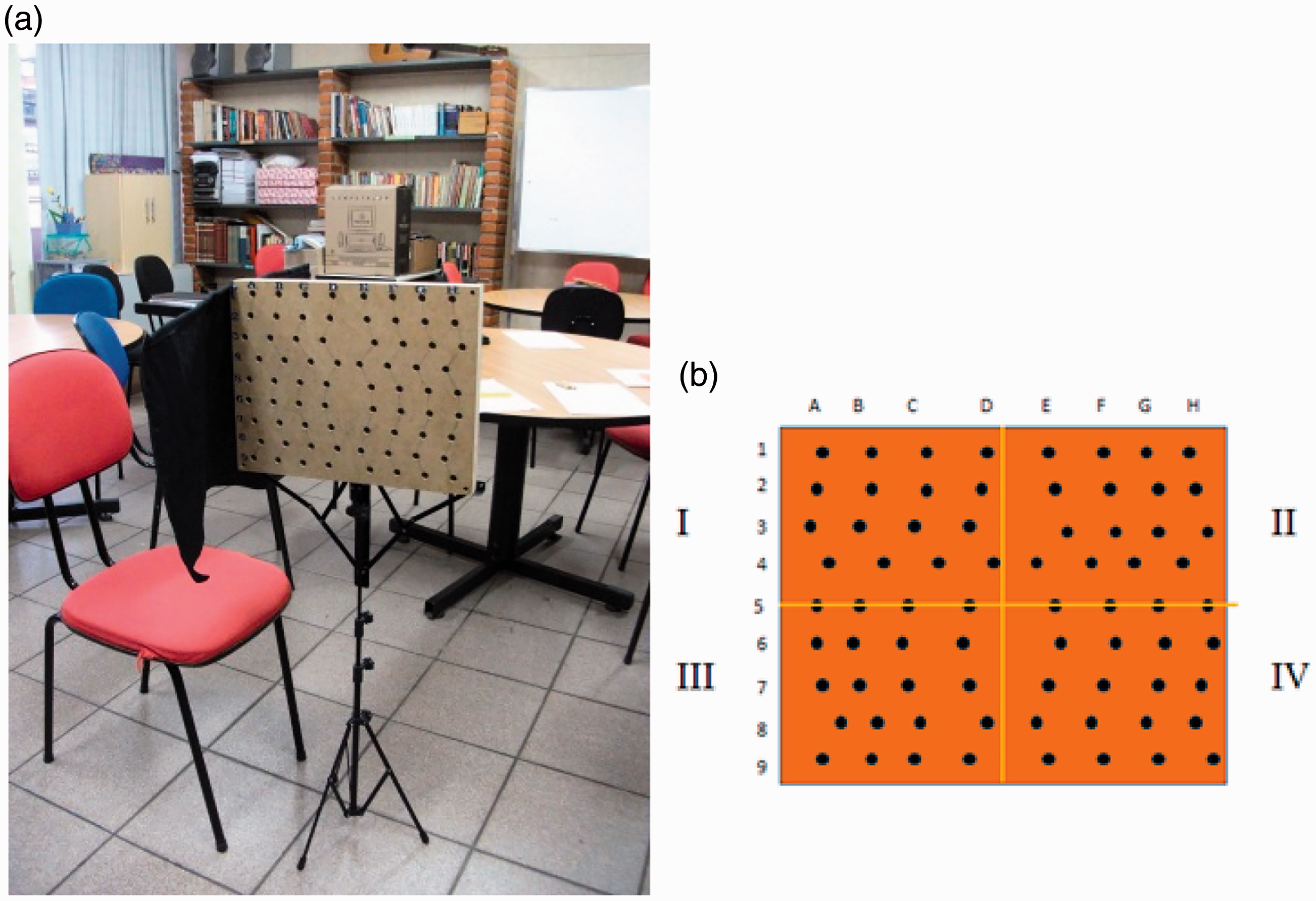
The experimental setting is depicted in Figure 2. The mirror was inclined about 40° to allow the child to have full view of each side of the wooden plate when looking just over the curtains.
Experimental setting.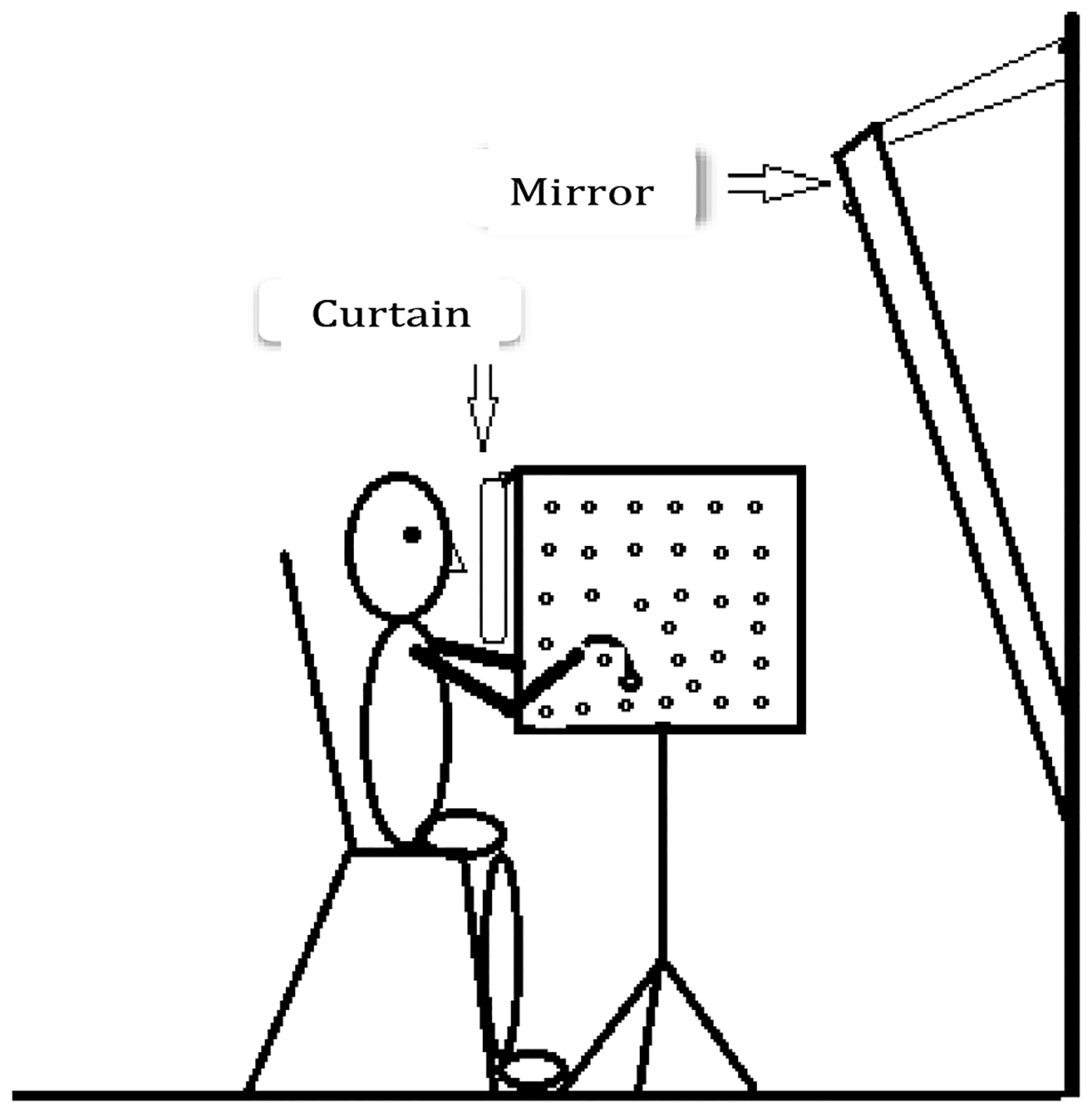
Cognitive assessment and procedures
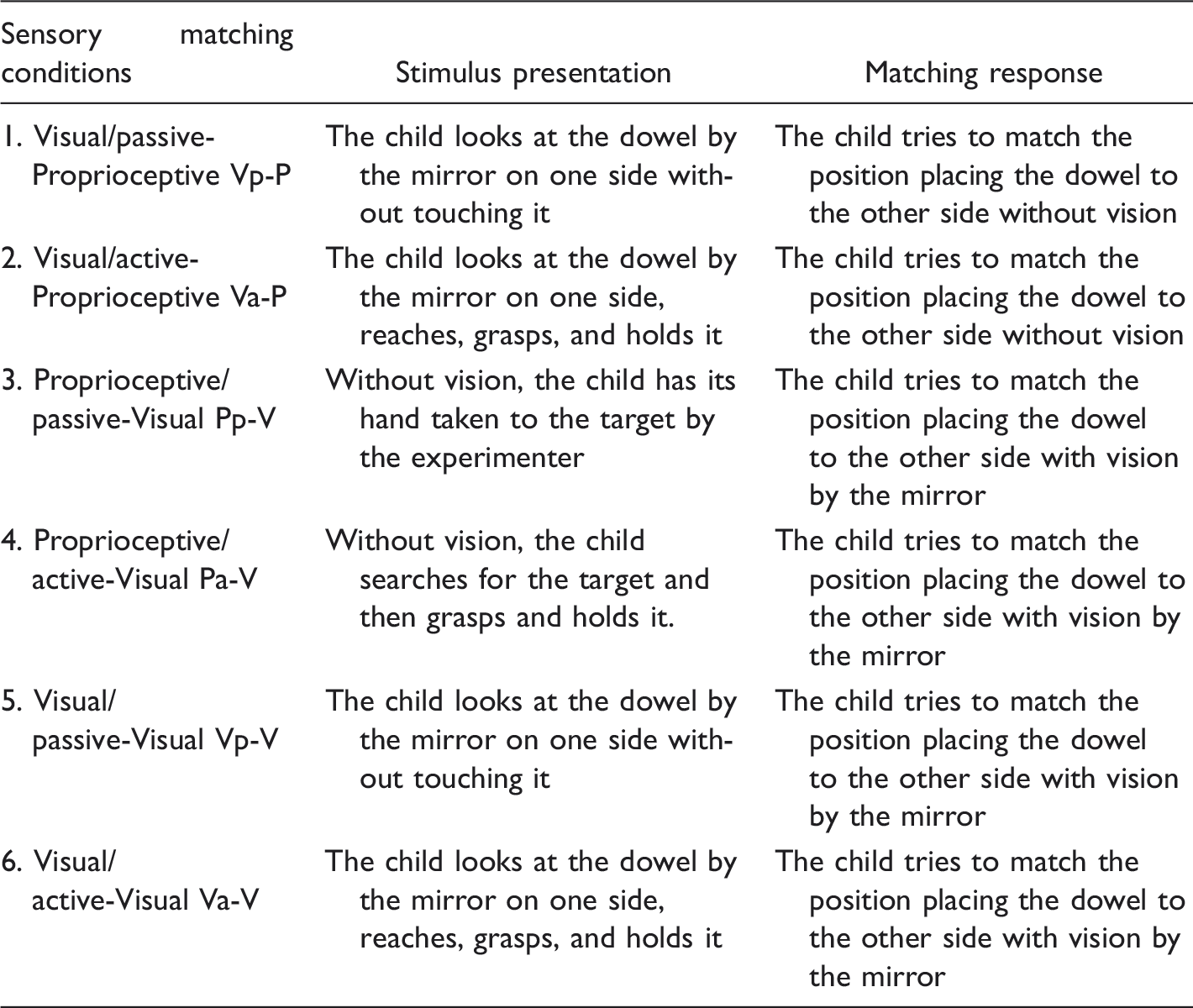
Sensory matching conditions.
Goals of each experimental condition.
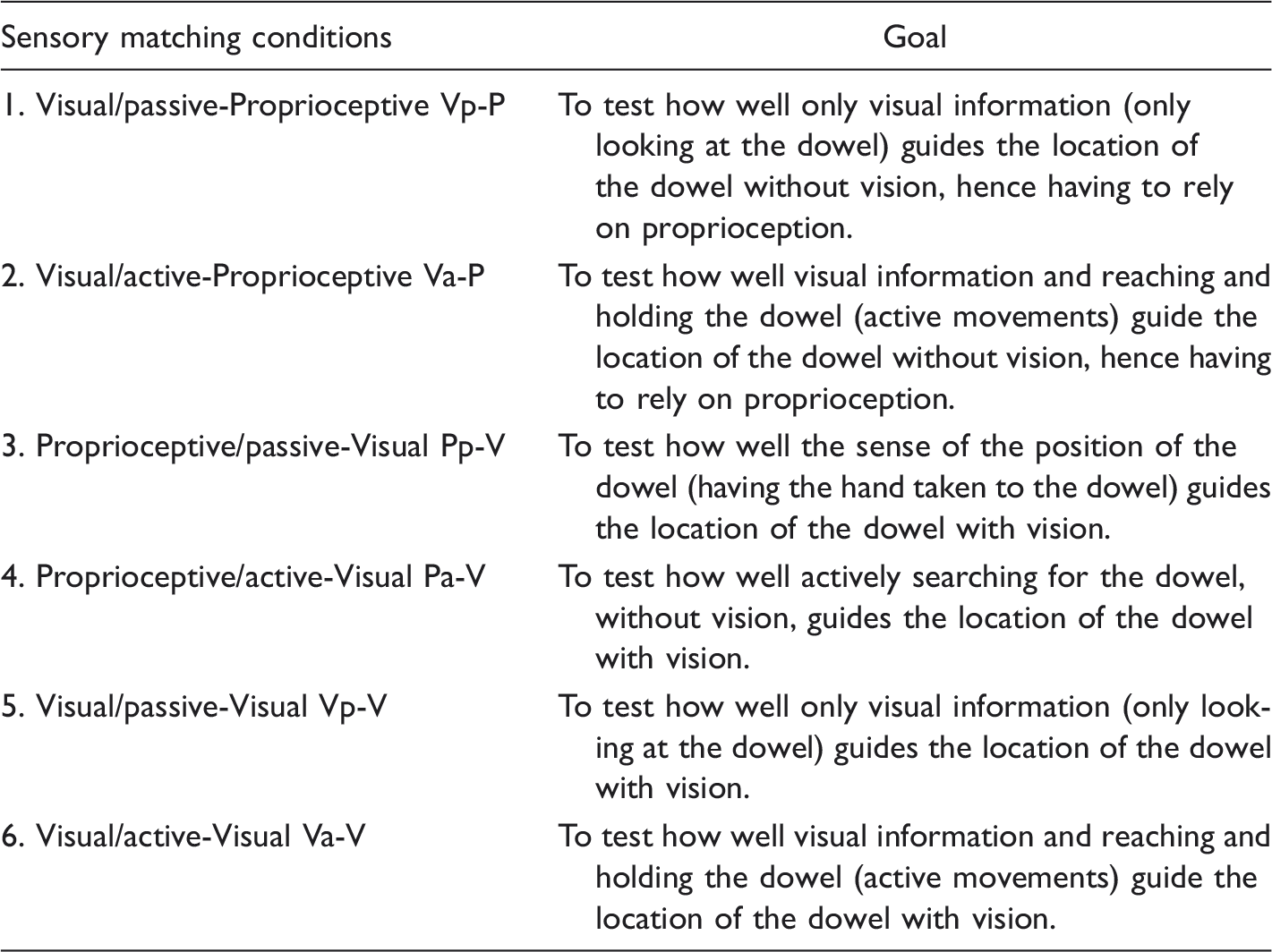
The order of conditions was balanced among the participants to minimize the order effect. The paramedial correspondence apparatus provides two kinds of results: (a) adequate response, the child placed the dowel in the corresponding spot of the target in the other side of the wooden plate; (b) error response, the child placed the dowel in a spot different from the corresponding target in the other side of the wooden plate.
Analysis
From the two kinds of results, we calculated the (1) number of overall errors for each condition and (2) number of adjacent and non-adjacent errors. This second kind of result indicates whether the child mistook the target by one cell in either position (adjacent error) or by two or more cells away from the target position (non-adjacent errors). Considering the design, we conducted a two-way analysis of variance (ANOVA) G(3) × Condition (6) with repeated measures on three measures: overall error, adjacent error, and non-adjacent error.
Results
The effect of the visual illusion caused by looking at the mirror is quite evident for condition Vp-P for all groups (Figure 3). A similar effect was also observed for condition Vp-V mostly for the younger children (G6 and G7).
Mean global error and its standard deviation in each condition for age groups G6, G7, and G10.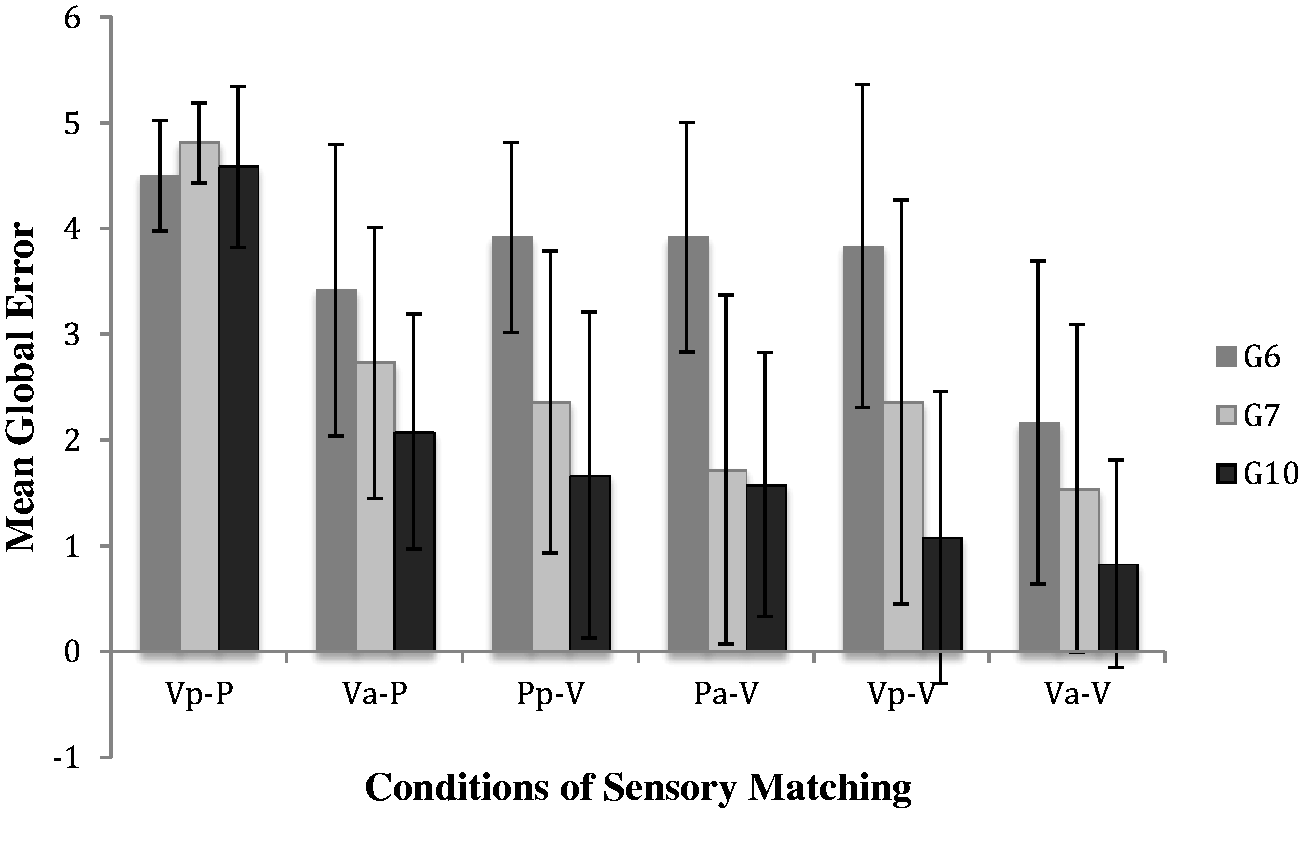
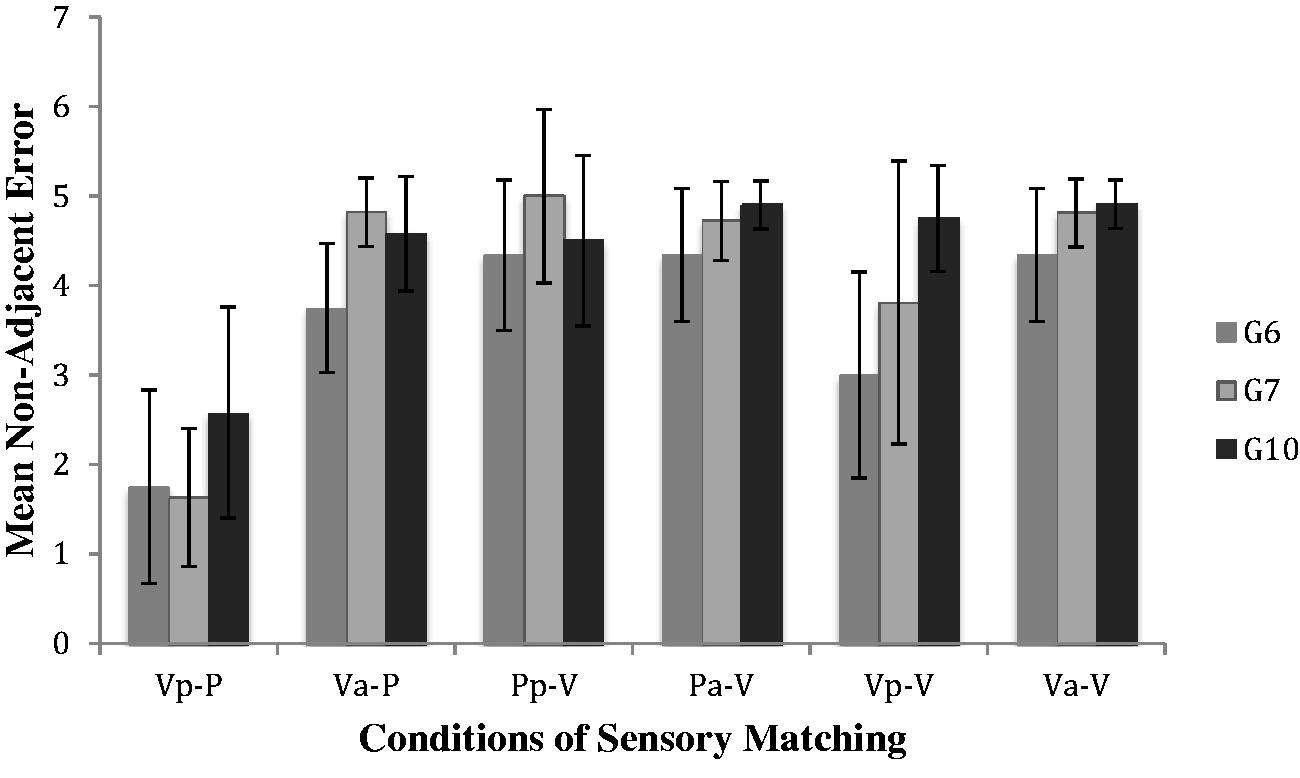
A two-way ANOVA G(3) × C(6) for the mean overall error indicated an interaction, F(10,56) = 2.73, p = .008, η2 = 0.33. The description of adjacent error (Figure 4) indicates that it contributed less to the overall error, i.e., errors in the present experiment were of greater magnitude for all groups. This was corroborated by the number of non-adjacent errors (Figure 5).
Mean adjacent error and its standard deviation in each condition for each age group G6, G7, and G10. Mean non-adjacent error and its standard deviation in each condition for each group G6, G7, and G10.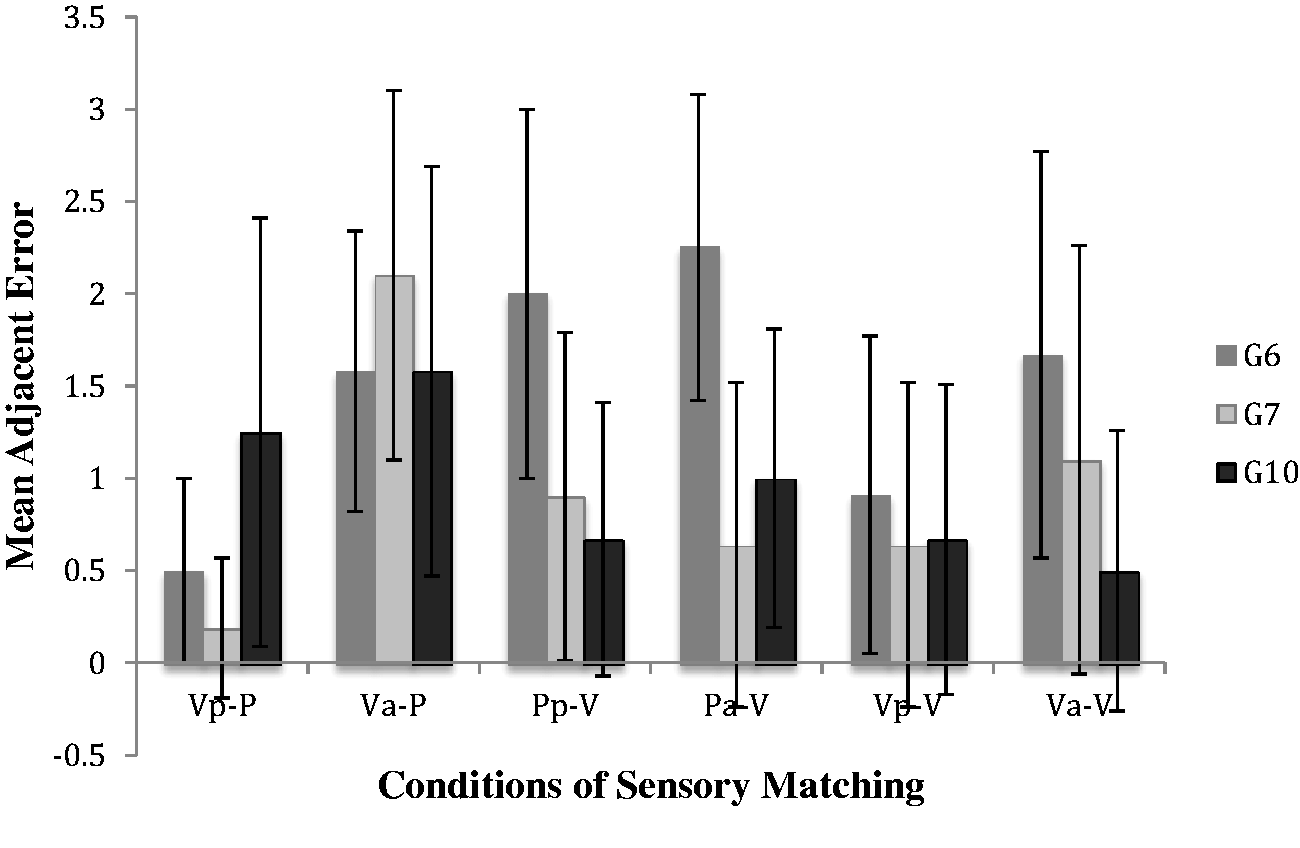
The six-year-old children were the most affected by the visual illusion and we suggest that this might be related to their egocentric mode of thinking, as this mode is expected to be predominant among this group. The two-way ANOVA G(3) × C(6) for the mean overall error indicated an interaction, F(10,56) = 4.51, p < .001, η2 = 0.45. In the problem-solving task, children in G6 showed predominantly an egocentric mode of thinking (Figure 6). In fact, this task proved to be very difficult for all children as can be seen in the mentioned figure.
Frequency of responses: Correct—decentered mode of thinking; Correct with feedback—transition to decentered mode of thinking; Error—egocentric mode of thinking.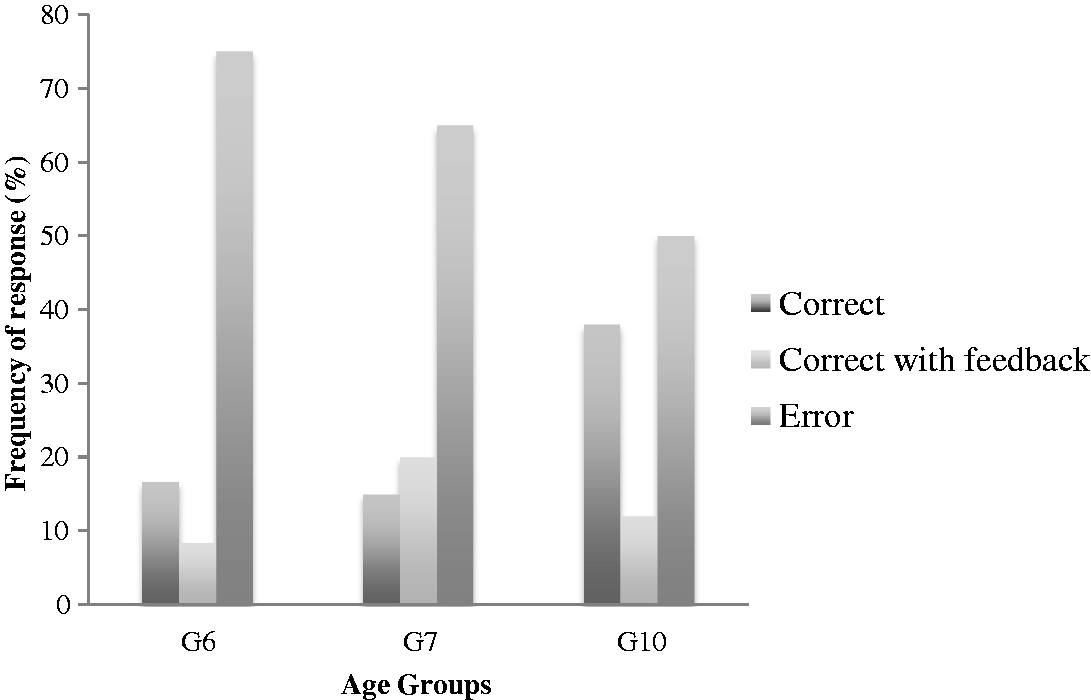
Discussion
Overall, the illusion created by the mirror led to greater disruption of the younger children’s performance. Judging by these results, we can present a new equation for inter-sensory judgments taking into consideration the performance of 10-year-old children:

Nevertheless, the results corroborate what has been shown by recent studies showing that proprioception increases in relevance for inter-sensory judgments (Gori, Del Viva, Sandini, & Bon, 2008; King, Pangelinan, Kagerer, & Clark, 2010). Younger children seemed to have relied more on visual information than hypothesized. Indeed, it has been reported that in conditions with sensory conflicts, young children (from two to five years of age) will rely on visual information (cf. Shumway-Cook & Woollacott, 1985; von Hofsten & Rosblad, 1988). However, our results showed that this is so only when young children can perform active visually guided movements, as in the active movement conditions. Only seeing the target in the mirror and being led passively to touch the target (as in the Visual-Passive condition) did not decrease the number of spatial error judgments. This might be an indication, however, an indirect one, that young children being self-centered have difficulty performing tasks when visual information is not associated with proprioceptive information.
The fact that proprioceptive information seems to be important for sensory-motor adaptation as children grow older has been explained recently. Ernst (2008) pointed out that conditions with conflicting sensory information lead to mismatches between intra-sensory discrimination and inter-sensory integration; to resolve them, the central nervous system weights each information source. Van Beers, Sittig, and van der Gon (1999) proposed a model to assess both intra-sensory and inter-sensory processes, called the Optimal Integration Model. It argues that the central nervous system uses all sensory information available for weighing and re-weighing each source of information in order to decrease uncertainty associated with multisensory stimuli. Ernst and Banks (2002) stated that sensory integration relies upon redundant sensory information in a statistical way. Traditional information processing approaches indicate that individuals process sensory information by different channels: visual, auditory, olfactory, gustatory, tactile, and proprioceptive. These different inputs would have to coalesce into a coherent set of perceptions to give an accurate description of the real world. This traditional view might be equivocated. Perception is first and foremost oriented for action (Gibson, 1966). Multisensory information makes sense when it entails sensorimotor coordination to guide action as well as possible, rather than to give a precise layout of the world (Bridgeman & Hoover, 2008). Although each sensory mode has peculiar features, the various modes only make sense in the realm of action because they are inextricably integrated in the sensorimotor interaction as in classical study by Sperry (1950).
The world that makes sense is the world in which one acts; sensory conflicts can be dealt with by taking the body as a frame of reference. The group of six-year-old children in our study gives some evidence of this quality when they could decrease errors by seeing and actively moving towards the target. Jovanovic and Drewing (2014) found that six-year-old children performed better on size estimation when they could have see and touch the object in spite of distortions caused by reduced or magnified lenses. Reaching and grasping an object entail perceiving it and acting on it. In a more radical view of embodiment, the object’s reality is framed using the actor’s body as a reference (Thompson & Varela, 2001). The ontogeny of the integrated, multisensory system of action is not trivial and lasts a decade or so during childhood. However, the basis for the integrative nature of modal senses is already present in infancy (Nardini, Dekker, & Petrini, 2014; Rigato, Ali, van Velszon, & Bremner, 2014).
Although these notions cannot be extrapolated from our investigation, we think that our results are in agreement with them and, in more general terms, might contribute to the view of embodied cognition in which “to know” is embedded into the context and grounded by the body (Robbins & Aydede, 2009). The results reported here indicate that the conflict between information sources, what is seen and what is felt, led older children to rely more on their proprioception. King et al. (2010) found results similar to these for children with 10 to 13 years of age. van Beers, Wolpert, and Haggard (2002) have shown that in adults, conflicts between vision and proprioception will be resolved by resorting to proprioceptive information. Jola, Davis, and Haggard (2011) found that adult ballet dancers showed better sensory integration relying upon on proprioceptive information in comparison with non-dancers.
Every action is guided by transactions between the individual and his surroundings. The individual acts prospectively and senses to detect something. This process is mediated by body dynamics, the basis for embodied cognition. Multisensory integration is entailed in this process and proprioception might play a major role in it as suggested by the Optimal Integration Model. Indeed, older children were more able to use proprioceptive information to make better spatial judgments. Furthermore, young children being self-centered in their mode of thinking also show dependence of active movements in judgment of spatial locations, reinforcing the role of multisensory information to guide their actions.
At least three aspects need attention in further studies. First, it would be interesting to pursue another test of egocentric thinking in children. The task we used proved to be too difficult for children, which may be why we could not discriminate the modes of thinking between 7- and 10-year-old children. Second, the paramedian correspondence apparatus allows an evaluation of sensory integration in a location task. The assessment of performance was limited to the number of errors. The number of adjacent and non-adjacent errors defined the variation on space location indirectly. Using the spread of variance around the target, we could refine the measurement and use a Bayesian framework to compute the probabilities involving the sensory matching. Third, the experimental task used consisted of matching spatial location without temporal demands. However, we should develop means to test sensory integration in tasks with varying movement speed, timing requirements, and complexity. These elements combined lead to increases in movement diversity and complexity, which characterize motor action development. The processes we investigated here are related to embodied cognition in the sense that they entailed the formation of a multisensory integration in motor actions and this, according to Cowie, Makin & Bremner (2013) is the very stuff from which the bodily self is constructed.