






Abstract
Set shot goal-kicking is recognized as an important skill in Australian Football (AF), accounting for over half of all goals kicked in the Australian Football League (AFL). However, as knowledge surrounding its performance is limited, this study described the frequency, types, and outcomes of set shots in the AFL and investigated the impact of task, personal, and environmental constraints on goal-kicking performance. We analyzed video footage of set shots from all 198 matches of the 2012 season, collecting data for kick distance, kick angle, player position, player experience (i.e., general and specific), kick outcome, and weather status. We found an average of 23.0 (standard deviation [SD] = 4.5) set shots/match, with a mean accuracy of 55.0% (SD = 0.7%). Kicking accuracy decreased with incremental increases in kick distance, with accuracy ranging from 97% (0–15 m) to 36% (≥50 m). Key forwards were more accurate kickers than other players. There was no significant effect of player experience. The number of set shots taken decreased by 13% in wet weather conditions. The primary determinant of elite set shot goal-kicking performance was the interaction of kick distance and angle (task difficulty). This research adds to an understanding of how personal, environmental, and match constraints influence this closed skill performance in AF match play.
Introduction
Success within an Australian Football (AF) game is achieved in part by kicking more goals. Although many kicks at actively defended goals are performed during free play, set shots refer to free goal kicks after markings, in which the player is given up to 30 seconds to perform the kick without threat of being actively defended (Robertson, Back, & Bartlett, 2016). Set shot goal-kicking forms a vital part of AF match play, accounting for 54% of all goals scored since 2007, with a reported accuracy rate of 61% (Champion data, Victoria, Australia). A limitation of this statistic is that it consistently fails to incorporate the most inaccurate shots that are kicked out-of-bounds or fail to make the distance, leading to an overstated accuracy estimate. Despite the match outcome significance of set shot goal-kicking, no studies have reported detailed data regarding set shot goal-kicking or thoroughly considered various environmental performance influences.
AF set shot performance can be viewed from a dynamic systems approach, specifically the constraints-led approach, to skill performance (Travassos, Duarte, Vilar, Davids, & Araújo, 2012). This approach describes how task, personal, and environmental constraints dynamically interact to organize movement (Davids, Button, & Bennett, 2008). Task constraints include match-specific aims, rules, and equipment, such as trying to maximize the number of points scored, the fixed location of the set shot, and the set shot time limit (Breed & Spittle, 2011; Travassos et al., 2012). Personal constraints include traits such as experience, anthropometry, anxiety, and decision-making skills (Breed & Spittle, 2011). Environmental constraints can include wind, rain, crowd noise, and the stadium where the match is contested (Breed & Spittle, 2011). Constraints may benefit or hinder movement, depending on the situation, and they are rarely independent (Breed & Spittle, 2011). For example, a player may balance perceived kicking ability with location and wind direction to assess if a set shot forms an optimal scoring opportunity at that point in the match. Therefore, research exploring set shot motor skill execution should consider the relevant constraints, some of which may be manipulated in practice, to help develop better game play (Breed & Spittle, 2011; Travassos et al., 2012).
Match-based (task) constraints are specific to the match play of each sport. Aside from the rules surrounding set shot performance, such as the time limit for performance, a player is generally limited by the location where they can perform the set shot. This location can influence the perceived task difficulty, which is regarded to be an interaction between the angle and distance from goal at the point where the kick is taken (Galbraith & Lockwood, 2010; Jackson, 2003). Galbraith and Lockwood attempted to describe this interaction by exploring the angle of opportunity of a given kick, the angle subtended by the goal line, and the player's point of contact with the ball (see Figure 1; Galbraith & Lockwood, 2010). The angle of opportunity decreases as either kick distance or angle increase, and it can therefore be thought of as the margin for error in the longitudinal (z) axis. This concept was shown to be a valid indicator of kick difficulty in rugby union (Jackson, 2003).
Example of the angle of opportunity in an Australian Football context.
Variations in elite AF set shot goal-kicking accuracy across distance and angle have been reported previously (Bedford & Schembri, 2006), although only scoring shots have been analyzed. As noted earlier, these data have neglected the most inaccurate kicks that land out-of-bounds or short and in the field-of-play. Bedford and Schembri (2006) observed that set shot goal-kicking accuracy decreased progressively as distance from the goal increased for set shots up to 45° in angle. There were nonsignificant differences in accuracy for set shots taken from the boundary line as kick distance increased (Bedford & Schembri, 2006), likely because of the small sample of kicks in these regions and the curved nature of the boundary line that results in angle decreases with increasing distance.
Important personal constraints to an ideal performance (Davids et al., 2008) can be role-oriented (e.g., player position) or psychosocial (e.g., experience). Players in team sports adopt positional roles based on certain anthropometric, physical, and tactical requirements of the role (Gabbett, King, & Jenkins, 2008; Gray & Jenkins, 2010) and any distinctive technical skill elements that may help explain why players are selected for particular positions (Jordet, Hartman, Visscher, & Lemmink, 2007). While various physiological demands of different AF playing positions have been reported previously (Dawson, Hopkinson, Appleby, Stewart, & Roberts, 2004; Wisbey, Pyne, & Rattray, 2011), research regarding technical performance in AF matches is far less extensive. However, findings from elite AF matches have demonstrated that players in key forward and ruckman roles were involved in approximately 15 marking opportunities per match, compared with only six per match for smaller midfielders (Appleby & Dawson, 2002). As set shots only arise from a successful mark or free kick, it is likely that key forward and ruck players perform proportionately more set shots than players in midfield and other roles. Greater experience performing match-related set shots for key forward and ruck players suggests that they may be more accurate with set shots than players in other positional roles. Bedford and Schembri (2006) found that “specialist” Australian Football League (AFL) goal-kickers were more accurate goal-kickers than players in other positions, although these statistics did not isolate set shot goal-kicking performance. Clearly, more research is required to describe the influence of player position on the frequency and accuracy of set shot goal-kicking performance in AF.
In addition to the foregoing constraints, a greater amount of experience at the elite level of play also provides an athlete with greater exposure to performing under the environmental constraints and pressures associated with elite competition. Gabbett and Ryan (2009) observed that experienced professional rugby league players exhibited superior tackling technique and missed fewer tackles in matches than less experienced players. Despite a logical expectation that greater experience should be associated with improved set shot goal-kicking, the relationship between performance and elite level AF experience has yet to be investigated.
One enduring attribute of skilled athletes is their capacity to adapt to the varying elements in the performance environment (Davids et al., 2008). Rainfall is one typically encountred environmental condition for AF players that may affect match play and skill performance. Appleby and Dawson (2002) observed a 9% drop in contested marking efficiency in wet conditions compared with dry conditions. A reduction in the number of marks taken during a match is likely to reduce the number of set shots performed. For the set shots that are taken in wet conditions, it is probable that a wet and heavier ball will be more difficult to grip and require more force for a required distance than a ball in dry conditions (Orchard, 2001).
Despite the importance of set shot goal-kicking in winning AF matches, to date, no studies have observed and reported on set shot goal-kicking in sufficient detail or thoroughly considered various performance constraints that can influence skill execution. Further, no investigations have provided a full report of set shot goal-kicking performance that includes nonscoring set shots. Therefore, this study aimed to describe the frequency, types, and outcomes of set shots in the AFL, and to investigate the impact of task, personal, and environmental constraints on elite set shot goal-kicking performance.
Method
Instruments
We used a between-group observational design to quantitatively examine the population of all set shots taken during all 198 matches of the 2012 AFL season, using a single observer's ratings of a combination of television broadcast and behind-the-goals video footage (i.e., footage from an elevated, fixed camera available to all AFL clubs). Video footage was viewed within SportsCode v.8 software (Sportstec, Sydney, Australia), with the footage paused, slowed, or replayed to maximize the integrity of data collection.
Sample Selection
As noted earlier, a set shot is a kick for goal which follows a mark or free kick; the player is given up to 30 seconds to perform the kick without threat of being actively defended. We applied strict inclusion criteria to ensure all kicks were set shots at goal. This included consideration of several temporal and behavioral cues to determine whether the player intended to kick a goal, pass, or gain territory. Cues indicative of the intent to kick a goal and leading to data inclusion were absence of urgency in kick preparation (e.g., a routine time longer than 15 seconds), presence of ritualistic behavioral idiosyncrasies (e.g., set shot routine, placing the ball on the ground, refitting socks, and throwing blades of grass), and eyes focused on the goal. Kicks were excluded from data analysis if the player attempted to pass the ball, the kicker was deemed to have moved off his direct line toward the goal, or the umpire called “play on” (as this call allowed the opposition to tackle the kicker and removed the stability of the free kick environment so that the set shot was no longer a predominantly closed skill). In addition, data were excluded from analysis if there were any of several cues generally indicative of the player's intent to pass the ball or gain territory, including a hurried kick preparation, a lack of any ritualistic behavioral idiosyncrasies, and eyes scanning the field-of-play for passing options. Finally, we excluded kicks taken after the siren (i.e., signaling the end of a quarter) unless the observer believed the player would have performed a set shot if all other options (i.e., pass or play on) had still been available.
Data Collection
Each time a set shot was performed, kick outcome and details regarding task, personal, and environmental constraints were recorded. To establish if there were differences in set shot frequency and accuracy between winning and losing teams, we divided set shots from each match into those taken by winning and losing teams. One drawn match was excluded from this analysis.
We scored kick outcome, based on the AFL scoring system whereby a goal (i.e., a kick by a player which passes unimpeded between the two large goalposts) was scored as six points; a “behind” (i.e., a kick that either struck a large goalpost, or passed unimpeded within the bounds of a smaller “behind post” on either side of the large goalposts) was scored as one point; and both a kick that fell short (i.e., a kick that was touched inside the field-of-play by any player) or went out-of-bounds (i.e., a kick which either struck a behind post or landed outside of the field-of-play without registering a score) was scored as zero points (Figure 2). The only accuracy measurement was a kick that achieved a goal.
Representation of the set shot scoring outcomes.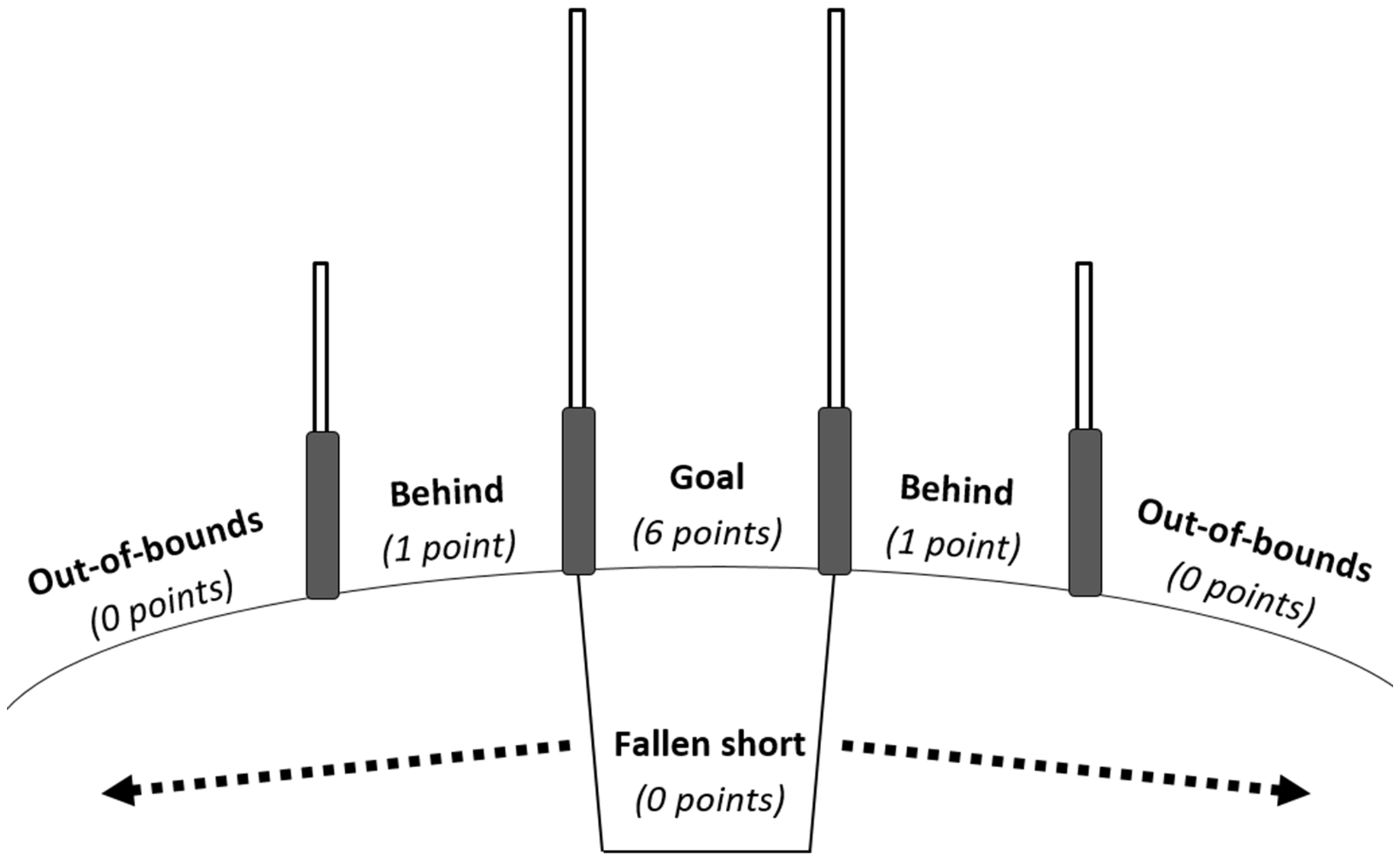
To determine the task constraints of each kick, we classified the kicking location into 15 zones, based on distance and angle. Kick distance categories were 0–15 m, 15–30 m, 30–40 m, 40–50 m, and 50 + m, based on the distance from the goal line at the time of performance. The acuity of the kicking angle was judged relative to the nearest goalpost into angles less than 30° (in front of goal), and 30° or more (acute angle) with either a left or right vector (see Figure 3; Nicholls, Loetscher, & Rademacher, 2010). We assessed interobserver reliability by cross-checking the locations of scoring shots (n = 4,094) with those logged by official AFL statisticians Champion Data. Interobserver agreement (with Cohen's kappa) for kick distance and angle categories were 96.6% (κ = 0.93) and 98.3% (κ = 0.97), respectively. We assessed intraobserver reliability by having the observer reanalyze set shots from four randomly selected matches (n = 98) six months after the initial observations. Intraobserver agreement (with Cohen's kappa) for kick distance and angle categories were 87.8% (κ = 0.75) and 88.8% (κ = 0.77), respectively. Thus, inter- and intraobserver reliability was excellent for this notational analysis (Fleiss, 1981).
Set shot goal-kicking accuracy relative to ground location.
To assess personal constraints, in conjunction with an AFL high-performance coach, we categorized players according to their playing positions into “key forwards” and “other players.” To assist with assigning players to a category, we adopted the same question as Jordet et al. (2007, p.124): “Is the player's primary task to score goals (key forwards) or to set up others (other players)?” The number of AFL games played and goals kicked by the player performing the set shot as of January 1, 2012 (just prior to the analysis period) were recorded as measures of general (i.e., games) and specific (i.e., goals kicked) experience. Both data sets were derived from the official AFL Record and were divided into frequency categories of: 0, 1–49, 50–99, 100–149, and 150+.
Weather related (i.e., rainfall) environmental constraint measures were based on rainfall data from the Bureau of Meteorology, with data from the nearest weather station (mean distance from stadium = 7.5 km, standard deviation [SD] = 5.9) used for analysis (Orchard, 2001; Orchard & Powell, 2003). We applied conservative arbitrary threshold values following preliminary examination of rainfall observations, with match conditions classified as wet if rainfall exceeded 1.5 mm during the match, or if rainfall exceeded 2.0 mm in the four hours prior to the match commencing. All classifications of weather conditions were verified by visual inspection of the match footage.
Statistical Analyses
All statistical analyses were performed using SPSS® v.20 (IBM Corporation, Armonk, NY) for Windows®/Apple Mac®. For some analyses, kick locations were grouped according to difficulty into low probability shot locations (i.e., lowest tercile for mean accuracy) and moderate-to-high probability set shot locations (i.e., middle and upper tercile; Figure 3). Significance levels for all variables were set at p < .05.
Set shot accuracy was defined as the percentage of goals scored from all set shots (presented as means (M) and standard errors). Because of the dichotomous nature of the data set, we used nonparametric Pearson's chi-squared independence tests (χ2) to determine which (if any) personal, environmental, or task constraints affected set shot goal-kicking accuracy. We used Bonferroni-adjusted chi-square tests for any needed post hoc comparisons. We calculated odds ratios (OR) as a measure of effect size for all accuracy comparisons between groups. The same statistical measures were used to report data on set shot selection, the proportion of low probability set shots (LPS) taken under a particular condition.
For selected variables, we also analyzed the frequency of set shots (shots per quarter/match). As Shapiro–Wilk tests revealed normality of the data distribution for the frequency of shots when grouped by weather status, we compared the frequency of set shots under various weather conditions using means and standard deviations in parametric one-way analyses of variance with post hoc Bonferroni-adjusted independent t tests. We confirmed equality of variance for these variables through Levene's test (p > .05). Effect sizes and nonparametric tests were given as Cohen's d and eta-squared (η2), respectively.
Results
A total of 4,599 set shots were taken during the 2012 AFL home-and-away season, with an average of 23.2 (SD = 4.6) occurring per match; set shots had a mean accuracy rate of 55.0% (SD = 0.7%). Inaccurate kicks comprised behinds (mean = 33.7%, SD = 0.7%), kicks that fell short (mean = 8.2%, SD = 0.4%), or kicks that were out-of-bounds (mean = 3.1%, SD = 0.3%).
Winning teams kicked more accurately (M = 57.5%, SD = 0.9%) from set shots than did losing teams (M = 51.0%, SD = 1.2%), χ2(1, N = 4,570) =18.40, p < .001, OR = 1.30, and performed more set shots per match (M = 14.0, SD = 3.8; range = 6.0–26.0) than losing teams (M = 9.0, SD = 3.4; range = 2.0–20.0), H(1, 394) = 128.67, p < .001, η2 = .327. Yet, there was no notable difference between winning and losing teams for shot selection. Losing teams performed an average of 32.3% of their set shots from low probability locations, compared with 31.5% by winning teams, χ2(1, N = 4,570) = 0.353, p = 0.55, OR = 1.04. Nearly one third of winning teams (33%) were able to win their match despite being less accurate from set shots than their opponents, although teams that performed a lower number of set shots won, on average, only 13% of the time.
Task Constraints
Set shot accuracy decreased consistently as kick distance increased, χ2(4, N = 4,599) = 440.20, p < .001 (Figure 3). Set shots were most frequently taken between 40 and 49 m (n = 1,876), accounting for 41% of all set shots (Figure 3). Set shots were taken least frequently between 0 and 15 m (n = 186), making up just 4% of the sample. Set shots taken on acute angles were, on average, 24% (n = 634; Mper match = 3.2; SDper match = 1.9) less accurate than those taken in front of goal (n = 1,893; Mper match = 9.5; SDper match = 3.1), χ2(1, N = 4,599) = 232.68, p < .001, OR = 2.61. On average, this equates to an extra 1.3 points to the offensive team for every set shot they produce toward the middle of the field.
Personal Constraints
Set Shot Accuracy (%) and Associated OR for Various Playing Positions by Kick Distance and Angle.
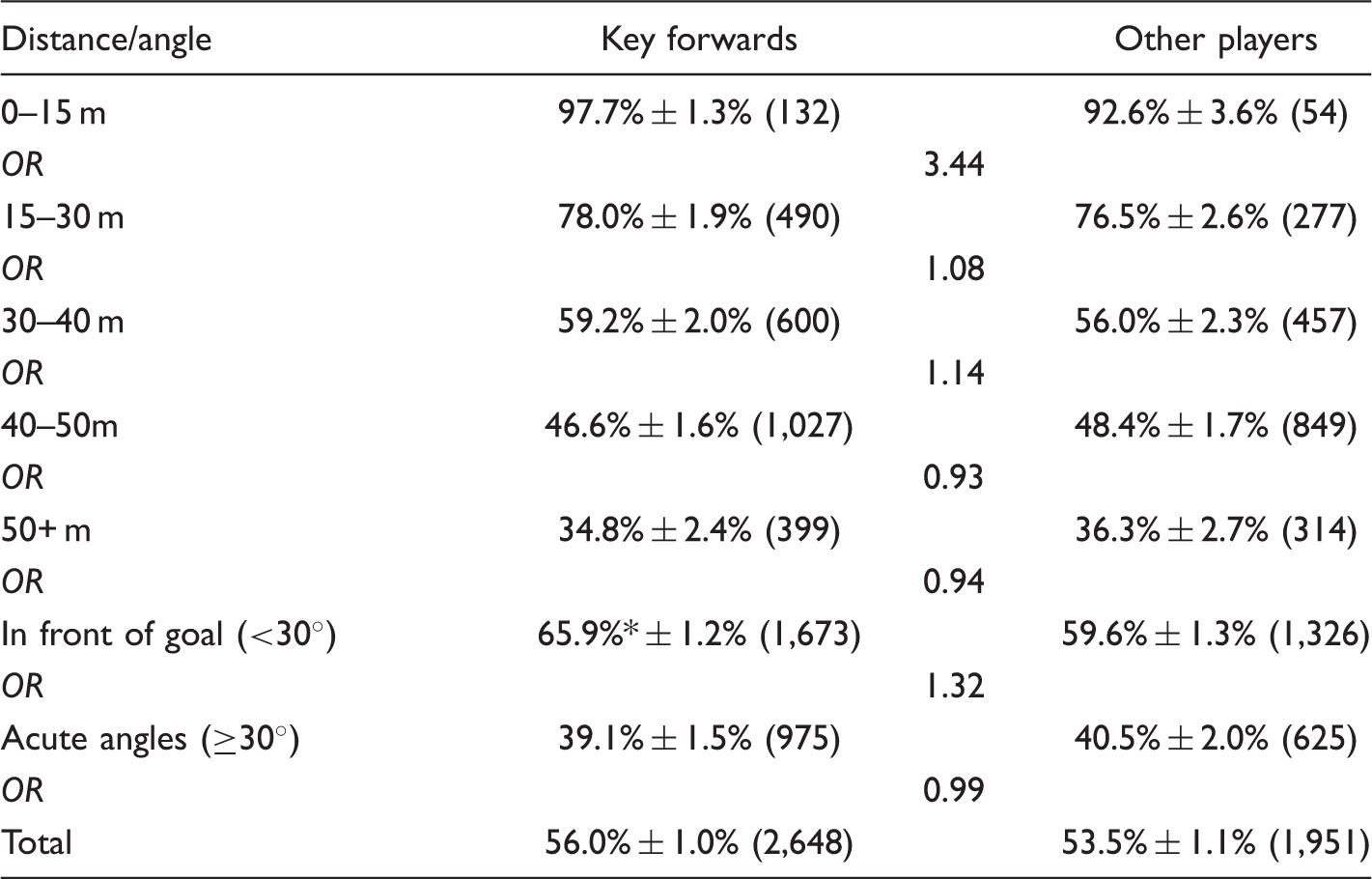
OR = odds ratio.
*p < .05.
Set Shot Accuracy (%), Low Probability Shot Accuracy (%), and Associated OR When Players Are Separated by General (i.e., Games Played) and Specific (i.e., Goals Kicked) Levels of Experience.
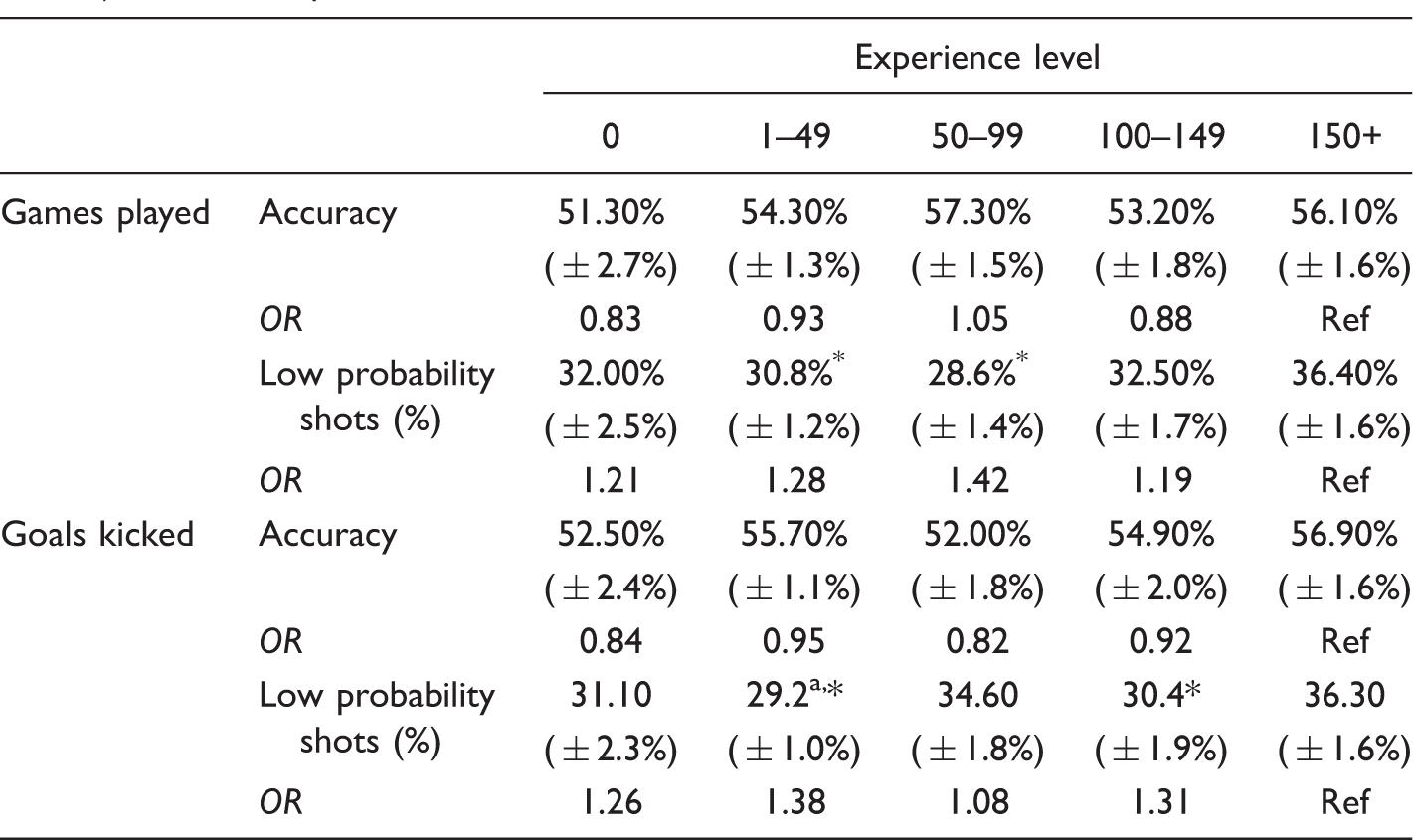
OR = odds ratio.
aSignificance to 50 to 99.
*Significant difference to 150+ p < .05.
Environmental Constraints
Set Shot Goal-Kicking Accuracy and Frequency Relative to Weather Conditions.
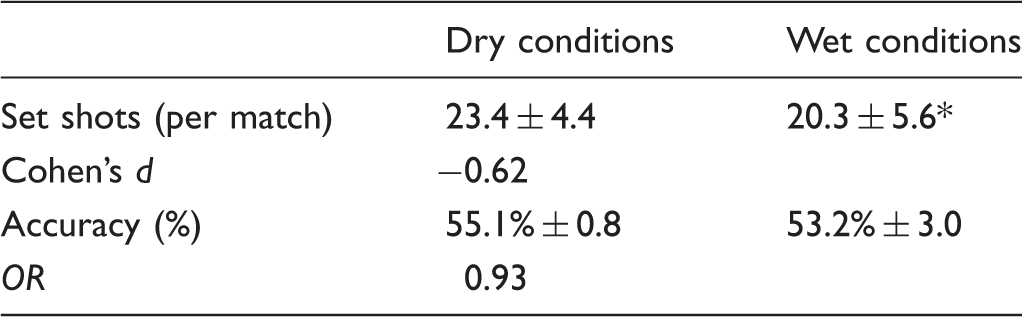
OR = odds ratio.
Discussion
The purpose of this study was to describe the frequency, types, and outcomes of set shots in the AFL, and to investigate the impact of task, personal, and environmental constraints on elite set shot goal-kicking performance. The overall accuracy rate reported in this study (55%) is 6% lower than the figure reported in official statistics for the 2012 season. This difference reflects the fact that data within this study included kicks that either landed out-of-bounds or failed to make the distance and landed in the field-of-play. Kicks of the latter category may indirectly lead to scores by advancing the ball toward one's attacking goal, but it was not within the scope of this study to examine the passages of play immediately following an inaccurate set shot. Preparing for a set shot allows the defensive team to place extra defenders close to the attacking goal, so a player performing a set shot consciously decides whether his set shot forms the optimal scoring opportunity for his team in that offensive possession. Kicks that fell short are therefore likely to have been some combination of an error in perceptual decision-making (perception of ability to kick the required distance) or error in skill execution. As just over a quarter of set shots greater than 50 m landed in the field-of-play, teams might be better advised to plan offensive and defensive strategies when the ball lands in the field-of-play.
These analyses showed set shot goal-kicking performance to be linked with ultimately winning matches. Winning teams averaged 4.5 more set shots during matches than losing teams, possibly because of a higher quantity or quality of possession in their team's attacking half, combined with superior contested marking ability. Our results also revealed that winning teams were, on average, 7% more accurate from set shots than losing teams. As scoring outcomes contribute directly to match outcomes, this finding may seem overt and self-explanatory. This accuracy difference, however, only equates to approximately 0.4 points per set shot on average, which suggests other mechanisms such as opposition quality may also influence these results. We conducted an exploratory analysis to control for opposition quality by removing data from the top four and bottom four teams in the competition rankings at the end of the home-and-away season, and the pattern remained.
There was an evident inverse relationship between kick distance and kicking accuracy, replicating findings in AF data (Bedford & Schembri, 2006) and rugby union data (Jackson, 2003). As kick distance increases, the angle of opportunity (and therefore margin for error) decreases (Galbraith & Lockwood, 2010), and the proportion of kicks that fail to make the distance also increase. Without controlling for these factors, it is difficult to rule out the influence of a speed-accuracy trade-off, although previous studies (García, Sabido, Barbado, & Moreno, 2011; Landlinger, Stöggl, Lindinger, Wagner, & Müller, 2011; Zebas & Nelson, 1988) suggest that elite team sport athletes in striking, throwing, and kicking tasks can maintain similar accuracy levels while aiming for maximal force production.
Our results showed set shots were most frequently taken at distances between 40 and 49 m from the goal. A likely explanation for this is that set shots from greater distances (50 + m) are beyond the kicking range of most professional AF players, and marking opportunities which result in set shots of shorter distances (<40 m) are defended more diligently by the opposing team. Examining Figure 3, an argument can be made that, in many cases, teams can enhance their probability of scoring a goal if they can successfully maintain possession and attain a set shot from a greater distance with a reduced angle. This may seem counterintuitive, given the propensity to gain territory toward one's goal; but as just over 30% of set shots currently performed are from locations with an average success rate of 37% and yield only 2.6 points on average for the offensive team, coaches should consider other strategies to score goals in AF.
AF players were, on average, 2.6 times more likely to score a goal from a set shot when the angle was less than 30°, compared with more acute angles. Comparable with our findings for kick distance, this can be attributed to a reduction in relative width of the goal line for each increase in angle at a given distance from goal (Galbraith & Lockwood, 2010). Clearly, teams should adopt defensive tactics that minimize marking opportunities in front of the goal. There were a proportionately lower number of set shots taken on acute angles when the player was less than 30 m from goal, compared with set shots of greater distances. An observation from the data collection was that the majority of players adopted a different kicking technique to the traditional drop punt kicking style for set shots closer than 30 m from the goal. There were various differentiations noticed, but the common feature was that players attempted to improve the angle of the kick by “playing on” and utilizing a 5-m protected area around the kicker.
When considering player positions, key forwards performed set shots more frequently than players in other positional roles. By definition, these players are the target of offensive strategies and as such spend the majority of playing time in their attacking half. This is supported by Appleby and Dawson (2002) who previously found key forwards are involved in more marking opportunities than other players, which would result in more set shot opportunities. There was selected evidence to support the finding of Bedford and Schembri (2006) that specialist goal-kickers are more accurate when performing set shots than nonspecialists. Key forwards were, on average, 6% more accurate than other players when in front of goal, but they were no more accurate when on acute angles. Previous researchers have attributed trends toward forwards being more accurate goal-kickers to greater task-specific experience (Jordet et al., 2007). It is reasonable to propose that key forwards would have greater experience in performing set shots than other players, given that they perform set shots more frequently in matches. This experience produced an advantage for lower difficulty set shots compared with other players; however, this did not translate to an advantage for higher difficulty shots. This suggests that the practice was beneficial for set shots that were performed from a lower difficulty and key forwards would normally be expected to successfully execute. This benefit was not evident for higher difficulty shots where all players have a similar rate of success. More research is required to assess this relationship and the potential link to practice conditions.
Neither the number of AFL games played nor the number of AFL goals kicked proved advantageous to set shot goal-kicking performance. Gabbett and Ryan (2009) showed that elite rugby league players with 150 professional games of experience or more were more effective tacklers than players with less than 150 professional games of experience, a finding that was not replicated in this study. This may be because tackling is a highly open skill requiring a strong perceptual and decision-making component, which may only be refined by extensive exposure to tackling situations at the professional level. The experience of a player was, however, linked to the selection of set shots. The most experienced players (150 + goals kicked; 150 + games played) were more likely to perform shots from locations with a low probability of success than several of the less experienced groups. This suggests that players in the less experienced groups choose other options (i.e., pass or run with the ball) when set shot opportunities arise in low probability locations, rather than kick for goal. Because of their experience, it is suggested these players are generally less likely to be the primary offensive target for their team, which would explain the inclination to pass the ball. Alternatively, it is possible that as AFL players gain experience, they become better at discerning which set shots are within their capabilities. The time course of this study was not sufficient to examine changes in individual set shot goal-kicking performance as experience develops; however, the findings allude to a trend toward AF players not improving their set shot goal-kicking accuracy once in the AFL system. If such a trend exists, it may be that professional AF teams may not be allocating sufficient practice time to set shot goal-kicking, or—on the other end of the paradigm—that players enter the AFL system at a relatively high performance level to begin with and experience a diminishing returns effect throughout their career.
When considering environmental constraints, results showed the number of set shots decreased by 13% in wet conditions. Appleby and Dawson (2002) reported the proportion of contested marks dropped increased by 9% in wet conditions, which would contribute to the decrease in set shots. There may also be tactical adjustments to the style of AF match play that occur in wet conditions which affect the number of marking opportunities close to goal resulting in set shots. Anecdotally, “wet-weather football” in AF consists of more congested match play, typically resulting in slower ball movement and less effective possession strategies, though this is yet to be described in research literature. Set shot goal-kicking accuracy was shown to be unaffected by rainy conditions, despite the assumption that a football becomes heavier during rainy matches and more difficult to grasp. This adds evidence to the idea that, similar to throwing (García et al., 2011) and striking tasks (Landlinger et al., 2011), elite athletes can maintain kicking accuracy with increasing kicking force.
Strengths and Limitations
This was the first study to show the impact of task, personal, and environmental constraints on set shot goal-kicking performance; this study also provides a more accurate measure of kicking accuracy by including set shots that are kicked out-of-bounds or fail to make the distance. Set shot goal-kicking is a predominantly closed skill that must be considered within the context of the performance environment. In contrast to a soccer penalty kick or free throw, set shot goal-kicking involves a decision-making component in which players must determine if a set shot maximizes the goal-scoring capabilities of their team for a particular offensive possession. They must balance their own perceived ability with the surrounding offensive and defensive tactics and any constraints that may influence performance. While not an aim of the current study, future research may consider the influence of a player's confidence (or overconfidence) to their set shot ability when making the decision to attempt a set shot, and whether this impacts set shot performance. The primary determinant of elite set shot goal-kicking performance was shown to be the interaction of kick distance and angle (task difficulty). Skill execution was shown to be relatively stable under various environmental constraints. The frequency of set shots, however, was shown to be negatively affected by wet playing conditions early in the competitive season and for losing teams. A limitation of this study is that it only sampled set shots from one AFL season (2012). In addition, we utilized only one observer for data collection, though inter- and intraobserver reliability data were strongly supportive of such verifiable observations as kicking location judgments. These data are not contemporary, though its findings are still important for athletes and coaches alike, as they involve elite performance in match situations across a national competition. While several potentially relevant variables, including anxiety, perceived momentum, and fatigue were not directly assessed, the results of this study may assist with the design of more effective practice environments from a variety of locations and especially from ranges of 40 to 50 m. Further, these results may influence technical (i.e., marking ability) and tactical (i.e., offensive structure) strategies employed by coaches to maximize the frequency and accuracy of set shots.