






Abstract
Visual illusions caused by varied orientations of visual patterns may influence the perception of space and size, possibly affecting body stability during locomotion. This study examined the effect of variations in shoe top visual patterns on perception and biomechanical stability while walking and running. Twenty healthy adults performed five walking and running trials along an instrumented walkway when wearing shoes with five different striped patterns (plain, vertical, outward, horizontal, and inward). Before these locomotion trials, participants ranked their perceptions of shoe width. We used synchronized force platform and motion capturing systems to measure ground reaction force, mediolateral center of position displacement, ankle inversion and eversion, ankle excursion, and maximum eversion velocity. We rated stability perception on a 150-mm visual analog scale immediately after each shoe condition. Data analyses indicated that participants perceived plain and horizontal striped shoes as significantly wider than inward and vertical patterned shoes. During walking, participants wearing shoes with plain and horizontal striped patterns demonstrated smaller mediolateral center of position displacement, maximum eversion velocity, and ankle range of motion when compared with walking when wearing outward and vertical striped patterns; when running, we observed a similar effect for maximum eversion velocity. Thus, certain visual patterns on the tops of shoes influence the wearers’ width perception and locomotion in ways that affect ankle stability during walking and running, with implications for risk of injury.
Introduction
Balance has been described as the ability to maintain a stable postural position without losing control or falling; balance is an essential attribute for effective exercises (Spink et al., 2011), as poor balance may lead to inferior postural performance and fall-related injuries, such as traumatic brain injury, hip and other bone fractures that may impair daily living activities and increase the incidence of hospital admissions (Melzer, Benjuya, & Kaplanski, 2004; Spink et al., 2011). Walking and running have been recommended as excellent exercises for improving general health and functional balance (Duncan et al., 2014). Exercising safely is important for developing long-term exercise habits and minimizing fall-related injuries. Footwear stability has been suggested as important to preventing falls and enhancing balance during locomotion. The stability of footwear can be improved by altering the base of support (wide vs. narrow), outsole shape (flat vs. round), and hardness (hard vs. soft; Price, Smith, Graham-Smith, & Jones, 2013; Ramstrand, Thuesen, Nielsen, & Rusaw, 2010). As walking and running are fundamental in daily activities, stable footwear benefits everyday competency.
From the cognitive perspective, visual illusions associated with certain visual patterns can play a significant role in human beings’ perceptions of size, shape, and space in their environments. Changes in visual patterns, and thereby in perceptions, can directly impact subjective stability perception and movement biomechanics (McAndrew, Wilken, & Dingwell, 2011; Whitney, 2002). Since footwear might be considered as visual stimuli that are directly controlled by the body during locomotion, optimizing the shoe top visual pattern may enhance balance and safety. Stripes have been commonly used in visual pattern research to alter perceptions of size and space dimensions. Distinct visual patterns (e.g., the horizontal–vertical pattern) may lead to visual illusions and have been used in past research to manipulate perceptions. Stairs with vertically striped patterns have been perceived as taller and narrower than stairs with horizontally striped patterns (Elliott, Vale, Whitaker, & Buckley, 2009). The opposite mechanism, the Helmholtz illusion, was found by varying the combination of shapes and empty spaces on a human-shaped figure so that participants perceived the figure as taller and narrower with horizontal striped as compared with vertical striped patterns (Thompson & Mikellidou, 2011). It is unknown whether applying similar visual striped patterns on footwear might influence the perception and, thereby, the dynamic balance of shoe wearers.
Biomechanically, shoes with a smaller base of support (narrow shape) lead to poorer dynamic stability (Menant, Steele, Menz, Munro, & Lord, 2008). If applying vertical or horizontal striped patterns onto the shoe top led the wearer to perceive the shoe to be narrower, then there might be a corresponding effect on the wearer’s balance and dynamic stability during locomotion. A previous study showed that participants demonstrated greater toe clearance when climbing stairs with vertical striped patterns than when stairs were horizontally striped (Elliott et al., 2009). This phenomenon, also known as the safe-stepping strategy, stimulates an exaggerated movement to elicit a safer step and avoid a sense of imbalance or falling. Elliott et al. (2009), however, only demonstrated that participants acknowledged perceiving the illusion, offering no reported data regarding actual changes in dynamic stability. Furthermore, according to the perception–action hypothesis, perception and motor performance are processed in two separate pathways (Goodale & Westwood, 2004). Therefore, research designs in this area can be improved by studying separately both stability perception and biomechanical indicators (e.g., center of pressure and ankle kinematics) of altered dynamic stability (Hiller, Refshauge, Bundy, Herbert, & Kilbreath, 2006; Hof, 2008).
As noted, walking and running are commonly prescribed exercises to lower mortality risks and promote healthy lifestyle in the general population (Lee & Buchner, 2008; Schnohr, Parner, & Lange, 2000). Executing a faster movement speed (running) requires greater effort and attention to maintain stability or performance than executing a slower movement speed (walking; Huxhold, Li, Schmiedek, & Lindenberger, 2006). Thus, the same shoe top visual patterns might differentially effect shoe perception and biomechanics when walking versus running. To better understand the separate perceptual and dynamic stability effects of varying shoe top visual patterns on both walking and running activities, this study manipulated visual patterns of the shoe top and measured participant wearers’ perceptions of shoe width and personal stability and directly assessed their dynamic balance during walking and running. We hypothesized that participants wearing shoes with horizontal striped patterns would perceive the shoes to be wider and their stability to be better and would demonstrate better dynamic balance.
Method
Participants
We recruited a convenience sample of 20 healthy male adults (mean age = 22.5, SD = 2.6 years; mean height = 1.7, SD = 0.2 m; mean weight = 76.5, SD = 22.4 kg) from local universities. To fit the standard shoes (all in U.S. 9.0) to participants, we recruited only participants who wore U.S. size 9 shoes. We took the foot size measurement with a Brannock foot measurement device (Brannock device, Syracuse, NY). We also excluded participants with any neurological or orthopedic injuries in the past six months that might affect their walking and daily activities. All experimental procedures were approved by the relevant institutional review board, and all participants signed informed written consent before the tests.
Footwear Conditions
Five nearly identical pairs of shoes (Li Ning LLAL019, Beijing, China) were provided to each participant, such that these shoe pairs differed only with regard to the following shoe top striped patterns (Figure 1): (a) Plain, (b) Vertical, (c) Outward diagonal, (d) Horizontal, and (e) Inward diagonal. The plain shoe condition (white color, no stripe pattern) was unmodified from its original specifications as available in the commercial market. For other striped shoe conditions, 1-cm wide black stripes with 1-cm spacing were prepared with spray-paint according to the five conditions of vertical, outward diagonal, horizontal, and inward diagonal directions of each shoe, respectively. The striped pattern conditions were made in accordance with procedures used in the horizontal–vertical stair study (Elliott et al., 2009).
Footwear conditions: (a) Plain, (b) vertical, (c) outward, (d) horizontal, and (e) inward.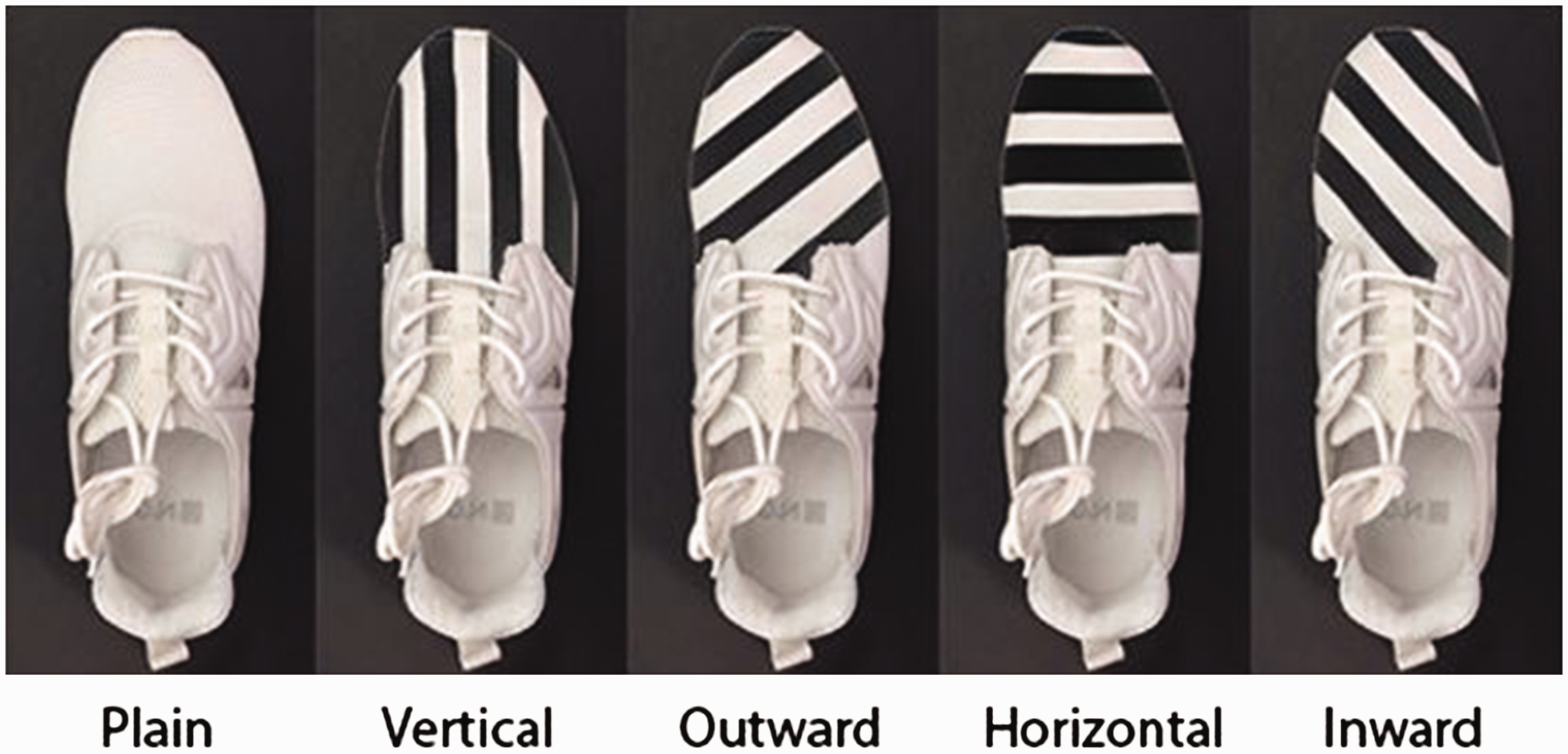
Experimental Procedures
Participants were first asked to rank their perceptions of shoe width (1 = narrowest and 5 = widest) on a diagram showing the top view of the five shoe conditions (Figure 1). To prevent any influence by the previous shoe rating scores, only one shoe diagram was presented to the participants at any time. After a standardized stretching warm-up protocol following procedures used in previous research (Kim et al., 2014), we averaged the participants’ five walking and running trials at the participant’s preferred speed while wearing their own shoes to determine the individual target speed for each participant for subsequent data acquisition. Participants were then asked to perform five walking and running trials on a flat and straight 15 -m runway wearing each of the varied shoe striped patterns (plain, vertical, and outward). We randomized the order of shoe patterns worn for each participant using an online randomization program (www.random.org). We then placed reflective markers over the participants’ right shoe according to a previous gait model (Altman & Davis, 2012). Participant’s gaze was not controlled during the walking or running trials, as any such instruction might have affected their normal gaits. Yet, to maximize the visual pattern effect, participants were reminded of the visual striped pattern worn by showing them a diagram of all five test shoe patterns (Figure 1) at the starting position and asking them, “Which pattern do you see on your shoe?” This reminder was shown to maximize the effect of the test condition in prior research (Masters & Maxwell, 2004). To ensure all participants were perceptually adapted to the shoe top pattern conditions, they were allowed to have 3-minute treadmill running in the test condition prior to the data collection (Fellin, Rose, Royer, & Davis, 2010). A successful trial was defined as one with a pace within 5% of the initially determined target speed and one with a clean right footfall on the force plate (AMTI, Watertown, MA), located at the center of the runway. We gave participants a 5-minute rest period between each test condition. During the rest period, participants were asked to rate their stability perception for each shoe condition on a 150-mm visual analog scale, commonly used to assess footwear stability perception due to its low bias tendency and high sensitivity (Lam, Sterzing, & Cheung, 2011; Mündermann, Nigg, Humble, & Stefanyshyn, 2003). The left end of the scale (0 mm) and the right end of the scale (150 mm) represented “very unstable” and “very stable” perceptions, respectively.
Data Processing
As noted, subjective width ranking and stability perception were assessed using shoe diagrams and visual analog scale (Mündermann et al., 2003). Synchronized ground reaction force (GRF) and ankle movements were recorded using force plate (AMTI, Watertown, MA) at 1600 Hz and an eight-camera motion analysis system (Vicon, Oxford Metrics, Oxford, UK) at 240 Hz, respectively. Kinetics and kinematics data were filtered using a fourth-order Butterworth low pass filter at 100 Hz and 12 Hz, respectively. Mediolateral GRF, anteroposterior GRF, total mediolateral center of position (COP) displacement, peak ankle inversion and eversion, ankle range of motion (ROM), and maximum eversion velocity were calculated as per the method described previously (Hiller et al., 2006; Hof, 2008).
Statistical Analysis
All statistical analyses were performed using SPSS 22 (IBM Corp., Armonk, NY). Descriptive statistics (mean and standard deviation) of biomechanical and perceptual variables were computed for respective walking and running conditions. A one-way repeated-measures analysis of variance was performed to detect any significant shoe visual-pattern differences on subjective shoe width ranking and the biomechanical and perceptual variables. Sphericity of data was assessed with Mauchly’s test with alpha <.05. In the case of a positive Mauchly’s test, a Huhnh–Feldt correction was conducted during the analysis to generate accurate alpha values. Post hoc two-tailed comparisons were conducted using a criterion alpha at .05.
Results
Shoe Width Perceptions
Shoe Width Ranking of the Visual-Pattern Conditions in Mean (Standard Deviation).

Note. “P” represents a significant difference from the plain condition, “H” represents a significant difference from the horizontal condition, “O” represents a significant difference from the outward condition, “V” represents a significant difference from the vertical condition, and “I” represents a significant difference from the inward condition. η2 = partial eta squared, β = observed power.
***p ≤ .001.
Shoe Stability Perception
Perceptual and Gait Biomechanics Variables of the Visual-Pattern Conditions in Mean (Standard Deviation) During Walking.
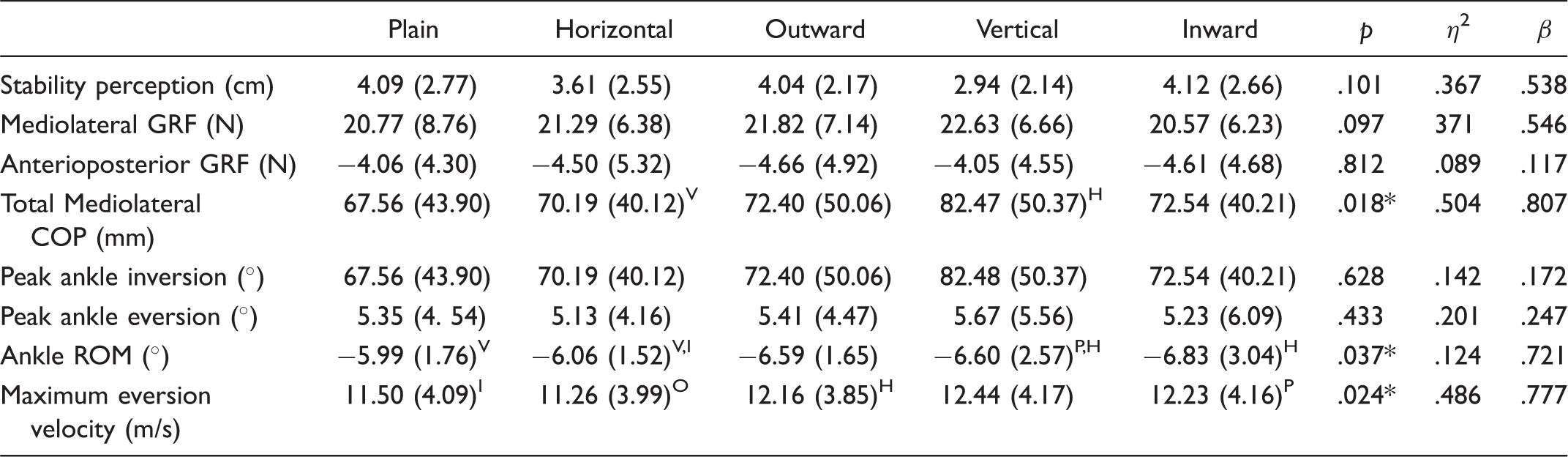
Note. “P” represents a significant difference from the plain condition, “H” represents a significant difference from the horizontal condition, “O” represents a significant difference from the outward condition, “V” represents a significant difference from the vertical condition, and “I” represents a significant difference from the inward condition. η2 = partial eta squared, β = observed power. GRF = ground reaction force; COP = center of position; ROM = range of motion.
*p ≤ .05.
Perceptual and Gait Biomechanics Variables of the Visual-Pattern Conditions in Mean (Standard Deviation) During Running.
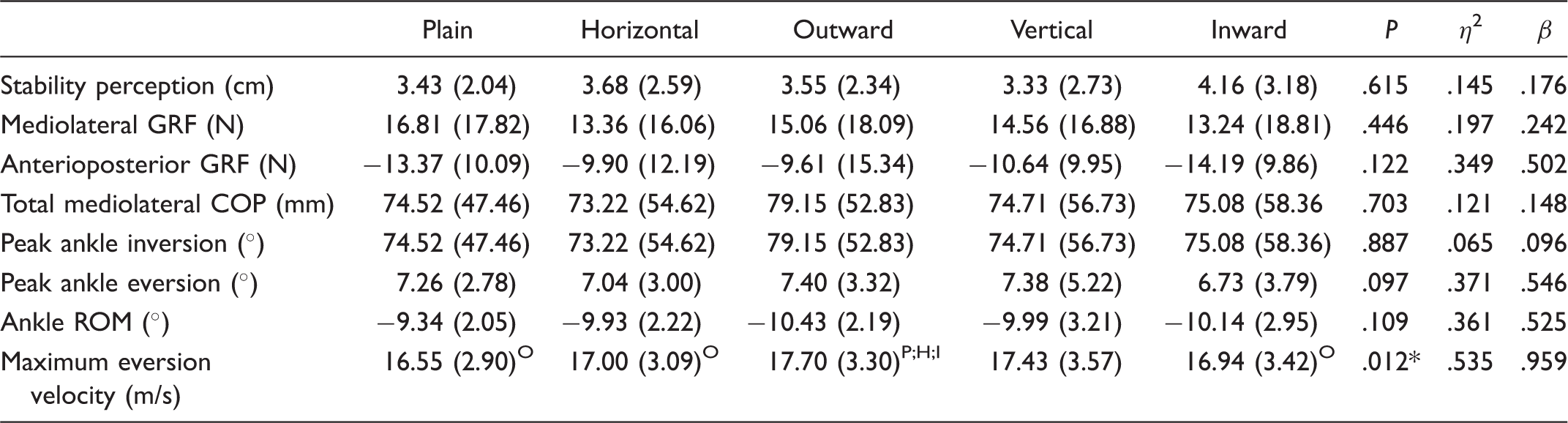
Note. “P” represents a significant difference from the plain condition, “H” represents a significant difference from the horizontal condition, “O” represents a significant difference from the outward condition, “V” represents a significant difference from the vertical condition, and “I” represents a significant difference from the inward condition. η2 = partial eta squared, β = observed power. GRF = ground reaction force; COP = center of position; ROM = range of motion.
*p ≤ .05.
Walking Biomechanics
A main visual-pattern effect was found for mediolateral COP displacement, maximum eversion velocity, and ankle ROM when walking. We observed a mediolateral COP displacement shoe effect, F(4, 16) = 4.62, p = .018 η2 = .504, β = .807, such that COP displacement was greater for vertical striped shoes than for horizontal striped shoes (p = .029). A maximum eversion velocity visual-pattern effect was found, F(4, 16) = 3.78, p = .024, η2 = .486, β = .774, with greater velocity for inward diagonal striped shoes relative to plain striped shoes (p = .005) and greater velocity for outward diagonal striped shoes relative to horizontal striped shoes (p = .041). An ankle ROM shoe effect was found, F(4, 76) = 2.69, p = .037, η2 = .144, β = .73, with larger ROM for vertical striped shoes than for plain (p = .009) and horizontal striped shoes (p = .015), respectively, and with larger ROM for inward diagonal striped shoes relative to horizontal striped shoes (p = .028).
Running Biomechanics
A main visual-pattern effect in running biomechanics was only found for maximum eversion velocity, F(4, 16) = 4.600, p = .012, η2 = .535, β = .858. Pairwise comparisons showed that outward diagonal striped shoes were associated with greater eversion velocity than inward diagonal striped (p = .044), horizontal striped shoes (p = .001), and plain shoes (p = .001).
Discussion
Visual perception is known to play a role in regulating the degree of balance and dynamic stability, thus affecting motor skill performance (Elliott et al., 2009). This study examined the effects of varied shoe top visual patterns on wearer perceptions of shoe width, stability perception, and the wearers’ actual biomechanics when walking and running. We showed that participants perceived shoes with a horizontal striped pattern to be wider than shoes with a vertical striped pattern, supporting Elliot’s Vertical–horizontal illusion as applied to shoe top perceptions (Elliott et al., 2009) and confirming that changes in shoe top visual patterns impacted perceptions of shoe width.
During dynamic situations, even though shoe top patterns did not alter stability perceptions after walking or running, participants wearing shoes with plain and horizontal striped patterns (vs. those wearing inward diagonal, outward diagonal, and vertical striped patterns) demonstrated significant differences in their mediolateral COP displacement, maximum eversion velocity, and ankle ROM, and maximum eversion velocity while walking. The inconsistent results between perceptual and biomechanical data provided partial support for the perception-action hypothesis, suggesting that perception and motor functions are processed in two independent pathways (Goodale & Westwood, 2004). Nevertheless, the shoe top visual-pattern effect implied that simple stripe alterations in the visual pattern on the shoe top might be a promising practical method to enhance gait stability (i.e., reduce eversion velocity, COP trajectory, and ankle ROM) or induce greater motor skill demands for shoe instability (i.e., increase eversion velocity, center of pressure trajectory, and ankle ROM) in rehabilitation efforts.
Interestingly, participants perceived shoes with plain and horizontal striped patterns as wider and demonstrated better dynamic stability during gait when wearing them; this finding supports the safe-stepping strategy that proposes that people use a safer step unconsciously to improve balance when they perceive a smaller shoe surface base (or narrower shoe width; Heasley, Buckley, Scally, Twigg, & Elliott, 2004). Therefore, in this study, increased mediolateral COP displacement, eversion velocity, and ankle ROM would be explained by an increase in perceived psychological threat of falling due to wearing a shoe perceived to be narrower or smaller based (Heasley et al., 2004). Furthermore, in another study in which participants walked on surfaces with different combinations of widths (0.60 m vs. 0.15 m) and heights (level vs. elevated: 0 m vs. 0.60 m), results were consistent with our findings that walking in situations that induce greater anxiety about falling (narrow and high surface) are associated with a more constricted gait (Brown, Gage, Polych, Sleik, & Winder, 2002). In the future, muscular and gait constriction pattern changes with top shoe visual patterns should be future explored.
Although the speed effect was not investigated, more significant gait biomechanics were evident in the walking condition (total mediallateral COP displacement, ankle ROM, and maximum eversion velocity) compared with the running condition (maximum eversion velocity). This difference may be due to the movement complexity (or speed) between walking and running tasks. Presumably, attention is divided among movement and perception tasks (visual pattern on shoe top) with attention on locomotion. As cognitive capacity is limited and complex (or higher speed) tasks require greater attention, a smaller attention proportion is available for shoe top visual-pattern perception during running (vs. walking), resulting in less visual-motor impact on the stability indicators when running. This suggests that the manipulation of the environment should be focused on simple (or lower speed) tasks for most significant effects. Given that the elderly population tends to display a slower walking speed than younger adults, visual patterns on shoe top might mostly influence gait biomechanics of older adults (Schmitz, Silder, Heiderscheit, Mahoney, & Thelen, 2009). However, since the elderly population may have weaker working memory and conscious resources than their younger counterparts, older adults may lack sufficient attention to the process for these effects to be evident, even when gait speed decreases (Jost, Bryck, Vogel, & Mayr, 2010). Thus, future studies should examine the shoe top visual-pattern effects on gait biomechanics in older adult populations to better understand their responses to the visual illusion.
Although biomechanical differences were evident in different shoe top visual-pattern conditions, continuous conscious processing of gait stability perception did not seem to be occurring. Participants perceived shoe width changes with visual pattern changes, but they were not able to discriminate different stability perception across shoe visual patterns; thus, movement control appeared to be autonomous among our young adult participants, in keeping with the perception-action hypothesis that the visual perception (i.e., ventral stream) and motor control (i.e., dorsal stream) are independent (Goodale & Westwood, 2004). The visual illusion did not reach the participants’ threshold for conscious detection, but a subliminal perception cannot be ruled out (Kouider, De Gardelle, Sackur, & Dupoux, 2010). Further research should identify how the two psychomotor streams of visual perception and motor control might be better understood under different specific situations.
When interpreting these results, readers should consider several limitations to this study. First, our participants were a small, restricted sample of healthy, young males, jeopardizing generalizability to other groups. It will be particularly important to study women and older adults, especially since older adults might be expected to have weaker muscular strength and weaker proprioception of the lower limb, perhaps increasing the visual-pattern’s anxiety-related impact (Hamburger & Hansen, 2010; Lockhart, Smith, & Woldstad, 2005). Second, our study suggested that the visual illusions were associated with biomechanical variables during walking and running; yet, the participant’s gaze information on the illusion during movement trials were not measured. Future studies can use remote eye tracker to examine the relationship between the gazing time and direction with biomechanical impact (Serchi, Peruzzi, Cereatti, & Della Croce, 2016). Third, the stimuli for ranking shoe top visual patterns were displayed on a picture with a top (or vertical) view for shoe ranking while other studies displayed the visual patterns with horizontal or front views (Elliott et al., 2009), making it possible that our vertically displayed extensions on a picture plane overestimated these effects (Richter, Wennberg, & Raudsepp, 2007; Spink et al., 2011). Due to this potential difference in visual-pattern presentations, optimizing the width and space of stripes would allow a more accurate application of these effects in training and rehabilitation in the future. Furthermore, a longer familiarization period might have increased the impact of the stripe visual patterns. Finally, as the participants were asked to rank the width of the shoe patterns before other data acquisition, they might have detected the rationale for this experiment, and this conscious awareness of its intent may have altered the visual-pattern effect.