







Abstract
Using multilevel analysis, this study examined a cross-level effect of paternalistic leadership and team cohesion on athletes’ burnout. We called 900 athletes from 28 colleges to participate in this survey, with a return rate of 85.2% and found that paternalistic leadership of coaches had a cross level effect across schools on athletes’ burnout. Based on these findings, we propose recommendations for coaches and school administrators.
Keywords
Introduction
Many athletes experience periods of feeling tired and fed up to the point of quitting or wanting to quit their sport participation (Raedeke, Lunney, & Venables, 2002). This common occurrence is termed athlete burnout (H. L. Chang, 2009). Eades (1990) defined athlete burnout as “mentally and physically drained due to intensified training regimes and increasing competitive pressure, resulting in indifferent attitude toward others” (p. 17). According to Raedeke (1997), athlete burnout is comprised of three distinct mental states: (a) emotional and physical exhaustion, (b) reduced sense of accomplishment, and (c) devaluation of sport. Athlete burnout usually occurs under overtraining and excessive games; athletes start to feel mentally and physically drained and gradually lose interests in sport, especially when they see no improvement in performance, and their zeal for sports finally depletes (Raedeke, 1997).
Multilevel research (MLR), often referred to as cross-level analysis, has been widely discussed in disciplines across management, education, and psychology; however, it is rarely found in an empirical study. Literature in this area has suggested that a researcher can miss or ignore any explanatory variable when using single-level analysis (C. C. Lin & Peng, 2006) and may lose the whole picture, especially in study on innovative behaviors (Y. S. Chen & Hu, 2008). According to Kozlowski and Klein (2000), inappropriate inference in multilevel analysis is problematic and can potentially result in an inaccurate and unreliable management decision. To illustrate, they proposed both ecological and atomistic fallacies. Ecological fallacy occurs when one makes an incorrect inference at a lower level, using information at a higher level, while, in contrast, atomistic fallacy occurs when one makes an incorrect inference at a higher level using information at a lower level. In any given empirical study, a researcher must understand the research structure from a theoretical perspective prior to a research analysis. False inference leads to misleading interpretation and the spread of false information (Kozlowski & Klein, 2000; C. C. Lin & Peng, 2006).
Empirical studies on athlete burnout have mostly been performed using individual-level analysis, while the MLR approach has been rare within this literature. In addition, some earlier research was not properly structured and has led to misinterpretation of findings. For example, C. M. Tseng and Wang (2011) intended to explore the impact of paternalistic leadership on team cohesion and burnout of 627 college athletes, and their research instrument included a paternalistic leadership questionnaire, a team cohesion questionnaire, and an Athlete Burnout Questionnaire, all of which were completed by student athletes. Such variables in early research on athlete burnout are classified as individual-level variables, including self-assessment, optimism, psychological resilience, communication skills, and psychological capital (Cengiz, Abakay, & Korucu, 2013). In contrast, group-level variables have included coaches’ perceived and paternalistic leadership, team emotional and general coherence, individual motivation, and social support. While these variables should have been treated conjointly, most past studies used a single-level analysis (DeFreese & Smith, 2013; Saadati, Nikbakhsh, & Afarinesh, 2014). We adopted MLR analyses for this research using paternalistic leadership and team cohesion as group-level variables and psychological capital and athlete burnout as both group and individual-level variables. We invited a large number of college athletes of various school clubs and teams to participate in this study, and we analyzed data using multilevel analysis.
Hypotheses
Psychological Capital
Psychological capital (PsyCap) is said to be comprised of four positive elements: hope, self-efficacy, resilience, and optimism (Luthans, Luthans, & Luthans, 2004). The Luthans (2004) suggest that PsyCap drives positive mental health, increases individual well-being and enhances organizational commitment and employees’ job performance. For athletes, self-efficacy is a strong predictor of individual performance, as individuals with high self-efficacy are more likely to set and achieve high goals (Locke & Latham, 2002) and are more likely to perform difficult tasks and maintain composure in intensive games (Tsai, Su, & Chou, 2010). Similarly, individuals with high resilience in competitive games have greater capacity to rebound or bounce back from adversity (C. J. Huang, 2003) and are more focused, confident, and determined, as compared with those with low resilience (Jones, Hanton, & Connaughton, 2002). In some past studies, resilience and athlete burnout were found to be negatively correlated, as, for example, among high school baseball players (Liu, Wang, & Huang, 2013). According to Gullette et al. (1997), optimistic individuals and athletes were found to handle stress with positive mentality, and, even when they failed, they were less likely to get easily discouraged and anxious, instead working even harder and focusing on coming games. These individuals were also found to be physically healthy and less prone to high-blood pressure, heart diseases, headaches, and digestive disorders. According to J. H. Lu, Lin, Huang, and Tsao (2004), optimistic athletes were more likely to maintain positive mentality, even when injured and traumatized. Their positive attitude was also negatively correlated with mental fatigue and discouragement. In accordance with these prior research findings, we proposed the following hypothesis regarding individual PsyCap variables: Hypothesis 1 (H1): Athletes’ psychological capital will be negatively correlated with burnout.
Leadership and Athlete Burnout
Coaches and players interact constantly in team sport as coaches watch players closely and monitor their training and performance. However, when coaches sometimes urge players to challenge their personal limits, they may hinder their players’ athletic performance, and players may then experience burnout from overcoaching (Collins, 2002). Previous research showed that a coach’s recognition and encouragement may boost players’ confidence and are likely to diminish players’ anxiety and stress (Price & Weiss, 2000). In social exchange theory (Blau, 1964), society presents a series of interactions between people that influence an individual’s estimates or expectations of rewards that may be received. A benevolent coaching style meets players’ needs, and a benevolent coaching style also inspires players to show their appreciation to coaches (S. F. Kao & Chen, 2006). Yet, in contrast to these contributions to high achievement, Kenttä, Hassmen, and Raglin (2001) reported that, following constant hard training, athletes without proper rest find training and games uninteresting and weary and feel burnout. Thus, motivation is a key element for getting positive results from players, and coaches use motivational strategies to breed players’ passion and drive and enhance individual athletes’ performance and team cohesion (L. H. Chen & Tasi, 2005). Moreover, a moral coaching style was found to be negatively correlated with athlete burnout (L. H. Chen & Tasi, 2005; C. H. Tseng & Lin, 2008). As for players under autocratic coaches, research found that players pay little respect to coaches who showed authoritarian power for personal interests (S. F. Lin & Su, 2008).
Among several different paternalistic leadership styles, an autocratic leadership style has been thought to create a negative ambience in a team environment and to lead athletes to quit the team (L. H. Chen & Tasi, 2005). Liu et al. (2013) discovered that overcoaching and overdiscipline make athletes devalue sport and perceive their own athletic performance to be unsatisfying in a process of emotional contagion (Hatfield, Cacioppo, & Rapson, 1994). From the perspective of emotional contagion, stressful and anxious coaches can easily mistreat their athletes, such that athletes feel the intensity and develop negative attitudes toward the coaches (L. H. Chen & Tasi, 2005). Moreover, C. M. Tseng and Wang (2011) stated that negative emotion is one of the several factors that cause athlete burnout. Unreasonable demands and an authoritarian coaching style demotivate athletes (Chou, 2003) and sabotage team satisfaction (L. H. Chen & Tasi, 2005). Based on S. L. Chen and Chen (2014), this study characterized a paternalist leadership style as a group-level variable and assumed that individual team members’ perception of leaders forms a collective group perception. When team members have a similar perception of their leader, a team leadership style is created, leading to the following group variable hypotheses in this study: Hypothesis 2-1 (H2-1): Coaches’ autocratic leadership will be positively correlated with athlete burnout. Hypothesis 2-2 (H2-2): Coaches’ benevolent leadership of coaches will be negatively correlated with athlete burnout. Hypothesis 2-3 (H2-3): Coaches’ moral leadership will be negatively correlated with athlete burnout.
Moderating Effects of Leadership on Psychological Capital and Burnout
B. S. Cheng et al. (2010) stated that leadership styles can be characterized as a contextual variable with moderating effects on members’ behavior. While past research has elaborated on a frog-pond-effect such that team atmosphere can impact an individual member’s performance, this effect can be a two-sided coin with both positive benefits and deleterious consequences. Relative deprivation occurs when a coach leads the team in an authoritarian way and discourages individual athlete performance, intensifying athlete burnout as psychological capital declines. On the other hand, benevolent and moral coaching styles enhance the athletes’ psychological capital and minimize the athletes’ feelings of burnout (Firebaugh, 1980). Accordingly, we proposed the following further hypotheses, related to the moderating effect of coaching style on PsyCap and athlete burnout: Hypothesis 3-1 (H3-1): Benevolent coaching leadership will have a positive moderating effect on the relationship between psychological capital and athlete burnout. Hypothesis 3-2 (H3-2): Moral coaching leadership will have a positive moderating effect on the relationship between psychological capital and athlete burnout. Hypothesis 3-3 (H3-3): Autocratic coaching leadership will have a negative moderating effect on the relationship between psychological capital and athlete burnout.
Leadership and Team Cohesion
Westre and Weiss (1991) revealed that a coach’s leadership behavior, from the athletes’ perspectives, is the key element in team cohesion. Previous studies found that when athletes perceived coaches to be exhibiting more moral and benevolent behaviors, they were more likely to commit emotionally to the team, thus suggesting a relationship between benevolent and moral coaching leadership and better team performance. Yet, if athletes perceived coaches to be providing an autocratic leadership style, they tended to commit to the team only for their own benefits, a commitment called an instrumental commitment. Then, when athletes no longer find personal benefits, they are more likely to quit. Thus, athletes under an autocratic coaching leadership style are expected to have a tendency to stay with the team only if they meet personal interests in the team, a commitment that can be detrimental to team performance (Tang & Sung, 2004). Empirical literature (Tasi, 2006) suggested that an autocratic coaching style was increasingly less acceptable, as athletes expressed their gratitude toward and satisfaction with coaches practicing benevolent and moral leadership styles. In addition, S. F. Lin and Su (2008) indicated that a moral coaching leadership style should predict positive team harmony and satisfaction with coaches and the sport. Chou (2003) conducted research among coaches from Taiwan and China on the impact of a paternalistic leadership style on group cohesion and found consistent results with previous studies such that, in Taiwan, an increasing perception of moral coaching leadership led to a high level of social and task cohesion. Similarly, an increasing perception of benevolent coaching improved task cohesion. Based on this prior research, our further hypotheses regarding coaching behavior and team cohesion were as follows: Hypothesis 4-1 (H4-1): Benevolent coaching leadership will be positively correlated with high team cohesion. Hypothesis 4-2 (H4-2): Moral coaching leadership will be positively correlated with high team cohesion. Hypothesis 4-3 (H4-3): Autocratic coaching leadership will be positively correlated with low team cohesion.
Team Cohesion and Burnout
Social identity theory developed by Tajfel and Turner (1979) proposed that people define themselves in terms of their group membership and seek to have their group valued positively, compared with other groups. Athletes in high cohesive teams usually find themselves emotionally attached to the team, frequently interact with each other, and are less likely to experience burnout (C. C. Lin & Peng, 2006). S. E. Lu (1995) also indicated that group cohesion is very crucial in any competitive sport setting. Coaches trust, inspire and motivate athletes, bring out the best in the team, and achieve the athletes’ goal. Thus, a final hypothesis of this study was as follows: Hypothesis 5 (H5): Team cohesion will be negatively correlated with athlete burnout. Figure 1 depicts the relationships among all variables as hypothesized earlier.
Research Hypotheses. Solid lines indicate positive impacts, and dotted line indicate negative impacts.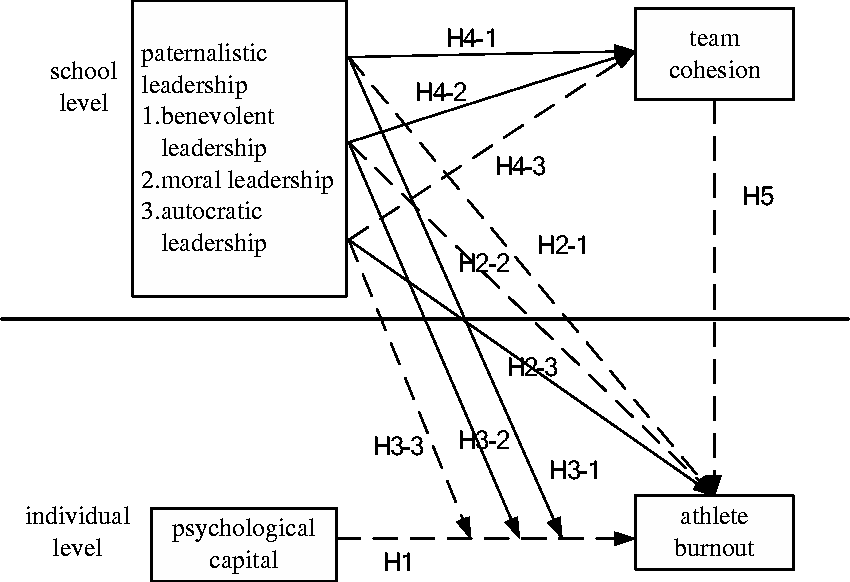
Method
Participants
Participants in this study were students selected from universities and technology schools in Taiwan. Thirty colleges were selected based on geographic areas of north, central, south, and off-shore. We then used convenience sampling to select one sports club and one athletic team from each university chosen in the first phase of the experiment. We chose a total of 60 groups for the study, each group consisting of 15 student athletes, resulting in 900 questionnaires; we then achieved a return rate of 85.2%. This study was approved by National Cheng Kung University Institutional Review Board.
Survey respondents were mostly from public universities (61%; n = 468), with a minority from private schools (31%; n = 299). There were 538 male athletes (70.1%) and 229 female athletes (29.9%). Respondents were evenly distributed between school athletic teams (50.8%, n = 390) and athletic clubs (49.2%, n = 377). Student athletes participated in competitive sports at different levels, such that 41.6% had never won anything in any competition (n = 319), 20.5% had been recognized in city-level competitions (n = 157), 35.9% had won titles in national-level competitions (n = 275), 1.2% had won some records in highly competitive games in Asia (n = 9), and 0.9% had proudly stepped up to the podium in some international competitions (n = 7). Most athletes had received training for a period of 13 to 24 months (n = 307, 40.0%), while 27.9% (n = 246) trained for less than a year (27.9%) and 27.9% (n = 246) received training for more than two years. There were 642 male coaches (83.7%) and 125 female coaches (16.3%) among these teams.
Research Instruments
Paternalistic Leadership Scale
We used S. F. Kao’s (2001) revised Paternalistic Leadership Scale, with subscales comprised of 13 items in three dimensions (autocratic leadership, benevolent leadership, and moral leadership). Each item was measured on a 5-point Likert-type scale, ranging from 1 (never) to 5 (always). The scale assessed athletes’ perceptions of their coaches’ paternalistic leadership style. We tested scale reliability with internal consistency coefficients alpha (α) was used and found high reliabilities as follows: α = .89 for autocratic leadership, α = .80 for benevolent leadership, and α = .90 for moral leadership.
Team Cohesion Scale
We employed the Team Cohesion Scale as modified from the Group Environment Questionnaire originally proposed by Widmeyer, Brawler, and Carrn (1985). This instrument was comprised of 10 items in two subdimensions: task cohesion (five items) and social cohesion (five items). Task cohesion refers to the shared commitment among members to achieving a goal that requires the collective efforts of the group; social cohesion is defined as the willingness of members of a group to cooperate with each other in order to survive and prosper. All items on the Group Environment Questionnaire were measured by 5-point Likert-type scales ranging from 1 (strongly disagree) to 5 (strongly agree). In our study, the coefficients of Cronbach’s α of task cohesion, social cohesion, and total scale are .92, .94, and .95 which indicated high reliability.
Psychological Capital Scale
The Psychological Capital Scale that we employed was a revision of C. M. Chang, Chen, Lin, and Huang’s (2012) scale with 16 items in four dimensions: self-efficacy (four items, α = .89), hope (four items, α = .84), optimism (four items, α = .84), and resilience (four items, α = .86). All items were measured on a 5-point Likert-type scale, ranging from 1 (strongly disagree) to 5 (strongly agree). In our study, the coefficients of Cronbach’s α of self-efficacy, hope, optimism, resilience and total scale are .89, .84, .84, .86 and .94, which indicated high reliability.
Athlete Burnout Scale
The Athlete Burnout Scale was originally developed by Raedeke and Smith (2001) and was translated into Chinese by C. M. Chang et al. (2012). The validity and reliability of the Athlete Burnout Questionnaire has been previously verified by Bryman and Cramer (1997), with reliability in three dimensions as follows: physical or emotional exhaustion (four items, α = .88), sport devaluation (four items, α = .90), and reduced athletic accomplishment (three items, α = .87). The total questionnaire is comprised of 11 items, which were measured on a 5-point Likert-type scale ranging from 1 (strongly disagree) to 5 (strongly agree) with an overall reliability α = .93.
Demographic information or control variables
Participants also completed a demographic information questionnaire with three items pertaining to the participants’ public or private University, sex, and training period. The control variables in this study were determined from past studies (e.g., C. C. Chang, Tsai, & Lai, 2003; Hsia & Lu, 2002) and were comprised of the athletes’ sex (male = 1 and female = 2), team category (athletic team = 1 and school club = 2), training period, number of team members, coach’s sex (male = 1 and female = 2), level of sports participation, and level of prior sports awards (world = 5, Asia = 4, national = 3, city = 4, and no award = 1).
Data Analysis
We analyzed data using SPSS 20.0 for Windows and HLM 7.0 (Scientific Software International, Inc.; Raudenbush, Bryk, & Congdon, 2011). Significance level was set to 5% (α = .05). Based on the purpose of this research and our hypotheses, our statistical methods were descriptive statistics, Pearson correlation, and hierarchical linear modeling (HLM). We set statistical significance levels at p < .05.
Results
Correlations and Descriptive Statistics
Aggregate Test on Group Data.
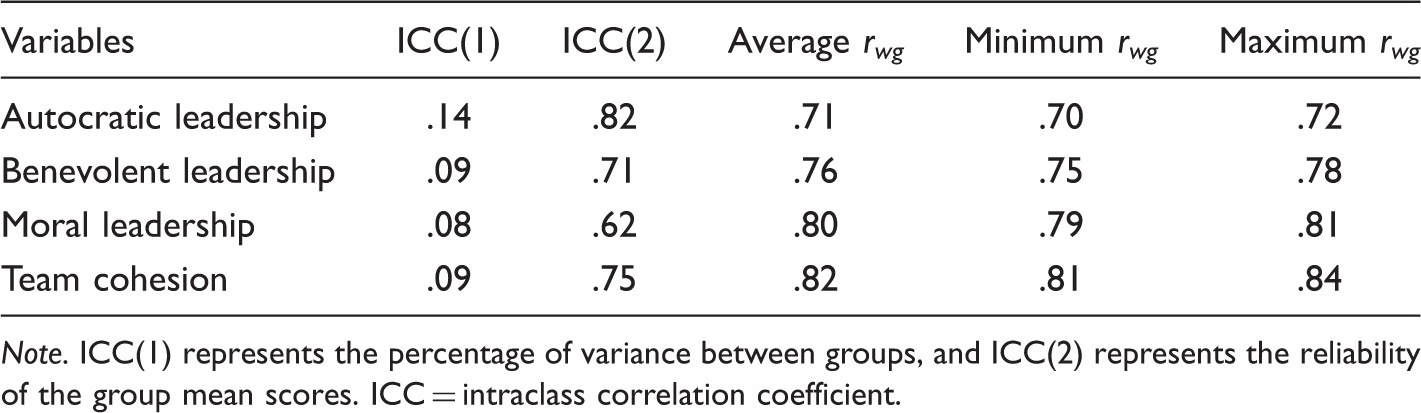
Note. ICC(1) represents the percentage of variance between groups, and ICC(2) represents the reliability of the group mean scores. ICC = intraclass correlation coefficient.
Summary Statistics and Pearson’s Coefficient of Correlation of Individual- and Group-Level Variables.
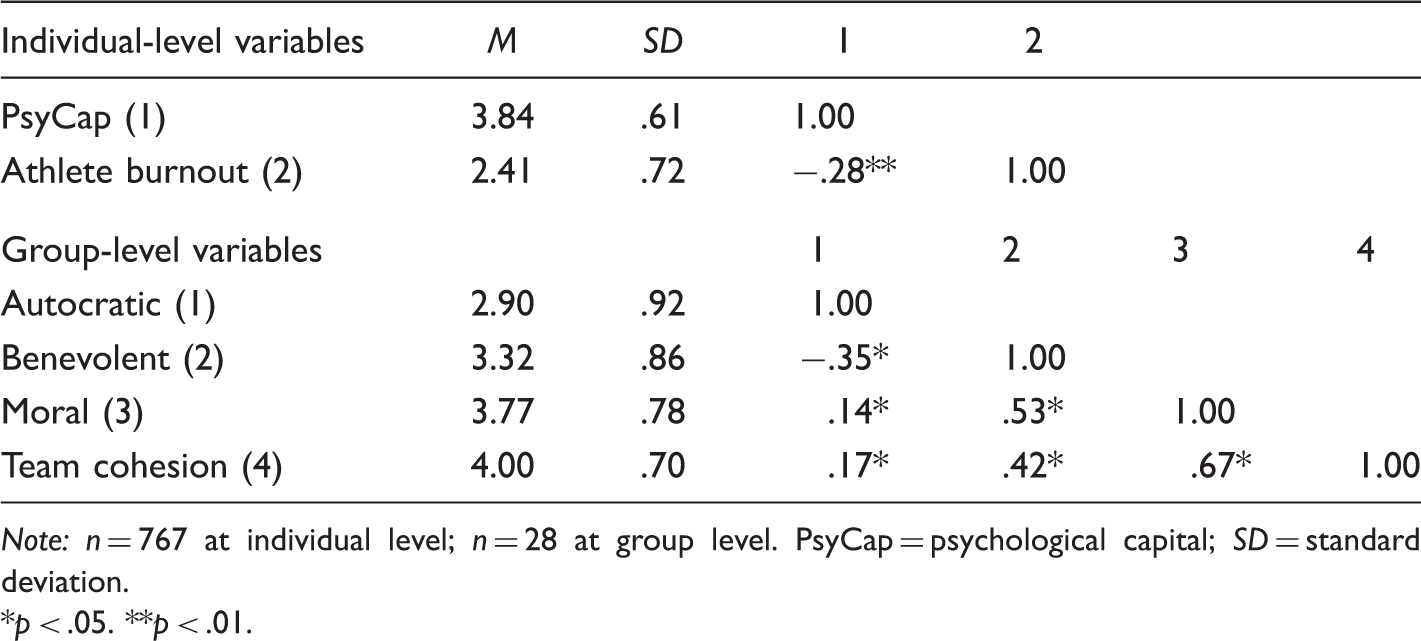
Note: n = 767 at individual level; n = 28 at group level. PsyCap = psychological capital; SD = standard deviation.
*p < .05. **p < .01.
Hypothesis Testing
Hierarchical Linear Modeling Analysis of Athlete Burnout.
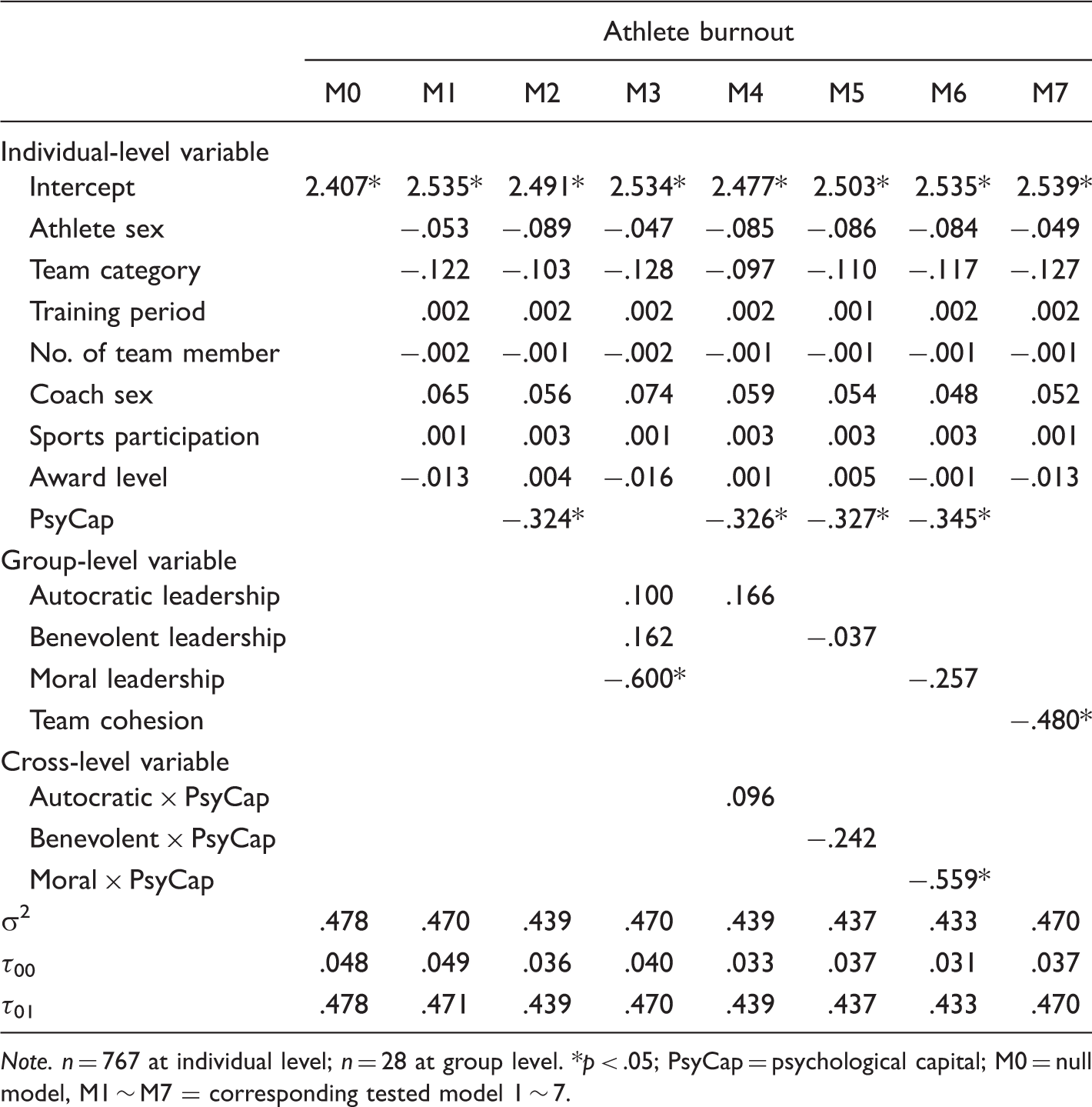
Note. n = 767 at individual level; n = 28 at group level. *p < .05; PsyCap = psychological capital; M0 = null model, M1 ∼ M7 = corresponding tested model 1 ∼ 7.
Multiregression Analysis of Relationship Between Paternalistic Leadership and Team Cohesion at Group Level.
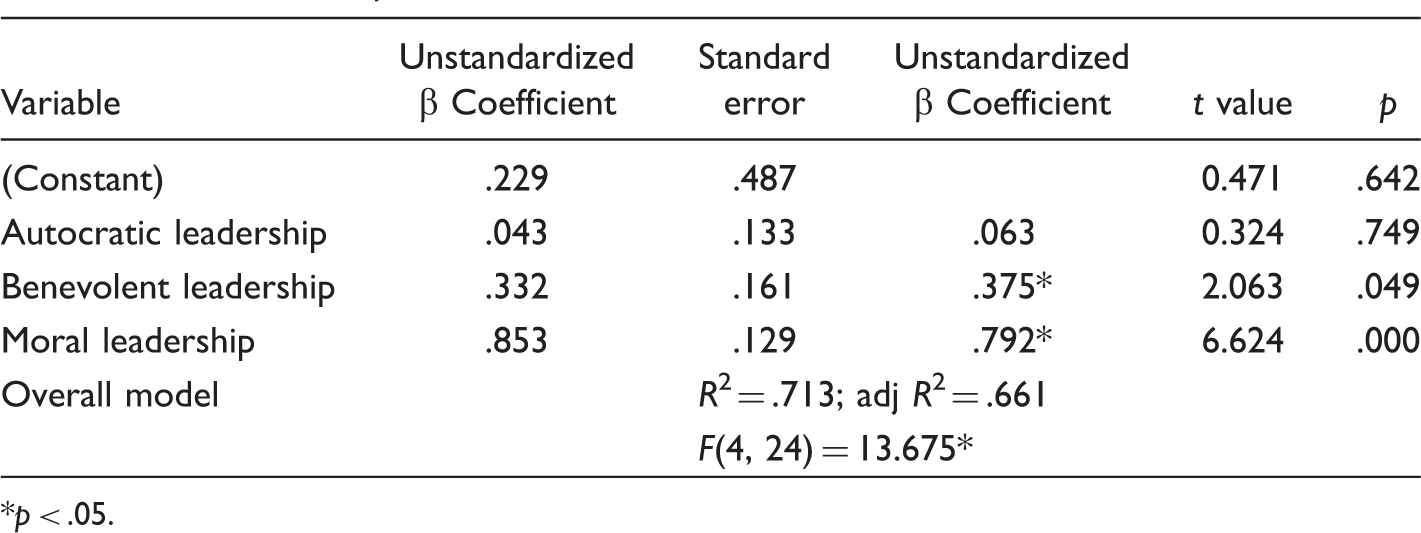
*p < .05.
Null model analysis (M1)
We conducted a cross-level analysis to explore the impact of variables at both the individual and the school level on athlete burnout. A χ2 in the null model presented in Table 3 indicated a significant between-group variance in athlete burnout (χ2 = 100.27, df = 27, p < .001). ICC(1) for the group variable was .091, indicating that the school factor accounted for 9.1% of the total variance of athlete burnout, and this met the criteria for next step HLM hypotheses testing.
Impacts of control variables on athlete burnout (M1)
The seven control variables (athlete sex, team category, training period, number of team members, coach sex, level of sports participation, and level of competition recognition) were analyzed by a random coefficient regression model, and none were significant, indicating that no control variables impacted athlete burnout.
Psychological capital and athlete burnout (M2)
While the random coefficients regression model, M2 in Table 3 revealed no statistical relationship between the seven control variables and athlete burnout, there were statistically significant relationships between psychological capital and athlete burnout (γβ0 = −.324, t = −5.03, df = 731, p < .001), such that psychological capital had a significant negative impact on athlete burnout. Compared with the null model analysis, the variance σ2 reduced 3.9%. Thus, in this study, seven control variables combined with psychological capital to account for 3.9% of the total variance in athlete burnout.
Paternalistic leadership and athlete burnout (M3)
As shown in Table 3, there was no significant relationship between control variables and athlete burnout in the intercepts as outcomes model. Also, there was no significant relationship between the autocratic or benevolent leadership of coaches and athlete burnout. In contrast, however, there was a significant negative relationship between moral leadership and athlete burnout (γ03 = −.600, t = −2.51, df = 24, p < .05), suggesting that athletes felt less burnout if coaches demonstrated moral leadership.
Paternalistic leadership as a moderator between psychological capital and athlete burnout (M4, M5, and M6)
The association among control variables, paternalistic leadership, psychological capital, and athlete burnout was studied using slopes as an outcomes model. Findings showed that neither autocratic (M4) nor benevolent (M5) leadership had any moderating effects on the relationship between psychological capital and athlete burnout (γβ1 = .096, t = −0.61, df = 730, p > .05; γβ1 = −.242, t = −1.81, df = 730, p > .05). On the other hand, moral leadership (M6) had a significant moderating effect on the relationship between psychological capital and athlete burnout (γβ1 = −.559, t = −2.78, df = 730, p < .01). As shown in Figure 2, moral leadership enhanced the relationship between psychological capital and athlete burnout.
Moderating effect of moral leadership on the relationship between PsyCap and athlete burnout.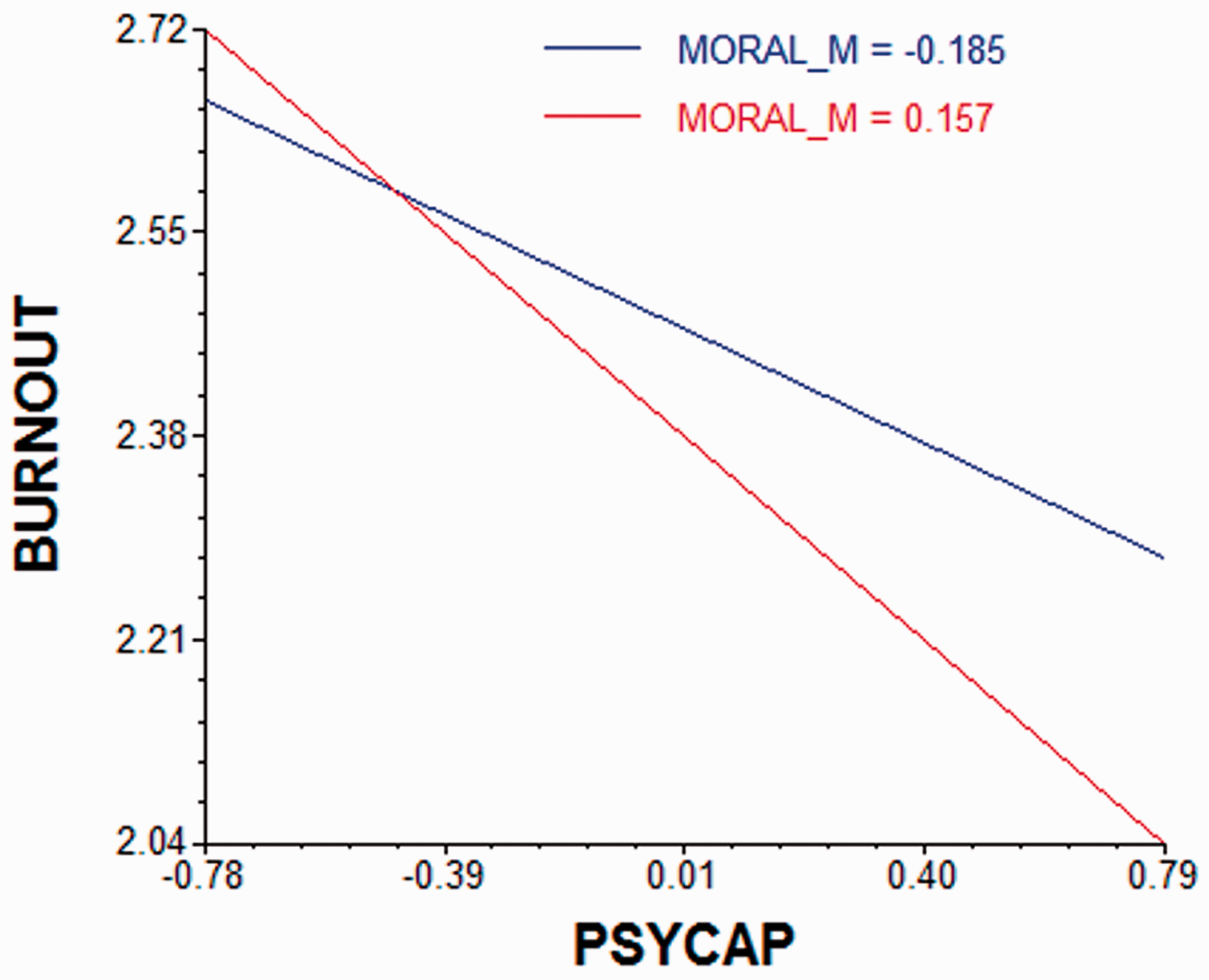
Paternalistic leadership and team cohesion
Because paternalistic leadership and team cohesion are both group-level variables, the analysis of their relationship to one another required ordinary least squares, instead of HLM. Table 4 shows that autocratic leadership had no significant impact on team cohesion (β = .063, p > .05), indicating that coaches’ autocratic leadership did not influence the team cohesion. By contrast, there was a statistically significant relationship between coaches’ benevolent leadership and team cohesion (β = .375, p < .05) such that benevolent leadership lead to higher levels of team cohesion.
Team cohesion and athlete burnout (M7)
Using intercepts as an outcomes model, the seven control variables had no significant relationship with athlete burnout. Nevertheless, team cohesion had a significant negative impact on athlete burnout (γ01 = −.480, t = −2.69, df = 26, p < .01), meaning that higher levels of team cohesion resulted in lower levels of athlete burnout.
Discussion
The results of this study indicated that, among the Taiwanese college athletes we surveyed, moral leadership of coaches across different schools was negatively correlated with athlete burnout. Thus, athletes whose coaches practiced moral leadership were more likely to experience less emotional fatigue. Moral leadership is rooted in Confucianism and typically found in the Chinese community. Moral leadership requires leaders to demonstrate integrity, virtue, and ethics in order for their subordinates to convey their deep reverence (H. Y. Chen, Kao, & Wu, 2007). While coaches who practice any form of self-interested leadership drive their players away from them, those who demonstrate integrity earn their players’ respect (S. F. Lin & Su, 2008). Thus, as suggested by prior literature, moral leadership is a preferred leadership style. When coaches exhibit behaviors and mannerisms that match their words and philosophies, they build a core value that provides players reliable guidance (S. F. Kao & Chuang, 2009). Several other empirical studies also reported that coaches who showed moral leadership were more likely to foster team harmony, reduce athlete burnout, and retain their players (C. H. Tseng & Lin, 2008). Similarly, in this study, moral leadership from coaches across different schools had a significant mediating effect on the relationship between personal psychological capital and athlete burnout such that moral leadership enhanced personal psychological capital to reduce the feeling of burnout. Therefore, our study affirmed that moral leadership from coaches is a preferred leadership style for preventing athletes’ burnout.
Our study also found that paternalistic leadership impacted team cohesion. Our data revealed that both benevolent and moral leadership style led to stronger group harmony, seemingly across teams, and colleges. Lee (2001) asserted that the words and actions a coach uses during games can have a huge impact on team atmosphere and cohesion. When players work together as a team, they look after each other, and the strong and positive group cohesion they build together has a significant and positive impact on game results. Similarly, when players perceive benevolent behaviors from their coaches, there is reduced athlete burnout and improved team performance and satisfaction. Similarly, it is easy to build a quality coach–player relationship if coaches practice moral leadership. The trusting rapport coaches and players develop together then strengthens team cohesion (Y. H. Huang & Nien, 2015). In contrast, as suggested by Tasi and Wang (2007), when effective communication is rare between autocratic leaders and their players, trust between leaders and players suffers. Players have a tendency to recognize coaches who demonstrate integrity, set good examples, motivate players positively, and work to build team cohesion.
Having a good coach sometimes can be the best part of being a professional athlete. A good coach does what he says and leads team with discipline (H. K. Cheng & Kao, 2008). Sport literature has suggested that coaches should always respect, encourage, and motivate each individual player while treating players equally and as a family. Coaches are the leader and motivator of the team. They constantly share their coaching philosophies with players, set attainable goals, and encourage players to do their best to achieve them. Qualities and characteristics of a coach not only contribute to team success but also influence to each athlete’s personal development and subsequent societal citizenship.
This study’s results also showed a negative association between team cohesion and athlete burnout, meaning that when team athletes stick together and show good team cohesion, they are less likely to feel burnout. Achieving team harmony is a dynamic process. Athletes who work in harmony trust and cooperate with each other, practice good camaraderie, and experience a higher level of team satisfaction. Other than the individual skill sets and physical qualities that a professional athlete must possess to be successful, team harmony is one of the key attributes of team success (Liang & Li, 2016).
Conclusion
In this study, we conducted multilevel HLM to identify the group-level effects of coaching leadership styles and team cohesion on Taiwanese college athletes’ burnout. We found moral leadership from coaches to be negatively associated with athletes’ burnout, and both moral leadership and benevolent leadership were positively related to team cohesion. An ancient Chinese proverb says, “if you are a teacher for a day, you are a father-figure for life”; this clearly explains how influential a coach can be to an athlete. This is consistent with prior research that has also suggested that coaches should build a trusting relationship within the team and create a positive environment for better team communication and interaction, though our study moved beyond more typical single-variable analyses to apply multilevel analysis to the sport context. A limitation of this research was its exclusive application among Taiwanese athletes. As paternal leadership theory is particularly relevant to oriental society, further research is needed to determine whether these findings will be replicated with participant samples from other cultures.