







Abstract
Although detailed descriptions of proper handshakes partly comprise many etiquette books, how a normal handshake can be described, its proper duration, and the consequences of violating handshake expectations remain empirically unexplored. This study measured the effect of temporal violations of the expected length of a handshake (less than three seconds according to previous studies) administered unobtrusively in a naturalistic experiment. We compared volunteer participants’ (N = 34; 25 females; 9 males; Mage = 23.76 years, SD = 6.85) nonverbal behavior before and after (a) a prolonged handshake (>3 seconds), (b) a normal length handshake (average length <3 seconds), and (c) a control encounter with no handshake. Frame-by-frame behavioral analyses revealed that, following a prolonged handshake (vs. a normal length or no handshake), participants showed less interactional enjoyment, as indicated by less laughing. They also showed evidence of anxiety and behavioral freezing, indicated by increased hands-on-hands movements, and they showed fewer hands-on-body movements. Normal length handshakes resulted in less subsequent smiling than did prolonged handshakes, but normal length handshakes were also followed by fewer hands-on-face movements than prolonged handshakes. No behavior changes were associated with the no-handshake control condition. We found no differences in participants’ level of empathy or state/trait anxiety related to these conditions. In summary, participants reacted behaviorally to temporal manipulations of handshakes, with relevant implications for interactions in interviews, business, educational, and social settings and for assisting patients with social skills difficulties.
Introduction
Even though etiquette books have presented detailed descriptions of proper handshakes (Post, 1960, 1965, 2007; Reid, 1950), experiments on handshake characteristics are sparse in psychology literature. Many nonverbal behaviors have consensually accepted meaning; the handshake, in particular, conveys interpersonal trust (Burgoon, 1991). Indeed, how people shake hands has been found to reflect their character. Chaplin, Phillips, Brown, Clanton, and Stein (2000) reported that firm handshakes were related to extraversion and emotional expressiveness, and, in women, to openness to experience. Strong handshakes have correlated positively with aggression and dominance, and, negatively, to sociability and neuroticism (Åström, 1994). Even when their overall behavior was negative and unfriendly, people who shook hands during an interpersonal encounter were perceived more positively than people who did not shake hands (Dolcos, Sung, Argo, Flor-Henry, & Dolcos, 2012). Unsurprisingly, handshakes can have long-lasting consequences. The quality of handshakes has been correlated with hiring recommendations after interviews (Stewart, Dustin, Barrick, & Darnold, 2008). Instances of touch, and to some extent handshakes, have been shown to increase the touch recipients’ financial risk-taking (Levav & Argo, 2010). In a clinical setting, when the doctor greeted a patient with a handshake, the patient later greatly overestimated the doctor’s contact time; and a patient’s offer to shake hands toward the end of a consultation reflected patient satisfaction with the consultation (Jenkins, 2007).
Descriptions of a normal handshake, such as how long it should last and the consequences of violating these expected patterns, have rarely been investigated. Feldhütter, Schleidt, and Eibl-Eibesfeldt (1990) explored the length of various motor behaviors; they analyzed 1,542 movements of the hand and body in three cultures and found that 93% of these movements lasted 2-3 seconds. Gestural behaviors such as waving goodbye or giving handshakes also showed a typical 3-second-long rhythmic pattern (Schleidt, 1988). Nagy’s (2011) analysis of the duration of 188 spontaneous embraces between pairs of people from 32 different countries after high-tension finals in various sporting events during the XXIX Summer Olympic Games also found a mean duration of these embraces to be three seconds.
This 3-second interval also corresponds to what we experience as “the now,” in successive “present moments” in our lives (Pöppel, 1978, 1997, 2004; Wittmann, 2011). Wundt (1911) described a limit of about 2.5 seconds as the temporal interval for grouping successive complex stimuli, and he noticed that when the temporal interval between two groups of stimuli is longer than 5-6 seconds, people perceive the stimuli as separate. Similarly, it takes 2-3 seconds to disengage from one stimulus in order to attend to the next (Pöppel, 1978). In visual perception, it takes about three seconds to change perspective when viewing ambiguous figures (Borsellino, De Marco, Allazetta, Rinesi, & Bartolini, 1972; Ditzinger & Haken, 1989; Fraisse, 1984; Schleidt & Kien, 1997), speech utterances tend to occur in 2-second temporal windows (Vollrath, Kazenwadel, & Krüger, 1992), and intonational units are usually two seconds long (Chafe, 1987). Three-second phrases can be identified even in proto-conversations with young infants (Trevarthen, 1999) and musical phrases are 2–3 seconds long (Parncutt & Pascall, 2002).
This universal expected temporal communication pattern raises questions about whether or how people react to its violations. Accordingly, this study aimed to test and measure the effect of temporal violations in the length of handshakes administered unobtrusively in a naturalistic experiment. Based on previous literature (Feldhütter et al., 1990), we presumed an average handshake duration of less than three seconds. We then observed and compared participants’ behavior before and after a “normal” (3 seconds) handshake versus a prolonged (>3 seconds) handshake and a control encounter with no handshake. We assumed that longer-than-normal handshakes that violated expectations would induce discomfort and social anxiety, compared with either normal-length or no handshake encounters, and that this discomfort would be manifested by other nonverbal behaviors.
Among relevant nonverbal behaviors that might be affected by handshake length manipulations is gaze aversion. Gaze aversion is a powerful interpersonal regulatory behavior, especially in situations in which gross motor approach or avoidance behaviors do not occur, such as in sitting positions. We know that young infants with limited mobility effectively utilize gaze aversion in stressful situations to reduce their heart rate (Field, 1981). Gaze aversion has also been found to decrease distress for adults (Stifter & Braungart, 1995). Gaze helps regulate interpersonal stress because looking at another person is a type of approach behavior while looking away is an avoidance behavior. Accordingly, we selected maintaining or averting gaze as a dependent variable in this research. Similarly, anxiety may be indicated by increased hand fidgeting, less fluent speech (Waxer, 1977), and increased self-touching, as self-touching helps regulate and maintain emotional stability in both humans and primates (Butzen, Bissonnette, & McBrayer, 2005; Heaven & McBrayer, 2000). A further indication of the relationship between anxiety and self-touching is that lorazepam, an anxiolytic, has been found to reduce self-touch (Schino, Troisi, Perretta, & Monaco, 1991). Hand-on-hand, hand-on-body, hands-on-face, and hands-on-hair movements are all classified as body manipulator movements (Friesen, Ekman, & Wallbott, 1979) that, like hand-fidgeting, are salient nonverbal indicators of anxious discomfort (Fairbanks, McGuire, & Harris, 1982; Friesen et al., 1979; Harrigan, Oxman, & Rosenthal, 1985; Waxer, 1977). As self-touch is widely regarded as a tactile self-stimulation that helps regulate and maintain stability in times of anxiety and stress (LeCompte, 1981; Ruggieri, Celli, & Crescenzi, 1982), we also coded and analyzed hand movements, self-touch (including touching the face, body and hair), and feet-tapping to assessing participant anxiety and arousal. We also followed past research findings by measuring arm activity and hand movements, including “folded-arms” behavior to indicate arousal (Grant, 1968). Arm-folding behavior has been linked to lack of engagement (Pease, 1984), anxiety (Gregersen, 2005), and a negative attitude (Mehrabian, 1968, 1997), and we expected such displays to increase with increased participant anxiety and tension. As changes in fluency and speech coordination have also been related to anxiety (Waxer, 1977), we also measured speech duration. Since, smiling and laughing are commonly regarded as indicators of happiness and contentment (Ekman & Friesen, 1971), and laughing often occurs as part of a group of behavioral indications that people are “relaxed” (Grant, 1968), we expected increased anxiety to be associated with decreased enjoyment, as measured by less smiling and laughing.
We expected that participants would perceive and behaviorally react to a violation in handshake length in our naturalistic and unobtrusive manipulations of handshake length. In particular, we expected prolonged handshakes (compared with normal length or no handshake interpersonal encounters) to negatively affect participants’ emotional responsiveness, as indicated by reduced smiling and laughing. We also expected prolonged handshakes to lead to increased anxiety as seen by increased arm and hand movements, foot tapping, fidgeting behaviors, and self-touching. We expected induced withdrawal from violations of expected handshake length to be indicated by gaze aversion and increased arms folding behaviors. To ensure a naturalistic setting, we employed a mild deception by asking participants to take part in a standard interview with the experimenters and allowing the experimental manipulation (the presence and length of the handshake) to be part of a naturally occurring social greeting with no apparent relevance to the study. We also had participants complete questionnaires regarding their personality characteristics.
Our study design enabled a further exploration of whether participants’ characteristics, such as their level of empathy, measured on the Balanced Emotional Empathy Scale (Mehrabian, 1996), and level of anxiety, measured on the Spielberger State-Trait Anxiety Inventory (C. Spielberger, Gorsuch, & Lushene, 1970), affected their nonverbal responses to violations of expected handshake length. Higher interpersonal sensitivity has been found to be related to higher emotional empathy (Davis & Kraus, 1997), including within Hall, Andrzejewski and Yopchick’s (2009) review of 215 studies. Therefore, participants with higher self-rated empathy might be more sensitive to violations of expected handshake length. Similarly, the recipient’s trait or state anxiety might affect their responses, as suggested by past research (Sarason & Ganzer, 1962). People with higher anxiety tend to decode social cues negatively (Pozo, Carver, Weflens, & Scheier, 1991). Assuming that a violation of the expected timing of a handshake is slightly anxiety provoking and that people with high trait anxiety can be reliably identified by their nonverbal behavior (Waxer, 1977), even in a no-pressure interview encounter, we expected people with higher anxiety to show increased withdrawal, averted gaze and fidgeting, as well as decreased enjoyment, in response to prolonged handshakes, compared with normal handshake duration or no-handshake situations.
Method
Participants
Participants’ Sex and Mean (and SD) Age Distributions by Experimental Condition.
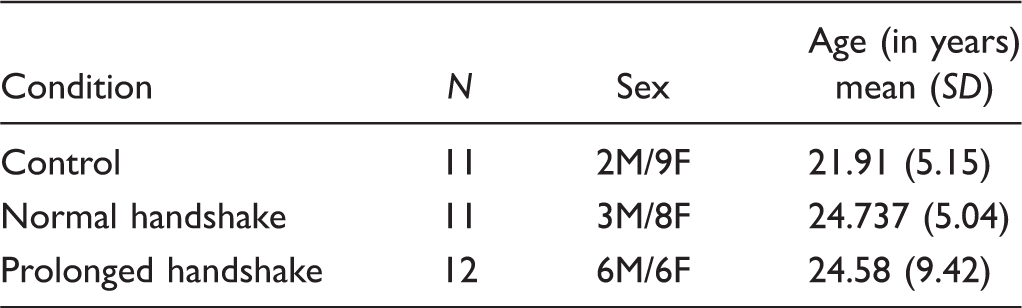
Figure 1 provides an illustration of the experiment (pictures of participants are published with the written informed consent of individual participants).
Illustrations of the experiment: (a) prehandshake stage with Experimenter 1 (Anna Symeonides; left), (b) handshake stage with Experimenter 2 (Frances Saunders), and (c) posthandshake stage with Experimenter 2. The pictures are illustrations of the experiment, published with the written informed consent of the pictured individuals.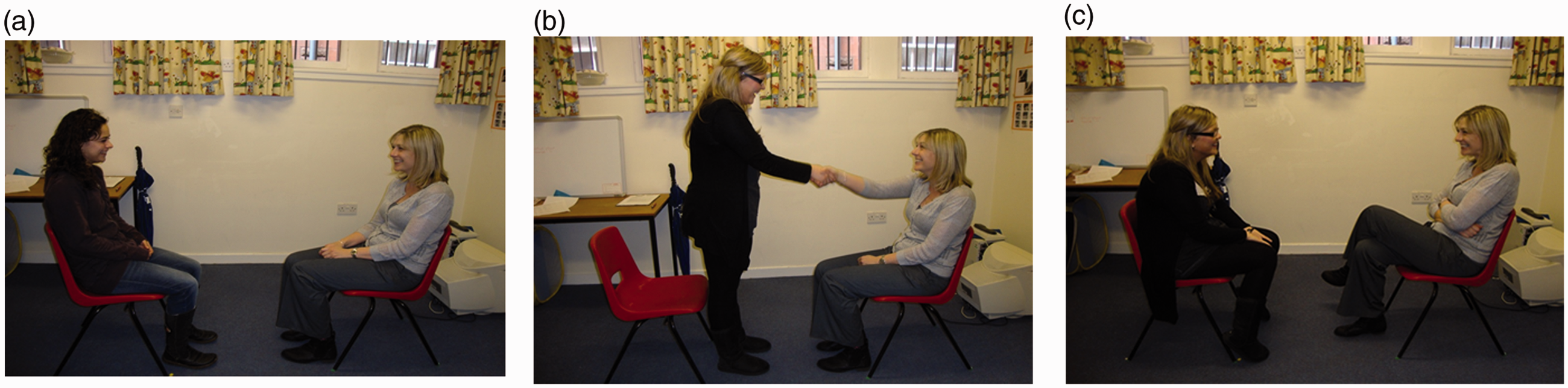
Procedure
The experimental setting was a basement laboratory room containing two desks, one computer, two chairs, and the camera. We held the thermostat constant at 21℃. Two experimenters, both female, led a reciprocal conversation with participants before and after the manipulated handshake. Each experimenter played the ‘greeter’ role an equal number of times in each condition, and ‘greeter’ order effects were counterbalanced. The participant and experimenter sat on two facing plastic chairs placed 75 cm apart at the chair legs and 78 cm apart at the edge of the chair seats, yielding about 115 cm between the experimenters’ and participants’ faces.
Experimenter 1 first explained the experiment and then gave an information sheet and obtained written informed consent from the participant. After a video-recording began (and continued throughout the experiment), Experimenter 1 gave the participant a clipboard with two questionnaires to complete (i.e., the State-Trait Anxiety Inventory by C. Spielberger et al., 1970, and the Mehrabian Empathy Scale (Mehrabian, 1996), with the stated overt goal of exploring aspects of mental health.
Experimenter 1 next suggested that she and the participant chat while waiting for Experimenter 2 to arrive to conduct the interview. Meanwhile, unknown to the participant, Experimenter 2 waited outside for 20 minutes from the moment the participant and Experimenter 1 entered the laboratory before entering themselves so as to allow sufficient time for participants to complete all the questionnaires and have a short discussion with Experimenter 1.
At this point, Experimenter 2 knocked and entered the laboratory, and Experimenter 1 stood up, said goodbye and left. Experimenter 2 introduced herself by saying hello and sitting down without any handshake (“Control”); shook the participant’s hand for 2-3 seconds (“Normal” Handshake); or shook the participant’s hand for 5-6 seconds (“Prolonged” Handshake). Experimeter 2 then sat down in the chair where Experimenter 1 was previously sitting.
The participants were randomly allocated into the three handshake conditions. The two experimenters were also randomly assigned into their respective roles of Experimenter 1 and 2, and, as noted, the order of these roles was counterbalanced across the participants and across the conditions prior to beginning the study. Neither of the experimenters who interacted with participants were involved in data coding or analyses.
All handshakes were given in a firm vertical movement, accompanied by a warm greeting and eye contact, consistent with handshake etiquette suggested by Emily Post (2007): The proper handshake is made briefly: but there should be a feeling of strength and warmth to the clasp, and as in bowing, one should at the same time look into the countenance of the person whose hand one takes. (p. 20)
Once seated, Experimenter 2 conducted a semistructured “interview” with a set of conversational questions that were employed flexibly, according to the participant’s interest and willingness to talk, to ensure smooth and reciprocal conversation. Questions included participants’ career choices, transitions in life, work, holiday plans, and current and future goals. This stage lasted for a further 15 minutes. Both experimenters kept their body language open and neutral (hands on lap and legs straight down) to further encourage open communication. Participants were fully debriefed afterward (see Figure 1(a) to (c) for an illustration of the experimental setup).
Behavioral Coding and Interrater Reliability
We coded participant’s nonverbal behavior in a 2-minute-long “prehandshake” phase of each participant encounter, and we coded a 2-minute-long “posthandshake” phase right after the handshake ended for participants in both the “normal” and “prolonged” handshake conditions. For participants in the “control condition,” we coded the same 2-minute-long pre- and postphases after the initial greeting when Experimenter 2’s handshake with the participant would have occurred.
We analyzed the participants’ gaze durations toward the experimenter and their hand movements, arm-folding, feet tapping, speech, and smiling and laughing behavior. We coded gaze duration during periods when the participant was looking toward the experimenter. We coded participants’ speech whenever the participant was speaking, smiling whenever the participant’s mouth moved laterally in a smiling expression without opening the mouth, laughing whenever participants made laughing sounds with an open mouth, feet tapping whenever either of the participants’ feet was tapping, and arms folded behavior whenever the participants sat with folded arms. We coded hand movements with reference to the hands’ position: (a) one hand placed on or touching the participants’ other hand, (b) hand(s) elsewhere on body (e.g., resting on leg(s)), (c) hand(s) on face, (d) hand(s) touching hair, and (e) hand(s) gesturing. All of these movement behaviors were coded frame by frame with 4-ms accuracy.
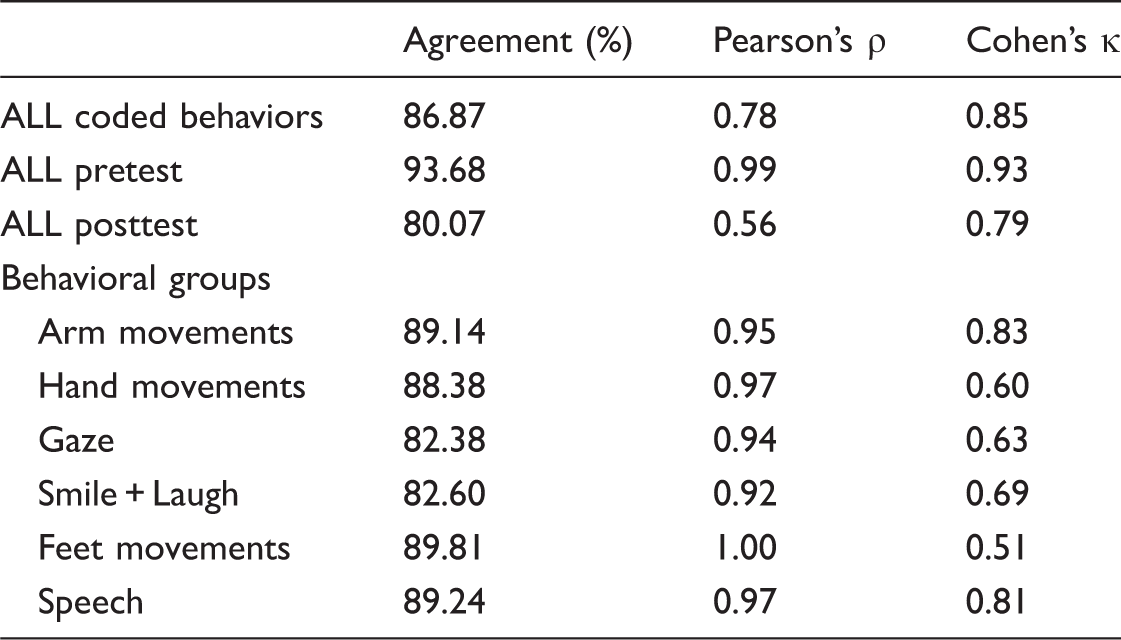
Interrater Coding Reliability Across Four Independent Coders.
Participant Questionnaires and Video Equipment
As noted earlier, we administered the State-Trait Anxiety Inventory (C. Spielberger et al., 1970) and Mehrabian’s Empathy Scale (Mehrabian, 1996) to all participants, and we scored their completed questionnaires according to the respective test manuals. We used a Panasonic NVGS27B digital video camera to record the experiments. The videotapes were digitized and edited for analysis using Ulead-VideoStudio 7 software. We used the Observer Pro 5 system (Noldus Information Technology, 2003) for frame-by-frame coding of the data and calculating the interrater reliabilities.
Statistical Analysis
Using Observer XT 9.0 (Noldus Information Technology, 2009) to extract the basic descriptive statistics regarding the codings, we conducted statistical analyses on durations of the target behaviors (seconds/analyzed duration). We conducted mixed-design repeated and univariate analyses of variances (ANOVAs) using IBM SPSS 22.0 for Windows statistical software, setting the criterion for statistical significance for all analyses at p < .05.
Results
Time Length of Handshakes Across Conditions
To determine whether handshake durations were indeed different in the normal and prolonged handshake conditions as intended, we measured and analyzed handshake duration from the videotapes. The results showed that handshakes that felt normal and natural to the experimenters were all within the desired 3-second window (M = 1.35, SD = 0.41), while handshakes in the prolonged condition were all well beyond this 3-second period (M = 4.84, SD = 0.81). The durations of the handshakes were significantly different in the two conditions, t(21) = 12.85, p < .001.
Condition and Experimenter Role in Pre- and Posthandshake Phases
First, we examined whether the experimental manipulation (handshake conditions) and roles assumed by experimenters (Experimenters 1 and 2) affected the durations of the measured target behaviors in prehandshake and posthandshake phases of participant encounters.
Hand movement behavior
A 5 (Hand movements: hands-on-hands, hands-on-body, hands-on-face, hands-on-hair, hands gesturing) × 2 (Phases: prehandshake and posthandshake) × 3 (Condition: control, normal handshake, prolonged handshake) × 2 (Experimenters: 1 and 2) mixed-design ANOVA yielded a significant Hand Movement × Phase × Condition interaction, F(8, 112) = 2.82, p = .007, ηp2 = .17. There was no significant Hand Movement × Phase × Condition × Experimenter interaction.
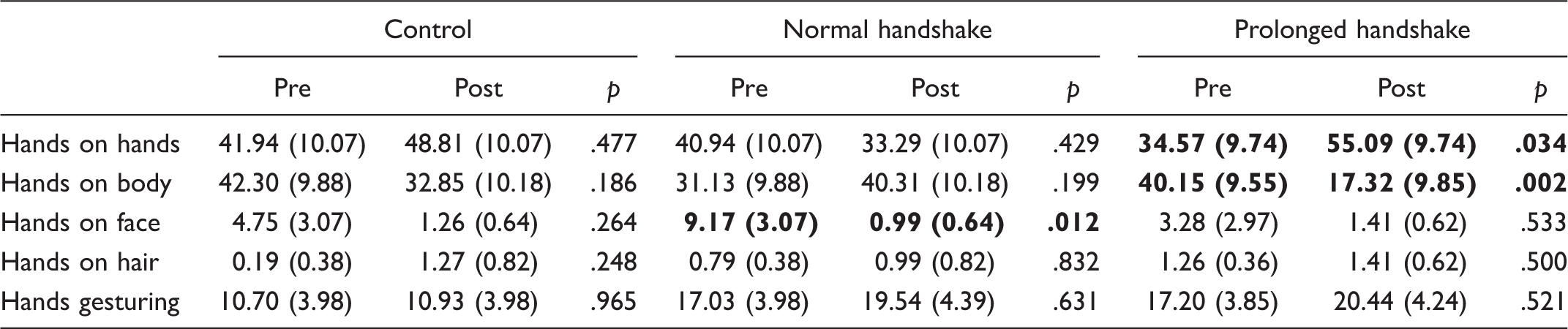
Post hoc pairwise comparisons with Bonferroni corrections found that participants in the normal handshake condition were engaged for significantly less time in hands on face movements from the prehandshake to the posthandshake phase (p = .012), while participants in the prolonged handshake condition were engaged for significantly more time in hands on hands movements in the post-compared with the prehandshake phase (p = .034), and for significantly less time in hands on body movements from the pre- to the posthandshake phase (p = .002). There were no changes in the control condition, and no other comparisons were significant. Also, there were no differences in the durations of any of these movements during the prehandshake period across the conditions (Table 3 and Figure 2).
The duration of hand movements: (a) Duration of hands on hands movements, (b) duration of hands on body movements, and (c) duration of hands on face movements in the prehandshake and posthandshake stages. *p < .05. **p < .01. Mean (and SD) Changes in Movement Durations (in Seconds) of Hands on Hands, Hands on Body, and Hand Gesture Movement in Pre- and Posthandshake Phases in the Control, Normal, and prolonged handshake Conditions.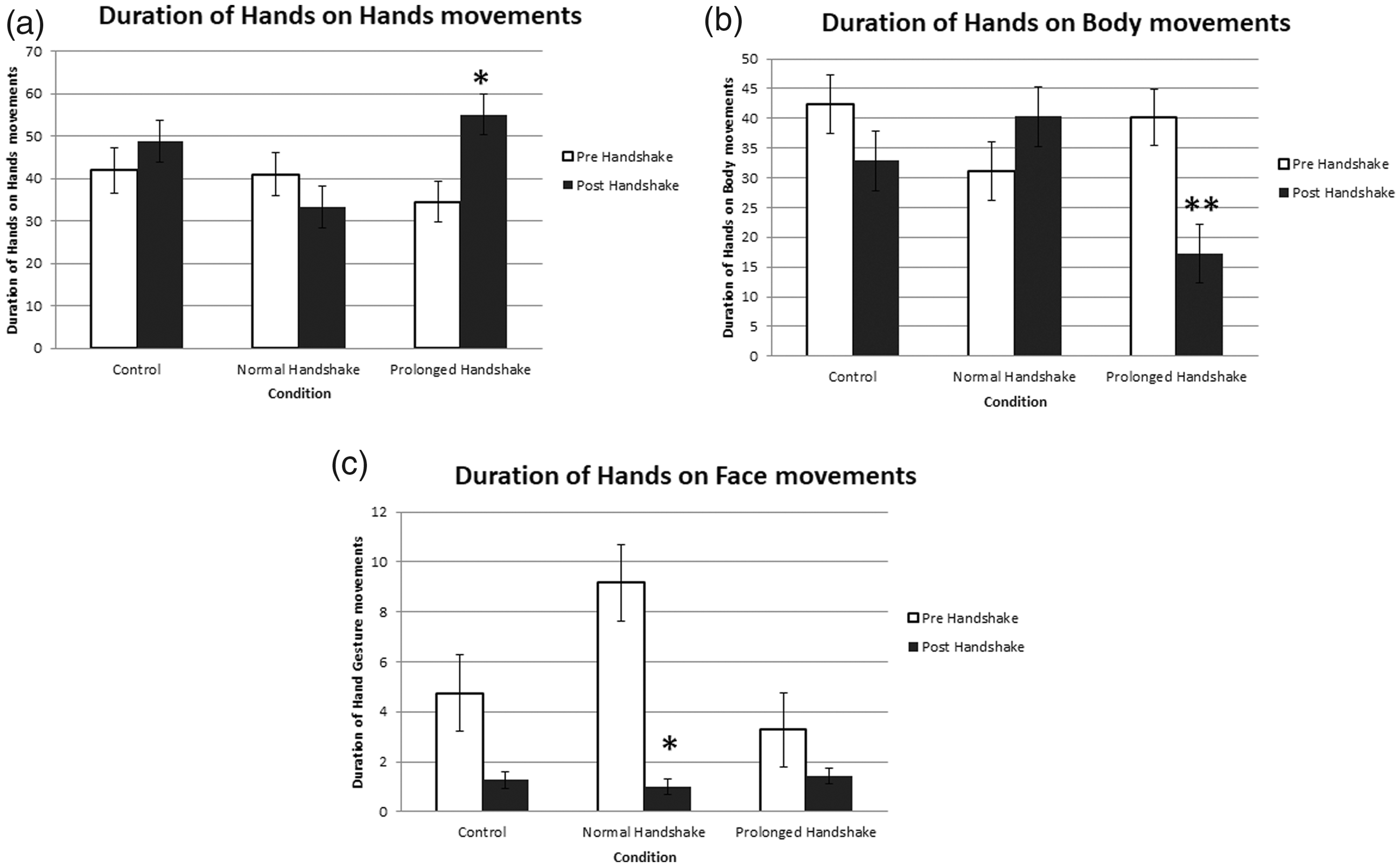
Smiling and laughing behavior
A 2 (Enjoyment: smiling and laughing) × 2 (Phase: prehandshake and posthandshake) × 3 (Condition: control, normal handshake, and prolonged handshake) × 2 (Experimenters: 1 and 2) mixed-design ANOVA yielded a significant Enjoyment × Phase × Condition interaction, F(2, 28) = 3.78, p = .035, ηp2 = .21. There was a trend toward but no significant Enjoyment × Stage × Condition × Experimenter interaction, F(2, 28) = .79, p = .047.
Post hoc pairwise comparisons with Bonferroni corrections revealed that participants in the normal handshake condition were engaged in smiles for significantly less time from the pre- to the posthandshake phase (p = .012) and showed shorter duration of laughing in the posthandshake phase of the prolonged handshake condition (p = .032). Changes in the duration of laughing and smiling between the pre- and posthandshake phases were not significant in the other conditions, and there were no differences in the duration of smiling and laughing in the prehandshake stage for any of the three conditions (see Table 4 and Figure 3(a) and (b)).
The duration of smiles (a) and laugh (b) in the prehandshake and posthandshake stages. *p < .05. Mean (and SD) Changes in Laughing and Smiling Durations (in Seconds) in Pre- and Posthandshake Phases in the Control, Normal, and Prolonged Handshake Conditions.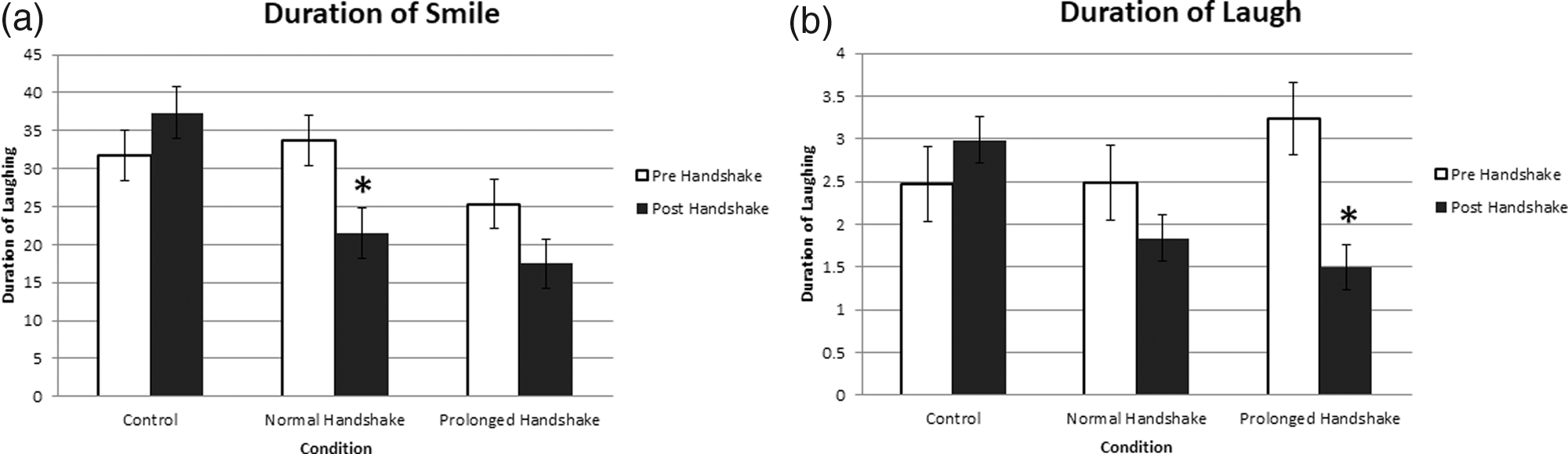

Gaze, speech, feet tapping, and arms folded behaviors
Handshake condition had no effect on gaze duration, and there was no Phase × Condition × Experimenter interaction on gaze duration. Condition also had no effect on speaking duration, and there was no Phase × Condition × Experimenter interaction on speaking duration. Condition also had no effect on feet tapping, and there was only a trend toward, but no significant, Phase × Condition × Experimenter interaction on the duration of feet tapping, F(3, 28) = 2.70, p = .065. Finally, Condition did not affect the duration of arms held folded, and there was no Phase × Condition × Experimenter interaction.
Condition and Experimenter Role: Posthandshake − Prehandshake Phase Differences
To further confirm the effects of the experimental manipulation, we conducted a series of univariate ANOVAs to directly investigate the effect of the experimental manipulation (Conditions: normal, prolonged handshake, and control) and the Experimenters (Experimenters 1 and 2) on changes in the durations of the measured target behaviors (i.e., posthandshake − prehandshake phase duration differences).
Hand movements
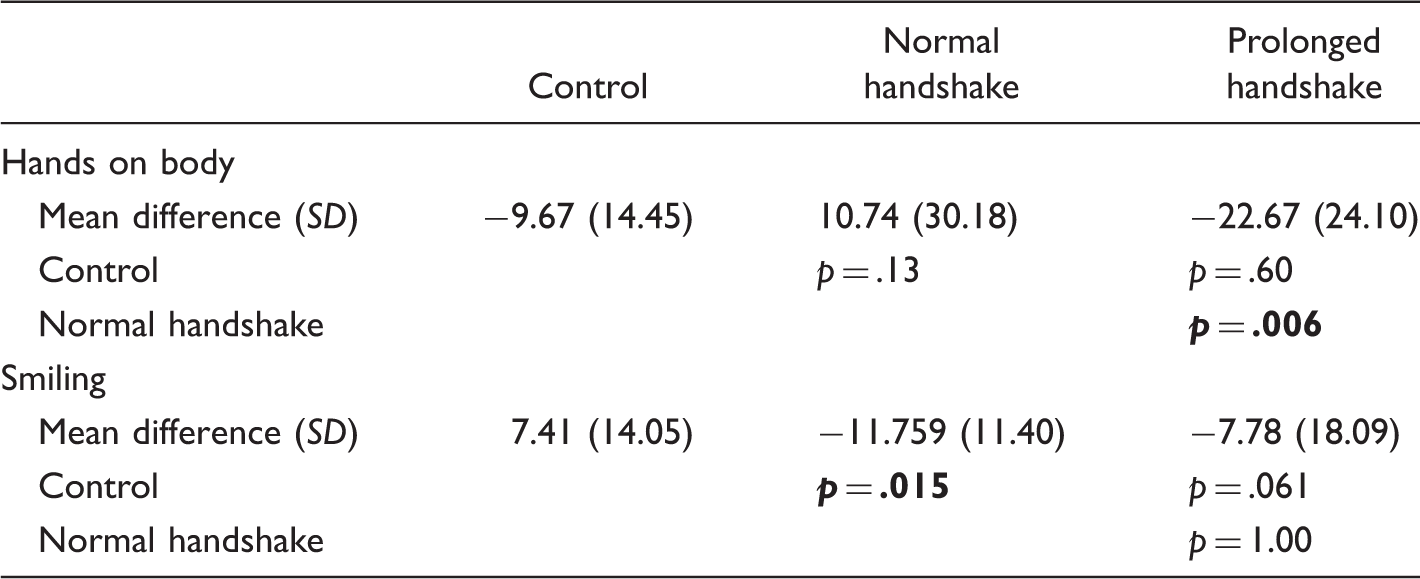
Mean Differences (and SDs) in Post − Prehandshake Phase Duration Scores for Hands-on-Body and Smiling Behaviors in the Control, Normal, and Prolonged Handshake Conditions and p Levels for Pairwise Comparisons of Handshake Conditions.
Smiling
There was a significant Condition effect on the duration of smiling, F(2, 33) = 5.11, p = .012, ηp2 = .25. Post hoc pairwise analyses using Bonferroni corrections found that the duration differences of smiling were significant in the normal handshake condition (p = .015) and showed a nonsignificant trend to be different in the prolonged handshake condition (p = .061) compared with the control condition. Participants in both handshake conditions (but not the control condition) decreased the duration of smiling from post to prehandshake phase (meaning that they smiled longer after the handshake). Difference scores of the two handshake conditions were not statistically different. No other main effects, interactions, or group differences were significant (see Table 5).
Laughing, gaze, speech, feet tapping, and arms folded behaviors
The main effect of Conditions on the posthandshake − prehandshake phase duration difference scores for the other target behaviors was nonsignificant.
Participants' Anxiety and Empathy levels
Participant Means (and SDs) by Experimental Condition on the Balanced Emotional Empathy Scale (Mehrabian, 1996) and State and Trait Anxiety Measures (C. Spielberger et al., 1970).
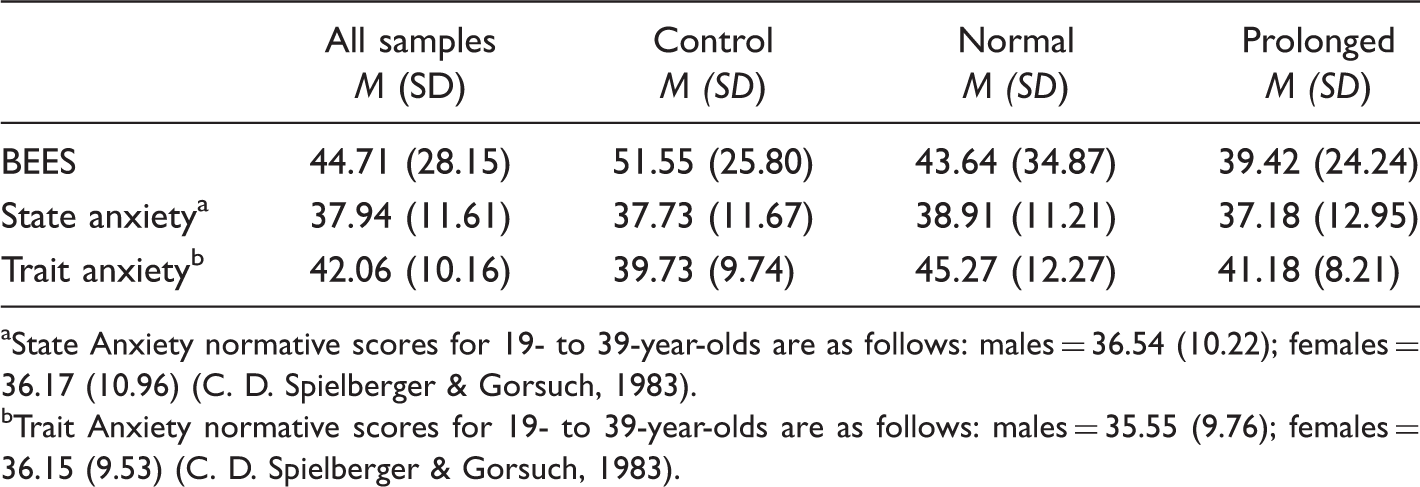
aState Anxiety normative scores for 19- to 39-year-olds are as follows: males = 36.54 (10.22); females =36.17 (10.96) (C. D. Spielberger & Gorsuch, 1983).
bTrait Anxiety normative scores for 19- to 39-year-olds are as follows: males = 35.55 (9.76); females =36.15 (9.53) (C. D. Spielberger & Gorsuch, 1983).
Empathy
We conducted univariate ANOVAs to directly investigate the effect of the conditions and the participants’ level of empathy on the posthandshake −prehandshake phase difference durations of the measured behaviors. Participant empathy had no significant effect on the posthandshake − prehandshake phase durations for any behaviors in any of the three conditions.
State anxiety
Further univariate ANOVAs found that posthandshake −prehandshake phase difference durations of the arms folded behavior was significantly affected by the interaction of Condition × State Anxiety, F(2, 33) =4.34, p = .023, ηp2 = .243. Post hoc correlational analysis showed a nonsignificant tendency for State Anxiety scores and duration of arm-folded behaviors in the normal handshake condition to be positively correlated (r = .566, p = .070), and there was a nonsignificant trend toward a negative correlation between these variables in the prolonged handshake condition (r = −.54, p = .08).
The posthandshake − prehandshake phase difference duration of feet tapping behavior was significantly affected by the interaction of Condition × State Anxiety, F(2, 33) = 4.57, p = .019, ηp2 = .253. Post hoc correlation analysis found a significant positive correlation between State Anxiety scores and the duration of feet tapping in the control condition (r = .64, p = .033), but there was no evidence of a significant correlation between these variables in the normal (r = .10, ns) or in prolonged handshake (r = .11, ns) conditions.
Trait anxiety
Finally, univariate ANOVAs found no significant affect from Trait Anxiety on the posthandshake − prehandshake phase difference durations of any of the target behaviors across the three conditions.
Discussion
Our literature review revealed that the duration of handshakes in initial interpersonal encounters follow a temporal pattern that has been previously reported for many interpersonal nonverbal actions (Nagy, 2011). We first confirmed that handshakes that felt natural to the experimenters in our normal handshake condition had durations that fell within this 3-second temporal window and that handshakes in our prolonged handshake condition were all longer than three seconds. Next, our experimental results showed that violating the normal expectation of 2-second handshakes had measurable impacts on our participants’ nonverbal behavior, representing manifestations of their mood states. For example, participants laughed less in a period after the prolonged handshake than after either a normal handshake or a no-handshake control condition. The most likely explanation for this behavioral difference is that participants experienced less enjoyment, intimacy, and friendliness after these unnaturally prolonged handshakes. In other research, Grant (1969) found that laughing often indicated that people were “relaxed” Grant, E. C. (1968), and spontaneous laughter has often been associated with greater positivity, friendliness (Bachorowski & Owren, 2001), and enjoyment (Neuhoff & Schaefer, 2002). Laughter is effective in reducing catecholamine and cortisol levels associated with stress (Hubert & de Jong-Meyer, 1991), increasing immune function (Dantzer & Mormede, 1995), and producing an analgesic effect (Fry, 1994; Provine, 2001). In dyadic situations, like the one in the present experiment, observers have perceived higher intimacy and more intimate disclosures when laughter was present, compared with similar dyadic situations when there was no laughter (Gray, Parkinson, & Dunbar, 2015). Thus, overall, in the context of previous literature, our finding of reduced laughter after prolonged handshakes likely indicates diminished enjoyment, intimacy, and friendliness.
The prolonged handshake was also uniquely associated with increased hand movements, and, in particular, increased time engaged in a movement in which one hand touches the other, as if grasping one’s own hand. Also, after the prolonged handshake, in comparison to other conditions, there were shorter periods of hands touching the body. It is possible that hand movements shifted from body-touch movements to own-hand touch in this condition. In past research, hand-fidgeting and hand-on-hand movements have been shown to indicate anxiety (Fairbanks et al., 1982; Friesen et al., 1979; Harrigan et al., 1985; Waxer, 1977). Hand-on-hand and hand-on-body movements are both classified as body manipulator movements (Friesen et al., 1979), and they are among the most salient nonverbal cues. Also, hand and arm movements are the most difficult nonverbal behaviors to consciously control; they are called “leaking channels” (Ekman & Friesen, 1969), as they reveal mood states. The suppression of hand movements can be interpreted within the self-control hypothesis under anxiety-provoking situations, based on studies of deception, where hand movements were often inhibited in an attempt to avoid leakage (Ekman, Friesen, & O’sullivan, 1988) and in which deception has been associated with less self-body touching (Vrij & Winkel, 1991). Perceived liveliness has also been related to an increase in body touch, among other behavioral signs, such as more trunk, hand, and arm movements (Vrij & Winkel, 1991). In addition, self-touch is regarded as a tactile self-stimulation that helps to regulate and maintain stability in times of anxiety and stress (LeCompte, 1981; Ruggieri et al., 1982). The decrease in self-body touching after our prolonged handshake condition is in accordance with prior research suggestions that self-touching decreases as people become more anxious and prone to censor their actions (Ekman & Friesen, 1972). According to Harrigan et al. (1985), in a medical setting, the majority (55%) of all self-touch happened on the head or the face and only about 2% on the trunk. Hand-on-trunk contact seems to be the least common form of self-touching behavior in adults, and Harrigan et al. (1985) have proposed that people tend to suppress these movements as inappropriate. It is possible that the decrease of this particular form of self-touching, but not of others in this study, was related to suppressed intimate self-expression.
Future studies could further examine the temporal relationship among these other nonverbal behaviors, as it is likely that they shift in a meaningful pattern in an anxiety-provoking situation. It has been found, for example, that the amount of eye contact is dependent on cultural context, participants’ sex, and other individual variables, and it relates, in turn, to the increase or decrease of other nonverbal behaviors. In Vrij and Winkel’s (1991) study, for example, gaze behavior and self-to-body touch were inversely related during deception and the direction of this correlation was dependent on cultural background.
The duration of our participants’ commonly occurring hands-on-face movements decreased following the normal handshake duration. Similar to Goldberg and Rosenthal (1986) who found that people touched their faces less in formal, compared with informal, interview conditions, our finding of decreased time spent engaged in hands-on-face movements may indicate reduced tension in our normal handshake condition versus the prolonged or no handshake conditions.
The duration of smiling behavior also decreased following our normal but not our other handshake conditions. In other research regarding interview conditions Forbes, R. J., & Jackson, P. R. (1980), introductory psychology participants exhibited the fewest smiles following interviews that led to their rejection with the next fewest smiles coming from a group placed on reserve, and the highest number of smiles coming from the accepted group. Smiles have been commonly interpreted as pleasant expressions (Mehrabian, 1968), and smiles and laughing are signs of enjoyment (Ekman & Friesen, 1971). Similarly, our seemingly uncomfortable prolonged handshake condition was uniquely associated with reduced laughing. Unexpectedly, our normal handshake condition, though less anxiety provoking, was associated with decreased smiling. Possibly, smiling is a natural prehandshake greeting behavior that may have diminished in the posthandshake period, even following the normal handshake, simply because the greeting was over. Also, in an experimental situation, however, naturally it is presented, even a normal handshake may introduce an element of formality that increases interpersonal tension. Formal interviews are known to evoke anxiety and self-awareness compared with informal interviews (Goldberg & Rosenthal, 1986). It is important to note, however, that although participants decreased their smiling, they also decreased their hands-on-face movements, suggesting minimal tension.
A secondary aim of this study was to test whether participants’ personality characteristics would affect their posthandshake behavior. We found minimal support for this influence. Participants’ self-reported empathy on the Balanced Emotional Empathy Scale (Mehrabian, 1996) had no relationship to participants’ behavioral responses in the handshake conditions, possibly because this scale measures affective trait empathy. From past research, the relationship between affective and cognitive empathy, or empathic accuracy (Ickes, Stinson, Bissonnette, & Garcia, 1990) and actual nonverbal behavior, is unclear. A recent model (Zaki, Bolger, & Ochsner, 2008) suggested that the concept of empathy is interpersonal by nature, meaning that it is dynamically interrelated between a specific perceiver and recipient. Thus, participants’ self-rated empathy is accurate only when the target person expresses his or her feelings, while our experimenters were careful not to change anything in their behavior other than handshake duration. It is possible that, if handshakes were accompanied by different displays of experimenter emotional behavior, such as showing or not showing embarrassment, signs of power or absent-mindedness, creating different emotional contexts, there might have then been evidence of greater influence from participants’ empathy scores (Mischel & Shoda, 1995). Alternatively, however, the lack of relationship between participants’ empathy and their behavioral responses in the three conditions may mean that the prolonged handshake was such an important custom violation (Borsellino et al., 1972; Chafe, 1987; Ditzinger & Haken, 1989; Feldhütter et al., 1990; Fraisse, 1984; Nagy, 2011; Parncutt & Pascall, 2002; Pöppel, 1978; Schleidt, 1988; Schleidt & Kien, 1997; Trevarthen, 1999) that its influence on participant nonverbal behavior after the handshake overpowered any further effect from this participant personality characteristic. Another explanation for a lack of effect from participant empathy characteristics may be that participants in the three conditions differed minimally on this personality construct.
State and trait anxiety were also unrelated to post handshake hand movements or smiling and laughing, all of which were differentially associated with the handshake conditions. Of relevance to this failure to find much of a relationship between anxiety test scores and nonverbal behavior following handshake conditions, none of our participants showed particularly high state or trait anxiety scores, relative to normative scores from past research (see Table 6). Trait anxiety was not related to any behavioral changes, while higher state anxiety was related to an increase in arm-folding and feet-tapping time after normal handshakes and decreased time spent in arm-folding after prolonged handshakes. Arm-folding behavior has been found to increase with age as part of anxiety and tension display (Saarni, 1992). Arm-folding has been found to indicate a lack of engagement in a business setting (Pease, 1984) and anxiety in a foreign-language setting (Gregersen, 2005). Overall, a closed-arm position often conveys a negative attitude (Mehrabian, 1968). Physicians who assumed a closed posture were viewed more negatively by patients than physicians with unfolded arms (Harrigan & Rosenthal, 1983). Grant (1968), however, found that folded arms during interviews indicated a relaxed attitude and a lack of arousal. Similarly, our recent microanalytic analysis of stimuli responsive fetal movements found arm-folding to indicate rest (Marx & Nagy, 2015). Overall, most previous studies have found an association between tension, anxiety, negative attitudes, and a folded-arm position, while several studies suggest a more complex, situation-dependent meaning for this behavior. It is possible that the normal handshake condition represented a context similar to that of a formal interview leading to more anxious nonverbal behavior, including foot-tapping and arm-folding.
In summary, this study found that an unexpectedly prolonged handshake (>3 second duration) negatively affected participants’ nonverbal behavior after the handshake, in the form of greater emotional discomfort. From our findings, we can only speculate how the length of the handshake was translated into anxiety signals from the handshake recipient. Experimenters were randomly allocated to their roles before and after the handshake in all three conditions, and we observed no experimenter effect in the analyses, ruling out the likelihood that the handshake effect was mediated by the experimenter’s reactions. Gender issues may be relevant to our findings. Although the identity of the experimenters did not affect the results, both experimenters were female, as were 75% of the participants. In previous studies, men have been found to offer firmer handshakes than women (Chaplin et al., 2000), though differences are also expected between the two sexes’ nonverbal behaviors. Katsumi, Y., Kim, S., Sung, K., Dolcos, F., & Dolcos, S. (2017) found the effect of a handshake to be more positive in male-to-male interactions than in other gender dyads. People also tend to smile more to individuals of their own sex (Mehu, 2011) and to smile more when the speaker is male and the audience is female (Provine, 1993). With respect to sex differences within dyads, same-sex dyads (male–male or female–female as opposed to mixed-sex) have been found to show more eye-contact, smiling, and laughing in a reciprocal situation compared with a more formal, one-sided interview situation (McAdams, Jackson, & Kirshnit, 1984). In a simulated interview situation, the sex of both the interviewer and participant affects nonverbal behavior (Goldberg & Rosenthal, 1986) in that, for example, females have been found to show more hair-touching than males. In this study, perhaps due to the use of mainly same-sex female dyads, there were no differences in this behavior across conditions.
A limitation of this study was its small participant sample size, made necessary by the large amount of data to be gathered through detailed frame-by-frame coding of nonverbal behavior. While, to our knowledge, no previous study has employed such a fine-grained, frame-by-frame behavioral analysis spanning several minutes, there can be problems generalizing our findings to other populations. Of importance, the effect sizes in the analyses were ηp2 = .167 and .21, respectively, which are considered to be small, according to Cohen (1977), indicating that the sample size may not have been associated with sufficient power for all variables. The study might have also been improved by introducing behavioral coding for nonverbal signals of self-consciousness and openness and by examining the temporal dynamics of how nonverbal target behaviors might have evolved over time for both the experimenter and in the participants. Future research might also use conditions in which handshakes are socially expected or not socially expected.
Footnotes
Acknowledgments
We thank the Reviewers for the helpful and encouraging comments and our Editor, Professor John Ball for the substantial help in editing.