







Abstract
This study aimed to compare the contributions of sources of proprioception to the reproduction accuracy of relatively slower and more rapid arm movements. We recruited 34 volunteers and gave them dart throwing tasks under two different durations followed by joint position sense (JPS) tests and force sense (FS) tests at the elbow and the wrist. We found moderately positive correlations between slow movement performance and proprioceptive acuity with FS (wrist) and JPS (elbow), accounting for 52% of the absolute errors (p < .001), and, with FS (wrist), accounting for 50% of the variable error (p < .001). Moreover, we observed a smaller correlation between rapid movement performance and proprioceptive acuity, accounting for 17% of absolute errors with JPS (elbow; p = .008) and 11% of variable error (p = .033). These results suggest that relatively slow movement performance is partly determined by performers’ proprioceptive acuity of the movement-related limbs. Relatively rapid movement performance is also affected by correctional proprioceptive feedback, though to a lesser degree.
Introduction
Movements can be divided into two categories, slow and rapid; the duration of slow movement is more than 200 milliseconds (ms), while that of rapid movement is less than 200 ms (Schmidt, Zelaznik, Hawkins, Frank, & Quinn Jr, 1979). In the traditional view, slow movements are controlled by closed-loop systems that may regulate ongoing movement by relying on information from sensory receptors, a process that is necessarily slow (Schmidt & Lee, 2011). While sensory feedback is vital in slow movements (Danna et al., 2015; Sarlegna & Mutha, 2015), rapid movements are controlled by open-loop systems, in which the movement program is prestructured (Summers & Anson, 2009). For rapid movements, duration has been seen as too short to allow proprioceptive feedback to be involved in error corrections (Blouin, Teasdale, Bard, & Fleury, 1995).
However, recent studies have found that sensory information also plays a role in rapid movement control. For example, Saunders and Knill (2003) observed movement correction responses based on visual sensory feedback within 160 ms after a small sensory perturbation was applied to fast reaching movements. In a subsequent study, these authors showed that responses based on sensory feedback to direction perturbations occurred within 117 ms, and corrections to distance perturbations appeared within 130–200 ms (Saunders & Knill, 2005). Although contradictory to previous studies that suggested there is no sensory feedback during rapid movements (Blouin et al., 1995; Todorov & Jordan, 2002), Saunders and Knill’s findings were consistent with the recently developed integrative hybrid movement model (Desmurget & Grafton, 2000; Schmidt & Wrisberg, 2008), maintaining that sensory feedback and motor program preplanning are both used in motor control. Specifically, online corrections could be completed by superimposing a dynamically appropriate correction signal onto the outgoing preplanning motor command (Gritsenko, Yakovenko, & Kalaska, 2009). Consistent with the hybrid model, studies demonstrated that visual feedback contributes to fast movement control (Saunders & Knill, 2003, 2005). Given these new research developments regarding fast movement control and the importance of proprioception in movement control, it is imperative to examine the role of proprioception in both slow and fast movement. Because the role of sensory feedback may depend on movement duration, understanding how proprioceptive feedback differs in slow and fast movements may provide important insights into human movement control.
Proprioception is an important source of sensory information that has been assumed to contribute heavily to motor control (Gandevia, 2014; Wiesmeier, Dalin, & Maurer, 2015). Proprioception is the ability to sense joint position and movement (Sherrington, 1906); it has three submodality sensations: kinesthesia, joint position sense (JPS), and force sense (FS; Riemann & Lephart, 2002). All of these submodalities are critical for generating accurate and stable complex movements such as basketball free-throw shooting. JPS and FS are the two most commonly used measurements of proprioception (Niespodziński, Kochanowicz, Mieszkowski, Piskorska, & Żychowska, 2018; Phillips & Karduna, 2017), and they could be of particular interest in throwing movements that require both position and force control and partly depend on joint angle, force, and speed at the time of release (Leigh, Liu, Hubbard, & Yu, 2010; Raeder, Fernandez-Fernandez, & Ferrauti, 2015). Proprioception has been widely investigated and shown to be very important in slow movement performance (Kalisch, Kattenstroth, Kowalewski, Tegenthoff, & Dinse, 2012; Simon, Kelly, & Ferris, 2009; Yosmaoglu et al., 2013). For rapid movements, there is still debate about the role of proprioception (Bagesteiro, Sarlegna, & Sainburg, 2006; Forget & Lamarre, 1987; Todorov & Jordan, 2002). Inconsistent findings regarding proprioception for rapid movements may stem from different research methods used to present participants with perturbations in movement tasks. The correcting effect of sensory feedback is almost negligible in response to environmental changes that appear just before movement onset (Blouin et al., 1995), whereas sensory feedback makes a significant contribution to movement correction in response to sensory perturbation during movements (Saunders & Knill, 2005).
The purpose of this study was to examine the effect of general proprioceptive feedback on relatively slow and rapid movement performance. We chose throwing tasks under two different movement durations that were adjusted by changing the target distance as the exemplars to explore the importance of JPS and FS on relatively slow and rapid movements. Given that proprioceptive feedback could play a role in movement control, we adopted general proprioceptive measurement by commonly used active position reproduction tests and force matching tests to measure JPS and FS at elbow and wrist, instead of using proprioceptive measurement specific to dart throwing. We hypothesized that proprioceptive acuity would correlate significantly with relatively slow movement performance and correlate only weakly with relatively rapid movement performance; we further hypothesized that proprioception would significantly predict relatively slow movement performance but only partly predict relatively rapid movement performance.
Methods
Participants
A total of 34 healthy participants (18 males, 16 females; M age = 21.68, SD = 1.77 years) volunteered for the study. No participants had special athletic, musical, or other high-intensity hand manual-skill training experiences, and no participants had a history of hand injury (such as finger, wrist, elbow, or shoulder fractures or the presence of surgical hardware) or other movement-related pathology (such as stroke, diabetes, arthritis, or neurological problems). All participants were right-handed, as determined by the Edinburgh Handedness Inventory (Oldfield, 1971), and all participants were blind to the nature of this study. All participants provided written informed consent prior to participation. The project protocol was approved by the Shanghai University of Sport Committee for Ethics.
Tests and Materials
Evaluation of slow and rapid movement control: throwing task
We employed a dart throwing apparatus constructed for this research purpose. In this apparatus, as shown in Figure 1, the participant was seated, and there was a mark on the table pointing to where the elbow of the participant’s dominant hand should be placed and fixed during each throw. Two targets were placed on the floor at a distance of 1.25 and 2.50 m from the participant, and concentric circles with radii of 5, 10, 15, 20, 25, 30, 35, 40, and 45 cm were drawn around the targets to help assess the accuracy of throws. A 50 cm × 35 cm liquid crystal dimmer glass baffle was placed vertically in front of the participant; it was transparent when powered on and opaque when powered off (Figure 1(a)) so as to be transparent before throwing, while at the moment of throwing, the arm interrupted the laser switch (Figure 1(b)) to turn the baffle opaque and make the location of the darts invisible to the participant. Thus, participants could see the target before throwing but could not obtain visual feedback after throwing, reducing any practice effect.
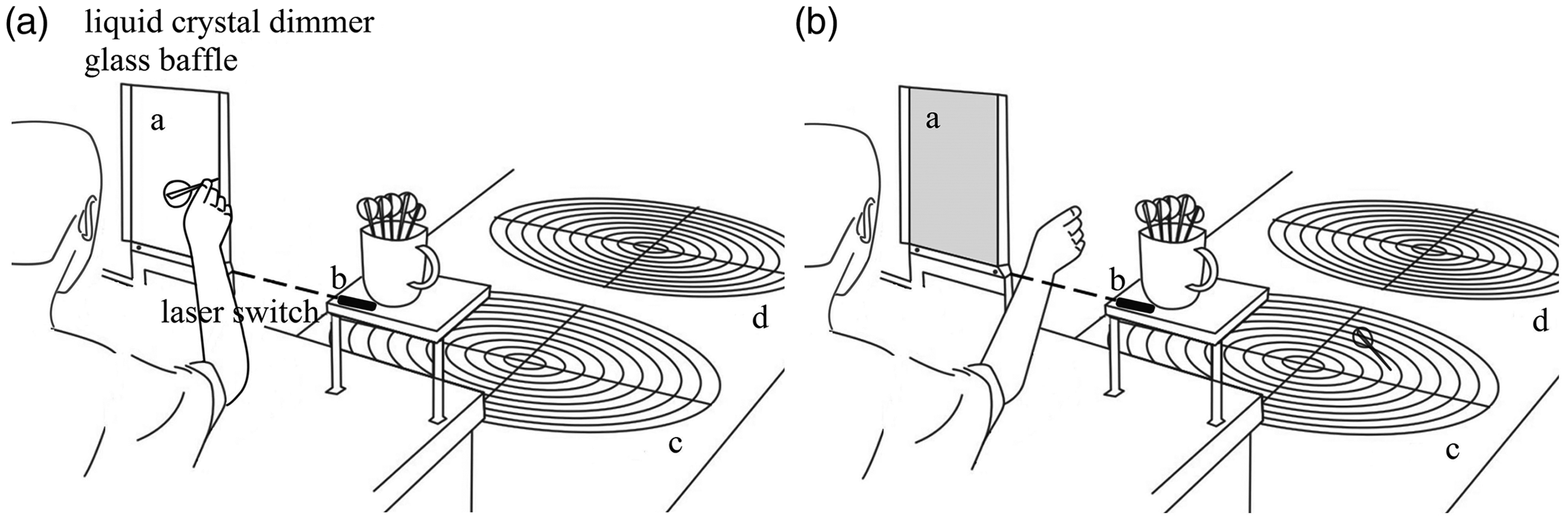
Throwing task. The equipment components (targets, glass baffle, and laser switch) of throwing task and subjects’ positioning before (a) and after (b) throwing.
Evaluation of proprioception at the wrist and elbow: JPS test
We assessed JPS using the Functional Assessment of Biomechanics (FAB; Biosyn Systems, Canada). The FAB is a wireless motion-capture system comprising 13 sensors (4 cm wide × 7 cm high × 2.4 cm deep; weight = 45 grams) that contain magnetometers, gyrometers, and gyroscopes. The FAB permits assessment of positions, angles, torque, velocities, accelerations, and power of body segments. Data were acquired at 100 Hz. For this study, sensors were placed on the occipital region, the T10-T11 spinous process, the L5-S1 spinous process, lateral to the biceps brachii, the dorsal part of ulnar styloid, and the back of the hand, using elastic bands (see Figure 2). The real-time position, angles, and velocities of body segments were presented on the FAB software. This device has been widely used to evaluate whole body kinematics (Rahimi et al., 2014) and range of joint motion (Corbett, Peer, & Ridgel, 2013).
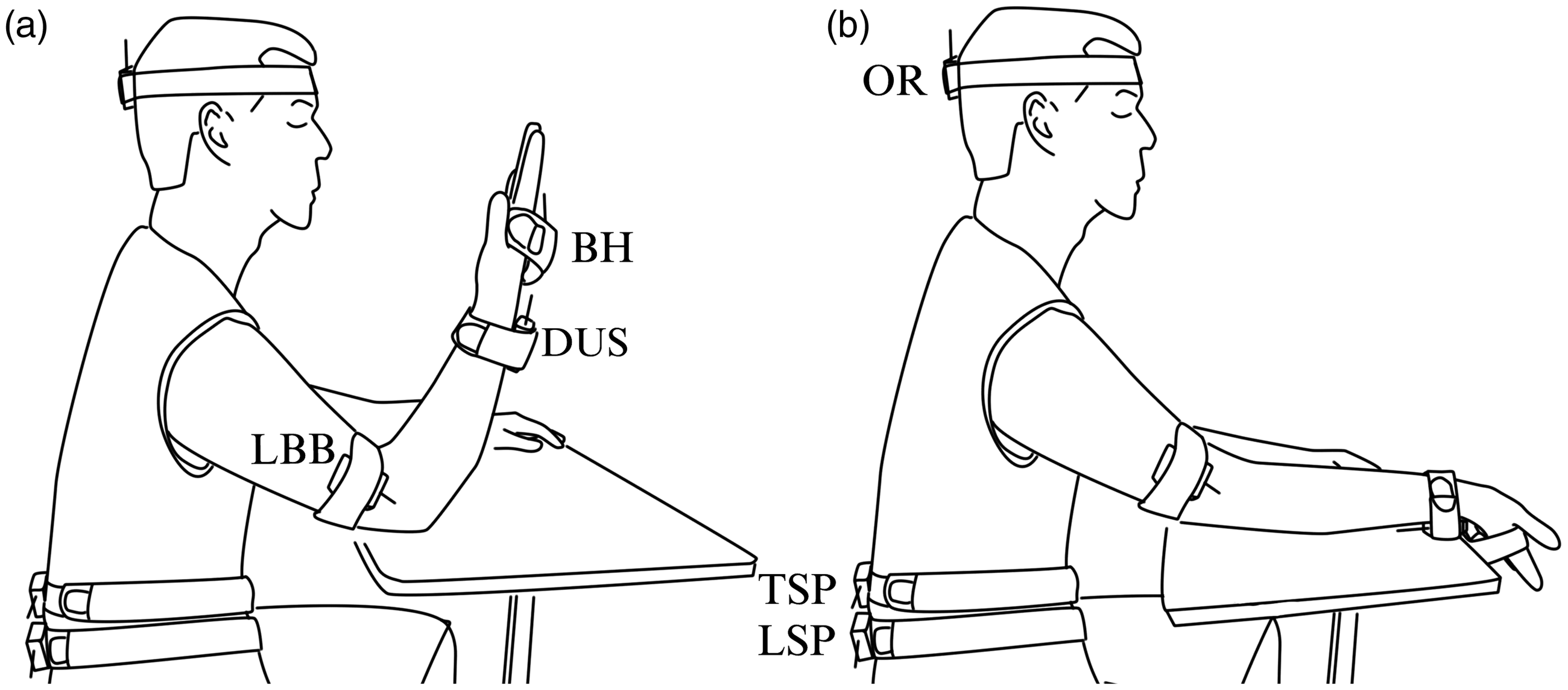
Position sense test. Sensor’s placement at the occipital region (OR), the T10-T11 spinous process (TSP), the L5-S1 spinous process (LSP), lateral to the biceps brachii (LBB), the dorsal part of ulnar styloid (DUS), and the back of the hand (BH), and subjects’ positioning for elbow (a) and wrist (b) JPS testing.
Evaluation of proprioception at the wrist and elbow: FS test
We prepared the apparatus for the wrist and elbow FS test using the same force matching equipment (Brooks, Allen, & Proske, 2013) for both joints. For example, the FS test apparatus on the elbow (see Figure 3(a)) consisted of a frame bolted to a baseplate, a digital dynamometer, and a paddle used to stabilize the forearm (or the hand for the wrist test). The participant sat with his or her dominant upper limb forearm (or hand for the wrist test) strapped to the paddle by elastic bands, with the palm facing the frontal plane of the body. The paddle was hinged at a point coincident with the elbow joint (or wrist for the wrist test) to allow a full range of motion of the elbow (or wrist) during flexion and extension. A digital pull-and-push dynamometer (HP-500 Handpi, Yueqing Handpi Instruments, China) was fixed on the frame, with its probe attached to the paddle; the real-time force was displayed on the screen. To approximate the real world, we placed no limit on the movements of other parts of the body.
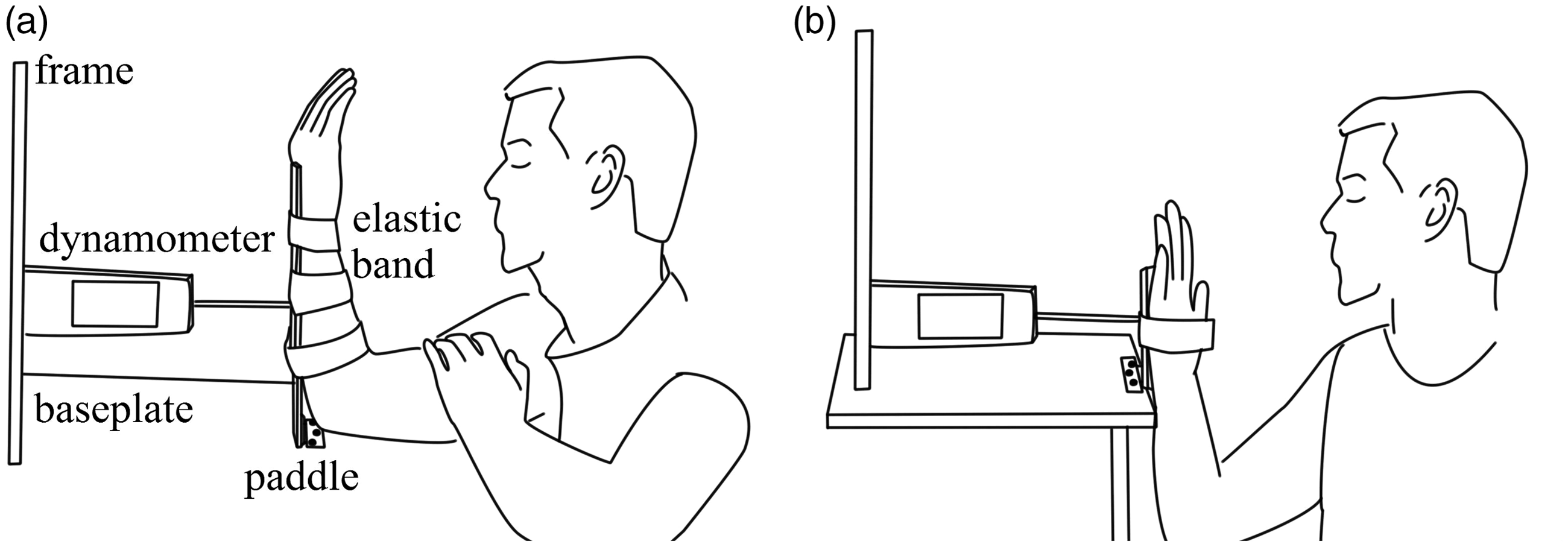
Force sense test. The equipment components (frame, baseplate, paddle, and digital dynamometer) of force sense test and subjects’ positioning for elbow (a) and wrist (b) FS test.
Dart Throwing Task
Evaluation of slow and rapid movement control: throwing task
We measured motor performance via dart throwing tasks (Ávila, Chiviacowsky, Wulf, & Lewthwaite, 2012; Chiviacowsky, Wulf, de Medeiros, Kaefer, & Tani, 2008) under two distance conditions: short-distance throwing (target at 1.25 m; movement duration of about 317 ms = slow movement; see Figure 1(c)) and long-distance throwing (target at 2.50 m; movement duration of about 189 ms = rapid movement; see Figure 1(d)). There were 15 trials per condition. In the short-distance condition, for example, participants threw the dart (20 g) at the target (Figure 1(c)) with their dominant arms.
Using a critical point of 200 ms for distinguishing slow and rapid movements in prior research (Schmidt et al., 1979), we considered a movement duration shorter than 200 ms as rapid movement and a movement duration longer than 200 ms as slow movement. We determined throwing distances of 1.25 m and 2.50 m for slow and fast movement, respectively, by measuring throwing duration in an earlier pilot study with three participants.
Evaluation of position sense at the wrist and elbow: JPS test
We measured JPS by the most commonly used active position reproduction test, based on the results of previous studies on the validity and reliability of various JPS tests (Goble, 2010; Proske & Gandevia, 2009). For example, in the JPS test on the elbow (Figure 2(a)), we seated participants with the forearm flat on the table and eyes closed. Participants were then required to actively move to one of three target positions (15° of flexion, 30° of flexion, and 45° of flexion for the elbow; 15° of flexion, 30° of flexion, and 15° of the extension for the wrist), randomly presented three times each, resulting in 18 trials per joint (3 target positions × 2 trial types × 3 repetitions). On reaching the target position, participants were instructed by verbal command to hold the limb position for three seconds. After returning to the starting position, participants were asked to reproduce the previous target position without feedback, and the experimenter recorded the real-time joint angle presented by FAB software. Figure 2(b) shows the measurement of the JPS test on the wrist.
Evaluation of FS at the wrist and elbow: FS test
We measured FS with the commonly used active force reproduction test (Brooks et al., 2013; Dover & Powers, 2003). As shown in Figure 3(a), in the FS test of the elbow joint, the participants were seated with their upper arms placed on the table horizontally, with both the elbows and shoulder at 90° of flexion each. Participants then actively generated one of three force levels (20 N, 30 N, and 40 N of flexion/extension for the elbow; 10 N, 20 N, and 30 N of the flexion/extension for the wrist), randomly presented three times each, resulting in 36 trials for each joint (2 directions × 3 force levels × 2 trial types × 3 repetitions). Upon reaching the target force, participants were instructed by verbal command to hold the muscle force for three seconds and then reproduce the target force from memory without feedback, and the experimenter recorded the real-time force presented by the digital pull-and-push dynamometer. Figure 3(a) and (b) shows the measurement of the FS test on the elbow and wrist, respectively.
Procedure
At the beginning of each test, participants were given a detailed description of that test. The throwing task started five minutes after 10 practice trials for each condition (slow movement and rapid movement), and subjects could see where the darts landed. Following the movement tasks and a 5-minute break, each participant was instructed to complete JPS and FS tests randomly, with breaks lasting five minutes between these two tests. Participants were not allowed to familiarize themselves with the apparatus prior to the JPS and FS tests, and they were required to close their eyes throughout the process for the purpose of the study. In each test, participants completed all the conditions randomly. Each participant was tested individually.
Statistical Analysis
We assessed the performance of slow and rapid movements using the absolute error (AE) and variable error (VE) of the dart throwing task. AE refers to distance from the throwing location to the target, and a higher AE indicates diminished accuracy; VE represents distance from the throwing location to the average location, which was defined as the average location achieved by the 15 darts, and a higher VE indicates worse stability. For the JPS test, we calculated the AE between the target position and the subsequent reproduction of the target position, and smaller AE represents higher JPS acuity. For the FS test, we calculated the AE between the target force and the reproduction force, and the smaller AE represents higher FS acuity. The AE of JPS and FS were calculated by the equation as follows:

We applied a paired t test to compare throwing task performance (AE and VE) between slow movements and rapid movements. We used Pearson’s correlation coefficients as a measure of the relationship between the throwing AE/VE and AE of proprioception tests (JPS and FS). We conducted stepwise multiple regression analyses with throwing task performance (AE and VE) of slow/rapid movement as the dependent variable and AE of JPS (elbow), JPS (wrist), FS (elbow), and FS (wrist) entered as independent variables. Data were processed using SPSS 22 software (IBM, Armonk, NY) with the alpha level set to .05.
Results
Throwing Task
In the slow movement condition, the mean AE was 7.62 cm (SD = 2.84), and the mean VE was 7.24 cm (SD = 2.72). The mean AE for rapid movement was 19.83 cm (SD = 7.14), and the mean VE was 23.04 cm (SD = 7.19). A paired t test revealed a significant difference in AE, t(33) = –10.71, p < .001, and VE, t(33) = –11.08, p < .001, indicating that the mean AE and VE was smaller in slow movements than in rapid movements.
Proprioception Test: JPS Test/FS Test
The AEs of each proprioception test are presented in Table 1 (JPS for flexion and FS for flexion and extension of the elbow joint as well as JPS and FS for flexion and extension of the wrist joint). Within the JPS test, the mean AE of elbow flexion was 1.75° (SD = 0.80°). At the wrist, the group pooled mean AE was 2.05° (SD = 0.68°). Within the FS test, the group pooled mean AE of elbow flexion was 2.12 (SD = 0.82 N). At the wrist joint, the group pooled mean AE was 1.83 (SD = 0.53 N).
Absolute Errors of Proprioception Tests (M ± SD).
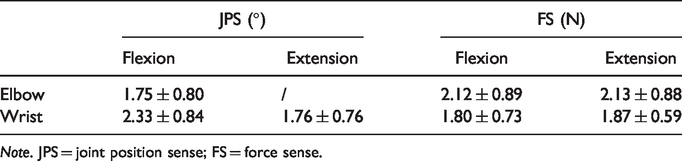
Note. JPS = joint position sense; FS = force sense.
Correlation for Performance in Throwing Task and Proprioception Test
Pearson correlation values are reported in Figures 4 and 5. For the correlation between slow movement AE, VE, and proprioceptive acuity at the elbow and wrist, all r values were ≥.37, p < .05. For AE of rapid movement, significant correlations were demonstrated only on the JPS (elbow; r = .45, p < .01) and FS (wrist; r = .36, p < .05); for VE, significant correlations were demonstrated only on the JPS (elbow; r = –.37, p < .05).
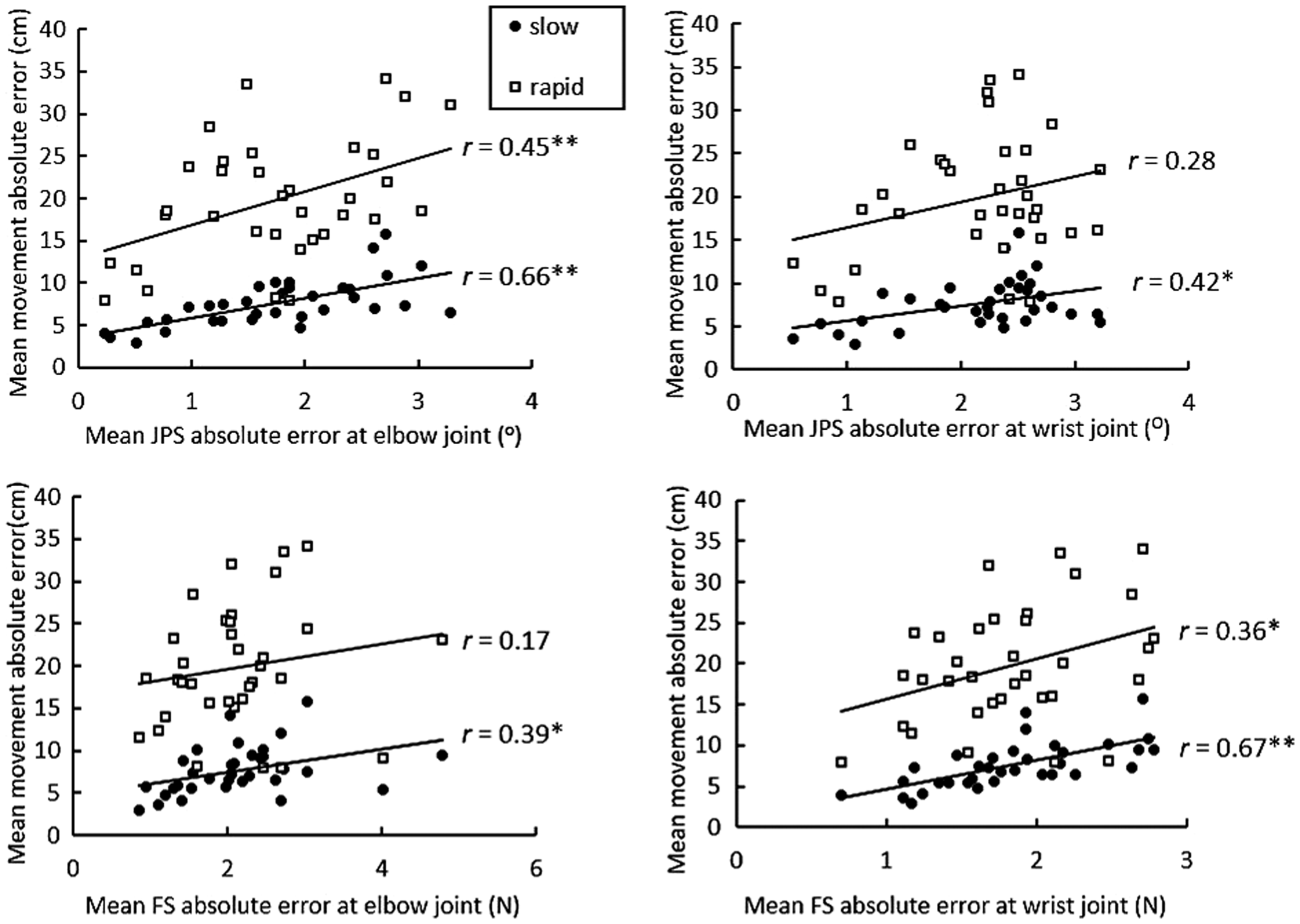
Correlation between the throwing absolute error and proprioceptive acuity (JPS and FS) at the elbow and wrist. *p < .05, **p < .01. JPS = joint position sense; FS = force sense.
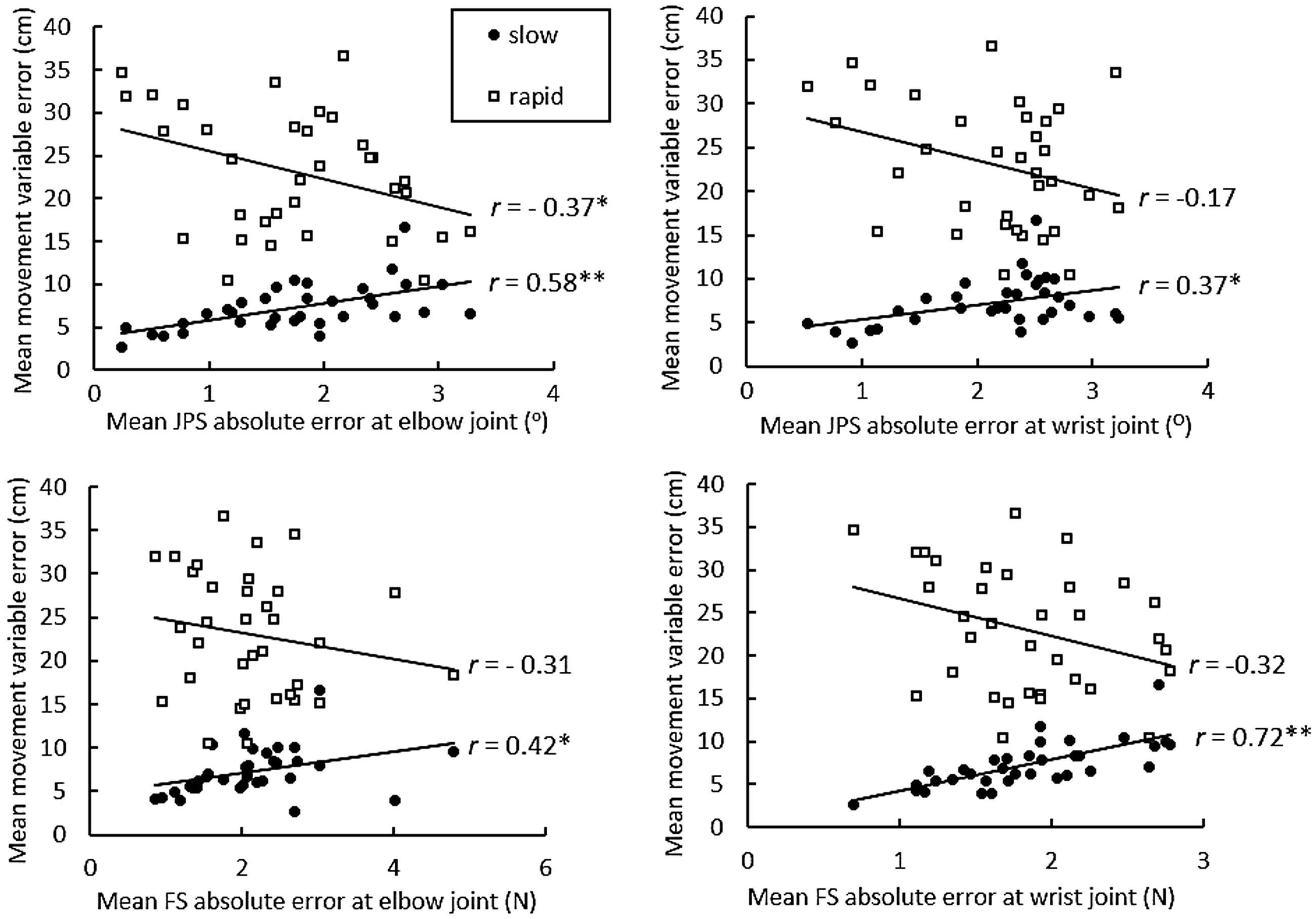
Correlation between the throwing variable error and proprioceptive acuity (JPS and FS) at the elbow and wrist. *p < .05, **p < .01. JPS = joint position sense; FS = force sense.
As shown in Table 2, stepwise multiple regression analysis showed that the combination of FS at the wrist (43%) and JPS at the elbow (10%) explained 52% of the variability of the slow movement accuracy (R2 adjusted = .52; p < .001), and FS (wrist) explained 50% (R2 adjusted = .50; p < .001) of slow movement stability. For rapid movement, JPS at the elbow explained 17% (R2 adjusted = .17; p = .008) of movement accuracy and 11% (R2 adjusted = .11; p = .033) of movement stability.
Summary of Stepwise Multiple Regression Analysis of Four Independent Variables Predicting Performance of Slow Movements and Rapid Movements.
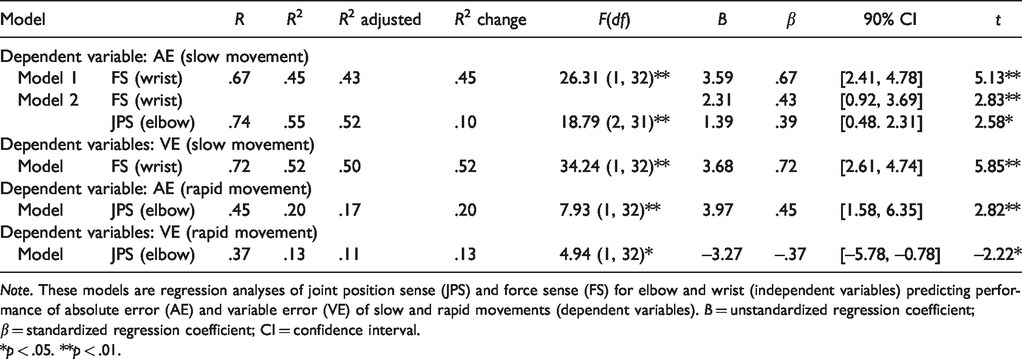
Note. These models are regression analyses of joint position sense (JPS) and force sense (FS) for elbow and wrist (independent variables) predicting performance of absolute error (AE) and variable error (VE) of slow and rapid movements (dependent variables). B = unstandardized regression coefficient; β = standardized regression coefficient; CI = confidence interval.
*p < .05. **p < .01.
Discussion
The aim of this study was to examine the effect of general proprioceptive feedback on relatively slower and more rapid movement performance. The results revealed a moderate correlation between relatively slow movement performance (AE and VE) and proprioceptive acuity measured both as JPS and FS at the elbow and wrist. In addition, proprioceptive acuity explained a significant proportion of the variance for relatively slow movement performance. For relatively rapid movements (Figures 4 and 5), we found a moderate correlation between movement performance (AE and VE) and JPS (elbow) and FS (wrist) but not for JPS (wrist) and FS (elbow). JPS and FS also accounted for some variance in relatively rapid movement performance, though this proprioceptive influence was less significant than with relatively slow movement.
With regard to our primary focus on the importance of proprioception in fast movement, our major finding was that proprioceptive acuity of JPS (elbow) accounted for 17% of the AEs and 11% of the VEs in our relatively faster movement condition. This finding suggested that proprioception is somewhat important in rapid movements but less vital than in relatively slower movements. This finding was consistent with previous studies showing the existence of automatic online modulation guided by proprioceptive inputs (Gosselin-Kessiby, Kalaska, & Messier, 2009). Other studies found that such proprioceptive correction begins at approximately 75 ms after the occurrence of errors (Cluff & Scott, 2015; Nashed, Crevecoeur, & Scott, 2014). This phenomenon could be explained by the hybrid model (combination of forward model and internal feedback loops), which allows for the modulation of fast movements by comparing actual state and predicted state based on copied motor commands so that errors could be corrected without large delays in feedback loops (Farrer, Franck, Paillard, & Jeannerod, 2003; Wolpert & Ghahramani, 2000). The present study not only provided evidence to support the hybrid model but also expanded the model to an examination of different proprioceptive contributions in fast movements. Overall, proprioceptive information was required to make corrections during rapid movements (Bagesteiro et al., 2006; Forget & Lamarre, 1987).
Our secondary purpose, to confirm the role of proprioception in relatively slow movements, was also achieved in that we found a relationship between relatively slow movement performance and JPS and FS at the wrist and elbow joints such that participants with more accurate JPS and FS performed better in movement tasks than those with less accurate JPS and FS. This finding is in line with our hypothesis and replicates previous studies that also showed the importance of proprioception in relatively slow movements, such as upper-limb motion tracking (Huysmans, Hoozemans, van der Beek, de Looze, & van Dieën, 2010) and walking slowly on a treadmill (Qaiser, Chisholm, & Lam, 2016). In addition, our regression analysis showed that FS (wrist) and JPS (elbow) combined accounted for 52% of the AEs of relatively slow movement performance, and FS (wrist) predicted 50% of relatively slow movement stability. This finding implies that having good proprioception at all involved joints is important in slow movements. Similarly, a previous study showed that training experience and proprioception of the ankle, shoulder, and spine accounted for 30% of variance in the competition level of elite athletes from five different sports (aerobic gymnastics, swimming, sports dancing, badminton, and soccer; Han, Waddington, Anson, & Adams, 2015). The high predictive capability of proprioception in our present study might be because our dependent variable was AE of movement tasks, which is directly related to JPS and FS, whereas the outcome variable in the study by Han and his coworkers (2015), competitive level, could be affected by many other factors. With regard to the higher predictive capability of FS (wrist; 43%) than JPS (elbow; 10%), previous studies have reported the important role of the distal joint, the wrist in our case, in compensating for variability caused by more proximal joints (Robins, Wheat, Irwin, & Bartlett, 2006; Sevrez & Bourdin, 2015). In accordance with the assumption of the sequential timing and the growing importance of proximal-to-distal segments of the upper limb in throwing movements (Marshall & Elliott, 2000; Wagner, Pfusterschmied, Von Duvillard, & Müller, 2012), we can assume that the wrist modulates force at the end of the sequence, whereas the elbow is responsible for direction control at the beginning of the chain.
It is important to note that proprioceptive acuity accounted for a much higher percentage of variance (52% vs. 17%) for slow movement accuracy than for that of fast movements on a descriptive level and also for movement stability. To the best of our knowledge, this is the first study to examine the different roles and contributions of proprioception in relatively slow and rapid movements. Nevertheless, results from neuroscience studies could be useful in interpreting our findings. Previous studies employing functional magnetic resonance imaging to examine differences in brain activation patterns between relatively slow and fast movements have suggested that slower movements required more feedback and regulation while faster movements required less feedback and more feedforward (e.g., Seidler, Noll, & Thiers, 2004). The finding that both FS (wrist; 43%) and JPS (elbow; 10%) could predict relatively slow movement accuracy while only one contributor (JPS [elbow; 17%]) could predict relatively rapid movement accuracy might be explained by the proximal-to-distal segmental sequencing (Marshall & Elliott, 2000; Wagner et al., 2012). In our study, the duration of the relatively slow movement task of 317 ms was enough time for proprioceptive feedback information from both the elbow and wrist to contribute to performance accuracy, allowing the more distal joint (wrist) to play a more important role. However, the shorter duration of the relatively rapid movement task of only 189 ms may have allowed proprioceptive feedback information from the elbow, the more proximal joint, to contribute to performance accuracy while not allowing as much of the more distal wrist-related proprioceptive feedback to contribute to performance. These findings imply that submodalities and joints are important mediating factors in the relationship between proprioception and slow and fast movement. Based on our findings, appropriate proprioceptive training may be useful in improving throwing athletes’ performance in sports such as baseball, softball, javelin, and basketball.
One limitation of the present study is that the participants were restricted to a seated condition when performing their throwing tasks. The purpose of this restriction was to reduce the influence of other factors such as trunk movements. However, future studies should employ alternative tasks that involve more joints and thus have more practical value. Also, we measured throwing error in terms of dart landing position, while future researchers might also record and analyze joint angles and speed at release. Another suggestion for future research is to employ shorter duration tasks. As previous studies demonstrated that the latency of proprioception-based online correction is approximately 75 ms (Cluff & Scott, 2015; Nashed et al., 2014) and we found proprioceptive feedback to help regulate fast movements in a task of 189 ms, future studies might employ movement tasks with durations of less than 189 ms, or even as short as 75 ms, to explore the role of proprioceptive feedback on even faster movements. Finally, we focused on the fundamental roles of proprioception in relatively slow and rapid movements and measured only general JPS and FS. Future studies might employ more specific proprioceptive measurement tailored to a specific motor skill to segregate the contributions of flexion and extension measures.
In conclusion, the present study provided evidence of the different roles and contributions of proprioception in both relatively slower and more rapid movements. Specifically, JPS and FS at both the elbow and wrist were important in relatively slow movements, whereas only JPS at the elbow was predictive of relatively rapid movement performance. Based on the different roles of proprioception in slow and rapid movements, corresponding aspects of proprioceptive training could play roles in improving movement performance, rehabilitating sports injuries, and daily actions.
