







Abstract
The present study aimed to determine the effect of mental fatigue (MF) on total training volume (TTV; number of repetitions x number of sets x load) and on ratings of perceived exertion (RPE; Borg, 1982) in the half-back squat exercise (HBSE). Nine male subjects (M age = 22.6 years, SD = 2.3; M height = 172.3 cm, SD = 6.8; M weight = 76.2 kg, SD = 9.8; M years of resistance training experience = 4.1, SD = 2.3 years) recruited from a university population were study participants in this participant-blind cross-over and randomized study. Participants underwent either the Stroop task – a highly demanding cognitive task (CT) – or a control condition (CON) in which they viewed a documentary exhibition for 30 minutes. Perception of MF and motivation were assessed after treatments using a visual analog scale of 100 mm. Participants then engaged in a countermovement jump (CMJ) test and three sets of HBSE until they reached momentary concentric failure, reporting RPE at the end of each exercise set. Following the CT, participants showed a significantly increased self-perception of MF in relation to the CON condition (p = 0.01; d = 1.2), but this did not affect their motivation to engage in subsequent tests (p = 0.99; d = 0.006). Neither the CMJ performances nor the RPE were statistically different between CT and CON conditions (p = 0.33; d = 0.09 and p = 0.20; η2 = 0.20, respectively). TTV was significantly lower in the CT relative to the CON experimental condition (Δ = −15.8%; p = 0.04; η2 = 0.48). Prolonged involvement in a CT was associated with reduced volume on a resistance exercise, though this effect was not associated with changes in CMJ performance or motivation to exercise.
Keywords
Introduction
Mental fatigue (MF) has been described as a psychobiological phenomenon resulting from prolonged engagement in high demanding cognitive tasks (CT), and it is characterized by increased self-reported tiredness or “lack of energy” (Marcora et al., 2009; Pageaux & Lepers, 2016) and reduced cognitive performance (Gantois et al., 2019). This acute fatigue has been mostly induced by periods of 30–90 minutes (min) of involvement in Stroop Task (ST) or Continuous Performance Test AX-version (AX-CPT) (Van Cutsem et al., 2017). This condition has been widely explored by exercise physiologists, since its establishment has had the capacity to degrade physical performance on endurance tasks (Marcora et al., 2009; Pageaux et al., 2013) and impair the accuracy of specific skills of soccer players (Gantois et al., 2019; Smith et al., 2016) and table tennis athletes (Le Mansec et al., 2018) and to impair the technical performance of basketball athletes (Moreira et al., 2018).
An early finding regarding the MF effect on physical performance was that prolonged CT involvement reduced the time to participants’ exhaustion by 15% on a cycle ergometer test to 80% of aerobic peak power (Marcora et al., 2009). Interestingly, impaired performance was not accompanied by any fatigue related physiological changes, but it was only associated with an increase in participants’ ratings of perceived exertion (RPE). Researchers have attributed the increase in RPE to an accumulation of extracellular adenosine in the anterior cingulate cortex (ACC) and the pre-frontal cortex (PFC) (Martin et al., 2018; Thompson et al., 2019). Therefore, the increase in RPE or perceived fatigue has been seen as the factor responsible for reduced endurance performance in MF conditions, leaving activities which only require short bursts of great strength [i.e., jumps, maximum voluntary contractions (MVC)] unaffected by MF (Martin et al., 2015; Pageaux et al., 2013).
Strength and power exercises lasting up to three minutes have not been affected by experimentally induced MF (Duncan et al., 2015; Martin et al., 2015; Smith et al., 2015). Exercise with this characteristic has not seemed to allow a distinction in the amount of effort required to perform the task and, therefore, has not implied a drop in performance to maintain the perceived exertion (Smith et al., 2015). On the other hand, prolonged involvement in CT (AX-CPT – 90 min) was able to reduce the time to failure in an isometric submaximal voluntary contraction (∼20% of MVC) (Pageaux et al., 2013), thus indicating a negative effect of MF on resistance-strength. Additionally, Dorris et al. (2012) found that ego depletion induced by previous involvement in CT attenuated the number of repetitions of push-ups and sit-ups (i.e. trunk flexion) with body weight. These findings provided evidence that resistance training (RT) sessions may be compromised by previous involvement in CT.
While knowledge about the effects of MF on physical performance has clearly grown in the last decade, there remains no evidence to date of the effect of MF on resistance exercise performance with weights, especially in terms of total training volume (TTV), which is the number of repetitions and number of sets multiplied by the load (kg) lifted in an exercise (American College of Sports Medicine, 2009). In recent years, TTV has been a predominant variable for influencing muscle hypertrophy. Schoenfeld et al. (2017) revealed a close relationship between weekly RT volume and muscle hypertrophy in adults. It is important to highlight that the type of stimulus applied in training sessions when TTV is equalized has not seemed to affect the magnitude of muscle hypertrophy (Schoenfeld et al., 2014). Moreover, muscle hypertrophy has been similar, regardless of the training method used, so long as TVV was equalized (Angleri et al., 2017).
Considering a heightened use of technological devices in the routines of most exercisers and a concomitant pursuit of muscle hypertrophy, research analyzing the effect on TTV of MF induced by high demanding CT has assumed a certain level of clinical relevance. Thus, our study aimed to verify the effect of MF on TTV and RPE associated with half-back squat exercise (HBSE). We hypothesized that CT induced MF would be associated with increased RPE and reduced TTV (a measure of physical endurance and therefore more sensitive to MF than measures of short bursts of muscle activity like jump tests) for adult participants engaged in RT.
Methods
Participants
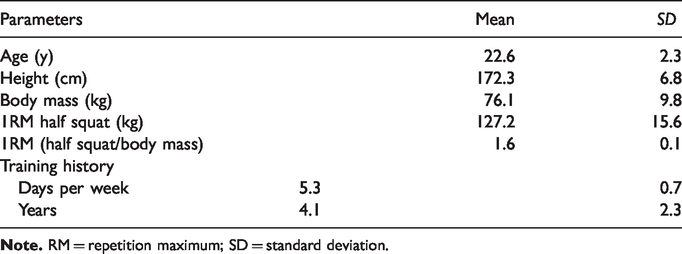
We recruited 10 healthy male college students with strength training experience for participation in this study. Their anthropometric characteristics are reported in Table 1. We estimated this sample size with an a priori power analysis using G*Power 3.1.9.2 (Dusseldorf, Germany) for which an effect size (ES) assumption of 1.05 was based on an earlier pilot study conducted with five participants. We determined the need for eight participants as a minimum sample size based on an alpha error of 5% and a β of 80% for our planned use of a Student’s t-test. Participant inclusion criteria were: (a) involvement in a RT program for more than 12 months (training frequency equal to or greater than three times a week) prior to the study; (b) able to present one repetition maximum (1RM) of HBSE with at least 130% of their body mass, not using any type of substance that could interfere with the results (i.e. dietary supplements, drugs); (c) having no osteomyoarticular lesions in the last 12 months that might impair performance on the proposed physical tests; and (d) presenting a negative result on the Physical Activity Readiness Questionnaire (PAR-Q, Canadian Society for Exercise Physiology). The PAR-Q consists of seven yes-no items (5 items related to the presence of cardiovascular problems; one item related to the presence of musculoskeletal problems; one item related to the presence of other diseases) that seek to assess the presence of any limitations for practicing physical activity (Shephard, 1988). One of the participants was excluded at the end of the study due to joint limitations that impaired their HBSE performance, leaving only nine participants who completed all of the research stages. All participants were informed of the study’s risks and benefits but were blind regarding the study hypothesis. In this context, all participants signed an informed consent form.
Participant Characteristics.
Experimental Design
This was a blind cross-over and randomized study on an acute effect of CT-induced MF in which we adopted an intervention wash-out between conditions of at least three days. The choice of a cross-over design was based on previous studies (Pageaux et al., 2013; Smith et al., 2015). Volunteers were always evaluated at the same time of day [9:00 to 12:00 (n = 5)/14:00 to 17:00 (n = 4)] to reduce possible climatic interference on three non-consecutive days, interspersed with a minimum wash-out of 72 hours and not exceeding seven days. We requested that participants avoid tasks that could generate MF in the three hours immediately preceding data collection, and compliance with this request was made possible by the fact that evaluations were carried out during a recess period of academic classes.
The volunteers were initially given the 1RM test for the HBSE, and were familiarized with the countermovement jump (CMJ), the psychometric scales used in the study, and the ST. In visits 2 and 3, participants engaged in the two conditions – CT and control video viewing (CON). Participants were assigned to treatment conditions through simple randomization (i.e. drawing pieces of paper from a plastic bag). We assessed participant motivation and MF level before the physical tests using a visual analog scale (VAS) [100 millimeters (mm)]. Then, the volunteers completed a warm-up on a cycle ergometer (five min in duration) and underwent the CMJ test. After two minutes they performed three maximum series (i.e. even concentric muscular failure) of HBSE at 70% of 1RM. The participants were asked to report the RPE for that task immediately after each set. Data collections were performed individually and lasted approximately 50 min. The participants were instructed to avoid any type of vigorous exercise that involved their lower limbs in the 48 hours prior to each test, to sleep at least seven hours and to exclude caffeine from their dietary routine in the 24 hours prior to each test. The step-by-step procedure within the experimental design is shown in Figure 1.
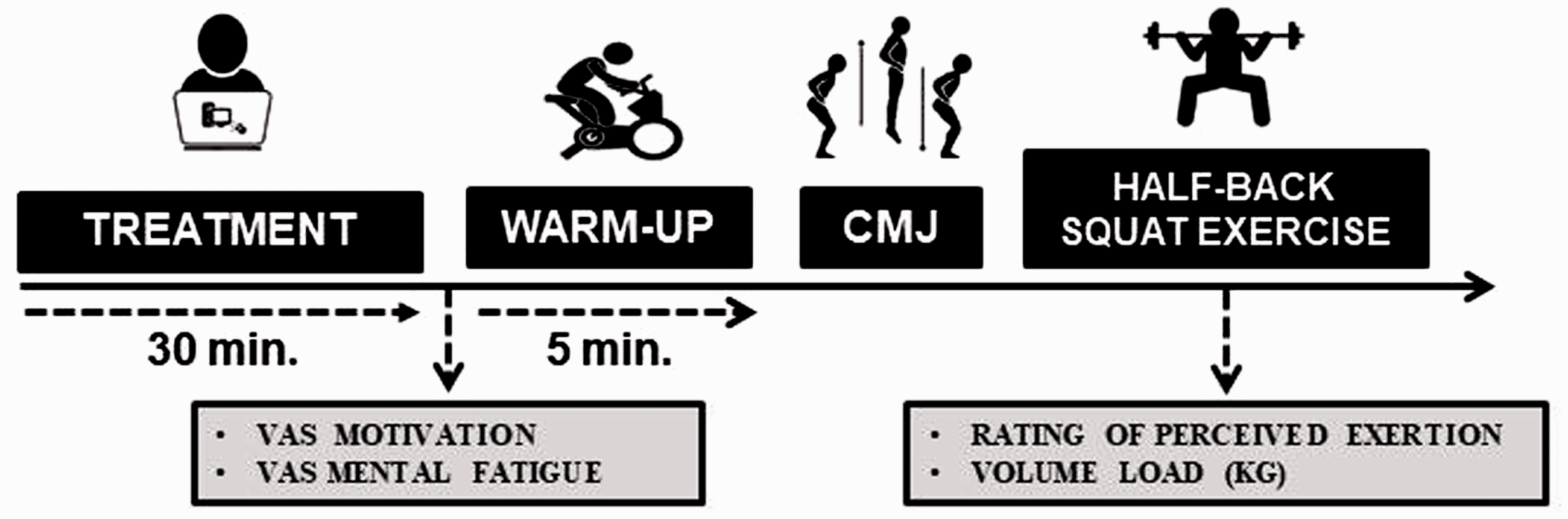
Delineation of the Experimental Sessions.
Maximum Dynamic Strength Test (1RM)
Participants performed the 1RM following guidelines from the American Society for Exercise Physiology (Brown & Weir 2001). The volunteers performed a specific warm-up consisting of 10 repetitions with a weight 60% of the estimate of 1RM after a general warm-up (RPE 6–20 = <10) performed on a cycle ergometer (Schwinn Quality®, Chicago, United States of America) with a duration of five minutes and a self-selected rhythm. After one minute, the volunteers performed 3–5 repetitions with a weight 80% of the 1RM estimate. Then after two minutes they performed their first attempt to determine the maximum load lifted in a single repetition with up to five attempts allowed, interspersed with five minutes of passive recovery. A single session was required to identify the 1RM values for all participants. We did not use a second session of the 1RM test, since a single session has provided reliable 1RM values for trained individuals (Ritti-Dias et al., 2011).
Resistance Exercise Sessions
The experimental sessions were initiated by a warm-up that simulated the warm-up used to measure 1RM. The participants performed three sets of HBSE exercises until they reached momentary concentric muscle failure (inability to perform the exercise correctly), with an intensity of 70% of 1RM (M = 88.8, SD = 10 kg) and a passive recovery interval of 120 seconds. The use of a 120-second inter-set interval has been recommended for RT programs that target muscle hypertrophy (Grgic et al., 2018). The range of motion allowed was 90° and was limited by an adjustment of the squat cage (Technogym®, Cesena, Italy) used in the tests. To calculate TTV from the number of repetitions performed, two independent evaluators and the authors of this manuscript counted them aloud. The volunteers were warned in all exercise series that they should conduct the exercise until they achieved fatigue. The tests were performed in the absence of verbal or musical stimuli.
Mental Fatigue and Control Treatment Conditions
As noted above, a computerized ST (Stroop,1935) continuum over 30 min was used as the cognitive task to induce MF in the CT condition following a procedure used in other studies (Badin et al., 2016; Filipas et al., 2019; Gantois et al., 2019; Smith et al., 2016). The ST consisted of three stages. In stage 1, blue, green, red and black rectangles appeared individually in the center of the monitor and the volunteer had to correctly point out the color presented by pressing the left (←) or right (→) arrow, as requested. In stage 2, visual stimuli and responses were presented in the format of names of colors painted in white. Both stages were congruent phases. In stage 3, visual stimulus was provided by words representing colors and painted with different colors (e.g., “red” word painted black). The options were the words painted in the colors they represented. Stage 3 was incongruent phase
The participants also watched the documentary “West African – Namibian Desert” for 30 min for the control (CON) condition, again using the 14’ inch monitor (Resolution: 1366 × 768 pixel) used in the CT condition. The participants reported low mental fatigue ratings [0-20 arbitrary units (A.U)] for this task. Participants were always in a calm environment with these conditions occurring at the same time of day for each participant, and all participants were supervised at all times by one of the researchers.
Countermovement Jump Performance
We assessed participants’ capacity for a short burst of muscle activity with the countermovement jump (CMJ) following participation in the two treatment conditions (CT and CON). We used the “My Jump 2” software application developed for the iOS computer operating system, as validated from the force platform which is the gold standard for this task (ICC = 0.997; p < 0.001) (Balsalobre-Fernández et al., 2015). Participants assumed an orthostatic position in front of the camera of an iPhone 6 s with iOS 13.3.1 (Apple Inc®, San Francisco, California), fixed their hands on their hips, crouched down to approximately 90° at the signal of the evaluator, and then jumped up as fast and as high as possible. The participant was instructed to keep their knees extended throughout the jump phase (Komi & Bosco, 1978). Each participant made two attempts interspersed with a 30-second passive recovery period, and we recorded the best performance for further analysis. All of these evaluations were performed by a single evaluator previously trained to operate the application.
Perceptual Assessments
We used a 100 mm VAS with two demarcated reference points at either end of the line (at 0 mm which represented “none” or no mental fatigue; and at 100 mm which represented “extremely” mentally fatigued) to separately measure both MF and motivation to engage in further exercise. Participants were instructed to draw a vertical line on the continuum at a point that best represented the sensation they were experiencing at that moment (Smith et al., 2016).
We used the Borg Scale (6-20) (Borg, 1982) to measure the RPE reported for each series. This scale showed sensitivity to detection of changes in the RPE in resistance exercise preceded by CT (Marcora et al., 2009). The participants were instructed to report the level of effort they experienced in performing the task immediately after each set. All participants were familiar with the instrument and were told that the answer they provided should express the total effort level and fatigue, and not pain sensations or muscle discomfort experienced during the task. All participants stated that they understood how to classify the RPE.
Statistical Analyses
We tested the normality of the data distribution through the Shapiro-wilk test and z-scores of asymmetry and kurtosis (–1.96 to +1.96). We verified data sphericity with the Mauchly’s test and used the Greenhouse-Geisser correction when the data sphericity was not confirmed. We used a two-way repeated measures ANOVA to analyze the condition effect (CT vs. CON) and assessment time (first exercise series, second exercise series and third exercise series) on TTV and RPE, and where significant, we followed up with Bonferroni’s post hoc testing. We calculated and presented partial eta2 (η2) as a measure of ES. We used the Student’s t-test for paired samples to analyze a time effect for TTV, CMJ, motivation level and MF level under the tested conditions. We classified ES according to Cohen’s d [small ES = 0.2; medium ES = 0.4; large ES = 0.8 (Cohen, 1988)]. We used a significance level of p < 0.05 for all analyses. Data are reported as means (M) and standard deviations (SD) or median and interquartile range (IR), according to the distribution presented. We relied on the IBM Statistical Package for the Social Sciences® (Chicago, United States of America), version 20.0 software program for these analyses.
Results
Perceptual Measures
The perception of MF was significantly higher after the CT condition, compared to the congrol condition (t(8) = –3.32; Mdiff = −23.3; p = 0.01; d = 1.2; CI95% = –39.5 to −7.1). On the other hand, the motivation to perform a subsequent exercise series was no different between the CON and CT conditions (t(8) = 0.01; Mdiff = 0.12; p = 0.99; d = 0.006; CI95% = –22.8 to 22.0; see Figure 2).
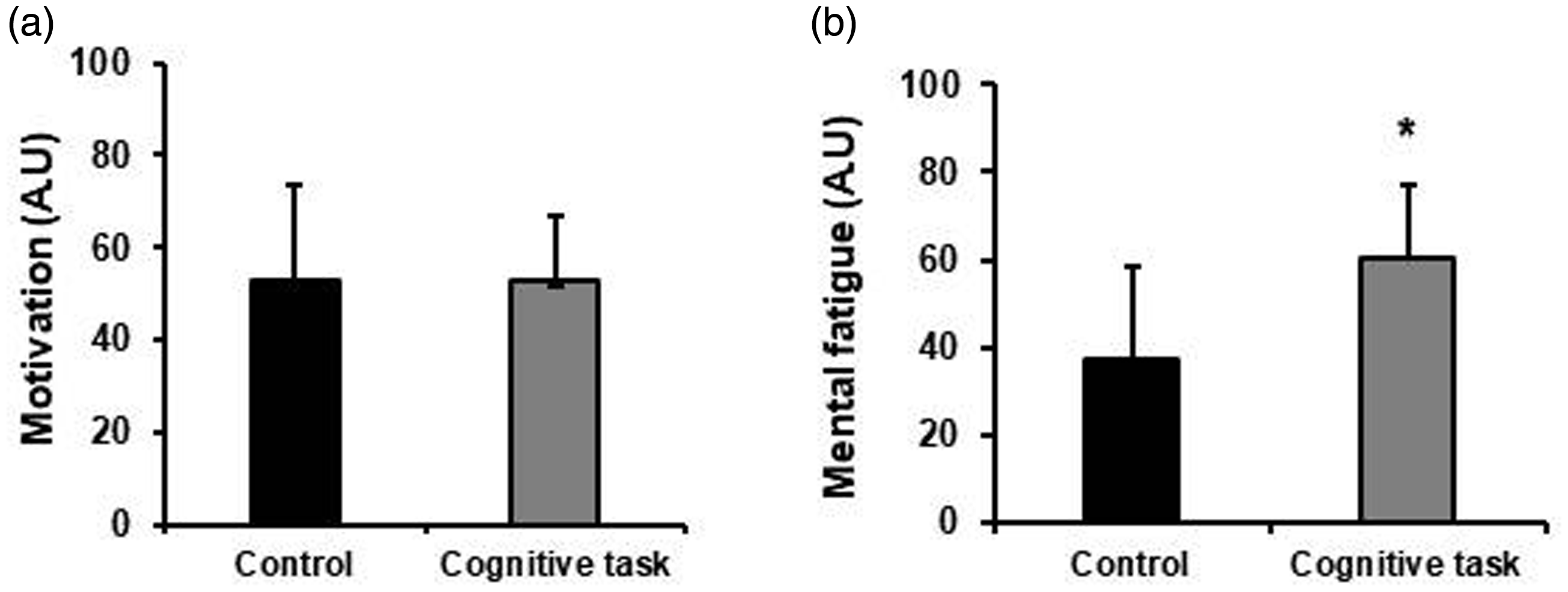
Effect of the CT. (a) Motivation for subsequent physical tests and (b) perception of MF.
Rating of Perceived Exertion
Regarding RPE (Figure 3), there was no significant interaction between conditions and time (F(2,16) = 1.53; p = 0.25; η2 = 0.16). Similarly, there was no significant main effect for condition (F(1,8) = 2.00; p = 0.20; η2 = 0.20). However, there was a significant main effect for time (F(1,083,8,676) = 29.63; p ≤ 0.001; η2 = 0.78).
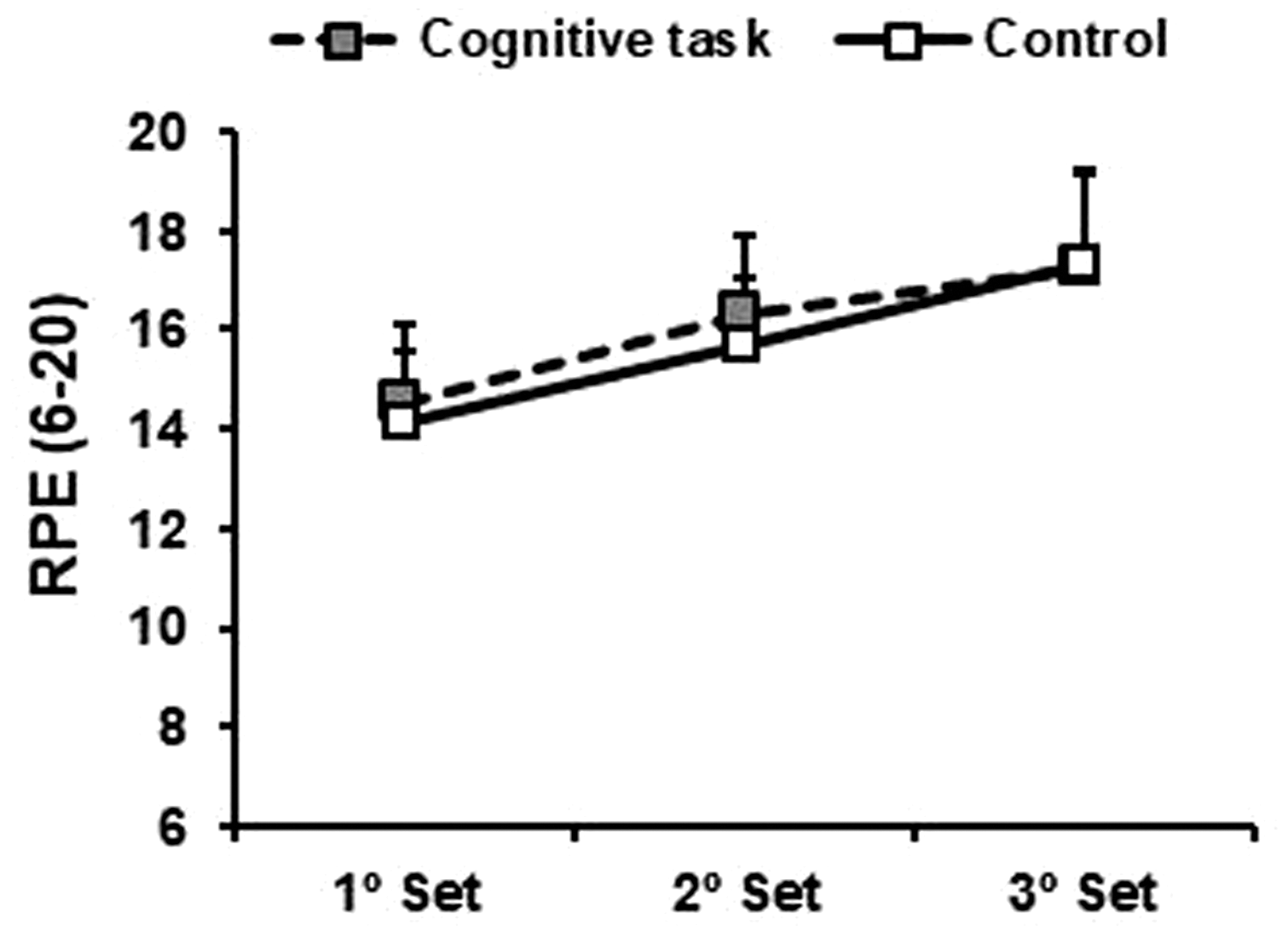
Effect of the CT on RPE.
Countermovement Vertical Jump
The participants’ performance on the CMJ was not statistically different between CT and CON conditions (t(8) = 1.02; Mdiff = 0.8; p = 0.33; d = 0.09; CI95% = -1.0 to 2.7; see Figure 4).
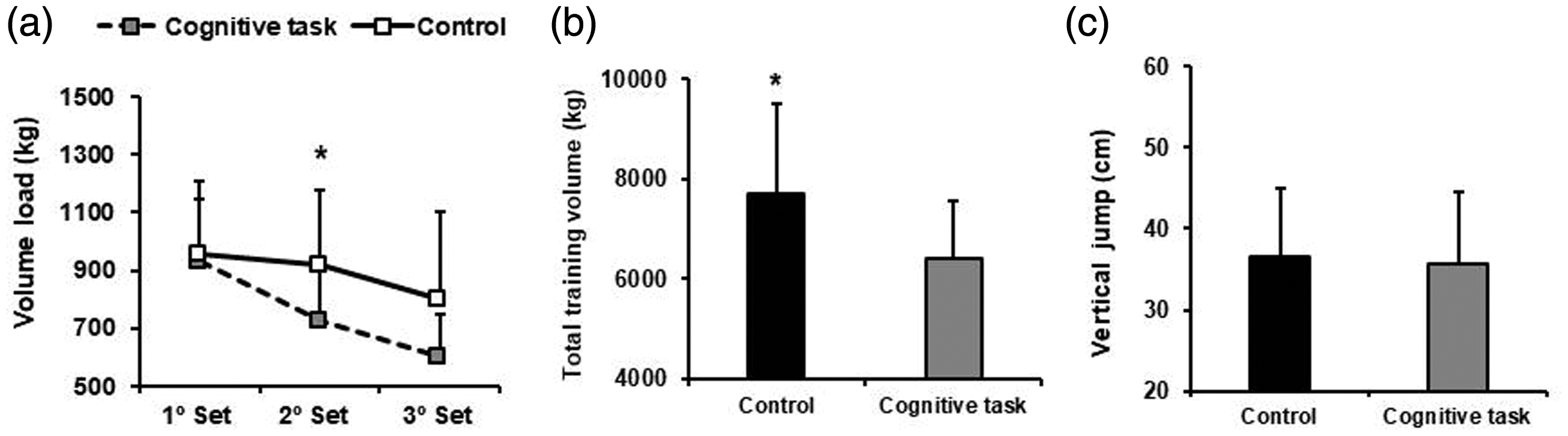
Effect of the CT on (a and b) TTV and (c) CMJ performance.
Total Training Volume
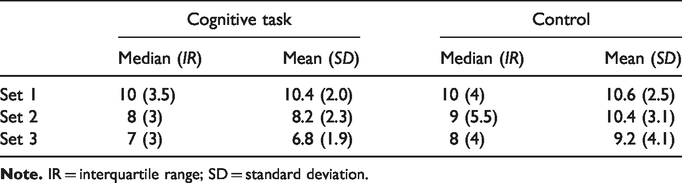
We identified a significant interaction between condition and time for TTV (F(2,16) = 3.67; p = 0.05; η2 = 0.31). We also identified a condition effect (F(1,8) = 5.73; p = 0.04; η2 = 0.42), such that a significantly lower TTV occurred in the second set of repetitions (F(1,8) = 8.42; Mdiff = 194.7; p = 0.02; η2 = 0.51; CI95% = 39.9 to 349.5) following the CT condition. We identified no significant differences for the first set (F(1,8) = 8.42; Mdiff = 17.7; p = 0.75; η2 = 0.01; CI95% = –105.5 to 141.1) or third set (F(1,8) = 4.76; Mdiff = 196.1; p = 0.06; η2 = 0.37; CI95% = –11.2 to 403.4). We identified a time effect (F(2,16) = 6.30; p = 0.01; η2 = 0.44). There was a significant main effect for condition in that TTV was higher in the CON than in the CT condition (t(8) = 2.39; Mdiff = 1225.8; p = 0.04; d = 0.8; CI95% = 44.9 to 2406.6) (Figure 4). Descriptive statistics for the number of repetitions are reported in Table 2.
Volume of Repetitions Reported Under the Conditions Tested.
Discussion
Our study aimed to determine the effect of a CT-induced MF state on total training volume or (TTV) and RPE within half back squat exercise (HBSE), a resistance exercise series. We hypothesized that participants experiencing MF would reduce their TTV and report increased RPE. Our data supported this hypothesis, as participants showed a ∼15.8% reduction in TTV following the CT condition, and they reported greater MF in this condition, as expected. There was no difference in participants’ TTV between the first series (3.1%; p = 0.74) and the third series (i.e., –28.5%; p = 0.06), but there was a decrease in TTV during the second series (i.e. –26.8%; p = 0.02). There was no statistical difference between experimental conditions for CMJ and RPE presented at the end of each set of repetitions.
The ST with a duration of 30 minutes was used to induce MF in our participants. We found higher classifications of MF after the ST (∼ 23 A.U; p = 0.01), thus indicating the more demanding nature of this task in relation to the control (CON) condition. These findings are consistent with the results presented by Pageaux et al. (2015). These authors found that higher classifications of mental effort and heart rate were reported after 30 minutes of ST when compared to a control condition. Additionally, Gantois et al. (2019) identified a decline in cognitive performance (i.e., MF marker) after 30 minutes of ST, but not after 15 minutes of a control task. Together, these data support the effectiveness of performing ST as a way to experimentally induce MF, especially after 30 minutes of the task.
The relationship of experimentally-induced MF and decreased physical performance is well documented in the scientific literature (Marcora et al., 2009; Pageaux et al., 2013; Smith et al., 2015, 2016). In previous research, involvement in CT reduced the time until exhaustion of a submaximal isometric contraction (∼20% of MVC) of the knee extensor (Pageaux et al., 2013) and of a cycling activity at 80% peak power (Marcora et al., 2009), while vertical jumping performance was not affected (Martin et al., 2015). Our results are in line with current research in that we found no significant differences in the performance of the CMJ test reported in the CON and CT condition (∼ 2.4%; p = 0.334). This finding can be justified by the fact that MF is not capable of affecting the muscle recruitment capacity of the central nervous system (CNS) or altering the contractile properties of the exercised muscle (Pageaux et al., 2013; Pageaux et al., 2015), or physiological aspects related to the performance of short duration and high intensity exercises (Weavil & Amann, 2019).
Martin et al. (2015) failed to show any CT effect on cycling exercise performance with maximum short-term effort (i.e., three min). In our study, we observed a similar behavior in the first and third sets of HBSE. In contrast, we found the training volume to be significantly lower in the second set. High intensity short-term exercise does not allow the subject to differentiate the amount of effort required to complete the task (Smith et al., 2015). However, the intention to carry out the exercise of longer duration can be modulated within the exercise itself to avoid increasing the RPE. In the present study, participants with weight training (>1 year) performed all sets up to concentric failure. We hypothesized that the participants programmed a reduction in training volume in the second set due to a previous maximum stimulus and in preparation for completing the next set. In summary, the volunteers reduced their training volume in order to adjust their effort and end the proposed session.
It was previously proposed that the negative effects of MF on physical performance might be explained by the theory of intentional motivation (Martin et al., 2018). According to the psychobiological model, the performance of resistance tasks is regulated by motivation and RPE. As shown in the current study and in previous studies on the subject (Brownsberger et al., 2013; Marcora et al., 2009; Smith et al., 2015), motivation does not seem to be altered due to MF, therefore it is likely that the drop in performance observed in our study is related to RPE.
RPE has been found to increase as a linear function of the number of repetitions during heavy-resistance exercise (Hackett et al., 2017). Thus, a single participant should perform a similar number of repetitions at the same level of effort. However, we did not observe similar effort levels for the CON and CT condition, despite a significantly lower TVV (∼15.8%; p = 0.044) in the CT condition. Therefore, the relationship between RPE and the amount of work performed seems to have been increased (i.e. a lesser amount of work was performed for the same RPE), indicating that RPE may have been greater in the CT condition. No direct comparison to prior research is currently possible, due to the lack of studies on MF and muscular resistance during resistance exercises. However, other studies have identified a drop in physical performance with similar RPE between experimental and control conditions (Filipas et al., 2019; Smith et al., 2015).
Limitations and Directions for Further Research
Our study has some limitations which need to be highlighted: (a) Our results are specific to young men with experience in strength training and cannot be extrapolated to other populations; (b) Although the ST is capable of inducing mental fatigue, this type of task does not reflect real conditions inherent in the routines of individuals who attend weight rooms (ecological validity), meaning that there is a need for new studies that analyze the effect of prolonged use of social networks and/or involvement in electronic games on the performance of resistance exercises; (c) we adopted only one resistance exercise, reducing our study’s ecological validity since strength training practitioners perform at least four exercises per session. Future researchers should address all of these limitations.
Practical Applications
The TTV has been presented as one of the main determinants of the muscle hypertrophy process. In this sense, factors that might detract from the use of this variable should be studied. Accordingly, we demonstrated that prolonged involvement in a mentally stressful task reduced TTV and found that the MF state does not reduce the motivation to exercise among experienced practitioners. From these data, we can affirm the importance of avoiding involvement in mentally stressful tasks (i.e. the prolonged use of smartphones and electronic games) before training sessions with muscular hypertrophy objectives, since these tasks can negatively interfere with exercise performance yield.
