







Abstract
Cooperative learning is a pedagogical framework extensively used in educational contexts worldwide, but some scholars warn that we do not know much about how its claimed outcomes are delivered. The aim of this study was to uncover the connections between cooperative learning contexts and students’ task and self-approach goals in physical education. We hypothesized that those students who perceived a stronger cooperative learning context in their classes would also show higher task and self-approach goals. A total of 1328 students (648 females and 680 males) from three different educational stages: primary education (n = 584), secondary education (n = 550) and baccalaureate (n = 194), agreed to participate. Participants’ ages ranged between 10 and 20 years (M = 13.11; SD = 2.45). An ex-post-facto, cross-sectional research design was followed. Results showed a direct and significant connection between high-perceived cooperative learning contexts and high students’ task and self-approach goals. The odds ratio tests verified this positive association, indicating a 4-times greater probability for students who perceived a strong cooperative learning context in the classroom of having high task and self-approach goals. In the same line, we observed that, as the perception of a cooperative learning context increased, task and self-approach goals also increased. This means that a small change in the class context to make it more cooperative had an impact on the students’ achievement goals. Teachers should try to create class contexts where students perceive a strong cooperative learning climate, because it has been connected to adaptive motivational patterns, task and self-approach goals, and these are associated with positive outcomes.
Introduction
One of the most important and difficult tasks of any physical education teacher is the selection of the pedagogical approach to be used. Over the last two decades, physical education and sport pedagogy have evolved enormously from traditional, teacher-centred approaches to novel, student-centred frameworks that place students in the center stage of the teaching-learning process (Casey, 2014; Metzler, 2011). One of these highly recognized student-centred pedagogical models is cooperative learning, in which students interact to learn (Johnson et al., 2013).
Cooperative learning is a pedagogical model based on small, heterogeneous work groups in which students learn with, by and for other students, sharing efforts and resources to maximize their own and their classmates' learning (Metzler, 2017). In this active context, students and teachers act as co-learners (Casey, 2012). Scholars and researchers agree that its framework is based around five critical elements (Dyson & Casey 2016; Johnson & Johnson, 1994): (a) interpersonal skills: students communicate effectively, respecting and encouraging each other, (b) group processing: members discuss and reflect on their performance to improve the group’s functioning, (c) positive interdependence: students depend on each other to reach the objectives set, (d) promotive interaction: students work together to support each other during the tasks, and (e) individual accountability: each group member must be responsible for a part of the group’s work. Two other elements have also been considered important (Kagan, 1992): (f) equal participation: all group members have similar, active participation in the class, and (g) simultaneous interaction: all students are engaged and involved in the different tasks. Several meta-analyses have highlighted the successful implementation of cooperative learning in different education contexts all over the world (Capar & Tarim, 2015; Johnson et al., 2014; Slavin, 2013; Slavin et al., 2014). In physical education, Bores-García et al. (2020) found benefits in students’ motor (Darnis & Lafont, 2015; O’Leary et al., 2015), social (Fernandez-Río et al., 2017; Sánchez-Hernández et al., 2018; Wallhead & Dyson, 2017), physical (Altinkok, 2017; Lee, 2014), cognitive (Dyson et al., 2016; Gorucu, 2016) and affective learning (Goodyear et al., 2014). Therefore, there are multiple empirical demonstrations of the effectiveness of cooperative learning to improve students’ performance in the four learning domains: physical, cognitive, social and affective (Casey & Goodyear, 2015). Nevertheless, in a recent review, Dyson et al. (2020) warned that we do not know much about how the claimed outcomes of cooperative learning are delivered. Therefore, more research is needed to clarify the connections between this framework and other variables that could explain how it works.
Grounded in self-determination theory (Deci & Ryan, 2000; Ryan & Deci, 2017), the relationship between cooperative learning and motivation has been well documented (Fernandez-Río et al., 2017; Ntoumanis, 2001). Yet, no studies have connected this pedagogical model with the other leading framework used to examine students' motivational processes: achievement goal theory (Nicholls, 1989). Achievement goal theory, is a socio-cognitive theory based on the expectations and values that individuals place on different goals to demonstrate competence or ability (Ames, 1992). It assesses the type of competence-based goals that individuals pursue when performing an activity (Elliot, 1999). At first, only two goals were identified (Ames, 1992): mastery goals: develop competence focusing on the task from an intrapersonal point of view, and performance goals: show competence focusing on others from an interpersonal point of view. This dichotomous model evolved into a tricotomous one (Elliot & Harackiewicz, 1996), when performance goals were divided based on the valence individuals pose on their actions, approach (to be positive in order to succeed) and avoidance (to avoid failure), giving birth to three goals: (a) mastery: focused on improving and mastering the task; (b) performance-approach: aimed at achieving competence compared to others; and (c) performance-avoidance: focused on avoiding incompetence compared to others (Elliot & Church, 1997). Later, mastery goals were also divided in two: mastery-approach: aimed at achieving competence focusing on the task and mastery-avoidance: focused on avoiding incompetence performing the task; thus, emerging the 2 × 2 model (Elliot & McGregor, 2001). Finally, Elliot et al. (2011) uncovered mastery goals that corresponded to two differentiated standards (task and oneself). Task-based goals take the task itself as an evaluation reference, while self-based goals take the person as a reference (intrapersonal). In addition, performance goals were renamed to other-based: using other individuals or a norm (interpersonal or normative) as a reference for evaluation (Murayama et al., 2012). Therefore, the 3 × 2 achievement goal framework was developed, that included three standards to define competence (task, self, other) and the two existing valences (approach and avoidance) (Elliot et al., 2011). This framework differentiates the current six achievement goals into: (a) task-approach goals: focus on achieving competence on the task (i.e., “performing a task correctly”); (b) task-avoidance goals: focus on avoiding incompetence on the task (i.e., “performing better than before”); (c) self-approach goals: focus on achieving competence based on oneself (i.e., “performing better than before”); (d) self-avoidance goals: focus on avoiding incompetence based on oneself (i.e., “avoiding performing worse than before”); (e) other-approach goals: focus on achieving competence based on others (i.e., “performing better than others”); and (f) other-avoidance goals: focus on avoiding incompetence based on others (i.e., “avoiding performing worse than others”). A few years ago, Elliot (2005) warned that mastery-approach goals could promote adaptive results and achievement processes, while mastery-avoidance goals were related to less adaptive patterns. In the same line, Elliot et al. (2011) clarified that approach goals, in general, produce more adaptive responses than avoidance goals. Liu et al. (2017, p. 294) pointed in the same direction: “goals aimed at mastering knowledge and developing self-competence lead to favourable consequences. If goals orient people to compete against others or avoid normative failure, consequences can be detrimental”. Task and self-approach goals have been connected to students’ intrinsic motivation (Elliot et al., 2011) and task-oriented classroom climates have been found to promote the most self-determined types of motivation (García-González et al., 2019). In physical education, recent research indicated that task and self-approach goals generate adaptive responses, including self-determined motivation and life satisfaction (Méndez-Giménez et al., 2017; Méndez-Giménez et al., 2018).
As previously noted, in cooperative learning contexts students perform tasks in small, heterogeneous groups to maximize their own learning and that of their peers, achieving the set goals with no need to outperform others (Casey, 2012; Johnson et al., 2013). Therefore, it could be said that this pedagogical model could generate learning climates in which no comparisons are made between students, where the focus is on the task, and the goal is to master it, both as a group and individually. Therefore, it could be said that when implementing this pedagogical approach, task and self-approach goals are being promoted. Research has shown that the most adaptive goal, and therefore the one that should be promoted in physical education, is the task-approach goal (Méndez-Giménez et al., 2014). Cooperative learning contexts have been found to promote students’ intrinsic motivation (Ning & Hornby, 2014; Tombak & Altun, 2016), but the connections between these and the students’ achievement goals remain uncovered.
To our knowledge, no previous research has assessed the possible links between cooperative learning contexts and the 3 × 2 achievement goals framework. In order to fill this gap, and considering the ideas presented earlier, this study aimed at uncovering the connections between cooperative learning contexts and students’ task and self-approach goals in physical education. Based on the essential elements of this pedagogical model and on the achievement goals theory framework, we hypothesized that those students who perceived a stronger cooperative learning context in their class would also show higher task and self-approach goals.
Methods
Participants
This study was conducted thanks to the voluntary participation of twelve randomly selected public schools in western Spain. A total of 1328 students (648 females and 680 males) from three different educational stages: primary education (n = 584), secondary education (n = 550) and baccalaureate (n = 194), agreed to participate. Participants’ ages ranged between 10 and 20 years (M = 13.11; SD = 2.45). The original sample consisted of 1422 students but 94 were excluded because they returned blank questionnaires. All the schools were located in urban areas with families with a medium-low socioeconomic level. An ex-post-facto, cross-sectional research design was followed (Cohen et al., 2011).
Instruments
Procedure
Prior to data collection, the Bioethics and Biosafety Committee of the University approved the study. Only then, the research team contacted all the schools in the region to explain the project and its objectives, and thus obtain the corresponding permission to conduct the study. In the schools that agreed to participate, the parents and/or legal guardians were contacted and informed, and those willing to let their children participate signed an informed written consent. All through the process, the ethical principles governing research with human beings were respected (World Medical Association Declaration of Helsinki, 2013). The administration of the questionnaires was conducted by the research team in a quiet classroom to avoid distractions. The participating students were informed that it was completely voluntary, and that their responses would not affect their grades. They were asked to be totally honest and they were also informed that they could leave the study at any time. All collected data was treated confidentially and anonymously as dictated by the American Psychological Association (2010).
Data Analysis
The entire data analysis process was conducted with the SPSS statistical program (v.21). First, the Kolmogorov–Smirnov test was used to confirm that the variables under study were normally distributed, thus supporting the use of parametric tests. Then, Student’s t-tests were conducted to asses differences based on gender. Bivariate correlations were performed to uncover associations among the different variables. Odds Ratio (OR) tests were conducted to estimate the connections between cooperative learning and the two approach goals. Finally, analyses of variance (ANOVA) tests were used to compare task and self-approach goals with three levels of cooperative learning (high, medium and low).
Results
First, the Student’s t-test showed that there were no significant differences based on gender on any of the variables under study: global cooperation factor (F = 1.612, ρ = .204), task-approach goals (F = 1.776, ρ = .183) and self-approach goals (F = .529, ρ = .467). Therefore, in the following analyses, the data was jointly analysed.
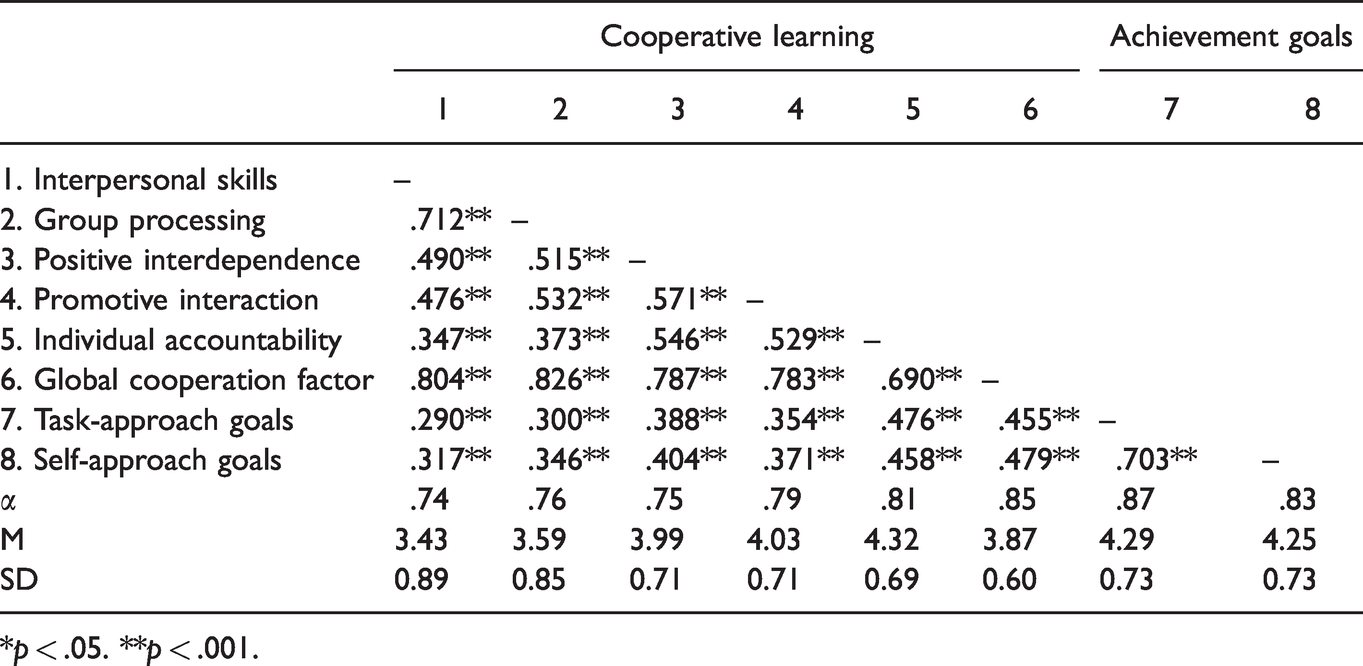
Table 1 shows internal reliability coefficients, descriptive statistics and bivariate correlations among variables. Regarding descriptive statistics, we observed that individual accountability showed the highest scores of all cooperative learning variables, while both achievement goals showed similar scores. Finally, the strongest correlations were found between both goals and individual accountability and the global cooperation factor.
Cronbach’ Alphas, Means, Standard Deviations, and Bivariate Correlations.
*p < .05. **p < .001.
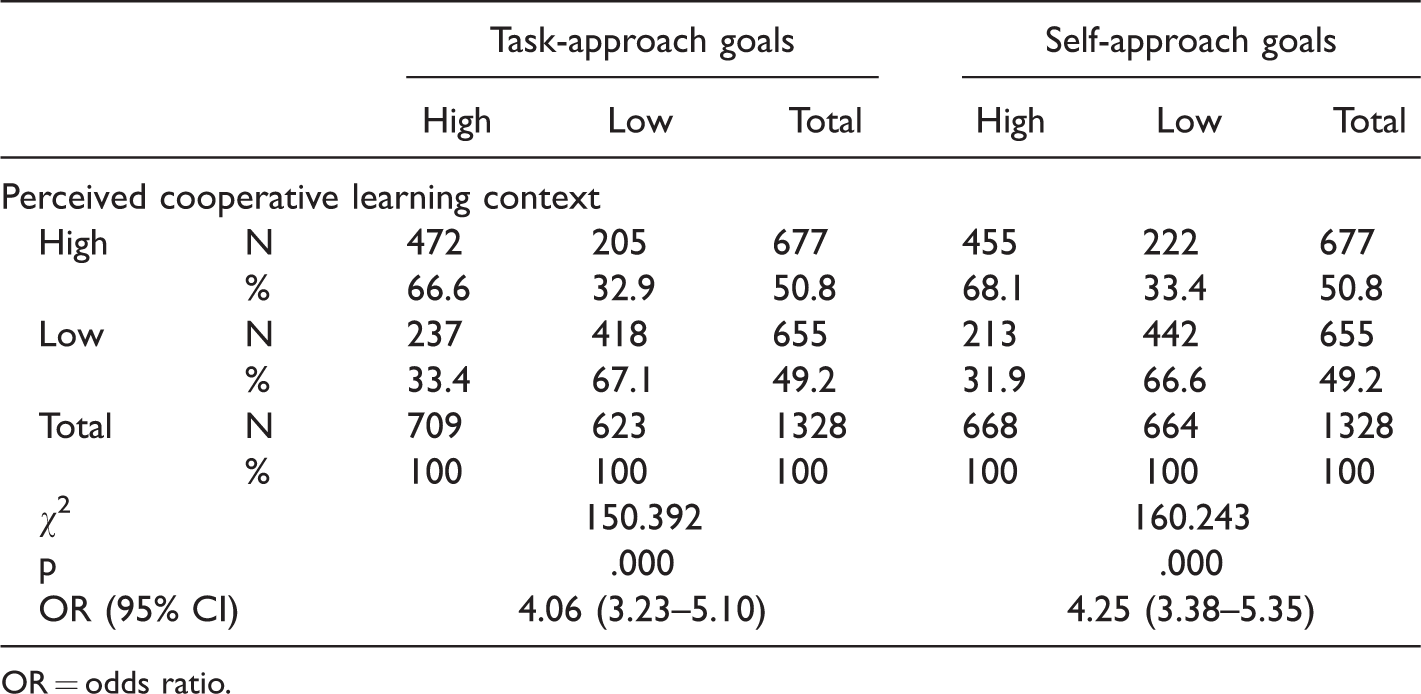
With the aim of examining the associations between classrooms’ perceived cooperative learning and each student achievement goal, the odds ratio (OR) was calculated. The global factor of cooperation (independent variable) and both achievement goals (dependent variables) were dichotomized using the 50th percentile criterion as a cut-point (high, low). Recounts of the number of classified subjects, the percentage distribution of the resulting sample and the OR values obtained are shown in Table 2. A probability analysis was conducted, using the contrast between the participants belonging to the high-perceived cooperative learning context group and those of the low group as a reference, to estimate the risk of occurrence (prognosis) of showing high task-approach or self-approach goals. Participants belonging to the high-perceived cooperative learning context group showed a positive and significant association (χ2 =150.392, p < .001) with high task-approach goals (OR = 4.06, 95% IC = 3.23–5.10). In the same line, a positive and significant association was also found (χ2 = 160.243, p <.001) with self-approach goals (OR = 4.25, 95% IC = 3.38–5.35). Both relationships showed a median effect magnitude, according to the equivalence established with Cohen's d (Chen et al., 2010). Therefore, students belonging to the high-perceived cooperative learning context group had 4.06 times higher probability of having high task-approach goals and 4.25 times higher probability of having high self-approach goals, compared to those included in the low-perceived cooperative learning context group.
Participants, Distribution and OR.
OR = odds ratio.
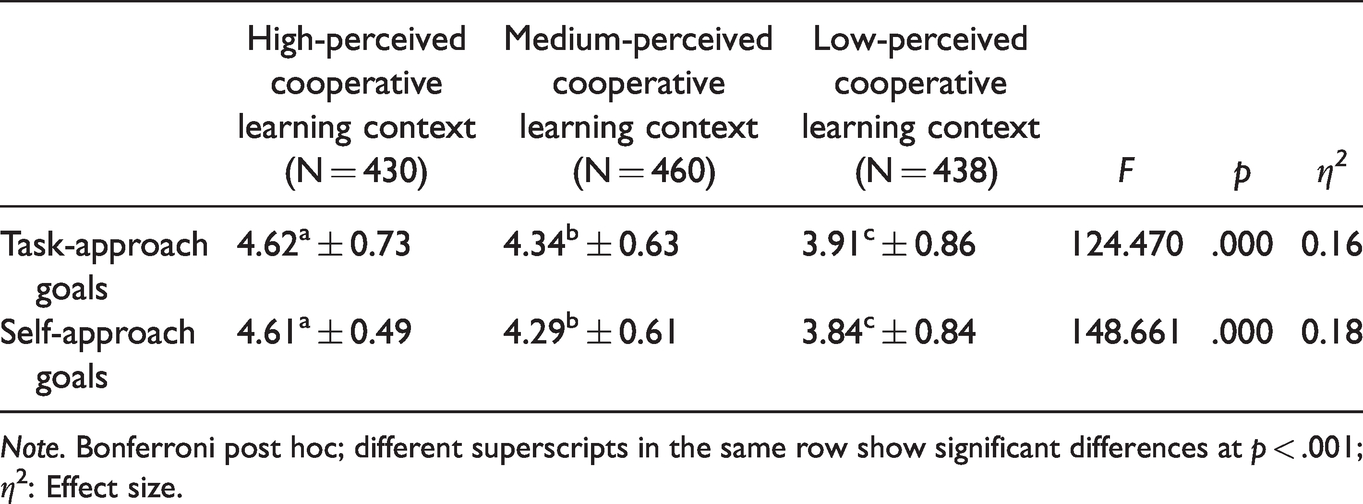
Finally, to deepen an understanding of the connections found between cooperative learning contexts and the two achievement goals, an ANOVA test was conducted with the different types of cooperative learning contexts. Three groups (high, medium, low) were obtained, using the 33rd percentile criterion as cut points. Significant differences were found between all the groups with large effect sizes (Table 3). Both task-approach goals and self-approach goals produced similar scores in each type of cooperation learning context, with the highest scores in the high-perceived group and the lowest in low-perceived group. These results showed a direct and clear relationship between cooperative learning contexts and task and self-approach goals.
Task and Self-Approach Goals and Perceived Cooperative Learning Context.
Note. Bonferroni post hoc; different superscripts in the same row show significant differences at p < .001; η2: Effect size.
Discussion
This study aimed to uncover the connections between cooperative learning contexts and students’ task and self-approach goals in physical education. Our results showed a direct and significant connection between high-perceived cooperative learning contexts and high students’ task and self-approach goals.
The initial hypothesis was that those students who perceived a stronger cooperative learning context in their classes would also show higher task and self-approach goals, and our results confirmed it. The OR tests verified this positive association, indicating a 4-times greater probability for students who perceived a strong cooperative learning context in the classroom to have high task and self-approach goals. Similarly, we observed that, as the perception of a cooperative learning context increased, task and self-approach goals also increased. This means that a small change in the class context to make it more cooperative had an impact on the students’ achievement goals. Therefore, any methodological step in the right direction is good for the students, and it should be supported. To our knowledge, this is the first study to assess the connections between cooperative learning and achievement goals. Previous research indicated a possible connection between cooperative learning and task-approach goals (Méndez-Giménez et al., 2017), focusing on achieving competence in the task (“performing a task correctly”; Elliot et al., 2011) and results from the present study confirmed it. In cooperative learning contexts, students perform tasks in small, heterogeneous groups to maximize their own and their partners’ learning, with no comparison or outperforming other students (Casey, 2012; Johnson et al., 2013). Therefore, this pedagogical model could generate learning climates where others’ performance (outside the working group) is not important, where the focus is on the task, and the goal is to master it, both as a group and individually, promoting task and self-approach goals. Results from the present study support these connections.
On the other hand, our results also showed that individual accountability was cooperative learning’s essential element (Johnson & Johnson, 1994), since this element showed the highest positive cooperative learning and encouraged students to concentrate on their part of the group’s task; that is to say: to achieve competence based on oneself (“performing better than before”; Elliot et al., 2011). In properly co-regulated (Salonen et al., 2005) and highly structured cooperative learning contexts (Cecchini et al., 2020), each group member is held responsible for one part of the group’s work, so they should focus on “performing better than before” (self-approach) so as not to harm the group’s final outcome. The high self-approach goals’ scores found in this study, connected to the high-perceived cooperative learning contexts, and the fact that individual accountability was the strongest correlated element all seem to support the path outlined.
In addition to the novel nature of the research, being the first one to assess the connections between both frameworks, it has more strengths. The large size of the sample used gives the study great statistical power (Sassenberg & Ditrich, 2019). The data was collected using specific, internationally validated instruments capable of assessing, one the five essential elements of cooperative learning, and the other task and self-approach goals. Both instruments give the study greater validity. However, this study also has some limitations that should be improved in future research. Its cross-sectional design prevents cause-effect inferences from the significant relationships found in this study. All the participating students lived in the same region, and had similar characteristics. Future studies should be conducted in samples with individuals from different backgrounds (economic, ethnic).
Conclusions
Teachers should try to create class contexts in which students perceive a strong cooperative learning climate, because this climiate has been connected to adaptive motivational patterns, task and self-approach goals, and positive learning outcomes. Contexts that focus on achieving task competence, both as a group and individually, while eliminating student comparisons or competition. Properly co-regulated and highly structured cooperative learning contexts can promote students’ highest task and self-goals; even small changes in the class context to make it more cooperative can have an impact on the students’ achievement goals. Therefore, teachers must try to make the shift, even if they do not do it completely.
Footnotes
Authors’ Note
The Bioethics and Biosafety Committee of the University of Extremadura gave approval for the study to be conducted (No. 0063).
Declaration of Conflicting Interests
The author(s) declared no potential conflicts of interest with respect to the research, authorship, and/or publication of this article.
Funding
The author(s) received no financial support for the research, authorship, and/or publication of this article.
