







Abstract
This study investigated the impact of mental fatigue and self-controlled versus yoked feedback on learning a force production task. We randomly assigned 44 non-athlete male students (Mage = 21.4, SD = 1.4 years) to four groups; (a) MF&SCF = mental fatigue & self-controlled feedback, (b) MF&Y = mental fatigue & yoked, (c) NMF&SCF = no mental fatigue & self-controlled feedback, and (d) NMF&Y = no mental fatigue & yoked). SCF group participants were provided feedback whenever they requested it, while YK group participants received feedback according to a schedule created by their SCF counterparts. To induce mental fatigue, participants performed a Stroop color-word task for one hour. During the acquisition (practice) phase, participants were asked to produce a given percentage of their maximum force (20%) in 12 blocks of six trials. We recorded the participants’ absolute error at the end of the acquisition phase, the immediate retention test, the first transfer test, and the second transfer test (after 24 hours and without any further mental fatigue). The acquisition phase data were analyzed in a 2 (feedback) × 2 (mental fatigue) × 12 (block) ANOVA with repeated measures on the last factor, while the retention and transfer data were analyzed in 2 (feedback) × 2 (mental fatigue) ANOVAs. We found that all four groups made significant progress during practice (p < .001), but there were no significant group differences during this phase (p>.05). There was a significant interaction effect of self-controlled feedback and mental fatigue at retention (p = .018) and transfer testing (p < .001). In the mental fatigue condition, participants in the self-controlled group had poorer learning compared to participants in the yoked group; but when not mentally fatigued, participants in the self-controlled group had better learning than those in the yoked group. These findings suggest that mental fatigue reduces typical advantages of self-controlled feedback in motor learning.
Introduction
Learning motor skills is influenced by three sources of constraints: the organismic, the environment, and the task at hand. Newell (1986) claimed that the interaction of these three constraints can have a multiplicative effect on motor learning. Designing effective motor learning exercises requires consideration of these combined effects (Edwards, 2010). An overly simplistic attitude toward teaching and learning can render many teaching methods ineffective. The challenge-point framework hypothesis holds that when a person faces an optimal challenge level while acquiring a motor skill, learning will be optimized. On the other hand, when the challenge level is too low or too high, learning suffers. According to the challenge-point framework, learning is directly related to existing and interpretable data concerning the level of the challenge created by practice conditions, learner characteristics, and task complexity (Guadagnoli & Lindquist, 2007; Guadagnoli & Lee, 2004). Neglecting these factors may cause some training methods to have different effects in different situations. For instance, Guadagnoli and Lee (2004) examined the interaction of feedback frequency with task complexity and found that reducing the frequency of feedback was useful for beginners who were learning (simple) tasks with low nominal difficulty. However, when learning (difficult) tasks with high nominal difficulty, reducing the frequency of feedback had an adverse effect, and learners needed more feedback. Kelley and McLaughlin (2012) also found that learners’ characteristics and different tasks need to affect the usefulness of feedback. Thus, for optimal learning, it is necessary to examine the effectiveness of practice variables in different situations. Learners’ physical and mental preparation is important while learning motor skills. For example, neglecting participant preparation may affect the efficiency of practice variables (including feedback). Thorndike referred to this phenomenon as the Law of Readiness (Olson, 2015). However, in some cases, individuals enter the learning process without proper mental readiness, and with mental fatigue.
Mental fatigue is a psychological state that results from constant cognitive activity; it is characterized by feelings of tiredness and lack of energy (Boksem & Tops, 2008; Marcora et al., 2009). The negative effects of mental fatigue on cognitive tasks (Boksem et al., 2005, 2006) and motor tasks (Duncan et al., 2015; Habay et al., 2021; Magnuson et al., 2021) have been well demonstrated. Mental fatigue can damage the capability to maintain attentional focus (Boksem et al., 2005), monitor and adjust performance (Lorist et al., 2005), rapidly and accurately respond (Boksem et al., 2006), and identify and respond to important visual cues in action preparation (Boksem et al., 2006; Lorist et al., 2005). Smith, Zeuwts, et al. (2016) and Smith, Coutts, et al. (2016) found that mental fatigue leads to a decrease in speed and accuracy of decision-making, and it also negatively affects the passing and shooting performance of skilled soccer players. Studies have also shown that mental fatigue impairs endurance performance by affecting perceived exertion or perceived effort, but it has no effect on maximal strength, power, and anaerobic performance (Van Cutsem et al., 2019). Although the aforementioned studies have shown the negative effects of mental fatigue on cognitive and motor activities, the effect of mental fatigue on motor learning is not as clear.
In addition to the role of mental preparation of individuals in motor learning, several training variables are also important. Augmented feedback during learning is one of the most important training variables. Many researchers believe that motor learning does not occur without augmented feedback. Understanding the principle of providing feedback in accordance with individual learning characteristics is very important. Providing feedback at the learner's request, or in a self-controlled way was first investigated by Janelle et al. (1995) who examined whether a schedule based on performance feedback controlled by the learner would be a more effective means of delivering feedback than any predetermined or random schedule. Their results showed that a learner-controlled feedback schedule may be a more effective means of delivering augmented feedback than other schedules that have been examined. In recent years, many other studies have shown positive effects of self-controlled feedback for learning motor skills (Januário et al., 2019), including different findings for people with high and low physical activity (Fairbrother et al., 2012), introverts and extroverts (Kaefer et al., 2014), people with Parkinson disease (Chiviacowsky et al., 2012), children (Chiviacowsky et al., 2008), and older adults (Chiviacowsky & Lessa, 2017). Evidence has suggested that self-controlled feedback generally improves performance and motor learning, due to the learners’ active involvement in the learning process, a deeper processing of relevant information, and increased intrinsic motivation and self-efficacy (Chiviacowsky, 2014; Fairbrother et al., 2012; Grand et al., 2015; Kok et al., 2020).
From a cognitive point of view, however, self-controlled feedback places more pressure on the learner. Participants should make decisions about their learning based on their abilities and their task knowledge to best know when and how to request feedback. Also, the learner's sense of responsibility increases during self-controlled feedback. The increased cognitive pressure on the learner has been shown to divide the learners’ attentional capacity between learning and self-controlling processes (Memmert, 2006; Friedrich & Mandl, 1997). This cognitive strain during practice, especially when the learner is mentally fatigued, could increase task difficulty and ultimately cause too great a challenge in practice, diminishing the typical benefits of self-controlled feedback. It should be noted that training does not always happen in optimal conditions. Sometimes people with mental fatigue must be engaged in learning motor skills. In other words, the learner may experience different levels of mental fatigue due to daily activities, coaching instructions, practice pressures, and frequent failures during the learning process. Therefore, the impact of such interacting variables involved in learning as self-controlled feedback and mental fatigue should be investigated. Since several studies have shown that mental fatigue affects access to and interpretation of available information (Boksem et al., 2005; Smith, Coutts, et al., 2016; Smith, Zeuwts, et al., 2016), an important question is whether self-controlled feedback is useful for learning a grip force production task under mental fatigue conditions. We hypothesized that mental fatigue would reduce the benefits of self-controlled feedback on learning of grip force production task. Thus, our aim in this study was exploratory, and we sought to examine the effectiveness of self-controlled feedback on learning a grip force production task under conditions with and without mental fatigue.
Method
Participants
According to the effect size reported in Martin et al. (2016) (ηp2 = 0.293) and considering an α level of 0.05 and actual statistical power of 0.95, using G * Power 3.1 (Faul et al., 2007), we estimated that 11 participants were needed in each of our four research groups. Thus, we recruited from an Hakim Sabzevari University in Iran a total of 44 male undergraduate college students with a mean age of 21.4 (SD = 1.4) years. After the volunteers had been informed about the nature of the experiment, they were randomly assigned to four equal-sized groups (MF&SCF = mental fatigue & self-controlled feedback, MF&Y = mental fatigue & yoked, NMF&SCF = no mental fatigue & self-controlled feedback, NMF&Y = no mental fatigue & yoked). All participants were right-handed and had no history of regular exercise. To assure a right-hand laterality preference, all participants had to reach a minimum laterality quotient of 80 points on the Edinburgh handedness inventory (Oldfield, 1971). None of the participants had previous experience with force production tasks. All participants signed an informed consent form before taking part in the study. The research protocol was approved by the ethics committee of Hakim Sabzevari University (IR.HSU.REC.1397.008).
Materials
Procedure
Before initiating the acquisition phase, participants of all four experimental groups participated in a familiarization session in which all testing procedures and equipment were explained. Upon arrival for testing, participants in mental fatigue groups filled out the MFI mental fatigue subscales. Immediately, after taking a 60-minute Stroop test, participants completed the MFI mental fatigue subscales again.

Schematic of Study Design.
Data Analysis
Before starting the acquisition phase, we used a dependent t-test used on pre and post MFI scores to ensure that mental fatigue was induced for participants in the mental fatigue condition. Also, we calculated the absolute error of all participants, based on the average difference between the produced force and the target force in each block. The acquisition phase data were analyzed in a 2 (feedback) × 2 (mental fatigue) × 12 (block) ANOVA with repeated measures on the last factor, while the retention and transfer data were analyzed in 2 (feedback) × 2 (mental fatigue) ANOVAs.
Results
Mental Fatigue
To assess alterations in the subjective level of mental fatigue after the fatigue-inducing mental task session, we evaluated the changes of the MFI mental fatigue subscale score before and after the mental fatigue session. Subjective self-reported mental fatigue increased significantly after the Stroop task. Results of the dependent t-test revealed that there were significant differences between pre and post mental fatigue treatment for both MF&SCF (t (9) = −14.99, p<.001) and MF&Y (t (9) = −8.15, p< .001) groups (see Figure 2).
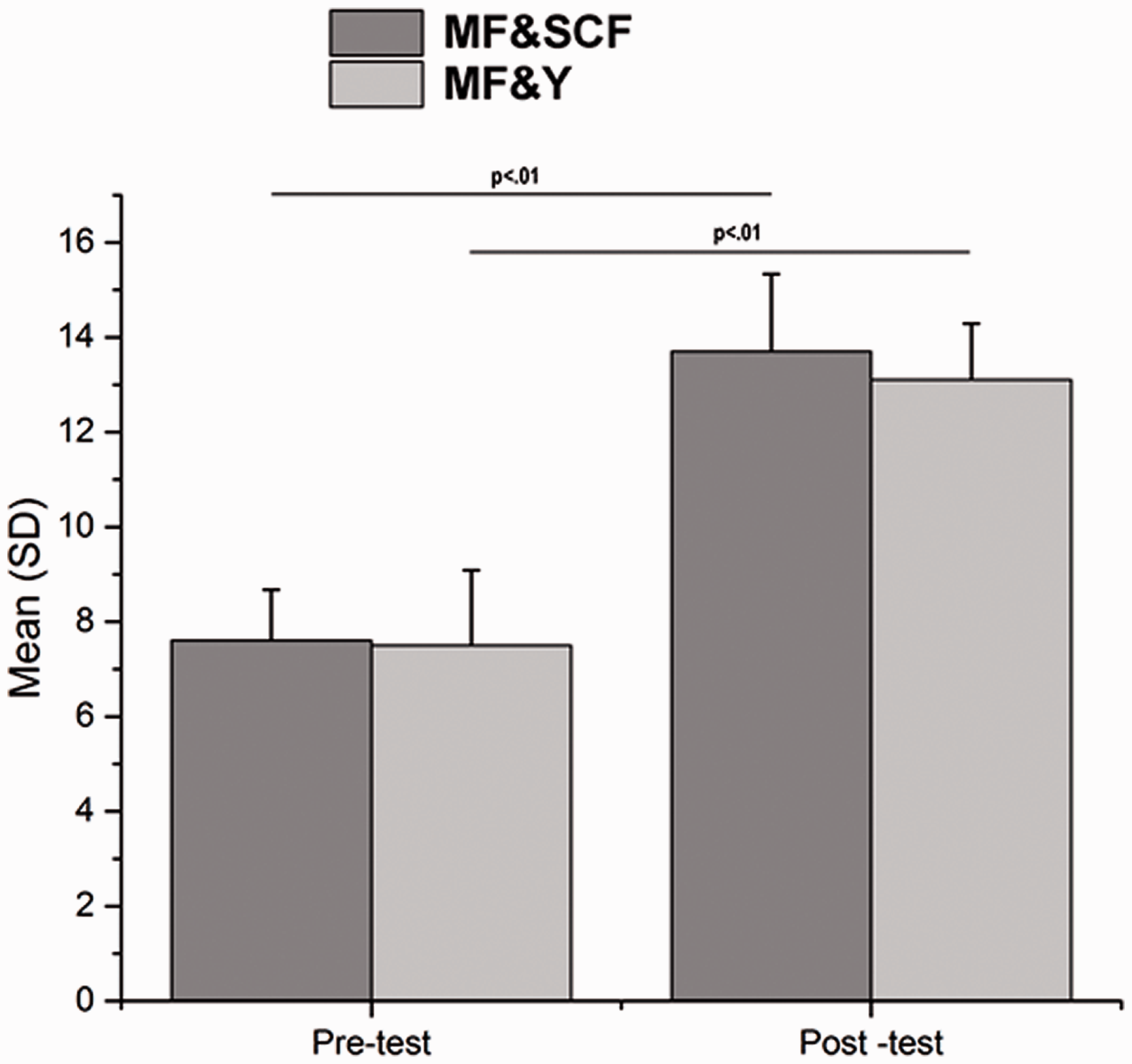
Mean (SD) Scores of Mental Fatigue in Both Pre-Test and Post-Test.
Acquisition Phase
There were no significant group differences on the precision force production pre-test. The main effect of feedback (F1,38 = .296, p = .590), fatigue (F1,38 = .303, p = .585), and the interaction between feedback and fatigue (F1,38 = .004, p = .977) were all statistically non-significant. As Figure 3 reveals, all groups reduced their absolute errors (AEs) through practice during the acquisition phase, as there was a significant main effect of training over blocks of trials (F11,418 = 20.55, p = .001, η2 = .351). However, the main effects of fatigue (F1,38 = .104, p = .748) and feedback (F1,38 = .144, p = .707), and the interaction effect of fatigue and feedback (F1,38 = .003, p = .960) were all statistically non-significant.
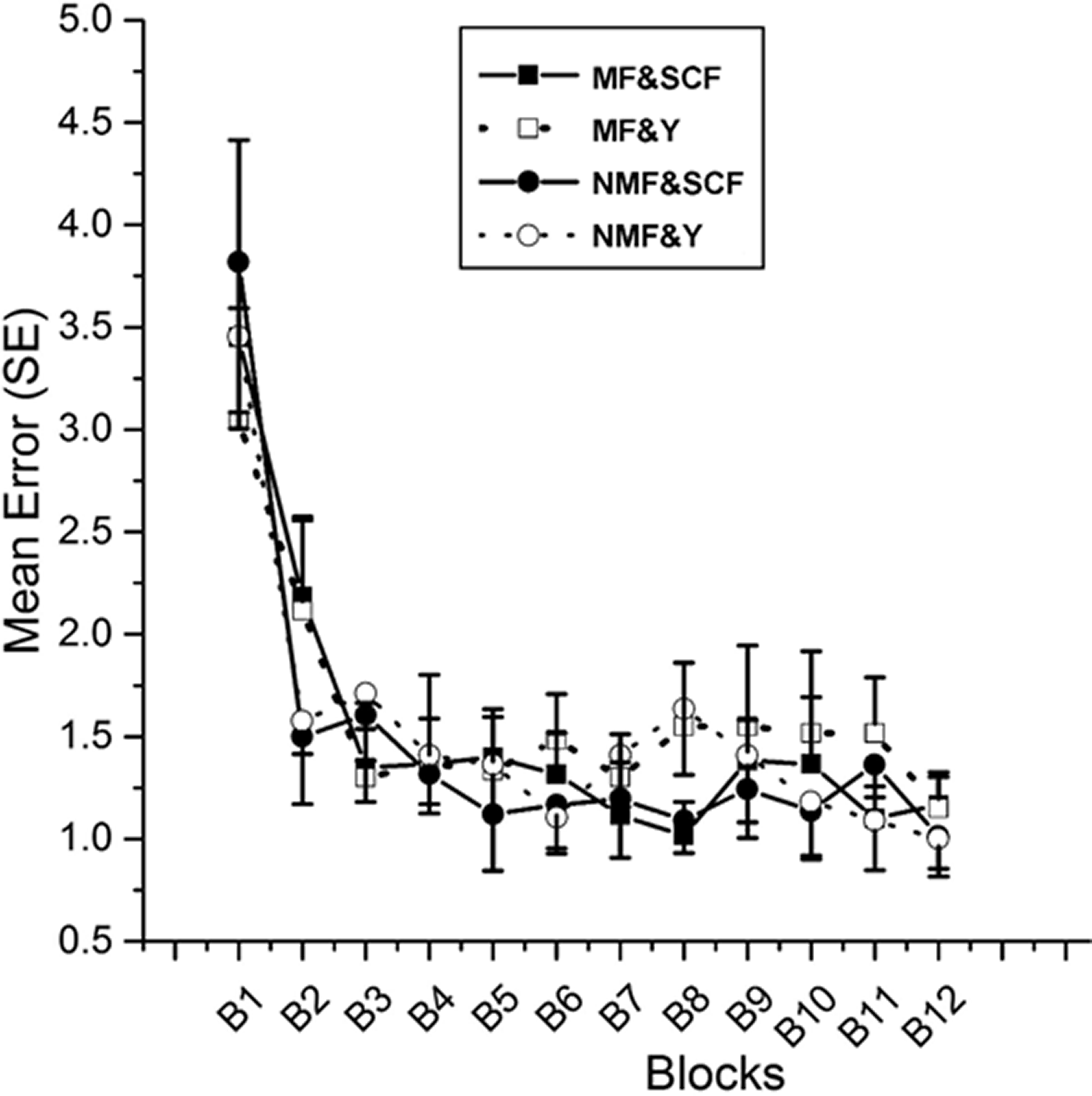
Mean (SE) Absolute Error During Acquisition Phase in Different Groups.
Retention Testing
Figure 4 shows the interaction effect of fatigue and feedback at retention and transfer testing. Results of two-way ANOVAs revealed that the main effect of feedback was not significant (F1,38 = .307, p = .583), but the main effect of fatigue (F1,38 = 8.98, p = .005, η2 = .191) was significant as was the interaction effect of feedback and fatigue (F1,38 = 6.154, p = .018, η2 = .139). Post-hoc Bonferroni tests revealed that there was only a significant difference between the MF & SCF (Mental Fatigue & Self-Control Feedback) group and the NMF & SCF (No Mental Fatigue & Self-Controlled Feedback) group (p = .002).
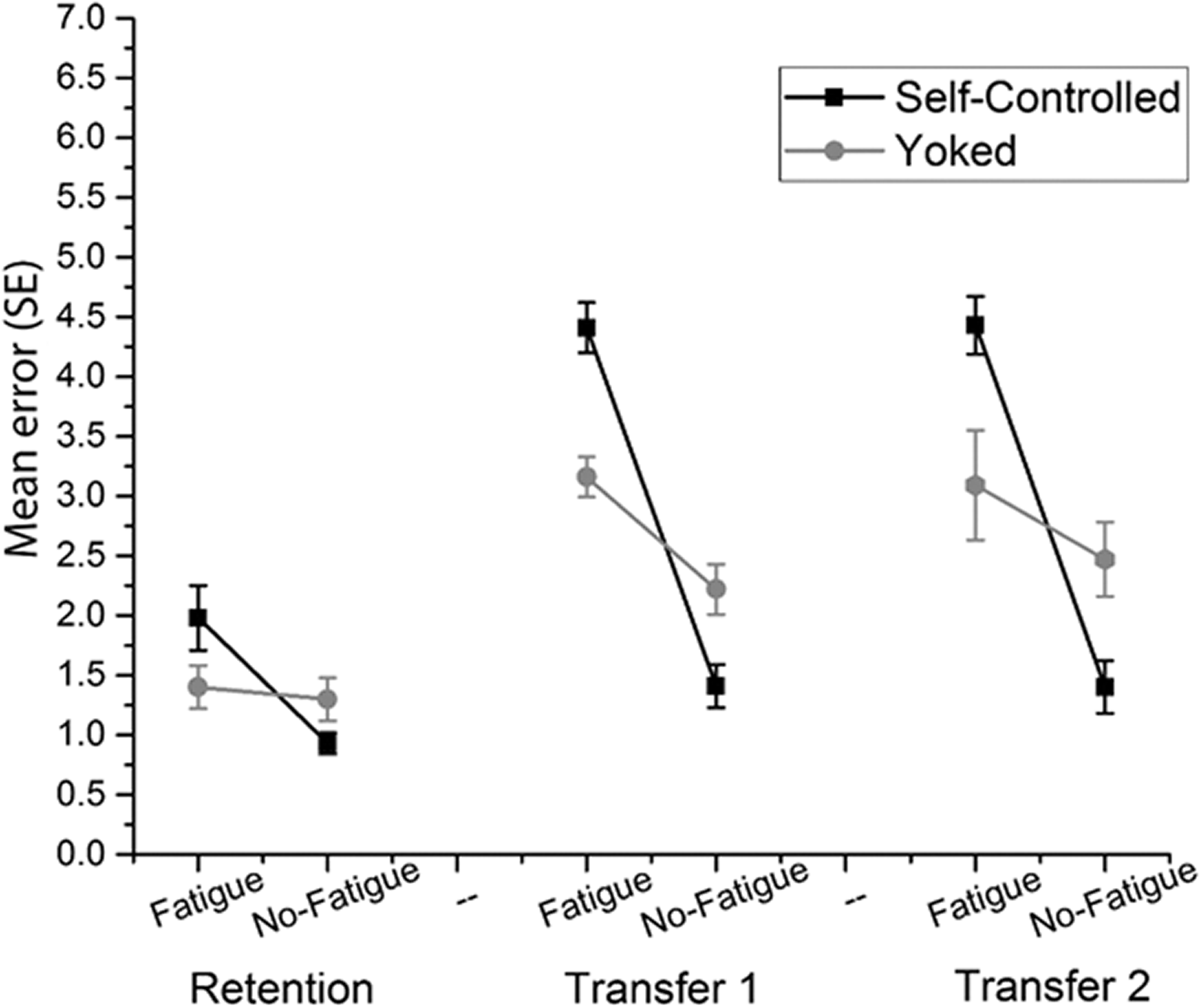
Interaction of Mental Fatigue and Feedback in Retention and Transfer Tests.
Transfer Testing
Results of a two-way ANOVA at the first transfer testing revealed that the main effect of feedback was not significant (F1,38 = 1.249, p = .271). However, the main effect of fatigue (F1,38 = 97.87, p = .001, η2 = .720) was significant as was the interaction of feedback and fatigue (F1,38 = 26.73, p = .001, η2 = .413). Further post-hoc analysis showed that significant differences between several groups (see Table 1).
Results of Bonferroni Post-Hoc Tests in Transfer 1 and 2.
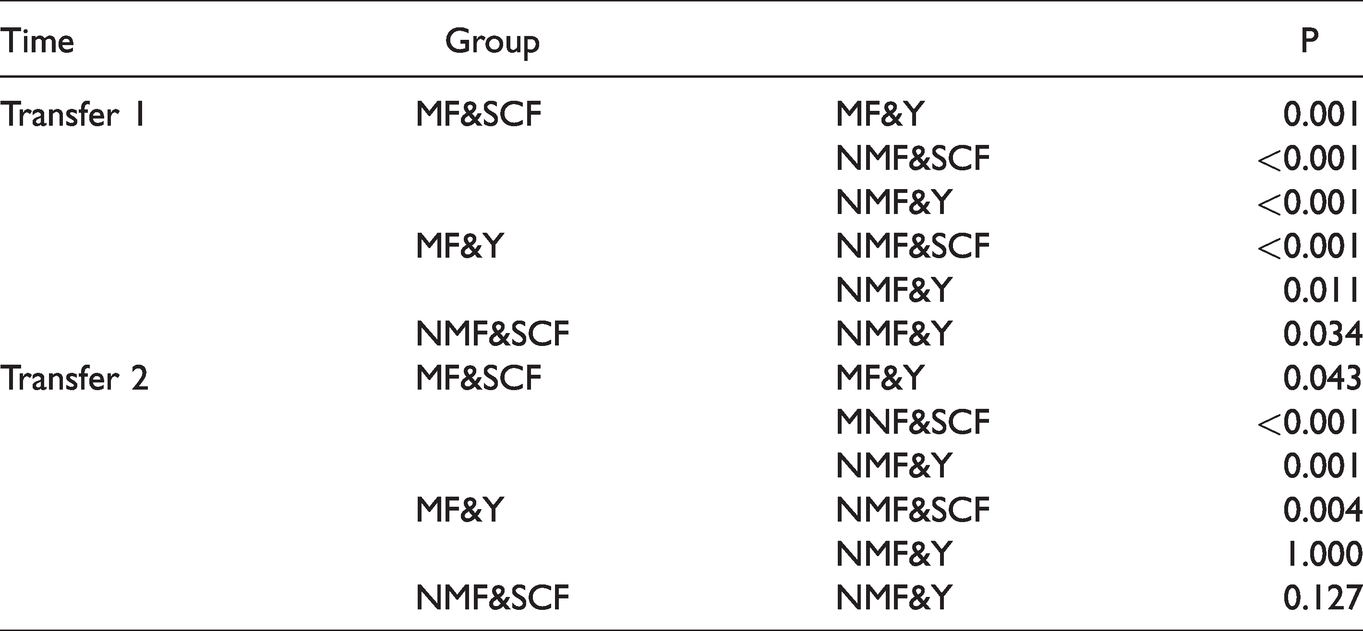
Also, results of another two-way ANOVA for the second transfer testing revealed that the main effect of feedback was again not significant (F1,38 = .160, p = .692). However, the main effect of fatigue (F1,38 = 31.64, p < .001, η2 = .454) was again significant, as was the interaction effect of feedback and fatigue (F1,38 = 13.82, p = .001, η2 = .267). Results of the post-hoc Bonferroni test revealed significant differences between several groups (see Table 1).
Discussion
The present study aimed to examine whether or not self-controlled feedback under mental fatigue conditions can be useful for learning force production. From analyses of performance at pre-test and after acquisition phase, we demonstrated that the combination of practice and feedback led to a significant improvement in all four experimental groups. However, there were no significant differences between groups at the end of the acquisition phase. In other words, there was no significant difference between the mean error of individuals with and without mental fatigue.
Our study is an outlier in this regard, since a number of previous researchers found that mental fatigue can impair both physical performance (Coutinho et al., 2017; Magnuson et al., 2021; Marcora et al., 2009; Smith, Coutts, et al., 2016) and the accuracy and speed of decision-making (Smith, Zeuwts, et al., 2016). The discrepancies between our study and others may be attributable to the combined role of practice and feedback in this study, since feedback may have reduced the effect of mental fatigue on performance during the acquisition phase (Schmidt & Lee, 2005).
At retention and first/second transfer tests, we found that mental fatigue had a significant negative effect on learning force production. That is, mean errors were significantly higher for participants with mental fatigue than for those who were not assigned to the mental fatigue condition; participants with mental fatigue also showed lower learning capacity than their non-fatigued peers. In fact, at the retention testing, the first transfer testing (with mental fatigue), and the second transfer testing (without mental fatigue), mental fatigue acquired during the acquisition phase had a negative performance impact. Even in the second transfer test, after a rest period and so without mental fatigue, participants who had practiced under mental fatigue still demonstrated weaker performance.
Although previous investigators have not directly examined the effect of mental fatigue on the learning process, they have suggested from their findings that mental fatigue has a detrimental effect on motor performance (Coutinho et al., 2017; Duncan et al., 2015; Marcora et al., 2009; Van Cutsem et al., 2019) and sub-maximal physical functions that require accuracy, cognitive control, and decision-making (Lorist et al., 2005; Smith, Coutts, et al., 2016; Van Cutsem et al., 2019). Mental fatigue is likely to affect the relationship between stimuli and responses, thereby interfering with information consolidation processes in memory (Jongman et al., 1999). Smith, Zeuwts, et al. (2016) explored the effect of mental fatigue on football players' decision-making, and they reported that mental fatigue impairs accuracy and decision-making. Also, Jongman et al. (1999) asserted that mental fatigue reduces memory capacity in storing and organizing information, which diminishes working memory capacity. Boksem et al. (2005) also reported that mental fatigue has a negative effect on decision-making. They stated that participants with mental fatigue had no understanding of the information they received. Thus, mental fatigue seems to have a deleterious effect on individuals’ preparation process and motor planning (Lorist et al., 2005; Smith, Coutts, et al., 2016; Smith, Zeuwts, et al., 2016), concentration and attention to detail (Boksem et al., 2005; Russell et al., 2019), leading to subsequently impairment on a learning force production task at retention and transfer testing.
On the other hand, Smith, Coutts, et al. (2016) reported that the participants’ responses induced by mental fatigue were strongly guided by automated cognitive processes, leading participants to offer pre-prepared or automated responses in new situations. Thus, in our study in which we altered the required performance force for the first and second transfer tests, participants exposed to mental fatigue may have tended to execute pre-prepared responses (forces produced in the acquisition phase) that increased the likelihood of error on transfer tests.
Based on previous studies (Coutinho et al., 2017; Duncan et al., 2015; Habay et al., 2021; Smith, Coutts, et al., 2016; Veness et al., 2017), we expected a negative impact of mental fatigue on motor performance. Our main interest was the interaction between self-controlled feedback and mental fatigue, as we were interested in whether mental fatigue might reduce the typical effectiveness of self-controlled feedback on learning a force production task. The interactive effect of self-controlled feedback and mental fatigue at retention and transfer testing demonstrated that the benefit of self-controlled feedback was influenced by whether or not participants had experienced mental fatigue. Under the mental fatigue condition, participants in the self-controlled feedback group performed more poorly than those in the yoked feedback group. Thus, self-controlled feedback was not effective at enhancing learning if it was delivered in the presence of mental fatigue. However, in the absence of mental fatigue (normal condition), learning was higher in the self-controlled feedback group than in the yoked group, as seen by the performance at retention and transfer testing.
Our findings of superior learning by participants who experienced self-controlled feedback during learning that was not impeded by mental fatigue are new, but they are consistent with prior research that has examined these variables separately. In the absence of mental fatigue (normal condition), self-controlled feedback, or permitting the learner to request feedback, facilitates the learners' active engagement in the learning process, leads to deeper processing of task information, increases intrinsic motivation and self-efficacy, and enhances self-perceived competencies (Chiviacowsky, 2014; Chiviacowsky et al., 2012; Fairbrother et al., 2012; Grand et al., 2015; Kok et al., 2020).
One possible mechanism for the detrimental effect of mental fatigue when learning in the self-controlled feedback condition is an adverse effect of mental fatigue on the learners’ perceptions (Van Cutsem et al., 2019) and on the learners’ information and planning processes (Lorist et al., 2005; Smith, Zeuwts, et al., 2016). Mental fatigue may impair the learner’s ability to decide on the proper time to request feedback so that they request it more randomly and then experience some learning inefficiency. The results of previous studies and interviews with participants in the self-controlled feedback group showed that these participants decided on the proper time to request feedback in a systematic way, consistent with their needs (Chiviacowsky & Wulf, 2002, 2005). However, since mental fatigue has been found to adversely affect cognitive and decision-making processes (Habay et al., 2021; Lorist et al., 2000; Smith, Zeuwts, et al., 2016; Van der Linden et al., 2003), mental fatigue may have impaired this systematic way of timing requests for feedback.
Some prior studies have shown that self-control processes for requesting feedback have the effect of increasing mental fatigue (Graham et al., 2017). Participants engaged in self-control processes experience cognitive pressure associated with dividing attention capacity between learning and self-controlled processes (Friedrich & Mandl, 1997). Thus, the poor learning of the self-controlled feedback group under the mental fatigue condition may be related to the challenge point hypothesis (Guadagnoli & Lee, 2004) stating that learning tends to decrease when the task challenge exceeds an optimal level. Cognitive strain may have been caused by the mental fatigue task and/or the self-controlled feedback process, significantly increasing the cognitive challenge during practice and impairing retention and transfer test performance.
Limitations and Directions for Further Research
One limitation in the current study was related to the frequency of self-controlled feedback. In order to match the frequency of feedback in our self-controlled groups, participants in these groups were asked to request feedback on only two trials in each block, perhaps meaning that feedback was not sufficiently self-controlled. Secondly, the motor task in this study was to produce a submaximal force, and participants received some natural feedback associated with increasing noises that accompanied increasing produced forces. We recommend that future investigators consider a force production task involving a higher volume of force production to control this potential confound. Also, future studies could test our findings in more natural conditions like in situations in which participants are performing in the real environment or in sports rather than in the laboratory.
Conclusion
In general, the present study showed that, while, under normal conditions, providing feedback in a self-controlled manner can be helpful for motor learning, under mental fatigue conditions, self-controlled feedback was not effective for enhancing motor learning. Mental fatigue probably increased the mental challenge in the self-controlled group, adversely affecting the learner's decisions about the right time to request feedback and, thereby, impairing motor learning in the self-controlled group under mental fatigue.
Footnotes
Acknowledgment
The authors would like to thank the participants for their engagement in this study. Also, we would like to thanks Mohammad Saber Sotoodeh for his edits on the manuscript.
Ethics Approval
The methodology for this study was approved by the Human Research Ethics committee of the Hakim Sabzevari University (Approval ID: IR.HSU.REC.1397.008).
Declaration of Conflicting Interests
The author(s) declared no potential conflicts of interest with respect to the research, authorship, and/or publication of this article.
Funding
The author(s) received no financial support for the research, authorship, and/or publication of this article.
