







Abstract
In the present study we investigated the effects of manipulating task difficulty (constant vs. progressive difficulty) and frequency of knowledge of results (KR) on the accuracy and consistency of children’s performance of a novel fine motor coordination task (dart throwing). We assigned 69 right-handed physical education (PE) students (M age = 10.73, SD = 0.89 years) to progressive (PDG) or constant difficulty (CDG) groups. PDG and CDG were each split into three subgroups who received varying KR frequency (100%KR, 50%KR, and 33%KR), creating a total of six groups. We increased difficulty in the PDG by manipulating the distance to the target (2 m, 2.37 m, and 3.56 m), while distance to the target was constant for CDG throughout the experiment (2.37 m). We conducted performance assessments during familiarization (pre-test), acquisition (post-test), and retention (retention testing) learning phases under both normal condition (NC) and a time pressure condition (TPC). Repeated-measures analysis of variance revealed a significant effect of difficulty manipulation on skill learning under both NC and TPC. Further analyses revealed that skill learning was enhanced by progressive difficulty manipulation. However, learning was not affected by KR frequency changes. Progressive difficulty practice enhanced both accuracy and consistency, specifically at retention testing. These results suggest that motor learning in children may be enhanced by practicing with progressive increases in difficulty. PE teachers are encouraged to gradually introduce difficulty levels in motor learning tasks that require high accuracy.
Introduction
The acquisition of new motor skills is a major aspect of daily living (Kantak & Winstein, 2012), and developing fine motor coordination is a prerequisite for numerous specialized motor skills (Lopes et al., 2011). Although prior investigators have sought to identify an optimum array of practice variables for motor skill acquisition, research regarding children’s motor learning remains sparse (Sullivan et al., 2008).
One variable of interest, augmented feedback (AF), is defined as the information regarding the extent to which learners’ behavior and performance correspond to expectations (Hein & Koka, 2007). AF has a direct effect on motor learning (Frikha et al., 2019; Wulf et al., 2010) and is an aspect of knowledge of results (KR), defined as data pertaining to the outcome of performing a skill. KR is an important source of information for children engaged in motor skill learning (Saemi et al., 2011; Sullivan et al., 2008). When KR is provided after the completion of the motor task, it may facilitate learning by providing the learner with directive information (Shewokis et al., 2000). Early theories suggested that (a) KR allows the learner to understand the correctness of the previous response, which could contribute to better future responses; and (b) providing KR after every trial enables learners to maximize their learning (Salmoni et al., 1984) by repeating or changing future performances according to feedback (Guadagnoli & Kohl, 2001). Yet, as favorable results have been found for reduced frequencies of KR, an alternative theory has emerged, suggesting that KR provided at frequencies less than 100% best engages working memory and enhances learning (Guadagnoli & Kohl, 2001). Several studies have confirmed that reducing KR frequency enhanced motor learning (Guadagnoli & Kohl, 2001; Rice & Hernandez, 2006). This newer guidance hypothesis has recently been used to explain findings of degrading effects of frequent feedback in which too much KR during acquisition is thought to create dependency on KR at the expense of the learner’s intrinsic self-reliance (Ronsse et al., 2010), causing diminished learning or memory processes required for planning the next action (Badets & Blandin, 2004; Salmoni et al., 1984). A frequent KR schedule may encourage learners to constantly adjust their movement patterns (Bilodeau, 1966). Similarly, AF that is too frequent may increase reliance upon it, and inhibit performers from relying on their own feedback when AF is unavailable (Salmoni et al., 1984; Schmidt et al., 1989).
Mediating factors that may extend the benefits of highly frequent KR beyond acquisition to also enhance retention have not been definitively identified (Schmidt et al., 1990). Studies that assessed the influence of varied KR frequency (i.e., 100% vs. 20%) showed that, while errors made by the 100% KR group decreased during the acquisition phase of learning, the group with 20% KR performed more accurately at retention testing (Guadagnoli & Kohl, 2001). Similarly, when learning a golf putt, participants in the 33% KR group had a more accurate delayed retention performance than did participants in the 100% KR group, even while there were no group differences in performance consistency (Ishikura, 2008). Others showed that reduced feedback over time helped maintain persistent movement during a subsequent retention test (Crowell & Davis, 2011; Kovacs & Shea, 2011). Additionally, investigators of studies on the effect of reduced feedback frequency have reported that cognitive challenge is increased under reduced KR learning conditions, making reduced KR frequency better suited for skilled and older participants but not necessarily well suited for novice and younger (i.e., child) participants (Goh et al., 2012). Although numerous investigations have revealed the effectiveness of reduced feedback on motor skill learning in adults (Sullivan et al., 2008), the effect of extrinsic feedback on children’s motor learning is unclear (Sidaway et al., 2012).
With respect to the influence of task difficulty on feedback effectiveness, evidence suggests that the optimal feedback frequency may vary with task difficulty such that reducing feedback frequency may be better for learning less difficult tasks, while higher feedback frequencies may be better suited to more difficult tasks (Guadagnoli & Lee, 2004; Winstein, 1991; Wulf & Shea, 2002). Guadagnoli and Lee (2004) interpreted these results in their Challenge Point Framework, which suggested that optimal feedback and practice conditions were a function of task difficulty.
Much of the research on KR frequency in motor learning has been derived from research with college-aged participants, but there is some evidence, related to the task difficulty research, that children benefit from more frequent feedback (e.g. da Silva et al., 2017; Sullivan et al., 2008), are less able to use intrinsic feedback during practice (Goh et al., 2012), and have different information processing capabilities than adults (Thomas, 1980). Therefore, there is a strong rationale for continuing to examine the effects of feedback frequency on children’s motor learning.
In practical learning settings, it is common practice to vary task difficulty to correspond to the learner’s ability. Novice baseball hitters may practice hitting a ball from a stationary tee, then practice hitting a ball thrown slowly and predictably, and finally practice with the ball thrown faster and less predictably. Manipulating task difficulty is a strategy that can be used to improve skill acquisition (Elghoul et al., 2018; Sawers & Hahn, 2013). The Challenge Point Framework (Guadagnoli & Lee, 2004) suggests that optimal learning occurs when functional task difficulty matches the learner’s ability. Learning conditions may involve constant practice (practicing one task at the same difficulty level) or progressive increases in difficulty (Czyż et al., 2019). Constant practice has been shown to benefit a variety of skills, and it is distinguished by its ability to improve performance within variations of a skill (Keetch et al., 2005); while progressive practice better prepares the individual to execute a non-practiced skill and promotes its transfer into novel situations (Czyż et al., 2019). While much motor learning research has studied constant practice type motor learning, there is considerable evidence to support the efficacy of practicing at gradually increasing difficulty levels, including research on children’s motor learning in physical education (PE) (e.g., French et al., 1991), college students’ acquisition of tennis skills (e.g., Hebert et al., 2004), and the effects of increasing levels of contextual interference over the course of practice (e.g., Porter & Beckerman, 2016; Porter & Magill, 2010).
While both feedback frequency and task difficulty are known to influence skill acquisition, questions remain about their impact in children’s motor learning. In this study, we examined the effects of both KR frequency and task difficulty in children’s learning of fine motor skills for dart throwing. We had children practice dart throwing under two task difficulty conditions (constant and progressive) and three KR frequencies (100%, 50%, and 33%); and we tested their consistency and accuracy at three time points (familiarization – pre-test; following acquisition – post-test; and at retention) under both normal and time-pressure testing conditions.
Method
Participants
Sixty-nine right-handed boys (M age = 10.73, SD = 0.89 years; M body height = 149.1, SD = 8.94 cm; M body mass = 40.64, SD = 11.46 kg) volunteered to participate in this study. All participants were right-handed, had no prior experience with the experimental task and no visual or cognitive problems. Once included, written informed consent was obtained from all participants’ parents after receiving a thorough explanation of the protocol. The protocol was conducted in accordance with the Declaration of Helsinki (1975, revised 1983) as determined by the local Ethics Committee who approved the protocol (EM2S-180026).
Task and Apparatus
Participants threw darts at a target dartboard fixed on a wall so that its center was at eye level for each participant. The goal of the task was to hit the bulls-eye in the center of the target. A digital camera (SONY Corporation, HDR PJ 270E, Tokyo, Japan) was installed behind and above the participant to record the position of each throw for subsequent analysis of x (horizontal) and y (vertical) coordinates to the origin of the dartboard. Three distances from the target were marked on the floor: short (2.0 m), standard (2.73 m), and long (3.56 m). During KR trials, participants could visually track the dart and its final striking point on the dart board. On trials when KR was withheld, an opaque curtain, 2 m wide, was placed in front of each participant following throws (Abbas & North, 2018). On these trials, as soon as a participant released the dart, an experimenter, who stood one meter away from the line of throw, raised the opaque curtain to occlude the view of the impact of the dart and prevent the participant from receiving visual KR of the outcome of the trial (Abdollahipour et al., 2014).
Procedures
Participant skill was approximately matched to pre-test performance (i.e., throwing nine darts to strike as close as possible to the bull's eye) (Elghoul et al., 2018; Ong et al., 2015). Participants were assigned to either a constant difficulty group (CDG, n = 33) or a progressive difficulty group (PDG, n = 36). Within each group, participants were assigned to three KR conditions (CDG: 100%KR, n = 12, 50%KR, n = 11, 33%KR, n = 10; PDG: 100%KR, n = 13, 50%KR, n = 11, 33%KR, n = 12).
Data were collected during three sessions. During the first session, participants performed two pretests, 108 acquisition trials, and two retention tests. For each pretest, participants attempted nine trials from the standard distance. The first pretest was under “normal” conditions (NC). During these trials, participants were instructed to aim for the bulls-eye and could perform attempts at a self-determined rate. The second pretest was under a “time pressured” condition (TPC); instructions for this assessment directed participants to throw the set of darts as quickly and accurately as possible. Following the pretests, participants performed a total of 108 acquisition trials. Participants assigned to the CDG performed all attempts from the standard distance (2.37 m). Distance from the dartboard increased progressively for those in the PDG, who performed 36 trials from each distance beginning at the short distance (2.0 m), followed by practice at the standard 2.37 m distance, and ending with practice from the long 3.56 m distance. KR was delivered according to the assigned KR condition. Participants in the 100%KR condition received visual KR every trial, those in the 50%KR condition received KR every other trial, and those assigned to the 33% condition received KR after every third trial. Following acquisition trials, participants completed two immediate retention tests similar to the pretests (nine trials under NC followed by nine trials under TPC). Delayed retention tests were performed using these same procedures one (Delayed Retention 1) and two weeks later (Delayed Retention 2). Table 1 provides an overview of test and acquisition conditions.
Summary of Task Difficulty Manipulations of the Distance to the Target Under Various Feedback Frequency Conditions During Acquisition and Test Periods for the Dart Throwing Task.
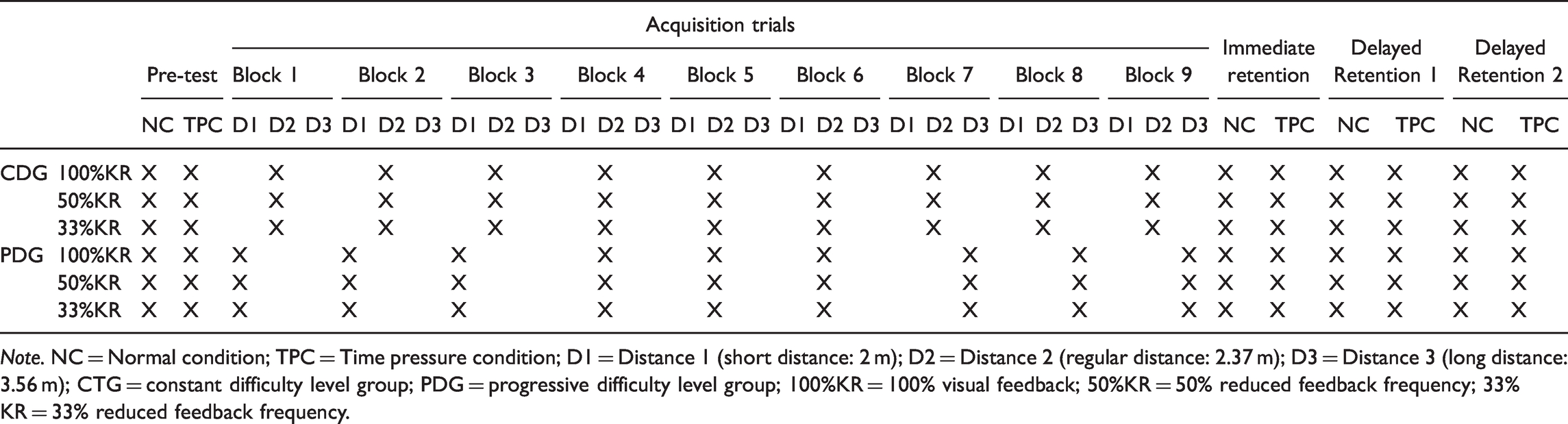
Note. NC = Normal condition; TPC = Time pressure condition; D1 = Distance 1 (short distance: 2 m); D2 = Distance 2 (regular distance: 2.37 m); D3 = Distance 3 (long distance: 3.56 m); CTG = constant difficulty level group; PDG = progressive difficulty level group; 100%KR = 100% visual feedback; 50%KR = 50% reduced feedback frequency; 33%KR = 33% reduced feedback frequency.
Data Analysis
Score Calculations
Data for dart throwing performance for the pre-tests and retention tests were analyzed. Two dependent measures of dart throwing were calculated. Accuracy was measured using Mean Radial Error (MRE), the absolute distance between the dart position and the center of the target. MRE was calculated as the mean of RE2 = (x2 + y2) for each block of nine trials. Consistency was measured using Bivariate Variable Error (BVE), based on Hancock et al. (1995) with the following equation: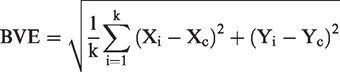
Xc = mean constant error on the X axis within a test or block
Yc = mean constant error on the Y axis within a test or block.
Statistical Analysis
All statistical tests were processed using STATISTICA Software (StatSoft, France), and data were reported as means (M) and standard deviations (SD). We first confirmed an assumption that data were normally distributed using the Kolmogorov-Smirnov test. MRE and BVE from the pre-test, immediate retention, and delayed retention tests during the normal condition were analyzed using 2 (Practice Conditions) × 3 (Feedback Conditions) × 4 (Tests) ANOVAs with repeated measures on the last factor. Similar analyses were used to analyze MRE and BVE for tests under the time pressure condition. When appropriate, post-hoc tests, using Fisher LSD, were conducted. We also calculated the effect size, as partial ηp2, which quantifies the proportion of the variability in the dependent variable that is explained by the effect. The thresholds for describing the effect sizes as small, moderate, and large were considered as 0.01 (small), 0.06 (medium), and 0.14 (large). The level of statistical significance was set, a priori, at p < 0.05.
Results
Performance During Normal Test Conditions
Mean Radial Error
Outcome accuracy performance under the NC throws is shown in Figure 1. The ANOVA revealed a significant effect of Practice Condition (CDG vs. PDG), F(1;63) = 5.47; p = 0.023; ηp2 = 0.08, superseded by a significant interaction of Test × Practice Condition, F(3;189) = 2.8; p = 0.041; ηp2 = 0.043. All other main effects and interactions were not significant. Errors decreased from pre-test to retention for the PDG, but increased for the CPG. Post-hoc analysis revealed a significant group difference at Delayed Retention 1 (p < .05) and Delayed Retention 2 (p < .01).
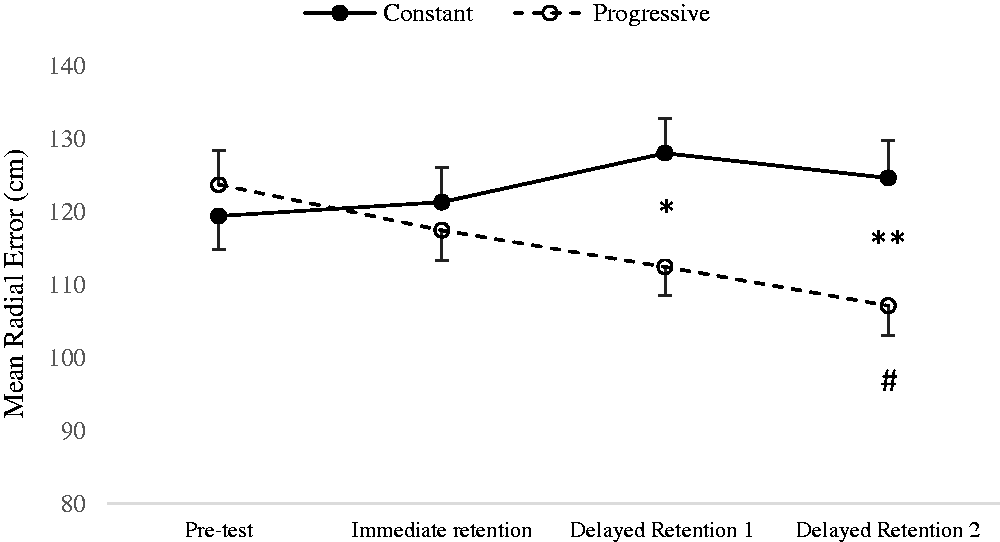
Accuracy (Mean Radial Error) of Constant and Progressive Difficulty Groups During Normal Test Conditions. *Significant difference between constant and progressive difficulty at p < 0.05; ** p < 0.01; # Significant difference to Pre-test at p < 0.05.
Bivariate Variable Error
Outcome consistency performance (BVE) under the NC throws is shown in Figure 2. The ANOVA analyzing BVE for NC throws revealed a significant effect of Feedback Conditions, F(2;63) = 3.6; p = 0.033; ηp2 = 0.102. As shown in Figure 2, BVE was inversely related to FB frequency with lowest error following 100%KR and highest error for the 33%KR groups. Post-hoc tests revealed that BVE was significantly lower in participants receiving 33%KR compared with 100%KR (p < 0.01) (Figure 2). Additionally, the repeated measures ANOVA revealed a significant interaction of Test Effect × Practice Condition, F(3;189) = 2.94; p = 0.035; ηp2 = 0.009. As shown in Figure 3, between groups comparisons indicated that, compared to the CDG, consistency was significantly better for the PDG at Delayed Retention 2 (p < 0.01). In addition, a significant difference was revealed at Delayed Retention 2 compared to the pre-test (p < 0.05) (Figure 3). All other main effects and interactions were not significant.
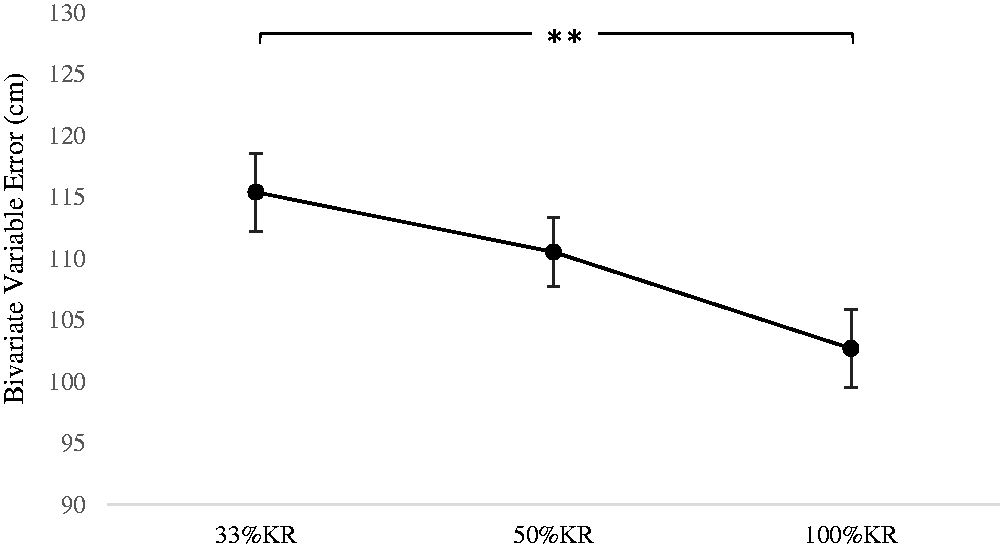
Consistency as Measured Through Bivariate Variable Error Under Feedback Frequency Conditions in the Dart Throwing Task. **Significant difference between 33%KR and 100%KR frequency at p < 0.01.
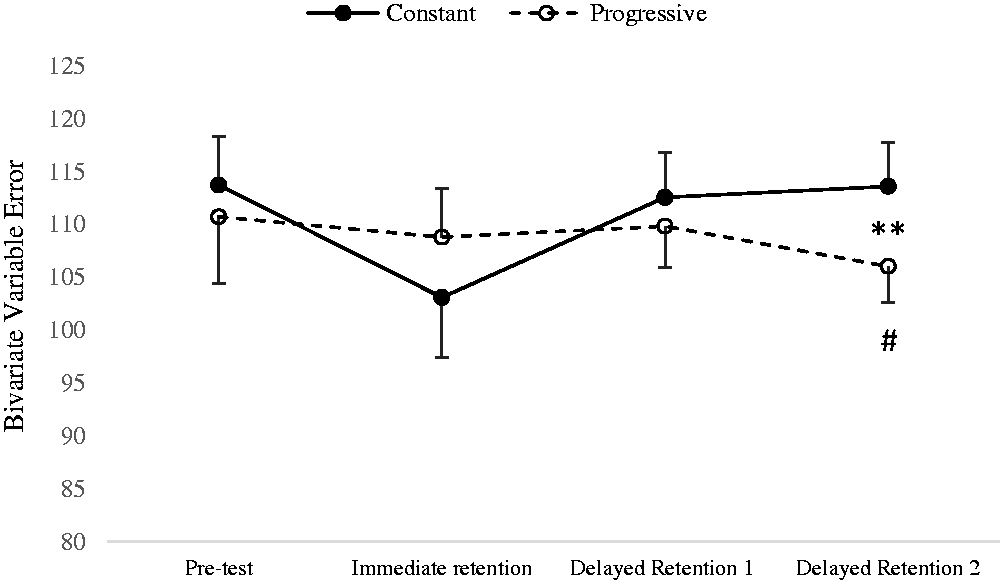
Consistency as Measured Through Bivariate Variable Error Under Normal Condition in the Dart Throwing Task. **Significant difference between constant and progressive difficulty at p < 0.01; # Significant difference to Pre-test at p < 0.05.
Performance During Time Pressure Test Conditions
Mean Radial Error
Accuracy performance (MRE) under the time pressure condition (TPC) is reported in Figure 3. The repeated measures ANOVA revealed a significant Test effect, F(3;189) = 6.52; p < 0,001; ηp2 = 0.094, and a significant interaction of Practice Condition × Test, F(3;189) = 6.65; p < 0.001; ηp2 = 0.096). No other main effects and interactions were significant. As shown in Figure 4, accuracy remained consistent from pre-test through retention testing for the CDG, but improved in the PDG. Between group comparisons indicated that, compared to the CDG, accuracy was significantly better for the PDG at Delayed Retention 2 p < 0.01.
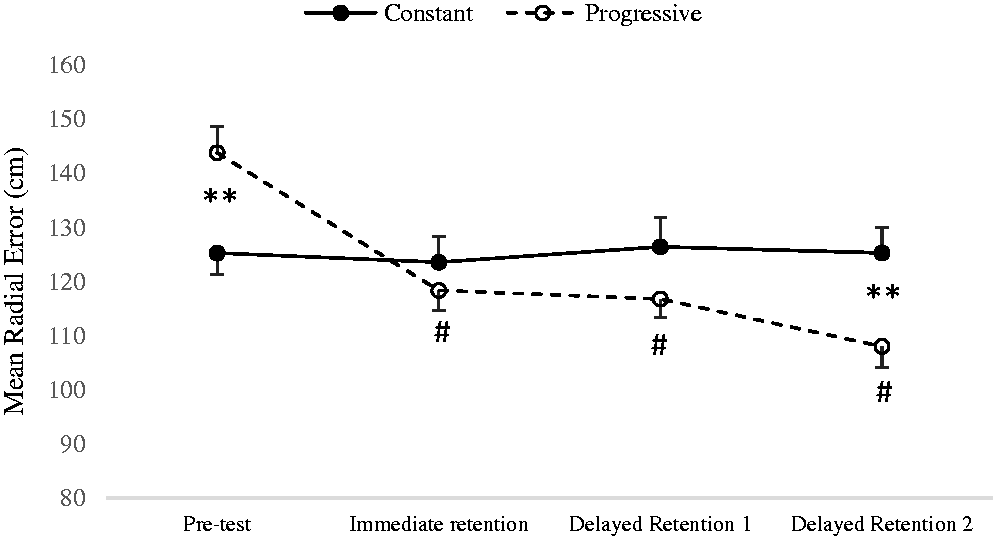
Accuracy (Mean Radial Error) of Constant and Progressive Difficulty Groups During Time Pressure Test Conditions. **Significant difference between constant and progressive difficulty at p < 0.01; # Significant difference to Pre-test at p < 0.05.
Bivariate Variable Error
The consistency performance (BVE) under the time pressure condition (TPC) is reported in Figure 5. The repeated measures ANOVA revealed only a significant Test × Practice Condition interaction, F(3;189) = 2.94; p < 0,05; ηp2 = 0.045. BVE was reduced from pre-test to retention in the PDG, but increased in the CDG. Between groups comparisons indicated only a significant difference at the immediate retention test.
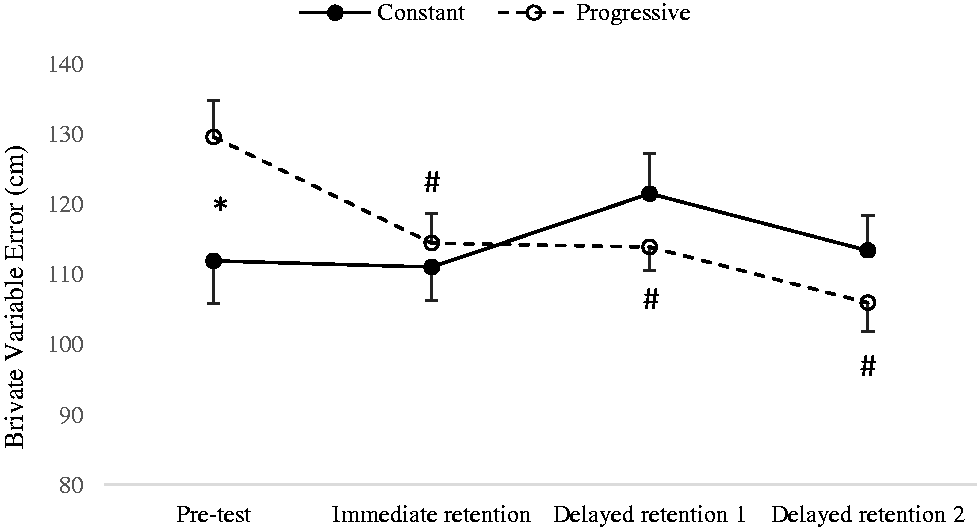
Consistency as Measured Through Bivariate Variable Error Under Time Pressure Condition in the Dart Throwing Task. *Significant difference between constant and progressive difficulty at p < 0.05; # Significant difference to Pre-test at p < 0.05.
Discussion
This study investigated the effects of manipulating difficulty (progressive difficulty vs. constant difficulty), concomitant to different KR visual feedback frequencies (i.e., 100%KR, 50% KR, and 33%KR), on child participants’ performances when learning a novel fine motor coordination task performed under normal and time pressure conditions. Our main findings were that participants in the progressive difficulty group (PDG) significantly improved their accuracy performance, under normal and time pressure conditions and showed long-term learning. These results also indicate no effects of feedback frequency on accuracy and a low variability for learners who received frequent feedback. Additionally, these findings demonstrated that the combined manipulation of task difficulty (TD) and visual feedback frequency minimally effected learning, and that improved performance in accuracy and consistency depended upon the strategy of manipulating task difficulty, primarily during retention phases.
The present results indicated an improvement in learning novel fine motor coordination tasks only for children in the progressive level difficulty conditions, with minimal effects from reduced KR frequency. MRE (accuracy assessment) decreased significantly from the first test session to the last under the standard condition. Similarly, the improvement effect of motor learning during the time pressure condition was dependent on the progressive difficulty group. Our current findings are concordant with those of Sidaway et al. (2012), who indicated that the manipulation of feedback frequency and TD (the requested task was to throw cloth bean bags over a barrier onto an unseen target on the floor) had a minor differential effect on the rate at which the children improved throwing performance. Although previous findings were based on perceived difficulty measurements and not on TD protocol, the authors suggested that, in children, the effect of feedback may be mediated by the difficulty of the motor skill being learned. Indeed, this was evident in our findings, which showed that the children who practiced after a gradual introduction of difficulty level demonstrated, on retention tests, better accuracy and consistency. This was revealed through enhanced accuracy (MRE) and consistency (BVE) under standard difficulty and time pressure conditions. The improvement in retention performances corroboraties the findings of Sawers and Hahn (2013), who explain that such progressive difficulty strategies act to reduce movement errors and TD across practice, when learning a discrete arm movement. Previous research suggested that learning a novel psychomotor task based on difficulty manipulation strategies (manipulation of the distance to a target) could improve the ability to manage the difficulty level so as to reduce errors under difficult conditions (Elghoul et al., 2018).
Considering the impact of feedback frequency on motor skill learning, our findings showed a minimal effect of the reduced feedback frequency conditions on performance consistency. This was noted when comparing consistency after 100%KR with 33%KR condition in the Delayed Retention 2. Moreover, no significant difference was recorded between consistency after 100%KR compared to the 50%KR condition in the Delayed Retention 2. Additionally, learners who received frequent feedback showed low variability in their performance and an improved performance consistency, which occurred only on the Delayed Retention 2, compared to the pre-test. These results also indicated no effects of feedback frequency on accuracy.
Further studies will be needed to fully understand these results. Importantly, our findings are contradictory to those of a previous investigation showing that children who practiced a discrete arm movement with reduced feedback during the acquisition phase performed less consistently across retention tests, when compared to those who received feedback after every trial (Sullivan et al., 2008). Moreover, frequent feedback may guide the learner to a correct response during practice and interfere with the problem-solving processes associated with a more effortful practice (Salmoni et al., 1984; Schmidt, 1991; Sullivan et al., 2008). The lack of an effect of KR frequency during acquisition and retention tests may be explained by the less efficient ability to attend to and interpret intrinsic feedback from various sensory systems and increased difficulty in the detection and estimation of movement errors in children (Sullivan et al., 2008). Another explanation may be that children are inefficient in tasks involving cognitive processing of intrinsic feedback when extrinsic feedback is not provided (Silva et al., 2017). According to Salmoni et al. (1984), four major sources of information must exist to enhance motor schemas - the relation between the initial conditions prior to movement as well as the parameter of the motor program, the sensory consequences, and the result of the movement. Therefore, schemas cannot be developed if the movement outcome is unavailable. The improved performances in the group of 100% feedback align with findings from Giannousi et al. (2017), who concluded that the combination of visual and audio AF might be an effective way to enhance performance of novice swimmers. Furthermore, Martinez et al. (2016) showed that immediate visual feedback provided with a portable computer, complemented and improved verbal feedback during skiing training. Similarly, Sigrist et al. (2013) demonstrated that visual FB has the potential to improve complex motor learning. According to Sullivan et al. (2008), optimized motor learning in children may require a higher frequency of feedback than in adults. That is, reduced feedback across the practice phase is presumed to increase information-processing capabilities (Sullivan et al., 2008). Thus, it is well established that cognitive processes, such as working memory, differ between children and adults and increases with age (Pollock & Lee, 1997). Our results are consistent with the Challenge Point Framework of Guadagnoli and Lee (2004), suggesting that skill level interacts with task demands to influence the optimal quantity of interpretable information called the “challenge point,” wherein excess available information overloads the information processing system, which negatively impacts immediate performance and long-term learning. The improved performance observed when feedback was given every trial (100%KR) could not be generalized for accuracy. This analysis demonstrated that the mean radial error values of different groups in KR frequency did not differ in test sessions. Our findings were similar to those reported by Sidaway et al. (2012), which shows that the manipulations of KR frequency and TD had little influence on dart-throwing performance. Nevertheless, this is contrary to the findings presented by Sullivan et al. (2008), who found that children who received reduced feedback performed with decreased accuracy and consistency during the practice phase. In previous research, Batcho et al. (2016) demonstrated that the visual feedback group reduced errors and enhanced their accuracy compared to the non-visual feedback group. A possible explanation for this difference could be related to age. This finding was supported by Heimbeck et al. (2003), who showed that training that includes errors may be crucial in forming mental models.
The current findings did not reveal an interaction between progressive difficulty and visual feedback frequency in children’s psychomotor learning, highlighting the importance of investigating other underlying cognitive variables that could be associated with TD and feedback frequency. However, reducing feedback frequency in children’s psychomotor learning has been correlated with limited information processing capabilities and should invoke the learner’s optimal cognitive ability (Sullivan et al., 2008). In order to benefit motor learning, practice conditions should invoke optimal effort while avoiding additional cognitive demands caused by uncontrollable reduced feedback or TD, especially when manipulations are performed distinctly.
Limitations and Directions for Further Research
The main limitation for this investigation involved our small sample size, reduced further by the fact that some of our recruited participants did not complete the retention phases of the study. We were not able to demonstrate robust differences between groups as indicated by our non-significant group difference with respect to task difficulty and by variability under both conditions; likewise, we found no feedback frequency group differences in accuracy under both conditions and observed variability under time pressure. Finally, we collected no data about psychological variables that may have been important to these results. Future studies should address these weaknesses.
Conclusion
Progressive vs. Constant Difficulty
The present study demonstrated that gradual manipulation of task difficulty was an effective strategy for enhancing 10-12-year-old children’s performance when learning a novel fine motor coordination task. Similar findings were previously reported, suggesting an important advantage to skill learning involving progressively more difficult practice (French et al., 1991; Hebert et al., 2004), perhaps because of added benefits of gradually increasing cognitive challenge (Guadagnoli & Lee, 2004).
The Effect of Feedback Frequency
Regarding the impact of feedback frequency on motor learning, we found that higher feedback frequencies resulted in lower performance variability, but did not impact accuracy. Additional research is needed to examine the interactive effects of these two variables.
Footnotes
Acknowledgements
We are grateful to all of the students who participated so willingly in the study.
Declaration of Conflicting Interests
The author(s) declared no potential conflicts of interest with respect to the research, authorship, and/or publication of this article.
Funding
The author(s) received no financial support for the research, authorship, and/or publication of this article.
