







Abstract
Talent identification in sports is a heavily debated topic. Previous studies have separately explored either executive functions or gross motor skills to predict the success of top-level soccer players or, more generally, to characterize elite performance in soccer. However, at mid-childhood, the possibility to scope sport-specific requirements remains elusive. We aimed in this study to investigate a valid and simple method of testing for a unique combination of cognitive and speed abilities for identifying promising soccer players at mid-childhood. We measured cognitive functions by means of a Stroop smartphone application and agility with a T-Drill Ball-success test, in two groups of (a) elite- (n = 31) and (b) low-division (n = 37) Italian 7-year-old male soccer players. We administered the tests in a randomized order to both groups. We found better inhibitory control, cognitive flexibility and soccer-specific agility in high-division versus low-division players (p < .001). Inhibitory response and agility were positively associated with the augmented quality of the performance from low-division players to high-division players (r = .55; p = .0001). These results suggest that, even at an early age, cognitive control together with soccer-specific skills is associated with better performance.
Keywords
Introduction
An emerging body of multidisciplinary literature has documented the tight link between cognitive and physical abilities in developing children, at school and in various sports, such as soccer (Sakamoto et al., 2018; Vestberg et al., 2012, 2017). Soccer performance is a complex phenomenon that relies on technical, tactical, physical, mental and psychological factors. Among other factors, playing capacity relates to sprint skills combined with sudden and explosive changes of direction, goal-shooting skills and the ability to “read the game” (Erren et al., 2016). Therefore, soccer skill sets entail not only motor skills, but they also include cognitive control, comprised of core and higher level cognitive functions such as inhibitory control and decision-making (Chang et al., 2017). Several past studies have separately explored either cognitive functions or motor skills in their separate associations with the success of top-level soccer players or, more generally, in characterizing high performance (Murr, Feichtinger, et al., 2018; Sakamoto et al., 2018), comparing top and amateur level players among both adolescent and adult research participants. On one hand, the cognitive burden of an open-skill sport like soccer is elevated by cognitive ability, as it requires motor inhibition (Wang et al., 2013), attention and visuospatial anticipation, spatial attention, situational probabilities (working memory) and high decision-making ability in response to rapidly changing situations (Huijgen et al., 2015). On the other hand, an elite soccer player must also exhibit physical skills, basic coordination, speed-agility, favorable somatotype measures, technical and tactical skills. At the youth level of play, among various neuro-motor skills, the physical component of agility (Sassi et al., 2009) is certainly one of the best performance indicators of a gifted soccer player (Ali, 2011; Bekris et al., 2018; Figueiredo et al., 2011; Rommers et al., 2019; Sheppard & Young, 2006; Svensson & Drust, 2005). Scouting and assessing these multifactorial skills is essential for profiling players, in order not only to “select” but above all to “identify” them as talent. In fact, while talent selection can be seen as a short-term process based on the current abilities of the players, talent identification is a long-term approach, ensuring that all sporting and psychological potential would be fulfilled.
Despite a well-documented body of literature concerning adolescent and adult players, little information is available about the impact of neurocognitive characteristics and, in particular, the connection between cognitive and speed abilities on soccer performance at mid-childhood remains partly unknown. In the framework of identifying potential parameters that might predict successful performance, our main purpose in the present study was to explore whether simple, valid, and relatively short tests combining cognitive function- and agility assessment could discern elite- from lower-level young soccer players.
Method
Study Description
On the same occasion, both low- and high-division young player-participants performed both a cognitive function and an agility test, administered, in a randomized order. This study design and its procedures were approved by the local Ethics Committee and followed the ethical principles for medical research involving human subjects set by the World Medical Association Declaration of Helsinki and the amendments made in the latest revision (World Medical Association, 2013). After ethical approval of the research protocol, we obtained written informed consent and medical declaration from the participants and their parents/legal guardians in line with the procedures set by the local Institution’s Research Ethics Committee (Approval no. 44/17, attachment 3).
Participants
Based on an a priori sample-size determination (using software package, G * Power 3.1.9.2, “t-test” as input parameter for the family of tests) with statistical power (1-β) set at 0.8, a probability level of 0.05 and an anticipated Cohen’s d effect size of 1.0 (based on previous research (Trecroci et al., 2018)) at least 18 participants per group would have sufficed to detect meaningful changes. However, for inclusivity purposes, and to account for any possible drop-out, we extended the testing to all team players and thus enrolled sixty-eight 7-year-old male soccer players into this study. We recruited players from academies of first division non-professional soccer clubs (level 3, low-division-players, LDP; n = 37) and first division professional Italian soccer clubs (level 1, high-division-players, HDP; n = 31) of northwest Italy. In Italy, soccer academies range from level 1 to 5, with 1 = 1st division pro; 2 = 2nd division pro, 3 = 1st division non-pro, 4 = 2nd division non-pro; and 5 = youth clubs. All group participants had one year of soccer experience on a team, during which both LDP and HDP underwent 2-hour training sessions twice a week, plus competition (∼ 1/week). HDP participants competed at a national level whereas LDP participants competed at a regional level (Lorenz et al., 2013).
We assessed the participants’ biological maturation through the somatic maturation method suggested by Moore et al. (2015). According to this method, Maturity Offset (MO) was determined from stature and chronological age, as follows:

Procedures
We visited all participating soccer academies at their training facilities during September 2020. Prior to testing, we instructed all participants on how to perform the tests, using oral explanations and easy-to-comprehend drawings. The enrolled players were tested before the actual training (around 05:30 PM) in a standardized session and by the same trained research scientists (one per the Stroop- and another one per the T-Drill Agility test, with overall testing procedures lasting around 15 minutes per player.
Stroop Test
We ran the EncephalApp_Strooptest (Bajaj et al., 2013) on an iPad, in Italian. The Stroop test has been widely used in physical activity research in children and adolescents (Wade et al., 2020) other than young soccer players (Huijgen et al., 2015; Verburgh et al., 2014). The Stroop format included two components: "Off" and "On" status, depending on the concordance or discordance of the stimuli. Both components were administered after two training sessions for each status. In the easier “Off” status, the participant viewed a neutral stimulus such as pound signs (###) that were differently colored (red, green, or blue) one at a time, and the participant was asked to respond, as fast as possible, with the color of the stimulus by touching the matching color of the stimulus to the colors displayed at the bottom of the screen. Even the colors at the bottom of the screen were randomized and not fixed to their respective positions. In the difficult "On" status, the participants viewed incongruent stimuli of color words displayed in discordant font colors, and they were asked to touch the colors (red, blue, green) corresponding to the name of the discordant font coloring. If the participant made a mistake, the run stopped and had to start again. Both tasks continued until the participant reached three correct executions in a row. The number of runs required to make three correct runs also indicated the number of errors. The specific outcomes at the end of the Stroop test were: (a) total time for three correct runs in the “Off” state (Total Off time) which primarily assesses psychomotor ability; (b) number of runs needed to complete the three correct “Off” runs (neutral stimuli); (c) total time for three consecutive correct runs in the “On” state (Total On time) which is a measure of response inhibition and motor speed (incongruent stimuli); (d) number of runs needed to complete the three correct “On” runs; and (e) total “On time minus Off time”, i.e. the variable created to control for psychomotor speed, providing a measure of cognitive processing. The accuracy and validity of the EncephalApp_Stroop test for this study was ascertained through the area under a receiver-operating-characteristic (ROC) curve (AUC) (Bajaj et al., 2013). (Supplementary Figure 1).
T-Drill Agility Test – Ball Success
The T drill agility test with the addition of balls and goals is a standardized way to measure the speed-ability of a soccer player during a running phase with a change of direction (Murr, Raabe, et al., 2018) and a goal shooting. A diagram of such agility and shooting skill test for soccer is offered in Figure 1. Protocol testing procedures were conducted as previously proposed and described (Kutlu et al., 2012). In brief, the test began with a sprint of 9.14 meters towards a line where four balls were placed equally spaced from each other. Then the sequence of goal shooting took place: the player performed four shots towards the goal which was 3-meters wide by 2-meters tall. The two central balls were placed at 10 meters from the soccer goal and the other two were one meter farther away. The trial ended with the player sprinting back to the starting point. From the final duration of the test, 0.25 seconds were subtracted from the recorded completion time for each goal scored by the player, up to a maximum of one second, when four goals were totally scored. Each player performed the test twice, with a 2-minute rest between the trials. We entered the best performance into data analysis.
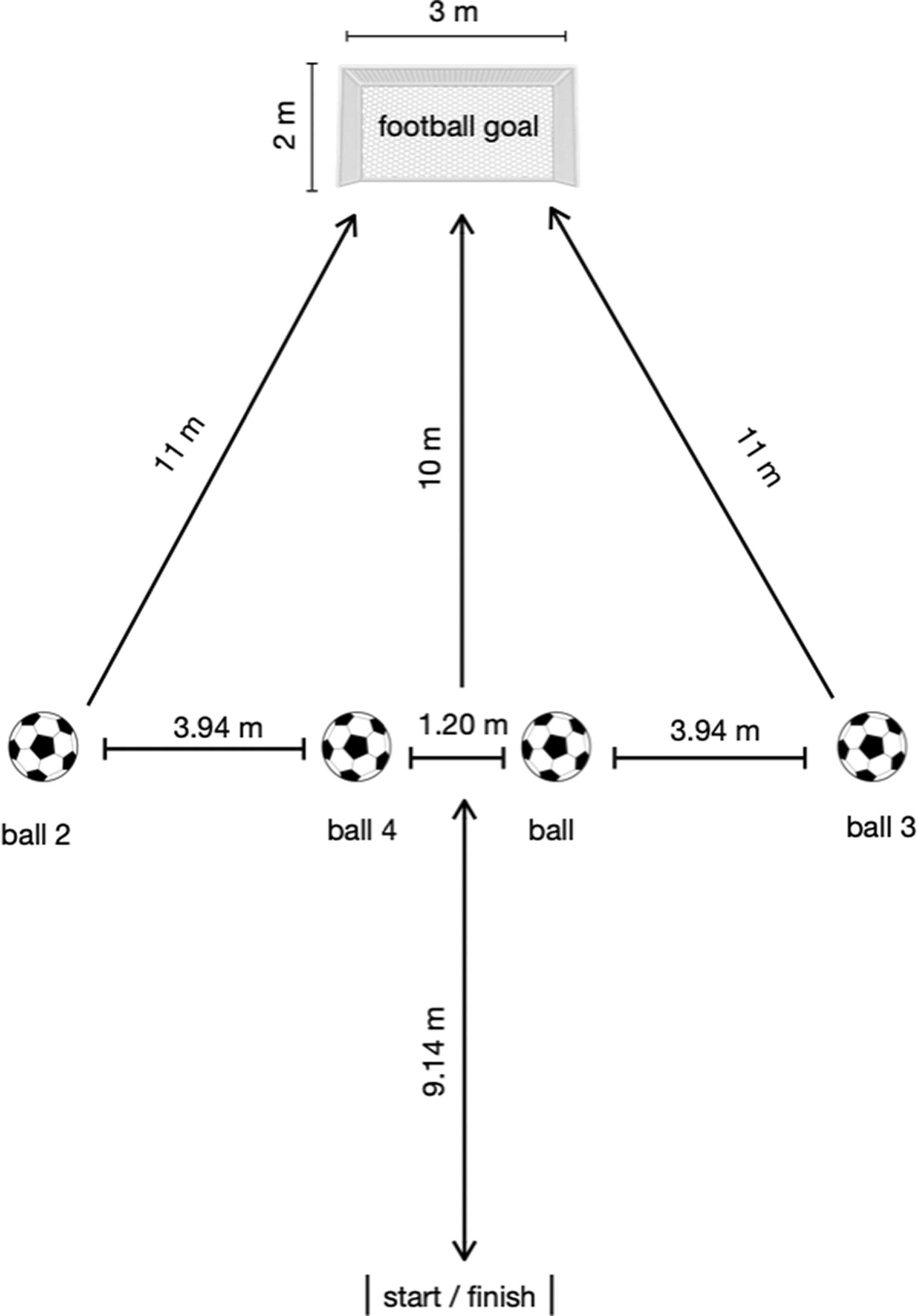
Diagram of the T-Drill Agility Test “Ball-Success.”
Statistical Analysis
We assessed for normal distribution of the data by Kolmogorov-Smirnov, D’Agostino & Pearson and Shapiro-Wilk tests. We checked for the equality of variances with Levene’s test. When the assumption of homogeneity was violated, the degrees of freedom were adjusted. We measured the test-retest reliability of the T-Drill Agility test with ball-success using an intraclass correlation coefficient (ICC, Cronbach-α) and interpreted it as follows: α ≥ 0.9 = excellent; 0.9 > α ≥ 0.8 = good; 0.8 > α ≥ 0.7 = acceptable; 0.7 > α ≥ 0.6 = questionable; 0.6 > α ≥ 0.5 = poor (Tavakol & Dennick, 2011). The number of correct runs of the Stroop test and the number of scored goals in the T-Drill Agility test were shown as medians and quartiles and compared using a nonparametric independent-samples median test. All other data were represented as means (M) and standard deviations (SD). We performed comparisons among means of the variables and parameters using two-tailed, independent Student’s t test. Cohen’s d effect sizes (ES) were determined for each significant test originating from motor skills (T-Drill Agility) and cognitive analysis (Stroop). ES were interpreted following Hopkins’s recommendations (Hopkins, 2007): 0.0–0.2 = trivial; 0.2–0.6 = small; 0.6–1.2 = moderate; 1.2–2.0 = large; > 2.0 = very large. Analyses were carried out with the Statistical Package SPSS version 26 for Mac (Armonk, NY, USA; IBM Corp.).
Results
Participant Groups
All demographic and anthropometric characteristics of the participants are shown in Table 1. High- and low-division soccer players were BMI- and age-matched. Variances of the BMIs were unequal (Levene’s, p = .004), although a comparison of their means revealed no difference between the groups (t(61.647) = 0.228, p = .820). HDP-participants were significantly taller (t(66) = -5.144, p < 0.001) and of greater body weight (t(66) = –3.002, p = .004) than LDP-participants.
Anthropometric and Demographic Characteristics of the Study Participants.
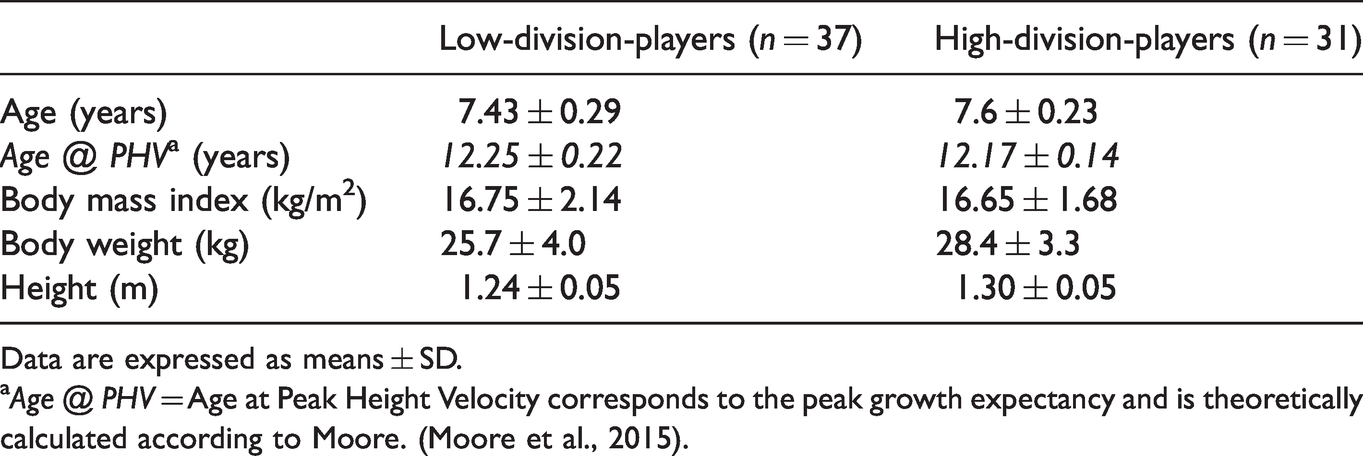
Data are expressed as means ± SD.
aAge @ PHV = Age at Peak Height Velocity corresponds to the peak growth expectancy and is theoretically calculated according to Moore. (Moore et al., 2015).
Maturity Offset (MO)
While Stroop On item analyses revealed a significant group difference (p = .004), there was no group difference with respect to MO (p = .353). The Stroop Off item analyses revealed no group difference (p = .111) and no MO difference (p = .322). Furthermore, analyses of the agility test revealed a significative group difference (p < .001) but, similarly, MO values did not influence agility performance (p = .376).
Cognitive Function
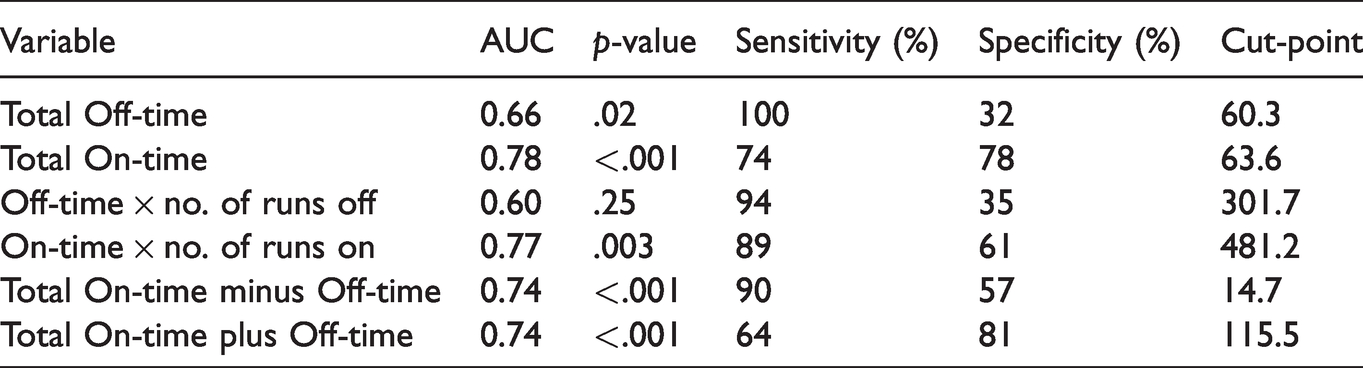
Stroop task results are shown in Table 2, whereas ROC results are reported in Table 3. When incongruent stimuli were displayed (Stroop On), the cognitive task was more difficult, resulting in greater On times than Off times for both groups (Table 2). The total On time was significantly better for the HDP than the LDP group (t(44.114) = 4.411, p < .001, d = 1.01). Correspondingly, there were better Total On time minus Total Off time scores (t(53.976) = 4.169, p < .001, d = 0.97) and for the sum of Total On time plus Off time scores (t(45,259) = 3.915, p < .001, d = 0.89) in the HDP vs LDP group. differences in the number or trials for the set correct runs (three) during either the Stroop On or Stroop Off tasks. ROC results (Table 3) reflected the validity of the Stroop app results (Table 2), as these findings were also demonstrated by the ROC curves. In detail, the total On time showed the highest AUC (AUC = 0.78, p < .001) as compared to all other ROC results. Total On time sensitivity was 74%. Likewise, On time minus Off time was highly sensitive (90%, AUC = 0.74, p < .001), while the sum of On time and Off time showed greater specificity (81%, AUC = 0.74, p < .001). Even the AUC of “On time × no. of runs On was significantly higher (AUC = 0.77, p = .003) and more sensitive (89%). Mean times and SDs for all “T-Drill Agility tests–ball success” are shown in Table 2. The HDP group exhibited a markedly better performance than the LDP group (t(51.663) = 11.069, p < .001), with a very large effect size (d = 2.58). The HDP scored more goals than the LDP group (respectively, medians = 3 vs 2; Q1 = 3 vs 2; Q3 = 4 vs 2, Mann-Whitney U test, p < 0.001). The T-Drill Agility test “ball-success” showed excellent reliability (α = 0.989).
Study Participants’ Results on the Motor Test and Cognitive Performance.
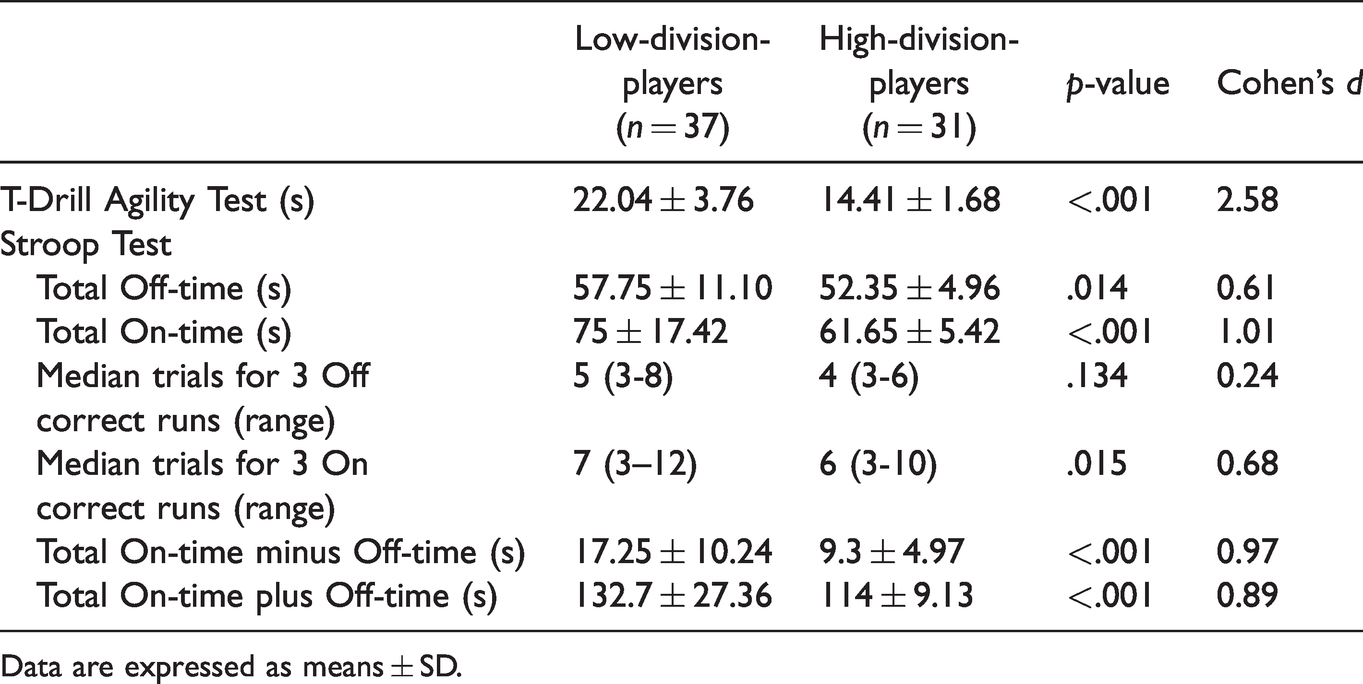
Data are expressed as means ± SD.
ROC Results for the Stroop Tests Conducted in All Young Players.
Discussion
In this study, we scoped the discriminative potential of the T-agility test and inhibitory control among very young soccer players of different competitive levels. The approach resulted ecological and easy-to-administer. Our HDP group performed much better than the LDP, both on the cognitive and soccer-specific agility tests. These findings are in line with previous studies with adolescents and adults demonstrating that in closed skill tasks, elite players, compared to amateurs, had greater: (a) motor skills (Bekris et al., 2018) and (b) cognitive control (Vestberg et al., 2012, 2017), particularly with respect to superior motor inhibition, ability to attain and maintain an alert state, and decision making for effective motor anticipation (Chang et al., 2017). In this study, we addressed similar research questions with very young (mid-childhood) soccer players by administrating brief and valid tests.
Color-word interference on the Stroop On-time task was capable of measuring core cognitive functions like processing speed and inhibitory control (Bajaj et al., 2013; Wang et al., 2013), properly specific to soccer situations (Huijgen et al., 2015; Verburgh et al., 2014). The total Stroop On-time was the best differentiator, since it was the major psychomotor speed variable (i.e., the inhibitory control). The On-time variable was tightly linked to soccer-specific situations in which the player had to quickly re-adapt actions in a dynamically changing environment, sometimes even canceling and reprogramming intended tasks. While the On-time task is a measure of response inhibition, motor speed and, thus, decision-making, the Off-time condition primarily assessed “psychomotor ability,” which covered a broader concept than a soccer-specific scenario in which stimuli are congruent and neutral. Even the total Off-time was significantly better for the HDP group compared to the LDP group. These findings suggest the discriminative validity of the Stroop On-time task (large ES) and that is the better psychomotor inhibitory test for the HDP group. Further, it is noteworthy to pinpoint the high sensitivity of the total On-time cut-point (74%, AUC = 0.78) for detecting HDP group membership (Supplementary Figure 1). Hence, the On-time minus the Off-time variable was selected to control for psychomotor speed, decision-making, and provide a measure of cognitive processing (Bajaj et al., 2013). As expected, this measure was also significantly better in the HDP with respect to the LDP group, with a large effect ES: the On-time minus Off-time was sensitive (90%; AUC = 0.74) for identifying HDP and specific (57%) for detecting LDP, as confirmed by ROC analysis (Supplementary Figure 1). In addition, considering the non-significant number of correct runs, the inter-group difference did reside in the precision of selections which are immediate in sports. In other words, the elite athlete does the right thing (decision-making) when needed.
As for the T-Drill Agility test, the HDP group outperformed the LDP group with a very large ES. The classical version of this test was modified according to Kutlu et al. (2012) in order to be more adherent to skills required by an iconic soccer behavior. Thus, we added the ability shoot and score goals (striking skills) and considered this a positive test. Importantly, the number of scored goals reflected the distinctive technical level of the players. In detail, the HDP group outperformed LDP peers, demonstrating high coordination skills during changes of direction (speed-agility), sprinting phases, left- and right-side shuffling, back pedaling run, and specific soccer strikes (Kutlu et al., 2012). Overall, this was accompanied by an integration of cognitive functions (in this case, action planning) that allowed successful motor performance. The present indications underlie that both components (cognitive and motor skills) elicit successful performance in soccer among players in mid-childhood and not only among those adolescence (Vestberg et al., 2017). Our tools were sufficiently robust and viable for this joint skill assessment. However, for scouting purposes in children of developmental age, a more comprehensive and multidimensional approach should be preferred.
These pairwise comparisons highlighted that cognitive tasks can be utilized in the future to distinguish between elite and novice young players, in line with findings from Sakamoto et al. (2018). Performance identification might harness routines based not only on technical-tactical skills, but also on these aspects of cognitive functioning. Relying on open-skills, a successful soccer behavior requires sport-specific perceptual abilities (“game intelligence”) that correspond to the “cognitive functions” in psychology (Leon-Carrion et al., 2004). In other words, we implemented a set-up capable of capturing even the young player’s ability to “read the game.”
We found a significant difference between groups on the Stroop test (On-time) and the agility drill test, even though MO values did not affect these cognitive and physical performances. Possibly, age and MO were not primarily responsible for the performance. In line with this, the age at peak high velocity was not low (Age@PHV, Table 1), considering that growth peak was attested to at the age of 13 (Centers for Diseases Control, 2001; Rogol et al., 2000). Moreover, it is quite common to have 11-12-year-old youngsters with very mature secondary sexual characteristics (Malina et al., 2015).
In their research of talented soccer performance, Johnson et al. (2017) suggested that selection bias in the maturation period appears from ∼11 years of age and increases thereafter. In younger players of about the same age, a different MO seems to be less crucial in determining cognitive functions and players’ agility (Tierney et al., 2016). At this age, the specific rules of youth soccer (players number, dimension of the field, duration of the matches, etc.) give less advantages to early-matured players compared to the older categories, owing to the lower physical component of the game.
Limitations and Directions for Further Research
Obviously, several limitations applied to this study. First, these findings are strictly related to these data and lack generalizability until there has been replication. Second, the Stroop-app we used was validated in a sport setting here for the first time; clearly limiting the translation of these data to other comparable scales (Leon-Carrion et al., 2004; Wright, 2017). Lastly, a myriad of incidental variables could deflect the path of a gifted player from becoming an actual elite adult player, meaning that a good performance on these measures does not assure success of individual players. While valuable in its simplicity, this athlete selection model risks being over simplistic. For instance, we omitted and neglected any study of peculiar cognitive- and motor skill profiles of different playing positions.
Conclusions
The present study corroborated the discriminative validity of the Stroop app test to detect cognitive control abilities in an easy-to-administer, quick and reliable way. Combining the Stroop On time score with an agility-ball-success score was associated with positive performance among male soccer players in mid-childhood. Practically, the identification of such promising performance might include tests based not only on technical-tactical skills, but also on the players’ level of cognitive functioning. This function has been demonstrated to be associated with higher-level players, both at adolescent and adult levels. Coaches and talent scouts should consider cognitive function as a concrete cognitive skill that helps distinguish propitious youth sport performance.
Talent identification is not utterly reliable until puberty is completed (Güllich, 2014; Höner et al., 2017). However, there is yet evidence that early specialization might be harmful for talent development (Sugimoto et al., 2017). In line with these arguments, we still think that multidimensional research in the youngest players may provide the basis for promising, long-term, soccer development model, irrespective of the actual performance level. An evidence-based adaptation of this model (Faude, 2018), entailing valid and quick assessment tools may save economic resources of the soccer academies and ensure health perspective (e.g. avoiding injuries). Soccer-specific skills and some aspects of cognitive functions, like executive functions, can be both trained from childhood. From the perspective of monitoring young players’ development, we recommend assessing agility and executive control, because these two factors have discriminative potential in distinguishing youth competitive levels.
Supplemental Material
sj-pdf-1-pms-10.1177_00315125211040283 - Supplemental material for Screening Youth Soccer Players by Means of Cognitive Function and Agility Testing
Supplemental material, sj-pdf-1-pms-10.1177_00315125211040283 for Screening Youth Soccer Players by Means of Cognitive Function and Agility Testing by Nicola Lovecchio, Gianluca Manes, Luca Filipas, Matteo Giuriato, Antonio La Torre, F. Marcello Iaia and Roberto Codella in Perceptual and Motor Skills
Footnotes
Acknowledgments
The authors would like to thank all the young players, their parents and the relative soccer academies that participated to the study.
Declaration of Conflicting Interests
The author(s) declared no potential conflicts of interest with respect to the research, authorship, and/or publication of this article.
Funding
The author(s) received no financial support for the research, authorship, and/or publication of this article.

Supplemental Material
Supplementary material for this article is available online.
Author Biographies
References
Supplementary Material
Please find the following supplemental material available below.
For Open Access articles published under a Creative Commons License, all supplemental material carries the same license as the article it is associated with.
For non-Open Access articles published, all supplemental material carries a non-exclusive license, and permission requests for re-use of supplemental material or any part of supplemental material shall be sent directly to the copyright owner as specified in the copyright notice associated with the article.
