







Abstract
How people encode numbers in the context of multiple overlapping encoded cues remains unclear. In this study, we explored Chinese finger numbers, which contain both a numerical magnitude cue and a left-right hand cue offered by the expressing hand, to investigate the number encoding mechanism in the context of multiple overlapping cues. Chinese finger numbers expressed by the left or right hand were randomly and centrally presented on a computer screen to participants who were asked to perform a hand classification task (Experiment 1), a magnitude classification task (Experiment 2), a parity classification task (Experiment 3) and a magnitude classification or ring classification task (Experiment 4). We discovered (a) only an association effect between the pressed key and the expressing hand in hand classification and parity classification tasks, (b) the SNARC effect only on the magnitude classification task, (c) the association effect between the pressed key and the expressing hand on the larger, Chinese finger number, magnitude classification task in Experiment 2, and (d) the SNARC effect and the association between the pressed key and the expressing hand were reversed on the ring classification task. From these results, we concluded that people can flexibly choose appropriate number encoding cues and how numbers are encoded in the context of multiple overlapping cues depending on (a) which cognition task individuals perform and (b) the character of the numbers involved.
Keywords
Introduction
While numbers have very important roles in our lives, how numbers are encoded in the brain and how this encoding influences a person’s responses remain open questions. At the end of the last century, Dehaene et al. (1993, 1990) studied these questions by centrally presenting Arabic numbers on a screen and asking participants to classify these probe numbers according to their magnitude or parity by pressing a left key or right key. The response to small numbers was faster when pressing the left (versus right) key, whereas the response to large numbers was faster when pressing the right (versus left) key. These findings were obtained in both numerical magnitude classification tasks and numerical parity classification tasks. This association phenomenon was named the spatial-numerical association of response codes (SNARC) effect (Dehaene et al., 1993, 1990). In subsequent research, many scholars have further investigated the stability and universality of the SNARC effect with other symbolic numbers, such as Chinese and German number words (Kopiske et al., 2016; Nuerk et al., 2005), and with non-symbolic numbers, such as brightness, luminance, angles, and pitch (Cho et al., 2012; Fumarola et al., 2014, 2016, 2020; Holmes & Lourenco, 2011). These results have shown that the SNARC effect occurs in both numerical magnitude-relevant classification tasks and numerical magnitude-irrelevant classification tasks. For example, Fumarola et al. (2014) replaced Arabic numbers with squares having varied luminance; they captured the SNARC effect in both a luminance-relevant task and luminance-irrelevant task.
To explain the presence of the SNARC effect during number processing, polarity correspondence theory emerged, suggesting that participants encode small numbers as having negative polarity and large numbers as having positive polarity. Participants encode left-key presses as having negative polarity and right-key presses as having positive polarity. Thus, the polarity of small/large numbers corresponds to the polarity of pressing the left/right key. Therefore, polarity correspondence between numbers and responses causes the SNARC effect in processing numbers (Proctor & Cho, 2006; Proctor & Xiong, 2015; Reber et al., 2010). Note that polarity encoding is observed for not only number processing but also processing other information, such as sequence symbols and locations (Mapelli et al., 2003; Proctor & Cho, 2006; Proctor & Xiong, 2015; Shi et al., 2020; Wang et al., 2021, 2020). For example, when the numerical location is stressed by presenting numbers on the left or right side of the screen, individuals may encode the left-hand presentations as having negative polarity and the right-hand presentations as having positive polarity; this encoding leads to the spatial stimulus-response compatibility effect in numbers cognition, in which left-hand stimuli elicit faster left-key pressing than right-key pressing, and vice versa, even in a location classification task (Wang et al., 2020).
Although previous studies have investigated the SNARC effect in the processing of symbolic and non-symbolic numbers, the numbers that earlier investigators explored offered only one effective polarity encoding cue (numerical magnitude). When numbers offer more numerical polarity cues, it is unclear how individuals might encode them. Answering this question would not only reveal the encoding mechanism for numbers but would also guide educational activities and human engineering designs. For example, this knowledge might assist in the design of a human-computer interaction interface, improving work efficiency and testing students' number encoding abilities based on the number processing mechanism.
Chinese people often count numbers with the fingers of their left or right hands in daily life. For example, Chinese people often express the number eight by using the thumb and index finger of their left hand or right hand so that Chinese finger numbers simultaneously offer two encoding cues for participants, a numerical magnitude cue and a left hand or right hand cue. For example, when expressing the number eight with the thumb and index finger of the left hand, participants can recognize the numerical magnitude and that the left hand is used to express the number eight. Since Chinese finger numbers are a very suitable stimulus for investigating the number encoding mechanism in the context of multiple overlapping encoded cues, in this study, we used Chinese finger numbers to further investigate numerical encoding in the context of multiple overlapping encoding cues.
This study consisted of four experiments. Each experiment involved Chinese finger numbers one to nine, except five, expressed with either the left hand or right hand and randomly displayed in the center of the screen. The cognitive tasks that the participants performed varied among these four experiments. In Experiment 1, participants were asked to determine whether the probe finger numbers were expressed by the left or right hand (hand classification task), permitting us to investigate how Chinese finger numbers were encoded when the left- and right-hand cues were emphasized. In Experiment 2, participants were asked to determine whether the probe finger numbers were larger or smaller than five (magnitude classification task) so that we could investigate how the finger numbers were encoded when the numerical magnitude was emphasized. In Experiment 3, participants were asked to determine whether the probe finger numbers were odd or even (parity classification task) so that we could investigate how the Chinese finger number was encoded when finger number parity was emphasized. In Experiment 4, we further manipulated the Chinese task character as the control variable to further investigate how the task character moderates number encoding in the context of multiple overlapping cues.
Method: Experiment 1
As noted, in Experiment 1, we applied the hand classification task to investigate how Chinese finger numbers were encoded when the left- and right-hand cues were emphasized in the context of multiple overlapping cues. We predicted that the left- and right-hand cues would be used to encode the Chinese finger numbers and cause the association effect between the pressed key and the expressing hand.
Participants
We recruited a sample of university student participants for Experiment 1. All participants were right-handed and had normal or corrected-to-normal vision and had not recently participated in a similar experiment. In total, we selected 30 university students (28 female and 2 male; age: M = 19.8, SD = 0.96 years, and range = 8 to 22 years). We obtained the participants’ informed consent prior to starting the experiment, and the research protocol was approved by the ethics committee (which also applies to the next three experiments of this study).
Stimuli and Apparatus
We explored Chinese finger numbers 1–9 (except 5) expressed by the left hand or right hand as our experimental stimuli (refer to Figure 1). All stimuli were presented on a 19-inch computer screen with 1280 × 1024 pixel resolution and a 60 Hz refresh rate. The visual angle of each finger number was approximately 3.76° when the viewing distance was 50 cm.
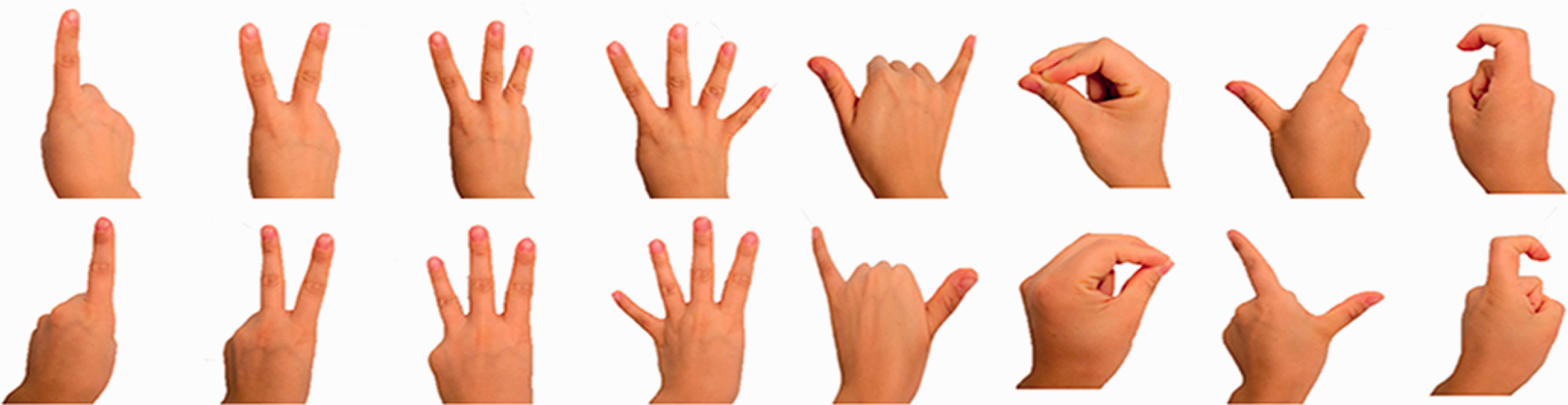
Chinese Finger Numbers Explored in Experiment 1.
Research Design
Experiment 1 applied a 2 (pressed key: left vs. right) × 2 (numerical magnitude: small numbers vs. large numbers) × 2 (expressing hand: left vs. right) within-participant experimental design. We employed the participants’ response times (RTs) as dependent measures. The small numbers were 1–4, and the large numbers were 6–9.
Procedure
The experiment was run with E-prime software. The procedure of each trial was as follows: First, a fixation cross was centrally displayed on the screen for 500 ms. Second, the fixation cross disappeared and was replaced by a probe Chinese finger number, which was randomly chosen from the stimuli displayed in Figure 1 and lasted three seconds or until the participant responded. Participants were asked to determine whether the probe Chinese finger number was expressed by the left hand or right hand and to give a response by pressing the left key (“F”) or right key (“J”) on the keyboard. Once the participants gave a response to the probe number, the probe number disappeared and was replaced by a blank screen for 1500 ms before the next trial started. If the participants gave no response to the probe number within three seconds, the probe number disappeared and was replaced by a blank screen for 1500 ms, and then the next trial started. The entire experiment contained two blocks. In one block, the participants were asked to press the left key in response to Chinese finger numbers expressed by the left hand and to press the right key in response to Chinese finger numbers expressed by the right hand. In the other block, the participants were asked to press the left key in response to Chinese finger numbers expressed by the right hand and to press the right key in response to Chinese finger numbers expressed by the left hand. In all trials, the left index finger was placed on the left key, and the right index finger was placed on the right key. The order of the two blocks was balanced across the participants. The entire experiment contained 160 formal trials. In addition, the participants were presented with six practice trials (repeated as needed) to familiarize themselves with the procedure before each block. The entire experiment lasted approximately 15 minutes.
Results and Discussion: Experiment 1
We excluded the RTs of the incorrect trials and the RTs that exceeded three standard deviations from the mean for each treatment (5% of all trials) from further analyses. We analysed the remaining RTs with a repeated-measures analysis of variance (ANOVA). The results indicated that the main effect of numerical magnitude was significant (F(1, 29) = 62.03, p < 0.001, and η2 = 0.681), and large numbers elicited faster responses (M = 691, SD = 23.80 ms) than small numbers (M = 769, SD = 29.48 ms). The interaction effect between the pressed key and the expressing hand was also significant (F(1, 29) = 60.30, p < 0.001, and η2 = 0.675), such that the numbers expressed by the left hand elicited faster responses (M = 623, SD = 19.08 ms) than the numbers expressed by the right hand (M = 840, SD = 37.09 ms) when the left key was pressed (F(1, 29) = 64.27, p < 0.001, and η2 = 0.689). The numbers expressed by the right hand elicited faster responses (M = 612, SD = 15.52 ms) than the numbers expressed by the left hand (M = 846, SD = 43.34 ms) when the right key was pressed (F(1, 29) = 44.45, p < 0.001, and η2 = 0.605). These results also reflect an association effect between the pressed key and the expressing hand (refer to Figure 2), and the interaction among the pressed key, numerical magnitude and expressing hand was significant (F(1, 29) = 4.75, p = 0.038, and η2 = 0.141). No other main effects or interaction effects were significant in this experiment.
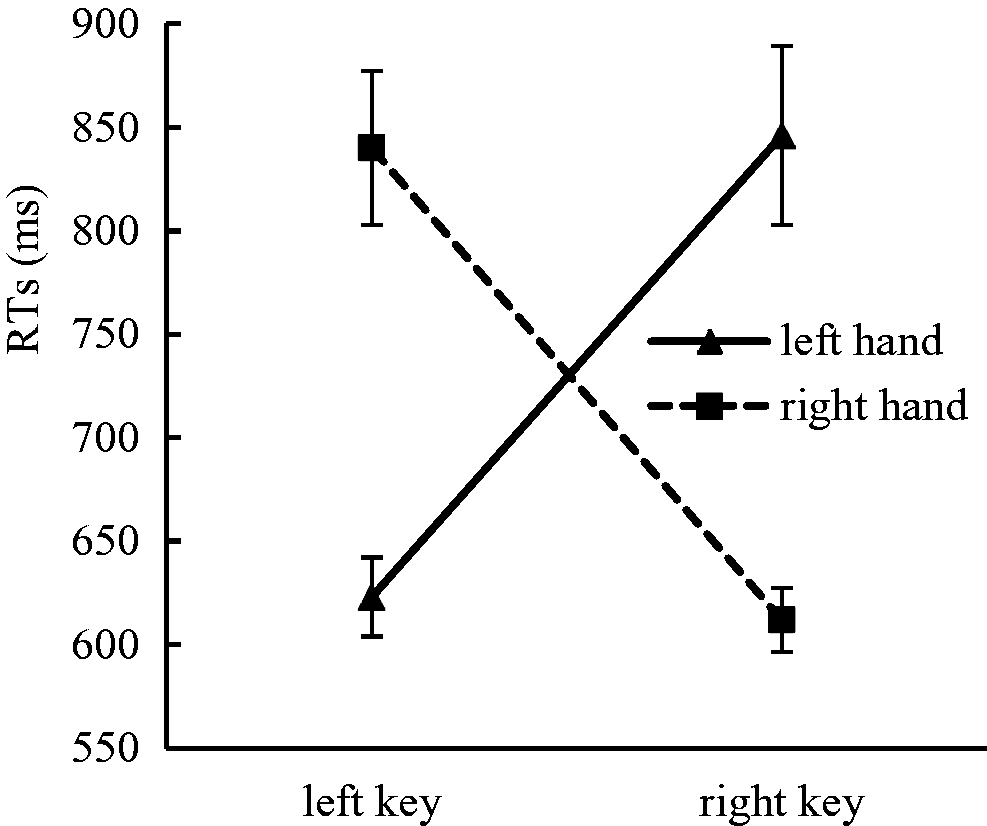
Mean RTs of Participants Responding to Chinese Finger Numbers Expressed by the Left Hand and Right Hand with Left Key Presses or Right Key Presses.
The interaction effect between the pressed key and the numerical magnitude was not significant, implying that there was no SNARC effect in this experiment. Given the significant interaction effect among the pressed key, numerical magnitude and expressing hand, we further analysed the SNARC effect in Chinese finger numbers expressed by the left hand and those expressed by the right hand to exclude the possibility that the SNARC effect was modulated by the expressing hand. These results showed that the SNARC effect was obscured in both the processing of Chinese finger numbers expressed by the left hand (F(1, 29) = 1.39, p = 0.248, and η2 = 0.046) and in the processing of Chinese finger numbers expressed by the right hand (F(1, 29) = 3.64, p = 0.067, and η2 = 0.111).
Experiment 1 aimed to investigate how Chinese finger numbers were encoded when the left-right hand encoding cue was emphasized. We discovered an association effect between the pressed key and the expressing hand but no SNARC effect, indicating that the participants could encode Chinese finger numbers by only relying on the left and right cues offered by the expressing hand.
Method: Experiment 2
In Experiment 2, we emphasized a magnitude classification task in the context of multiple overlapping encoded cues. We then predicted that the numerical magnitude cue would be used to encode the Chinese finger numbers and would therefore lead to the SNARC effect. However, we could not rule out the possibility that the left and right cues could also be applied to encode the Chinese finger numbers in this context.
Participants
We recruited a convenience sample of university student participants. All participants were right-handed and had normal vision or corrected-to-normal vision. In addition, none of the participants had recently participated in a similar experiment. We selected 32 University students (30 female and 2 male) for Experiment 2 (M age = 19.56, SD = 0.86 years; age range: 18–21 years).
Stimuli, Apparatus and Research Design
We used the stimuli and apparatus utilized in Experiment 1 and employed a 2 (pressed key: left vs. right) × 2 (numerical magnitude: small numbers vs. large numbers) × 2 (expressing hand: left vs. right) within-participant experimental research design, with participant RTs as dependent measures. The small numbers were 1–4, and the large numbers were 6–9.
Procedure
The procedure in Experiment 2 was similar to that of Experiment 1, except that in Experiment 2, the participants were asked to classify the Chinese finger numbers based on numerical magnitude.
Results and Discussion: Experiment 2
We deleted all RTs from the incorrect trials and the RTs that exceeded three standard deviations from the mean for each treatment (4.34% of all trials), removing these data from further analyses. The remaining RTs were analysed by a repeated-measures ANOVA. We then found the main effect of the pressed key to be significant (F(1, 31) = 4.95, p = 0.034, and η2 = 0.138) and determined that the RTs for pressing the right key were faster (M = 581, SD = 11.10 ms) than those for pressing the left key (M = 590, SD = 11.77 ms), indicating a dominant hand effect. The main effect of numerical magnitude was also significant (F(1, 31) = 42.51, p < 0.001, η2 = 0.578), and small numbers elicited faster responses (M = 568, SD = 10.71 ms) than large numbers (M = 603, SD = 12.39 ms). The main effect of the expressing hand was also significant (F(1, 31) = 6.50, p = 0.016, and η2 = 0.173), and numbers expressed by the left hand elicited faster responses (M = 581, SD = 10.92 ms) than those expressed by the right hand (M = 590, SD = 11.84 ms). The interaction effect between the pressed key and the numerical magnitude was significant (F(1, 31) = 8.08, p = 0.008, and η2 = 0.207), and a simple effect analysis revealed that there was no significant difference in RTs for small numbers between response times with the left key (M = 564, SD = 11.47 ms) and those with the right key (M = 572, SD = 11.00 ms); F(1, 31) = 1.28, p = 0.267, and η2 = 0.04. However, for large numbers, the right key elicited faster responses (M = 590, SD = 12.94 ms) than the left key (M = 616, SD = 13.26 ms) (F(1, 31) = 12.20, p = 0.001, and η2 = 0.282), indicating the presence of the SNARC effect (refer to Figure 3).
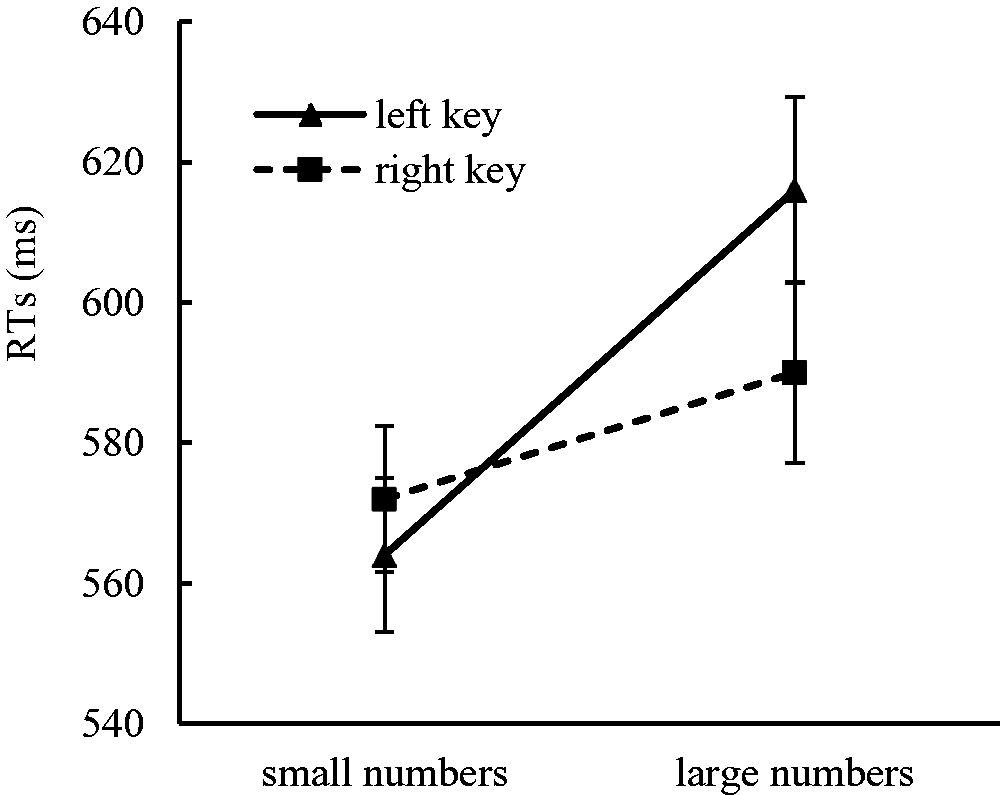
Mean RTs of Participants Responding to Small Chinese Finger and Large Chinese Finger with Left Key Presses and Right Key Presses.
Although the difference in RTs for small numbers responded to with the left and right keys was not significant, this result does not negate our discovery of the SNARC effect as the SNARC effect was illustrated by the main effect of numerical magnitude, in which small numbers elicited faster responses than large numbers. Similar results were also obtained in previous studies (Price & Mentzoni, 2008; Riello & Rusconi, 2011; Wang et al., 2018, 2019).
The interaction effect between the pressed key and the expressing hand was not significant (F(1, 31) = 2.33, p = 0.137, and η2 = 0.07). However, the three-way interaction effect among the pressed key, expressing hand and numerical magnitude was significant (F(1, 31) = 5.93, p = 0.021, and η2 = 0.161), implying that the association effect between the pressed key and the expressing hand was likely to have been moderated by the numerical magnitude. Therefore, we further investigated the association effect between the pressed key and the expressing hand with small and large number conditions. These results showed that the interaction between the pressed key and the expressing hand was not significant in the small number condition (F(1, 31) = 0.04, p = 0.836, and η2 = 0.001), indicating that the association effect between the pressed key and the expressing hand was obscured in the small number condition in this experiment. The interaction between the pressed key and the expressing hand was significant with large numbers (F(1, 31) = 6.20, p = 0.018, and η2 = 0.167), indicating that the association effect between the pressed key and the expressing hand occurred in the large number condition in this experiment (refer to Figure 4).
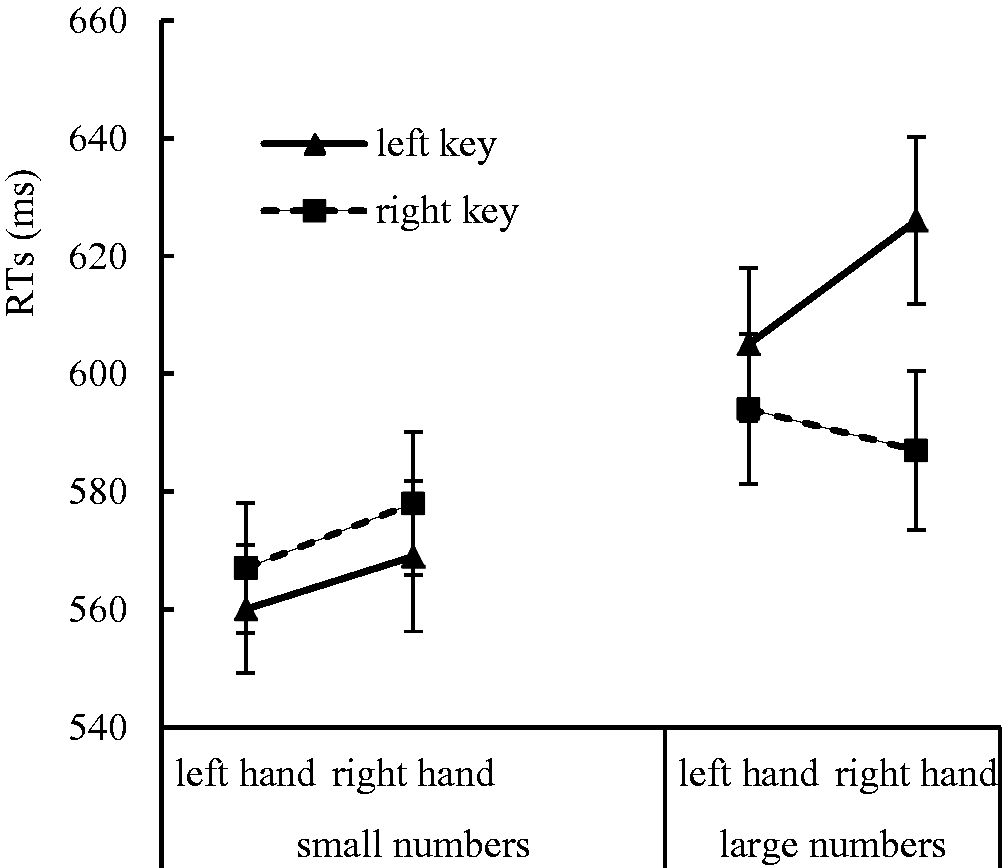
Mean RTs of Participants Responding to Chinese Finger Numbers Expressed by the Left Hand and Right Hand with Left Key Presses or Right Key Presses.
Experiment 2 investigated how Chinese finger numbers were encoded when the numerical magnitude cue was emphasized, when the SNARC effect occurred, and when there was an association effect between the pressed key and the expressing hand only in the large number condition. Thus, participants encoded Chinese finger numbers based on their magnitude and based on the left and right cues in the larger Chinese finger number condition. Note that the encoding strength of the left-right hand cue seemed weak and was only reflected in the encoding of large finger numbers.
Method: Experiment 3
In Experiment 3, we stressed a parity classification task to investigate how Chinese finger numbers were encoded when neither the numerical magnitude cue nor the left-right hand cue was emphasized. We predicted that the left- and right-hand cues would then be utilized to encode Chinese finger numbers, leading to an association effect between the pressed key and the expressing hand in this context.
Participants
We used convenience sampling to recruit 32 University students as participants for Experiment 3. All participants were right-handed and had normal vision or corrected-to-normal vision and had not recently participated in a similar experiment. The students included 30 females and 2 males (M age = 20.5, SD = 1.11 years; age range: 18–24 years).
Stimuli, Apparatus and Research Design
The stimuli and apparatus utilized in Experiment 3 were similar to those employed and described in Experiments 1 and 2. Experiment 3 applied a 2 (pressed key: left vs. right) × 2 (numerical magnitude: small numbers vs. large numbers) × 2 (expressing hand: left vs. right) within-participant experimental design, and we applied the participants’ RTs as dependent measures. The small numbers were 1–4, and the large numbers were 6–9.
Procedure
The procedure for Experiment 3 was similar to that of Experiments 1 and 2, except that the participants in Experiment 3 were asked to classify the Chinese finger numbers based on numerical parity.
Results and Discussion: Experiment 3
We deleted the RTs from the incorrect trials and the RTs that exceeded three standard deviations from the mean for each treatment (5.70% of all trials), removing them from further analyses. We analysed the remaining RTs by a repeated-measures ANOVA. We observed a significant main effect of the pressed key (F(1, 31) = 6.60, p = 0.015, and η2 = 0.176), such that pressing the right key was faster (M = 633, SD = 14.17 ms) than pressing the left key (M = 654, SD = 15.33 ms), indicating a dominant hand effect. The main effect of numerical magnitude was also significant (F(1, 31) = 30.78, p < 0.001, and η2 = 0.498), with small numbers eliciting faster responses (M = 621, SD = 12.20 ms) than large numbers (M = 666, SD = 16.98 ms). The interaction effect between the pressed key and the expressing hand was significant (F(1, 31) = 4.27, p = 0.047, and η2 = 0.121), with numbers expressed by the left hand eliciting faster responses (M = 642, SD = 16.46 ms) than numbers expressed by the right hand (M = 666, SD = 16.03 ms) when the left key was pressed (F(1, 31) = 5.04, p = 0.032, and η2 = 0.14). There was no difference in RTs between the numbers expressed by the left hand (M = 631, SD = 14.57 ms) and the numbers expressed by the right hand (M = 636, SD = 17.03 ms) when the right key was pressed (F(1, 31) = 0.137, p = 0.714, and η2 = 0.004). This finding indicated an association effect between the pressed key and the expressing hand (refer to Figure 5). No other main effects or interaction effects were significant in Experiment 3.
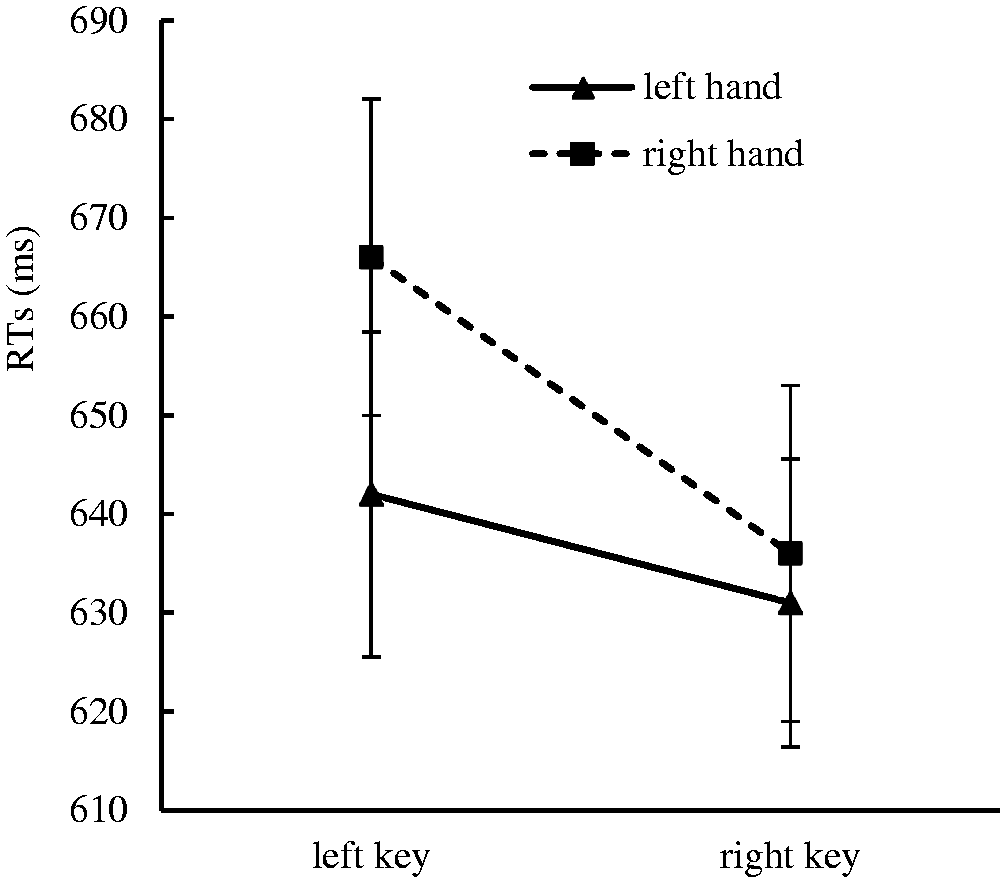
RTs of Participants Responding to Chinese Finger Numbers Expressed by the Left Hand and Right hand with Left Key Presses or Right Key Presses.
Experiment 3 investigated how Chinese finger numbers were encoded when numerical parity was stressed and revealed an association effect between the pressed key and the expressing hand. The SNARC effect was obscured, indicating that the participants encoded Chinese finger numbers based on only the left- and right-hand cues in this condition.
Method: Experiment 4
Having concluded from the first three experiments that the SNARC effect occurred only in the magnitude classification task, in Experiment 4, we further manipulated a task character as a control variable. We predicted that the SNARC effect in processing Chinese finger numbers would interact with the task character effect.
Participants
We performed convenience sampling to recruit 64 University students as participants for Experiment 4. All participants were right-handed, had normal vision or corrected-to-normal vision, and had not recently participated in a similar experiment. The students comprised 52 females and 12 males (M age = 20.38, SD = 1.64 years; age range: 18–25 years).
Stimuli and Apparatus
The stimuli and apparatus used in Experiment 4 were similar to those used and described in Experiments 1, 2 and 3, except that we included additional stimuli, in which all hands displaying Chinese finger numbers included a ring worn on the left index finger or right index finger. In Experiment 4, half of the hands displaying Chinese finger numbers excluded a ring worn in the same manner as worn in the first three experiments, but half of the hands displaying Chinese finger numbers included a ring worn on the left or right index finger.
Research Design
In Experiment 4, we applied a 2 (pressed key: left vs. right) × 2 (numerical magnitude: small numbers vs. large numbers) × 2 (expressing hand: left vs. right) × 2 (task character: magnitude classification vs. ring classification) mixed experimental design, in which the pressed key, numerical magnitude and expressing hand were within-participant factors, but the task character was a between-subjects factor. We utilized the participants’ RTs as dependent measures. The small numbers were 1–4, and the large numbers were 6–9.
Procedure
The procedure for Experiment 4 was similar to that of Experiment 1, except that the participants in Experiment 4 were asked to judge whether the Chinese finger number was smaller or larger than five in the magnitude classification task or to judge whether a ring was worn on the index finger of the Chinese finger number in the ring classification task. We randomly assigned 32 university students to the magnitude classification task and randomly assigned 32 other university students to the ring classification task.
Results and Discussion: Experiment 4
We deleted the RTs from the incorrect trials and the RTs that exceeded three standard deviations from the mean for each treatment (5.08% of all trials), removing them from further analyses. We analysed the remaining RTs by a repeated-measures ANOVA. The results showed a significant main effect of the pressed key (F(1, 62) = 6.33, p = 0.014, and η2 = 0.093), such that pressing the right key was faster (M = 527, SD = 8.26 ms) than pressing the left key (M = 536, SD = 9.06 ms), indicating a dominant hand effect. The main effect of numerical magnitude was also significant (F(1, 62) = 37.78, p < 0.001, and η2 = 0.379), such that small numbers elicited faster responses (M = 524, SD = 8.27 ms) than large numbers (M = 540, SD = 8.87 ms). The main effect of task character was also significant (F(1, 62) = 11.92, p = 0.001, and η2 = 0.161), such that ring classification elicited faster responses (M = 503, SD = 11.99 ms) than magnitude classification (M = 561, SD = 11.99 ms). The interaction effect among the pressed key, numerical magnitude and task character conditions was significant (F(1, 62) = 17.61, p < 0.001, and η2 = 0.221), indicating that the SNARC effect in processing Chinese finger numbers was moderated by the task character. Further simple effect analysis showed a significant interaction between the numerical magnitude and the pressed key in the magnitude classification task (F(1, 31) = 11.22, p = 0.002, and η2 = 0.266), in which there was a difference in the RTs for small numbers between response times with the left key (M = 542, SD = 13.17 ms), while differences with the right key (M = 555, SD = 13.70 ms) were not significant (F(1, 31) = 1.91, p = 0.177, and η2 = 0.06). However, the large numbers elicited faster responses for the right key (M = 558, SD = 12.45 ms) than for the left key (M = 589, SD = 15.34 ms), (F(1, 31) = 13.37, p = 0.001, and η2 = 0.301), indicating the presence of the SNARC effect in the magnitude classification task. Although the interaction between the numerical magnitude and the pressed key was also significant in the ring classification task (F(1, 31) = 7.57, p = 0.01, and η2 = 0.196), in which the small numbers elicited faster responses for the right key (M = 491, SD = 10.04 ms) than for the left key (M = 508, SD = 11.75 ms), (F(1, 31) = 12.49, p = 0.001, and η2 = 0.287), the absence of a significant difference in RTs for large numbers between response times with the left key (M = 506, SD = 12.13 ms) and response times with the right key (M = 506, SD = 11.99 ms), (F(1, 31) = 0.005, p = 0.944, and η2 = 0.000) indicated that the SNARC effect was reversed in the ring classification task (refer to Figure 6).
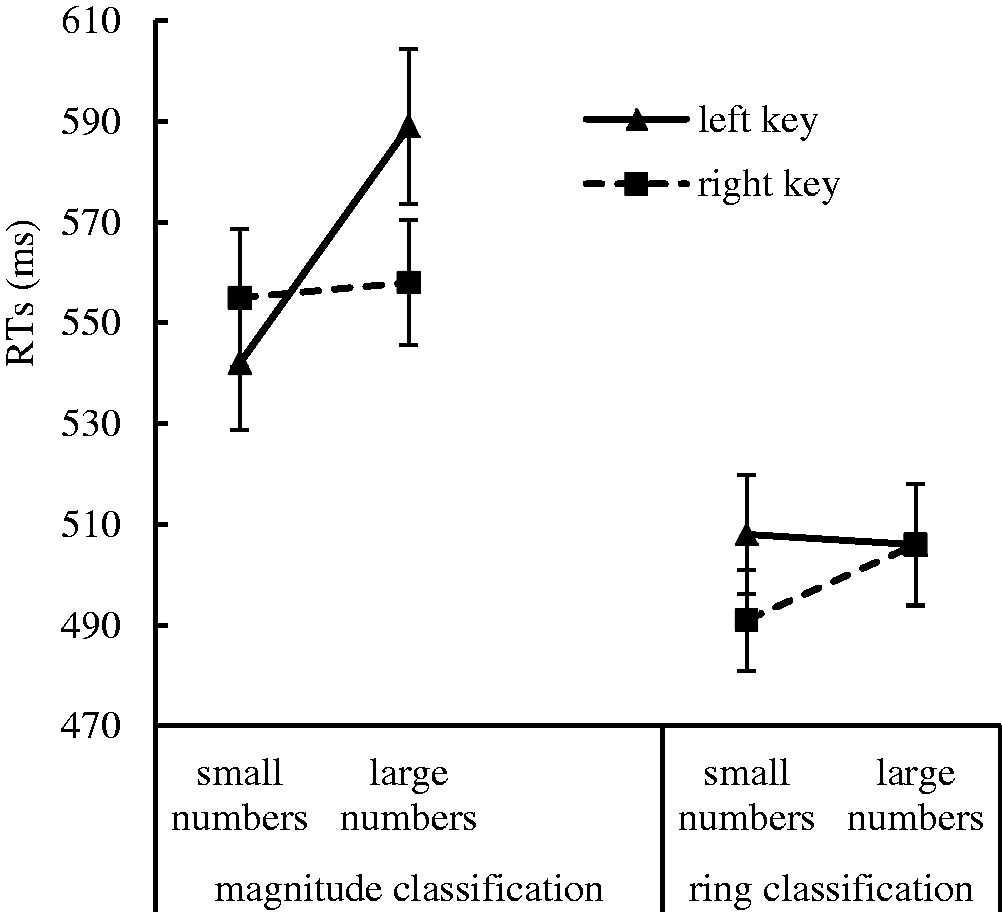
RTs of Participants Responding to Chinese Finger Numbers with Left Key Presses or Right Key Presses in Magnitude Classification Task and Ring Classification Task, Respectively.
There was also a significant interaction among the pressed key, expressing hand and task character (F(1, 62) = 10.16, p = 0.002, and η2 = 0.141), indicating that the association effect between the pressed key and the expressing hand in processing the Chinese finger numbers was moderated by the task character. Further simple effect analysis showed no significant interaction between the expressing hand and the pressed key in the magnitude classification task (F(1, 31) = 2.13, p = 0.15, and η2 = 0.064), indicating that the association effect between the pressed key and the expressing hand was obscured in the magnitude classification task in this experiment. The interaction between the expressing hand and the pressed key was significant in the ring classification task (F(1, 31) = 8.63, p = 0.006, and η2 = 0.218), in which the numbers expressed by the right hand elicited faster responses (M = 499, SD = 11.62 ms) than the numbers expressed by the left hand (M = 515, SD = 12.63 ms) for the left key (F(1, 31) = 8.71, p = 0.006, and η2 = 0.219), and the numbers expressed by the left hand (M = 494, SD = 10.63 ms) elicited faster responses than the numbers expressed by the right hand (M = 502, SD = 11.15 ms) for the right key (F(1, 31) = 4.15, p = 0.05, and η2 = 0.118), indicating that the association effect between the pressed key and the expressing hand was reversed in the ring classification task (refer to Figure 7).
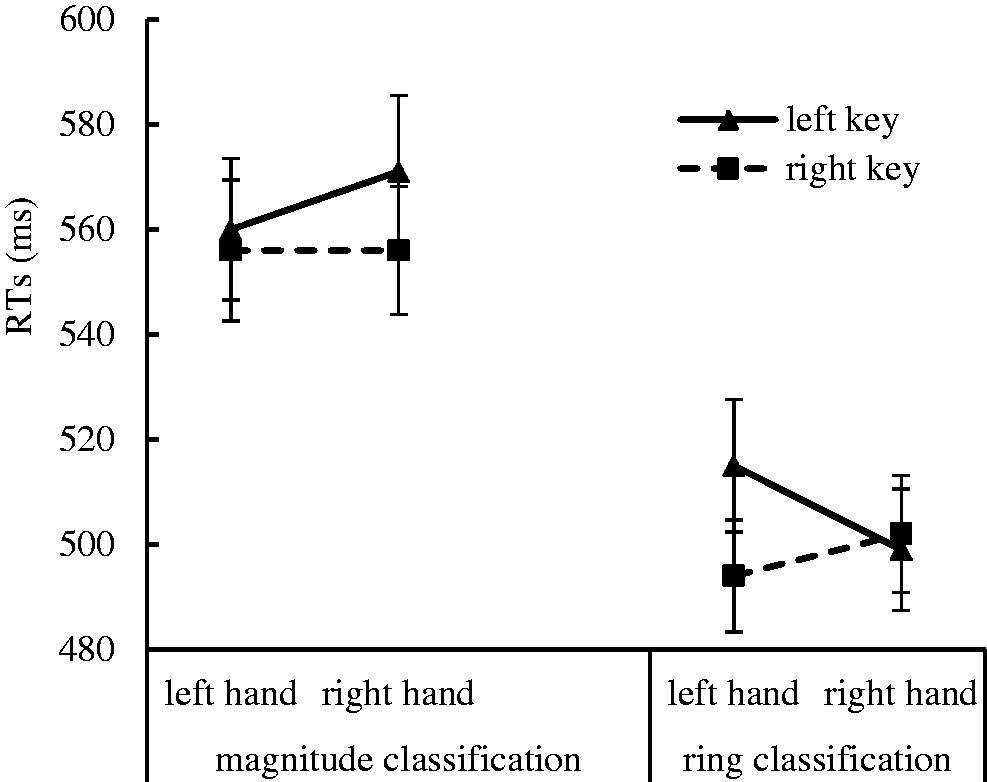
RTs of Participants Responding to Chinese Finger Numbers Expressed by the Left hand and Right hand with Left key presses or Right Key Presses in Magnitude Classification Task and Ring Classification Task, Respectively.
In Experiment 4, we further manipulated the task character as a control variable to strengthen the conclusion that the SNARC effect only occurred in the magnitude classification task and discovered that the SNARC effect occurred in the magnitude classification task but was reversed in the ring classification task. This result further suggested that the SNARC effect only occurred in the magnitude-relevant classification task. In addition, the association effect between the pressed key and the expressing hand was obscured in the magnitude classification task but was reversed in the ring classification task, suggesting that participants encoded Chinese finger numbers based only on numerical magnitude in the magnitude classification task but encoded Chinese finger numbers based on both the numerical magnitude cue and the left-right hand cue in the ring classification task.
General Discussion
Through four experiments, we explored the encoding of Chinese finger numbers with both a magnitude cue and a left-right hand cue for participant encoding. We sought to identify the number encoding mechanism in the context of multiple overlapping encoded cues by stressing. In Experiment 1, we asked the participants to indicate whether the right hand or left hand expressed Chinese finger numbers. We observed an association effect between the pressed key and the expressing hand, but the SNARC effect was obscured. Consistent with polarity correspondence theory, the association effect between the pressed key and the expressing hand was induced by the polarity correspondence between the polarity for encoding the pressed key and the polarity for encoding the expressing hand, but contrary to this theory, there was no polarity correspondence between the polarities for encoding the pressed key and the number magnitude (Proctor & Cho, 2006; Proctor & Xiong, 2015; Reber et al., 2010). From the results of Experiment 1, we can conclude that encoding Chinese finger numbers was based only on the left-right hand cue offered by the expressing hand.
In Experiment 2, we asked participants to classify the probe finger numbers according to the numerical magnitude. We found a SNARC effect in this condition. In addition, we also captured an association effect between the pressed key and the expressing hand in the processing of large numbers. This finding suggests that the Chinese finger numbers were encoded based on the numerical magnitude in this condition. When larger numbers were presented (not when smaller numbers were presented), the Chinese finger numbers were encoded simultaneously based on both numerical magnitude cues and left-right hand cues.
In Experiment 3, we emphasized neither of these cues (numerical magnitude and left-right hand) by asking participants to classify the probe Chinese finger numbers according to their parity. We then observed an association effect between the pressed key and the expressing hand, but the SNARC effect was obscured, meaning that Chinese finger number encoding was based only on the left-right hand cue offered by the expressing hand.
From these three experiments, we could conclude that the SNARC effect occurred only in the numerical magnitude classification task. In Experiment 4, we further strengthened this conclusion by adding task characters with a new ring classification task to examine whether the encoding mechanism was dependent on the task situation for a classification task, making both numerical magnitude cues and left-right hand cues irrelevant. We then discovered that the SNARC effect was moderated by the task character such that it only occurred in the numerical magnitude classification task. Moreover, new findings in Experiment 4 were that both the SNARC effect and association effect between the hand pressing the key and the hand expressing the numbers were reversed in the ring classification task. Thus, the polarity encoding of both numerical magnitude and expressing hand were reversed in the ring classification compared to the parity classification tasks. Although the parity classification task in Experiment 3 and ring classification task in Experiment 4 were irrelevant to the numerical magnitude cues and left-right hand cues, the polarity encoding of numerical magnitude cues and left-right hand cues differed between these two tasks, suggesting a task situation dependency on encoding numbers in the context of overlapping cues.
Previous studies have investigated the SNARC effect for various types of numbers and have shown the SNARC effect in both numerical magnitude-relevant tasks and numerical magnitude-irrelevant classification tasks (Dehaene et al., 1993, 1990; Fumarola et al., 2014, 2016; Holmes & Lourenco, 2011; Kopiske et al., 2016; Nuerk et al., 2005). In this study, we investigated the SNARC effect in the processing of Chinese finger numbers in four different classification tasks. The SNARC effect was only present in the numerical magnitude classification task but was not present (even in reverse) in the numerical magnitude-irrelevant classification task. Our results obtained in the numerical magnitude-irrelevant classification task are inconsistent with the results of previous studies. The experimental paradigm that we applied was similar to that utilized in previous studies, except that the stimuli were different: Chinese finger numbers contained both numerical magnitude cues and left-right hand cues, and these dual cue stimuli were not contained in the stimuli used in previous studies (Dehaene et al., 1993, 1990; Fumarola et al., 2014, 2016; Holmes & Lourenco, 2011; Kopiske et al., 2016; Nuerk et al., 2005). As participants in our study were able to flexibly choose one or two cues when encoding the Chinese finger numbers across different experimental contexts, our failure to show the presence of a SNARC effect in the numerical magnitude-irrelevant classification task suggests that the left-right hand cue in the Chinese finger numbers influenced the encoding of these stimuli. In previous studies using only numbers containing the magnitude cue, participants encoded the numbers based only on the numerical magnitude cue, even in numerical magnitude-irrelevant classification tasks based on parity, colour or other attributes; therefore, the SNARC effect was also captured in the numerical magnitude-irrelevant classification task in previous studies (Dehaene et al., 1990; Fumarola et al., 2014, 2016; Holmes & Lourenco, 2011; Kopiske et al., 2016; Nuerk et al., 2005). Previous studies have shown that the SNARC effect is automatically activated in numerically irrelevant classification tasks. Our failure to observe a SNARC effect in our numerically irrelevant classification task further revealed that the automatic activity of the SNARC effect in processing numbers was moderated by the experimental context.
In addition, we employed Chinese finger numbers to investigate the number encoding mechanism in the context of multiple overlapping encoded cues. Our results revealed that Chinese finger numbers were encoded only on the basis of the left-right hand cue when hand classification was emphasized, but when number magnitude classification was emphasized, the participants encoded the Chinese finger numbers based on both number magnitude and the left-right hand cue in some trials. Thus, the influence of the magnitude cue and left-right hand cue on number encoding is asymmetric, such that the left-right hand cue seemed to be more easily captured for number encoding than the numerical magnitude cue. In our third experiment involving a parity classification task that was irrelevant to both magnitude and left-right hand cues, the participants only used the left-right hand cue to encode the Chinese finger numbers, which provides further evidence that the influence of magnitude and left-right hand cues on number encoding was asymmetric.
From these results, we can conclude that there is great flexibility in encoding Chinese finger numbers. Faced with multiple overlapping encoding cues, participants were able to flexibly choose specific encoding cues and encode numbers accordingly. The encoding cue that participants chose was related to its activation strength. Polarity correspondence theory suggests that individuals encode stimuli and use response behaviors that have a negative or positive polarity based on the salience of various attributes of the stimuli that can vary with the experimental context (Proctor & Cho, 2006; Proctor & Xiong, 2015; Shi et al., 2020). Our findings supported polarity correspondence theory in that participants flexibly chose a specific encoding cue according to changes in the classification task.
Limitations and Directions for Further Research
Although we revealed some number encoding mechanisms in the context of multiple overlapping cues, some questions remain, and further research is required. While the ring and parity classification tasks were irrelevant to both numerical magnitude cues and left-right hand cues, we found that the SNARC effect was obscured and that there was an association between pressed key and expressing hand in the parity classification. However, these two effects were reversed in the ring classification task. Collectively, these findings suggested that the encoding of numbers when there were multiple overlapping cues depended on the task situation even when the classification task was irrelevant to both numerical magnitude cues and left-right hand cues. However, to answer why these two effects were reversed in the ring classification task, we must better understand the more complex encoding mechanisms of numbers in the context of multiple overlapping cues. We will address this question in a series of subsequent studies, perhaps using additional symbols, such as the arrow, location and direction words to represent the left-right hand cue. Furthermore, there may be differences in individual ability to recognize and show sensitivity to different left-right hand cues. Whether our results will extend to other left-right hand cues still needs to be confirmed by further research.
Conclusion
This study explored Chinese finger numbers through a series of experiments to systematically investigate the number encoding mechanism in the context of multiple, overlapping encoding cues. Our results showed that participants could not encode the numbers based only on the numerical magnitude cue. As the classification task changed, participants chose other cues to encode the numbers. Although we obtained some valuable results and improved our understanding of the number encoding mechanism in the context of multiple, overlapping encoding cues, we must next determine with further research whether our findings can be extended to other overlapping encoding cue contexts.
Footnotes
Declaration of Conflicting Interests
The author(s) declared no potential conflicts of interest with respect to the research, authorship, and/or publication of this article.
Funding
The author(s) disclosed receipt of the following financial support for research, authorship and/or publication of this article: This work was supported by the humanities and social sciences preresearch project of Huzhou University (grant number: 2020Skyy02).
