Abstract
In the present study, we aimed to investigate the association between soccer players’ cognitive effort and their tactical behavior. We assessed 52 young male soccer players from a first division Brazilian club, using FUT-SAT to evaluate tactical behavior efficiency and Mobile Eye Tracking-XG software and a video test protocol to measure pupillary behavior and cognitive effort. Following data collection, statistical analyses were performed using the Kolmogorov-Smirnov normality test, and linear regression. We found a high inverse association between cognitive effort and tactical behavior efficiency; players with less cognitive effort during the task displayed higher values of tactical behavior efficiency on the field. We concluded that sustaining less cognitive effort in game situations helped players realize better tactical behavior and enabled better performance.
Introduction
In soccer, many decisions are made under time and space constraints, requiring players to employ cognitive resources quickly and efficiently in order to maintain a high level of performance (Vickers & Williams, 2017). This soccer characteristic requires that players have an appropriate capacity to manage their cognitive effort (Cardoso et al., 2019). Cognitive effort was defined by Lee et al. (1994, p. 329) as the “[…] mental work involved in decision making.” Fiske and Taylor (2013) indicated that, in some situations, the level of cognitive effort required to accomplish some tasks can be very high, exceeding the brain's capacity to use cognitive and neural resources to solve a specific problem. In such cases, players may experience problems with their sports performance (van der Wel & van Steenbergen, 2018; Westbrook & Braver, 2015).
As strong arguments in the literature have supported the possibility of managing cognitive effort (Karatekin, 2004; Shenhav et al., 2013; Westbrook & Braver, 2015), individuals facing situational problems can decide whether investing more or less cognitive effort is best (van der Wel & van Steenbergen, 2018; Westbrook & Braver, 2015). In everyday tasks, with more straightforward decision-making scenarios, researchers have observed a directly proportional relationship between the investment of cognitive effort and successful problem-solving (Botvinick, 2007). In this context, increasing an investment of cognitive effort has led to a more favorable outcome (Botvinick, 2007; Botvinick et al., 2001). However, in soccer, due to its dynamic nature and numerous, quick decision-making demands, sports researchers have suggested that this effort-performance relationship is inversely proportional, meaning a lower investment of cognitive effort has seemed advantageous to performers (Cardoso et al., 2019). However, empirical investigations of this idea in soccer remain limited, and those few that have addressed this issue were conducted in laboratory settings. Therefore, a broader investigation of the effects of cognitive effort on players' tactical behaviors in an actual game context is needed.
In past research, players who were better able to manage their cognitive resources by employing higher cognitive effort during critical situations tended to be more cognitively efficient; and, consequently, they improved their chances of displaying superior performance (Cardoso et al., 2019; Klingner et al., 2011). This observation seemed to be related to the ability of more cognitively efficient players to focus on aspects of play that were more relevant to performance, such as formulating hypotheses, recognizing patterns and searching for relevant information during the game (Klingner et al., 2011; Vickers & Williams, 2017). This assumption was verified in a study by Naito and Hirose (2014) in which the authors observed that a top-level soccer player with high technical skills needed to activate the motor regions of the medial wall of the cortex to a lesser extent during a task in which he was required to move his feet. Thus, this player, seemed to need to employ less cognitive effort when performing certain motor actions, while committing more cognitive effort to highly demanding cognitive tasks, such as accurately processing other environmental and contextual game information (Naito & Hirose, 2014). Thus, when there was a lower demand for cognitive effort to perform a motor action, even if demands were increased in other tasks of greater importance, there was a better performance outcome when lower cognitive effort was generated overall. This higher-performance player was thought to be unlike players who would need a higher cognitive effort in both motor and tactical behavior.
These findings were also supported by Cardoso et al. (2019) who presented first-hand evidence of the associations between tactical (declarative and procedural) knowledge and cognitive effort. They found that players with greater declarative and procedural tactical knowledge required less cognitive effort to make decisions. In addition, findings from some recent studies suggested a three-way relationship between game demands, required cognitive effort and the players’ state of mental fatigue (Cardoso et al., 2019; Kunrath, Nakamura, et al., 2020; van der Wel & van Steenbergen, 2018). If game demands are very high and players are not able to manage cognitive effort appropriately, mental fatigue is more likely, and this, in turn, generates a significant performance decrement (Kunrath, Cardoso, et al., 2020). In the context of these observations and past findings related to cognitive effort, there has been an intensified search for a deeper understanding of the relationship between cognitive effort and performance (Naito & Hirose, 2014; van der Wel & van Steenbergen, 2018; Westbrook & Braver, 2015).
In the specialized literature, several techniques for assessing cognitive effort have been proposed (Brouwer et al., 2014; Just et al., 2003). Among them, pupillometry has stood out, because it allows a precise evaluation of important aspects of real-time information processing at low financial cost (Laeng et al., 2012). Using pupillary behavior to estimate cognitive effort was first proposed by Hess and Polt (1964) who observed small changes in pupil diameter in response to mental activities. Subsequently, Hahnemann and Beatty (1967) demonstrated, in a numerical digit recall task, that pupils progressively dilated as cognitive effort demands increased. On the other hand, as the stimulus/demand decreased, the pupils gradually returned to their resting size. Evidence of a relationship between pupillary behavior and cognitive effort has also been found in other recent studies (Duchowski et al., 2018; Moran et al., 2016).
Only a few soccer studies have utilized pupillometry to assess cognitive effort (Cardoso et al., 2019), and their focus was purely on cognitive and/or physiological variables related to cognitive effort (Capão Filipe et al., 2003; Cardoso et al., 2019). Although we consider the purpose of these studies relevant to this topic, we believe that the key to further insights in the effort-performance relationship is to assess how pupil dilation is associated with tactical actions performed by players in actual game situations. The assessment of cognitive effort in relation to tactical behavior is an interesting way to examine more global aspects of the influence of effort on various game components. Observed tactical behavior reflects the integration of players’ technical, physical, psychological and cognitive skills (Raab, 2003; Teoldo et al., 2015). Thus, in this study we aimed to study the association between soccer players’ cognitive effort and tactical behavior, using pupillometry as an indicator of cognitive effort and eye tracking to measure tactical behavior.
Method
Participants
We recruited 52 male academy soccer players from a Brazilian first division soccer club as study participants. They averaged 14.89 years of age (SD = 1.42). As additional inclusion criteria, all players had to be engaged in training routines with at least five weekly sessions of 90 minutes each, and to have participated in national and/or international competitions. All players assessed had accumulated at least 800 hours of deliberate practice in soccer. We used G*Power 3.1.9.4® software to estimate minimum sample size following the procedures described by Faul et al. (2007). An a priori power analysis considered as sufficient a sample size of 50 players, based on assumptions of 85% power (1 − β), an alpha (α) of 0.05, and a moderate effect size (ES) (d = 0.5) (Faul et al., 2007).
In order to take part in the research, participants signed an informed consent form; and, for participants under the age of 18, we procured informed consent from their legal guardians. All research procedures were conducted in accordance with the norms established by the Resolution 466/2012 of the National Health Council and with the Declaration of Helsinki for human research. The project was approved by the Human Research Ethics Committee (CAAE, N°. 01903818.7.0000.5153).
Experimental Procedures
Evaluation of Cognitive Effort
We obtained cognitive effort data through pupillometry, recording pupil size at a sampling rate of 60 times per second (60 Hz) with the Mobile Eye Tracking-XG (Applied Science Laboratories, Bedford, MA, USA). The Mobile Eye Tracking software has been used to track research participants’ central vision and to measure the dynamics of pupillary behavior through cameras mounted on eye glasses. This equipment works by detecting the reflection of the pupil and the cornea, determined by examining the reflection of an infrared light source on the surface of the cornea and displaying a video image of the eye (Wilson et al., 2009). We processed pupil diameter measurements using the GazeTraker software which allows pupil size to be measured and synchronized with the video task. We then registered pupil diameter measurements in Excel for Windows® 2016. Data lost due to the subjects' blinking and head movements were excluded from the analysis. No individuals or clinical trials were excluded due to excessive data loss. The metrics provided by this equipment have an error rate of 0.025° per observed data set.
For the experimental protocol, we set up a closed environment, without external interference, with controlled sound (maximum 13 Db), brightness (average values were 332 lux, with a variation less than 7 lux during the experimental protocol) and room temperature (24°C). We controlled luminosity variance and limited participants’ head movements. Eye movements were corrected by the ASL Results® software (Applied Science Laboratories, Bedford, MA, USA), considering the x and y coordinates and the degree of change in each measurement. Subsequently, we adjusted the Mobile Eye Tracking – XG and performed the required 9-point calibration procedure with the participants.
Cognitive Effort Assessment Task
To assess cognitive effort, we had participants perform an experimental task. They were positioned standing 2.5 meters from the screen, within a previously defined area. After watching some soccer scenes, each participant deliberated on the next best course of action for the player in the video. This video test protocol included 11 different 7–9 second scenes that were excerpts from 11 vs. 11 soccer matches recorded from a third-person perspective. All the scenes presented to the participants were validated by a panel of six experts. The 11 selected scenes displayed 100% agreement among experts with respect to the most appropriate responses. This number of scenes, yet limited, allowed us to observe the categories and variations of participants’ cognitive effort during the task (Cardoso et al., 2019). At the end of each video sequence, the video was paused and the screen image was occluded moments before an action was performed by the player. As soon as the video was paused, the participant was instructed to verbally respond as quickly as possible to “what the player in possession should do” at that moment. Before the start of the experimental task, all procedures were thoroughly explained and participants performed practice trials through two test scenes, to ensure familiarity with the task. Data analysis was performed by two trained evaluators whose interrater reliability value was of 97% with other two evaluators (kappa index = 0.96). This is higher than the minimum reliability value proposed by the literature (Landis & Koch, 1977).
All test scenes were presented to participants on a retractable projection screen (TES – TRM 150 V with a “Matte White” projection surface), with the following measures: 3.04 X 2.28 meters. The video scenes were designed to be used with an HD projector (Epson Powerlite X14) mounted to the ceiling, with XGA resolution of 2.0X2.0 meters. We periodically checked the calibration of the Mobile Eye Tracking – XG to ensure the accuracy of the pupillary behavior readings. The entire test procedure lasted approximately 30 minutes per participant. For this experiment, participants were asked not to ingest caffeine 24 hours prior to the start of the test.
We recorded all participant verbal responses with a microphone built into the Mobile EyeTracking-XG (Applied Science Laboratories, Bedford, MA, USA). We then transcribed the obtained audio material into a digital format in Microsoft Word® documents, using a portable computer (POSITIVE T model 3300 Intel Core ™ i3 processor). We analyzed the transcribed data and compared the responses with those from an official test panel (Mangas, 1999). Subsequently, we awarded one point to each correct response provided by participants, whereas errors were not scored, following the criteria employed by other recently published studies (Américo et al., 2017; Cardoso et al., 2019). After generating the final score, the results obtained were displayed based on the percentage of correct answers.
To analyze cognitive effort, we used values of pupil diameter variability, relative to baseline values such that we considered the difference (in millimeters) between the baseline value and the peaks of pupil diameter during the video tasks. We collected the baseline value of the pupil diameter shortly after the equipment was calibrated, using a black background screen. We obtained experimental mean values of peak pupil diameter during the presentation of the 11 test video scenes (the period related to the test response or participant’s verbalization was discarded due to the participants’ head movements during this period). This analysis was performed for each participant, enabling us to distinguish those who displayed higher or lower cognitive effort for decision making throughout the protocol, without discriminating the relative response specificities of each of the scenes. This method of analysis allowed close inspection of the actual cognitive effort associated with decisional problem solving. Only the scenes to which players provided correct responses were used for analysis. In this protocol, the players’ accuracy rate in the video task was of 81.17%.
Tactical Behavior
In order to collect data regarding players’ tactical behavior, we used the System of Tactical Assessment in Soccer – FUT-SAT validated by Teoldo et al. (for more information, see Teoldo et al., 2011). FUT-SAT allows the assessment of players’ tactical behavior efficiency through the analysis of their tactical actions with and without the ball during the task. FUT-SAT is based on the core tactical principles of soccer, which comprise five principles for the offensive phase and five principles for the defensive phase (for more information, see Teoldo et al., 2015).
The field test that made up this instrument was conducted in a field of 36 meters long by 27 meters wide. Participants were grouped into two teams, each with three outfield players and a goalkeeper (GK-3 vs. 3-GK), and each team included a defender, a midfielder and an attacker. During the test, players were asked to play according to the official rules of the game. Players were given between 30-60 seconds to familiarize themselves with the test and to warm-up. The test had duration of four minutes, as recommended in the original protocol (Teoldo et al., 2011). For the 24 hours prior to the test, players were asked not to ingest caffeine nor to perform vigorous physical activities; and, for the 72 hours prior to the experimental protocol, players did not participate in official matches.
In order to assess players’ tactical behavior efficiency, we followed the procedures proposed by Teoldo et al. (2011). A trained analyst performed data analysis, and two other analysts performed the reliability analysis. Reliability values among rater evaluations were 97%, which is higher than the minimum Kappa index of .94 proposed by other researchers (Landis & Koch, 1977; Tabachnick & Fidell, 2007).
Data Analysis
We used descriptive statistics to obtain means and standard deviations of tactical behavior efficiency and cognitive effort. The normality of data distribution was verified using the Kolmogorov-Smirnov test. To verify the association between the variables, we used linear regression; the R-squared was used to indicate the coefficient of determination, and adjusted R-squared was used to indicate the explanatory power of the regression models. The Durbin-Watson test was used to detect the presence of autocorrelation (dependence) in the regression residues. For this purpose, we assumed that cognitive effort was associated with tactical behavior efficiency. Consequently, we hypothesized that players who employed less cognitive effort were more tactically efficient. We performed all statistical procedures with SPSS, version 24.0 and set the statistical significance level at p < .05.
Results
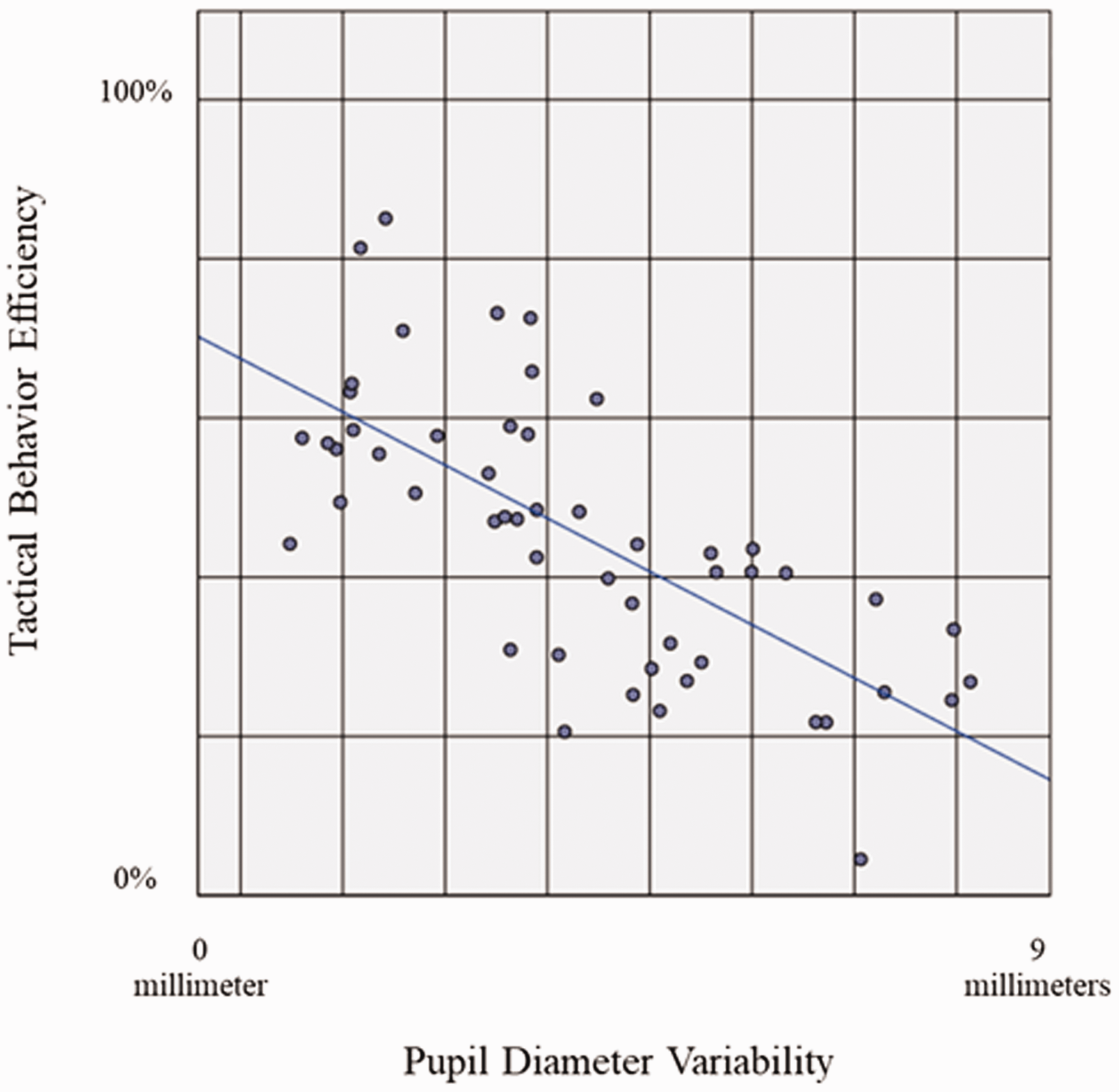
The linear regression test indicated that when players needed to exert less cognitive effort during the video task, they displayed better tactical behavior efficiency (see Figure 1). The regression model was significant (F(51) = 49,396; p < .001), thus indicating a significantlt (p < .001) high association between these variables (R = .72), whereas the coefficient of determination (R2 = .52) showed that cognitive effort explained slightly more than 50% of the variance for tactical behavior efficiency (see Table 1).
Results of the Linear Regression Test.

*Significance level p < 0.05; CI = Confidence Interval (95%).
Discussion
This study examined the association between young soccer players’ cognitive effort and tactical behavior. We found a significant association between cognitive effort and tactical behavior, in that players who invested lower cognitive effort in soccer decision-making tasks displayed higher tactical behavior.
With respect to practical applications in the soccer context, our findings indicate both the importance and quality of a connection between players’ cognitive effort investment and their tactical behavior. Based on previously reported data (Bornemann et al., 2010; Naito & Hirose, 2014; Robert & Hockey, 1997), the process of internal control and management of cognitive effort during decision making seems to directly affect players’ tactical behavior and, consequently, their sports performance.
Several recent studies have shown that sports performance was directly associated with better regulation of cortical activity, even if to the detriment of physical and physiological capacities (Kunrath et al., 2018; van der Wel & van Steenbergen, 2018; Vickers & Williams, 2017; Voss et al., 2010). The ability to manage the investment of cognitive effort in tasks induces significant economy in cortical functioning, promoting automaticity in the behavior performed. Some studies suggest that individuals who achieve a high level of expertise are better able to manage cognitive effort (Botvinick et al., 2001; van der Wel & van Steenbergen, 2018; Westbrook & Braver, 2015). Thus, our results allow us to suggest that, in an ideal scenario, in order to display better tactical behavior, the cognitive effort that players are required to employ in really important situations will be reduced. This reduction in cognitive effort allows for a greater ability to manage soccer’s cognitive demands, and is likely to reduce players’ mental fatigue (Kunrath et al., 2018).
One of the main ways to prompt a reduction in the investment of cognitive effort in soccer is through motor training. Training fosters knowledge acquisition, potentially reducing the need for effortful retrieval of long-term memory during the game and facilitates the utilization of working memory, thus ensuring automaticity of behavior (Alarcón et al., 2018; Cardoso et al., 2019). Hence, with respect to possible interventions based on reducing cognitive effort, we recommend the design and utilization of appropriate training stimuli primarily focused on the athlete, and not only on the drill per se, with the purpose of promoting automaticity in retrieving soccer knowledge and reducing cognitive effort in common game situations (Williams et al., 1993). Investing in technologies that enable coaches and trainers to assess players’ cognitive effort during training activities and games may prompt an understanding, control, and direct training of cognitive effort.
Since we found lower cognitive effort to be associated with better tactical behavior, our findings indicate the importance of tactical training, with high cognitive demands, for players’ development. As a result of tactical training, players will adapt and increase their ability to deal with high cognitive demands and therefore to employ lower cognitive effort when making decisions in the game. However, to achieve this goal, training design should have a fair degree of correspondence with real game situations and require players to learn to act under time and space constraints. Training is then likely to support the development of important aspects, such as attention, memory, pattern recognition skills, and situational probabilities (Otero-Esquina et al., 2017; Ward & Williams, 2003; Williams et al., 2012). As these elements are developed, players will likely increase their ability to manage cognitive effort (generating higher cognitive efficiency) for making decisions in the game, which may consequently improve their tactical behaviors.
Limitations and Directions for Future Research
One of the limitations of the present study is the laboratory task used for measuring cognitive effort. Although the laboratory task allowed the standardization of the decision making conditions, the utilization of video scenes and the participants’ verbal description of their intended actions did not directly transfer to players’ decisions and actions in game conditions. For future studies, ideal experimental designs should include new creative measurements of cognitive effort in real game situatios. Secondly, to ensure that reduced cognitive effort is directly associated to tactical behavior, researchers might measure the activation of brain regions during the tasks with instruments such as quantitative EEG (QEEG) or functional magenetic resonance (fMRI).
Conclusions
In a study with young soccer players in which we used pupillary behavior to measure cognitive effort and eye tracking to measure tactical behavior efficiency, we found an inverse relationship between these variables, with greater tacticl behavior efficiency associated with cognitive effort. This important association has practical implications for soccer training, and this finding sets the stage for further advances in this line of research going forward.
Scatter Plot Showing the Association of Tactical Behavior Efficiency and Pupil Diameter Variability (Cognitive Effort).