







Abstract
In this study, we analyzed the effect of mental and muscular fatigue on the accuracy and kinematics of dart throwing. For this purpose, 28 young adults (19 females and 9 males) aged 25–35 years, without any regular experience in dart throwing, participated in this study. We evaluated their dart throwing skills in mental fatigue, muscular fatigue, and non-fatigue conditions. To induce mental fatigue, we used the Stroop task for 70 minutes and a simulated dart throwing exercise with an elastic band. In all three conditions, we collected accuracy data, based on the score of the dart on the board and the kinematic properties with a motion capture device. For analyzing the data and testing the research hypotheses, we employed ANOVA analyses with repeated measures after examining the normality of data distributions using skewness and kurtosis. We observed a significant decrease in the accuracy of dart throwing following mental fatigue (p = 0.027) and muscular fatigue (p = 0.001) compared to non-fatigue and following muscular fatigue compared to mental fatigue (p = 0.001). In the kinematic results, we observed a significant difference in the mean velocity of the elbow between different experimental conditions (p = 0.001). This variable decreased due to muscular fatigue, compared to the other two conditions. On the other hand, there was no significant difference among the three experimental conditions for the variables of elbow range of motion, shoulder range of motion, and mean velocity of the shoulder joint. These findings affirm mental and muscular fatigue effects on dart throwing and provide further detail regarding the specific aspects of these effects on dart throwing skills or other fine motor activities.
Introduction
An understanding of the principles related to performance and motor control requires the study of factors affecting performance. Motor function can be influenced by various person, environment, and task constraints (Newell, 1986), one of which is fatigue. Fatigue is a complex phenomenon, known as a reduced capacity for maximum performance and an inability to perform a task that was once achievable over a reasonable period (Russell et al., 2020). Previous studies have distinguished between cognitive and neuromuscular fatigue (Branscheidt et al., 2019; Taylor, 2013), with cognitive fatigue typically caused by a long period of cognitive activity (Boksem & Tops, 2008) and exercise (Gandevia, 2001), respectively. Generally, muscular fatigue is defined as a decline in an individual’s ability to exert force (Enoka & Duchateau, 2008), and muscular fatigue can be separated into peripheral and central types. Peripheral fatigue occurs in a specific group of muscles that play a role in the movement. This type of fatigue can disrupt neuromuscular junction, stimulation-contraction mechanisms, and calcium release, as well as the stimulation of the contractile components producing forces (Joseph & Katleen, 2009). On the other hand, central fatigue is related to motor cortex of the brain and the invocation of alpha motor neurons; central fatigue affects the whole body (Fitts, 1996). In other words, the motor command does not decrease in peripheral fatigue, but it may increase in central fatigue when motor commands sent to muscles are reduced to the point that they may diminish muscle tension or force (Arendt-Nielsen & Sinkjær, 1991).
As noted above, people often experience mental fatigue when they are engaged in a cognitively demanding task for a long time. Mental fatigue leads to a decline in performance, less motivation to continue the work, and a rise in the number and severity of errors (Van der Linden, 2011). Mentally fatigued individuals can usually concentrate or maintain their attention, but they are easily distracted, indicating that mental fatigue affects attention. In a state of mental fatigue, a person changes from a state of consciousness to fatigue (Van der Linden & Eling, 2006).
Fatigue acts as an unavoidable internal factor that influences performance, with various degrees of fatigue evident on different motor tasks, both mentally and muscularly. Investigators have assessed the effect of mental or muscular fatigue on performance outcomes, muscle electrical activity, how movements, are performed, and changes in the underlying processes of kinematic and kinetic properties of movements. Muscular fatigue has been represented through variations in such movement elements as peak muscle activity (Huysmans et al., 2008), the capacity of muscle force production, accuracy and performance velocity (Filipas et al., 2021; Le Mansec et al., 2018; Suzuki et al., 2006), as well as joint angular velocity (Apriantono et al., 2006; Côté et al., 2005). Furthermore, this type of fatigue can negatively influence the accuracy and velocity of targeted movements (Missenard et al., 2009). In contrast, other researchers have reported no significant difference in player performance when players were in a state of fatigue and physical stress, compared to a no-fatigue condition (Lidor et al., 2007).
Further, regarding mental fatigue, some studies have revealed its limited effect on maximal strength and explosive power (Martin et al., 2015; Pageaux et al., 2013; Rozand et al., 2014), and its negative effect on attention (Boksem et al., 2005) and on motor tasks that require accuracy (Duncan et al., 2015). An inability to keep a focus (Boksem et al., 2005), problems with using feedback correctly, and performance regulation after making an error (Boksem et al., 2006; Lorist et al., 2005) may be reasons for the negative attention effect. Other researchers have found this negative effect of fatigue on the performance of targeted movements, manual dexterity, anticipation timing, and accuracy (Duncan et al., 2015; Rozand et al., 2015; Smith et al., 2016).
In general, the results of most studies have affirmed a negative effect of both types of fatigue on performing sports-related motor skills. Dart-throwing, which needs both accuracy and force generation, is one such set of sports skills (Nakagawa et al., 2015). In dart-throwing, the individual aims to place the dart in a certain position on the board. In addition, the region at which a thrown dart hits the board depends on a combination of position, velocity, and the direction of motion at the moment it is released (Smeets et al., 2002). These three factors are related to kinematic characteristics. Attention is another influential factor in dart-throwing, and it is one of the most critical parameters in performing motor skills generally.
Singer (1986) suggested that focused attention is the third of five general steps for successful motor performance, and it is an essential factor affecting dart-throwing. Individuals with mental fatigue often experience difficulty with concentration, planning, changing adaptive strategies to the environment, preparing responses, and ignoring irrelevant information (Boksem & Tops, 2008; Van der Linden & Eling, 2006; Van der Linden et al., 2003), all of which can affect the accuracy of dart-throwing. Based on the results of previous studies, mental and muscular fatigue can influence kinematic properties, muscular force, and performance accuracy (Le Mansec et al., 2018; Missenard et al., 2009; Smith et al., 2016), and dart-throwing requires both accuracy and force. Accordingly, a question arises as to how mental and muscular fatigue can affect kinematics and accuracy in this skill. Therefore, in the present study, we analyzed the effect of mental and muscular fatigue on the dart-throwing skill.
Method
Participants
This study was approved by the Ethics Committee in Biological Research of Shahid Beheshti University (ID: IR.SBU.REC.1400.157), and all participants provided informed consent for participation in the study. Nine males and 19 females voluntarily participated in this research. All participants were aged 25–35 years (M age = 28.96, SD = 0.64 months; M height = 167.64, SD = 1.88 cm; M weight = 66.82, SD = 2.82 kg; M body mass index or BMI = 23.54, SD = 0.63 kg/m2). All participants were right-handed, and had no regular experience throwing darts. All participants threw the dart with their dominant hands. Participants were selected based on their answers to a questionnaire that included the following inclusion/exclusion criteria: (a) normal or corrected vision with glasses; (b) no injury or pain in the upper and lower limbs; (c) no neurological disease; (d) no use of drugs and psychotropic medicine; (e) adequate sleep the previous night, based on the participants’ answers to a questionnaire; and (f) no signs of fatigue during the experimental sessions, as defined by obtaining at least a score of 50 on the visual analog scale (VAS) for mental fatigue and obtaining a 50% reduction of the maximum upper limb force as an index of muscular fatigue.
Procedure
A brief session was held for each participant before the test to completely familiarize the participant with the procedure and specify when they should be in the laboratory to collect data. The following instructions were provided to the participants in this session: “Do not exercise vigorously 48 hours before the test; do not sleep less than usual the night before the test; do not use any stimulants or medication on the day of the test; and refrain from any mental activities which lead to stress or fatigue and also cause a change in your mood 24 hours before the test.”
The protocol of this study consisted of a familiarization phase and three experimental conditions. The familiarization phase was to provide instructions on how to throw the dart, including how to take the dart correctly (Figure 1(a)), throw the dart, and the intended position on the dart board (Figure 1(b)). The participants were asked to stand laterally while throwing, to position both feet perpendicular to the target, and to throw the dart to the frontal plate without rotating the shoulders. As shown in Figure 1(b), the dartboard consisted of concentric black and white circles from a score of 10 at the center to a score of 1 at the most peripheral circle. The participants were asked to aim to the center of the board and try to hit the dart to the most central circle. After receiving the instructions, each participant performed 90 throwing trials in 30 blocks of three trials with a 30-second break between each block to minimize fatigue (Lohse et al., 2010; Ong et al., 2015). The Correct Style of Holding a Dart (a), and Standing (b).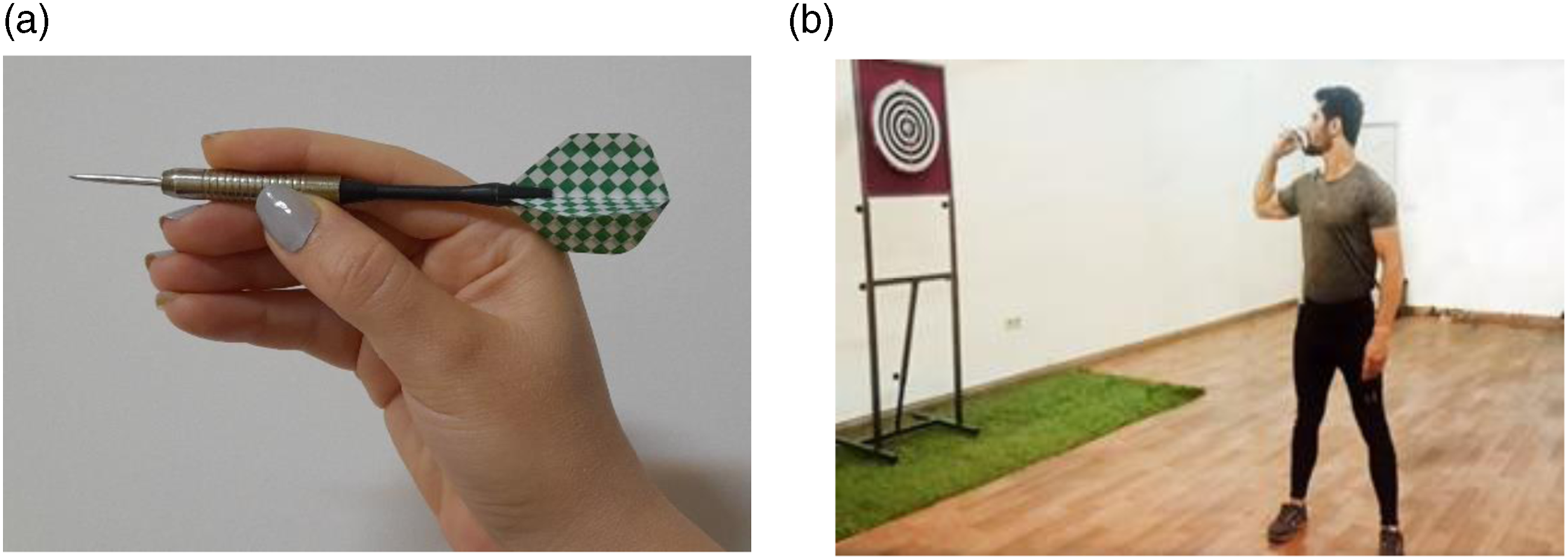
In the first experimental condition, after the marker placement process and the motion capture device calibration, each participant was asked to perform 21 dart throwing trails in seven blocks of three trials with a 30-second break between each block to minimize fatigue (Lohse et al., 2010; Ong et al., 2015). The second and third experimental conditions involved performing under mental and muscular fatigue conditions. These two experimental conditions were selected randomly for the participants so that for half of the participants, the second experimental condition was mental fatigue, and the third experimental condition was muscular fatigue. For the other half, the second experimental condition was muscular fatigue, and the third experimental condition was mental fatigue.
In the muscular fatigue condition, the maximum force of the participants’ upper limbs was first measured after the marker placement by a spring scale force gauge. One end of the gauge was connected to a fixed vertical bar so that its location could be adjusted according to the participants’ height at their shoulder level, and a rope was attached to the other end of the gauge to facilitate pulling. The participants’ upper limb force was measured by holding the rope and pulling it in a position like throwing darts. Each participant then performed at least three sets of the fatigue protocol that involved simulating throwing darts constrained with an elastic band. At the end of each set, the participants’ upper limb force was measured by a spring scale force gauge. The fatigue protocol continued until the individual force was reduced to 50% of the maximum force (Johnston et al., 1998; Orishimo et al., 2010). The darts were then thrown in the form of seven blocks of three trials by the participants. A set of fatigue protocols was implemented after each block to prevent recovery during throwing darts. At the end of the seven blocks, the participants’ upper limb force was measured again to ensure their fatigue during throwing the darts (Figure 2). Procedures of Muscular Fatigue Sessions.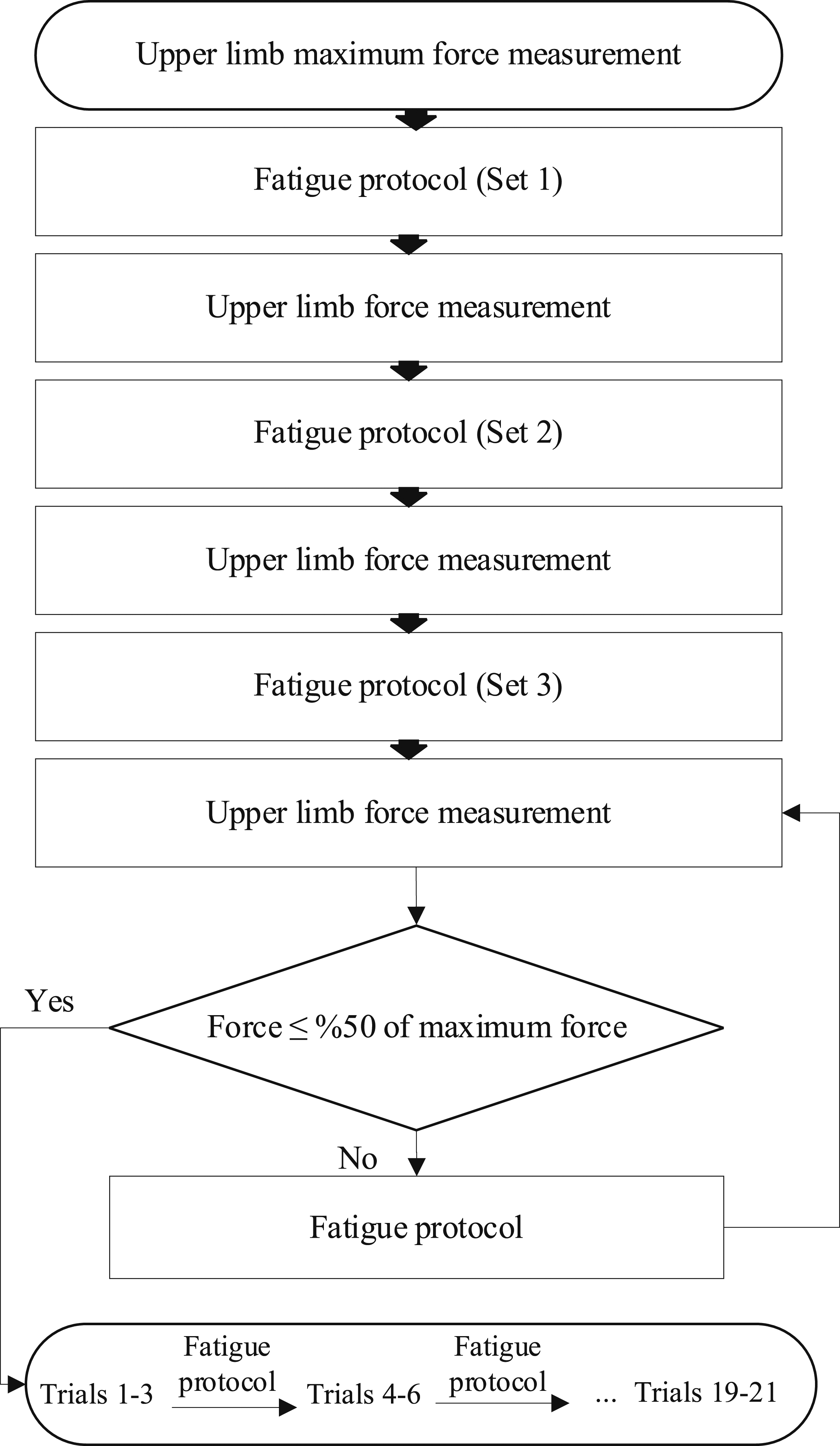
In the mental fatigue condition, participants’ fatigue levels were first assessed by participants’ self-reports on the visual analog scale (VAS) questionnaire that was prepared on a piece of paper and completed by the participants within 1 minute. After that, the participants performed the Stroop task for 70 minutes after placing markers. The VAS was then completed again by the participants within 1 minute. If the participants scored at least 50 points on this questionnaire, it meant that they had reached an optimal level of mental fatigue (Smith et al., 2019). Otherwise, they continued the Stroop task and completed the VAS questionnaire again every 10 minutes until they reached the desired level of mental fatigue. This procedure led to 26 participants after 70 minutes and two participants after 80 minutes scoring at least 50 on the VAS. Afterward, they threw 21 trials. It should be noted that there was a 1-week gap between the second and third fatigue conditions to minimize the effects of any fatigue on the next condition (Figure 3). Procedures of the Experimental Sessions.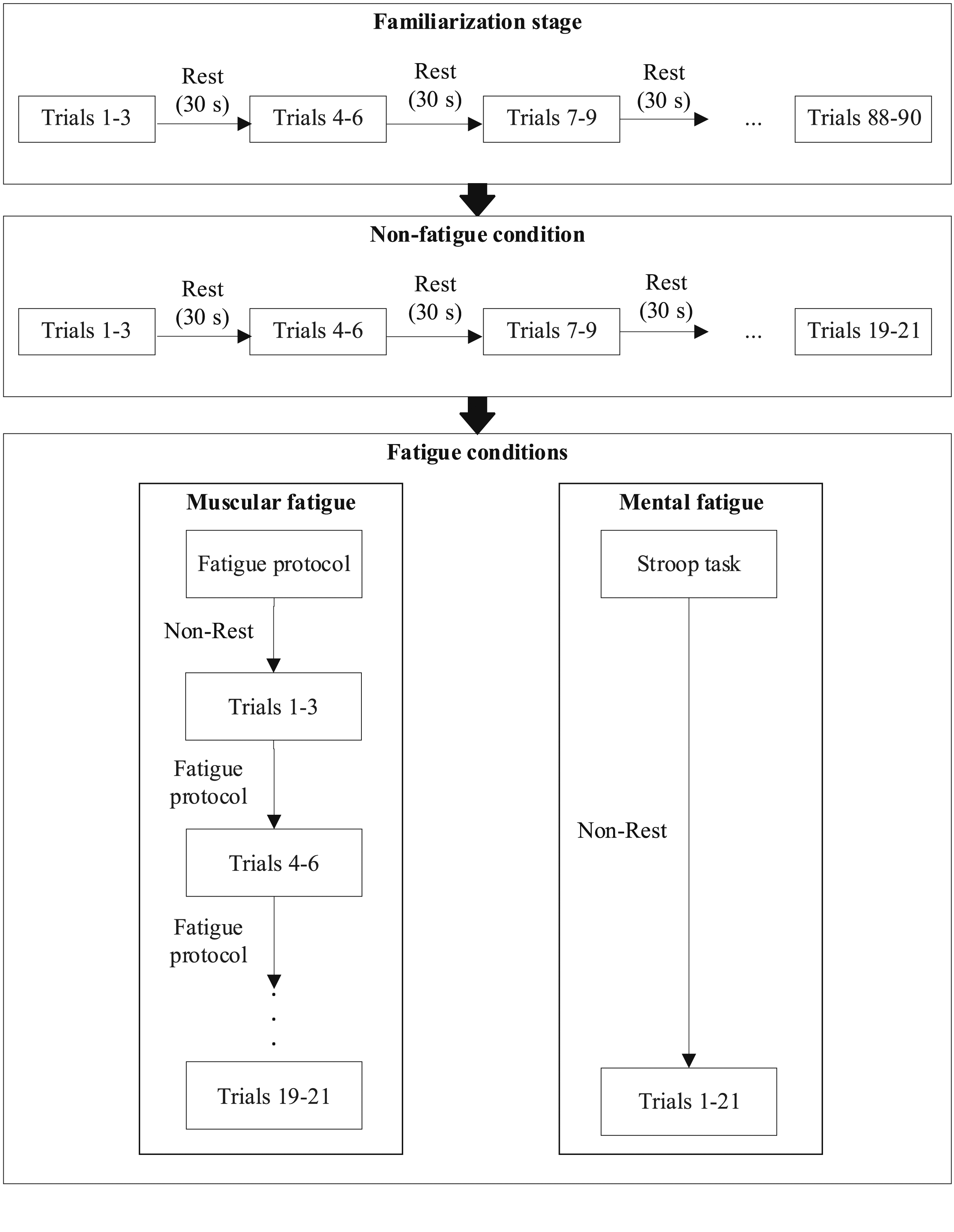
Materials
Motion Capture Device
We used a motion capture device (Motion Analysis Inc., Raptor-4H) containing hardware and software to record the kinematics of movements. The hardware included eight infrared cameras running at 240 frames per second. It was installed by using a flash drive and ran with Cortex software. The cameras were arranged in a rectangular laboratory environment, with each marker identified by three cameras. The marker placement process was performed by a plug-in method and by considering the goals of the study to record the kinematics of the movement in experimental conditions. The markers were placed on the following anatomical landmarks by a special adhesive tape (Nakagawa et al., 2015): right anterior superior iliac spine; right acromioclavicular joint; lateral epicondyle approximating right elbow joint; and right wrist bar thumb side.
Stroop Task
The Stroop task was used in this study to induce mental fatigue. This task consisted of presentations of color words (green, blue, red, and yellow) displayed one after the other in a mismatched color on the screen (for example, the word “green” in blue). There were four buttons in red, green, yellow, and blue colors on the keyboard. Participants were asked to press a response key whose color was the same color as the ink, once each word appeared on the screen throughout the task (for example, they were expected to press the green button for the word “blue” which was printed in green). However, if the color of the ink was red, they had to press the key whose color matched the color word. For example, they were expected to press the yellow button for the word “yellow” printed in red. The appearance of words on the screen was completely random, and 25% of the words were displayed in red ink. Additionally, the participants were asked to respond as quickly and accurately as possible. Before starting the mental fatigue task, 20 experimental trials were performed to ensure that the participants perceived the instructions correctly (Rozand et al., 2015). Based on previous studies, the duration of this task varied between 30-90 minutes (Behrens et al., 2018; Rozand et al., 2015). Therefore, five participants did the Stroop test for 90 minutes in a primary study before performing this intervention to determine the appropriate time for this study. These five participants had the same characteristics as the participants of the present study, but they only participated in this primary study after signing informed consent. In other words, they were not part of the main 28 participants, but they too provided informed consent. Their fatigue level was assessed every 10 minutes and after 60 minutes, with the VAS used to see when they showed signs of mental fatigue (obtaining a score of at least 50 on the VAS). Based on when we observed this sign of mental fatigue, the duration of the Stroop task was considered to be at least 70 minutes in the present study. Each word was displayed on the screen for 1000 ms, and then a blank screen appeared for 1500 ms before showing the next word. Therefore, a new word was presented within 2500 ms which provided a total of 1680 stimuli during 70 min (Smith et al., 2019).
Visual Analog Scale (VAS)
To measure the perception of mental fatigue, we used the VAS, a tool that was easily implemented in a short period and that could be scored quickly. The VAS method for measuring mental fatigue has been previously demonstrated (Monk, 1989). This scale consisted of 18 items with items 1–5 and 11–18 related to fatigue and items 6–10 related to energy. There was a 10 cm line graded from zero to 10 under each item, and the participant marked one of these numbers based on their current perceptions. Zero indicated the least amount of fatigue, and 10 showed the highest. There was high internal reliability ranging from 0.94 to 0.96. The validity was constructed by simultaneous correlations in prior research with the Stanford Sleepiness Scale (SSS) and Profile of Mood States (POMS) (Lee et al., 1991).
Data Analysis
Throw accuracy was quantified by calculating the participants’ average score for each experimental condition, including mental fatigue, muscular fatigue, and no fatigue. The kinematic time series of joint angles were first filtered using a 3-point moving average. The range of motion was then calculated as the difference between the maximum flexion and the maximum extension of each joint. For velocities, after a simple numerical differentiation, the same filter was applied again, then the average value of the velocity time series was considered the joint mean velocity. Statistical analyses were performed using the SPSS software package. We used a repeated measures analysis of variance (ANOVA) at a statistical significance level of 0.05 after examining the normality of the data distribution using skewness and kurtosis. The classification scheme used for the effect sizes was based on Cohen’s classifications (0.01 = small effect, 0.06 = medium effect, and 0.14 = large effect) (Cohen, 1988). Bonferroni post-hoc tests were run to elucidate the differences among the experimental conditions.
Results
VAS and Force Measures
The results of the spring scale force gauge showed that the participants’ mean upper limb force before the muscular fatigue protocol was 6–13.5 kgf, and it was 3–6.5 kgf after the muscular fatigue protocol. The participants’ scores on the VAS were 2–24 before mental fatigue and 101–158 afterwards.
Descriptive Statistics of the Participants’ Visual Analog Scale Scores and Upper Limb Force.
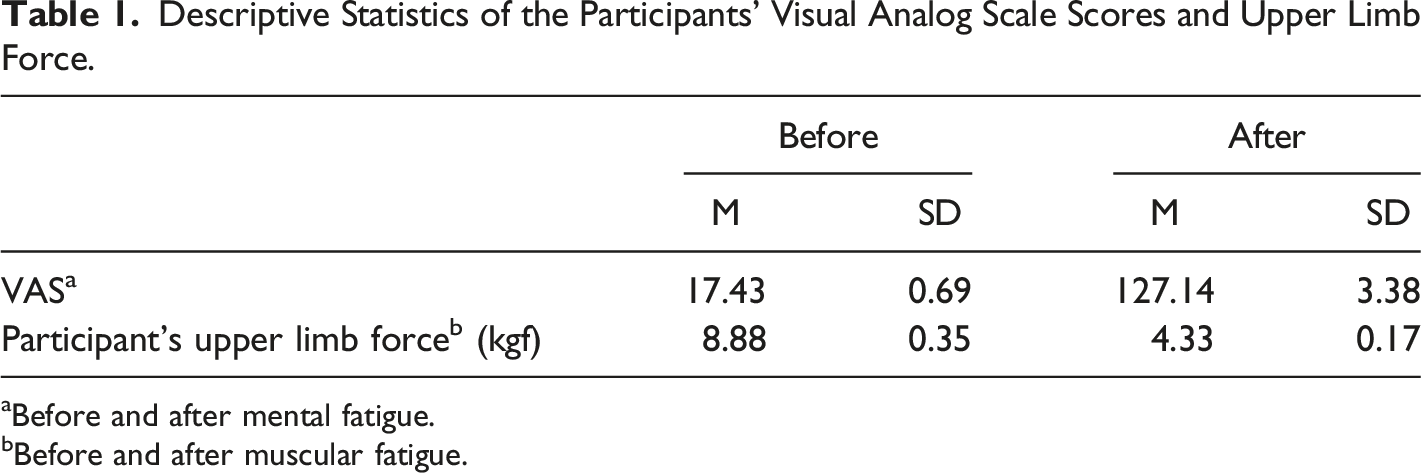
aBefore and after mental fatigue.
bBefore and after muscular fatigue.
Accuracy Measures
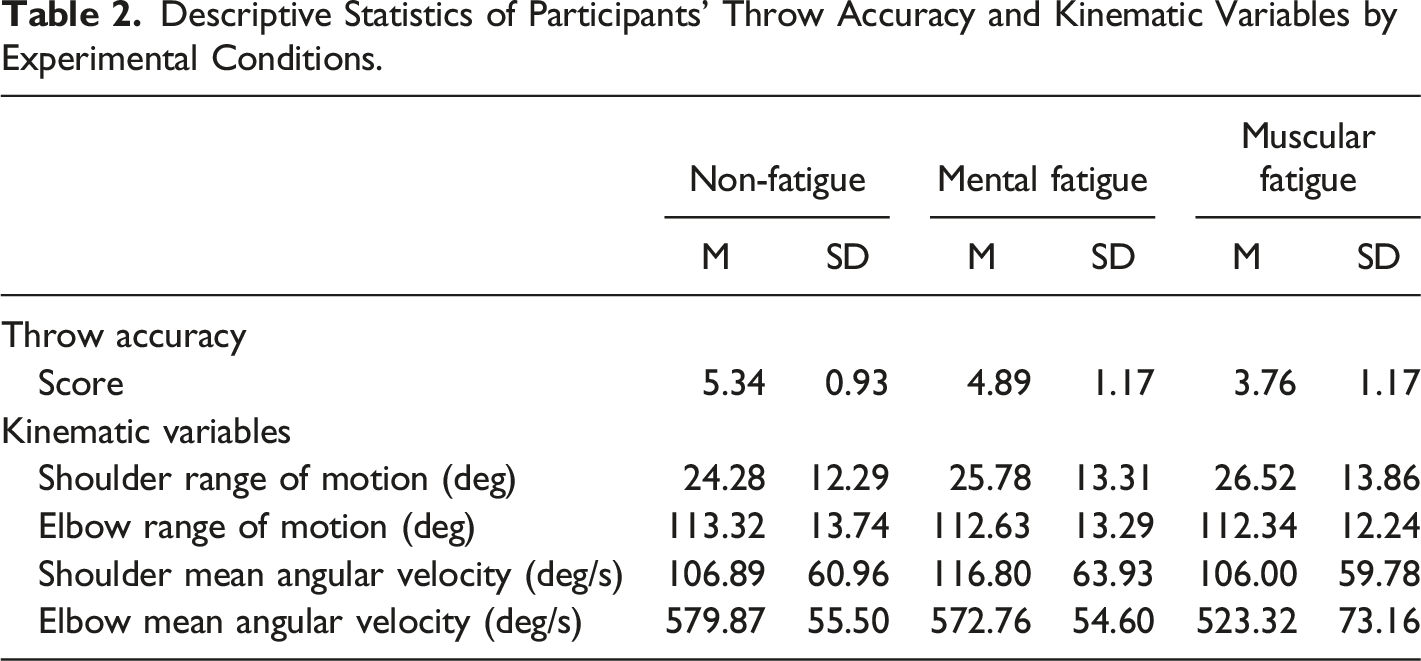
Descriptive Statistics of Participants’ Throw Accuracy and Kinematic Variables by Experimental Conditions.
Repeated Measures ANOVA Results for Throw Accuracy and Kinematic Variables.
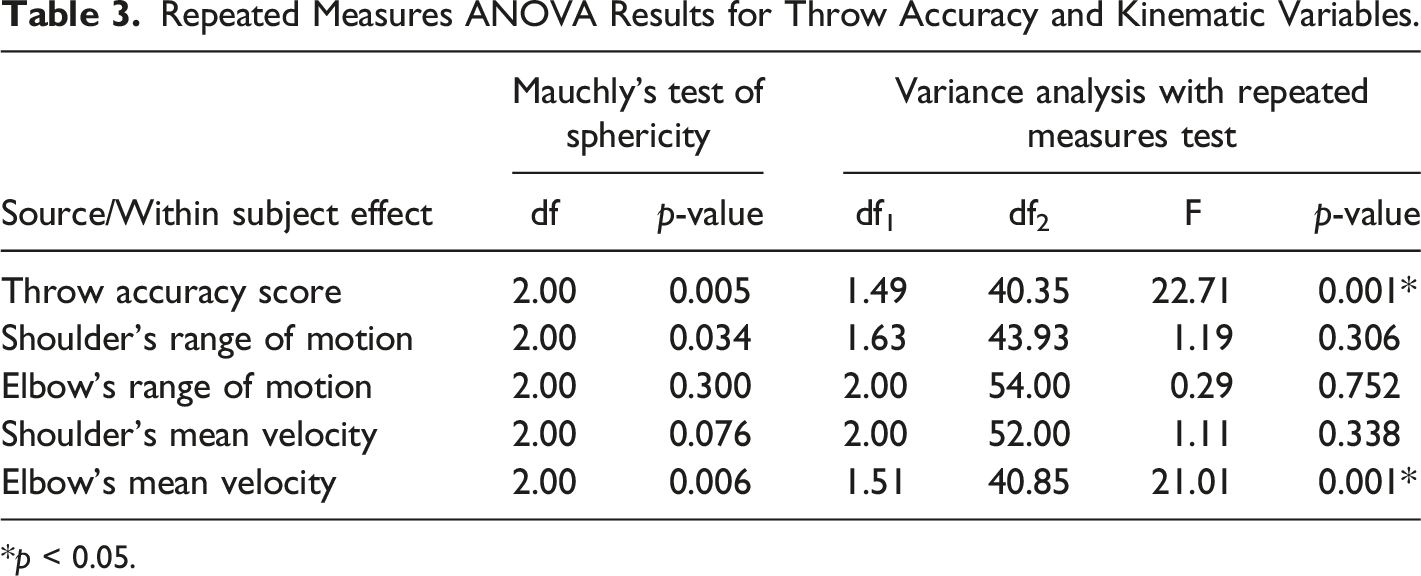
*p < 0.05.
The effect of fatigue on accuracy was statistically significant (F (1.49,40.35) = 22.71, p = 0.001, η2 = 0.45, large effect). In other words, there was a significant difference between the accuracy of dart throwing in the three conditions of mental fatigue, muscular fatigue, and non-fatigue condition. Post-hoc testing with the Bonferonni test showed that the average accuracy of dart throwing in muscular fatigue conditions was significantly lower than in mental fatigue conditions (p = 0.001) and in non-fatigue conditions (p = 0.001). Furthermore, the accuracy of dart throwing in mental fatigue conditions was significantly lower than in non-fatigue conditions (p = 0.027).
Kinematic Measures
Table 2 shows descriptive statistics of the participants’ kinematic variables for the different experimental conditions. The shoulder range of motion in mental fatigue and muscular fatigue conditions increased by 1.5° and 2.24°, respectively, compared to the non-fatigue condition. The changes for the elbow joint were increased 0.69° and decreased 0.98°. The shoulder mean velocity increased by 9.91°/s after mental fatigue and decreased by 0.89°/s after muscular fatigue, compared to the non-fatigue condition. The elbow mean velocity in the conditions of mental and muscular fatigue was reduced by 7.11°/s and 56.55°/s, respectively, compared to the non-fatigue condition.
Based on Table 3, the results of Mauchly’s test of sphericity showed that the variances of the two variables of the motion range of elbow (p = 0.300) and mean velocity of the shoulder (p = 0.076) were homogenous, whereas the two variables of the motion range of shoulder (p = 0.034) and mean velocity of the elbow (p = 0.006) were not homogenous. The results of the Greenhouse-Geisser test for the last two variables are shown in Table 3.
As shown in Table 3, there was no significant difference among the variables of the motion range of the elbow joint, the motion range of the shoulder joint and the mean velocity of the shoulder. It was measured among the three following experimental conditions, including the mental fatigue condition, muscular fatigue and non-fatigue conditions. While a significant difference was seen between the different experimental conditions on the variable of mean velocity of the elbow (F (1.51,40.85) = 21.01, p = 0.001, η2 = 0.43, large). Bonferroni post-hoc tests showed a significant difference between the mean velocity of the elbow in muscular fatigue with mental fatigue (p = 0.001) and muscular fatigue with non-fatigue (p = 0.001) conditions. In other words, the mean velocity of the elbow in muscular fatigue was lower than the other two conditions.
Discussion
In the present study we analyzed the effect of mental and muscular fatigue on the accuracy and kinematics of dart-throwing. The results confirmed our first hypothesis that the accuracy of dart-throwing would decrease in individuals suffering from mental or muscular fatigue; the participants in both mental and muscular fatigue conditions scored lower in dart throwing accuracy than in the non-fatigue condition. Also, we observed less accuracy in the muscular fatigue condition compared to the mental fatigue condition. The loss of control over post-error feedback could explain these results, leading to an impaired monitoring performance and inadequate action regulation (Lorist et al., 2005). Erroneous deviations occurred in the proximal limbs during throwing. The distal joints can compensate for the deviations through compensatory variability (Robins et al., 2006), for which the proprioception feedback of the joints is essential (Sevrez & Bourdin, 2015). On the other hand, muscular fatigue adversely affected joint proprioception (Blasier et al., 1995; Voight et al., 1996). According to Lorist et al. (2005), fatigued individuals are less likely to correct their mistakes. Further, Boksem et al. (2006) reported impairment in the performance regulation of those with fatigue after the error.
Seemingly, the inability to allocate attention efficiently was a major cause of the mental fatigue effect on performance, which can be another explanation for these results. Attention to tiredness prevents the person from simultaneously paying attention to the optimal performance of the task. This explanatory model is known as the parallel information processing model (Langner et al., 2010). According to the theory of perceptual narrowing (Easterbrook, 1959), attention to the mental fatigue inhibits simultaneous attention to the task performance. Therefore, it can be expected that the emergence of mental fatigue reduces attention to optimal performance leading to an impaired performance. In this regard, Van der Linden et al. (2003, 2006) pointed out that fatigued persons have difficulty concentrating, planning, and changing adaptive strategies when encountering negative consequences. Boksem et al. (2005, 2006) reported fatigue difficulty preparing answers, keeping attention, and ignoring irrelevant information, also seen as increased distractibility.
Our other hypothesis was that mental and muscular fatigue can also influence the kinematics of dart-throwing. We tested this hypothesis by examining the four kinematic variables, including the range of motion of shoulder and elbow joints, and the mean angular velocity of these joints. These results signaled a decline in the mean angular velocity of the elbow joint in the muscular fatigue condition, compared to both the mental fatigue and no-fatigue conditions. However, the three conditions were not significantly different for the range of motion of shoulder and elbow joints or the mean angular velocity of the shoulder joint. Some studies have revealed that multi-joint movements, such as throwing skills, require the hierarchical control of the joints (Bernstein, 1996; Dounskaia et al., 1998). The proximal joint causes the movement of the entire chain, while movement regulation to perform the task is the role of the distal one (Dounskaia et al., 1998). According to this idea, the velocity of the shoulder joint should remain constant during the movement under study, and the velocity of the elbow joint should be adjusted to ensure the final adjustment of the throwing.
Limitations and Directions for Further Research
Our results confirmed the negative effects of mental and muscular fatigue on the accuracy and some kinematic features of dart throwing. Nevertheless, this investigation contained some limitations. We conducted the current study on people with no regular experience in throwing darts, meaning that our findings may not be generalized to expert players. Future investigators might select experts as participants in future studies to cross-validate and extend these results. Of particular importance, future investigator might apply a similar research paradigm to studies of critically important, high risk fine motor activities (e.g., performing surgery, repairing expensive equipment, etc.).
Conclusion
We investigated the effect of mental and muscular fatigue on accuracy and kinematics of dart throwing and found that mental fatigue significantly affected the accuracy of dart throwing, and muscular fatigue had a significant effect on both accuracy and one of the kinematic variables. Mentally fatigued individuals kept the kinematic properties of their movement, but their functional accuracy decreased. On the other hand, participants with muscular fatigue had a greater decrease in their functional accuracy, but they had changes in their kinematic properties. Thus, fatigue may have a very negative effect on performance during a match, and coaches and players should evaluate their pre-match activities to ensure that players do not engage in pre-match activities that demand constant attention or high muscle activity that would likely lead to a performance decline. Of course, this demonstration of negative effects of mental and muscular fatigue on aspects of dart throwing performance have important implications for similar mental and muscular fatigue effects on a wide variety of human endeavors, perhaps including such critically important activities as performing surgery or engaging in other high risk fine motor activities.
Footnotes
Acknowledgments
We would like to thank Mr. Sheykhi, laboratory of motor behavior and cognitive sciences of Shahid Beheshti University, and Mr. Rastgoo, who helped us in preparing the motion capture system and setting up the cameras. We truly appreciate Prof. John David Ball for his constructive comments on the manuscript of this paper.
Declaration of Conflicting Interests
The authors declared no potential conflicts of interest with respect to the research, authorship, and/or publication of this article.
Funding
The authors received no financial support for the research, authorship, and/or publication of this article.
Ethics Approval
The methodology of this study was approved by the Ethics Committee in Biological Research of Shahid Beheshti University (Approval ID: IR.SBU.REC.1400.157).
