







Abstract
A recent systematic review reported positive associations between parents and children’s physical activity participation. Moreover, parents’ perceptions of the importance and value of physical activity can influence their children’s participation in it. Our aim in this study was to develop and validate an instrument to assess parents’ perceptions of the importance of physical activity and physical education. After first creating the instrument, we conducted content and exploratory factorial validation and reliability analyses of it with 93 parents (M age = 44.76, SD = 6.05, range = 31–66 years; 73 females, 20 males). The result was a 9-item instrument, with items assessed on a 5-point Likert scale and grouped into three factors: (a) importance of physical education; (b) importance of engaging in physical activity or sport; and (c) importance of joining your children in physical activity or sport. In a second confirmatory factor analysis with 224 parents (M age = 44.53, SD = 6.07; 174 or 77.7% females and 50 or 22.3% males) we confirmed the factor validity and reliability previously analyzed (χ 2 = 42.77, df = 24, p = .011, GFI = 0.96, NFI = 0.98, NNFI = 0.99, CFI = 0.99, RMSEA = 0.06 (90% CI: 0,04, 0.08), SRMR = 0.04, ECVI = 0.04, CR = 0.70–0.87). Thus, the new Physical Activity and Physical Education Importance for Parents Scale (PAPEIPS) is a valid and reliable instrument for measuring parents’ perceived importance of physical activity and physical education.
Introduction
Parents of school-age youth play a critical role in their children’s adherence to physical activity (PA) (Coulter et al., 2020; Ho et al., 2022; Rhodes et al., 2020). Moreover, parents’ own PA and their support for children to be active can affect PA behaviors of both young children and adolescents (Yao & Rhodes, 2015). Evidence from a recent systematic review of 39 research studies, supports a positive relationship between parents’ own PA and their children’s PA regardless of the age of the child, the sex of the parent-child dyad, and the type of PA (Petersen et al., 2020). Parental role modeling can directly influence children’s participation in PA (Pocock et al., 2010), and this association is stronger for families than for other primary role model relationships for youths, such as with physical education teachers (Olivares et al., 2015). Additionally, parents’ perceived importance and value of PA can influence their children’s PA participation (Mitchell et al., 2012). How children perceive this parental support is also associated with their PA engagement (Shen et al., 2018; Wilk et al., 2018). The value parents place on PA may be indicative of their children’s level of participation (Trost et al., 2003; Xu et al., 2015). One plausible explanation for this relationship is that the importance parents assign to their children’s PA is related to the level of family support children are given for their PA practice (Dowda et al., 2011).
Of importance, although PA is widely addressed as an important aspect of an individual’s life, physical education (PE) is still considered a “marginal” school subject (Richards et al., 2014). As a result, children who grow up in a context where PE is not valued are likely to consider this subject and its lessons less important than others, and, as explained by Richards (2015), they are apt to “perpetuate stereotypes that marginalize the discipline” (p. 384). This is especially worrying in the context of the Self-Determination Theory of motivation that emphasizes intrinsic motivation in PE (Ryan, 2023). Hassandra et al. (2003) conducted a qualitative analysis and found that both individual and social-environmental factors influenced children’s motivation toward PE. Among these, the perceived usefulness of the PE lesson and family encouragement were associated with students’ development of intrinsic motivation.
Despite evidence for the importance of parents’ views on PA and PE to promote an active life for their children and to increase their children’s intrinsic motivation in PE classes, few assessment scales for parent perceptions have been developed. Moreno-Murcia et al. (2006) designed a scale to measure students’ assigned importance and usefulness of PE with three items: (e.g., “I consider it important to receive physical education classes”), and Dalmau Torres (2003) created an extensive scale (53 items grouped in eight subscales) to assess parents’ views on PE in primary education, which included their (a) “perception about physical activity” (e.g., I like to exercise or play sports); (b) “perception of physical education from a personal perspective” (e.g., I think that physical education is a waste of time in school); and (c) “perception of the subject profile” (e.g., I believe that physical education is less important than the rest of the subjects because it takes place in the playground or gym and not in the classroom). These two scales are each limited, in that the first, very brief scale focused exclusively on the student’s perceptions (and did not consider the parents) and the second more lengthy scale was impractical for many research projects. To our knowledge, there are no other validated questionnaires on these topics.
As previously introduced, the value parents place on PA and PE can influence their children’s engagement in an active lifestyle, as well as their motivation in PE classes (Richards, 2015; Trost et al., 2003; Xu et al., 2015). Therefore, it seems important for researchers and educators alike to have a validated instrument that can show how strong the connections between these previously mentioned variables are to make the needed changes when necessary. However, to our knowledge, no such instrument has been published. To this end, our purpose in this study was to create and validate a new instrument called the Physical Activity and Physical Education Importance for Parents Scale (PAPEIPS) in Spanish-speaking contexts. We first developed the instrument and then conducted a content validity analysis, an exploratory factor analysis (study 1), and a confirmatory factor analysis (study (2) on it.
Method
Development of the Physical Activity and Physical Education Importance for Parents Scale (PAPEIPS)
We recruited three university professors with extensive research expertise in the area (Muñiz et al., 2005) to create an initial 24 items for the instrument. These professors had 3–30 years of teaching and research experience in physical education and PA. They all had previous experience in the creation and validation of questionnaires. We used the previously validated scales described above to create this item pool. Each professor collected and analyzed each of these items independently before jointly discussing the items to be included in the new questionnaire. We selected a 5-point Likert scale response method, ranging from 1 = strongly disagree to 5 = strongly agree under the heading: “Please answer honestly by circling the number that comes closest to your opinion”.
Content Validity and Applicability
The first version of the instrument underwent a double examination by our expert panel to assess the content validity and applicability of the new instrument. Five expert professors (different from those who created the initial pool of items) from five different Spanish universities evaluated the content validity of each of the 24 items based on any duplication/similarity of items, clarity of item wording, and item relevance to PE and PA. The professors assessed whether the items should be included and/or made proposals for item modification. We used the Content Validity Coefficient (CVC) to assess the degree of agreement (Hernandez-Nieto, 2002). Next, in a pilot study, 14 parents (Mage = 40.07, SD = 5.82, range = 33–52; 10 females, 4 males) evaluated the selected new items to assess whether they were understandable or had any grammatical errors. Each participant independently read each item and provided any necessary comments or corrections.
Procedure
Permission to carry out this research project was granted by the Ethics Committee of the researchers’ university. Experts and parents signed an informed consent document prior to data collection. The questionnaire was digitalized and disseminated using the snow sampling method (Kosinski et al., 2015) at three moments of data collection that are described below (a pilot study, Study 1, and Study 2). The first page of the questionnaire indicated the objective of the study, as well as the confidentiality of the subsequent treatment of the retrieved information. Data collection for Study 1 took place in the last months of 2022 (October and November). Study 2 started in January 2023 and ended in March 2023.
Psychometric Assessment of Factorial Validity and Reliability (Study 1)
Participants
For Study 1, 93 parents of school-aged children agreed to participate (M age = 44.76, SD = 6.05, range = 31–66 years; 73 females, 20 males). The only participant eligibility requirement was to have at least one child enrolled in elementary, middle, or high school in a Spanish school.
Instruments
We administered the new Spanish PAPEIPS to our 93 parent volunteers in this phase of the study. The final scale was comprised of nine items, three for each of the three intended dimensions: (a) importance of PE, (b) importance of engaging in PA or sport, (c) importance of joining your children in PA or sport. We conducted an exploratory factor analysis on this instrument, based on these 93 responses.
Confirmatory Factor Analysis (Study 2)
Participants
For Study 2, we relied on a separate sample of an additional 224 volunteer parents of school-aged children (M age = 44.53, SD = 6.07; 174 or 77.7% females and 50 or 22.3% males), again with the only eligibility requirement that these participants have at least one child enrolled in elementary, middle, or high school in a Spanish school.
Instruments
We used this larger group of parents’ responses to the final version of the PAPEIPS in a confirmatory factor analysis procedure to evaluate the completed instrument.
Data Analysis
Most statistical analyses were performed using SPSS 25.0 (SPSS Statistics, v.25.0 Chicago, IL, USA). First, we used the CVC to assess the degree of agreement between our expert panel members as they reviewed and developed instrument item content. Scores between three and five on a 5-point Likert scale are recommended for item suitability (Hernandez-Nieto, 2002). Second, we performed an exploratory factor analysis to examine the scale’s factor structure. We examined the adequacy of the factor analysis by calculating the Kaiser-Meyer-Olkin (KMO) index and Bartlett’s test of sphericity. In addition, we analyzed item consistency or internal reliability through Cronbach’s alpha and Omega coefficient (Nunnally & Bernstein, 1994).
We used the statistical package LISREL 9.1 (Jöreskog & Sörbom, 1993) to carry out a confirmatory factor analysis. The results of the multiple kurtosis coefficient (Mardia coefficient = 100.75) indicated that the sample did not follow a normal distribution (Mardia, 1974). Therefore, since the variables were ordinal and did not meet assumptions of normality, we estimated the model using the robust maximum likelihood method (Hu & Bentler, 1999). We considered the following indices for this analysis: chi-square (χ2); GFI: Goodness-of-Fit Index (recommended values >0.9); NFI: Normalized Fit Index (recommended values >0.9); NNFI: Non-Normed Fit Index (recommended values >0.9); CFI: Comparative Fit Index (recommended values >0.9), RMSEA: Root Mean Square Error of Approximation (a value of <.08 suggests a reasonable model-data fit); SRMR: Standardized Root Mean Square Residual (recommended values <0.08), ECVI: Expected Cross-Validation Index (values close to zero represent a greater possibility of generalization of the model), CR: composite reliability (recommended values >0.70), and the AVE: average variance extracted (recommended values >0.50).
Results
Content Validity and Applicability
Physical Activity and Physical Education Importance for Parents Scale (PAPEIPS) (Spanish and English Versions).
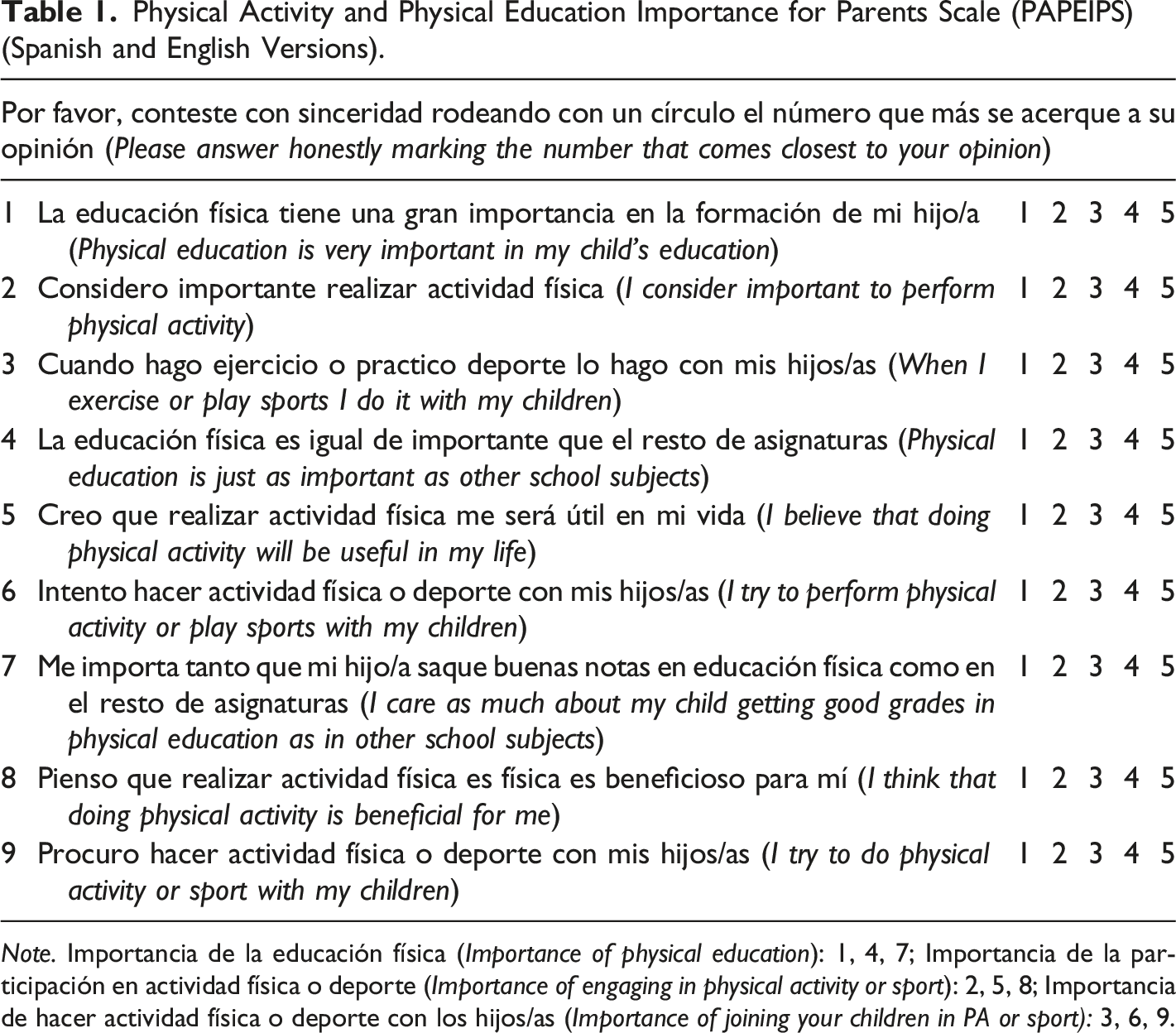
Note. Importancia de la educación física (Importance of physical education): 1, 4, 7; Importancia de la participación en actividad física o deporte (Importance of engaging in physical activity or sport): 2, 5, 8; Importancia de hacer actividad física o deporte con los hijos/as (Importance of joining your children in PA or sport): 3, 6, 9.
Psychometric Assessment of Factorial Validity and Reliability (Study 1)
Factorial Solution.
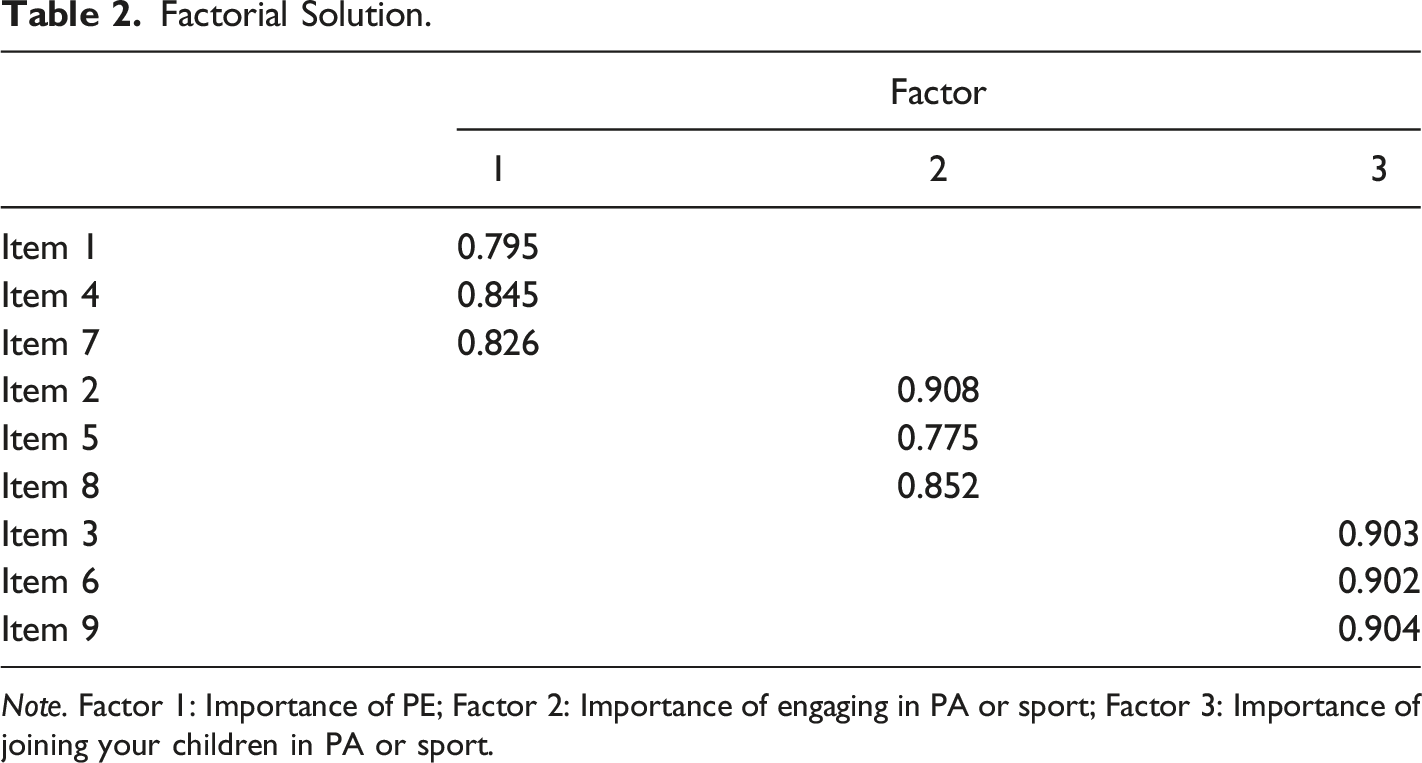
Note. Factor 1: Importance of PE; Factor 2: Importance of engaging in PA or sport; Factor 3: Importance of joining your children in PA or sport.
Finally, all factors had acceptable internal consistency scores: (a) importance of PE (α = 0.75; ω = 0.76); (b) importance of engaging in PA or sport (α = 0.88; ω = 0.88); and (c) importance of joining your children in PA or sport (α = 0.90; ω = 0.90; Nunnally & Bernstein, 1994).
Confirmatory Factor Analysis (Study 2)
We conducted a confirmatory factor analysis with the large validation sample using the RML estimation model to assess the model’s fit, since the multivariate kurtosis analysis with this sample yielded a score of 100.75. The factorial structure discovered in the exploratory factor analysis was confirmed: χ
2
= 42.77, df = 24, p = .011, GFI = 0.96, NFI = 0.98, NNFI = 0.99, CFI = 0.99, RMSEA = 0.06 (90% CI: 0,04, 0.08), SRMR = 0.04, ECVI = 0.04. The standardized factor loadings of each of the items were analyzed in their respective factors according to the hypothesized theoretical model (Figure 1). Further, we estimated the l item reliability and t-value for each item. All items presented adequate values for each of the factors: (a) importance of PE (λ = 0.81–0.99); (b) importance of engaging in PA or sport (λ = 0.77–0.88); and (c) importance of joining your children in PA or sport (λ = 0.81–1.07). On the occurrence of standardized factor loadings greater than one, as in the case for item 9 (λ = 1.07), Jöreskog (1999) suggested checking the residual variance of the item to determine whether the variance was positive, allowing the solution to be accepted. In our case, the residual variance of item 9 was positive, and we retained the item. Moreover, all items obtained a t-value >1.96 and <0.05 for individual reliability. These data established the convergent validity of the model (Hair, 2011). Confirmatory Factor Analysis.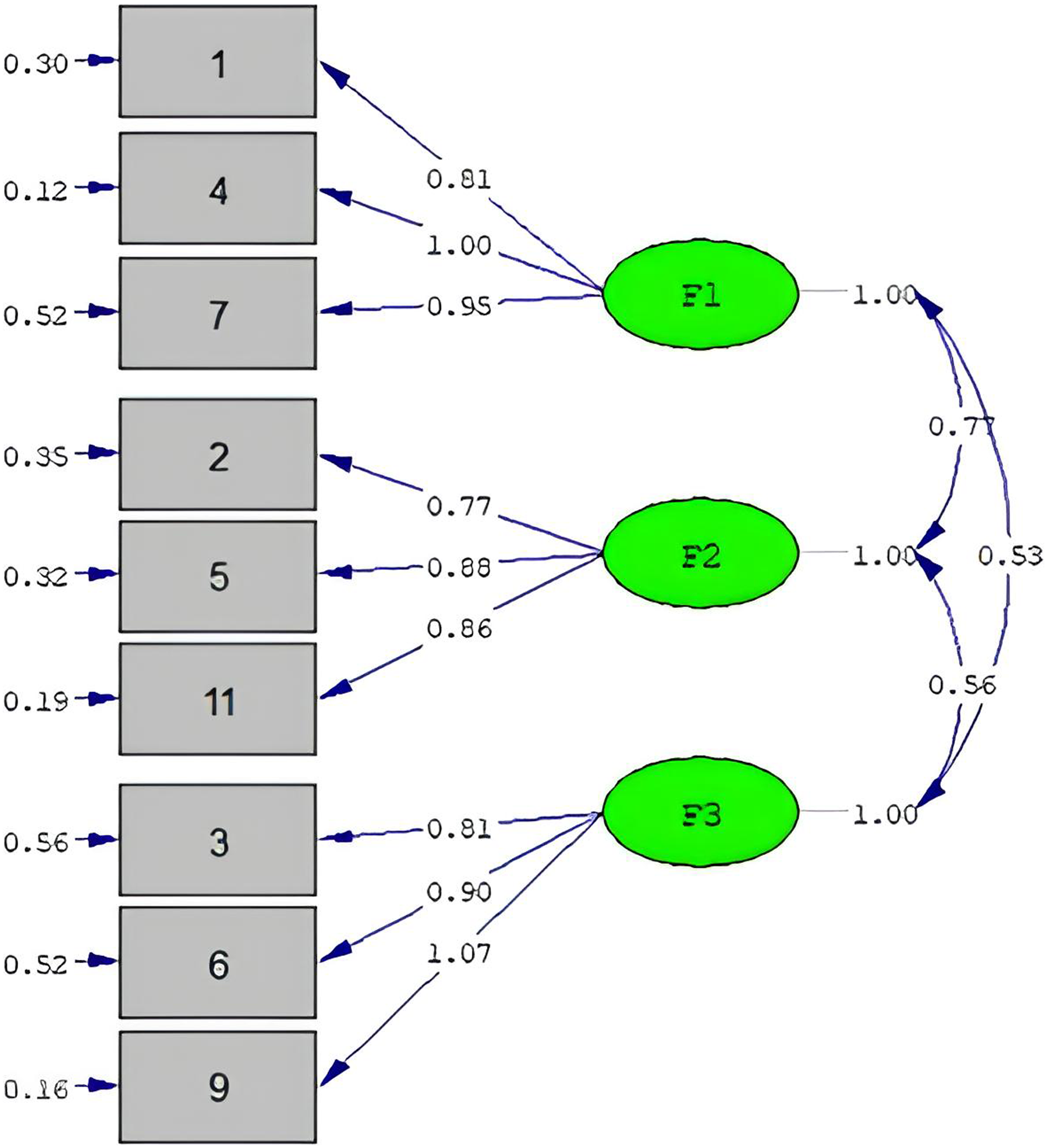
Instrument Factors’ Descriptive Statistics, Internal Consistency, Composite Reliability, and Average Variance Extracted.
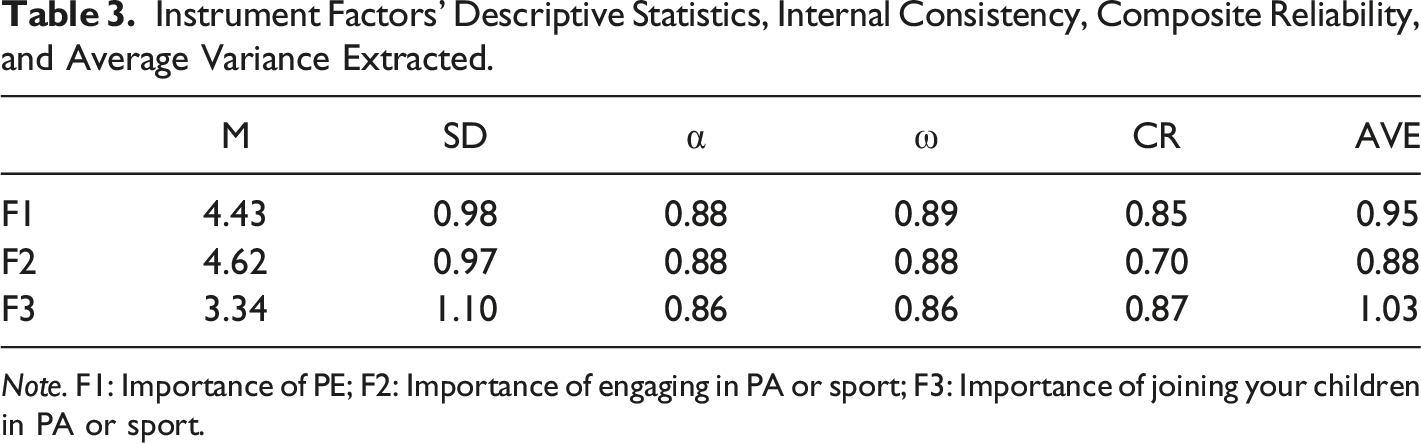
Note. F1: Importance of PE; F2: Importance of engaging in PA or sport; F3: Importance of joining your children in PA or sport.
Discussion
Our purpose in this study was to create and validate a new instrument, the Physical Activity and Physical Education Importance for Parents Scale (PAPEIPS). Previous research highlighted that family, school, and community settings should provide opportunities for children to be more active (Woods, 2014). Promoting positive attitudes in PE and PA seems to be a key factor in promoting healthy lifestyles (Noonan et al., 2017; Petersen et al., 2020). In particular, ‘parents of school-aged children and their attitudes and perspectives can be a key determinant in facilitating children’s adoption of physical education and physical activity’ (Coulter et al., 2020, p. 430). As previously introduced, the value parents place on PA and PE can influence their children’s engagement in an active lifestyle, as well as their motivation in the PE classes (Richards, 2015; Trost et al., 2003; Xu et al., 2015). Parental role modeling has been signaled as a strong determinant in their children’s PA practice, but more research is needed to clarify the links among family members (Santos et al., 2023). Based on the previous ideas, it seemed important for researchers and educators alike to have a validated instrument that could show how strong the connections between these previously mentioned variables are to make the needed changes when necessary. However, to our knowledge, no such instrument has been published. Therefore, we created the instrument presented here, validated it by means of content and factorial validity analysis, and found it to have strong internal reliability. Respondents assessed the nine items of this instrument in a 5-point Likert scale. Items are grouped into three factors: (a) Importance of PE; (b) Importance of engaging in PA or sport; and (c) Importance of joining your children in PA or sport. Finally, we conducted a confirmatory factor analysis to corroborate the factor validity and reliability previously analyzed.
This new tool can now help (a) identify and assess parents’ views on the PE class, on performing PA, and on joining their children to perform PA or sport independently; (b) understand the impact of all these variables, jointly or independently, on other variables like their children’s PA habits; and (c) make PE and PA adjustments as needed. It is a short, quick, and easy-to-use tool that can be convenient in advancing knowledge about the parental role in children’s active lifestyles, and it can be used in future cross-sectional and quasi-experimental research (Petersen et al., 2020).
The importance parents assign to PA practice can be used as an indicator of their children’s level of PA participation (Xu et al., 2015). More important, the significance parents ascribe to their children’s PA practice can be linked to the strength of the family support children are given for their PA practice (Dowda et al., 2011). Finally, it is worth mentioning a finding in recent research that PA practice among family members can positively affect family cohesion (Rhodes et al., 2023). Therefore, the new tool presented here can help understand parents’ views on PE and PA, their connections with their children’s PA/sport practice and, more importantly, family functioning in relation to PA. This is very significant for promoting better lifetime health habit.
Limitations and Directions for Further Study
Our new scale is not without its limitations. As it is a subjective, self-report measure, it may introduce respondent biases and inaccuracies due to recall errors, judgment errors, and/or motivations to represent themselves in a socially desirable light. Secondly, we validated this scale in Spanish-speaking contexts and in a convenience sample comprised mainly of mothers. Future investigators should adapt additional validated versions for other languages and cultures and include more paternal participants. Despite these limitations, this is the first tool to provide needed information on this theme and shed slight on connections between parent’s beliefs and their children’s lifestyles, and it is a short, practical instrument for educational applications and further research.
Conclusions
In this manuscript, we present a new valid and reliable tool for assessing parents’ perceived importance of their children’s PE and PA. Additionally, the instrument allows independent assessment of its three subscales, meeting the interests of researchers who may be separately focused on PE and/or PA. Psychometric characteristics and easy administration now make it a useful questionnaire for use in schools and future research.
Footnotes
Declaration of Conflicting Interests
The author(s) declared no potential conflicts of interest with respect to the research, authorship, and/or publication of this article.
Funding
The author(s) disclosed receipt of the following financial support for the research, authorship, and/or publication of this article: This work was supported by the Government of Spain (Ministry of Education, Culture and Sport); FPU21/02826.
