







Abstract
Our aim in this study was to investigate the effects of motionless interventions, based on visual-auditory integration with a sonification technique, on the learning a complex rhythmic motor skill. We recruited 22 male participants with high physical fitness and provided them four acquisition sessions in which to practice hurdle running, based on a visual-auditory instructional pattern. Next, we divided participants into three groups: visual-auditory, auditory, and control. In six sessions of motionless interventions, with no physical practice, participants in the visual-auditory group received a visual-auditory pattern similar to their experience during the acquisition period. The auditory group only listened to the sound of sonified movements of an expert hurdler, and the control group received no instructional interventions. Finally, participants in all three groups underwent post-intervention and transfer tests to determine their errors in the spatial and relative timing of their leading leg’s knee angular displacement. Both visual-auditory and auditory groups had significantly less spatial error than the control group. However, there were no significant group differences in relative timing in any test phase. These results indicate that the use of the sonification technique in the form of visual-auditory instruction adapted to the athletes’ needs benefitted perception-sensory capacities to improve motor skill learning.
Introduction
Researchers have been studying new training and learning methods to investigate the potential benefits of cognitive interventions in motor learning. Cognitive capacity plays a key role in motor learning in various sports, perhaps especially when physical training is impaired by, for example, time limitations and physical injury. Effective cognitive interventions require the athlete to attend to physical training techniques during motor acquisition. One such technique, movement sonification, is defined by the transformation of kinematic and kinetic characteristics of movement into nonverbal sound signals (Bevilacqua et al., 2016; O et al., 2016; Schaffert et al., 2019) via changes in sound parameters such as loudness, rhythm, tone, pitch, and harmony. This conversion can take place either online (in the form of feedback) or offline (as instructions) (Effenberg et al., 2011). Connecting sound information to a particular action or motion is intended to improve motor skill learning (Rizzolatti & Craighero, 2004; Zhang et al., 2022). The combination of auditory data associated with movement and visual information in soundless phases of action that are rich in kinematic movement information can facilitate motor learning (Effenberg, 2005; Effenberg et al., 2016; Vinken et al., 2013).
Visual-auditory modeling with physical training has been shown to improve kinematic, kinetic, and timing parameters of motor skills (Bieńkiewicz et al., 2019; Effenberg et al., 2016; Ramezanzade, 2020; Ramezanzade et al., 2014, 2017). Similar results have been reported regarding the positive effect of auditory modeling without physical training on the relative timing variable in simple rhythmic motor tasks (Dyer et al., 2016; Shea et al., 2001). In the field of neurology, researchers have confirmed the effects of different motor skill learning techniques using visual-auditory modeling during motionless interventions that emphasized the activation of mirror neurons (Cross et al., 2009; Lahav et al., 2007; Wu et al., 2016). Gibson’s direct perception-action hypothesis (1950) suggested that multisensory integration produced by reliance on visual and auditory information during physical training facilitates more precise reproduction of movement by creating a wider perception of movement. Multisensory signs compliment the evaluation of a single event, resulting in decreased uncertainty in the perception of the motor event (Van Atteveldt et al., 2014). The Theory of Event Coding (TEC) suggested that a cognitive representation of the action is formed by using conceptual functions related to the movement, and the formation of a common coding system of perceptual understanding and of action goals creates a direct interaction between movement and cognitive perception (Richardson & Michaels, 2001).
The event coding hypothesis stated that stimuli codes in perception areas and response codes in motor areas interact automatically without the need for controlled high-level translations (Rosenbloom & Newell, 1988). Event coding is involved in mirror neuron activity, such that mirror neurons both influence the action of a motor skill and become active during observation of the skill performance or when hearing the related sound of the action (Cross et al., 2009; Lahav et al., 2007; Rizzolatti et al., 1996). But, without common sensorimotor experiences, mirror neurons cannot be developed as motionless brain-based activities. Lahav et al. (2013) found improvement in performing a piano piece after a period of motionless brain activity through non-active listening to the same piece of music. Their results indicated the necessity of the practical experience of performing the desired motor skill although, a high level of skill was not required to create mental representations of sensorimotor activity related to that action (Lahav et al., 2013). Therefore, motor acquisition is necessary before motionless interventions can form an integrated perception of visual-auditory instructions. Using monosensory or multisensory stimuli aided by movement sonification may result in more efficient sports coaching and rehabilitation to facilitate motor learning by activating mirror neurons (Binks et al., 2023; Cross et al., 2009; Lahav et al., 2007, 2013; Shea et al., 2001; Wu et al., 2016).
The use of sonification without attention to the aesthetic and perceptual aspects could negatively affect this training method. Therefore, training using this method must be designed to be relative to the movement skills involved (Walker & Nees, 2011). In this work, the hurdle, due to the intrinsic nature of its rhythmic and continuous movement, was well suited for designing cognitive motionless interventions. The continuous nature of data in this skill facilitates an aesthetic sonification design. Also, running over hurdles is known to be a complicated motor skill for which the correct technique involves transferring full kinematic information of body movements by first observing the performance. This skill has always been a great challenge to teach. The rhythmic nature of this sport requires a combination of auditory signals and visual information. Pizzera et al. (2017) showed that adding the real sound of steps to hurdling training protocols had long-term benefits. However, the transfer of this type of auditory information in hurdling is limited to the times when feet touched the ground. The complexity of hurdling is related to the precise performance of lower body movements that are timed with jumping over the hurdle (Amara et al., 2019; Brničević, 2020). For this reason, more complex movement sonification can be an effective complement to visual modeling in acquisition of this specific skill.
Therefore, our two main assumptions were that: (i) The use of visual-auditory instructions by stimulating sensory-motor representations during the period of motionless interventions would improve the spatial and temporal performance parameters in hurdle running. (ii) Using auditory stimuli alone, after a period of motor acquisition, can have a similar effect on performance as visual-auditory instructions; the removal of visual information from motionless interventions can achieve a novel demonstration of the effectiveness of auditory perception capacities during training.
Method
Participants
Twenty-two males (M age = 26.9, SD = 2.07 years) voluntarily participated in this research. We chose to involve only males because men and women train differently and hurdle different heights. A much larger sample would be required to study men and women separately, and the scope of such research was beyond our means at this time. Our sample included men with high physical fitness and regular training routines (except hurdle running) in the sports clubs of the city where the researchers live. The first prerequisite for participants was to obtain high scores on the American Alliance for Health, Physical Education, Recreation and Dance (AAHPERD) physical fitness test and 1600-m aerobic test. Participants had no experience in learning hurdle running. They were healthy physically and mentally as determined by their responses to the Goldberg-Healer’s General Health Questionnaire (GHQ) (Malakouti et al., 2007; Vieweg & Hedlund, 1983). Their vision and hearing were evaluated using Snellen vision and Starkey hearing tests for the Android system (version 1.2.4), respectively. Eleven participants were found to be left-legged by the Waterloo Questionnaire (van Melick et al., 2017).
We conducted a power analysis with G*power (3.1) software to estimate the required sample size for this research using (Kang, 2021). We assumed an average effect size of 0.875 that has been found in prior research of motor learning methods (Kantan et al., 2022; Schaffert et al., 2020; Schaffert & Mattes, 2014, 2015), and we set statistical significance at 0.05 and a desired statistical power of 0.8. The estimated required sample size for each experimental group was found to be eight for the F test statistical family. According to the obtained sample size, at the beginning of the research process, we recruited eight participants for each of three groups (visual-auditory, auditory, and control). But later, two participants withdrew from the research protocol due to illness, reducing the control group to six participants.
Ethical Considerations
We obtained advance approval for implementing this research protocol from Kharazmi university’s ethics committee with document number IR.KHU.REC.1399.033. All participants signed written informed consent documents before engaging in this research.
Apparatus for the Initial Visual-Auditory Instruction Process
To provide participants with visual-auditory instruction for the hurdling task, an expert 110-m hurdler with twenty years’ experience performed demonstration jumps over two hurdles. Since all the participants were unfamiliar with hurdling, the height of hurdles was set at 91.4 cm.; which was lower than the standard height (106.7 cm) of 110-m hurdle competition for men. Kennel et al (2014) showed this height to be acceptable for beginners (Kennel et al., 2014).
Visual Data
We used a GoPro 6 camera with 120 HZ frequency to capture the performance of the expert hurdler. The camera was adjusted vertically to the sagittal plane of the movement in the path of jump so that it recorded a complete step of the leading leg before the first hurdle and after the second hurdle.
Auditory Data
We used IMU sensors (Noraxon® company) with 100 HZ sampling rate (Ho et al., 2019) to capture the hurdler’s kinematic information that would then be sonified (e.g., angular displacement of the leading leg’s knee and the time of touching the ground of both feet). Five accelerometer sensors were installed on the leading leg (hip, thigh, and shank), and shoes. Butterworth low pass filter and 5 HZ cut of point were used to create sonified data. Sensors were used to measure the time of both feet touching the ground. For the first event trace, the minimum point in the X-axis direction corresponded to these sensors. This was used as the instance of the starting touch of the foot with the ground. The second event was defined by the acceleration in the X and Z axes so that, minimum and maximum points in these graphs were taken as the instance close to the end of the foot touching the ground (Purcell et al., 2005). The data obtained to create sonified data were fed to the sandbox software (6.0.0ᵝ). To sonify the angular displacement of the leading leg’s knee, due to the sequential nature of this data, we used a continuous choir sound. A computer-synthesized choir sound of continuous up and down scales represented changes in these data. In contrast, due to the momentary nature of the time of ground touching of the leading and the trail feet, we used the sounds of a string instrument pizzicato and vibraphone, respectively. Pizzicato is a playing technique that involves plucking the strings of a string instrument such as a violin that produces a momentary sound and, vibraphone, a percussion instrument that has tuned metal bars. To produce a better auditory sense of the hurdler’s running direction, we adjusted the stereo state of the sound at a 45⁰ angle from the right to the left ears. The output graph of the sandbox software is shown in Figure 1. Output Graph of the Sandbox Software to Sonify the Angular Displacement of the Leading knee Data.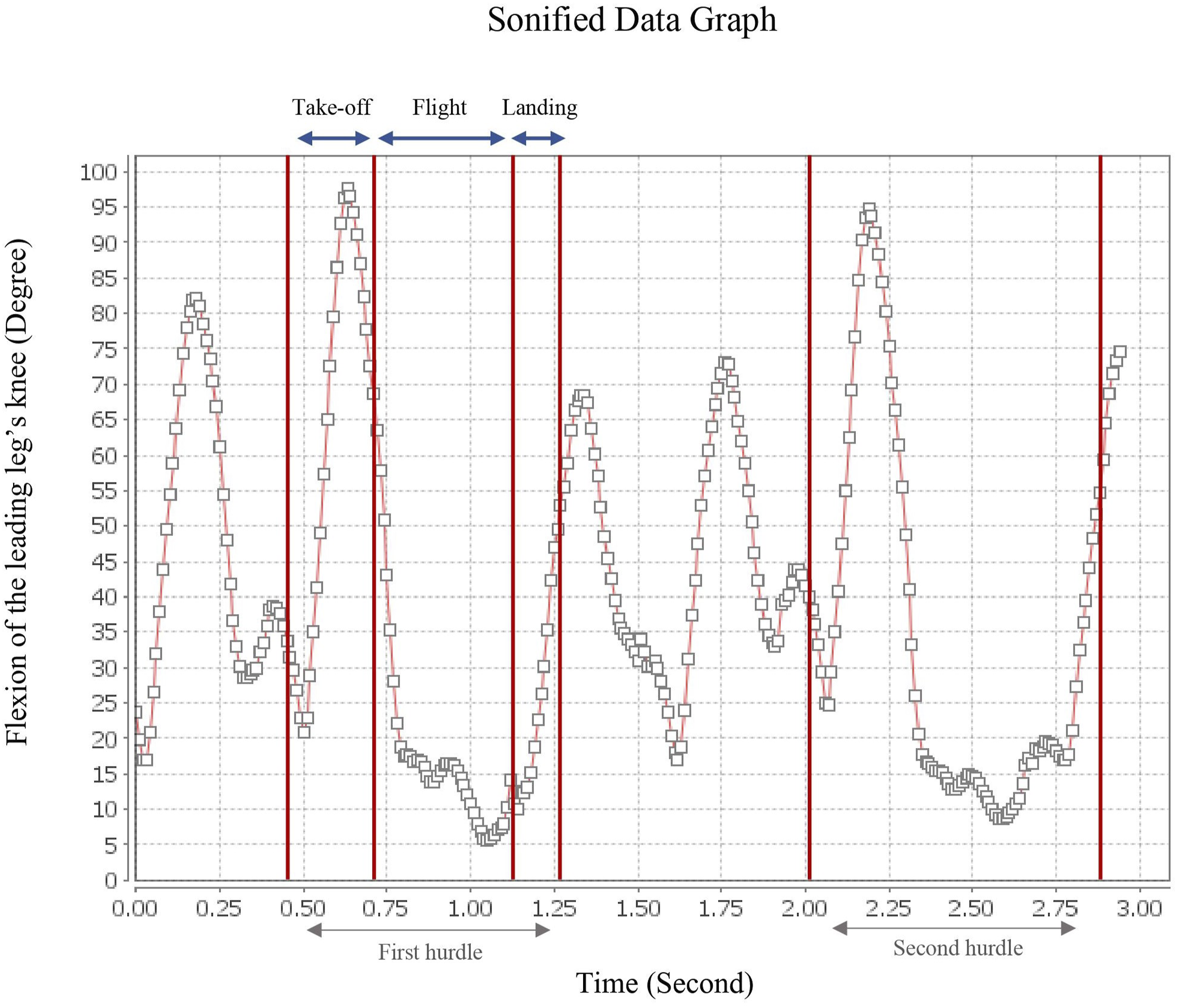
In the end, visual and auditory data were adjusted together. Since hurdling is performed at a high speed and the participants could not have a proper perception of the details of the expert hurdler’s performance, we set the speed of the film taken at 70% of the true speed. In both periods of acquisition and motionless interventions, we presented the instructions to the volunteers via a 15˝ Lenovo (Ideapad 330) laptop and a headphone.
Procedure
First, volunteers had to attend two 45-min introductory sessions to gain experience in hurdle running. Thereafter, participants took part in four sessions (2 sessions per week) of motor acquisition based on visual-auditory instructions. Explanations were provided to familiarize participants with movement sonification and visual-auditory instruction. After warm-up participants performed four trials over two hurdles 8.30 m apart (Pizzera et al., 2017). Instructions were given to each person five times before each trial. The pre-test was conducted after motor acquisition.
Next, participants were randomly assigned into three groups during motionless interventions: visual-auditory (n = 8), auditory (n = 8), and control (n = 6). All groups were homogenized with regard to their right/left leggedness. Immediately after the motor acquisition period, there were six 45-min sessions per week for two weeks (3 sessions per week). The visual-auditory group received instruction similar to the acquisition period, the auditory group only used sonified sound, and the control group had no intervention. Instructions were presented via laptop and headphones in a quiet environment. Details of interventions are shown in Figure 2(A). The post-test was taken after the motionless interventions period. After that, hurdles were set to 110-m standard height (106.7 cm) and transfer tested. Training and tests performed in this study are shown in Figure 2(B). Block Diagra Showing the Pedagogy Instructions Presented to the Visual-Auditory (VA) and Auditory (A) Experimental Groups During the Motionless Interventions Period.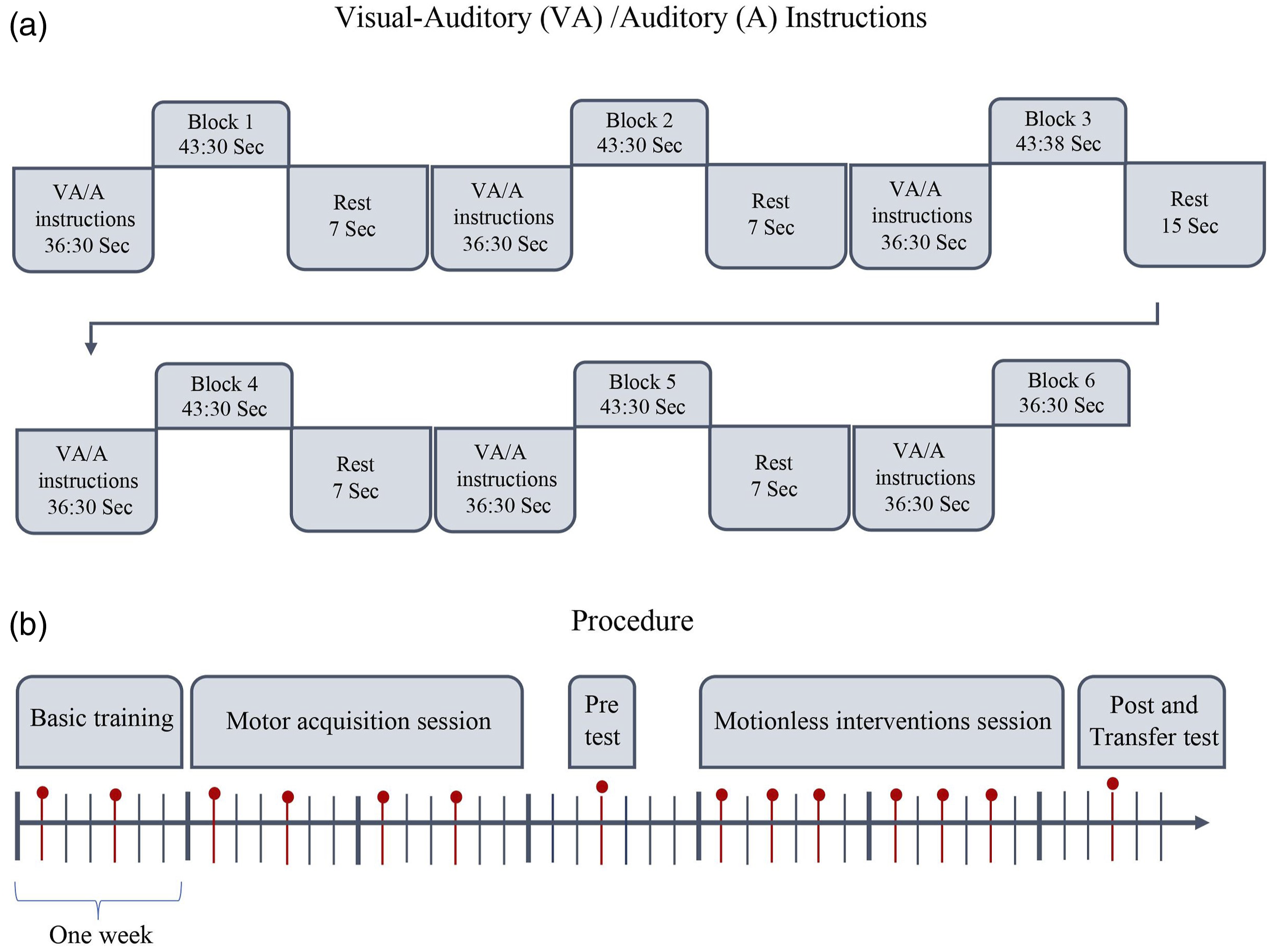
Assessments
At the pre-test, post-test, and transfer test, a Canon 5D-mark Ⅲ camera with 60 HZ frequency (28) recorded the angular displacement of the leading leg’s knee. The camera was adjusted vertically to the sagittal plane of the hurdler’s running direction. Markers were placed on the middle of the thigh bone, external epicondyle, and the external side ankle of the dominant leg. Then again, a video recording of the expert hurdler was used to calculate the participant’s performance error, relative to the expert performance. We used Kinovea software (0.9.5 version) to analyze movement kinematics.
Data Gathered
To calculate the spatial and relative timing errors of the angular displacement of the leading leg’s knee, we analyzed the participants’ movements, based on the following main three phases (Amara et al., 2019; Čoh et al., 2020): • Take-off phase: from the touch of the trail leg to the floor to the moment of separation of the toe of the same leg from the floor. • Flight phase: from the separation of the toe of the trial leg from the floor to the instance of the toe of the leading leg to the floor. • Landing phase: from the moment the toe of the leading leg touches the floor to the instance of separation of the same leg from the floor.
We used root mean square error to measure performance errors in the spatial dimension of these three phases. In this way, it was possible to compare the performance of the participants with the corresponding criterion of the expert hurdler to evaluate the variation in performance (Ramezanzade, 2020). Relative timing error values for each phase of the movement were used to measure error (Ramezanzade, 2020).
Statistical Analysis
We conducted statistical analysis with SPSS (version 25) software. First, we used the Shapiro-Wilk and Levene’s tests to evaluate the normal distribution and homogeneity of variance of the data in the three conditions. To compare the amount of spatial error between the groups and to eliminate the effect of possible differences between groups on the pre-test, we conducted an analysis of covariance (ANCOVA), covarying on pre-test scores and analyzing by Group (three levels: Auditory, Visual-Auditory, Control), followed by Bonferroni post-hoc tests to determine the effect of motionless interventions in the spatial dimension of the performance. Since the assumption of normality of the data distribution of the relative timing error section was not met, we used the non-parametric Kruskal–Wallis test for this variable. Also, we used an analysis of variance (ANOVA) to compare the mean transfer test scores of the three groups. Additionally, in all statistical analyses, we provided effect size values to report the meaningfulness of the findings. Due to the comparative nature of the analyses of the present study, we used Cohen’s d (Cohen, 1962).
Results
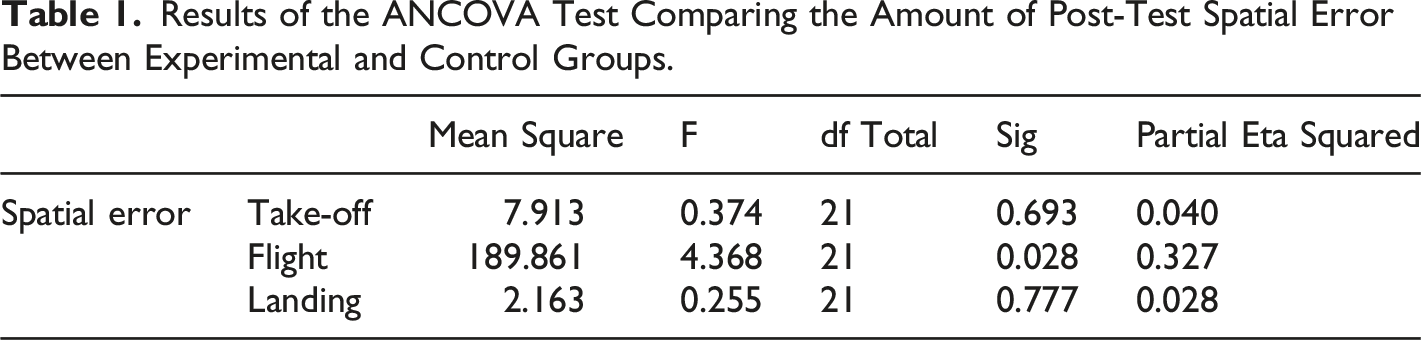
Results of the ANCOVA Test Comparing the Amount of Post-Test Spatial Error Between Experimental and Control Groups.
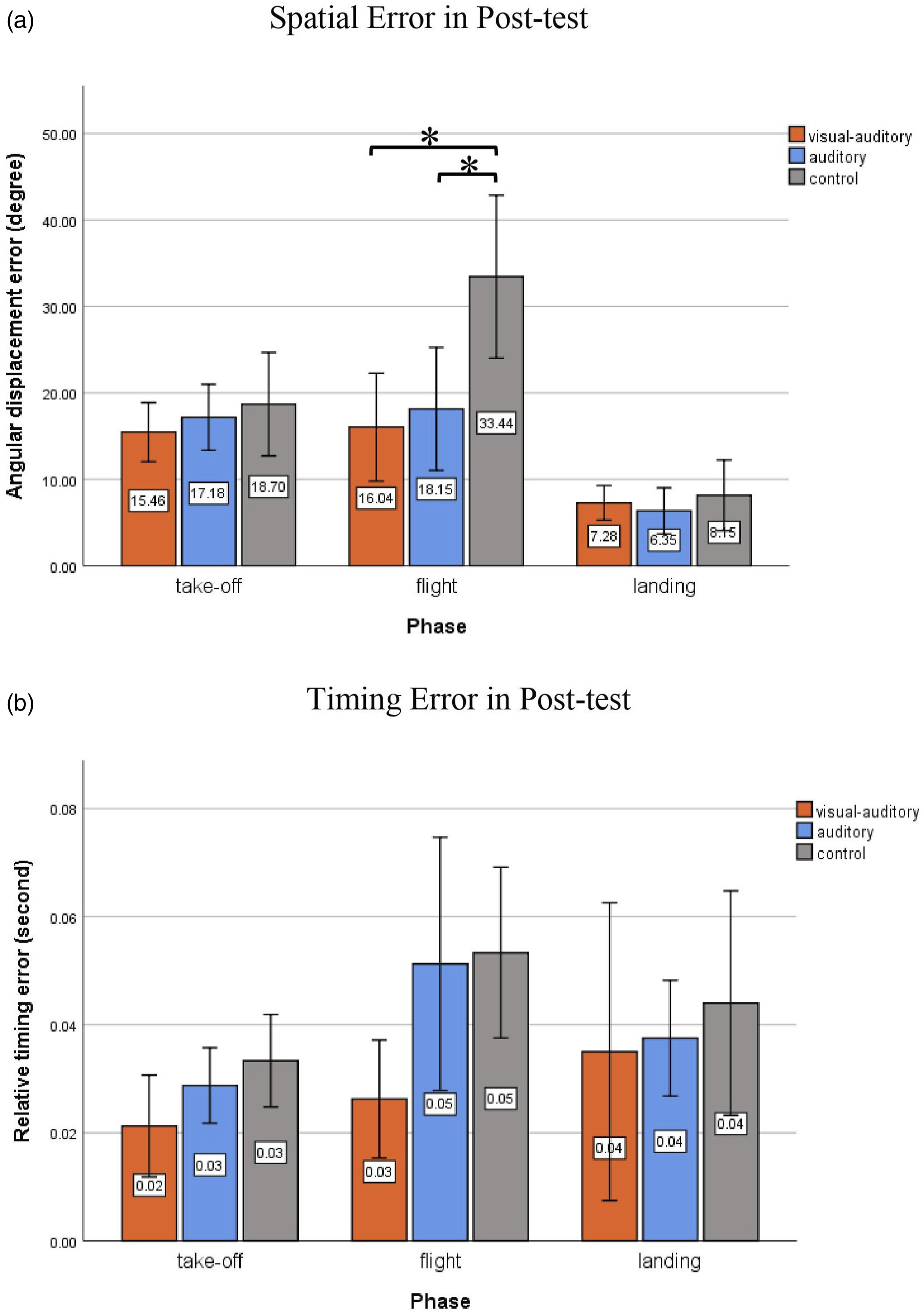
Comparison of Mean Amount of the Spatial Error (A) and Timing Error (B) of the Angle of the Leading Leg Knee Between Experimental and Control Groups in the Post-Test in the Three Phases of Movement: Take-Off, Flight, and Landing.
To compare the amount of the relative timing errors between the three groups we used the Kruskal–Wallis test. Results showed that there was no effect of this Time period on the relative timing parameter in all three phases of take-off (H = 0.73, p = .69), flight (H = 3.20, p = .20), and landing (H = 4.02, p = .013). However, the visual-auditory group had a lower timing error than the other two groups, and the auditory group had a better performance than the control group (Figure 3(B)).
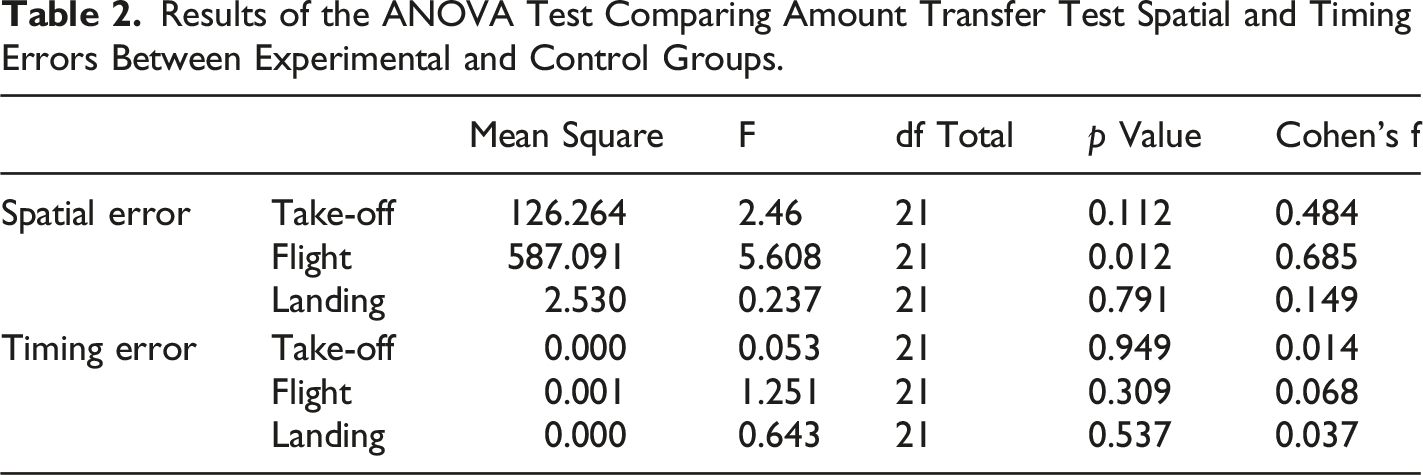
Results of the ANOVA Test Comparing Amount Transfer Test Spatial and Timing Errors Between Experimental and Control Groups.
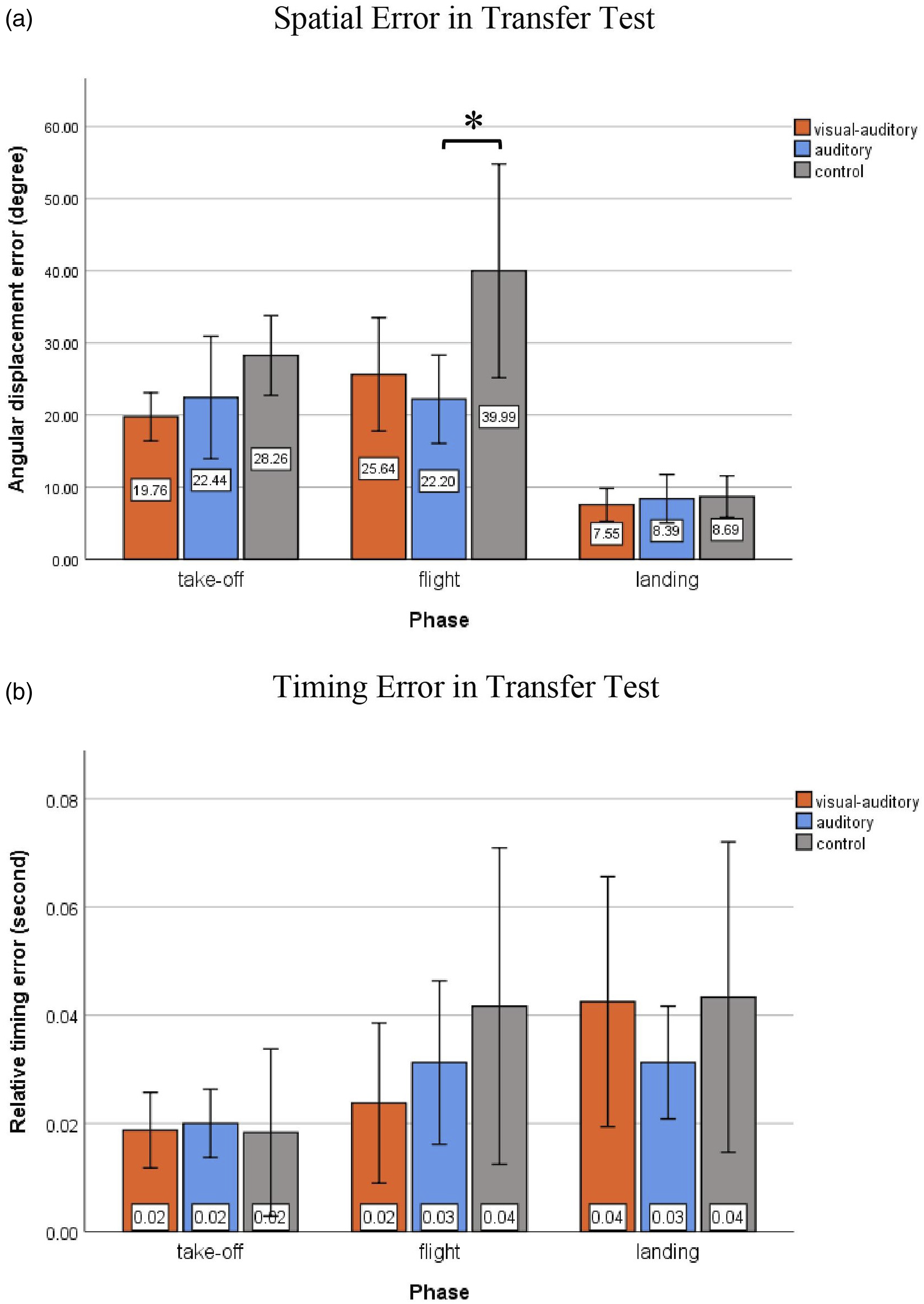
Comparison of Mean Amount of the Spatial Error (A) and Timing Error (B) of the Angle of the Leading Leg Between the Experimental and Control Groups in the Transfer Test in the Three Phases of Movement: Take-Off, Flight, and Landing.
Discussion
In this study, we evaluated the effects of visual-auditory and auditory instructions based on the sonification technique in the framework of motionless interventions on the spatial and timing dimensions of hurdle running. After a period of motor acquisition, based on visual-auditory integration, our two experimental groups of visual-auditory and auditory training participated in motionless interventions. These results showed that these groups had significantly different spatial errors in the flight phase, and visual-auditory and auditory groups had lower spatial error than the control group. The experimental groups had a lower spatial error than the control group in the take-off and landing phases.
Assuming that the common coding of perception conceptual and action goals was correctly shaped during sensory-motor integration in the motor acquisition phase of this research, the activation of mirror neurons could have played an important role in the effect of the motionless interventions on the motor learning process. Prior neuroscience research has shown that the presence of mirror neurons makes it possible to translate information between senses via creating action-perception representations (Cook et al., 2014). Neurons of the motor cortex not only become active during performance of motor skills but also at the time of sensory stimulation involved in the coding of action-perception (Cook et al., 2014) (similar to what occurred during motionless interventions for our visual-auditory and auditory groups).
Therefore, to some extent, the motionless intervention period after the motor acquisition prepared a context to develop sensory-motor circuits involved in the activity of mirror neurons. These circuit preparations were purely based on cognitive interventions without physical training. In the acquisition stage, these commands act as an external movement but, during the motionless interventions stage, they acted on the response level of the nerve cells of the premotor cortex (Bstract et al., 2014).
Findings from Cross et al. (2009) also support our reasoning about motor learning without physical training. These authors reported that participants demonstrated motor perception ability just by observing a set of dance sequences without engaging in personal physical training. Cross et al. (2009) found that the premotor cortex reacted similarly to auditory stimuli with or without physical training and suggested that physical training and observational learning have common neural substrates for learning.
The better performance of our auditory group compared to our control group in the flight phase at post-testing could be used to guide researchers and coaches to transfer motor learning to a viable single auditory modeling process. Referring to the integrity of properties, repeating a property of stimuli previously observed in the form of multiple senses could activate a response that had been coupled ensuite with those stimulants. Therefore, we can assume that the better performance of the auditory group compared to the control group in this phase was due to the simultaneous activation of both visual and motor areas during the presentation of just the auditory stimulus (Shams & Seitz, 2008). Presenting motionless interventions in auditory form could lower the cognitive load in these presentations relative to presentations with both visual and auditory cases, thereby eliminating the need for visual attention in the auditory group.
Lahav et al. (2013) reported similar findings. Their study showed that listening to a piano piece without action improved novice pianists’ performances via its impact on variables such as intensity of pressing keys and precision in relative timing (Lahav et al., 2013). However, in the present study motionless interventions had no positive effect on relative timing error, possibly because of the difference between the motor tasks in our study. In Lahav’s work, it is natural for piano playing to accompany an auditory model, while we added unnatural sonified sounds to create our auditory model.
The post-test showed no significant difference in spatial error between the experimental and control groups in the take-off and landing phases. In the pedagogical instructions, kinematic data of the angular displacement of the leading leg’s knee was transferred to sonified data in a continuous form. Therefore, in this continuous sound, the contribution of the data related to the flight phase in terms of both timing and changes of sound properties, with the maximum changes in sound higher in the flight phase than in the two other phases. While we used the sonified data to create the sensory-motor integration, part of the perceived sounds followed an up-down process. This happens particularly when sound data is presented in a continuous form (Walker & Nees, 2011). Thus, it is possible that, during the motionless interventions, the visual-auditory and auditory groups focused on the changes in the angular displacement of the knee during the flight phase. Even the assumption that the changes in the two phases of take-off and landing were unrecognizable in the auditory group should be kept. Since attention, as a representative of high-level cognitive processes, plays an important role in recalling action related to auditory perception, it is reasonable to assume that auditory discrimination and perception in the integration of sounds with action were not shaped correctly in these phases.
This work also focused on the movement of the knee of the leading leg. Sonified data synchronized to visual modeling may exemplify a non-verbal cueing technique for the displacement of the knee of the leading leg (Stanton & Spence, 2020). Perhaps, this caused the participants to become overfocused on one dimension of movement so that they were deprived of unconscious processing of other movement components of the model. Specifically, for correct performance in the landing phase, participants needed to coordinate between the opposite arm and leg when jumping over the hurdle to keep their balance and land with minimal deviation from the sagittal plane and with the shortest time of the leading foot touching the ground. Therefore, they may have unconsciously reduced the height of their center of mass by bending the knee of the leading leg when landing to preserve their balance. Regarding the timing parameter of the performance, the visual-auditory group had a lower relative timing error than the other two groups in the flight phase, but there was no significant difference between all groups in the three phases of movement.
According to Schmidt’s motor program theory (1975), a generalized motor program (GMP) skill performance with correct properties becomes active when a person has reached enough flexibility in performing motor sequences by training to make performance compatible with the condition (Blandin et al., 1999). Therefore, the improvement of the relative timing parameter is probably dependent on physical training, and motionless interventions alone cannot affect it. These findings contradict those of Shea et al. (2001) whose research tested the effect of combining auditory modeling with physical training. These authors showed that relative timing in both groups improved. Perhaps, the discrepancy between their results and ours is due to the complexity of the tasks or the type of auditory modeling technique we used. Shea et al. (2001) used a task of pressing five keys with a specific timing model while we used hurdle running in which there was a high degree of freedom that required extensive coordination of different parts of the body. Shea et al. (2001) also used an auditory modeling system, based on simple sequence resonances, while we used an auditory modeling technique that was based on complex sonified movement that required more perceptual processing. Also, our results were inconsistent with Dyer et al. (2016) for similar reasons. Their results showed improved performance timing by passive listening to the sonification of hand movements. The movement task in their research consisted of moving the hand along a simple predetermined path (Dyer et al., 2016).
Finally, our transfer test showed that our auditory and control groups were significantly different in the spatial dimension of their performance in the flight phase, but not in the other two phases. Similar to the post-test, the control group performed more poorly than the two experimental groups on this dimension of performance. Yet, comparing the average spatial error between the post-test and transfer test for all groups revealed an increase in the amount of error with the change of the hurdle height in the two phases of take-off and flight. These results point to the high importance of physical training with a similar condition for motor acquisition before the motionless interventions in the spatial dimension. The differences between the groups were not significant in any phase of the timing dimension. But, in contrast with the spatial dimension, improvement in the timing dimension of the performance was observed in the transfer test compared to the post-test. Similar results were also observed when comparing the average timing error between the transfer test and the pre-test in the take-off and flight phases. We assume that increasing the height of the hurdle caused the participants to increase their speed and acceleration of their running to increase the chances of going over the hurdles. Therefore, the amount of their timing error in these two phases decreased compared to the pre-mentioned tests, but in the landing phase, due to the previously mentioned reasons, relative timing error also increased at post-test. This may be related to the difficulty of regaining balance while clearing hurdles of higher heights.
Limitations and Directions for Further Research
Possibly, more pre-learning with verbal feedback was needed to maximize the benefits of the movement sonification technique we studied. Longer pre-learning might help the learner better understand the most important variables involved in performing the motor skill. Further research is needed to ensure the proper frequency and combination of instructions during motor acquisition and motionless interventions. In this research, our main focus was on investigating the capacities and impact of auditory interventions based on sonification when learning a complex motor skill. However, a separate comparison might be made between visual and auditory motionless interventions in future research by separately evaluating the effects of these interventions over time and with retention tests at different intervals. Finally, a larger sample size should be used in future studies to permit generalization of these findings to other populations, especially including female participants, and to gain greater comfort with generalizing these findings to the general population.
Conclusion
We showed in this research that motionless training interventions, in the form of visual-auditory and auditory instructions based on the sonification technique after a period of movement acquisition, improved the spatial parameter of the performance of novice hurdle runners. However, these interventions did not affect the performance timing parameter. Overall, these results indicated the effectiveness of this cognitive training method as a supplement to physical training for athletes. The effect of this type of cognitive training based on sonification in different sports should be investigated in future research. We highlighted limitations to our research, including our small sample size, and made recommendations for future investigators.
Footnotes
Acknowledgements
We sincerely thank the Tehran Fire Organization and Safety Services for their help in making this work possible. We would also like to thank Mr Alireza Salimi for his guidance.
Declaration of Conflicting Interests
The author(s) declared no potential conflicts of interest with respect to the research, authorship, and/or publication of this article.
Funding
The author(s) received no financial support for the research, authorship, and/or publication of this article.
Correction (May 2024):
The article type has been changed from Review to Original Manuscript.
