







Abstract
This study investigated the impact of early success in cadet and junior World Championships on career longevity among elite judo athletes, focusing on the critical transition from junior to senior levels. Using survival analysis, we examined dropout rates and career durations for medalists and non-medalists, defining career termination as a period of at least two consecutive years without international competition. The results from the Cox regression showed that medalists exhibited significantly lower risks of career termination in certain years (e.g., 2011, 2013, 2014, 2015, and 2016), with reductions ranging from 43% to 75%. However, this protective effect was inconsistent, with no significant differences observed in other years. Factors such as injuries, performance stagnation, and structural changes in the International Judo Federation’s ranking system likely contributed to these variations, particularly during years of significant policy shifts. Our findings highlight the importance of early success in extending career duration while emphasizing that it is not a guaranteed predictor of long-term success. These insights indicate the need for tailored athlete development programs that address physical, psychological, and social dimensions, as well as further research to understand the mechanisms supporting career longevity and inform policies aimed at sustaining elite judo athletes.
Keywords
Introduction
The transition from junior to senior levels in judo represents a critical phase in an athlete’s career. However, the relationship between early achievements and long-term success is not straightforward and varies across different sports. Research by Güllich (2017) and Barth et al. (2024) highlighted that, in many sports, success at the youth level did not consistently predict success in senior competitions. For example, in sports like soccer and track and field, athletes who excelled in youth categories often failed to maintain the same level of performance as seniors (Kearney & Hayes, 2018). In contrast, sports such as gymnastics tend to see athletes achieve international success at a younger age (Pasulka et al., 2017), suggesting that the timing of specialization and the specific demands of each sport play a significant role in this transition.
In judo, the relationship between early success and senior performance appears to be more nuanced (Julio et al., 2011). Judo requires advanced technical and tactical skills, as well as significant physical development, which may be developed over a longer career. Judo combines complex technical skills with the need for cognitive maturity and extensive competitive experience, which typically develop with age and exposure to high-level events (Schoof et al., 2024). Similar trends have been observed in endurance sports like cycling, where early success does not always guarantee long-term senior performance (Cesanelli et al., 2022). These parallels suggest that sport-specific demands and development pathways play critical roles in career longevity.
Julio et al. (2011), in their analysis of state-level competitions, found that early success in youth categories did not always translate to success at the senior level, suggesting that factors such as competition level and athlete development pathways may play a significant role. In contrast, it was observed that 61.4% of junior judo medalists and 90.4% of athletes who achieved senior medals while still juniors went on to secure international medals at the senior level, indicating a strong correlation between early success and senior performance in high-level competitions (Li et al., 2018). More recently, it was reported that the chance of winning a medal in the senior category was 8.1-8.5 times greater for junior medalists compared to non-medalists in the Junior Judo World Championships (Junior et al., 2024). These discrepancies highlight the need to investigate the specificities of judo, particularly how factors such as technical, tactical, and physical development influence the transition to the senior level. The contrasting results between state and international competitions reinforce the importance of considering the context in which early success occurs and its implications for long-term career sustainability. The variation in results could be attributed to differences in competition levels. State-level competitions may not fully reflect the intensity and skill required at the international level. Additionally, the most successful judo athletes likely shifted their focus to higher-level events and no longer participated in state competitions—an aspect not considered by Julio et al. (2011).
The high-intensity nature of judo, combined with intensive training regimens (Franchini et al., 2011), increases injury risks that may shorten careers (Lambert et al., 2022). While early specialization offers short-term advantages, it elevates injury risks and reduces long-term participation (Goodway & Robinson, 2015; Myer et al., 2016), whereas diversified childhood activities promote longer careers through broader motor skill development (Güllich, 2017; Wiersma, 2000).
Early success in sports can significantly impact career longevity by attracting greater resources and support (Hallmann et al., 2018). Athletes who achieve early success, such as medalists in youth championships, often receive more financial backing, institutional support, and enhanced training opportunities (Hallmann et al., 2018). This early advantage can lead to a cumulative effect, where past success contributes to future career development. This demonstrates the ‘Matthew Effect’ (Walberg & Tsai, 1983), where early advantages compound through preferential access to elite coaching, advanced training facilities (e.g., sport science labs, recovery centers), and competition opportunities. These advantages can reinforce motivation, improve access to elite coaching and facilities, and ultimately contribute to an extended career (Petersen et al., 2011). Conversely, athletes without early achievements may face systemic resource constraints, including limited access to high-performance training facilities (e.g., specialized judo dojos, strength and conditioning rooms), reduced competition opportunities due to lower federation prioritization, and lack of individualized coaching (Henriksen et al., 2014; Schinke et al., 2018). While early success often attracts resources (the Matthew Effect), survivorship bias must be acknowledged: only athletes who transitioned to senior levels were observable. Conversely, some medalists may face burnout from premature specialization (Giusti et al., 2020). Future studies should track cohorts prospectively to clarify these effects.
The International Judo Federation (IJF) has played a pivotal role in structuring competitions for cadets (15-17), juniors (18-20), and seniors, creating a pathway for athlete development. The IJF organizes a series of international competitions, including the Cadet World Championships, Junior World Championships, and senior-level events such as the World Championships, Grand Slam, and Grand Prix. In addition to these major events, there are also other international tournaments for cadets and juniors, structured similarly to senior-level competitions, including ranking systems, although with smaller participation compared to the main category (Conceição-Santos et al., 2025; Li et al., 2018). These competitions are designed to provide young athletes with opportunities to compete at increasingly higher levels, promoting their development and preparing them for the senior stage (Li et al., 2018). Over the years, the IJF has undergone significant structural changes, particularly in its ranking system and competition formats. For example, the introduction of the IJF World Tour in 2009 reshaped the competitive calendar, offering more opportunities for athletes gain visibility. While the World Tour initially focused on senior athletes, its impact eventually extended to junior competitions as well, particularly after the establishment of a dedicated junior ranking system. This evolution has likely increased the visibility of junior athletes, providing them with a broader platform to present their abilities.
This study aimed to investigate whether early success in cadet and junior World Championships was associated with a higher chance of sustaining an international long career at the senior level in judo. Our hypothesis was that athletes who achieved early success would more likely sustain an international long-term career at the senior level.
Methods
Data Extraction and Procedures
The data used in this study was obtained from the open-access archives of the International Judo Federation (IJF) (https://www.ijf.org/judoka?name=). The analysis in question was based on publicly accessible secondary information, and as a result, no personal information about the athletes was revealed. The study conformed to the ethical guidelines specified in the Belmont Report (National Commission for the Protection of Human Subjects of Biomedical and Behavioral Research, 1979), which prioritizes respect for individuals, the principle of doing good, and fairness in research that involves human data. Since the data were anonymized, additional ethical approval was not required.
The dataset comprised information on athletes’ identification, sex, medalist status (cadet or junior World Championships medalists), year of first and last competition, age, participation in all competitions, and competition results. To ensure that athletes had sufficient time to progress to the senior level, only those who started their international careers up to 2018 were included. Athletes who began their international careers in 2009 and 2010 were excluded from the analysis. This decision was based on the fact that the IJF World Ranking system was introduced in 2009, and athletes who started their careers during this initial phase did not accumulate the necessary number of outcomes (e.g., consistent participation in international events and ranking points) required for a robust Cox regression analysis. Including these athletes could have introduced bias due to incomplete or insufficient data, as the ranking system was still in its early stages of implementation. Although cadet and junior competitions represent distinct age categories, we grouped cadet and junior medalists due to significant overlap in athlete participation across these levels. Therefore, we opted for a combined group to ensure robustness in our comparative analyses. It is important to note that, especially in earlier years, the Cadet and Junior World Championships were held in odd-numbered years (e.g. 2011, 2013, 2015).
Athletes’ international careers were analyzed based on their participation in all competitions included in the IJF World Tour, namely the World Championships, Grand Slam, Grand Prix, and Continental Championships. No national, state or regional competitions were included. Given this scope, the term “international career” refers to participation in IJF-recognized events, including cadet, junior, and senior-level competitions. For some athletes, this comprised only youth-level participation, while for others it included extended senior-level careers. This broad definition was adopted to capture the full developmental trajectory. To categorize athletes based on their competition history, we considered three groups: (1) those who competed in both youth (cadet/junior) and senior competitions, (2) those who only competed in youth competitions and did not transition to the senior level, and (3) those who debuted directly at the senior level. The second group was considered to have discontinued their international careers after the junior level, while the third group was analyzed based on their longevity in senior competitions. However, challenges arose during model estimation due to the imbalanced distribution of the groups. Specifically, some categories had a disproportionate number of observations, with many cases where no event occurred. The mean international career duration (± standard deviation) for each group was: both youth and senior (8 ± 3 years); those who only competed in youth (3 ± 2 years); senior only (5 ± 4 years). The three athlete groups based on competition history were primarily used for descriptive purposes to contextualize the diversity of career trajectories observed. However, the survival analysis and Cox regression models focused specifically on medalist status (medalist vs. non-medalist) at youth level.
A ‘sustained international career’ was operationalized as active participation in IJF World Tour events (World Championships, Grand Slam, Grand Prix, Continental Championships), with career termination defined as ≥2 consecutive years without competition. This threshold accounts for both duration and competition level while allowing for temporary absences. This criterion has been established as a robust indicator of dropout in high-performance contexts (Lemez et al., 2014; Moulds et al., 2020). However, it is important to acknowledge that this definition does not account for factors such as injuries or voluntary career breaks that may lead to temporary inactivity. Despite this limitation, a two-year period without competition has been widely used in the literature as an effective threshold for identifying career discontinuation in elite sports (Lemez et al., 2014; Moulds et al., 2020).
To assess the robustness of our findings, we conducted a sensitivity analysis by testing different inactivity periods (1 year and 2 years). The results obtained with a 1-year threshold were like those using a 2-year threshold. Given this consistency, we chose the 2-year period and have justified this choice above.
Data Overview
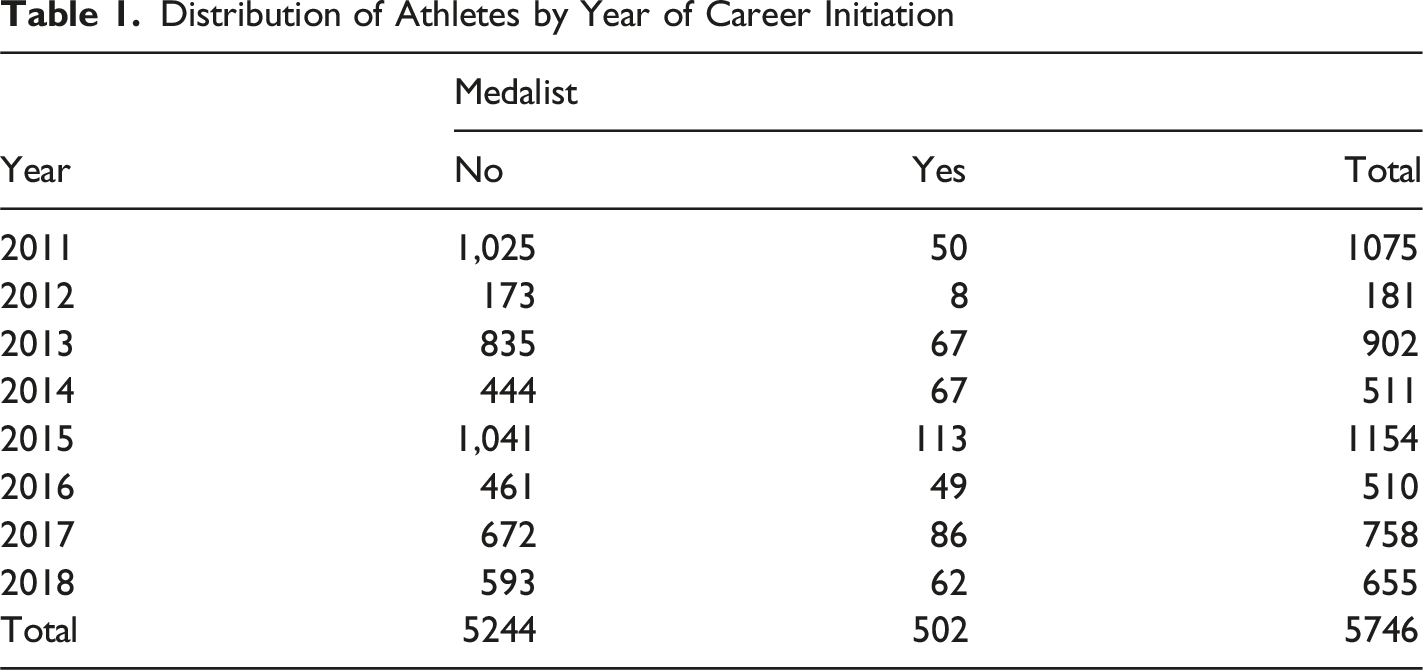
Distribution of Athletes by Year of Career Initiation
Statistical Analysis
Descriptive statistics were calculated to summarize patterns of sustained participation and withdrawal over time. Kaplan-Meier survival analyses were used to estimate withdrawal rates based on years of participation and medalist status, after verifying that outcomes were mutually exclusive and time-to-event data were properly defined. To predict factors influencing career sustainability, Cox proportional hazards models were applied, with medalist status as the primary covariate. These models generated hazard ratios (HR) with 95% confidence intervals (CI), and incorporated time-dependent covariates when proportional hazards assumptions were violated, as verified through Schoenfeld residuals. Sensitivity analyses were conducted to compare alternative inactivity thresholds (1-year vs. 2-year). Before conducting these analyses, we performed comprehensive assumption checks: proportional hazards assumptions were verified using Kaplan-Meier curves for categorical variables, with time-dependent covariates introduced when violations occurred, and model fit was assessed using likelihood ratio tests. A significance level of p < 0.05 was adopted for all statistical tests. All analyses were conducted in R (version 4.4.1) using the survival package and related tools.
Results
Figure 1 demonstrates the participation of athletes in international competitions by the year they started their international careers. Kaplan-Meier Survival Estimates Illustrating Differences Between Annual Cohorts Based on the Year Athletes Began Their International careers.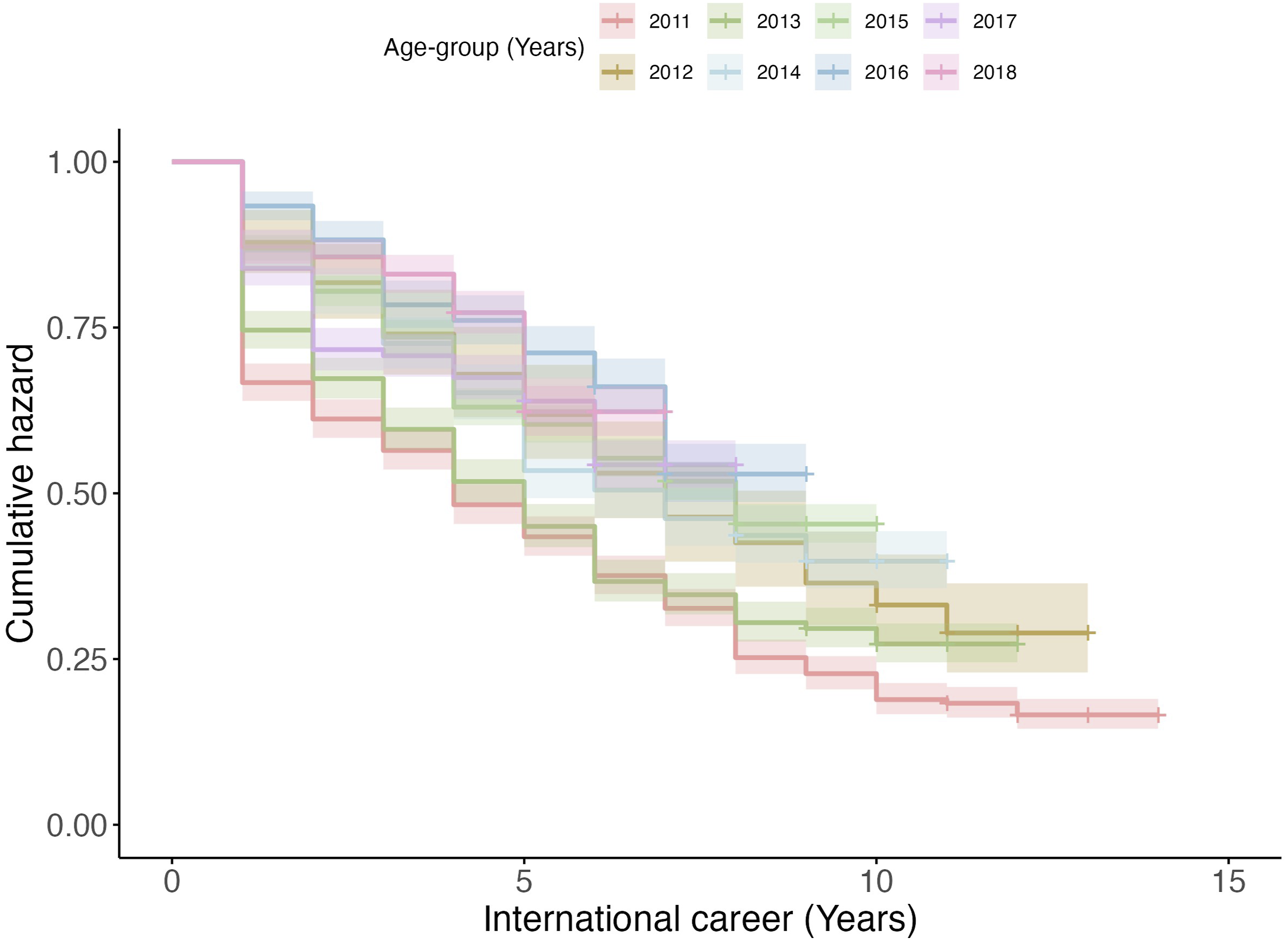
Figure 2 illustrates the Kaplan-Meier survival estimates, revealing significant differences between medalists and non-medalists at Cadet or Junior World Championships in international career dropout rates for the years 2011, 2013, 2014, 2015, 2016, and 2017. Medalists consistently displayed a lower cumulative hazard of international career termination compared to non-medalists. Cumulative Hazard for International Career Dropout by Medalist Status and Career Start Year.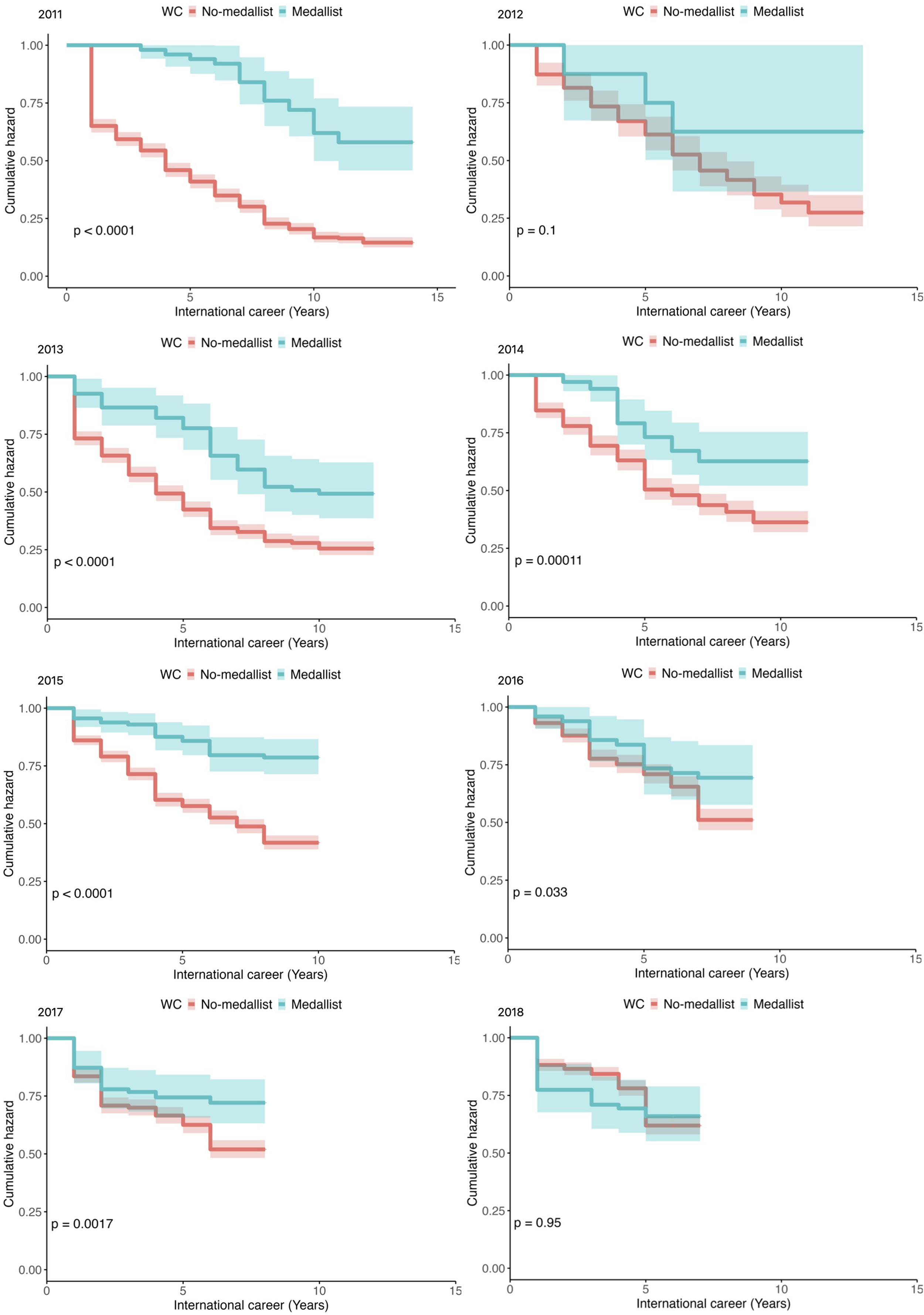
Cox Regression Analysis of Career Dropout Rates by Medalist Status at Cadet or Junior World Championships and Year of Career Initiation
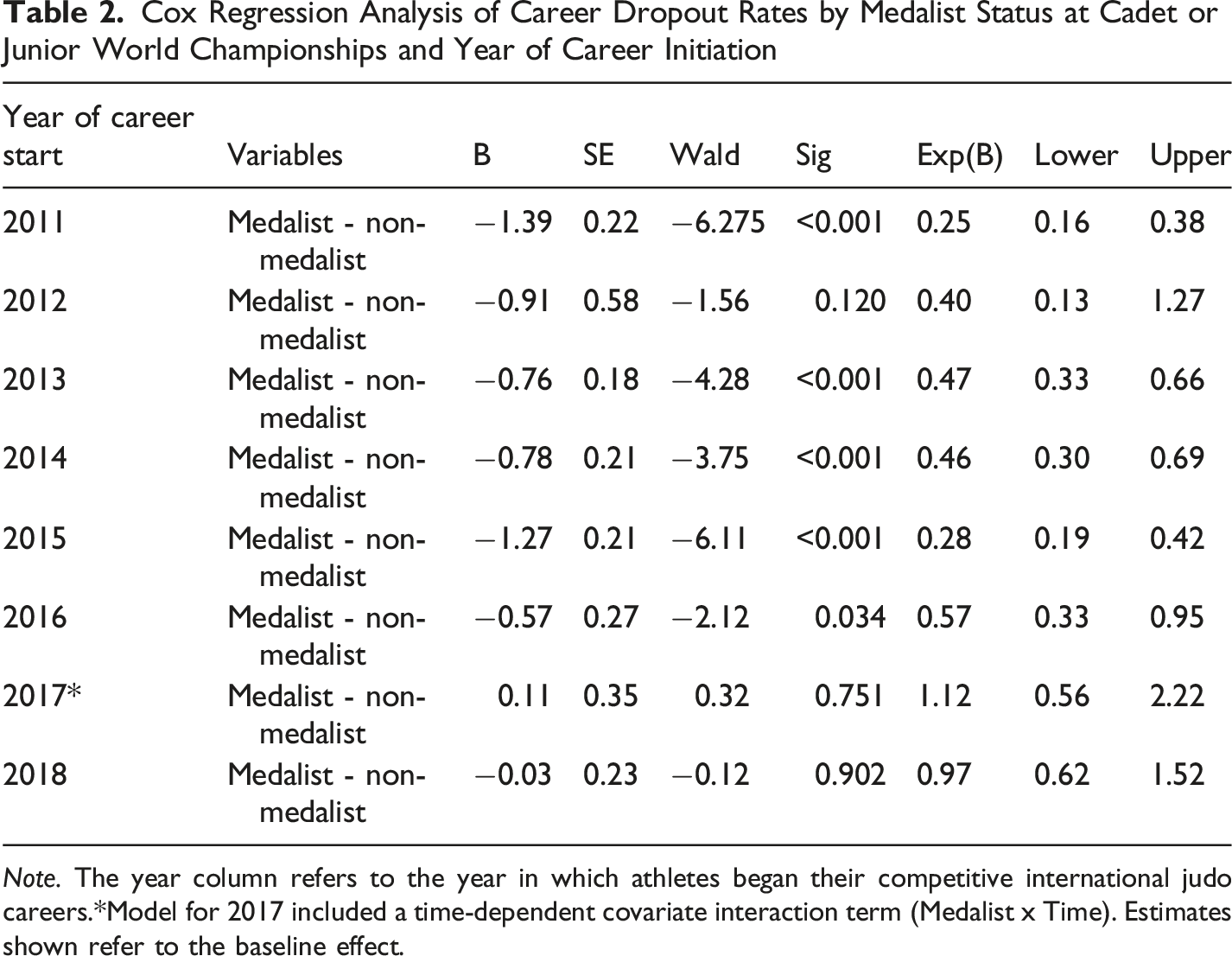
Note. The year column refers to the year in which athletes began their competitive international judo careers.*Model for 2017 included a time-dependent covariate interaction term (Medalist x Time). Estimates shown refer to the baseline effect.
Discussion
This study demonstrated that early successes in the Cadet and Junior Word Championships were associated with greater international career sustainability among elite judo athletes. Medalists showed a significantly lower risk of career dropout in specific years (2011, 2013, 2014, 2015, and 2016), with reductions in risk ranging from 43% to 75%. However, this protective effect was not observed in other years (2012, 2017, and 2018). Our findings highlight the variable nature of the impact of early success on international career longevity, which is influenced by temporal and contextual factors.
Regarding the years with significant differences (2011, 2013, 2014, 2015, and 2016), the analysis revealed a consistent protective effect for medalists compared to non-medalists. These findings suggest that, in those cohorts, stable competitive structures and enhanced institutional support—such as greater visibility and access to resources—may have contributed to prolonged international careers. In contrast, no significant differences in dropout risk were found in 2012, 2017, and 2018. This absence of effect may reflect lower medalist representation, less supportive development environments, or broader cohort heterogeneity. Additionally, structural transitions in competition policies or reductions in available resources during those years may have influenced athlete retention independently of early success.
Our findings align with the Foundations, Talente, Elite, Mastery (FTEM) framework’s emphasis on phased transitions (Gulbin et al., 2013). Medalists may benefit from targeted support during the ‘Talent Development’ (T2-T3) phases, while non-medalists require interventions to bridge the ‘Foundation’ (F1-F3) to elite pathways. This structured approach could explain why early success conferred advantages only in specific years, likely those with more stable development conditions.
Literature suggests that factors such as injuries, performance stagnation, educational demands, and lack of motivation are key contributors to career dropout (Bennie & O’Connor, 2006). Additionally, social and economic factors, such as economic crises or changes in funding, may have played a significant role during the years in question. The complexity of career development is reflected in the fact that, as highlighted by Güllich (2017), international medalists often delayed their specialization and engaged in more diverse activities during childhood, compared to non-medalists, who focused more early on their main sport.
While early success is not a guarantee of a prolonged career, medalists may benefit from preferential selection for high-level events, greater visibility, and more support from the training system. These factors, such as increased coaching investment, facilities, and financial resources, can create a positive cycle, reinforcing motivation and self-confidence (Güllich, 2017). However, as shown by a previous study (Barth et al., 2024), not all elite athletes at the senior levels succeeded during their youth, and some early achievers may experience burnout from excessive specialization pressures. This suggests that early achievements, while advantageous, are neither necessary nor sufficient for sustained success. In the lastly, some athletes could experience burnout.
The variability in protective effects observed in this study — particularly during periods of structural changes in the International Judo Federation (IJF) ranking system — demonstrates the multifactorial nature of athlete development. Structural changes can alter competition dynamics and access to opportunities, impacting career trajectories independently of early success (Li et al., 2018). The introduction of the IJF World Tour in 2009 and its establishment in the early 2010s years created differential impacts across cohorts, as documented in the IJF’s 2015 policy review. Athletes starting careers during full implementation (2011, 2013) benefited from stabilized systems, while the 2012 cohort faced transitional challenges (IJF, 2015).
From a practical perspective, these findings emphasize the importance of providing targeted support for cadet and junior medalists during their transition to senior competition. To maximize the benefits of early success, federations should implement mentorship programs that pair these young athletes with experienced senior competitors and/or coaches (Behr & Kuhn, 2019). Additionally, investments in injury prevention and mental health resources (Lundqvist, 2024; Pilkington et al., 2024) are essential to sustaining careers, particularly during transition periods. However, the effectiveness of such strategies in judo remains insufficiently studied and should be investigated in future research.
Study Limitations
This study is not without limitations. The reliance on archived data restricts the ability to capture unobserved variables, such as injury history or changes in athlete motivation. The lack of injury data, for example, may mean that some athletes dropped out due to health issues, which was not captured in the analysis. Furthermore, athlete motivation can fluctuate over time, which could explain why some years did not show significant differences between medalists and non-medalists. Additionally, unmeasured confounders (e.g., socioeconomic status, training environment differences) may influence career trajectories, though the IJF dataset provides robust competition records. For instance, athletes from well-resourced nations may simultaneously have higher medal probabilities and longer career support systems (De Bosscher & De Rycke, 2017). While extensive theoretical and empirical literature exists on athlete career development and transition across various sports (e.g., Stambulova et al., 2021), the sport of judo presents unique characteristics — such as early international exposure, weight-class dynamics, and global competition structure — that may influence career progression and dropout differently. Therefore, future research should investigate career endings in judo through integrated approaches combining medical records, psychological assessments, and athlete interviews, while informed by and contributing to broader frameworks established in athlete career research.
Conclusion
This study provides robust but context-dependent evidence that early achievements in Cadet and Junior World Championships positively influence international career longevity in judo. However, the variability observed reinforces the need for tailored athlete development strategies that transcend early success, fostering resilience and adaptability to sustain long-term engagement. By addressing these factors, federations and policymakers can optimize athlete development programs, ensuring greater sustainability and success at elite levels.
Footnotes

Funding
The author received no financial support for the research, authorship, and/or publication of this article.
Declaration of Conflicting Interests
The authors declared no potential conflicts of interest with respect to the research, authorship, and/or publication of this article.