







Abstract
Generated drawing is a specific instructional approach that has been investigated in academic settings. However, in sports, tactical drawings are often presented based more on coaches’ preferences than on empirical evidence. This study examines the impact of coach’s drawing and the moderating role of Visuospatial Abilities (VSA) on soccer tactical memorization and visual attention. A total of 54 male university students, all novices in soccer, were randomly assigned to one of two conditions. In the static-drawing condition, participants viewed a pre-drawn tactical diagram while listening to an oral explanation. In the dynamic-drawing condition, they observed the coach actively drawing the diagram while providing the same explanation. Initially, individuals’ VSA were assessed through a control test. Subsequently, in a main test, participants memorized and reproduced the tactical scene while their gaze was recorded with an eye-tracking system. Key findings reveal a moderating effect of VSA, as high-VSA participants benefited more from the dynamic-drawing condition and showed more effective visual processing, supporting the ability-as-enhancer hypothesis. In contrast, low-VSA participants showed no significant benefit from the coach’s dynamic-drawing and demonstrated less effective visual processing, indicating difficulties in extracting and interpreting diagram elements. These results highlight the importance of adapting instructional drawing strategies based on individual cognitive characteristics, particularly VSA, to optimize visual attention and memorization from narrated tactical diagrams.
Introduction
In team sports, visual aids, particularly diagrams, are crucial for tactical learning. These tools help coaches enhance players’ ability to develop a comprehensive mental model that accurately reflects the spatial and temporal dynamics of gameplay strategy. Research suggests that verbal explanations from coaches enhance the understanding of abstract symbols and their interrelations in diagrams (Khacharem, 2017). This mechanism, known as the modality effect, is supported by Ginns (2005), whose meta-analysis found a significant advantage for spoken over printed words in multimedia lessons. This superiority stems from two mechanisms: the overloading of the visual/pictorial processing channel and the split-attention effect. Spoken words are processed directly through the auditory channel, which prevents the visual channel, already engaged with pictures, from becoming overloaded and allows both sources of information to be processed in parallel (Tabbers, 2002). Furthermore, learners are not required to divide their attention between reading text and examining images, which facilitates the immediate connection between verbal and pictorial information and supports the construction of a more coherent mental representation (Sweller, 1999). According to the cognitive theory of multimedia learning (Mayer, 2005, 2009, 2014, 2017), narrated diagrams engage three core cognitive principles: First, dual channels for processing visual and verbal input (Paivio, 1986); second, limited working memory capacity (Baddeley, 1999; Sweller et al., 2011); and finally, active processing through the selection, organization, and integration of information (Mayer, 2009; Wittrock, 1989). Therefore, memorizing narrated diagrams remains a challenging task, particularly for novices. It is achieved through selecting relevant information, organizing it into coherent structures, and integrating it with prior knowledge, all while avoiding the overload of the limited capacity of the visual and verbal channels in working memory (Johnson et al., 2015; Mayer, 2014). Indeed, unnecessary visual searches to align relevant information in the diagram with auditory instructions can consume substantial cognitive resources and hinder learning (Kalyuga et al., 1999). To address these issues, researchers have proposed dynamic-drawing as an effective strategy to enhance cognitive processing of narrated diagrams (Fiorella et al., 2019, 2020; Fiorella & Mayer, 2016; Mayer et al., 2020). This instructional approach is based on the dynamic-drawing principle which states that instructor-generated drawing, where visuals are drawn in real time, enhances learning more than pre-drawn visuals (Mayer et al., 2020).
Instructor-Generated-Drawing
Instructional design incorporating hand-drawn illustrations has already been recognized as an effective teaching tool in educational settings. Indeed, hand-drawn illustrations, which progressively build the final image alongside verbal explanations, have been shown to boost engagement and learning more than slideshows, audio, or text (Guo et al., 2014; Türkay, 2016). Similarly, Fiorella and Mayer (2016) conducted a series of experiments to test whether instructor-generated drawings during a video lesson enhance learning. Students watched a video on the Doppler Effect featuring either dynamic diagrams drawn in real-time or static, pre-drawn diagrams. Results showed that the dynamic-drawing group outperformed the static-drawing group on a transfer test assessing learners’ ability to apply their understanding of the Doppler Effect to novel situations. Taken together, this body of research supports the dynamic-drawing principle (Mayer et al., 2020) and suggests that dynamic-drawing acts as a dynamic construction of static visuals, sharing key design features with dynamic visualizations (Fiorella & Mayer, 2016). In fact, drawing while explaining aligns with fundamental principles of multimedia learning. This instructional strategy reduces extraneous processing by limiting the working memory resources devoted to irrelevant information. These resources freed are then redirected towards germane processing, dealing with the intrinsic cognitive load, and to support the mental representation and processing of the essential material (Fiorella, 2021; Mayer, 2005). Dynamic-drawing achieves all these advantages by applying three multimedia principles: signaling, segmentation and temporal contiguity. First, consistent with the signaling principle, during dynamic-drawing, the instructor’s hand serves as a guiding cue that directs students’ attention to relevant sections of the diagram. This facilitates the identification and selection of key components, in contrast to learners exposed to static, pre-drawn diagrams without visual guidance. Second, according to the segmenting principle, diagram elements are progressively drawn, part by part, rather than presented all at once. This allows learners to handle each component before moving on to the next, unlike static diagrams that require understanding all information at once. Third, in line with the temporal contiguity principle, the instructor’s verbal explanations are synchronized with the dynamic-drawing of the corresponding diagram components. This synchronization allows learners to integrate spoken words with the corresponding parts of the diagram as they appear, thereby building a coherent representation more effectively than those who listen to an oral explanation while viewing already-completed diagrams. Overall, dynamic-drawing emerges as a powerful instructional tool for enhancing learning. Yet, its effectiveness may depend on individual learner characteristics, particularly visuospatial abilities (VSA), which remain unexplored despite their proven influence on both multimedia learning (Castro-Alonso et al., 2019) and tactical performance in sports (Ben Mahfoudh & Zoudji, 2020, 2022, 2024).
Visuospatial Abilities
VSA refers to the capacity to recall, generate, depict, and manipulate both symbolic and non-verbal information (Linn & Petersen, 1985; Toivainen et al., 2018; Yılmaz, 2009). VSA is considered a cognitive trait that differs among individuals and influences learning outcomes when visual aids are used (Peck et al., 2012). The processing of visuospatial information involves various skills, including the mental manipulation of static visual inputs (static VSA) and the ability to reason about moving visual components (dynamic VSA) (Ben Mahfoudh & Zoudji, 2022). Researchers have founded two contrasting theories to explain how VSA interacts with different presentation formats in the learning process. First, the ability-as-enhancer hypothesis suggests that individuals with high-VSA are better equipped to process dynamic visualizations due to their advanced cognitive and attentional capacities, enabling them to extract and integrate complex visual information more effectively (Brucker et al., 2014; Hegarty, 2005; Hegarty & Sims, 1994; Huk, 2006; Çöltekin et al., 2018). As a result, individuals with high-VSA achieve better learning outcomes from animations than those with low-VSA (Brucker et al., 2014). Second, the ability-as-compensator hypothesis (Hays, 1996; Höffler & Leutner, 2011) posits that dynamic visualizations serve as cognitive support for individuals with low-VSA (Hegarty & Kriz, 2008) by offering a tangible external representation of the system, thereby reducing their reliance on complex mental manipulations. Thus, dynamic presentations help low-VSA individuals reach a learning efficiency level similar to that of high-VSA individuals (Höffler, 2010; Kaushal & Panda, 2019). The crucial role of VSA in multimedia learning has been extensively documented across the disciplines of science, technology, engineering and mathematics (STEM) (Berney et al., 2015; Black, 2005; Uttal et al., 2013). More recently, research has extended to team sports. Ben Mahfoudh and Zoudji (2020) found that players with high-VSA exhibited superior learning efficiency when memorizing dynamic tactical scenes, requiring fewer repetitions and expending less mental effort to retain and reproduce the scenes compared to those with low-VSA. While these studies highlight the importance of VSA in multimedia learning, its role across other instructional approaches, such as drawing, remains unexplored. Research has shown that VSA significantly moderate the impact of drawing on learning, particularly when drawing is used as a generative learning strategy (Bobek & Tversky, 2016). However, most of this work has focused on learner-generated drawings, paying little attention to instructor-provided ones, even though the associated cognitive demands may differ. In addition, to better understand the mechanisms underlying the impact of drawing and the potential moderating effect of VSA, it is essential to examine how learners visually process information during learning.
Eye Tracking
Just and Carpenter’s eye-mind hypothesis (1980) states that there is little delay between eye movements and the cognitive processing of corresponding information. Eye-tracking technology has supported research in cognitive psychology by providing valuable insights into attention-related cognitive processes during task performance (Sáiz-Manzanares et al., 2021). Scene perception results from the continuous alternation between fixations, where the eyes remain focused on a specific point, and saccades, which are rapid movements between fixation points (Liao et al., 2017). These eye movement metrics, such as fixation duration, saccade speed and amplitude, can vary with individual characteristics and reflect differences in tactical learning contexts. Ben Mahfoudh and Zoudji (2022) showed that VSA significantly influence the visual processing of tactical soccer scenes. Eye-tracking data revealed that high-VSA players displayed longer fixations and saccades that were slower in velocity and shorter in amplitude, reflecting focal processing and sustained focused attention. In contrast, low-VSA players showed shorter fixations and faster, longer saccades, suggesting ambient processing that hindered conscious identification of key elements. In eye-tracking research on instructor-generated drawings, Stull et al. (2018) examined students’ attention in relation to instructor visibility, but overlooked the cognitive impact of the drawing itself. To our knowledge, no study has investigated learners’ visual processing of instructor-generated drawings while considering individual differences in VSA.
Rational of the Study
The aim of the present study was to explore the impact of the coach’s drawing and the role of VSA on novice participants’ memorization and visual processing of a tactical soccer scene. Due to the lack of research on drawing in tactical learning, this study relied on findings from STEM disciplines (Fiorella et al., 2020; Fiorella & Mayer, 2016). According to the dynamic-drawing principle (Mayer et al., 2020), we expected that dynamic-drawing of a diagram would enhance learning and promote more efficient visual processing (Hypothesis 1). Concerning the impact of VSA, we expected high-VSA participants to better memorize the tactical scene than low-VSA participants (Ben Mahfoudh & Zoudji, 2020, 2022, 2024), and to exhibit more focused visual attention, reflected by focal processing (Ben Mahfoudh et al., 2021; Mahfoudh & Zoudji, 2022) (Hypothesis 2). In addition, this study explores the interaction between coach-generated tactical drawing and VSA. Building on Fiorella and Mayer’s (2016) suggestion that dynamic-drawing may produce effects similar to dynamic visualizations, and on prior findings about the role of VSA in processing such material (Ben Mahfoudh & Zoudji, 2020; Mahfoudh & Zoudji, 2022), we expect high-VSA participants to benefit more from dynamic-drawing. This expectation is based on their enhanced ability to extract, process, and integrate visual informations (Hypothesis 3).
Method
Participants
To estimate the required sample size, a priori power analysis was conducted using G*Power software (Version 3.1.9.7) (Faul et al., 2020). A large effect size (f 2 = 0.35), with statistical power set at 0.80 and an α level of 0.05, indicated that a sample size of 25 participants was sufficient to guarantee robust statistical analyses. To account for potential dropout or technical issues during data collection, a sample of 54 male university students (M age = 21.5, SD = 3.3, range = 17 to 35) participated in this study. Only male participants were recruited, ensuring that the results could not be attributed to gender-related differences. Although the participants were familiar with soccer rules through occasional matches in physical education classes or informal games with friends, they had never played soccer or any other team sport at a club, ensuring the absence of cross-sport transfer effects (Smeeton et al., 2004). The subjects stated that this was their first participation in this type of laboratory experiment, thus eliminating any prior familiarity. They reported no vision impairments, otherwise, any detected issues were corrected with contact lenses. Finally, all participants volunteered and provided informed consent, confirming the full respect for their rights. The study was approved by the university’s ethics committee and conducted in accordance with the Declaration of Helsinki.
Materials
Two computerized tests were displayed on a 15.6-inch laptop screen. First, the control test consisted of two tasks designed to assess participants’ VSA. Second, the main test required subjects to memorize a soccer scene and reproduce it on a printed paper. This video-based tactical scene was filmed in two distinct versions using an Ultra HD camera, strategically set up on a tripod 1.5 meters from the whiteboard. During the visualization phase, eye movements were recorded using a head-worn, wireless eye-tracker (Tobii Pro Glasses 2, 50 Hz; Tobii AB, Danderyd, Sweden) connected to a 13-inch Dell computer. The recording was managed with Tobii Pro Glasses Controller software (version 1.95), and the data were analyzed using Tobii Pro Lab software (version 1.241).
Measures
Control Test
Based on the taxonomy of Ben Mahfoudh et al. (2022), two tests were selected to evaluate participants’ static and dynamic VSA. Static VSA was measured using the Vandenberg and Kuse (1978) Mental Rotation Task, which required participants to mentally rotate two- and three-dimensional images and figures. In this task, participants viewed a cubic figure (X) and four rotated alternatives, and had to identify the two that matched the original. Dynamic VSA was evaluated through the ‘Shoot’ task, which involved predicting the trajectory of a moving object (D’Oliveira, 2004; Sanchez & Wiley, 2014). Participants completed twenty trials in which they launched a black ball vertically at a speed of 1600 px/s by pressing the G key, aiming to collide with a white ball moving horizontally at a speed of either 900 or 1400 px/s. Each participant’s VSA score was calculated as the average of their performance on the static and dynamic tests (Ben Mahfoudh et al., 2021).
Main Test
In the study’s main test, participants were instructed to memorize one of two versions of a video-based tactical lesson depicting the structure of a soccer game system: dynamic-drawing or static-drawing (Figure 1). In both experimental conditions, a male soccer coach verbally narrated the progression of an offensive soccer scene on a whiteboard. The tactical play featured six attacking players executing a series of six passes before the goal was scored. Throughout each pass, players engaged in various actions. The attacking drill and the explanation remained identical in both versions, with each video lasting approximately 3 min. In the static-drawing condition, the coach positioned himself beside and facing the whiteboard, verbally describing a pre-drawn tactical scene. In contrast, during the dynamic-drawing condition, the coach faced the whiteboard and progressively drew each significant phase of the tactical scene while simultaneously providing verbal explanations. Notably, in both conditions, the coach refrained from using pointing gestures to reference elements of the system. As participants memorized the scenes, they wore eye-tracking glasses to detect pupil position via the corneal reflection of infrared light, providing three key gaze metrics. First, the average duration of fixations (ADF) measured the time, in milliseconds, that participants spent focusing on elements in the diagram. Second, the average amplitude of saccades (AAS) quantified the distance, in degrees, covered between two fixation points in the diagram. Third, the average peak velocity of saccades (APVS) represented the speed, in degrees per second, at which the gaze moved between two fixation points in the diagram. Illustrative images of the two experimental conditions: (A) static-drawing and (B) dynamic-drawing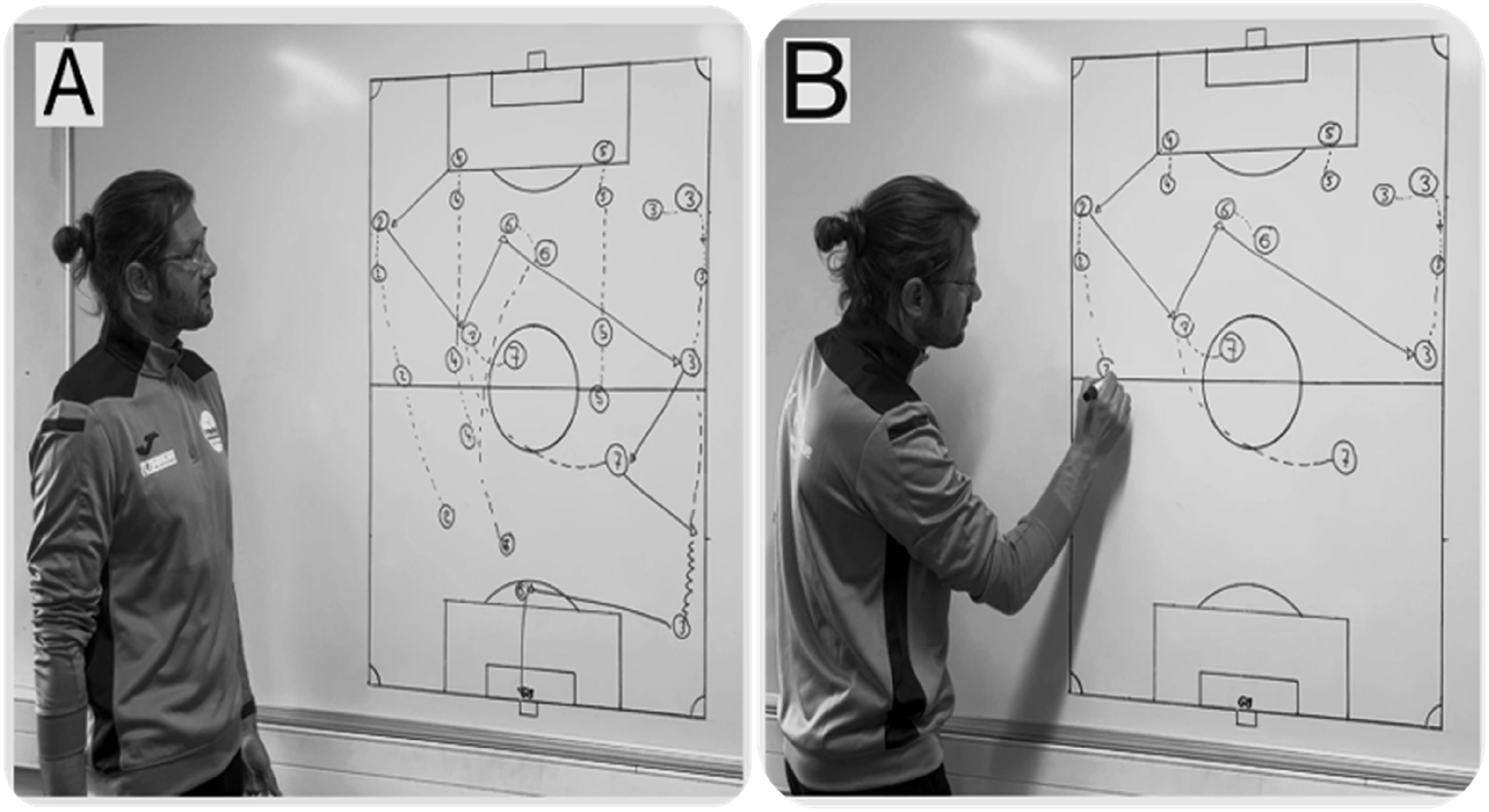
Procedure
Participants were randomly divided into two groups of 27 each: dynamic-drawing group and static-drawing group. First, they performed the control test, then proceeded to the main test. At the end of the video presentation, participants were asked to complete Likert scale items assessing the overall mental effort invested in memorization. To measure intrinsic load, participants answered the item ‘How much mental effort did you invest?’ (Paas, 1992). Extraneous load was evaluated through the item ‘How difficult was it to learn with the material?’ (Hasler et al., 2007). Finally, germane load was measured using the item ‘How much did you concentrate during learning?’ (Cierniak et al., 2009). A global score was calculated as the average of responses ranging from 1 (very low) to 9 (very high). Right after, in order to complete the recall test, participants received a sheet of paper featuring a blank football field diagram. Their task was to sequentially reconstruct the game system’s progression from action 1 to action 6 by precisely placing players and/or the ball in their respective positions. An independent evaluator reviewed each reconstruction, awarding one point for each correctly placed player and/or ball and zero for incorrect placements (Chikha et al., 2024). Additionally, the time each participant took to complete the recall test was measured in seconds.
Data Analysis
To evaluate participants’ ability to memorize the tactical scene, learning efficiency was calculated using the three-dimensional formula by Tuovinen and Paas (2004), based on recall accuracy, overall mental effort invested during the test, and recall time. The formula standardizes the raw values of each of the three variables through z-transformation.

The direct effects of each predictor, along with the moderating effect of VSA on the relationship between the experimental condition (dynamic-drawing and static-drawing) and the four dependent variables, learning efficiency, ADF, AAS, and APVS, was assessed using Model 1 of the PROCESS macro (Hayes, 2013). Preacher and Hayes (2008) PROCESS macro, developed as an SPSS extension, is a valid statistical tool for testing moderation effects in complex models. It also facilitates path and mediation analyses through the use of ordinary least squares regression (Hayes et al., 2017). Continuous predictor variables were mean-centered, and the analysis was conducted with 5,000 bootstrap samples at a 95% confidence level for the computed confidence intervals. A significance threshold of p ≤ .05 was applied to all analyses. Four separate moderation analyses were conducted, with VSA as the moderating variable and learning efficiency, ADF, AAS, and APVS as the dependent variables.
Results
Learning Efficiency
The analysis for learning efficiency revealed a significant regression model, R
2
= .29, p < .001. The regression analysis revealed no main effect of condition [β = −.56, se = .35, p = .11] but a significant main effect of VSA [β = .06, se = .01, p < .001] on learning efficiency. High-VSA were more efficient in memorizing the tactical scenes than low-VSA. Notably, an interaction between VSA and condition [β = −.09, se = .03, p = .01] was observed. Participants with high-VSA memorized the tactical scene better in the dynamic-drawing condition than the static-drawing condition (p < .001), while participants with low-VSA benefited equally from both conditions (Figure 2). Moderation of learning efficiency by VSA in dynamic and static conditions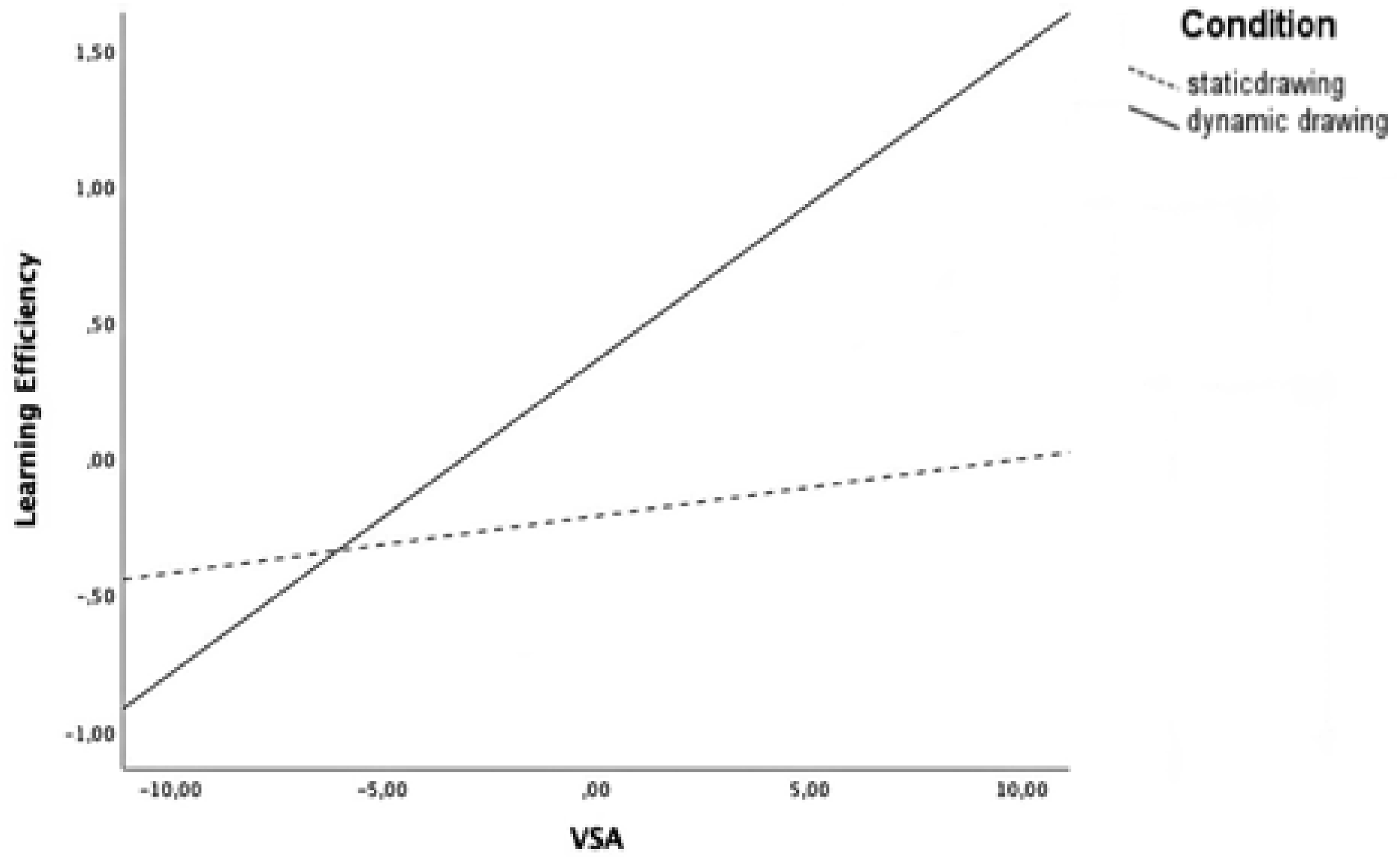
Average Duration of Fixations
The analysis for the ADF revealed a significant regression model, R
2
= .55, p < .01. The regression analysis revealed a significant main effect of condition [β = 97.44, se = 25.81, p < .01], indicating that participants in the dynamic-drawing condition had longer fixations compared to the static-drawing condition. There was also a significant main effect of VSA [β = 29.06, se = 4.57, p < .001], showing that participants with high-VSA tended to have longer fixations than those with low-VSA. Importantly, a significant interaction between VSA and condition was observed [β = −19.31, se = 2.82, p < .001]. Learners with high-VSA had shorter fixations in the dynamic-drawing condition than in the static-drawing condition (p = .01). However, learners with low-VSA exhibited the opposite pattern, showing longer fixations in the dynamic-drawing condition compared to the static-drawing condition (p < .001) (Figure 3, ADF). Moderation of eye movements by VSA in dynamic and static conditions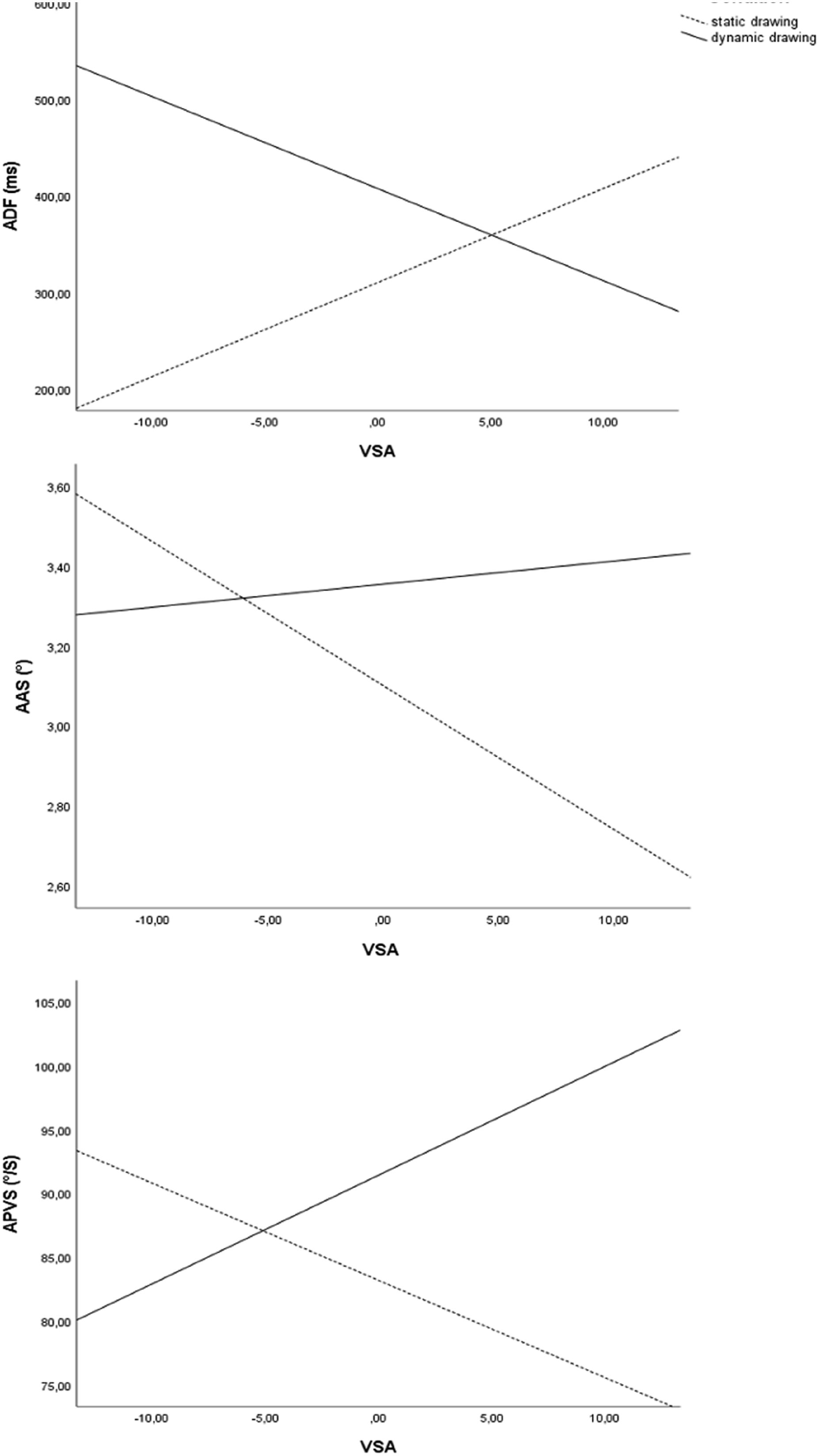
Average Amplitude of Saccades
The analysis for the AAS revealed a significant regression model, R 2 = .18, p = .01. The regression analysis did not reveal a main effect of condition [β = .25, se = .16, p = .12]. However, a significant main effect of VSA was emerged [β = −.07, se = .02, p < .01], indicating that participants with high-VSA exhibited shorter saccades compared to those with low-VSA. Moreover, there was a significant interaction effect between condition and VSA on AAS [β = .04, se = .01, p < .05]. Participants with high-VSA had longer saccades in the dynamic-drawing condition compared to the static-drawing condition (p < .001). In contrast, participants with low-VSA had an equivalant saccades amplitude across both of conditions (Figure 3, AAS).
Average Peak Velocity of Saccades
The analysis for the APVS revealed a significant regression model, R 2 = .47, p < .001. The regression analysis indicated a significant main effect of condition [β = 8.24, se = 2.54, p < .01], with participants demonstrated faster saccades in the dynamic-drawing condition than in the static-drawing condition. A significant main effect of VSA was also identified [β = −2.37, se = .45, p < .001], indicating that participants with high-VSA had slower saccades relative to those with low-VSA. Additionally, there was a significant interaction effect between condition and VSA [β = 1.61, se = .28, p < .001]. Participants with high-VSA, had faster saccades in the dynamic-drawing condition compared to the static-drawing condition (p < .001). Conversely, for participants with low-VSA, saccades were slower in the dynamic-drawing condition compared to the static-drawing condition (p < .05) (Figure 3, APVS).
Discussion
This study aimed to investigate the impact of drawing and VSA on the memorization and visual processing of soccer tactical scene. Contrary to our initial hypothesis, the dynamic-drawing condition did not enhance memorization of tactical soccer scenes compared to the static-drawing condition. The results revealed no significant effect of drawing conditions on learning efficiency scores. This finding can be explained by the way multimedia principles were applied in the act of drawing. Dynamic-drawing resembles previous visual signaling interventions, but the implementation of temporal contiguity and segmentation principles in our study differed from that in prior research. For example, research on temporal contiguity typically compares simultaneous versus sequential presentation of verbal and visual information (Mayer & Anderson, 1991), whereas in our study, verbal explanations were simply accompanied by the gradual drawing of diagrams. Similarly, segmentation in earlier work often allowed learners to control the pace of instruction (Mayer & Chandler, 2001), while in our design, the segmentation was coach-paced and thus could limit some of the potential benefits of dynamic-drawing. From another angle, based on observational learning, the impact of observing instructor-generated drawings may involve motivational mechanisms through social cues, whose absence could partly explain the limited instructional impact of dynamic drawing. This result aligns with previous studies showing that the instructor’s visibility did not significantly improve retention scores (Fiorella et al., 2020; Fiorella & Mayer, 2016). The lack of significant difference between conditions may be due to the absence of social cues from the coach. Research suggests that instructor presence alone does not necessarily enhance learning unless accompanied by human-like gestures, facial expressions, and eye gaze (Fiorella et al., 2020). In this study, as the coach primarily focused on drawing without engaging in other expressive nonverbal communication, his mere embodiment may have introduced extraneous cognitive load rather than facilitating deeper processing of the instructional content (Mayer, 2014; Sweller et al., 2019). Although learning outcomes did not significantly improve, instructional design influenced learners’ visual information processing (Ouwehand et al., 2015; Sáiz-Manzanares et al., 2021; van Wermeskerken et al., 2018). In the present study, this was reflected in longer fixation durations and faster saccades observed in the dynamic-drawing condition. Learners quickly shifted their gaze to follow the coach’s dynamic-drawing, which suggests an increased level of attentional engagement (Di Stasi et al., 2013a, 2013b; Galley, 1993; Mallick et al., 2016). However, they fixated longer on the diagram, which may indicate negative academic effects and be associated with higher levels of cognitive processing difficulties (Elgort et al., 2018; Goh et al., 2013; Negi & Mitra, 2020; Ooms et al., 2012; Pei et al., 2022; Rayner, 2009).
Regarding the second hypothesis, although the drawing condition did not significantly improve learning, the results nevertheless confirmed that the VSA was crucial for memorizing tactical scenes. In line with the ability-as-enhancer hypothesis (Hegarty & Sims, 1994; Huk, 2006), participants with high-VSA demonstrated better memorization performance than those with low-VSA. This suggests that greater VSA support more efficient mental representation and encoding of visual information (Ben Mahfoudh & Zoudji, 2020, 2021, 2024). Furthermore, eye-tracking data revealed that VSA also influenced visual processing (Chen & Yang, 2014; Park et al., 2015; Roach et al., 2017). High-VSA individuals exhibited longer fixation durations followed by shorter and slower saccades, indicating a focal processing mode characterized by conscious engagement with key elements of the scene and enhanced object retention (Ben Mahfoudh et al., 2021; Eisenberg & Zacks, 2016; Negi & Mitra, 2020). In contrast, low-VSA participants showed a more ambient gaze pattern, with shorter fixations and longer, faster saccades a profile typically associated with superficial scanning and less effective integration of visual information (Eisenberg & Zacks, 2016; Helmert et al., 2005; Negi & Mitra, 2020).
Concerning our third hypothesis, an interaction between the drawing conditions and VSA indicated that the effectiveness of instructional drawings depends on learners’ cognitive abilities. As expected, individuals with high-VSA benefited more from dynamic-drawing diagrams. Given the limited research on how VSA levels affect the effectiveness of instructor-generated drawings, and the similarities between dynamic-drawing conditions and dynamic visualizations (Fiorella & Mayer, 2016), research on VSA and dynamic visualizations could offer valuable insights into how VSA impacts the efficiency of coach-drawn diagrams. High-VSA participants likely allocated additional cognitive resources, enhancing their performance (Isaak & Just, 1995; Mayer & Sims, 1994). This enabled them to use multimedia learning principles embedded in the dynamic-drawing condition, including signaling, temporal contiguity, and segmenting (Fiorella & Mayer, 2016; Mayer, 2005). However, in the static-drawing condition, the same information was presented both verbally and through a fully pre-drawn diagram presented in its entirety. This duplication may have provided redundant instructional details, leading high-VSA participants to experience increased cognitive load and reduced performance (Chikha et al., 2021). According to low-VSA learners’ performance, dynamic-drawing did not provide a compensatory benefit, as their learning efficiency remained similar across conditions. The evolving nature of dynamic-drawing may have hindered their ability to process and integrate key information. Concerning learners’ visual processing, high-VSA were more effective in processing diagram elements with shorter fixation duration and faster and longer saccades in the dynamic-drawing condition. High-VSA learners benefited from the hand-drawn, step-by-step narrated diagram by effectively extracting, processing, and retaining relevant information, which resulted in shorter fixation durations (Dong et al., 2018; Liu, 2014; Van Asselen et al., 2011). Also, the larger and faster saccades observed in high-VSA learners can indicate the presence of meaningful cues within the dynamic-drawing, as their attention is attracted very rapidly to the relevant elements from a distance (Ehmke & Wilson, 2007; Goldberg et al., 2002; Goldberg & Kotval, 1999). Conversely, low-VSA participants exhibited in the dynamic-drawing condition, longer fixation durations and slower saccades, which may be attributed to their potential difficulty in extracting, processing and integrating the dynamic creation of static visual elements (Di Stasi et al., 2009, 2011, 2013a, 2013b; Ehmke & Wilson, 2007; Pei et al., 2022; Rayner, 2009).
Limitations and Future Studies
While this study provides new evidence on the role of coach-drawn diagrams in team sport memorization across VSA levels, it has some limitations. Notably, some moderating factors, like prior knowledge, were not considered. Future studies should include elite players to better assess the VSA-expertise interaction. Moreover, it would be valuable to examine how the instructor’s presence during drawing distracts or engages learners. Further research could explore this by adding social cues to the drawing process, such as gaze guidance and pointing gestures, to better understand their impact on attention and memorization. Lastly, the study was conducted in a controlled laboratory environment. To enhance the practical relevance of the findings, future research should be conducted in more authentic settings, such as on-field soccer environments.
Conclusion
In summary, the key contribution of this study is that drawing alone does not necessarily improve tactical scene memorization. Whether the coach drew while explaining or used a pre-drawn diagram, participants showed similar learning outcomes despite differing visual processing strategies. However, when considering VSA levels, high-VSA individuals benefited more from the dynamic-drawing condition, showing higher learning efficiency and more effective visual processing. Overall, these findings highlight the moderating effect of VSA, providing valuable insights for trainers and coaches to assess players’ VSA levels and refine their drawing strategies to optimize visual attention and memorization.
Footnotes

Funding
The authors received no financial support for the research, authorship, and/or publication of this article.
Declaration of Conflicting Interests
The authors declared no potential conflicts of interest with respect to the research, authorship, and/or publication of this article.