







Abstract
This paper reports on a study investigating the level and correlates of foreign language classroom anxiety among pre-adolescent students. The participants were 385 L1 Chinese primary school students of L2 English, aged between 8 and 13 (with a mean age of 10.73), who completed a validated English Classroom Anxiety Scale and a questionnaire tapping: (1) three learner-centered predictor variables (i.e., gender; attitudes towards English, and perceived relative standing among peers in English proficiency; The participants’ age was provided by their parents or caregivers) and (2) six teacher-centered predictors (i.e., attitudes towards the English teacher; teacher strictness, friendliness, joking, and predictability; and the frequency of the teacher’s English usage in class). Data analysis showed that the participants generally experienced a moderately low level of English classroom anxiety. English classroom anxiety showed no significant difference among Years 3 to 5 participants but significantly decreased in Year 6. Girls and boys did not differ significantly in their English classroom anxiety levels. Attitudes towards English, attitudes towards the English teacher, perceived relative standing among peers in English proficiency, and age significantly negatively predicted English classroom anxiety, in descending order of magnitude. Teacher friendliness and the teacher’s frequency of English usage in class significantly and negatively predicted English classroom anxiety but only marginally so. Three variables under consideration, teacher joking, strictness, and predictability, were not significant predictors of English classroom anxiety. The results and their (pedagogical) implications are discussed and the limitations of this study are put forward.
Keywords
Introduction
Foreign language anxiety is a negative psychological construct that is perhaps the most widely recognized and researched emotional variable influencing (classroom-based) second language acquisition (Dewaele et al., 2022; Jin et al., 2021). Nevertheless, previous studies targeting foreign language anxiety have predominantly focused on adult learners, leaving this issue insufficiently addressed for children and adolescents, most notably producing a blind spot for child learners. This is counterintuitive as foreign languages, particularly English in non-Anglophone settings, has become increasingly widely introduced at younger ages in school systems around the world (Chen et al., 2022; Hu et al., 2024; Waddington, 2022; Yang et al., 2023).
Committed to filling this research gap, this study set out to investigate to what extent Chinese primary school students in the age realm of 7 to 13 years old experience anxiety in their English classroom and what might cause such anxiety. The theoretical perspectives taken in this study were the classic Affective Filter Hypothesis (Krashen, 1982), which posits that negative emotions hinder the processing of information, and the control-value theory (Pekrun, 2006), which maintains that negative emotions interfere with learning and performance. Methodologically, we adopt a quantitative approach to meet this research aim. The results advance the current knowledge of the construct of foreign language classroom anxiety (FLCA), the exploration of which until now has been largely based on older learners in early stages of their foreign language learning trajectories. In addition to scientific advancement, however, this study also has clear pedagogical implications; foreign language (English) teaching to young learners can be enhanced based on its results. This study focuses on the Chinese context as a first step but the study’s methodological set-up can easily be extended to include other early-life foreign language classroom contexts, to solidify both theoretical and empirical knowledge of the precedents of FLCA.
Literature Review
The Construct of FLCA
The construct of FLCA can be traced back to Scovel’s (1978) research synthesis, which revealed a rather confusing picture of the relationship between anxiety and language proficiency, leading him to conclude that “anxiety itself is neither a simple nor well-understood psychological construct and that it is perhaps premature to attempt to relate it to the global and comprehensive task of language acquisition” (p. 132). Drawing on Scovel’s (1978) remarks and their own field (i.e., classroom) observations, Horwitz et al. (1986) further developed and investigated the construct of FLCA and defined it as “a distinct complex of self-perceptions, beliefs, feelings, and behaviors related to classroom language learning arising from the uniqueness of the language learning process” (p. 128). Following their seminal work, many studies have been conducted on FLCA since the field’s inauguration, leading to the present situation where FLCA is the most widely studied emotional variable in the realm of second language acquisition.
The accumulated evidence to date shows FLCA to be highly prevalent among learners. It modulates not only adult language learning but has also been tentatively attested to play a role in pre-teen and teen learners (Liu & Hong, 2021). It is likewise attested not only in low-proficiency learners, but is also common in advanced learners (Marcos-Llinás & Garau, 2009); and both in learners whose first language is typologically closely related to the target foreign language, and in those whose native language and target language belong to different language families (Chen et al., 2024; Morgan & Katz, 2021). By extension, FLCA as a construct exerts an influence on learners from collectivism-oriented cultures, and those from more individualistic cultures (Dewaele, 2019; Jin & Dewaele, 2018); and has been found for online classes (Resnik & Dewaele, 2021) as well as in-person class settings. Despite its high incidence, FLCA generally seems to only relatively moderately affect learners. More often than not, researchers report a moderate level of FLCA among their participants, for example as reported in Dewaele et al.’s (2019) study investigating L1 Spanish learners of L2 English, and Jin et al. (2021) examination of L1 Chinese university students taking L2 English language classes. A FLCA meta-analysis across 35 countries/regions (Toyama & Yamazaki, 2022) likewise reported mostly moderate effect sizes for the construct.
The Influencing Factors of FLCA
Previous studies over the years have contributed to a deeper understanding of the different variables that may influence the complex construct of FLCA. Gender differences have been very widely investigated in this respect, yielding mixed results. Dewaele and MacIntyre (2014), for instance, in their study on 1,746 foreign language learners worldwide, found that gender differences significantly distinguished between FLCA levels: Females were significantly more anxious than males. This finding was corroborated by Dewaele and Dewaele (2017) and Dewaele et al. (2018), both based on 189 British secondary school pupils, but not by Dewaele et al. (2022), who reported significantly higher FLCA in Kazakh university and secondary school male students of Turkish as opposed to their female counterparts. Jiang and Dewaele (2019) finally, did not find any significant difference in FLCA between the two genders in their sample of L1 Chinese university students of L2 English.
Other than gender, several other variables have been frequently related to FLCA, among which age. Similar to gender, the relationship between age and FLCA has emerged inconsistently across studies. Dewaele and Al-Saraj (2015) found that age overall negatively predicted FLCA levels: older participants generally showed lower levels of FLCA. Others (Dewaele & Dewaele, 2017; Dewaele et al., 2018, 2022; Dewaele & MacIntyre, 2019), however, found no significant evidence for a relationship between age and FLCA.
In addition to gender and age, the role of self-perceived variables such as perceived foreign language proficiency and perceived relative standing among peers in foreign language proficiency in moderating FLCA have also been investigated. The results so far suggest that both of these two self-concept variables may exert an influence on the level of FLCA. For instance, Jin et al. (2015) found that self-rated foreign language proficiency significantly predicted FLCA in L1 Chinese university students of both English and Japanese, more so than personality traits such as self-esteem and competitiveness. Dewaele and MacIntyre (2014) and Dewaele and Dewaele (2017) reported a larger effect size of perceived relative standing among peers than perceived language proficiency for FLCA, but the opposite effect was attested in Dewaele et al. (2018). However, it should be noted that perceived relative standing among peers and perceived foreign language proficiency were significantly linked to FLCA in all these studies.
Attitudes towards the foreign language emerged as an important influencing factor of FLCA in Dewaele et al. (2018). Jiang and Dewaele’s (2019) study showed that attitudes toward English significantly negatively predicted Chinese university students’ English classroom anxiety, more so than attitudes towards the English teacher but less than perceived relative standing among peers in English proficiency and the foreign language level. However, Dewaele and MacIntyre (2019) failed to unravel a significant predictive effect for attitudes towards the foreign language on FLCA. In Dewaele et al. (2022), the effect of attitudes towards the foreign language on this emotional variable was only marginally significant and the effect size was small.
Finally, FLCA has also been linked to teacher-centered variables. Dewaele et al. (2018) documented that attitudes towards the foreign language teacher marginally but significantly predicted FLCA, but did not find the teacher’s frequency of foreign language use in class or teacher predictability (i.e., the degree to which teaching contents are foreseeable according to Jiang and Dewaele (2019) and Jin et al., 2025) to be significant predictors of FLCA. Jiang and Dewaele (2019) reported that, in their investigation of the variables of attitudes towards the teacher and teacher strictness, friendliness, joking, and predictability, only attitudes towards the teacher significantly predicted FLCA levels. In a subsequent study, however, Dewaele et al. (2022) revealed that teacher strictness and friendliness positively and negatively predicted FLCA, respectively, but attitudes towards the foreign language teacher, the teacher’s age, the teacher’s frequency of foreign language use in class, and whether the teacher has a discernable foreign accent did not significantly modulate FLCA. In the same vein, Dewaele et al. (2019) found that a foreign accent on the part of the teacher was not a significant predictor of FLCA, nor was teacher friendliness, but the teacher’s age and their frequency of foreign language use in class both negatively predicted FLCA: if the teachers were younger and used the target language in class more sparingly, higher levels of FLCA were attested. In that same study, teacher strictness was found to positively affect FLCA: stricter teachers induced greater levels of FLCA. Finally, although the fact that a teacher had a foreign language accent did not seem to matter; learners were found to experience significantly more FLCA when taught by non-native speaker teachers of the target language.
To sum up, FLCA is subject to the effect of a complex of student- and teacher-centered variables, and the influence that these variables exert on FLCA is constantly in flux and depends on the instructional setting. In the work targeting FLAC thus far, age has been considered and yet young learners have rarely specifically been targeted in trying to unravel the complex correlates of this emotional variable.
This Study
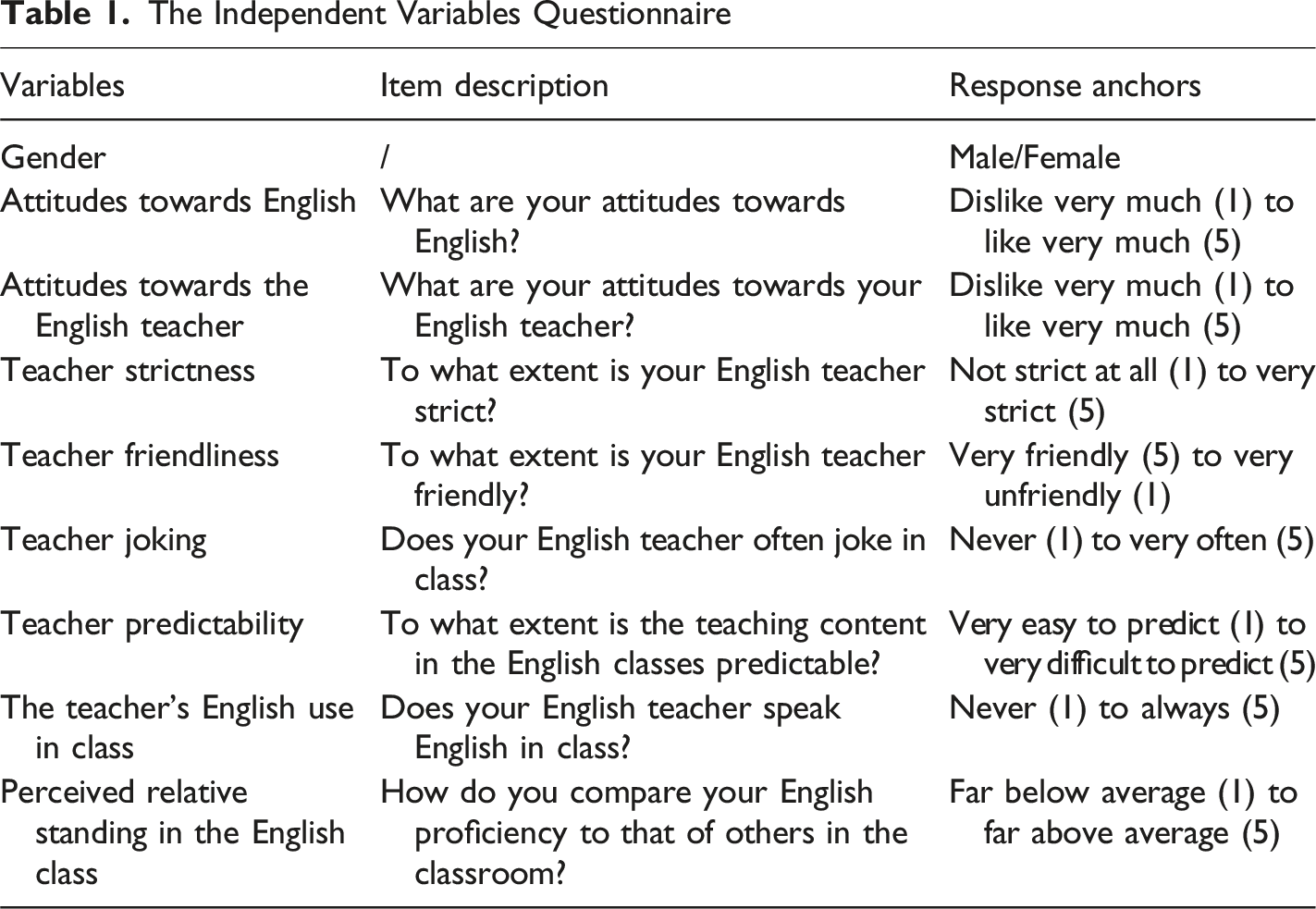
The current study targets precisely the underrepresented learner group in the FLCA literature—that is, primary school students, aiming at detailing their overall anxiety level and uncovering the student- and teacher-centered variables underlying their FLCA. Previous studies have not addressed the sources of child learners’ FLCA, except for Liu and Hong (2021), who quantitatively investigated the role of gender and age in Chinese primary school learners’ speaking anxiety in the English classroom and qualitatively explored other possible correlates of this classroom-based emotion. We believe the current findings provide a window through which a deeper understanding of the concept of FLCA among early-stage foreign language learners can be reached. We additionally intend to contribute insights to inform pedagogical practices for child learners by understanding the potential influencing factors of their FLCA journeys. At a higher level, the findings can also shed light on foreign language education policy planning for school-aged children. Specifically, in examining L1 Chinese learners of L2 English, the following questions form the basis of the current investigation: (1) What general FLCA levels do Chinese primary school students show? (2) To what extent do student- and teacher-centered variables that have been frequently associated with FLCA in earlier investigations (i.e., gender, age, grade, attitudes towards the foreign language, and others presented in Table 1) affect Chinese primary school students’ FLCA?
The Independent Variables Questionnaire
Methods
Participants
Three hundred and eighty-five Year 3 to 6 students were recruited as a convenience sample from a primary school in a North China city (n = 104, 95, 113, and 73 for Years 3–6, respectively). These students comprised 176 girls and 209 boys aged 8 to 13 years (M = 10.73; SD = 1.13). At the time of data collection, they all attended three weekly 40-min English classes, all taught by a teacher whose first language was Chinese. Out of class, they had very limited to no exposure to English.
Instruments
The Independent Variables Questionnaire
We verified all children’s ages provided by their parents or caregivers to ensure the accuracy of this information. Other learner- and teacher-centered variables combined with English classroom anxiety were measured using a Chinese language questionnaire developed by Jiang and Dewaele (2019), with one item for each variable. The item for teacher friendliness placed in the questionnaire’s middle position was reverse-scored to reduce the acquiescence bias (cf. Dörnyei & Dewaele, 2023). The questionnaire is presented in more detail in Table 1.
The English Classroom Anxiety Scale (ECAS)
The ECAS is a Chinese language measure. It was adapted from the classroom anxiety subscale of the short-form Achievement Emotions Questionnaire (Bieleke et al., 2021) through a translation procedure specifically created for the current study. In doing so, the fourth author first translated the original scale into Chinese. The first author then checked the translation for appropriateness. Any disagreements were resolved through discussion by the two researchers. This instrument was deemed appropriate for child participants due to its parsimony and comprehensibility: it contained only four positively worded items all rated on a 5-point Likert scale: strongly disagree (1), disagree (2), neither agree nor disagree (3), agree (4), and strongly agree (5). As such, a higher overall score reflected a higher level of anxiety experienced in the English classes; with an upper threshold score of 20.
Despite being a short measure, the ECAS was found to be psychometrically strong: its internal reliability was reflected by a high Cronbach’s alpha of 0.80 in the current sample of 385 young L1 Chinese learners of English. With this sample size, the ECAS’s internal validity was also adequate, as suggested by the standardized factor loadings of its items (0.63 to 0.84) revealed by a confirmatory factor analysis as well as the results of model evaluation: x2/df = 1.20 < 3, GFI = 0.99 > 0.95, AGFI = 1.00 > 0.95, SRMR = 0.01 < 0.08, RMSEA = 0.02 < .07, NFI = 0.99 > 0.95, CFI = 0.99 > 0.95, and TLI = 0.99 > 0.95 (Hooper et al., 2008; Jackson et al., 2009). Further, the ECAS’s criterion validity was established in correlational analysis in a randomly chosen subsample (n = 32, 15, 25, and 23 for Years 3–6, respectively). The results showed that the scale correlated highly with self-rated English classroom anxiety on a 0–100 interval, rs = 0.57, p < 0.001, but less moderately with the Social Anxiety Scale for Children (Wang et al., 1999), r = 0.39, p < .001 (Correlation close to 0.40 is interpreted as moderate and 0.60 as strong, following Plonsky and Oswald (2014); a few cases reporting missing data were excluded for the analyses).
Data Collection
Data for this study were collected from a primary school in the Shandong Province in the North of China. The school and the class teachers gave consent. Active consent was also sought from the parents or caretakers of students in all 12 classes (three classes for Years 3 to 6, respectively) who were included in this study by completing two paper-and-pencil formatted questionnaires after school hours without their teachers present. The fourth author distributed the questionnaires. Prior to doing that, she explained to the students that their participation in this study was voluntary, the collected data would be only used for research purposes, and participation in this study would not affect their course grades. Furthermore, it was pledged to the students that all the collected data would be treated strictly confidentially, and would not be accessible to anyone but the paper authors, which encouraged honest responses. Following this data collection, the researcher marked the responses of those students whose parents or caregivers had returned the informed consent form and registered their scores in an Excel file, discarding all other data. The first and fourth author independently checked whether the participants’ responses were correctly scored and registered.
Data Analysis
As a first step in the data analysis, the participants’ mean scores on the ECAS and other measures employed in the current study (except for gender and grade) were computed. Calculating the mean scores for the ECAS served to answer the first research question and doing so for the other variables helped to interpret the ECAS descriptive analysis results. Then, the participants’ ECAS scores were compared across the four school years incuded in this study and two genders (Research Question 2). To do so, we performed either Kruskal-Wallis test or independent-samples t-test (see the Results section for a justification for using either one of these statistics).
Next, a correlational analysis was run comprising the variables of age, attitudes towards English, attitudes towards the English teacher, teacher strictness, teacher friendliness, teacher joking, teacher predictability, the teacher’s frequency of English use in class, perceived relative standing among peers in English proficiency, and English classroom anxiety. The results of the correlational analysis were used to determine the variables to be further examined in relation to English classroom anxiety in a follow-up regression analysis (Research Question 2) and check for multicollinearity. Concerning the regression analysis, we adopted a forced entry method, because previous studies had not yet related the current student- and teacher-centered variables to FLCA among primary school students and we could thus not rely on prior knowledge related to the relative weightings of FLCA-associated variables that does exist for older learners (cf. Field, 2009).
Results
Descriptive Analysis
The Descriptive Analysis Results
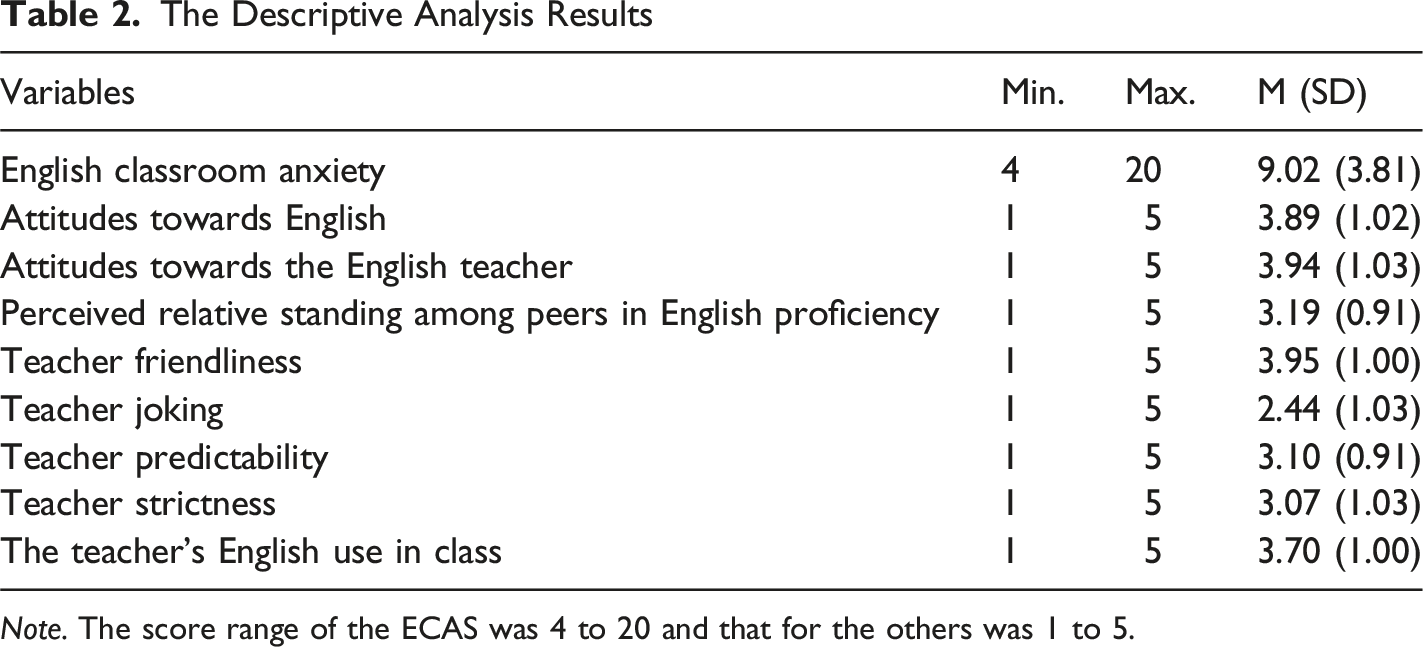
Note. The score range of the ECAS was 4 to 20 and that for the others was 1 to 5.
Comparative Analysis of Classroom Anxiety Among Four Grades
A Kruskal-Wallis test was performed to examine whether English classroom anxiety levels significantly differed across the four years. We adopted this non-parametric statistical technique due to the non-normal distribution of data we found for all databases and heterogeneity of variances for certain comparisons, as identified by a Levene’s test. The results revealed a significant difference in English classroom anxiety among the four grades, x2 (3, n = 385) = 14.52, p = .002. A post-hoc Mann-Whitney U test with Bonferroni correction performed on the basis of the significance level (0.05/6 = 0.008) indicated that significance emerged between Year 6 and Years 3 through 5 participants (p = .001, .001, and .004, respectively). Effect sizes (r, −0.24, −0.26, and −0.21 respectively for the Years 3 to 5 versus Year 6 comparisons) fell in a small to moderate range (Cohen, 1988). Figure 1 visualizes the differences among Years 3–6 in English classroom anxiety. English classroom anxiety levels among four grades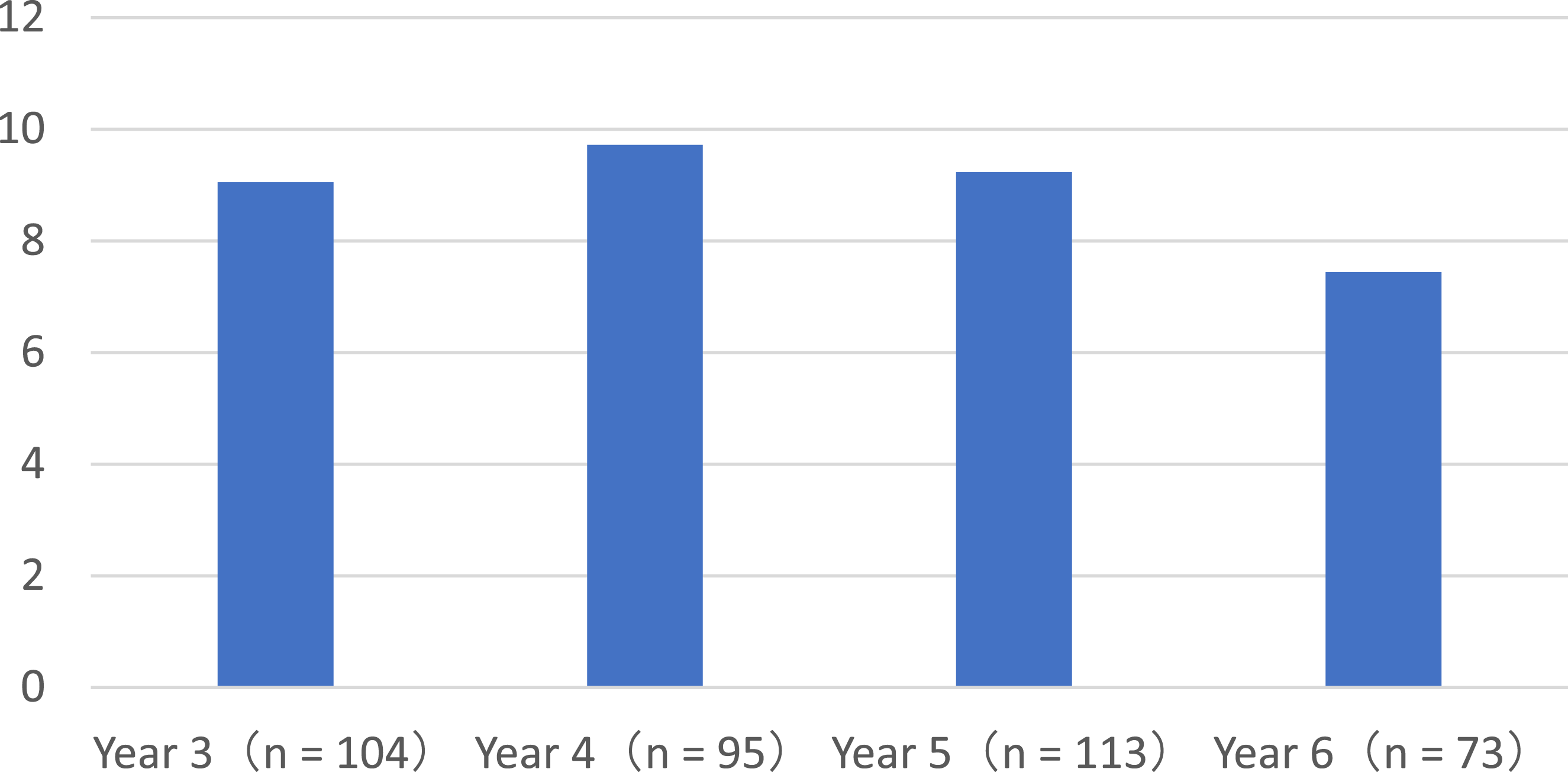
Comparative Analysis of Classroom Anxiety Between the Two Genders
Data normality and homogeneity of variances were examined before comparing the female and male participants’ English classroom anxiety levels. The two-sample Kolmogorov-Smirnov test showed that neither of the genders’ ECAS scores was normally distributed (both p < .001), further confirmed by histograms, but a Levene’s test demonstrated homogeneity of variances (p = .82). In this case, we used independent-samples t-test to compare the two participant groups’ ECAS scores due to its robustness to non-normality, and based in the premise that groups under comparison had an equal sample size larger than 30 (following Field, 2009). The results indicated no significant difference in the ECAS scores between the two genders (Males: M = 9.09, SD = 3.86; Females: M = 8.93, SD = 3.77): t (383) = .41, p = .68.
Correlational Analysis
The Results of the Correlational Analysis
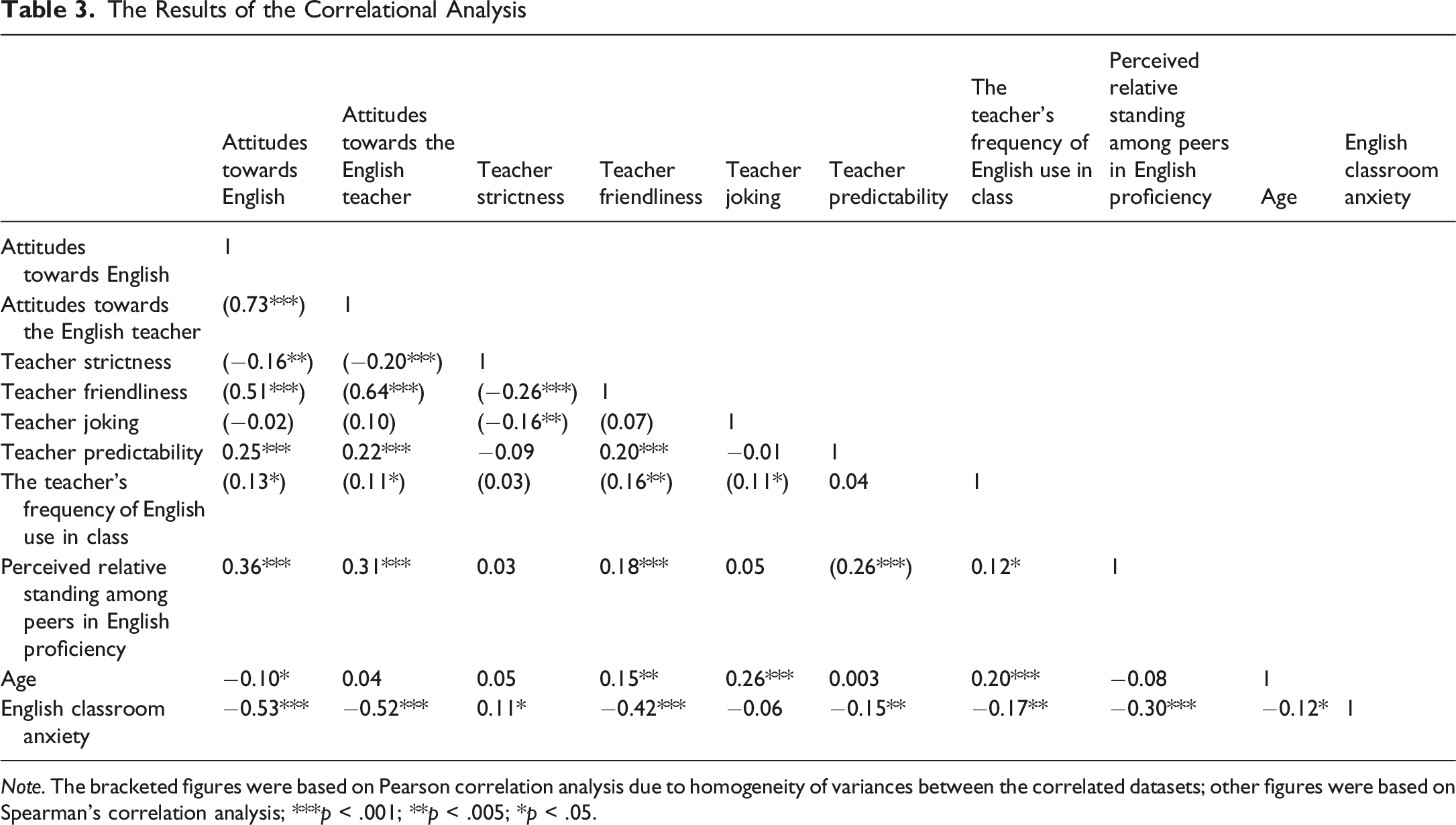
Note. The bracketed figures were based on Pearson correlation analysis due to homogeneity of variances between the correlated datasets; other figures were based on Spearman’s correlation analysis; ***p < .001; **p < .005; *p < .05.
Based on the correlational analysis, age, attitudes towards English, attitudes towards the English teacher, teacher strictness, teacher friendliness, teacher predictability, the teacher’s frequency of English use in class, and perceived relative standing among peers in English proficiency were included in the subsequent regression analysis. As the strongest correlation attested among these variables (i.e., that between attitudes towards English and the English teacher) was 0.73, potential multicollinearity issues did not pose any threat for this analysis; correlational values of 0.80 and up have been marked as giving rise to multicollinearity concerns (Field, 2009).
Regression Analysis
The Regression Results for English Classroom Anxiety
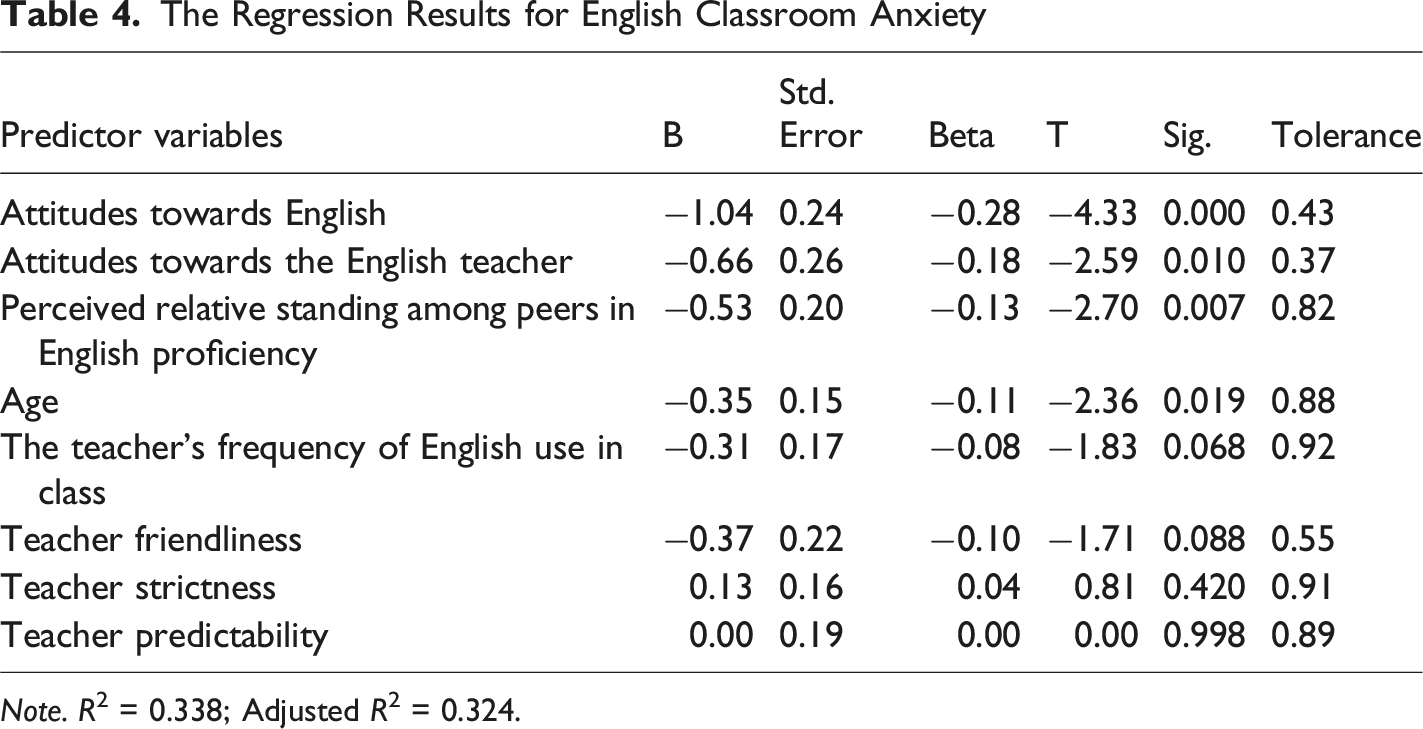
Note. R2 = 0.338; Adjusted R2 = 0.324.
Overall, the analysis generated a significant predictive model, F (8,376) = 23.97, p < .001, which accounted for 32.36% of the attested variance in English classroom anxiety within our sample. Concerning the individual predictor variables, attitudes towards English, attitudes towards the English teacher, perceived relative standing among peers in English proficiency, and age significantly and negatively predicted the level of English classroom anxiety, in descending order of magnitude. Teacher friendliness and the teacher’s frequency of English use in class, although failing to reach significance levels, did show a trend in that they negatively predicted English classroom anxiety. Teacher strictness and teacher predictability emerged as non-significant predictors of English classroom anxiety in our regression model (see Table 4 for details).
Discussion
The Level of English Classroom Anxiety in Primary School Students
The initial descriptive analysis of our data revealed that the Chinese primary school participants we targeted generally experienced a moderately low level of anxiety related to English learning and instruction in the classroom. This anxiety level is slightly lower than the FLCA level reported in many previous studies that targeted pre-adolescent learners (e.g., Hu et al., 2024; Liu & Hong, 2021), adolescent learners (e.g., Dewaele et al., 2018; Dewaele & MacIntyre, 2014), or adult learners (e.g., Chen et al., 2024; Dewaele et al., 2019; Jiang & Dewaele, 2019; Jin et al., 2021; Morgan & Katz, 2021). This might be related to the participants’ self-conceptual and contextual factors. As suggested by the descriptive results, the participants were relatively confident in their English proficiency and held a generally positive view towards English and their English teacher. In addition, English teachers in the primary school at which this study was conducted often adopted gamified learning activities in the classroom, which might provoke the participants’ positive emotions that in turn may have neutralized negative emotions like anxiety (Jin et al., 2025). In other words, the teachers’ class practices might have led to the participants’ relatively low anxiety levels in the English classrooms. Gamification practices are fitting for the age group under investigation. Related to that, it is also possible that the participants in our study, because they were quite young, experienced less anxiety anyway, perhaps seldom relating English learning to their future education or career success yet, the way their older peers are often found to do (Huang & Curle, 2021).
Nevertheless, it must be recognized that substantial individual differences were found in the level of anxiety among the participants, evident from the score range (see Table 2 above). Some learners, despite their young age, did feel rather anxious. Therefore, we suggest that teachers understand what causes such students’ anxiety and in turn seek solutions to alleviate their anxiety levels. Otherwise, anxiety as it prolongs can negatively affect students and their learning trajectories (Dewaele & Thirtle, 2009; Horwitz, 2017; Jin & Dewaele, 2018). Suggestions as to anxiety-reducing activities and practices in the foreign language classroom have been presented by Jin et al., 2020, 2021.
The Influencing Factors of Primary School Students’ English Classroom Anxiety
This study has shown that female and male participants did not significantly differ in their ECAS scores. This result supports the findings obtained by Jiang and Dewaele (2019) and Liu and Hong (2021) for Chinese students of English, but not those reported in Dewaele and MacIntyre (2014) with a large international sample, and Dewaele and Dewaele (2017) and Dewaele et al. (2018) with 189 British secondary school pupils; the latter studies reported a significantly higher level of FLCA in females than in males. Similarly, the current comparative result for females and males’ English classroom anxiety levels is also inconsistent with Dewaele et al.’s (2022), which unraveled a higher level of Turkish as a foreign language classroom anxiety in Kazakh female learners than in their male counterparts. Non-significance is difficult to explain. We posit that modern education in China emphasizes humanism in the realm of schooling, equally involving female and male learners in the teaching procedures, so the two genders did not show a significant difference as to foreign language classroom anxiety in this study. This result might also reflect the more complex influence of a series of personal, instructional, family, and school factors on both genders’ English learning process, which is worth exploring in the future.
This study did not replicate the increasing trend that Hu et al. (2024) found in their study, in which FLCA developed over the primary school years. Instead, it showed an increase in English classroom anxiety in Year 4 participants, compared to Year 3 participants, though not significantly, complemented by a continuous decrease of anxiety until a significant drop in Year 6. In China, Year 3 of primary school marks the beginning of school-based English learning; thus, both learning tasks and materials are made relatively easy for students at this educational stage. For example, the current Year 3 participants only needed to familiarize themselves with the articulation of words, not necessarily remembering their spelling. Sentences (e.g., yes-no and how many/where-led questions) were not grammatically analyzed. Year 4 participants, however, were introduced to grammatical rules such as tense and number. They were confronted with more complex vocabularies in spelling and pronunciation and needed to recite textbook dialogues. These increased demands on English learning might explain Year 4 participants’ higher level of anxiety, though this explanation cannot be applied to Year 5 and 6 participants, who reported lower levels of English classroom anxiety, particularly Year 6 ones, despite heavier demands placed on their English learning tasks. This might reflect Years 5 and 6 participants’ accumulated capability to cope with English challenges due to gained learning experiences and increased mental maturity as they approached adolescence.
The multiple regression analysis that was performed in this study yielded four significant predictors of English classroom anxiety for our group of young learners of English, namely attitudes towards English, attitudes towards the English teacher, perceived relative standing among peers in English proficiency, and age, in descending order of predictive power. These outcomes are consistent with Dewaele et al. (2018) and Jiang and Dewaele (2019) in indicating that attitudes towards the foreign language and the foreign language teacher exert a greater influence on FLCA in favor of the former. However, at the same time, our findings diverge from Dewaele and MacIntyre (2019), who established a greater predictive value of attitudes towards the foreign language teacher for FLCA; Dewaele et al. (2022), who showed a significant effect of attitudes towards the foreign language but not attitudes towards the foreign language teacher; as well as Dewaele and Dewaele (2017), who found that attitudes towards both the foreign language and the teacher did not significantly predict FLCA. In addition, like Dewaele and MacIntyre (2014), Dewaele and Dewaele (2017), Dewaele et al. (2018), Jiang and Dewaele (2019), and Dewaele and MacIntyre (2019), the current study uncovered a significant predictive relationship between perceived relative standing among peers in foreign language proficiency and FLCA. However, the predictive power of perceived relative standing among peers for FLCA was less prominent than attitudes towards the foreign language or the foreign language teacher for this emotional variable, contrary to earlier work (e.g., Dewaele & Dewaele, 2017; Jiang & Dewaele, 2019).
Attitude reflects one’s (dis)identification with specific events and people (Hogg & Vaughan, 2018). Holding a positive attitude towards the foreign language, learners are more motivated to master the language. According to the control-and-value theory (Pekrun, 2006), mastery goals can effectively reduce learners’ negative emotions such as anxiety by mediating the appraisal of learning activities. Similarly, a positive attitude toward the teacher can prompt approach behaviors to the teacher and benefit a healthy student-teacher relationship. As a result, learners may experience more positive affect towards with the teacher and thus experience more positive compared to negative emotions in the classroom (Jin et al., 2025). Foreign language anxiety encompasses a competence dimension (Horwitz, 2001). Given the close relationship between perceived relative standing among peers in language proficiency and self-perception of language proficiency, it is no surprise that this study revealed a significant positive effect of perceived relative standing among peers in English proficiency on English classroom anxiety. In addition, feeling competitive among peers can strengthen learners’ academic self-efficacy and increase their perceived controllability over the learning process, both also modulating anxiety responses (e.g., Jin et al., 2015; Shao et al., 2020).
Further, age proved to be a negative predictor of FLCA in our study. This finding conflicts with that of Dewaele and Dewaele (2017), Dewaele et al. (2018), Dewaele and MacIntyre (2019), and Dewaele et al. (2022), who all failed to find a significant relationship between this demographic variable and FLCA, but it does support a few other studies (Dewaele & Al-Saraj, 2015; Dewaele & MacIntyre, 2014). Also, this result is somewhat consistent with comparing English classroom anxiety levels across instructional levels, revealing that Grade 6 participants were significantly less anxious than those in other grades. By implication, anxiety is a developmental characteristic of quite early foreign language learners and their anxiety would drop considerably at a point in time. During this process, many anxiety-reducing factors become stronger, as experiences are gained in life and learning, which include self-regulatory strategies (Guo et al., 2018), autonomy (Ghorbandordinejad & Ahmadabad, 2016), and perseverance (Liu et al., 2025).
The regression analysis also showed that teacher friendliness and the teacher’s frequency of English use in class marginally predicted English classroom anxiety in our sample, and that teacher joking, strictness, and predictability were not significant predictors of English classroom anxiety at all. In the past, Jiang and Dewaele (2019) and Dewaele and MacIntyre (2019) revealed a non-significant relationship between teacher joking, strictness, and friendliness, and FLCA. Dewaele and Dewaele (2017), Dewaele et al. (2018), and Jiang and Dewaele (2019) reported that teacher predictability and the teacher’s frequency of foreign language speaking in class did not significantly predict the FLCA level. Therefore, the present study supports the previous ones in showing that teacher joking, strictness, friendliness, and predictability, and the teacher’s frequency of foreign language speaking in class are negligible in the learners’ FLCA. This study and others discussed previously used single-item measures for the teacher-centered variables. These findings are likely attributed to the methodological design of these studies. On the other hand, the findings might suggest that child learners’ FLCA levels are more closely linked to the learner-centered variables. Teachers and their practices play a rather limited role in this emotional experience in any event (Dewaele et al., 2018).
Limitations and Implications
This study is not without its limitations. First, although a large sample size formed the basis of the current investigation, the 385 participants were recruited from only one Chinese primary school through convenience sampling, which, as a non-random sampling approach, cannot warrant a representative sample of the general population and the generalizability of findings (Dewaele, 2018). In other words, the extent to which the current results are generalizable to the primary school student population in China as a whole requires investigations in the future. The study does, however, mark one of the first investigations of foreign language anxiety specifically targeting this young group of learners and future research is invited to build on the foundations outlined. Second, this study relied solely on quantitative data and statistical analyses, rather than adopting a mixed-methods approach in which, for instance through the use of observations or follow-up focus interviews with the students, more qualitative information can be recorded. Thus, the identified relationships between the student- and teacher-centered variables and English classroom anxiety were not investigated using qualitative data. In addition, through qualitative insights, the finding of the individual differences attested in our young learner sample as to the level of English classroom anxiety might also be better interpreted.
Despite these limitations, the current findings still bear important implications for both research and pedagogy. Importantly, this study established a somewhat different anxiety profile in Chinese primary school students as well as a unique pattern of the underlying factors of FLCA compared to older learner cohorts. These thus further showed the context-specificity of FLCA, calling for more studies on this emotion among pre-adolescent learners. In addition, though this study revealed that primary school students generally displayed relatively low levels of anxiety, quite some participants felt anxious to very anxious in the classroom. It follows that anxiety is an inherent part of foreign language learning at all stages and ages, while also being subject to substantial individual differences. Teachers should recognize the existence of anxiety among students and by no means seek the short-term facilitating functions of anxiety by enhancing their students’ anxiety levels, which is harmful to learners’ physical and mental health (Horwitz, 2017). Further, this study showed that attitudes towards English, attitudes towards the English teacher, and perceived relative standing among peers in English proficiency significantly predicted English classroom anxiety. Attitudes and self-perceptions are more manageable learner variables. Given this, researchers and teachers might consider helping learners reconstruct their beliefs about the foreign language, the foreign language teacher, or their academic capabilities by using reminiscence or imagination strategies (see Jin et al., 2021 for the empirical evidence of the effect of reminiscence on FLCA) to alleviate learner anxiety in the classroom. This is particularly an issue for quite young foreign language learners, since they may enter their learning journeys with a relatively high level of anxiety, as suggested by the results of comparing FLCA across instructional levels.
Conclusion
This study has established that pre-teen students (in the particular context that we investigated) generally displayed mild FLCA in relation to English language learning. It has also provided a unique conceptual network for child learners’ FLCA by showing that attitudes towards the foreign language, attitudes towards the foreign language teacher, perceived relative standing among peers in foreign language proficiency, and age significantly predicted this group of learners’ FLCA, in descending order. Overall, this study has shown that child learners’ FLCA is inherently constructed on the basis of mostly student-centered variables, more so than teacher-centered variables, which has important scientific and pedagogical implications. Future studies might consider investigating to what extent the current findings can be replicated and complement this design with qualitative data. Meanwhile, we advocate that attention should be given to other emotions in children’s foreign language learning rather than just anxiety, particularly positive emotions. This leads to a more inclusive child language psychology.
Footnotes
Acknowledgements
We thank the editors for the time and energy they spent in our manuscript. We thank the anonymous reviewers for their insightful comments on the earlier versions of this manuscript. Our gratitude also extends to the Chinese students willing to participate in this study and those who provided their assistance to us in data collection.

Ethical Considerations
This study was approved by an ethics committee organised by the first author’s affiliation.
Funding
The authors disclosed receipt of the following financial support for the research, authorship, and/or publication of this article: This work was supported by the Hainan Federation of Humanities and Social Sciences Circles (HNSK(ZC)22-161).
Declaration of Conflicting Interests
The authors declared no potential conflicts of interest with respect to the research, authorship, and/or publication of this article.
Data Availability Statement
The data supporting the findings are available upon request from the first and corresponding authors.