







Abstract
Balance control is a fundamental motor skill influenced by various external and internal factors, including social influences (spectator effects) and visual fixation. In a two-step approach, we investigated the influence of videotaped spectators on balance performance in 32 female dancers and 64 control participants (32 Non-Dancers 1, 32 Non-Dancers 2 – sport students) using a single-leg balance task on an ankle-disc board. The participants balanced on their dominant and non-dominant leg alone and in front of a simulated audience (pre-recorded video). While dancers and 32 control participants (Non-Dancers (1) were told they were being watched in real time, the other 32 control participants (Non-Dancers (2) were aware that the video was pre-recorded. Balance performance improved in the presence of simulated spectators, independent of expertise level or leg dominance of the participants, also in participants who were aware that the audience was “fake”. These findings challenge traditional theories of social facilitation effects in motor tasks and highlight the stabilizing role of visual fixation in balance control.
Introduction
Well-developed coordinative skills are critical determinants of athletic performance across various sports. From a movement-scientific perspective, balance is considered a motor ability that primarily depends on sensory input from the visual, vestibular, and proprioceptive systems (Bös & Mechling, 1983). Maintaining balance requires keeping the center of gravity vertically aligned above the base of support (Nashner & McCollum, 1985).
Balance and Social Facilitation
Sport psychology has explored balance performance through the lens of social facilitation or social inhibition theories. Studies in this research field investigate how the presence of others can influence an individual’s performance (Strauss, 2002). Classic theories (Henchy & Glass, 1968; Sanders et al., 1978; Zajonc, 1965) propose that well-learned or routine motor tasks tend to improve in social settings, whereas complex or novel tasks may be impaired. Despite extensive research over the past century, the underlying mechanisms of social facilitation and inhibition remain insufficiently understood. Strauss (2002) proposed that the presence of spectators enhances performance in tasks requiring strength and endurance, but may impede coordination-based tasks. However, empirical findings on the social facilitation of coordinative abilities remain inconsistent.
For instance, balancing on a stabilometer has been shown to improve in the presence of spectators compared to performing alone (Murray, 1983). Previous studies used a variety of balance tasks such as line and beam walking, balance ladder tests, bullet maze tasks on Wii Balance Boards, and carnival dancing (Engler et al., 2024; Landers & Landers, 1973; Lau et al., 2019). While some studies observed social facilitation effects (Doumas et al., 2018; Engler et al., 2024; Landers, 1975; Landers & Landers, 1973), others found no performance differences when participants were observed by an audience (Livingston et al., 1974). Lau et al. (2019) further investigated social facilitation effects using a bullet maze task on a Wii Balance Board, reporting no performance changes in the presence of a passive observer, but improvements when competing against an opponent. A recent systematic review by van Meurs et al. (2022) concluded that balancing, as a gross-motor coordination-based task (Bös & Mechling, 1983; Utesch et al., 2019), generally benefits from social facilitation across studies, with only a few contradicting findings.
Task-Difficulty and Social Facilitation
In addition to predictions based on different types of motor tasks (Strauss, 2002), task difficulty plays a crucial role in social facilitation research. According to Zajonc’s (1965) model, simple, well-learned tasks tend to benefit from spectators, whereas complex or unfamiliar tasks are more likely to be inhibited. However, the impact of different skill levels on the social facilitation of balance tasks has received limited attention in previous research. MacCracken and Stadulis (1985) found that spectators enhanced performance in higher-skilled children during a line and beam walking balance task, but impaired performance in lower-skilled participants. Singer (1965) examined social facilitation effects in college athletes from various sports (basketball, tennis, baseball, and golf) as well as non-athletes performing a stabilometer balancing task. Contrary to expectations, non-athletes performed better in the presence of spectators, whereas athletes showed no performance improvements. Wankel (1975) examined the effects of positively and negatively reinforcing spectators on stabilometer performance in young children and found no significant impact of audience presence or reinforcement conditions. Furthermore, no differences emerged between high- and low-ability participants when performing alone versus in front of an audience.
In summary, there is limited evidence regarding the influence of spectators on balance performance. While Strauss (2002) suggested that balance and coordination tasks should be negatively affected by the presence of spectators, most empirical findings indicate performance improvements (for a review, see van Meurs et al., 2022). Additionally, the interaction between ability level and social facilitation in gross-motor coordination tasks remains largely unexplored. The first part of the current study therefore contrasted dancers and non-dancers in their reaction to a simulated audience. Research indicates that dancers, as balance specialists, exhibit superior postural control due to faster neuromuscular responses and enhanced proprioceptive sensitivity (Crotts et al., 1996; Gerbino et al., 2007; Golomer et al., 1999; Janura et al., 2019; Perrin et al., 2002; Ramsay & Riddoch, 2001; Simmons, 2005). The balance task employed in the current study, namely one-legged balancing on an ankle-disc board, should therefore be an easier task for dancers as compared to non-dancers.
Visual Fixation and Postural Control
An alternative perspective on performance changes can be found in studies on postural control, which indicate that spatial orientation – and consequently the ability to maintain postural stability – is highly dependent on vision. The role of visual fixation in postural control has long been recognized. Early research (e.g., Gibson, 1966) demonstrated that spatial orientation is heavily reliant on visual cues. In experimental settings, participants are often instructed to “look at the center of the stimulus and stand relaxed” (Dijkstra et al., 1994, p. 481) or to “look straight ahead and stand as still as possible” (Lee & Lishman, 1975, p. 90). This practice, known as the “quiet stance” (Stoffregen et al., 1999, p. 1641), involves fixating on a target point while minimizing body movement. Research has shown that poorer visual acuity correlates with diminished balance ability in both adults and children (Edwards, 1946; Riach & Starkes, 1989; Travis, 1945).
Fixation strategies, such as maintaining a steady gaze on a fixed target, are considered crucial for postural stability (Prado et al., 2007; Stoffregen et al., 1999, 2000, 2007). In the context of fall prevention among older adults, unstable visual fixation has been linked to poorer balance and an increased risk of falls, particularly in individuals with central vision loss (Murphy et al., 2019). Beyond static balance, gaze fixation also appears to enhance dynamic balance. Diehl and Pidcoe (2010) found that fixating on an earth-fixed target reduces stepping latency following a balance perturbation, particularly in older adults. Additionally, eye position has been shown to influence balance performance. Schulmann et al. (1987) reported that static visual fixation improves balance more effectively than smooth pursuit or saccadic eye movements in healthy individuals. In conclusion, these findings highlight the critical role of visual fixation in balance control, with potential implications for both static and dynamic postural stability.
The Current Study
While social facilitation and visual fixation have been extensively studied as independent factors, their interaction in motor performance – particularly in coordinative tasks such as balance – remains poorly understood. This paper aims to address this gap by examining how these mechanisms influence balance performance in female dancers and control participants.
The current study investigates the balance performance of young adults in a laboratory setting using a balance task on an ankle-disc board. The task requires constant compensatory movements to maintain balance, incorporating more dynamic aspects than traditional quiet stance tasks performed directly on the ground. In the first part of the experiment, we examined the main effect of spectator presence on balance performance. Additionally, we explored the interaction between ability level and spectator effects by comparing skilled athletes (Dancers) with novices (Non-Dancers 1). Participants performed the balance task on both their dominant and non-dominant leg, with the latter expected to further increase task difficulty. Spectator presence was manipulated using a video of a pre-recorded audience, but subjects were told that the simulated spectators were actually watching their performance.
Since the first part of the experiment does not allow to disentangle the effect of visual fixation from the effect of spectators, we recruited an additional sample of control participants (Non-Dancers 2 – sport students), who were also asked to perform the balance tasks mentioned above, while being explicitly told that the simulated spectators were “fake”, consisting of a pre-recorded video.
Method
Participants
To minimize interindividual variance and to control for potential gender-specific differences, only female participants were recruited for this study.
For the first part of the experiment, an a priori power analysis was conducted on expertise differences in balance performance changes in front of an audience, using the G*Power 3 software (Faul et al., 2007). Note, however, that the limited number of previous studies that used balancing as a motor task (for a recent review, see van Meurs et al., 2022) makes it difficult to predict specific effects sizes. The current study compared dancers to control participants (Non-Dancers 1), and the repeated measures factor had 2 levels (balancing alone versus in front of simulated spectators). The interaction of group and spectator effects on balance performance was predicted to be of medium size (effect size f = 0.25). Using a correlation of r = .50 for the repeated measures factor, a significance level of .05, a power of .95, the analysis resulted in a sample size of 54 participants. However, to increase the chances to also detect a smaller-than-medium effect size, we decided to test 32 participants per group.
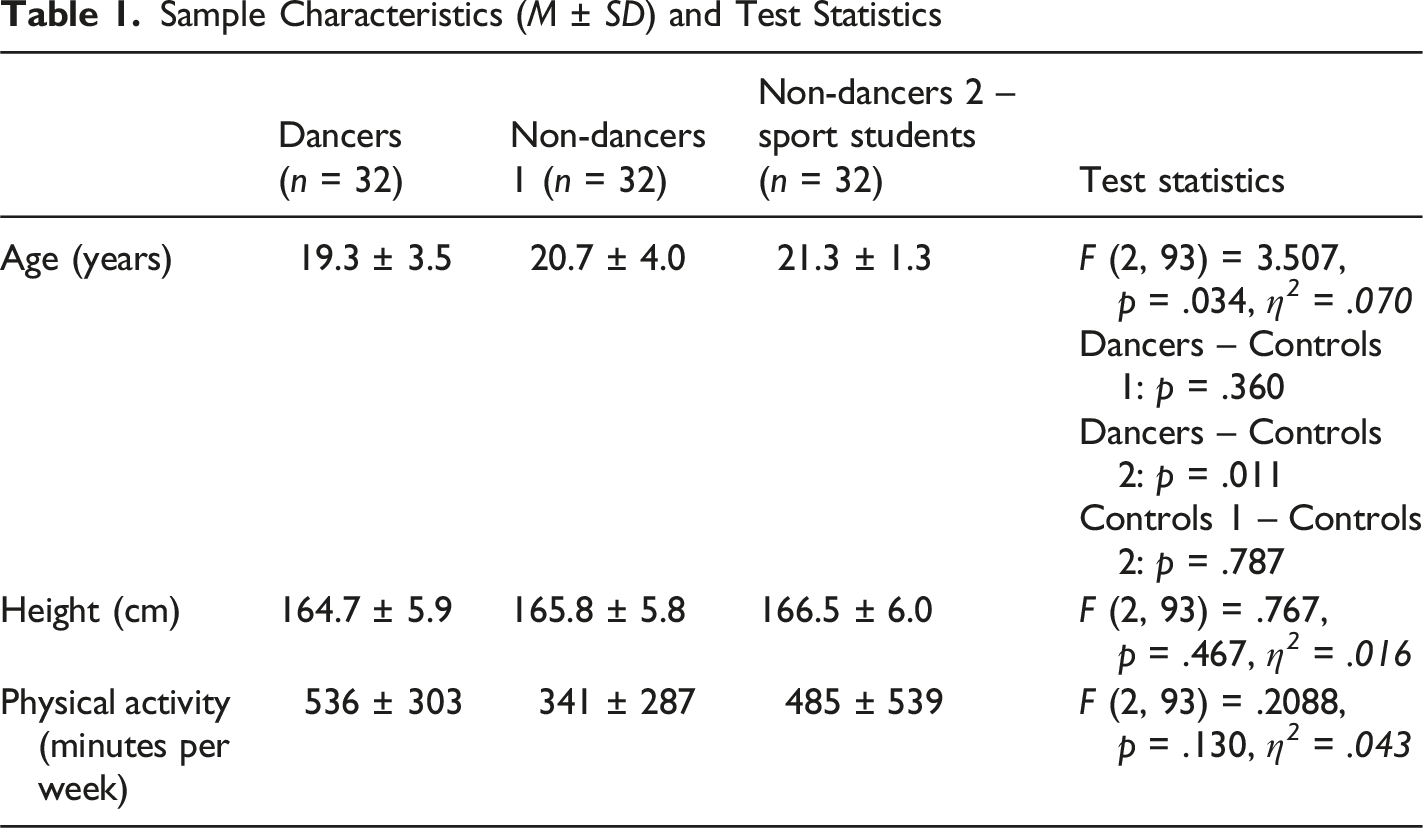
Sample Characteristics (M ± SD) and Test Statistics
Apparatus and Experimental Task
Participants performed a single-leg balance task on an ankle-disc board with a diameter of 40 cm and a height of 10 cm. The lower surface of the board was convex, and participants stood on its flat top. Balance performance was assessed by placing the ankle-disc board on a multifunctional force plate (Zebris™ FDM-2; Isny, Germany). This device quantifies balance through the “center of pressure” (CoP), which is calculated from the ground reaction forces and represents the weighted center of all downward forces acting on the ground via the contact surface (Palmieri et al., 2002; Winter et al., 1990). The 95% confidence ellipse area, defined as the ellipse (mm2) enclosing 95% of the CoP points, was used as a key CoP parameter. Larger ellipse areas indicate more body movement and poorer balance control, whereas skilled performance in balancing on the ankle-disc board results in smaller CoP areas, reflecting minimal body movement required to maintain stability.
Participants were tested both alone and in the presence of seven simulated spectators (5 males, 2 females). The spectators were shown via a pre-recorded video projected onto a laboratory wall, simulating an online meeting through the Microsoft Teams communication platform. Each spectator was shown in his/her own home environment. Simulated spectators appeared to watch the scene attentively, looking straight at the participant, without showing any emotional reactions to the experimental situation. The size of the projection area on the wall was 1 × 1.5 meters, and the distance of the balance platform with the ankle-disc board to the screen was 1.5 meters. This experimental setup was used for both parts of the study, and it is depicted in Figure 1. Standardized experimental setup for the alone and simulated spectator condition.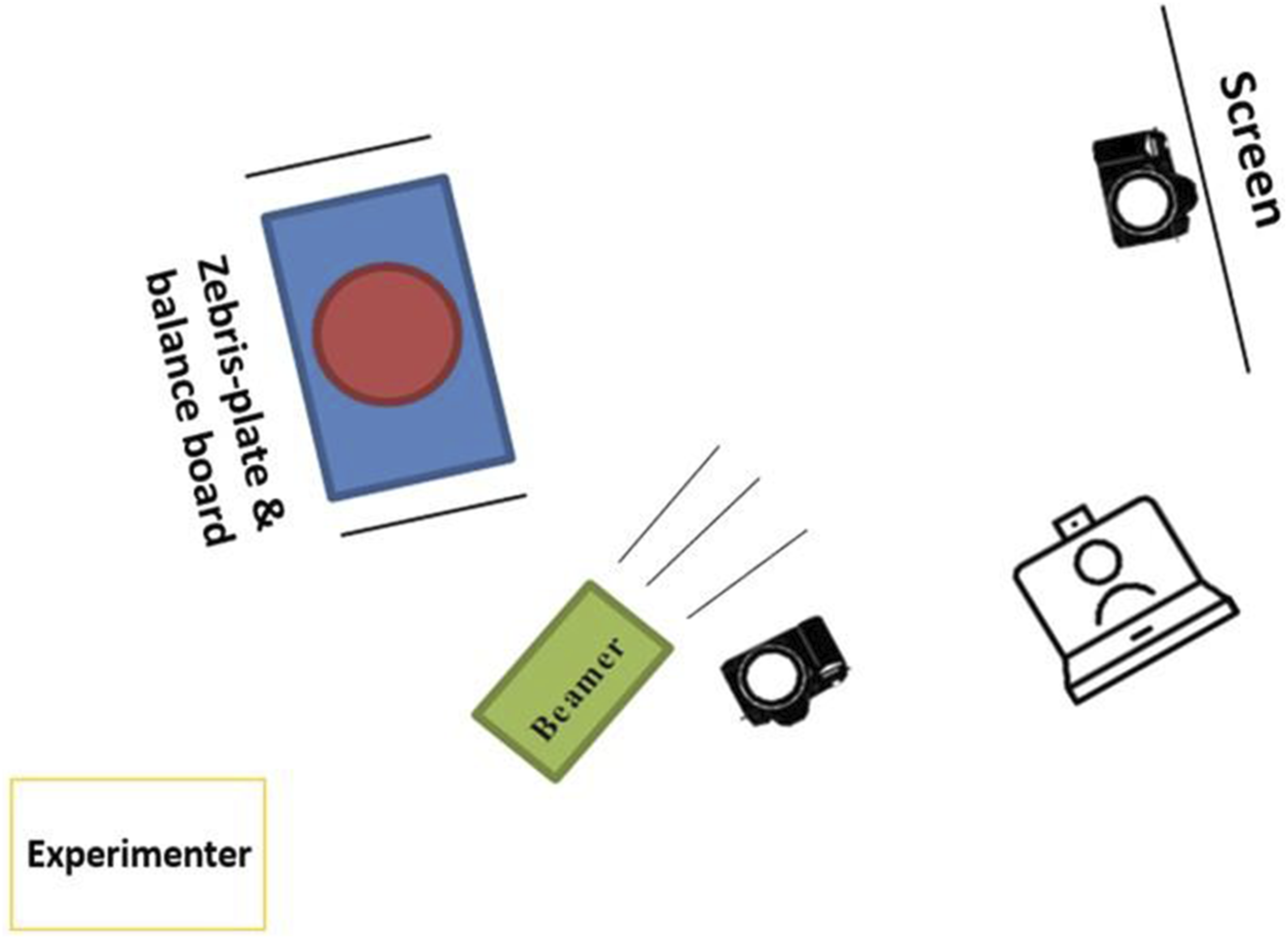
In the alone condition, only the experimenter was present. Participants were instructed to focus their gaze on the screen during this condition, but the screen did not show any image. Performance was assessed for both legs in both the alone and spectator conditions. The legs were categorized as dominant or non-dominant based on a self-report questionnaire. Each condition consisted of four trials per leg (4 trials dominant leg – alone, 4 trials non-dominant leg – alone, 4 trials dominant leg – simulated spectators, 4 trials non-dominant leg – simulated spectators), each lasting 30 seconds. Multiple trials per leg and condition were conducted to increase measurement reliability and to account for intra-individual variability in postural control. A short break was given between each trial, and participants were allowed to decide when to start the next trial.
Procedure
Study Design: Counterbalancing Orders
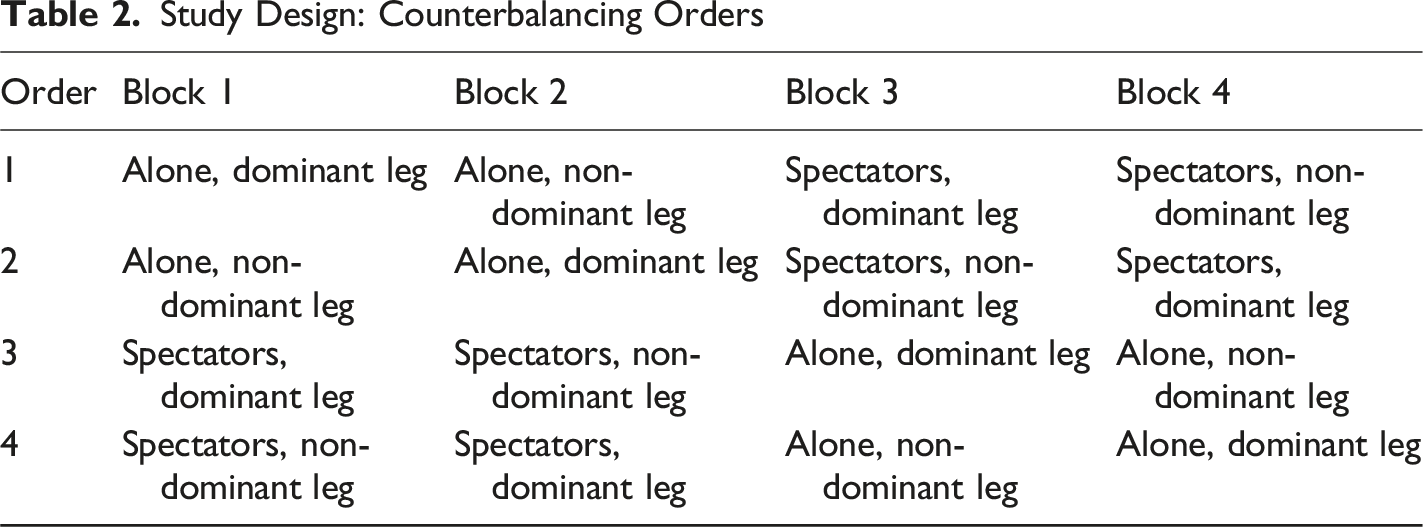
Participants were instructed to stabilize the balance board as much as possible while keeping their hands on their hips and placing the heel of the free leg on the knee of the standing leg (quiet stance). No performance feedback was provided during the trials.
For the first part of the study with Dancers and Non-Dancers 1, the experimenter informed the participants that the spectators were part of an online meeting due to COVID-19 restrictions. Participants were told they were being observed through the experimenter’s camera and were prohibited from communicating with the audience. As a manipulation check, each participant was asked after the study whether the simulated audience was perceived as real. We hypothesized that Dancers would outperform the control group (Non-Dancers 1). Specifically, we expected the presence of spectators to result in performance decrements for the control group and less pronounced decrements, or even performance improvements, for the Dancers. Additionally, we anticipated that the relative performance advantage of Dancers would be more pronounced when balancing on the non-dominant leg. This part of the study was not preregistered.
In the second part of the study, Non-Dancers 2 (sport students) were explicitly informed that the “spectators” were part of a pre-recorded video clip, and were not actually watching them perform. Participants were told, as part of a cover story, that the study aimed to investigate whether the video clip could be used in future research (whether it “feels real” – rated on a seven-point Likert scale: 1 = absolutely not real, 7 = absolutely real). Based on research in social facilitation, we predicted that performance would not improve if subjects are aware that they are not being observed in real time. This part of the study was preregistered, and the corresponding link is available at: aspredicted org/5mtb-n8hp.pdf.
Overview of Analysis
Statistical analysis was performed using IBM SPSS Statistics 25 (IBM Corporation, Armonk, NY, USA). A mixed-design ANOVA was conducted to analyse balance performance (CoP - 95% confidence ellipse area) with the within-subjects factors of spectators (2: present or absent) and leg dominance (2: dominant or non-dominant leg), and the between-subjects factor of group (3: Dancers, Non-Dancers 1, Non-Dancers 2). Significant effects were followed up with Bonferroni corrected post-hoc comparisons.
Results
Normally distributed data are given for 7 out of 12 test occasions (3 groups: Dancers, Non-Dancers 1, Non-Dancers 2 – sport students; 4 spectator conditions: alone – dominant leg and non-dominant leg, simulated spectators – dominant leg and non-dominant leg) using the Kolmogorov-Smirnov test. We decided to report the mixed-design ANOVA, since it is not very sensitive to moderate deviations from normality (Glass et al., 1972; Harwell et al., 1992; Lix et al., 1996).
Reliability coefficients based on all 16 balance trials (N = 96) were good (Cronbach’s Alpha = .921), indicating that inter-individual differences in balance performance remained stable across trials.
Data (M ± SD) of the Experimental Variables by Condition
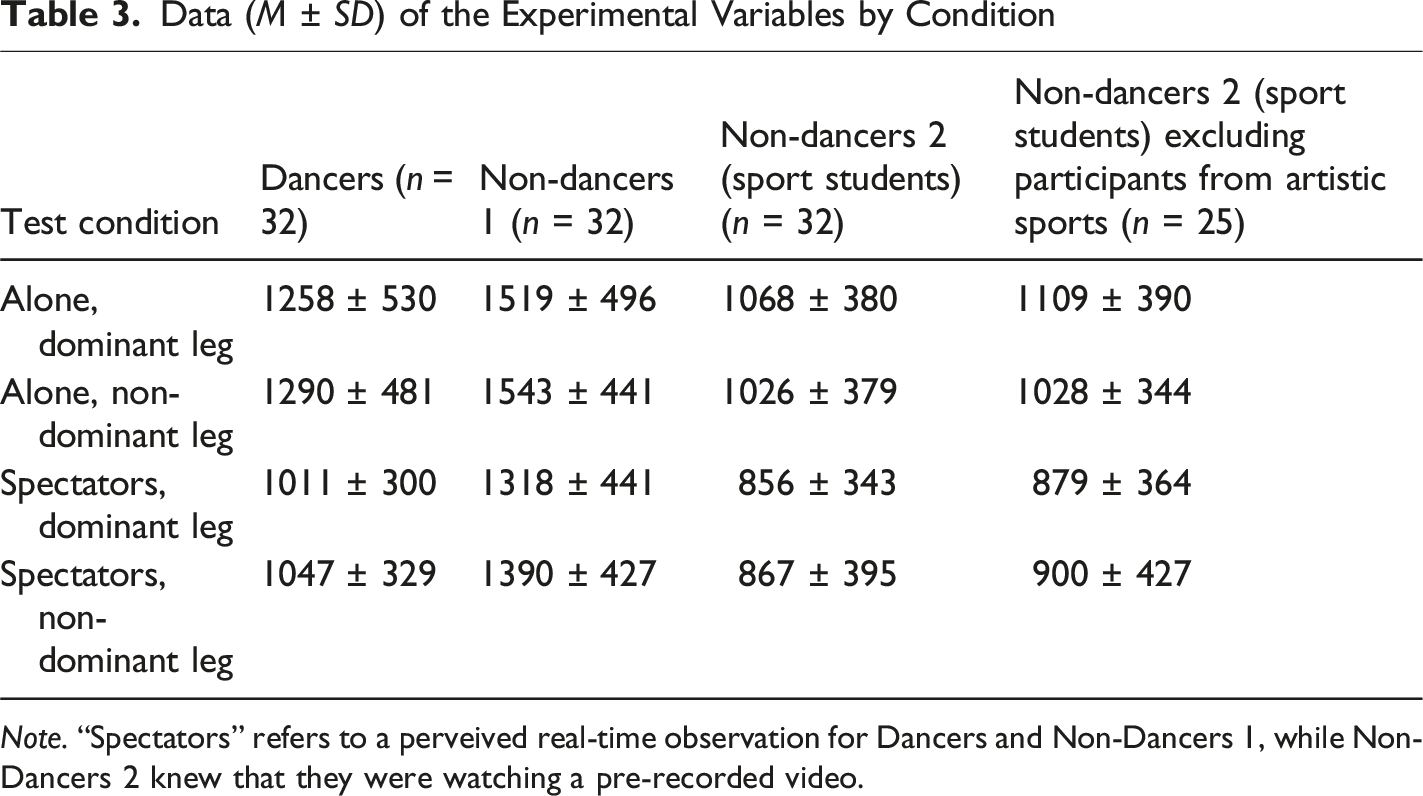
Note. “Spectators” refers to a perveived real-time observation for Dancers and Non-Dancers 1, while Non-Dancers 2 knew that they were watching a pre-recorded video.
A mixed-design ANOVA with spectators (2: present versus absent) and leg dominance (2: dominant versus non-dominant leg) and group (3: Dancers, Non-Dancers 1, Non-Dancers (2) was conducted. Figure 2 shows the results of the current study. The analysis revealed a significant main effect of spectators, F (1, 93) = 47.921, p < .001, η
2
p
= .340. Participants showed better balance performance in front of the simulated audience. There was no interaction between the spectator effect and group, F (2, 93) = .528, p = .592, η
2
p
= .011, indicating that the social facilitation effect was consistent across expertise levels and across assumptions about the spectators being “real” or “fake”. Furthermore, a significant main effect group was found, F (2, 93) = 15.113, p < .001, η
2
p
= .245. 95% Confidence ellipse area by test condition.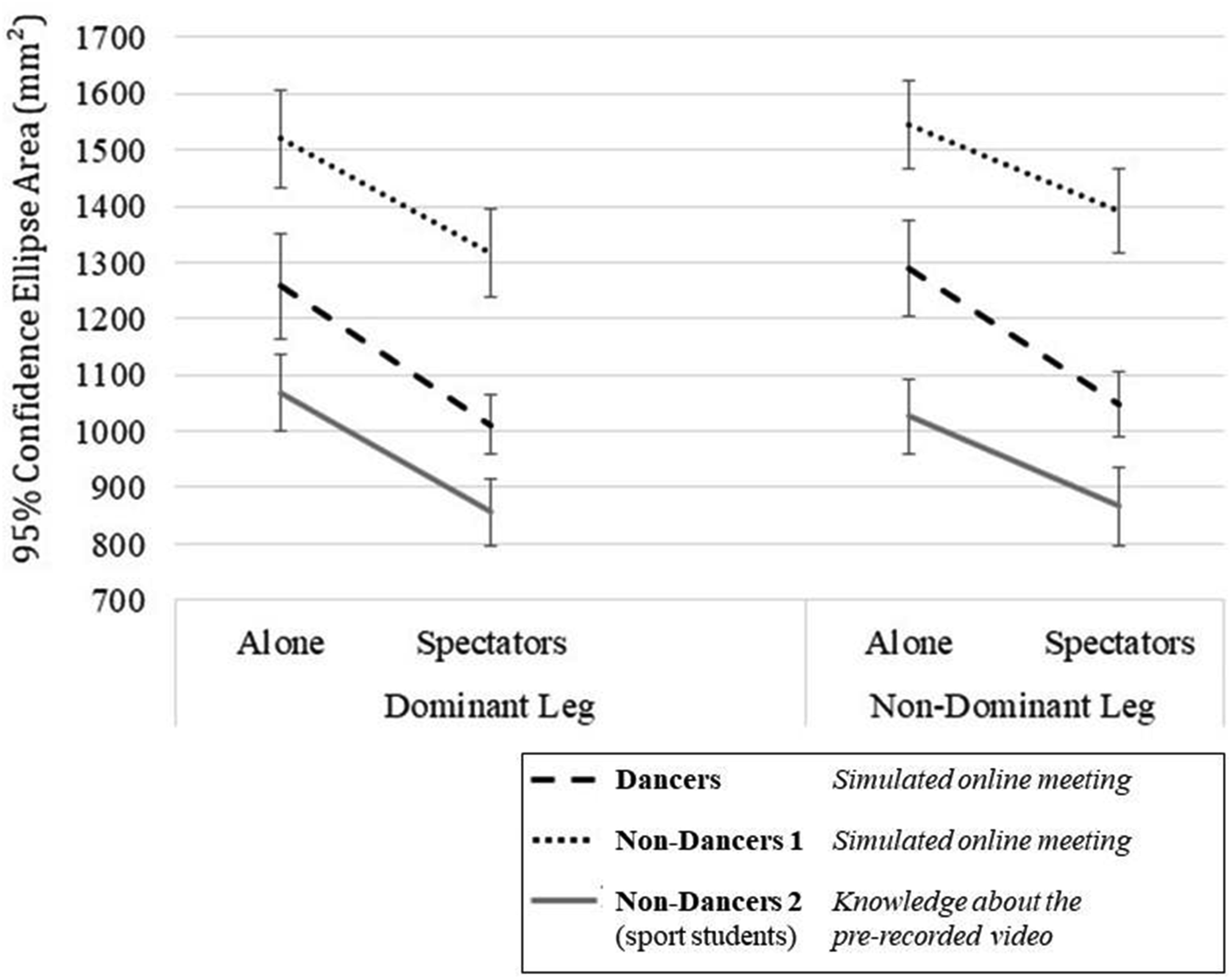
No significant main effect for leg dominance was found, F (1, 93) = .850, p = .359, η 2 p = .009, and leg dominance did not interact with group, F (2, 93) = .661, p = .519, η 2 p = .014. There were also no significant interactions between spectator presence and leg dominance, F (1, 93) = .661, p = .437, η 2 p = .007, and the three-way interaction between spectator presence, leg dominance, and group also failed to reach significance, F (2, 93) = .123, p = .885, η 2 p = .003.
To follow-up the significant effect of group, we calculated the average balance performance across spectator condition and leg dominance for each participant. The mean COP area was 1151 mm2 (SD = 355) in Dancers, 1443 mm2 (SD = 373) in Non-Dancers 1, and 954 mm2 (SD = 344) in Non-Dancers 2. A univariate ANOVA confirmed the significant effect of group, F (2, 93) = 15.113, p < .001, η 2 p = .245. Bonferroni-corrected post-hoc comparisons showed that Dancers outperformed Non-Dancers 1 (p = .005, MDiff = 291.43, 95%-CI [509, 73]), and Non-Dancers 2 performed better than Non-Dancers 1 (p < .001, MDiff = 488.52, 95%-CI [707, 271]), but the difference between Dancers and Non-Dancers 2 did not reach significance (p = .090, MDiff = 197.1, 95%-CI [20, 415]).
When we asked the Non-Dancers 2 whether the simulated spectators “felt real”, they responded with a mean score of 3.84 (SD = 1.69) on a seven-point Likert scale.
To control for potential biases due to comparable levels of expertise (22% of the sport science students had experience in artistic sports), an additional mixed-design ANOVA was conducted excluding seven sport science students who practiced dance, gymnastics, Equestrian vaulting, or cheerleading, reducing the sample size of the Non-Dancers 2 group to n = 25. The date of the reduced sample are presented in Table 3. The effects did not differ from those obtained in the analyses of the total sample (including sport science students who practiced artistic sports). There was a significant main effect of spectators, F (1, 86) = 43.686, p < .001, η 2 p = .337, and no interaction between spectator effect and group, F (2, 86) = .569, p = .568, η 2 p = .013. There were also no significant main effect for leg dominance, F (1, 86) = .453, p = .503, η 2 p = .005, no interaction between leg dominance and group, F (2, 86) = .806, p = .450, η 2 p = .018, no interaction between spectator presence and leg dominance, F (1, 86) = 1.165, p = .283, η 2 p = .013, and no three-way interaction between spectator presence, leg dominance, and group, F (2, 86) = .341, p = .712, η 2 p = .008. There was also a significant main effect group, F (2, 86) = 12.087, p < .001, η 2 p = .219.
Follow-Up Analyses on the average balance performance across spectator condition and leg dominance showed the same pattern of findings as reported above for the whole sample, with Dancers outperforming Non-Dancers 1 (p = .006), Non-Dancers 2 performing better than Non-Dancers 1 (p < .001), and the difference between Dancers and Non-Dancers 2 not reaching significance (p = .235).
Discussion
Note that the two parts of the current study had been conducted consecutively. Initially, we were interested in expertise differences between dancers and novices in the effects of spectators on balance performance. In this part of the study, participants were told that the simulated spectators were real, and were actually watching them while balancing on the ankle-disc board. We observed a strong improvement of balance performance in front of spectators, as compared to balancing alone. In addition, Dancers showed superior balance performance compared to Non-Dancers 1, but there were no interactions of spectator effects and group. In order to show that the effects were caused by the social influence of being watched by an audience (Strauss, 2002), and not due to stabilizing effects of fixation (Stoffregen et al., 1999), we recruited an additional group of Non-Dancers (2 – sport students). Different from the previous subjects, they were explicitly told that the simulated spectators were “fake”, and only consisted of a pre-recorded video. As a cover story, subjects were asked to judge whether the “fake” spectators felt real and could be used as stimuli in future research. The main result of the second part of our study was that these control participants also showed strong improvements of their balance performance in front of the “fake” spectators. This suggests that postural stabilization by fixation is more likely to have caused the effect, as opposed to the social facilitation account. Although participants had been instructed to fix their gaze on the wall also in the alone condition, it is reasonable to assume that people payed more attention to the images projected onto the wall when the simulated audience was presented. This happened because participants either wanted to detect the audience’s feedback about their performance (Dancers and Non-Dancers 1), or because they wanted to judge whether the simulated audience “felt real” (Non-Dancers 2).
However, alternative explanations also remain plausible. Doumas et al. (2018), for example, showed that social stress (being watched and criticized by the experimenter) can improve postural control, probably due to a stiffening or freezing response. In the current study, it is conceivable that the simulated video did not induce stress, but instead promoted an external attentional focus, which can enhance motor automaticity and thus improve balance performance.
Subjects were asked to balance on their dominant and non-dominant leg, with the assumption that the task should be more difficult on the non-dominant leg. However, we found no significant difference in balance performance between the self-reported dominant and non-dominant leg in any of the groups. This finding is consistent with the results of Hoffman et al. (1998) and Lin et al. (2009), who also found no differences in balance performance between both legs in healthy adults across various functional tests. Although leg preference is often included as a control variable in balance research, the distinction between preference (e.g., for kicking a ball or jumping) and functional dominance (based on observed performance) often remains blurred. The study of Kozinc and Šarabon (2021) showed only small differences in static balance (e.g. anterior-posterior CoP parameters) in favour of the preferred leg for kicking, whereas hardly any differences were found in dynamic tasks (e.g. landing). Importantly, the performance-based leg differences were more pronounced than those based on subjective preference.
Contrary to our expectations, the presence of simulated spectators led to performance improvements in both Dancers and Non-Dancers. These results are consistent with previous studies (Kozar, 1973; Lau et al., 2019; Wankel, 1975), which demonstrated no interaction between ability level and social facilitation/inhibition, with a few exceptions (e.g., MacCracken & Stadulis, 1985; Singer, 1965).
Our study is not the first to report positive effects of spectators in static balance tasks. Murray (1983) found performance improvements when participants balanced on a stabilometer in front of spectators. The mechanism underlying these performance improvements may involve a shift in attention away from the task itself, as suggested by the distraction-conflict hypothesis (Sanders & Baron, 1975). Balancing on an ankle-disc board might be best performed in an automatized manner (Beilock & Gray, 2012). When participants focus their attention on the spectators, possibly anticipating performance evaluations (Henchy & Glass, 1968), they may be less likely to focus on the balance task itself. Schaefer et al. (2008) observed similar effects in children and young adults using the same balance task in a dual-task setting, where improved balance performance was observed under cognitive load. Note that this explanation also fits the “postural stabilization by fixation” account (Gibson, 1966; Prado et al., 2007; Stoffregen et al., 1999, 2000, 2007), since focusing on the projection screen may have helped stabilize participants’ posture, regardless of the social-evaluative context provided by the spectators. Non-Dancers in the second part of the study had been instructed to closely observe the “fake” audience in order to tell whether the audience “feels real” or not. This probably made participants focus their attention on the audience, serving as a strong stabilizing cue for the body’s center of gravity. When we asked participants whether the simulated spectators “felt real”, they rated the audience as “relatively real”. Interestingly, out of the 64 dancers and novices tested in the first part of the study, only two participants verbalized any doubt that the spectators may not be actually watching them in real time. Excluding these participants from the analyses did not change the pattern of findings.
In addition to the significant main effect of spectators/visual fixation, we also found significant group differences. Dancers outperformed the first group of Non-Dancers, which had been expected. However, we also observed performance advantages Non-Dancers 2 group compared to the Non-Dancers 1. Participants from group 2, which consisted of female sport students, did not differ significantly in their balancing performance from the Dancers. We cannot exclude to possibility that this is also driven by a relatively high proportion of female sports students who also do gymnastics or other aesthetic sports as regular sport activities (Kiers et al., 2013). Note, however, that excluding the sports students with experience in artistic sports did not change the pattern of results. All three groups tested in the current study were physically very active and are therefore not representative of the general population. Future research should control for sport expertise more carefully, and construct experimental groups without any overlap in sporting activities.
Limitations
A limitation of our approach is the lack of a condition where participants had no external fixation points. Participants were always instructed to focus on either a blank screen (the “alone” condition) or the simulated projection (the “spectator” condition), and to remain as stable as possible. Future research should include conditions where no external fixation point is provided, to assess the individual contributions of visual and social factors more precisely. Note, however, that giving participants the choice of directing their gaze to any place they want will introduce considerable noise in the data, due to inter-individual differences in preferences for “natural” gaze direction (e.g., some participants may prefer to not look at the audience in the spectator condition, others may direct their gaze in many different locations in the room in the “alone” condition).
Future research needs to assess whether the mere instruction to focus on a specific location (e.g., a dot in the center of the screen) already has a stabilizing effect on balance performance, or whether people need to work on a specific task that requires constant visual input. The visual demands of a real dance performance with an audience seated in the stands are more complex than in the current study. Mobile eye-tracking systems (Dicks et al., 2010) could be employed to measure visual fixations in more ecologically valid task scenarios.
For research on social facilitation/inhibition, the presence of an experimenter in the “alone” condition may be criticised. It has been argued that a real “alone” condition is a better comparison for the spectator condition, because an experimenter also observes the performance of the subject. For the current experiment, the experimenter was required for running the study for technical reasons. A true “alone” condition without an experimenter would be challenging to implement for the current task, as participants would need to independently start and finish the tests. This aspect should be considered in future designs.
Another limitation is the reliance on self-reports for determining leg dominance. In our sample, many participants identified a leg as dominant that did not exhibit superior balance performance. Future studies should investigate whether balance performance reliably differs between legs in healthy young adults, and whether self-reported leg dominance can be an accurate predictor of performance.
Finally, as the current studies involved only female participants, the findings cannot be generalized across genders. This is particularly noteworthy in the light of recent findings on gender differences in spectator effects (Heinrich et al., 2021; Pelzer et al., 2025). Future research should aim to replicate our findings in men, and should generally include gender as a factor in studies on spectator effects.
Conclusion
The present findings offer valuable insights into the effects of spectator presence on motor performance, particularly in coordination tasks. For balancing in front of a simulated audience, the study provides a more nuanced explanation, highlighting the stabilizing role of visual fixation. The results challenge traditional theories of audience effects in balance tasks and suggest that visual fixation may play a more significant role than previously thought. Future research should further explore the complex interplay between social and visual factors, particularly by controlling for visual fixation in tasks that involve balance (both in front of a present and simulated audience), to better understand the mechanisms underlying these performance enhancements. One might assume that, due to the relatively high perceived realism of the simulated audience, the same effects would also occur in the presence of a real audience. However, this cannot be answered based on the current findings, and should be tested in future studies.
Footnotes
Acknowledgements
The authors would like to thank Kai Leisge, Anna Heggenberger, Tiziano Agostini, Fabrizio Sors, and Mauro Murgia for interesting and helpful discussions. The authors also would like to thank all participants for taking part in the study.

Ethical Considerations
The study was approved by the ethics committee of Saarland University (approval number: 17-08).
Consent to Participate
Each participant received written information about the study and signed an informed consent statement.
Author Contributions
Christian Kaczmarek: Conceptualization, Methodology, Formal analysis, Writing – original draft, Visualization. Fabian Pelzer: Conceptualization, Methodology, Writing – review & editing. Celine Engler: Conceptualization, Investigation. Anna Ziegler: Conceptualization, Investigation. Christian Bohnenberger: Investigation. Sabine Schaefer: Conceptualization, Methodology, Formal analysis, Writing – review & editing, Supervision.
Funding
This research was supported by Saarland University. The authors received no financial support for the research, authorship, and/or publication of this article.
Declaration of Conflicting Interests
The authors declared no potential conflicts of interest with respect to the research, authorship, and/or publication of this article.
Data Availability Statement
Data will be made available on request.