







Abstract
Background
Home environment opportunities, such as adequate physical space, a variety of stimuli, and toys, can facilitate motor skill development. Thus, the environment should be adapted to maximize action possibilities for infants, especially those with biological risk. However, the presence and impact of these opportunities in infants with biological risk at different developmental stages is limited. This study aimed to compare the availability of home environment opportunities and determine their impact on motor skills in infants with low biological risk at different stages.
Methods
This cross-sectional remote study included 54 infants: Group 1:2–6 months, M = 3.95; SD = 23 days and Group 2: 6–11 months, M = 7.89; SD = 37 days. Motor skills and home environment opportunities were assessed remotely using the Alberta Infant Motor Scale and the Affordances in the Home Environment for Motor Development - Infant Scale, respectively. Intergroup comparison tests and intragroup multiple linear regression analyses were conducted, considering p ≤ 0.05.
Results
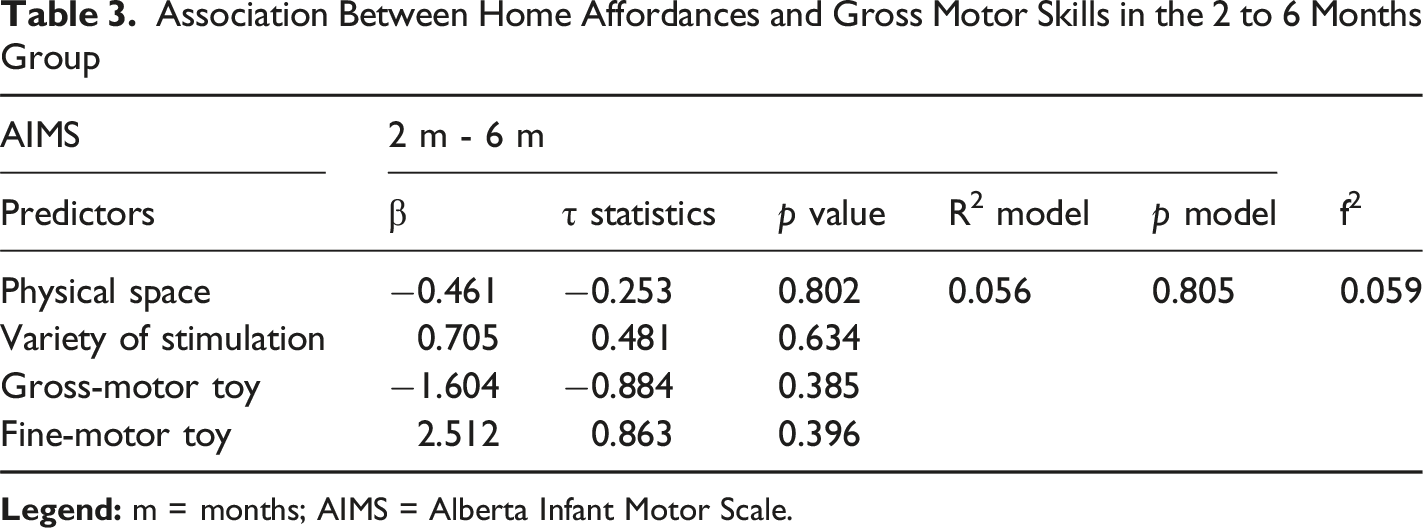
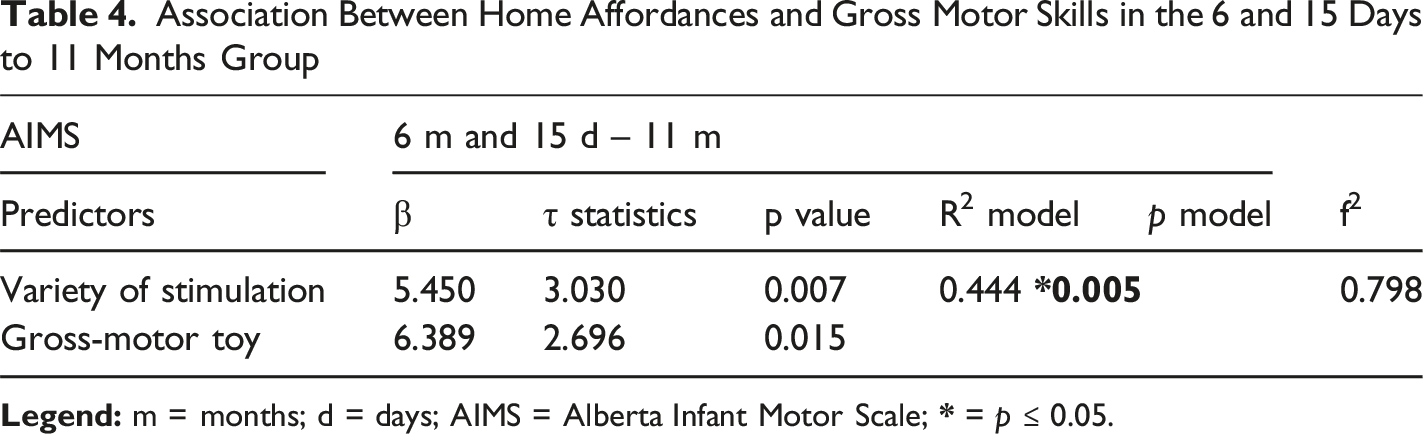
Group 2 had more toys than Group 1. In the regression analysis, Group 2 showed significant associations between the variety of stimulation (p = 0.007) and gross motor toys (p = 0.015) and gross motor skills.
Conclusion
Identifying intergroup differences and associations between environmental factors and gross motor skills underscores the need for family-oriented practices that emphasize early environmental enrichment.
Key Messages
• The older infant group had more toys than the younger infants group. • The variety of stimulation and gross-motor toys domains were responsible for improving motor outcomes. • Health professionals should provide families guidance on stimulation for each stage of child development, taking into account home environment.
Introduction
A child’s increasing adaptation to the environment results from the reciprocal relationship between their ability to perform tasks, their intrinsic properties, and the information provided by the physical and social environment. This interaction is conceptualized as affordance, which is refined through continuous and cyclical perception-action and exploration-selection (Adolph et al., 2000; Gibson & Pick, 2000). This concept is fundamental to motor development, since constant interaction with the environment promotes learning and improves skill. Exploring the environment enables the acquisition of essential information for producing appropriate responses to different situations (Oudgenoeg-Paz et al., 2016). In this respect, providing opportunities in the physical environment, such as adequate spaces and different toys compatible with the child’s abilities (Almeida et al., 2015), as well as appropriate social and attitudinal stimuli, can increase the frequency of exploratory behaviors (Correr et al., 2014) and positively impact motor skill development (Caçola et al., 2011; Miquelote et al., 2012).
Environmental exploration begins in the neonatal period (Jouen & Molina, 2005) and becomes progressively more refined throughout development. During the first months of life, infants spend more time engaged in tactile, visual, and proprioceptive self-exploration through motor actions such as touching their own body, raising their hand to their mouth, and bringing their hands together at the midline (Babik et al., 2017; Lobo et al., 2015). In the second half of their first year, they show increased interest in exploring objects and the physical environment, since adaptive actions are acquired; that is, different movement strategies are used based on environmental information (Hadders-Algra & Heineman, 2021). Motor competencies also develop, including mobility skills such as crawling, creeping, and walking (Hadders-Algra & Heineman, 2021), which impact the perception-action system, resulting in greater environmental exploration (Babik et al., 2022).
However, infants with biological risk exhibit disadvantages in motor skill acquisition and refinement (Dusing et al., 2014; Sato et al., 2021), reduced bodily self-exploration (Babik et al., 2017), and lower variability in environmental exploration behaviors (Lobo et al., 2015). However, the environment can exacerbate or mitigate the detrimental effects of these risks (Paiva et al., 2010). During the early years of life, children spend most of their time in the home environment, which plays a fundamental role in their development (Hua et al., 2016; Lo et al., 2017). Stimulating environments provide infants with valuable opportunities to explore and learn, enabling improved motor outcomes during the first year of life (Santos et al., 2023; Zorlular et al., 2024). Conversely, understimulating environments increase the likelihood of developmental delays (Cao et al., 2022), especially in infants with biological risk (Araujo et al., 2019; Cunha et al., 2018).
Although the literature indicates that more environmental opportunities are associated with better motor development, it is still unclear how environmental factors differentially influence motor development across early developmental stages in biologically at-risk infants. Apaydin et al. (2023) conducted an exploratory analysis and identified moderate associations between opportunities in the home environment and both gross and fine motor skills, as assessed by the Bayley III, in infants with an average age of 10 months. Although the present study shares methodological similarities, the authors neither stratified the participants by developmental stages nor established a homogeneous group for infants with biological risk.
In order to address this gap in the literature, the present study compared the availability of home environment opportunities (physical space, a variety of stimuli, and toys) and to determine their association on motor skills in infants with low biological risk at different developmental stages: before and after six months of age, when exploratory and mobility behaviors are developing.
In light of the concept of affordance for development (Gibson & Pick, 2000), possibilities for action emerge from the reciprocal interaction between individual abilities and environmental characteristics. Due to their greater mobility and adaptive responses to task and environmental demands, older infants are more exposed to a variety of stimulation at home and display stronger associations between the quality of the physical environment, number of toys, and greater motor capacity, compared to their younger counterparts.
In this context, this study seeks to provide evidence to support guidelines and interventions centered on the modulatory role of the environment in infant motor development.
Methods
Study Design and Setting
This was an observational, cross-sectional, and remote study, using a non-probabilistic intentional sample (specific criteria) and following the recommendations of the Strengthening the Reporting of Observational Studies in Epidemiology (STROBE) and Checklist for Reporting Results of Internet E-Surveys (CHERRIES) checklists for remote studies. It was approved by the local Research Ethics Committee (case: 34718020.2.0000.5504) and conducted from April to December 2020, following the caregivers’ signing of the informed consent form.
Participants
The sample size was calculated a priori using G*Power 3.1.9.4 software. The effect sizes reported by Apaydin et al. (2023), based on the correlation between the total AHEMD score and total Bayley-III score, were used to determine the sample. A statistical power of 80%, effect size of 0.52, and a significance level of 5% were established. An F-test (linear multiple regression: fixed model, R2 deviation from zero) was applied, resulting in 31 participants.
Participants were recruited from a biological risk infant follow-up service in São Carlos, Brazil, and through social media dissemination.
A total of 54 infants participated in the study out of 86 invited. Inclusion criteria were infants aged between 2 and 11 months (chronological or corrected age for preterm infants) with at least one biological risk factor. Infants were divided into two groups: Group 1: 2 to 6 months and 15 days and Group 2: 6 months and 15 days to 11 months. Group 1 consisted of 14 boys and 18 girls (M = 3.95 months; SD = 23 days), while Group 2 included 16 boys and 6 girls (M = 7.89 months; SD = 37 days).
Characterization of Participants
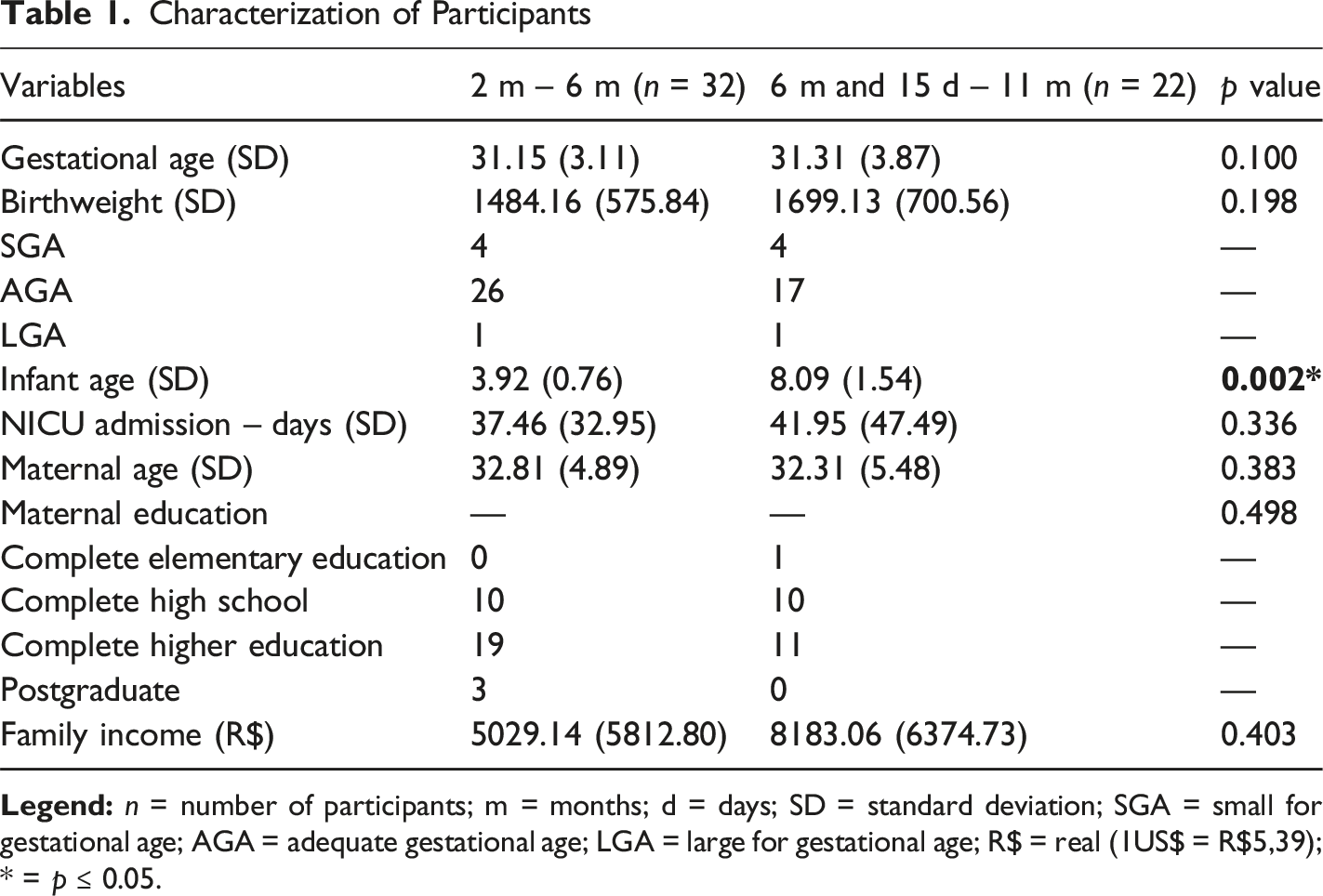
Exclusion criteria included infants with orthopedic, visual, and/or auditory impairments; diagnosed genetic syndromes, malformations, congenital anomalies, or drug-resistant epilepsy.
Procedures
After determining infant eligibility, caregivers interested in participating contacted the evaluator via WhatsApp, Facebook, Instagram, or phone calls. To confirm participation, caregivers completed the informed consent form and provided the infant’s pre- and perinatal history to identify inclusion criteria. Biological risk factors and socioeconomic characteristics were collected through an electronic form.
Assessments began once participants were included in the study. Gross motor skills were assessed using asynchronous video recordings made by caregivers, who then sent the videos to the evaluator via WhatsApp (Lima et al., 2022). The home environment was assessed through an electronic form (Google drive) using the Affordances in the Home Environment for Motor Development – Infant Scale (AHEMD-IS), which caregivers completed.
The researchers remained available throughout the evaluation process to address any questions regarding the questionnaires. Caregivers who had difficulties completing the questionnaires or recording videos could contact the researchers via telephone or text message.
Measuring Instruments
Gross Motor Skills – Alberta Infant Motor Scale (AIMS)
AIMS evaluates gross motor skills and contains 58 items that address movements, weight-bearing, and postures. The instrument is used up to 18 months of age or until independent walking was achieved (Piper & Darrah, 1994). It has been validated for the Brazilian population (Valentini & Saccani, 2012), and its remote application has demonstrated good interexaminer agreement for typical infants (Boonzaaijer et al., 2019) and good reliability (81.8–85.7%) for those with biological risk (Lima et al., 2022).
Scores range from 5 to 90 and are based on percentiles according to age, with infants above the 25th percentile considered typical, between the 5th and 25th percentile suspected motor delay risk, and below the 5th percentile high risk for motor delay (Piper & Darrah, 1994).
In this study, AIMS was applied remotely. Parents recorded videos using mobile phones, following evaluator instructions (Lima et al., 2022). The videos were scored by an evaluator, blinded to the infants' age and risk factors. The interexaminer reliability was 81.8 to 85.7%.
Affordances in the Home Environment for Motor Development – Infant Scale (AHEMD-IS)
The AHEMD-IS is a parent-reported questionnaire with good inter- and interexaminer reliability (Caçola et al., 2015) on the quality and quantity of home-based opportunities for the motor development of children aged 3-18 months and is a validated parent-reported questionnaire good intra- and interexaminer reliability (Caçola et al., 2015). It does not assess social interactions or the level of environmental exploration, but instead focuses on available physical space, play resources and the amount of stimulation provided by the home environment. It consists of 35 questions, divided into four dimensions: physical space, variety of stimulation, gross and fine motor toys. The total score is the sum of all four dimensions or can be analyzed separately. Higher scores indicate a more favorable home environment for motor development (Caçola et al., 2015).
For analyses, the total score of each dimension was considered.
Data Analysis and Statistical Tests
Descriptive statistics were used to describe the variables, including frequency data, means, and standard deviations. Infant characteristics and the families' socioeconomic data were compared to assess intergroup homogeneity. Data distribution was verified using the Kolmogorov-Smirnov test.
Comparisons between Group 1 (younger infants) and Group 2 (older infants) were conducted using the independent samples t-test or Mann-Whitney test, depending on the data distribution, for the following variables: AIMS percentile, physical space, variety of stimulation, in addition to AHEMD-IS gross and fine motor toys. The groups were also compared based on risk classification, according to AIMS, using a chi-square test.
A linear regression analysis was performed for each group, using the AIMS percentile as the dependent variable and the AHEMD-IS domains as independent variables. The analysis indicated that the assumptions of linear regression were satisfied, including normally distributed residuals, homoscedasticity, and the absence of multicollinearity among the independent variables. Statistical significance was set at 5% (p ≤ 0.05), and SPSS software, version 20 was used.
Results
Characterization of Groups Regarding Home Environment Opportunities and Gross Motor Skills
Both groups had an average AIMS percentile above the 20th percentile, with no statistically significant differences between them (p = 0.135). Group distribution is presented in Figure 1. Differences between the risk classification for motor delay in each age group.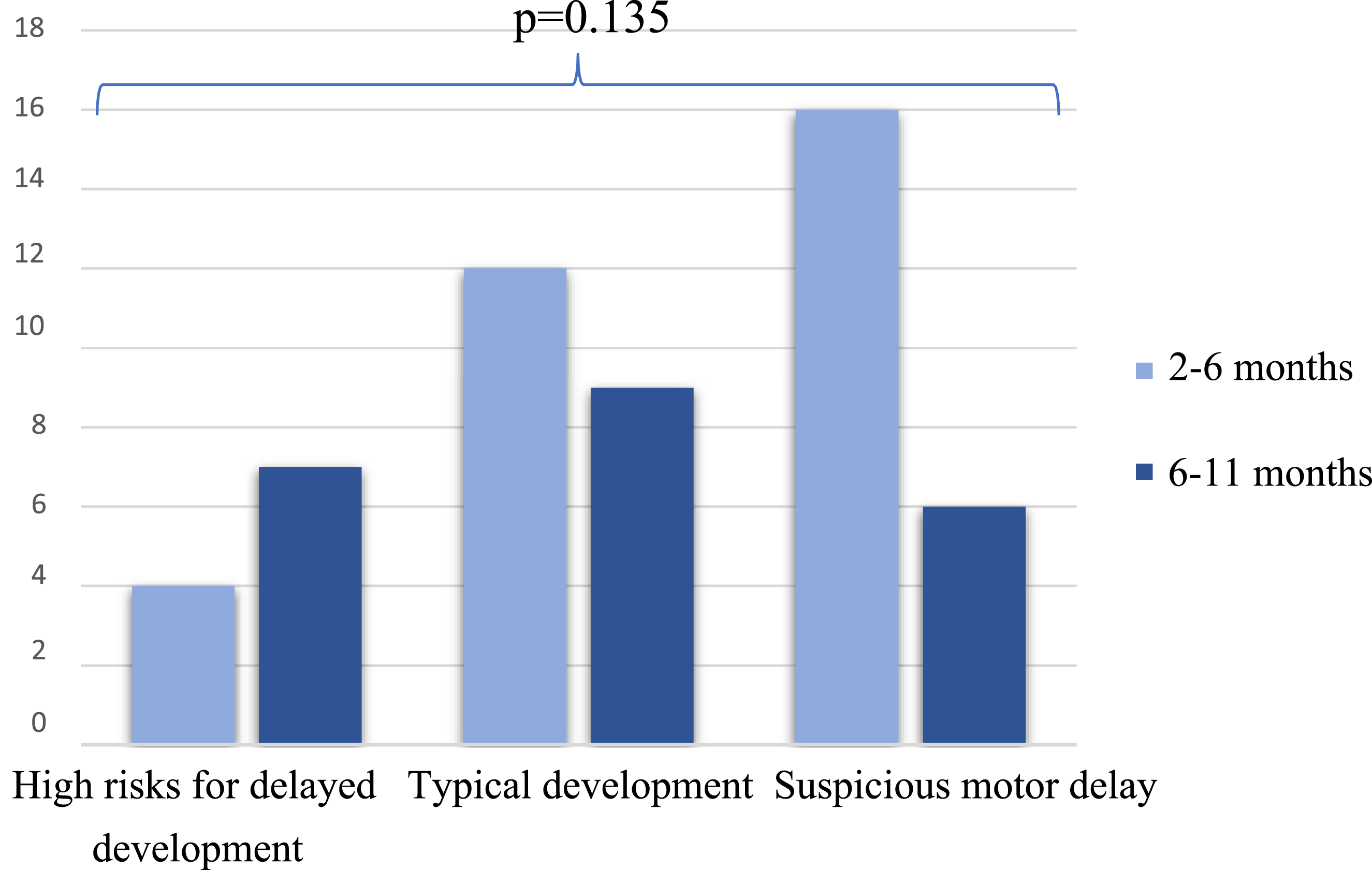
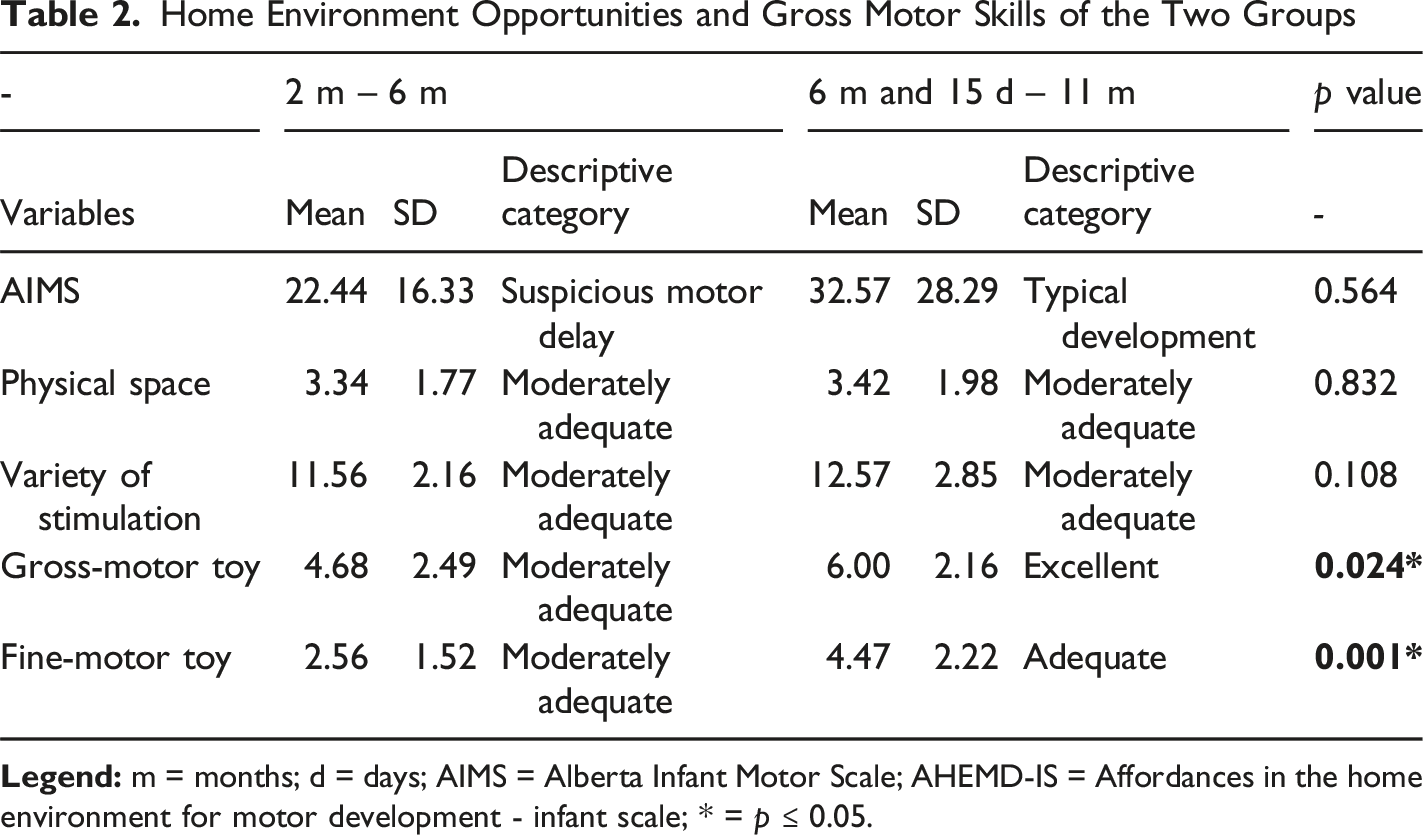
However, significant differences were found in the gross- and fine-motor toy dimensions, with Group 2 scoring higher in both categories.
Home Environment Opportunities and Gross Motor Skills of the Two Groups
Association Between Home Environment Opportunities and Intergroup AIMS Percentile
Association Between Home Affordances and Gross Motor Skills in the 2 to 6 Months Group
Association Between Home Affordances and Gross Motor Skills in the 6 and 15 Days to 11 Months Group
Discussion
This study aimed to compare the availability of home environment opportunities and to determine their impact on motor skills in infants with low biological risk at different developmental stages. Our hypotheses were partially confirmed, since there were intergroup differences only in terms of the number of toys and associations were found between AHEMD-IS and gross motor skill dimensions only in the group older than 6 months.
We found that older infants had access to a greater number of toys than their younger counterparts. This likely reflects developmental changes that occur during the second half of infancy, when infants begin to acquire motor milestones such as pivoting, dragging themselves, and crawling (Dosman et al., 2012; Hadders-Algra & Heineman, 2021). Reaching, grasping, and object- handling skills are also enhanced in this period, with movements becoming smoother, more fluent, faster, and adapted to task demands (Hadders-Algra, 2013; Rohr et al., 2021). Achieving these milestones may lead to increased opportunities for environmental exploration and interaction with different toys, prompting caregivers to acquire a wider range of toys commensurate with an infant’s developmental stage. Moreover, prior research indicates that caregivers of younger infants do not always know which toys are appropriate for stimulating child development (Defilipo et al., 2012) and frequently tend to provide electronic toys, which attract more attention than their traditional counterparts (Hassinger-Das et al., 2021).
These findings reinforce the need to provide guidance to parents of younger infants regarding the importance of a stimulus-rich environment. This is particularly important for infants at biological risk. Previous studies have demonstrated that premature infants exhibit reduced variability in exploratory behaviors, impaired bimanual skills, and challenges in integrating motor strategies with object-directed exploration (Babik et al., 2017; Lobo et al., 2015). Therefore, early exposure to stimulating environments and toys suited to infants’ motor abilities may foster adaptive variability and active engagement, contributing to the acquisition of motor and cognitive skills (Babik et al., 2017).
In relation to intergroup comparison, no differences were found between the other domains, physical space and variety of stimulation. The physical space domain consists of questions related to the structural aspects of the home where the infant lives, such as types of flooring, presence of steps, and sloped surfaces (Caçola et al., 2015). Thus, the instrument does not assess whether the infant explores this space, but whether the space exists, which may be more strongly influenced by economic factors than by the child’s ability to explore the environment at each developmental stage. Studies have shown that an inadequate home environment may be linked to a lack of financial resources for better living conditions (Araújo et al., 2019; Santos et al., 2023). The sample in the present study consisted of families with middle and high socioeconomic status across both groups. Accordingly, a favorable socioeconomic condition appears to have led to a more stimulating environment, favorable physical structure, and a diversity of spaces available for infant exploration.
In the “variety of stimulation” domain, no intergroup differences were observed, despite the expectation that older infants would obtain higher scores in this domain. The AHEMD-IS instrument assesses the amount of time infants spend on devices (e.g., infant car seat, stroller, crib), are carried in someone’s arms, and are free to move about within the home. Due to their increased mobility (Dosman et al., 2012), infants older than six months would be more exposed to a broader range of stimulation at home and likely spend more time moving freely by creeping, rolling, and crawling. As such, it was expected that younger infants, whose mobility is more restricted, would be more dependent on the caregiver and therefore exposed to fewer environmental stimuli.
Both groups exhibited a “moderately adequate” classification in this domain, indicating that all assessed infants had similar and relatively positive access to a variety of stimuli within the home environment, contrasting with findings from previous studies. According to Dinkel et al. (2021) and Birken et al. (2015), parents of infants at biological risk tend not to prioritize motor stimuli, thereby restricting environmental exploration through the frequent use of limiting devices such as strollers, playpens, and car seats.
In regard to the comparison of gross motor skills, similarities were found between the groups, although the younger infants with biological risk had an average AIMS score that classified them as “suspected of motor delay risk” (M = 22.44%), while older infants exhibited typical motor development for their age (32.57%). It is noted that most of the study samples were infants who showed no severe motor impairments. Thus, the low biological risk, absence of brain injury, and low social vulnerability in these infants may have contributed to this result. Future studies with infants at higher biological and environmental risk should be conducted for more definitive conclusions about these relationships.
In regression analysis, more gross motor toys and a greater variety of stimulation at home were associated with better motor outcomes in infants over 6 months of age. Toys, these can serve as bridges between the environment and the individual, promoting exploratory behaviors and stimulating development (Valadi et al., 2020; Zorlular et al., 2024). Similarly, a greater variety of stimulation can lead to experiences involving more complex activities (Beach et al., 2021; Rodrigues et al., 2005). Thus, playing with objects is vital for learning, since these interactions help expand the motor repertoire and adapt to the context (Libertus & Joh, 2016).
These are consistent with those reported by Apaydin et al. (2023), who found a positive association between number of toys and motor skills. However, the association found in Apaydin’s study was established in infants during their first year of life, with no differences across age groups. These results reinforce the importance of promoting environmental structure, positive parenting, and a variety of toys to favor the infant’s efficient adaptation to the environment, especially in at-risk populations.
Furthermore, it is important to note the absence of an association between the number of fine motor toys and gross motor skills in the young group, which may reflect characteristics inherent to sensorimotor development in this age group. Infants at this stage are predominantly engaged in multimodal exploration of their own body, discovering its motor possibilities through spontaneous movements, such as raising their hands to their mouths or observing their hands and feet (Babik et al., 2017; Lobo et al., 2015). Another aspect to highlight is that the assessment scale used may not have been sensitive enough to detect the impact on fine motor skills, given that AIMS assesses gross motor skills (rolling, dragging, crawling, and walking, among others). Toys involving fine motor skills, such as building blocks or shape-sorting toys, are designed to elicit precise and controlled hand and finger movements, which are not related to the skills assessed by AIMS.
Limitations and Directions for Further Research
The study had a cross-sectional design, which prevented determining causal relationships between the variables. Thus, it cannot be confirmed whether the environment improves motor skills or whether infants with better motor skills are more likely to be in enriched environments.
The sociodemographic profile of the sample was predominantly composed of families from middle and high socioeconomic levels and highly educated mothers. This characteristic may limit generalizing to more socially vulnerable populations. Despite these limitations, the study was valuable for evidence-based pediatric practice, since it identified associations and questions that can be explored in future longitudinal studies.
Clinical Implications
The fewer toys available to younger infants with a more limited motor repertoire may minimize opportunities for exploration that are essential for development. Early environmental stimulation with appropriate toys and a variety of stimuli may promote adaptive variability, contributing to the acquisition and refinement of motor and cognitive skills (Hadders-Algra & Heineman, 2021).
Thus, providing guidance to families on creating safe spaces for infants to move, offering toys of different sizes, textures, and shapes, and promoting a variety of activities and postures to foster motor learning in infants across different developmental stages is essential for improving gross motor skills (Caçola et al., 2015) in infants born with biological risk.
Conclusion
Infants with greater mobility engage with a larger number of toys compared to their younger counterparts. Furthermore, greater variety in environmental stimulation and increased access to gross motor toys are associated with better motor skills in infants older than six months. These findings underscore the need to emphasize family-centered practices that focus on early environmental enrichment.
Footnotes
Acknowledgements
We thank all the caregivers who participated in the research with their children and CAPES for the funding and support. Furthermore, we would like to thank the NGO Prematuridade.com and the Associação de Cuidado Integral à Prematuridade (ACIP); Brazil, for disseminating the research.

Ethical Considerations
Ethics Committee aproved The study was conducted according to the guidelines of the Declaration of Helsinki, and approved by the Ethics Committee of Federal University of São Carlos (UFSCar), São Paulo/Brazil (case: 34718020.2.0000.5504; date of approval: September 22th, 2020).
Consent to Participate
Informed consent was obtained from all subjects involved in the study.
Author Contributions
Funding
The authors disclosed receipt of the following financial support for the research, authorship, and/or publication of this article: This work was supported by the Cordenação de Aperfeiçoamento de Pessoal de Nível Superior - Brazil (CAPES) Finance Code 001 and Fundação de Amparo à Pesquisa do Estado de São Paulo (FAPESP) - (2020/02818-4).
Declaration of conflicting interests
The authors declared no potential conflicts of interest with respect to the research, authorship, and/or publication of this article.
Data Availability Statement
The data presented in this study are available on request from the corresponding author.