







Abstract
Virtual Reality (VR) is increasingly employed in sports science as it enables ecological and standardized assessments of cognitive–motor skills in immersive, controllable environments. This study examined the influence of lateral dominance on response time (RT) in elite athletes from two situational sports: volleyball (predominantly symmetrical motor demands) and fencing (asymmetrical motor demands). A secondary objective was to explore the relationship between dynamic visual attention and RT. Eighty-five elite athletes (41 volleyball players, 44 fencers) completed VR-based assessments of RT and dynamic visual attention. A mixed-design ANOVA showed significantly faster RT with the dominant hand across both groups (Volleyball: dominant 467.4 ± 60.1 ms vs non-dominant 485.2 ± 68.5 ms, p < 0.001; Fencing: dominant 462.4 ± 47.4 ms vs non-dominant 481.3 ± 65.1 ms, p < 0.001). No significant interaction between sport type and dominance was found (p = 0.851). To examine whether sex influenced lateral dominance (males: n = 44, females: n = 41), we compared the Δ% in RT between the non-dominant and dominant hand. No significant differences were observed between males and females (males: 3.91 ± 6.93%; females: 3.38 ± 4.64%; p = 0.718). Pearson correlations revealed a significant inverse association between attentional index and RT (volleyball: r = −0.460, p = 0.006; fencing: r = −0.418, p = 0.007), indicating that greater attentional capacity relates to shorter RT. These findings suggest that dominance effects persist in elite athletes regardless of sport-specific motor symmetry, and that attentional abilities contribute meaningfully to visuo-motor responsiveness.
Introduction
In recent years, Virtual Reality (VR) has emerged as a powerful and versatile tool in sports science, enabling the creation of immersive, interactive environments that replicate the perceptual and cognitive demands of real competition (Akbaş et al., 2019; Richlan et al., 2023). The main advantages of VR include stereoscopic vision, which improves depth perception, and a heightened sense of presence, enabling individuals to actively engage with virtual environments rather than merely observe them (Cipresso et al., 2018; El Beheiry et al., 2019; Hibbard et al., 2017). Its programmable, precise stimuli enable standardized testing, making it ideal for adaptive cognitive and motor assessment (Imperiali et al., 2025; Riva, 1997). Among cognitive skills in the sporting context, dynamic visual attention and response time (RT) play a crucial role, particularly in situational sports (Brimmell et al., 2024; Russo & Ottoboni, 2019). The unpredictable nature of situational sports demands that athletes process multiple stimuli simultaneously and make rapid, instinctive decisions in response to their opponents’ behavior. These cognitive skills are vital in both team and individual contexts, across attack and defense. Some sports develop motor-perceptual abilities symmetrically across limbs, while others, especially those involving equipment like weapons, favor specialized development (Badau et al., 2023). Existing studies show that hand or limb laterality can significantly influence RT depending on task complexity and sport discipline (Badau et al., 2018; Dexheimer et al., 2022; Loffing et al., 2014). Moreover, the two limbs may acquire distinct roles within a sport-specific context (Badau et al., 2018; Loffing et al., 2014). For example, Zouhal et al. demonstrated that lateral dominance influences agility performance in team sports such as soccer, with athletes responding faster when stimuli occur on the side of their dominant eye or limb (Zouhal et al., 2018). These behavioral asymmetries are plausibly underpinned by use-dependent neuroplasticity. Long-term, highly specialized practice can shape motor-network organization and corticospinal excitability, leading to task-specific changes in cortical recruitment and inter-limb control as shown by transcranial magnetic stimulation and neuroimaging studies (Moscatelli et al., 2021). In strongly unilateral sports such as fencing, discipline-specific practice has been associated with distinct brain structural and functional patterns compared with non-athletes, consistent with training-related reorganization (Cordani et al., 2022). At the same time, expertise-related changes may also manifest as more “neurally efficient” or focal recruitment rather than simply increased activation (Li & Smith, 2022). However, despite the growing body of evidence on laterality effects in motor and cognitive performance, little is known about how these patterns apply to elite athletes, who represent a unique population due to their intensive training, high levels of expertise, and repeated exposure to competitive stress. It’s unclear whether years of practice and sport-specific adaptations reduce, enhance, or alter typical differences between dominant and non-dominant limbs. This question is key in sports with contrasting demands, where elite athletes may develop neuromotor and cognitive profiles unlike those of the general or recreational population (Aslam et al., 2025; Faubert, 2013; Jin et al., 2023; Vona et al., 2024). Moreover, the structural and functional demands of different sports may distinctly influence athletes’ neuromotor and cognitive adaptations (Ren et al., 2025). To deepen the investigation, this study focuses on two distinct groups of elite athletes: volleyball players and fencers. Given their contrasting motor and cognitive requirements, these sports provide ideal models for investigating how sport-specific symmetry or asymmetry may affect lateral dominance and RT. In particular, fencing represents a paradigmatic example of a highly lateralized discipline, in which repeated unilateral weapon-hand actions are central to performance. Volleyball, conversely, is often characterized as relatively symmetrical because the situations in which reaction time is most critically involved (e.g., reception, setting, blocking, and defense) require bilateral and highly symmetrical upper-limb responses. However, key offensive actions such as spiking and serving are strongly unilateral, potentially reinforcing lateralized motor patterns despite the broader bilateral demands of the sport. Considering the potentiality of VR as an ecological and standardized method to evaluate cognitive performance, the current study employs a VR system as an assessment tool to evaluate the influence of lateral dominance on RT in professional athletes. VR setups used for RT evaluation engage visuomotor integration processes such as depth perception, spatial localization, full arm extension, and hand–target interception. These demands differ substantially from those of conventional two-dimensional (2D) screen-based keypress paradigms.
Similarly, for attentional evaluation, VR tasks require continuous spatial updating, peripheral visual monitoring, and dynamic allocation of attention within a three-dimensional (3D) environment, rather than simply tracking objects projected onto a flat 2D display. Therefore, the primary objective was to compare RT between dominant and non-dominant upper limbs in two structurally distinct situational sports, volleyball (predominantly symmetrical) and fencing (asymmetrical), and to investigate whether the dominance effect differs between less lateralized and highly lateralized disciplines. Specifically, we test whether the percentage difference in RT between dominant and non-dominant limbs is different in volleyball players than in fencers. A secondary objective is to explore the relationship between dynamic visual attention and RT in elite athletes, aiming to understand whether higher cognitive-perceptual efficiency is associated with enhanced sensorimotor responsiveness in high-performance settings.
We hypothesized that elite athletes exhibit faster RT with their dominant upper limb, with this dominance effect being more pronounced in fencers (asymmetrical sport) than in volleyball players (symmetrical sport). Additionally, higher levels of dynamic visual attention are expected to be associated with faster RT, with the strength of this relationship potentially differing between sports due to their specific cognitive and motor demands.
Materials and Methods
Study Design
This observational, cross-sectional study was conducted at the Università degli Studi di Milano (Milan, Italy) during the 2024–2025 sports season. The study protocol was approved by the University’s Ethics Committee (ref. n.:126/23) and all procedures were performed in compliance with laws and regulations governing the use of human subjects (Declaration of Helsinki). All participants were fully informed about the study’s purpose, procedures, potential risks, and benefits, and provided written informed consent prior to participation. Each participant completed the following evaluations: (i) an assessment of RT using a VR-based system (VR-CNS Sprint software); (ii) an assessment of dynamic visual attention using a VR-based system (VR-Brain Tracker software); (iii) a survey collecting demographic information, sport-specific data, and details regarding training duration and frequency.
Participants
The study involved elite volleyball players and fencers. The volleyball players were recruited from professional clubs affiliated with the Federazione Italiana Pallavolo (FIPAV) and competing in the Italian Serie A Volleyball League. The fencers were all high-level athletes specialized in the épée discipline, members of the Federazione Italiana Scherma (FIS). All athletes recruited were athletes with experience in World Championships and Olympic Games with a minimum of seven years of competitive experience in their respective sport. All participants met the following inclusion criteria: (i) age between 18 and 35 years; (ii) current engagement at the elite level, according to the McKay classification (McKay et al., 2022). Exclusion criteria were: (i) any musculoskeletal or neurological conditions that could affect physical or cognitive performance; (ii) uncorrected visual impairments; (iii) current use of medications that could alter neuromotor function; (iv) prior experience using VR systems and (v) failure to provide informed consent. The sex, age, weight, height and hand dominance of the participants were collected prior to conducting the experimental assessments. In addition, current training load was recorded to further characterize the sample and provide a more comprehensive description of the athletes’ competitive level. Both volleyball athletes and fencers engaged in high weekly training volumes (approximately 20–25 hr/week), encompassing technical, tactical, and strength-conditioning components. Training was typically distributed across five days per week (excluding official matches/competitions), with several days including double sessions in the morning and afternoon. Sport dominance was defined as the hand used to perform sport-specific actions: in volleyball players, by the hand primarily used for spiking and serving; in fencers, by the weapon-holding hand (épée). In our cohort, sport-specific dominance fully matched self-reported general handedness (writing hand), with no cases of discordance between daily-life handedness and sport-specific dominance. We note this explicitly because sport-specific dominance does not necessarily coincide with daily-life handedness: in some sports, athletes may preferentially use the limb that is more practical, advantageous, or comfortable for a given technical gesture, even if it differs from their writing hand.
Virtual Reality System
The VR system used is composed of three components: a computer, a headset and a specialized software. The headset, the Meta Quest 3S, is produced by Meta’s Reality Labs, and offers a 360° immersive virtual environment, with 20 pixels per degree images and a fast-switching LCD display with a resolution of 1832 × 1920 pixels per eye. Furthermore, the system is composed also with two controllers that track hand movements. Equipped with 8 GB of RAM, the headset operates on the Qualcomm Snapdragon XR2 Gen 2 platform and includes built-in 3D audio. The headset connects to the computer via cable, and it is used in offline mode.
The computer is a Lenovo’s IdeaPad Gaming 3 15IAH7 model with Intel® Core™ i7-12650H processor, featuring 16 GB of RAM, a 15.56-inch display with a resolution of 1920 × 1080 pixels, and running on the Microsoft Windows 11 Home operating system. It is also equipped with an NVIDIA RTX3060 graphics card.
The VR software (VR-Brain tracker and VR-CNS Sprint) have been developed and provided by Mind Room Lab s.r.l., a company based in Bassano del Grappa that specializes in creating programs for assessing and training mental abilities.
Experimental Procedures
All assessments were conducted in a single session lasting approximately 40 min in a dedicated area adjacent to the training/competition court. Upon arrival, participant completed a questionnaire collecting anthropometric information and sport-specific background (e.g., training history and sport-specific dominance). Participants then received standardized instructions about the VR equipment and the evaluation protocol. A familiarization phase was provided to allow participants to become comfortable with the head-mounted display and the hand controllers, which were rendered in the virtual environment as the participant’s hands. The protocol included two VR tasks administered in a fixed order, as shown in Figure 1: (1) a simple RT task (VR-CNS Sprint) to assess RT in response to visual targets appearing randomly in the field of view followed by (2) a multiple object tracking task (VR-Brain Tracker) to assess visual attention and memory skills. Before each task, participants performed a short practice block identical to the test condition (only 20 repetitions for VR-CNS Sprint and five repetitions for VR-Brain Tracker) to minimize learning effects during the actual assessment while ensuring adequate familiarity with the interface and response requirements. The VR tools used have demonstrated good reliability and validity in a previous study (Imperiali et al., 2025). VR experimental setup and illustration of the VR-CNS sprint test and VR-brain tracker test. Panel (a): illustration of the VR-CNS sprint task assessing RT, with the athlete in power position reaching toward a green target in a 4 × 4 grid. Panel (b): illustration of the VR-brain tracker task assessing visual dynamic attention, where the participant tracks four green spheres among eight moving objects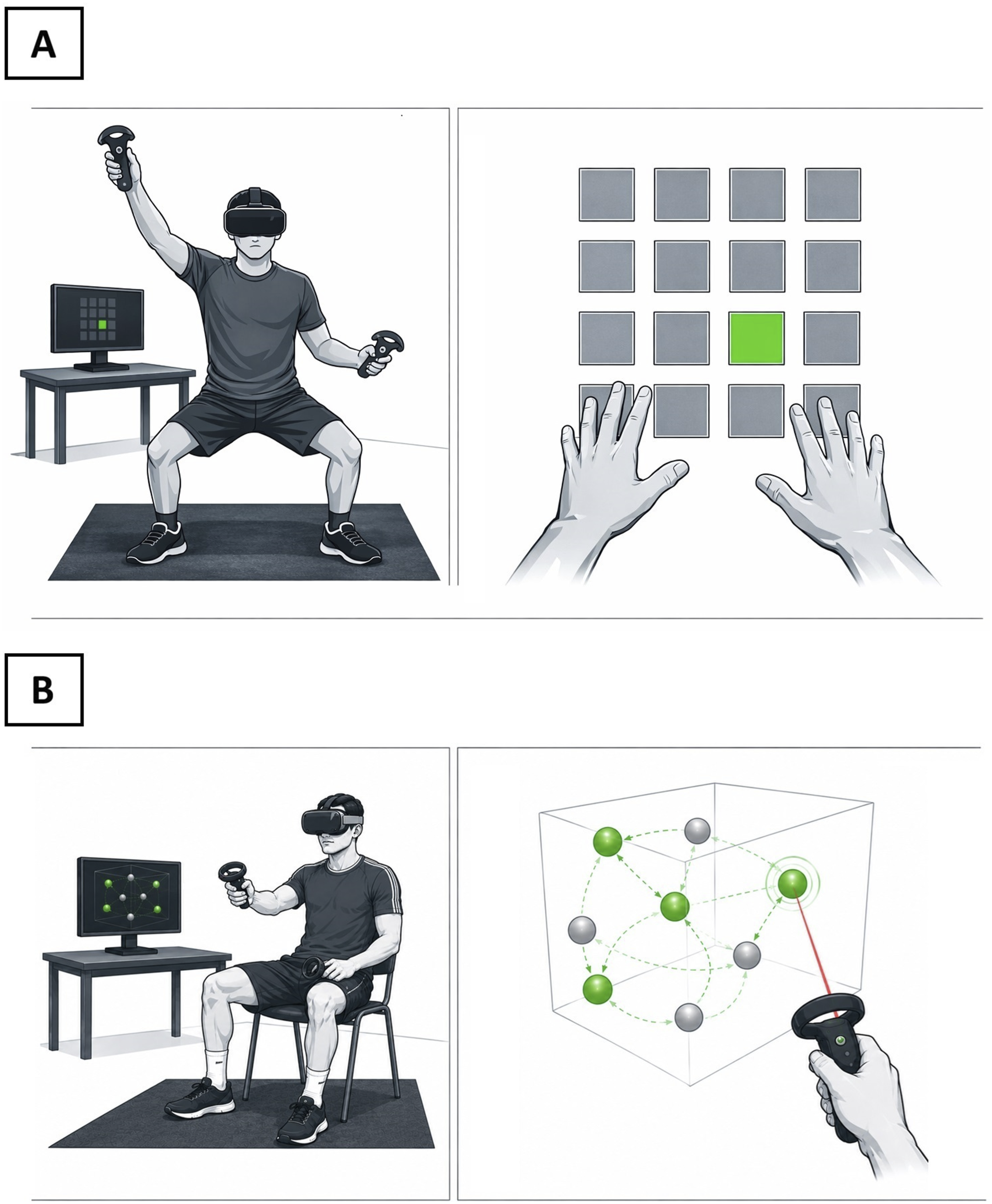
VR-CNS Sprint Software
VR-CNS Sprint assessed RT in response to visual targets appearing randomly in the field of view with a simple reaction-time paradigm. Stimuli were presented on a standardized virtual panel consisting of 16 target locations arranged in a 4 × 4 matrix. The panel size was selected according to the participant’s arm reach from three available options (extra small: 70 × 70 cm; small: 90 × 90 cm; medium: 120 × 120 cm). In the present study, the extra-small panel (70 × 70 cm) was used for all participants to ensure consistency across assessments.
The assessment comprised 96 trials (“hits”) separated by variable inter-stimulus intervals. Specifically, after each response the next target appeared following a random interval of 0.25, 0.50 or 1.00 s. Each target location was activated six times (16 × 6 = 96), and each inter-stimulus interval appeared 32 times, 2 times for each block (32 × 3 = 96). Responses occurring within <100 ms from target onset were classified as anticipations, whereas trials with no response within >2000 ms were classified as omissions. Both anticipations and omissions were automatically excluded from the RT computation and subsequent analyses by the software.
During VR-CNS Sprint participants, after wearing the head-mounted display and holding a controller in each hand, adopted a standardized “power position” to be ready to respond (knees flexed, trunk slightly inclined forward, elbows flexed at ∼90°, with the arms slightly abducted from the trunk). In the VR scene, they faced a 4 × 4 grid of 16 grey cubes. On each trial, one cube randomly turned green (target onset), and participants were instructed to respond as quickly as possible by reaching and “touching” (hitting) the illuminated cube with a full arm extension movement initiated from the power position. To standardize limb selection, targets appearing in the eight cubes on the participant’s right side had to be contacted with the right hand/controller, whereas targets appearing in the eight cubes on the left side had to be contacted with the left hand/controller. RT was defined as the interval between the onset of the green target and the moment the target was contacted by the controller. The software provided three RT outcomes from the same assessment: overall RT (computed across all trials), right-arm RT (trials requiring a right-hand response), and left-arm RT (trials requiring a left-hand response). Based on each participant’s reported sport-specific dominance, right- and left-arm RTs were then re-labelled as dominant- and non-dominant-limb RT for the subsequent analyses.
VR-Brain Tracker Software
Visual dynamic attention was assessed using the VR-Brain Tracker software based on Multiple-Object Tracking (MOT) task (Pylyshyn & Storm, 1988). The test consisted of 20 trials performed within a virtual cubic space in which eight spheres were displayed. At the start of each trial, four spheres were randomly designated as targets by briefly illuminating green for 3 s. After this cueing phase, all spheres returned to the same appearance and moved within the cube for 7 s along varying trajectories at the initial speed of 244 cm/s. At the end of the movement period, the spheres stopped and participants were asked to identify the four target spheres previously highlighted in green by selecting them using the hand controllers of the dominant hand.
Task difficulty was adaptively adjusted across trials by modifying sphere speed: correct identification of all targets increased movement speed on the subsequent trial, whereas one or more errors resulted in a reduction in speed. The software provided an Attentional Index (AI) as the primary outcome measure (baseline value = 1.2 corresponding to 244 cm/s sphere speed), with higher AI scores indicating better visual dynamic attention. The AI was derived using a staircase procedure, which aims to keep task difficulty close to the participant’s threshold by decreasing the signal level after correct responses and increasing it after incorrect responses. In the present study, staircase adjustments used an asymmetric rule (+1 step after incorrect trials; −1.5 steps after correct trials). The MOT assessment was administered with participants seated on a chair. Participants remained stationary throughout the task and interacted with the stimuli exclusively via the hand controllers.
Statistical Analysis
Descriptive statistics were first computed for all variables, expressed as mean ± standard deviation (SD), median, 95% confidence intervals (CI) and quartiles (25%–75%). Shapiro–Wilk tests confirmed that RT and attentional index were normally distributed whereas the percentage delta (Δ%) variable was non-normally distributed. The Δ%, an index calculated as the percentage difference in RT between the dominant and non-dominant upper limb, was calculated as: ((non-dominant limb – dominant limb)/non-dominant limb) × 100 (Parkinson et al., 2021).
Three main statistical analyses were then performed. The first was a mixed-design ANOVA with two factors: group (volleyball players vs. fencers) and hand dominance (dominant vs. non-dominant hand), treating hand data as paired. A Bonferroni-adjusted post hoc analysis was performed to examine inter- and intra-group differences. The second analysis employed a Mann-Whitney test to compare i) volleyball players vs. fencers and (ii) sexes based on the Δ%. The third analysis was the correlation between attentional index scores and overall RT. Given the normal distribution of the data, Pearson’s correlation coefficient was used. All statistical analyses were conducted using GraphPad Prism Software, version 8.0 for Windows (GraphPad Software, San Diego, CA), with the significance level set at p < 0.05. Effect sizes for pairwise comparisons were interpreted according to Cohen’s d: trivial (<0.20), small (0.21–0.60), moderate (0.61–1.20), large (1.21–2.00), and very large (>2.00) (Cohen, 1992).
Sample Size Estimation and Justification
A priori power analyses were conducted according to the statistical tests performed in the study. For the Two-Way ANOVA, an α level of 0.05, a power of 0.95 and a medium effect size (d) of 0.25 (according to the GPower software guidelines (Faul et al., 2007)) were selected, resulting in a required total sample size of 54 participants (27 for each group). With regard to the correlation test, an α level: 0.05, power: 0.80, effect size: 0.3 (according to the GPower software guidelines (Faul et al., 2007)) were selected. Based on these criteria, the final number of subjects required for the study was determined to be 84. Power analyses were conducted using GPower Software.
Results
Study Population
Eighty-five elite athletes participated, including 41 volleyball players (21 males, 25.4 ± 5.2 years; 20 females, 23.0 ± 5.8 years) and 44 épée fencers (23 males, 23.6 ± 4.4 years; 21 females, 24.3 ± 4.4 years). Hand dominance was predominantly right-handed: 40 volleyball players and 33 fencers; left-handed athletes included 1 volleyball player and 11 fencers. Self-reported general handedness (writing hand) fully coincided with sport-specific dominance in all participants (85/85; 100%), with no cases of discordance observed.
VR-CNS Sprint and VR-Brain Tracker
Comparison of Response Time and Attentional Index Across Sports Disciplines
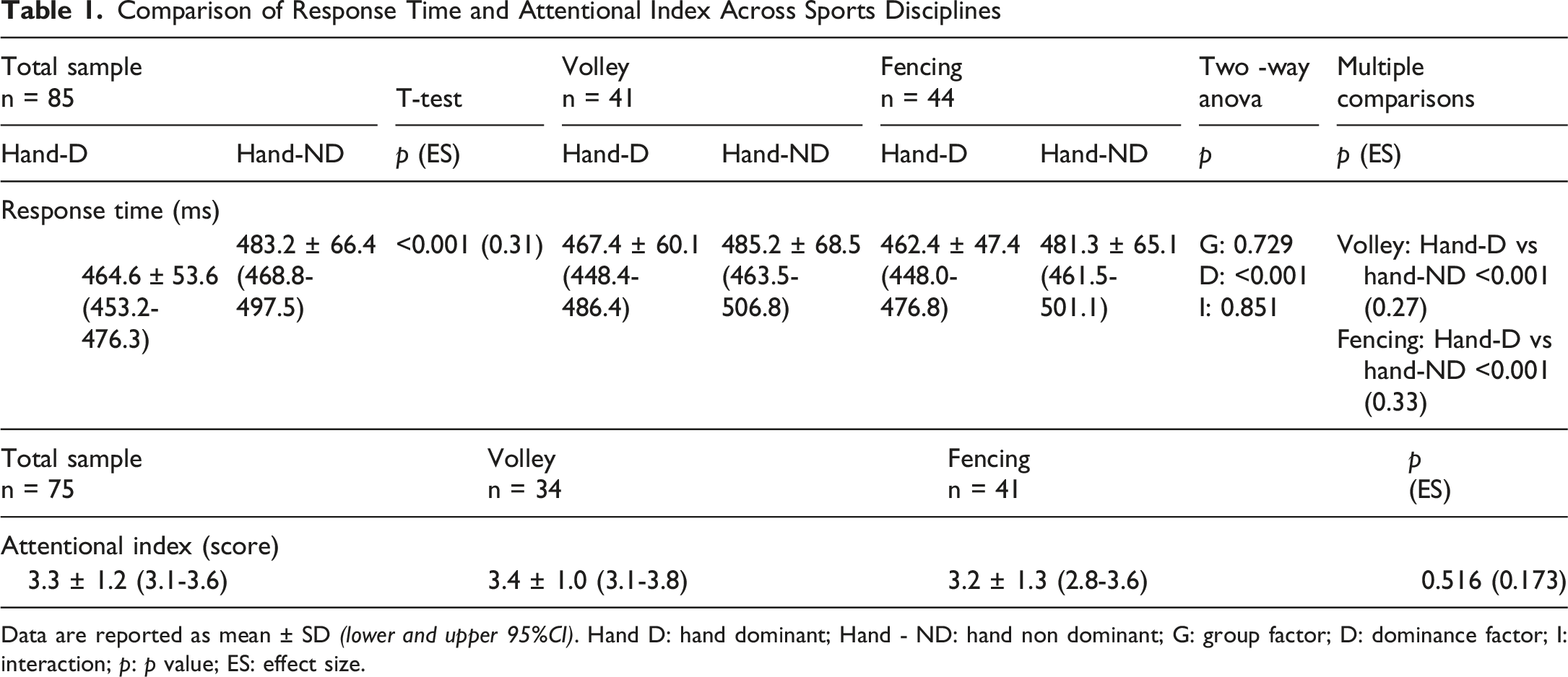
Data are reported as mean ± SD (lower and upper 95%CI). Hand D: hand dominant; Hand - ND: hand non dominant; G: group factor; D: dominance factor; I: interaction; p: p value; ES: effect size.
Although these differences were statistically significant, the corresponding effect sizes for dominant vs. non-dominant hand comparisons were small (Cohen’s d = 0.27–0.33), indicating that the magnitude of the dominance effect on RT was modest in this elite sample.
A subsequent analysis was conducted to evaluate potential differences between dominant and non-dominant hands across the two disciplines. The results indicated a median Δ% of 4.2 (25th – 75th percentiles: 0.47 – 5.68) in volleyball players and 3.0 (25th −75th percentiles: −0.56 – 7.52) in fencers, with no significant difference between groups (p = 0.775; ES = 0.028). Figure 2 shows the distribution of the asymmetry in RT between dominant and non-dominant hands in the two disciplines. Distribution of dominant-hand RT, non-dominant-hand RT, and RT asymmetry (Δ%) in volleyball players and fencers. Black lines indicate the median, and red lines represent the 25th–75th percentiles. Each point (volleyball player) or square (fencer) represents an athlete’s response time. RT: Response time. Panel (a): dominant hand response time; Panel (b): non-dominant hand response time; Panel (c): Δ% in response time between dominant and non-dominant hands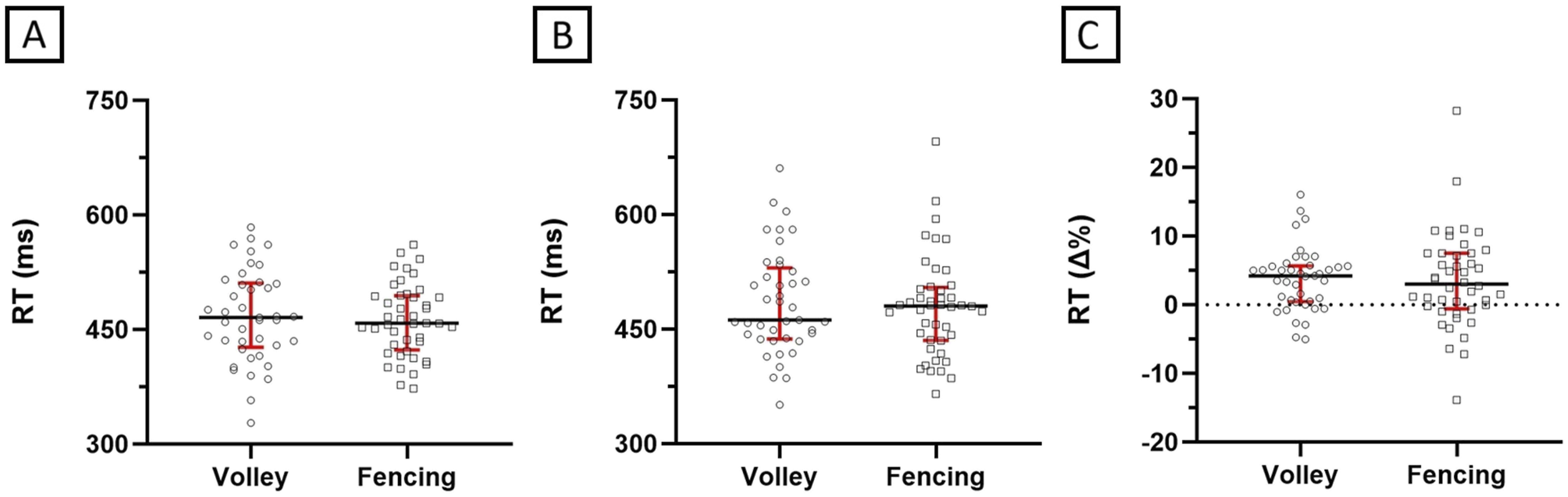
An additional analysis restricted to right-handed athletes was conducted to control for the unequal distribution of left-handers between groups. The Δ% in RT did not differ significantly between right-handed volleyball players (median: 4.4%; 25th–75th percentiles: 0.44–5.69) and right-handed fencers (median: 5.3%; 25th–75th percentiles: 1.12–8.40; p = 0.252).
To examine whether sex influenced lateral dominance, we compared the Δ% in RT between the non-dominant and dominant hand. No significant differences were observed between males and females (males: 3.91 ± 6.93%; females: 3.38 ± 4.64%; p = 0.718).
Correlations
To investigate the relationship between attentional performance and sensorimotor responsiveness, Pearson’s correlation analyses were conducted between attentional index scores and overall RT. Figure 3 presents the results of these analyses separately for volleyball players (Panel a), fencers (Panel b), and the combined sample (Panel c). Due to scheduling constraints typical of elite-level athletes, not all participants were able to complete the attention test, which required more time than the RT assessment. As a result, the correlation analyses included 34 volleyball players and 41 fencers. The results revealed a significant negative correlation in all three conditions. Specifically, in volleyball players, the correlation coefficient was r = −0.460 with p = 0.006; in fencers, r = – 0.418 with p = 0.007; and in the total sample, r = −0.432 with p < 0.001 (with a 95% confidence interval for the correlation ranging from −0.60 to −0.23). These findings suggest a consistent inverse relationship between attentional capacity and reaction latency across both groups. Correlation between AI and RT. AI: attentional index; RT: response time; p: p value; r: Pearson correlation coefficient. Panel (a): correlation between AI and RT in volleyball players; Panel (b): correlation between AI and RT in fencers. Panel (c): correlation between AI and RT in both volleyball players and fencers. Dashed lines represent the 95% confidence bands surrounding the regression line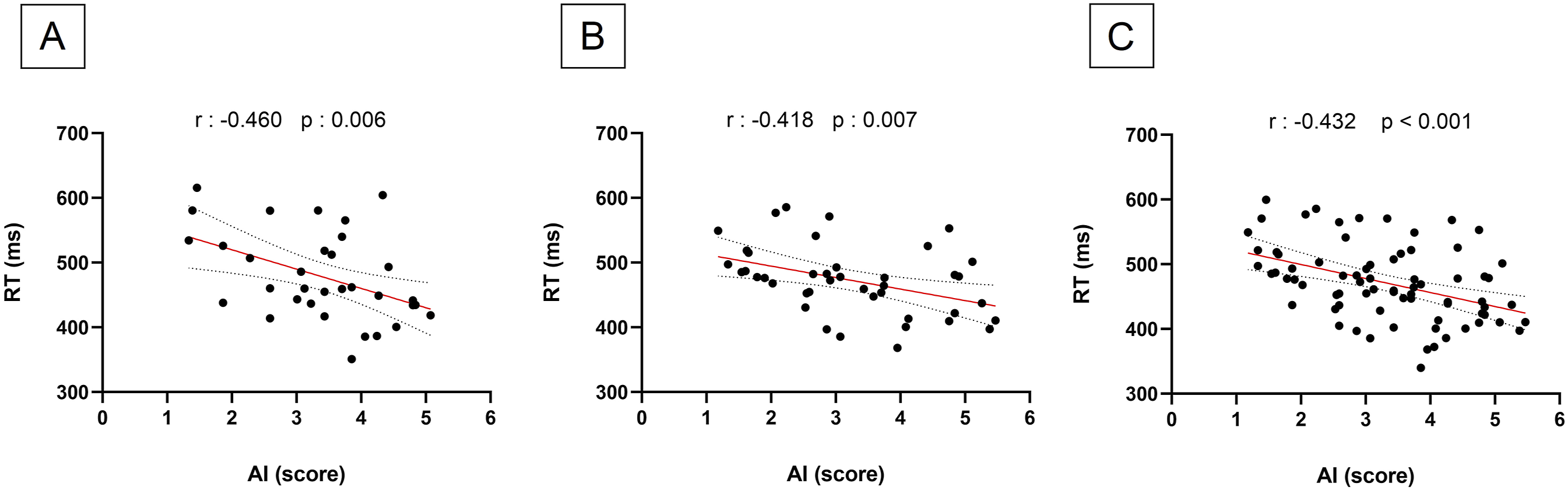
Discussion
This study investigated, with the use of VR, the differences in dynamic visual attention and RT between elite athletes in two distinct sports: volleyball and fencing. Our results partially confirmed the initial hypotheses: elite athletes exhibited faster RT with their dominant upper limb, and higher levels of dynamic visual attention were associated with faster RT. However, contrary to our expectations, the dominance effect was similar in fencers and volleyball players.
Previous literature has consistently shown that limb dominance is a key factor influencing RT, alongside variables such as sex, age, training experience, and the type of RT measured (simple vs. complex) (Badau et al., 2018, 2023; Bajkowski & Cynarski, 2024; Franco et al., 2024). Our results confirm that, across the entire sample and within both volleyball players and fencers, the dominant hand exhibited faster RT than the non-dominant hand. However, the effect sizes associated with these differences were small (Cohen’s d = 0.27–0.33), suggesting that, while statistically reliable, the impact of limb dominance on RT is modest in practical terms for elite athletes. These findings align with studies showing superior performance of the dominant hand in movement time (Dexheimer et al., 2022; Karim Chouamo et al., 2021), likely due to the structural and functional hemispheric differences, especially in right-handers, who represent approximately 90% of the population (Coren & Porac, 1977). Research has shown that the grey matter volume of the central sulcus is greater in the left hemisphere than in the right (Hervé et al., 2005), the motor cortical representation in the left hemisphere is larger (Volkmann et al., 1998), and the right corticospinal tract is correspondingly more prominent (Kertesz & Geschwind, 1971). Moreover, the motor cortices in the left hemisphere exhibit higher excitability than those in the right, as evidenced by their lower activation threshold during transcranial magnetic stimulation (Ilic, 2004; Triggs et al., 1994, 1997). A key question remains the extent to which this hemispheric asymmetry translates into performance differences, and whether training modality, quantity, and quality can modulate this effect, with the hypothesis that elite athletes may exhibit distinct dominance-related patterns compared to amateurs or sedentary individuals (Piatysotska et al., 2023a, 2023b; Wolf et al., 2015). Interestingly, limb-dominance differences emerged not only in fencing, where strong lateralization is expected due to unilateral weapon-hand actions, but also in volleyball, which is often described as relatively more bilateral. From an applied perspective, these findings indicate that limb dominance may contribute to RT performance, but the small effect sizes observed suggest that its practical impact on high-level performance is likely limited and should be interpreted with caution. This finding may reflect the fact that, despite the sport’s substantial bilateral demands (e.g., reception, setting, blocking, and defensive actions), volleyball also includes performance-critical skills with a pronounced unilateral character, such as serving and spiking, which can reinforce lateralized motor patterns. Therefore, despite elite athletes’ specialization and training, dominance may still influence motor response efficiency in tasks requiring rapid upper-limb reactions, including sports with comparatively balanced training demands.
In addition, we quantified limb dominance asymmetries to explore potential disparities between sports, anticipating that they might be more pronounced in fencing than in volleyball given the strongly unilateral demands of the discipline. However, Δ% between dominant and non-dominant hands did not differ significantly between volleyball players and fencers. One possible explanation for the absence of a significant result could be the composition of our sample, particularly the higher number of left-handed fencers (11) compared to only one left-handed volleyball players. Literature suggests that left-handers tend to develop reduced lateralization, partly because they operate in a predominantly right-handed world and thus frequently engage their non-dominant hand (Przybyla et al., 2012; Witkowski et al., 2020). Moreover, evidence points to neurobiological and developmental factors, such as greater interhemispheric connectivity and more variable brain asymmetries, which further contribute to a smaller gap between dominant and non-dominant hands (Rogers, 2024). This reduced lateralization may have attenuated the expected dominance effect in fencing. To address this potential limitation, we performed an analysis restricted to right-handed athletes only. The Δ% in RT remained comparable between right-handed volleyball players (median: 4.4%; 25th–75th percentiles: 0.44–5.69) and right-handed fencers (median: 5.3%; 25th–75th percentiles: 1.12–8.40; p = 0.252), indicating that the main conclusion of the study was not affected by the imbalance in handedness distribution. Additionally, although volleyball is often considered a relatively symmetrical sport, several key technical actions—such as spiking and serving—are inherently unilateral and repeatedly performed with the dominant arm. These sport-specific constraints may promote lateralized motor adaptations, potentially reducing the contrast with fencing and contributing to the similar inter-limb differences observed between groups. Another possible explanation could be that elite athletes, through extensive and specialized training, develop adaptations that minimize differences between dominant and non-dominant limbs, even in sports that are typically asymmetric. Future research should compare right- and left-handed athletes to clarify these patterns, with the expectation that right-handers show stronger lateralization, while left-handers exhibit reduced inter-limb differences. These findings also support the potential benefits of incorporating bilateral training in both disciplines, particularly volleyball, to further enhance overall performance.
Consistent with prior research (Aydın et al., 2024; Huerta Ojeda et al., 2022; Hülsdünker et al., 2018, 2019; Reigal et al., 2019), our findings revealed an inverse correlation between attentional index and hand-eye RT across the total sample, as well as within both volleyball and fencing athletes. Specifically, higher attentional scores correlated with shorter RT, supporting the idea that enhanced attention improves RT. This may reflect more efficient cognitive resource allocation, enabling faster visuo-motor integration and quicker motor response selection. Previous research has shown that RT, particularly visual–motor RT, depends heavily on the efficiency of perception and processing within the brain’s visual-movement system when responding to visual stimuli (Hülsdünker et al., 2019). Limited attentional capacity may therefore impair the ability to focus, prioritize relevant information, and inhibit irrelevant inputs, ultimately slowing down response execution (VencesBrito et al., 2012). Taken together, these findings contribute to the growing body of literature emphasizing the multidimensional nature of sports performance, where physical abilities interact with cognitive and attentional factors. In this regard, attentional indices may serve as useful markers for profiling athletes’ cognitive readiness, monitoring training effects, and even predicting performance in competitive scenarios (Faubert & Sidebottom, 2012; Harenberg et al., 2022; Memmert et al., 2009; Vestberg et al., 2012).
One limitation of this study is that, for the correlation analyses, the required sample size was not fully reached because some athletes, due to high-level commitments, were unable to complete the attention assessment, which required more time than RT tests. The reduced sample in the correlation tests (n = 75) may have decreased the statistical power, potentially limiting the sensitivity to detect weaker associations. Although the correlations observed were statistically significant and aligned with previous literature, the 95% confidence interval for the total-sample correlation (r = −0.432; 95% CI: −0.60 to −0.23) indicates moderate uncertainty around the exact strength of the association. Moreover, although both groups consisted of elite Italian athletes, the sample included only volleyball players and épée fencers, which restricts the generalizability of the findings. Despite these limitations, the use of a VR system represents a major strength, as it provides a more ecological and advanced tool than most traditional laboratory methods, serving as a bridge between controlled experimental tasks and sport-specific contexts. To our knowledge, no previous study has assessed these abilities in professional athletes using VR, supporting the validity of this approach and offering an innovative perspective for future research.
Our findings highlight the combined influence of limb dominance on RT performance, indicating that dominance effects in RT remain detectable in elite athletes, although their magnitude is small, and should therefore be interpreted with careful consideration. Similarly, the association between attentional index and reaction time reflects a correlational relationship rather than a causal one. These results suggest that a portion of training could be dedicated to developing RT skills in both hands, with particular focus on the non-dominant hands, especially in symmetrical sports that require proficiency with both limbs. In volleyball, where both arms contribute substantially to technical actions, incorporating bilateral RT training may help optimize performance and reduce functional imbalances. Conversely, in sports characterized by highly unilateral motor patterns, such as fencing, the relevance of bilateral RT training may be more limited, and interventions might instead be tailored to the specific demands of the dominant limb. Considering the relationship between dynamic visual attention and RT is especially relevant in sports contexts involving rapid decision-making under dynamic conditions. Decision-making in sport is closely tied to attentional control, which enables athletes to filter relevant stimuli and respond effectively under pressure. Our results reinforce the idea that attentional training could be a valuable component in optimizing RT, even among elite athletes. Although VR offers a more naturalistic visuomotor context than traditional 2D screen-based paradigms, its ecological validity depends on the specific task implemented. In our protocol, the tasks did not consist of a simple button-press in response to a visual stimulus: participants were required to physically reach and ‘hit’ spatially distributed targets using both hands while holding the controllers within a stereoscopic, depth-based 3D environment. This setup engages visuomotor processes such as depth perception, spatial localization, arm extension, and hand–target interception, making it more representative of real-world visuomotor demands than conventional laboratory tasks. However, despite these advantages, the task does not replicate the complex, whole-body actions typical of real fencing or volleyball performance. The ongoing evolution of immersive technologies is likely to support the adoption of increasingly sport-specific virtual environments, enabling the recreation of realistic competitive scenarios tailored to each discipline. Such ecologically valid settings may enhance the sensitivity of VR-based assessments and provide a more accurate representation of sport-specific perceptual–motor demands. Future research should also consider additional factors that may influence lateralized perceptual–motor performance. In particular, ocular dominance and potential cross-dominance (e.g., right-hand dominant but left-eye dominant) may represent relevant variables in sports that strongly rely on spatial perception and visuomotor integration, such as fencing and volleyball. Assessing these characteristics could provide a more comprehensive understanding of individual lateralization profiles and their functional implications.
Footnotes
Acknowledgments
This work was supported and funded by the Italian Ministry of Health, “Ricerca Corrente”.
Ethical Considerations
The study protocol was approved by the University’s Ethics Committee (ref. n.:126/23) and conducted at the Università degli Studi di Milano (Milan, Italy).
Funding
The authors disclosed receipt of the following financial support for the research, authorship, and/or publication of this article: The study was supported by the Italian Ministry of Health (Ricerca Corrente).
Declaration of Conflicting Interests
The authors declared no potential conflicts of interest with respect to the research, authorship, and/or publication of this article.
Data Availability Statement
Disclosure of AI Use
Artificial intelligence (ChatGPT, https://chatgpt.com/) was used for the generation of the representative illustration ( ).
).