







Abstract
Recently, the use of different forms of Artificial Intelligence (AI) have been highlighted in second/foreign language (L2) education. However, the psycho-affective consequences of using such tools for a long period of time have received insufficient scholarly attention. To address this gap, the present research aimed to examine the impact of prolonged AI adoption on English as a foreign language (EFL) students’ emotional engagement and perceptual skills. It employed a qualitative design using semi-structured interviews with 57 Chinese students. The results of manual thematic analysis revealed eight ways in which AI adoption could affect the participants’ emotional engagement and perceptual skills. Particularly, it was found that by increasing intrinsic motivation and academic interest, enhancing autonomy and confidence, reducing negative emotions, and increasing emotional safety the prolonged use of AI could positively affect students’ emotional engagement. Furthermore, the students declared that their perceptual skills could develop by prolonged AI adoption through the capacity of such tools in increasing phonological awareness, fostering multisensory learning, facilitating lexical-structural recognition, and enhancing auditory-visual decoding skills. The study discusses the obtained outcomes and provides practical implications for L2 educators and educational policymakers regarding the contributions of AI-mediated education to learners’ psycho-affective factors.
Introduction
The rapid expansion of artificial intelligence (AI) in language education has generated extensive scholarly attention, with research consistently demonstrating its capacity to enhance instructional quality, learner engagement, and pedagogical innovation (Derakhshan & Park, 2026a, 2026b; Pan & Wang, 2025; Stockwell, 2024; Wang, 2026; Wang & Xue, 2024; Wu & Wang, 2025; Zare et al., 2025). AI-mediated environments offer personalized learning pathways, abundant linguistic input, immediate feedback, and diverse communicative tasks that align with learners’ needs and preferences (Derakhshan & Li, 2026; Fryer et al., 2020; Guo et al., 2023; Pan & Wang, 2025; Park & Derakhshan, 2026; Wang & Shi, 2026). Tools such as chatbots and multimodal systems provide authentic interaction and support the development of various language skills and subskills (Kartal & Yeşilyurt, 2024; Zare et al., 2025). AI integration also strengthens learner autonomy and engagement by enabling flexible access to instructional content and several task types (Dai & Liu, 2024; Huang et al., 2023; Wang et al., 2026; Xin & Derakhshan, 2025). Beyond cognitive and behavioral dimensions, AI may influence the emotional experiences of both teachers and learners, shaping how they respond to and participate in language learning processes (Wang & Wang, 2026; Zhang & Derakhshan, 2025).
Despite the growing interest in AI contributions, the influence of AI technologies on a wide range of emotional dimensions in language learning remains largely underexamined. One salient example is learners’ emotional engagement, widely recognized as a core component of overall academic engagement (Reeve & Tseng, 2011). Emotional engagement, which reflects learners’ affective responses to instructional activities and learning environments, plays a pivotal role in sustaining motivation, deepening cognitive involvement, and supporting overall engagement (Bond & Bedenlier, 2019; Huang et al., 2022; Sulis, 2022; Wang & Wang, 2026). Emotional engagement is distinct from other dimensions of student engagement in the sense that its focus is solely on one’s affect and affective reaction to a practice or event.
With the rise of AI-enhanced instruction, scholars have increasingly examined how AI tools influence engagement, reporting improvements in emotional well-being, social-emotional competencies, and engagement across various EFL contexts (Liu & Chang, 2024; Liu et al., 2024; Wang & Hui, 2024; Wu & Yang, 2025; Zhang et al., 2023). Yet, despite evidence that AI can foster emotional engagement, research specifically addressing how AI tools shape this dimension of engagement remains limited (Wang et al., 2024; Zhai et al., 2025).
At the same time, perceptual skills have been largely overlooked in the context of AI-mediated language instruction. Perceptual skills refer to learners’ ability to interpret, evaluate, and organize sensory and linguistic information, enabling them to make sense of auditory, visual, and textual input during language learning (Stokes & Nanay, 2020). In L2 contexts, these skills underpin essential processes such as reading comprehension, writing development, speech production, and interactional competence (Eickhoff, 2025; Lai & Leung, 2012). They involve capacities such as auditory discrimination, visual recognition, spatial awareness, and lexical–grammatical sensitivity, all of which support effective engagement with AI-generated language content. Although perceptual skills are dynamic and can be strengthened through targeted instructional practices (Inceoglu, 2016; Lee & Lyster, 2016; Sakai & Moorman, 2018), their relationship with AI-mediated EFL learning remains largely underexplored in current research.
Collectively, despite AI advancements, two critical gaps remain in the literature. First, emotional engagement within AI-supported EFL learning environments has not been sufficiently examined. Second, the influence of AI technologies on EFL learners’ perceptual skills is an uncharted territory. More importantly, no empirical research has explored how learners perceive changes in their emotional engagement and perceptual skills after extended use of AI tools. To address these gaps, the present qualitative study investigates Chinese EFL students’ perceived changes in emotional engagement and perceptual skills following prolonged interaction with AI-mediated technologies. In so doing, we draw on two frameworks, namely control–value theory (CVT) of Pekrun (2006) and the technology acceptance model (TAM) of Davis et al. (1989). CVT proposes that individuals’ emotional experiences during a task are shaped by their appraisals of the task’s value, controllability, and perceived affordances (Pekrun, 2006). TAM, as the second theoretical foundation, explains how users come to accept and engage with new technologies based on their perceptions of usefulness and ease of use. TAM has been widely applied to examine factors influencing individuals’ responses to AI-mediated tools (e.g., Yang & Rui, 2025; Yao & Wang, 2024). Guided by these frameworks, it is assumed that when students perceive AI technologies as valuable, manageable, beneficial, and user-friendly, they are more likely to engage with them both emotionally and perceptually. The findings of this study will deepen EFL teachers’ understanding of how sustained AI use shapes affective and perceptual dimensions of language learning.
Literature Review
AI Adoption and EFL Education: Emotional Consequences in Focus
There has been a growing number of studies on AI integration in language education, demonstrating a wide range of affordances that enhance both teaching and learning processes (Derakhshan et al., 2026; Derakhshan & Lalli, 2025; Kohnke et al., 2023; Solhi et al., 2026; Wang et al., 2025; Wang & Guo, 2026; Wang & Xue, 2024). A growing body of evidence highlights AI’s central role in advancing language education (Wang et al., 2026; Wang & Gao, 2026; Zhou & Hou, 2024), particularly through its capacity to tailor instruction to learners’ diverse needs and preferences by enabling personalized learning processes. AI-supported learning contexts also provide abundant linguistic input, immediate feedback, and varied communicative tasks (Fryer et al., 2020; Guo et al., 2023; Liu, 2026). Notably, AI-driven chatbots offer authentic language exposure by engaging learners in interactive dialogues (Kartal & Yeşilyurt, 2024), and multimodal tools such as ChatGPT are reported to support the development of a wide range of language skills and subskills (Zare et al., 2025). Furthermore, AI integration enhances learner autonomy by allowing unrestricted access to educational content across time and space (Huang et al., 2023) and can increase learner engagement through diverse task types (Dai & Liu, 2024). Beyond cognitive and behavioral dimensions, AI also shapes the emotional experiences of both teachers and learners (Du & Yang, 2025; Guo & Wang, 2024; Wang, 2026; Wang & Derakhshan, 2025; Yang & Yang, 2025; Zong & Yang, 2025).
With AI technologies becoming increasingly integrated in educational contexts, a substantial body of research has been conducted on diverse aspects of AI-mediated language instruction. Very recently, emotional states of L2 educators in AI-mediated contexts have been the focus of empirical studies (Qin & Derakhshan, 2026a). It has also been found that AI adoption, in under-resourced contexts, leads to psychological needs satisfaction and frustration depending on how AI tools are implemented (Derakhshan & Park, 2026a). It has also been reported that despite the increasing attention to AI tools by L2 teachers and learners, there is still a sense of reluctance to practically use them in EFL classes and they prefer to stay within their comfort zone. To unveil the emotional consequences of AI adoption, in their recent study, Derakhshan and Park (2026b) explored how multimodal AI tools shape EFL learners’ positive and negative achievement emotions through the lens of existential positive psychology. The findings demonstrated that multimodal AI tools exerted a significant influence on learners’ emotional experiences, enhancing positive achievement emotions while simultaneously reducing negative emotions such as boredom. In another study, Zare et al. (2025) examined the impact of ChatGPT on 60 EFL learners’ engagement and writing performance over a two-month period. Quantitative results revealed that learners in the experimental group exhibited higher levels of engagement during the writing process. Additionally, qualitative analyses identified several themes, including increased motivation, reduced anxiety, heightened interest, a sense of partnership, individualized feedback, and improved perceptions of competence. Derakhshan and Taghizadeh (2025) investigated L2 learners’ perceptions of the influence of AI on their higher-order thinking skills. The findings indicated that AI use can both support and hinder the development of higher-order cognitive abilities. While learners acknowledged the benefits of AI for enhancing certain aspects of critical and analytical thinking, the study also cautioned that excessive reliance on such tools may diminish learners’ capacity to independently evaluate and analyze information. However, many other dimensions of language education remain underexplored in the context of AI inclusion. Studies on the linkage of AI and emotions are limited to a specific list of positive and negative emotions. Yet, how AI adoption affects perceptual skills and a particular dimension of student engagement (i.e., emotional engagement) rather than overall engagement is missing in the literature.
Student Emotional Engagement: Conceptualization and Research Evidence
Engagement is widely considered as a multidimensional construct that reflects learners’ active participation in the learning process (Fredricks et al., 2019). Early conceptualizations considered engagement as behavioral and emotional components (Finn, 1989). Connell and Wellborn (1991) later expanded this view by introducing cognitive engagement to elucidate students’ mental effort and depth of learning. Building on this three-part model, Reeve and Tseng (2011) proposed a fourth dimension, agentic engagement, to highlight learners’ proactive contributions to shaping their own learning experiences. Together, these four dimensions of behavioral, emotional, cognitive, and agentic form the current understanding of student engagement. Behavioral engagement refers to learners’ observable efforts, persistence, and attentiveness during academic tasks (León et al., 2015). Cognitive engagement captures students’ psychological investment in learning, including their use of self-regulation and metacognitive strategies as well as their willingness to tackle challenging material (Fredricks et al., 2004; Manwaring et al., 2017). Agentic engagement reflects learners’ intentional efforts to shape and enrich their own learning experiences (Bandura, 2018; Reeve, 2012). Emotional engagement encompasses the affective responses students display during learning or interactions with peers, teachers, and the broader educational environment, ranging from positive feelings such as interest and belonging to negative reactions such as boredom (Bond & Bedenlier, 2019). These four dimensions are interconnected and collectively contribute to improved academic outcomes.
With the emergence of advanced technologies such as AI, recent research has increasingly emphasized their role in fostering student engagement, indicating that responsive support and personalized education based on learners’ needs can enhance EFL learners’ engagement (Liu & Fan, 2026; Zong & Yang, 2025). A growing body of empirical work has examined different facets of AI integration and its relationship with engagement. For example, Zhang et al. (2023) explored the combined effects of gamification and AI in EFL contexts and reported positive associations among well-being, heightened engagement, and academic performance. Similarly, Wang and Hui (2024) demonstrated that AI tools contribute to the creation of engaging learning environments, improving learners’ emotional well-being and engagement levels. Liu et al. (2024) found that AI-supported social-emotional learning strengthened EFL students’ engagement and academic outcomes. Likewise, Liu and Chang (2024) showed that AI-driven learning analytics can enhance social competencies and emotional engagement. Additionally, Zong and Yang (2025) reported that AI-based social-emotional learning interventions boosted both learners’ well-being and their emotional engagement.
Among diverse components of engagement, emotional engagement plays a crucial role in shaping learners’ academic performance (Huang et al., 2022). Enhancing students’ emotional engagement has been shown to positively influence their behavioral and cognitive engagement as well (Sulis, 2022). Notably, scholars have remarked that emotional engagement receives heightened attention in technology-enhanced learning environments (Gao et al., 2020; Halverson & Graham, 2019). Teachers can foster this form of engagement by creating supportive and positive learning contexts within technology-mediated instruction (Liu & Zhou, 2024). Li et al. (2025) further demonstrated that AI technologies can strengthen behavioral, cognitive, and emotional engagement, with learners experiencing a range of emotions during AI-mediated activities that directly affect their engagement. Given that emotional engagement is deeply intertwined with overall engagement (Martucci et al., 2025), examining learners’ emotional responses in AI-supported pedagogy becomes essential. The capacity of AI systems to detect and respond to learners’ emotional states may offer new avenues for enhancing emotional engagement (Yang & Rui, 2025). However, despite the evidence of improved motivation and emotional engagement in AI-mediated learning, there is still lack of research exploring the role of AI tools in enhancing the emotional engagement of learners, as a single variable rather than in conjunction with other dimensions of learner engagement (Qin & Derakhshan, 2026b; Wang et al., 2024; Zhai et al., 2025).
Student Perceptual Skills
It is widely endorsed in the literature that learning depends on several learner abilities including perceptual skills, which refer to one’s cognitive capacity in interpreting, understanding, evaluating, and organizing information received from the environment (Stokes & Nanay, 2020). Such skills are essential for detecting and understanding relationships among variables that foster daily performance and learning (Cesur & Akyol, 2021). Perceptual skills are important in L2 education, especially reading and writing skills (Eickhoff, 2025; Hatami, 2018; Thuketana & Makgabo, 2022). Yet, interactional skills and speech production are by no means detached from perceptual skills (Lai & Leung, 2012; Lee & Park, 2020). Through perceptual skills, students can analyze sensory information and assign meaning to stimuli (Jacobs & Michaels, 2007). As noted in prior studies, perceptual skills involve visual, auditory, tactile, kinesthetic, and spatial awareness. Perceptual skills, namely auditory processing, spatial awareness, and tactile perception allow students to learn and to engage with their environment and educational materials more effectively. Strong perceptual skills facilitate the ground for an improved learning performance and cognitive functioning (Kellman & Massey, 2013; Man et al., 2025). Perceptual skills may develop in socio-cultural context implicitly without conscious attention (Munton, 2019; Shmuelof & Krakauer, 2014). A venue in which perceptual skills may go through changes is AI-mediated L2 education as an emerging instructional approach (Sakai & Moorman, 2018). The capacities of AI technologies can shape EFL students’ perceptual and academic abilities in various ways (Derakhshan & Ghiasvand, 2024). Yet, such connection has scarcely received empirical attention in EFL contexts. In the context of this study, then, perceptual skills are operationally defined as EFL learners’ ability to accurately perceive and understand AI-generated language contents, including speech, feedback, and visual-textual input. Such skills are manifested in learners’ ability to understand and discriminate auditory, visual, lexical, and grammatical inputs in spoken and written language produced by AI tools.
In light of perceptual skills, students can make quick decisions during their education and act effectively, flexibly, and sensibly in critical moments (McDonic et al., 2025). Perceptual development is the outcome of learners’ sensory development and understanding of the world around them (Goldstone, 1998; Stokes & Nanay, 2020). It is believed that learners’ perceptual skills are dynamic and changeable in case targeted practices and training courses are provided by teachers in the classroom (Inceoglu, 2016; Lee & Lyster, 2016; Sakai & Moorman, 2018). So, by raising learners’ AI literacy and readiness, teachers can develop perceptual skills. However, this line of thinking has received scarce attention, to date. Most of the existing studies are limited to the conceptualization or measurement of perceptual skills and their mechanism in mathematics and sports education (e.g., Cesur & Akyol, 2021; Kapidis et al., 2024; McDonic et al., 2025; Naderi et al., 2018). Nevertheless, the interplay of AI and perceptual skills in the context of L2 education has been largely overlooked in the literature.
Taken together, the reviewed studies indicate that emotional engagement within AI-mediated EFL learning environments remains insufficiently examined. Moreover, the influence of AI technologies on EFL learners’ perceptual skills has been underexplored, to date. More importantly, learners’ emotional engagement and perceptual skills may shift over time as they continue to use AI tools. Yet, to date, no empirical research has examined how EFL learners themselves perceive these changes after extended engagement with such technologies. To address these research gaps, this qualitative study draws on two well-known theoretical foundations in researching AI-related emotions and behaviors, namely CVT of emotions (Pekrun, 2006) and TAM (Davis et al., 1989). CVT considers one’s emotions and behaviors as outcomes of his/her appraisal of a task’s value and controllability. TAM, on the other hand, regards the usefulness and affordability of using a technology as shaping factors of its acceptability by users. In view of these conceptualizations, this study aims to inspect EFL learners’ perceived changes in emotional engagement and perceptual skills after the prolonged use of AI-mediated tools. The study intends to answer the following research question: (1) How does the prolonged use of AI technologies influence Chinese EFL students’ emotional engagement and perceptual skills?
Method
Participants and Context
A sample including 57 Chinese EFL students were recruited through convenience sampling to explore their perceived changes in emotional engagement and perceptual skills following prolonged use of AI-based tools. Eligibility criteria required participants to be university students aged 18 or above who were currently enrolled in English-related programs or courses and had sustained experience using AI-assisted tools (e.g., AI writing assistants, translation tools, conversational agents) in their English learning practices. Students without prior exposure to AI-based learning tools or those below the age of 18 were excluded, as they would be unable to provide informed reflections aligned with the research focus. The age of the students varied from 18 to 28 years old. There were 25 males and 32 females in the sample. Their self-reported AI literacy levels were basic (5), moderate (9) and high (43). They claimed to be using AI tools every day over the past two years. The students were upper-intermediate English speakers. Their native language was Chinese.
Instrument
A semi-structured interview was used as the source of data collection in this study. It was carried out virtually using ‘WeChat’ platform during non-instructional times. The interview included a demographic part followed by four open-ended questions about learners’ AI usage and experiences (Appendix). Prompts focused on how AI adoption could affect learners’ emotional engagement and perceptual skills after prolonged uses. The language of interviews was English given the students’ preference and proficiency level. Each interview took 30 minutes and audio-recorded through a smart voice recorder.
Data Collection Procedure
In this study, first, the interview questions were developed in line with the goal of the study. Then three experts with Ph.D. degrees in applied linguistics were invited to review the instrument in a week. They were experienced in qualitative research and content validity check of L2 education research tools. They recommended some comments to refine the items and improve clarity, reduce ambiguity, and ensure alignment with the study’s objectives. Then through university communication channels and social media platforms, EFL learners with experiences of using AI-based tools were targeted. After two weeks, 57 students agreed to participate in the study. They reviewed and signed an informed consent form before attending the interviews, confirming their understanding of the research purpose, confidentiality measures, and their right to withdraw at any time. The time of the interviews was discussed and scheduled with all students. The interviews were conducted in a friendly atmosphere. The interviewees were inspired to explain their views as much as possible to gain a rich dataset. Practical examples of using AI tools and their impacts on learners’ emotions and skills were requested. The interview questions were flexibly posed rather than following a fixed format. However, an identical protocol was used to run all the interviews. After collecting all the data, the students were given gift cards as an appreciation of their cooperation. The data were transcribed and put in an Excel file for qualitative analysis, as explained below.
Data Analysis
The thematic analysis model proposed by Braun and Clarke (2006) was used in this study. First the interview audios were carefully transcribed word by word. The transcription was done manually with the help of three MA students. The transcriptions were then sorted based on interview questions and the assigned number of the participant in the sample. Then the coding process began by reading the transcriptions a couple of times to get familiar with the overall perceptions. Relevant parts of responses were underlined to be used in later coding. We went back and forth reading and reviewing the transcripts. Afterwards, initial codes were created from underlined parts of the responses. A table was drawn to codify the data in which the themes, frequencies, and sample excerpts were shown. The preliminary codes were combined to generate themes. The analysis led to eight themes out of 18 initial codes. The themes were then reviewed in terms of reliability and content validity. An external expert did this part of the study. Next, the themes were refined once more and labels were given to each of them based on the research question. Finally, the results of the thematic analysis were reported.
To ensure trustworthiness of the study, we asked the students to review and check the extracted themes. This could establish credibility. Likewise, another researcher examined all the stages of the analysis in an auditing process that secured confirmability. Dependability of the themes was ensured by asking a second-coder to re-code the interview data. An agreement index of .79 was obtained that is acceptable. Disagreements were resolved in a face-to-face meeting with the second-coder, who was a university professor in China. Principle of transferability was taken into account using thick description. Every step and detail of the study was explained in the methodology section. Finally, the researchers remained neutral and outsiders in the data analysis process. Such positionality could leave the data unbiased.
Findings
The Impacts of Prolonged AI Adoption on EFL Students’ Emotional Engagement
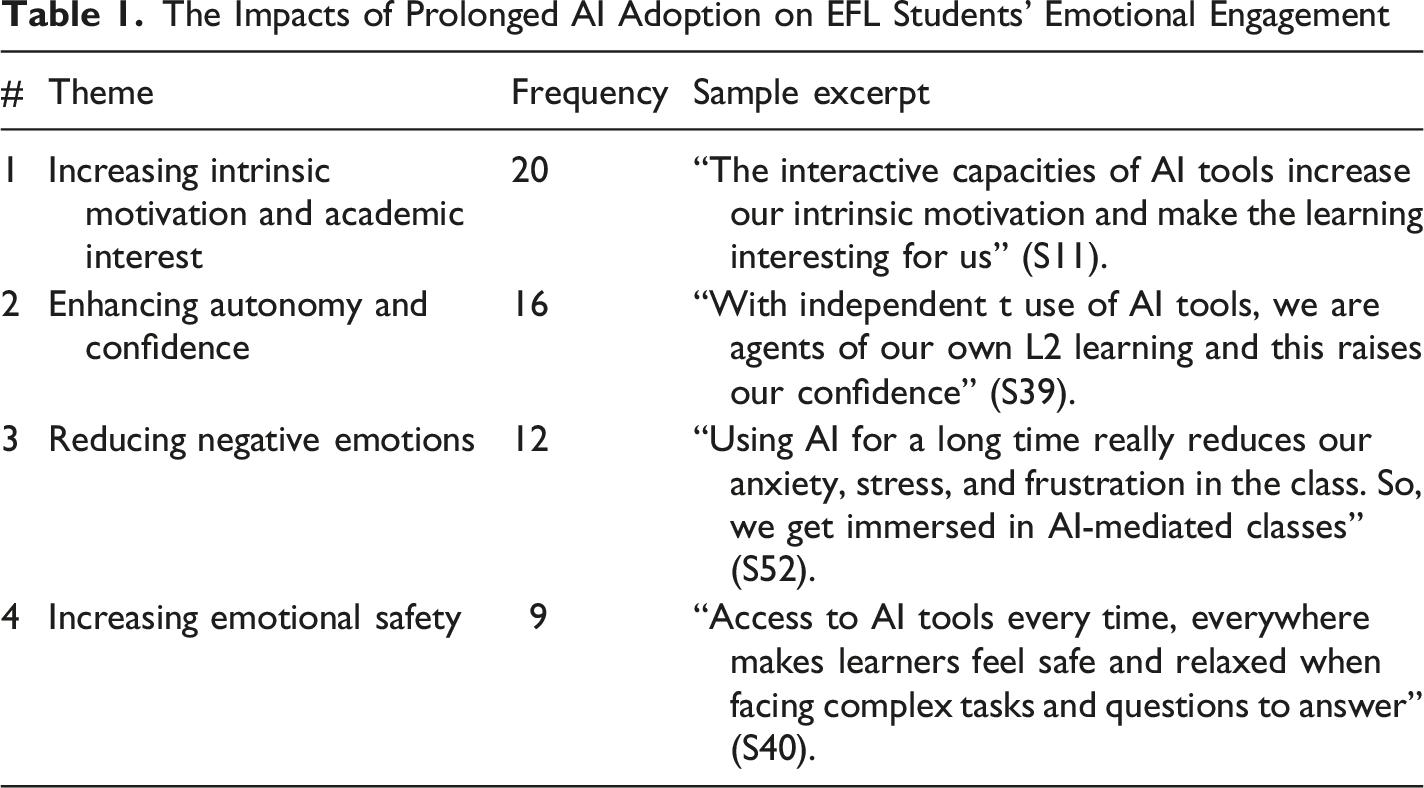
‘Reducing negative emotions’ in learners was the focus of the third extracted theme concerning AI-enhanced emotional engagement. In an interview session, one of the students argued that “AI tools reduced my anxiety in learning English. I was afraid of speaking in the class, but after using speaking bots and chatbots that anxiety decreased” (S29). Similarly, another student claimed that “the novelty of AI technologies prevents and reduces negative emotions in learners. Students feel less stress and boredom. So, they become more emotionally interested and engaged in the classes” (S10). Finally, the students perceived the prolonged use of AI tools effective in their emotional engagement as it could ‘increase emotional safety’ in learners. As maintained by S6, “AI creates a sense of emotional safety in learners as they can ask their questions immediately and get responses quickly. They are relaxed and confident that AI will help them”. One of the students considered such emotional bond to be created from “constant questions and answers and companionship that AI is forming with users” (S28).
The Impacts of Prolonged AI Adoption on EFL Students’ Perceptual Skills
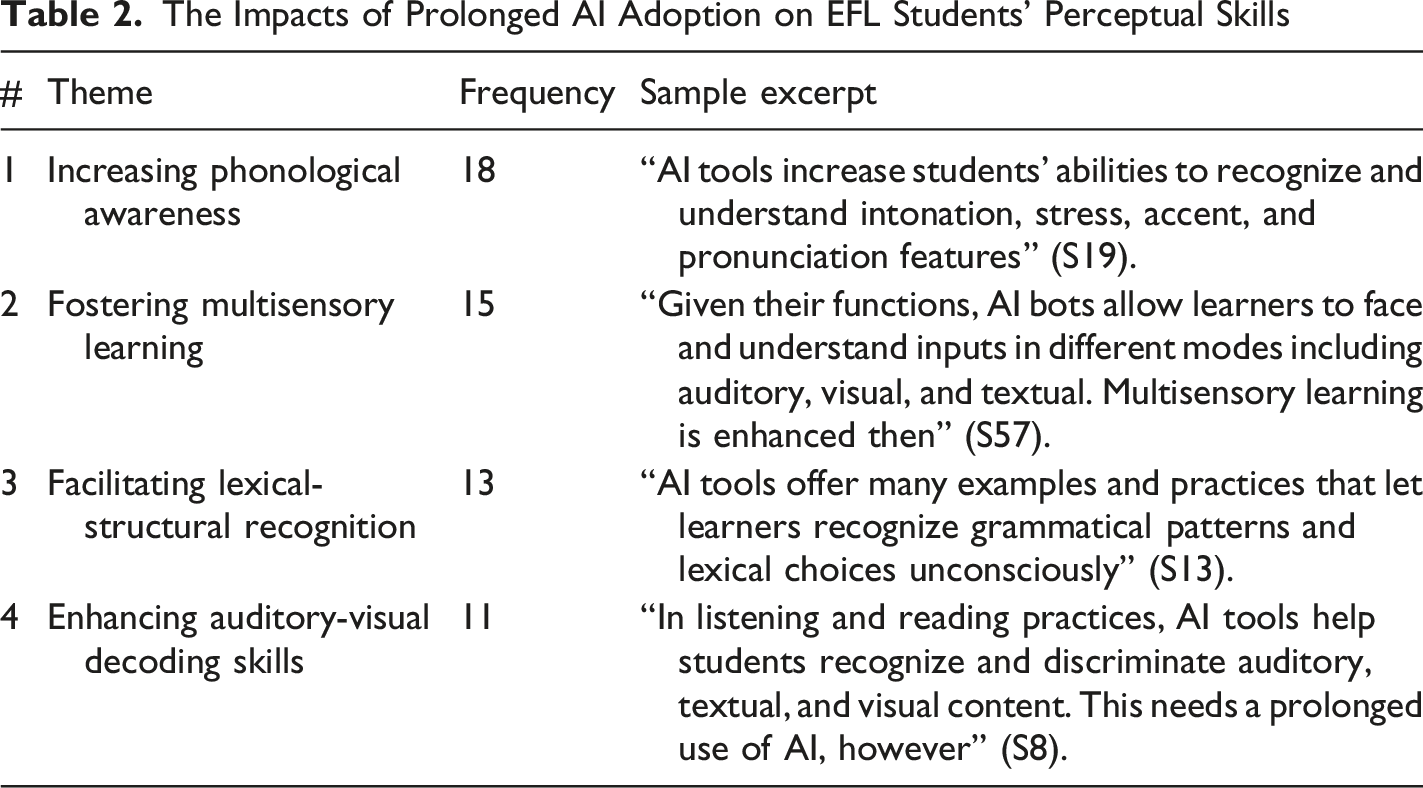
The third theme concerned the capacity of AI tools in ‘facilitating lexical-structural recognition’ in learners, as a possible to develop perceptual skills. One of the students claimed that “using AI tools let learners recognize common patterns in using English words and grammar after extensive exposure to AI-generated language content and practices” (S34). Furthermore, such patterns could be useful for learners in that “one can easily figure out which words and structures are more frequent in a specific area or genre” (S49). The last way in which prolonged AI adoption could affect EFL learners’ perceptual skills was through ‘enhancing auditory-visual decoding skills’. To describe the theme, S2 declared that “many AI tools used for listening skills allow multiple rounds of listening and re-listening to an input. Students then learn how to decode various accents and intonations by adjusting to their speed”. Another student talked about reading comprehension saying that “using AI tools for a long time to learn reading skills helps us decode the texts more quickly and effectively. There are annotations and definitions for vocabularies in some AI tools that make visual processing faster” (S55). In sum, the findings revealed different ways in which the prolonged use of AI tools could positively affect Chinese EFL students’ emotional engagement and perceptual skills.
Discussion
This study investigated the impact of prolonged adoption of AI tools by Chinese EFL students on their emotional engagement and perceptual skills. The findings indicated that both constructs could be positively affected by AI adoption. Regarding emotional engagement, the study revealed that prolonged AI adoption could improve emotional engagement in four commonly mentioned ways. First, it was argued that by increasing motivation and interest in learners, AI technologies could develop emotional engagement. This finding resonates with previous studies on the contribution of AI-mediated L2 education on learners’ emotional factors (e.g., Derakhshan, 2026; Derakhshan & Park, 2026a, 2026b; Li et al., 2025; Zhang & Derakhshan, 2025). The study also reflects CVT of emotions in that EFL students’ perceived value and affordability of AI tools for L2 education could have made them experience an increased emotional engagement, motivation, and interest (Perkrun, 2006). The participants’ acceptance of such innovative tools may further explain this finding, as supported by TAM (Davis et al., 1989). The bond between emotional engagement and motivation and interest is also consistent with previous research reports on emotional engagement (e.g., Bond & Bedenlier, 2019; Huang et al., 2022). A justification for this theme could be the proximity of positive emotions (i.e., motivation and interest) with emotional engagement, as another positive construct. The triggering interaction among emotions and their transferability could be another reason. It is also possible that the students’ emotional engagement developed due to the prolonged use of AI tools.
The next finding was that by enhancing autonomy and confidence in learners AI tools could develop emotional engagement. Derakhshan and Ghiasvand (2024) asserted that AI tools like ChatGPT can develop EFL learners’ autonomy and confidence, thereby fostering psycho-affective developments. Similar claims are also reported in other studies in this area (e.g., Dai & Liu, 2024; Huang et al., 2023). Emphasis on confidence, however, is unique to this study as a trigger of emotional engagement. Nevertheless, Seyri and Ghiasvand (2025) have regarded confidence as one of the emotional outcomes of AI-mediated L2 education. The students’ preferences and personality traits of seeking autonomy and self-confidence in education may clarify this finding. The controllability element of CVT may also justify this theme as it showcases agency and power of decision when doing a task. Positive attitudes and perceived usefulness of AI technologies could have encouraged the students to highlight such contributions of AI, as defensible by TAM.
Emotional engagement was also perceived to grow by AI technologies’ reducing role in negative emotions. This outcome agrees with Derakhshan and Park (2026b), who argued that using AI tools could prevent and reduce EFL students’ negative emotions. Likewise, Bond and Bedenlier (2019) declared that emotional engagement appears when negative emotions are reduced in learners. So, the dependency of emotional engagement to negative emotions’ reduction is supported by the literature. Accepting both positivity and negativity implies the students’ high understanding of life and existence, which entail positive and negative emotions at the same time. This theme indicates that AI-mediated L2 education is neither ‘absolutely positive’ nor ‘absolutely negative’ in terms of emotions. Such understanding can be attributed to the participants’ emotional literacy and AI literacy. The fourth way in which AI tools could affect emotional engagement in learners was by increasing emotional safety in them. This outcome makes the present research differ from the literature. Such perceived safety in using AI tools could be due to the participants’ positive appraisal of the technologies and their utility in education, a contention supported by CVT and TAM. It seems that the students had experienced a sense of safety and relief after a prolonged use of AI tools. Therefore, their emotional engagement enhanced in light of that safety. The students’ degree and depth of AI adoption may be another reason for experiencing and highlighting emotional safety granted by AI tools.
Concerning perceptual skills, the study indicated AI tools could increase students’ phonological awareness after prolonged adoption, which agrees with previous studies on the concept of perceptual skills (e.g., Stokes & Nanay, 2020). The modifiability of perceptual skills, especially auditory processing and discrimination also aligns with the literature (e.g., Lee & Lyster, 2016; Munton, 2019; Shmuelof & Krakauer, 2014). Frequent use of speaking and listening-related AI bots and chatbots could explain this emphasis on phonological aspects of L2 learning. Another contribution of AI to perceptual skills concerned multisensory learning, which concurs with previous explorations (e.g., Goldstone, 1998; Jacobs & Michaels, 2007; Stokes & Nanay, 2020). The multimodality of AI tools used by the learners and their capacities for offering inputs in various modes justify this finding. The wide scope of perceptual skills that vary across senses further explain why multisensory learning and multiple sources of information are stressed out by the participants. Their language learning styles and preferences for different forms of input in the classroom also explain this theme.
Additionally, it was found that by helping students better recognize lexical-structural patterns AI tools could develop their perceptual skills. This finding partially agrees with, who claimed that by making learners sensitive to lexical-grammatical patterns, their perceptual skills develop as well. The databases and algorithms of AI technologies could have fostered the detection and learning of common and frequent lexical-grammatical patterns in learning English. Hence, the potentials of AI can explain this finding. Likewise, AI-powered corpora might have been used by the students helping them realize such patterns. Concerns about learning English from the very basic levels of lexis and structure show the participants’ passion for deep learning via AI. The final way in which prolonged AI adoption could affect learners’ perceptual skills was through enhancing their decoding skills in terms of auditory-visual inputs. This theme demonstrates the core conceptualization of perceptual skills that involves one’s ability to discriminate and decode textual, auditory, and visual inputs, as endorsed by prior researchers (e.g., Bee & Boyd, 2009; Stokes & Nanay, 2020). Again, the multimodal capacities of AI tools, in contrast to monomodal ones, may justify such emphasis on decoding data in modes beyond text. Their age and personal characteristics may have made them willing for multimodal learning contexts that is enhanced by the rapid growth of AI technologies. The educational context of China, which supports and encourages multimodal learning (Zhang & Ma, 2026) could be another explanation for highlighting decoding skills in various modes of information.
Conclusion and Implications
This qualitative research explored the impact of prolonged use of AI technologies on EFL students’ emotional engagement and perceptual skills in the context of China. The findings indicated a positive contribution of AI adoption to both constructs after a long time of using AI regularly. The study provides evidence in support of AI-mediated L2 education as a strategy for cultivating various emotional factors and academic skills. The dynamism of emotional engagement and perceptual skills in relation to AI-powered practice is also implied in the findings. Another conclusion is that proper and longitudinal use of AI technologies could provide optimal and positive academic outcomes of L2 learners beyond their development in language skills. Emotional and cognitive domains of their education can also promote through AI tools. The sensitivity of emotional engagement and perceptual skills to targeted training and practices mediated by AI is another conclusion drawn from the findings. The study provides theoretical implications for CVT and TAM regarding the role of psycho-affective factors in adopting technology. Prior research on perceptual skills may also develop given the fresh insight provided by AI tools. Models of perceptual skills can be designed in relation to AI-mediated education. Another contribution relates to the emotional atmosphere and consequences of AI-mediated L2 education that is currently capturing a rise of attention.
While the study involves contextual constraints, EFL students may use its findings to develop their emotional literacy, AI literacy, and perceptual awareness of the positive contributions of AI adoption over extended periods. Venues of influence that AI tools may cross to develop emotional engagement and perceptual skills are unveiled for learners. Therefore, students are no longer passive and inattentive users of AI tools when they realize how such technologies could affect their emotions and practices. EFL students can feasibly use AI technologies to develop their detection and interpretation skills after multiple rounds of prompt-posing and responses from AI bots and chatbots. Their critical thinking skills may also develop. The study can be used by EFL teachers to integrate various forms of AI in their L2 classes as an engaging instructional approach, wherein positive emotions can soar. For example, teachers can practically draw on AI tools to develop plans and activities for the classroom and develop learning motivation and engagement among students. They can also develop strategies to further expand areas of AI impact on learners’ emotions and language learning skills. By designing workshops related to AI and cognitive-emotional aspects of L2 education, teacher educators can benefit from the insights provided in this study. Practical techniques can be taught to teachers in teacher training courses in the future. Educational systems and policymakers can use the findings to design plans for integrating AI tools into L2 education with a specific attention to the emotional and academic potentials of such tools for learners. They can specifically seek budget and infrastructure from macro-level authorities to integrate AI tools in L2 classes to emotionally and perceptually engage learners with different characteristics in the course. Emotional and technical supports can be provided by policymakers for L2 teachers and learners to perfume better in AI-mediated instruction.
Limitations and Suggestions for Future Research
This study suffers from some limitations that should be considered in future endeavors. The use of a single phase, qualitative research design limits the depth of insights. Future researchers are suggested to use mixed-method research designs. Moreover, the data came from a single source (i.e., interview) without any triangulation. Therefore, it is highly recommendable to run studies in which multiple data collection tools are used by researchers. The use of convenience sampling poses the risk of un-representativeness of the sample. Future research can use random sampling or other techniques that consider diversity in selecting participants rather than their simple availability. Pretest-posttest studies are suggested to capture the actual impact of AI on EFL students’ emotional engagement and perceptual skills. The study did not control the impact of AI literacy and degree of AI adoption in perceiving AI-enhanced emotional engagement and perceptual skills. So, further research is needed to control mediating and extraneous variables. The perspectives of EFL teachers can be the focus of future studies as well. Likewise, as emotional engagement and perceptual skills are highly contextual, it is advisable to conduct cross-cultural and cross-disciplinary research in the future. Replications can be done in the future focusing on other psycho-emotional and L2 learning constructs.
Supplemental Material
Supplemental Material - Exploring EFL Students’ Perceived Changes in Emotional Engagement and Perceptual Skills After Prolonged Use of AI-Based Tools: A Qualitative Study
Supplemental Material for Exploring EFL Students’ Perceived Changes in Emotional Engagement and Perceptual Skills After Prolonged Use of AI-Based Tools: A Qualitative Study by Tao Dou in Perceptual and Motor Skills
Footnotes

Funding
The author disclosed receipt of the following financial support for the research, authorship, and/or publication of this article: This study is supported by Henan Provincial Education Science Planning Office Project in 2024 (Research on Integrating New Quality Productive Forces of Artificial Intelligence into Foreign Language Education, Project No.: 2024YB0040).
Declaration of Conflicting Interests
The author declared no potential conflicts of interest with respect to the research, authorship, and/or publication of this article.
Supplemental Material
Supplemental material for this article is available online.
Author Biography
References
Supplementary Material
Please find the following supplemental material available below.
For Open Access articles published under a Creative Commons License, all supplemental material carries the same license as the article it is associated with.
For non-Open Access articles published, all supplemental material carries a non-exclusive license, and permission requests for re-use of supplemental material or any part of supplemental material shall be sent directly to the copyright owner as specified in the copyright notice associated with the article.
