







Abstract
While acute exercise enhances cognitive performance, comparative effects of different maximal-effort exercise modalities remain unclear. This randomised crossover trial examined the differential cognitive impacts of graded maximal aerobic versus supramaximal exercise in active young adults. Forty-two participants (mean age = 24 ± 2 years) completed a progressive treadmill test to volitional exhaustion and a 30-s Wingate test, separated by ≥ 24-h washout. Cognition was assessed immediately before and 5 minutes post-exercise using computerized reaction time and Stroop tasks. Significant Time × Condition interactions revealed superior improvements following supramaximal exercise for simple reaction time (F (1,41) = 5.04, p = .030, ηp2 = 0.11) and incongruent Stroop performance (F (1,41) = 5.75, p = .021, ηp2 = 0.12). Supramaximal exercise produced 12.4 % improvement in reaction time versus 7.2 % for graded aerobic, and 12.8 % improvement in incongruent Stroop versus 7.6 % for graded aerobic. Congruent trials and interference scores showed no significant differences. These findings challenge the assumed superiority of aerobic exercise and demonstrate that brief supramaximal exercise elicits greater acute cognitive benefits than prolonged graded maximal exercise in physically active young adults.
Keywords
Introduction
The relationship between acute physical activity and cognitive performance has attracted substantial research attention. Accumulating evidence demonstrates that single bouts of exercise produce transient improvements in cognitive functioning across multiple domains (Chang et al., 2012; Lambourne & Tomporowski, 2010). A recent comprehensive meta-review confirmed that acute exercise yields significant cognitive benefits with a small-to-medium effect size, with improvements observed across attention, executive function, memory, and information processing (Chang et al., 2025). These benefits appear to generalise across participant characteristics and exercise parameters, although the timing of cognitive assessment relative to exercise has been identified as a significant moderator (Chang et al., 2025). Despite this general consensus, questions remain regarding whether specific exercise characteristics, (e.g., intensity, duration, and resulting metabolic/neuromuscular demands) differentially influence acute cognitive outcomes (Chang et al., 2025; Sudo et al., 2022).
Exercise can be broadly characterised along a metabolic continuum, though the traditional dichotomy between “aerobic” and “anaerobic” exercise represents an oversimplification (Chamari & Padulo, 2015; Gastin, 2001; Gastin & Suppiah, 2026). Rather than operating sequentially, energy systems function simultaneously, with their relative contributions determined by exercise intensity and duration. Graded exercise to volitional exhaustion provides a standardised maximal aerobic stimulus, although evidence specifically isolating cognitive effects of maximal graded protocols is more limited than for submaximal aerobic exercise (Sudo et al., 2022). In contrast, brief supramaximal efforts such as the 30-s Wingate test are powered primarily by phosphocreatine and glycolytic pathways, though with an aerobic contribution commonly estimated in the range of ∼20–30% during 30-s all-out cycling, depending on training status and methodological approach even during such short-duration maximal efforts (Calbet et al., 2003; Gastin, 2001; Gastin & Suppiah, 2026). Importantly, acute responses to exercise are shaped by the interaction of mechanical power output, bout duration, and (when applicable) recovery structure, which together influence metabolic and neuromuscular strain (Buchheit & Laursen, 2013). Despite growing interest in high-intensity protocols, the acute cognitive effects of supramaximal exercise remain less understood, with emerging evidence suggesting potential for distinct benefits compared to traditional aerobic exercise (Sudo et al., 2022; Tsukamoto et al., 2016).
The catecholamine hypothesis provides a theoretical framework for predicting differential cognitive effects between exercise modalities. This hypothesis proposes that high-intensity exercise triggers a larger and more rapid surge of catecholamines, particularly dopamine and norepinephrine, compared to lower-intensity exercise (McMorris et al., 2011). These neurotransmitters are fundamental to prefrontal cortex function, directly influencing attention, processing speed, and executive control (Xing et al., 2016). The magnitude of this catecholaminergic response may therefore determine the degree of cognitive enhancement. Additionally, the inverted-U hypothesis suggests that cognitive performance follows a curvilinear relationship with physiological arousal, with optimal performance occurring at intermediate arousal levels (McMorris & Hale, 2015). Whether brief supramaximal exercise positions individuals at a more optimal point on this arousal curve compared to prolonged graded exercise remains an empirical question. Notably, while recent meta-analytic evidence suggests exercise intensity may not moderate cognitive effects when pooling across heterogeneous studies (Chang et al., 2025; Oberste et al., 2021), direct within-subject comparisons of maximal protocols differing in metabolic and neuromuscular characteristics have rarely been conducted, potentially obscuring modality-specific effects.
Research directly comparing maximal aerobic versus supramaximal exercise protocols on cognitive outcomes remains limited. Furthermore, most existing studies have examined sedentary or mixed-fitness populations, leaving a gap in understanding how exercise modality affects cognition in physically active individuals who may demonstrate different response patterns due to training adaptations. Individual differences in training background can substantially influence metabolic responses to identical exercise protocols (Calbet et al., 2003; Sandford et al., 2021), suggesting that active populations warrant specific investigation. Young adults represent a particularly relevant population, as they typically exhibit peak cardiovascular fitness, neuroplasticity, and baseline cognitive functioning (Voss et al., 2013).
This randomised crossover trial directly compared the acute effects of maximal graded aerobic exercise (treadmill test to volitional exhaustion) versus supramaximal anaerobic exercise (30-s Wingate test) on cognitive performance in physically active young adults. We assessed simple reaction time as an index of processing speed, and Stroop Color-Word test performance as a measure of executive control and interference resolution, that are the domains sensitive to acute exercise (Chang et al., 2012). Based on the catecholamine hypothesis, we hypothesised that both exercise protocols would improve cognitive performance, but predicted a significant Time × Condition interaction whereby improvements in reaction time and incongruent Stroop performance would be greater following supramaximal anaerobic compared to graded aerobic exercise. As an exploratory analysis, we examined whether Stroop Interference Scores would show differential changes between conditions.
Materials and Methods
Ethical Considerations
This study protocol received approval from the Ethics Committee of the University and data collection was completed between 2020-2021. The study was conducted in accordance with the standards provided in the Declaration of Helsinki (World Medical Association, 2013). All participants provided written informed consent before participation in the study after being fully informed about the study procedures, potential risks, and their right to withdraw at any time without penalty.
Study Design and Participants
This study employed a randomized crossover design with an adequate washout period of at least 24 hours between conditions to minimize potential carryover effects. This does not guarantee complete recovery from supramaximal exercise; participants were instructed to avoid strenuous physical activity between sessions. Data collection occurred between 2020-2021 as part of a larger research program investigating exercise and performance outcomes.
Forty-two physically active adults (22 men and 20 women; mean age = 24 ± 2 years; age range = 21–29 years) were recruited on a voluntary basis. Inclusion criteria involved participants with classification as moderately active using the International Physical Activity Questionnaire (IPAQ) and aged between 20-30 years, without musculoskeletal injuries, neurological or mental disorders, and smoking. These criteria were identified and verified through self-reported medical history. Participants were asked to avoid ergogenic aids for 24 h prior to testing (e.g., caffeine/stimulant pre-workouts, creatine, beta-alanine, bicarbonate, nitrate/beetroot products, and other acute performance-enhancing supplements).
Study Procedure
Each participant attended three laboratory sessions. The first session served as a familiarization visit, during which participants were briefed on the procedures and practiced the cognitive tests to minimize learning effects. The subsequent two sessions were scheduled at least 24 hours apart and conducted in randomized order. The sessions involved a graded maximal aerobic and a supramaximal anaerobic exercise protocol. All testing sessions were scheduled between 10:00 AM and 12:00 PM to minimize the influence of circadian fluctuations. Participants were advised to maintain consistent sleep (6–8 hours) and fast for 2 hours before testing.
Baseline assessments included demographic and anthropometric measurements such as age, sex, height, weight, and body mass index (BMI). Cognitive performance was assessed immediately before and 5 minutes after each exercise session. The 5-min post-exercise assessment timing was selected based on prior research indicating that acute cognitive benefits peak within the immediate post-exercise window (approximately 0–15 minutes), coinciding with elevated catecholamine levels and physiological arousal (Chang et al., 2012; McMorris & Hale, 2015). This timing also allowed for partial recovery from acute exercise-induced fatigue while capturing the window of enhanced arousal, and enabled participants to transition safely from the exercise equipment to the testing station.
Exercise Protocols
Supramaximal Anaerobic Protocol: The Wingate Anaerobic Test (WAnT) was administered on a calibrated Monark 894E cycle ergometer following standard procedures (Bar-Or, 1987). Participants completed a 2-min warm-up at ∼60 rpm, interspersed with two brief sprints of 4–5 seconds to familiarise themselves with the resistance. After a 2-min seated rest, participants began pedalling at ∼60 rpm. Once this cadence was reached, the predetermined resistance (7.5% of body weight) was applied and participants pedalled all-out for 30 seconds with strong standardised verbal encouragement throughout. Recorded variables included peak power (W and W/kg), mean power (W/kg), and power drop (%). The seat height was adjusted individually for each participant and kept constant across sessions.
Graded Maximal Aerobic Protocol: The Balke and Ware treadmill test was administered following the standard protocol (Balke & Ware, 1959). Participants walked at a constant speed of 3.3 mph (5.3 km/h) beginning at 0% grade. The incline was increased by 1% every minute while speed remained constant. The test continued until volitional exhaustion, defined as the participant’s inability or unwillingness to continue despite verbal encouragement. Standard termination criteria were also applied (e.g., participant request to stop, signs of severe distress). Heart rate was monitored continuously. Peak oxygen uptake (V̇O2peak), peak heart rate (HRpeak), respiratory exchange ratio (RER), and metabolic equivalents (METs) were recorded.
Cognitive Assessments
Cognitive performance was assessed using two validated online tools. 1. 2.
Statistical Analysis
Data normality was assessed using the Kolmogorov-Smirnov test. To examine the differential effects of exercise modality on cognitive performance, separate 2 × 2 repeated-measures ANOVAs were conducted with Time (pre-exercise vs. post-exercise) and Condition (graded aerobic vs. supramaximal anaerobic) as within-subject factors.
The primary outcome of interest was the Time × Condition interaction effect. Partial eta squared (ηp2) was calculated as a measure of effect size. Post-hoc paired t-tests were conducted to decompose significant interactions. Exploratory analyses including sex as a between-subjects factor were initially considered; however, given the sample size, the study was not adequately powered to detect Sex × Time × Condition interactions. Therefore, data were pooled across sexes. Main effects of Time (pre vs post) and Condition (graded aerobic vs supramaximal) were examined and reported in addition to the interaction effects. To address potential speed–accuracy trade-offs, accuracy data were analysed using nonparametric Wilcoxon signed-rank tests given ceiling effects. Between-session baseline reliability was assessed using intraclass correlation coefficients (ICC2,1, two-way mixed, absolute agreement) with corresponding standard error of measurement (SEM = SD × √(1 - ICC)) and minimal detectable difference (MDD95 = SEM × 1.96 × √2) (Weir, 2005). Descriptive pre–post cognitive outcomes stratified by sex are provided in Supplemental Table S1 to facilitate future meta-analytic syntheses. Statistical significance was set at p < 0.05. All analyses were performed using SPSS version 21 (IBM Corp., Armonk, NY).
Results
Participants
All 42 participants completed both exercise conditions without adverse events.
Exercise Performance Outcomes
During the graded maximal treadmill test (Balke & Ware protocol), participants achieved a mean V̇O2peak of 2.44 ± 0.70 L/min (39.2 ± 7.7 mL/kg/min), peak heart rate of 181 ± 11 bpm, peak respiratory exchange ratio of 1.09 ± 0.12, minute ventilation of 78.63 ± 26.77 L/min, and 11.21 ± 2.20 METs. During the 30-s Wingate test, mean peak power was 5.82 ± 1.96 W/kg, average power was 4.30 ± 1.43 W/kg, and power drop was 62.03 ± 19.57%.
Effects of Exercise Modality on Cognitive Performance
Descriptive Statistics for Cognitive Performance by Time and Exercise Condition
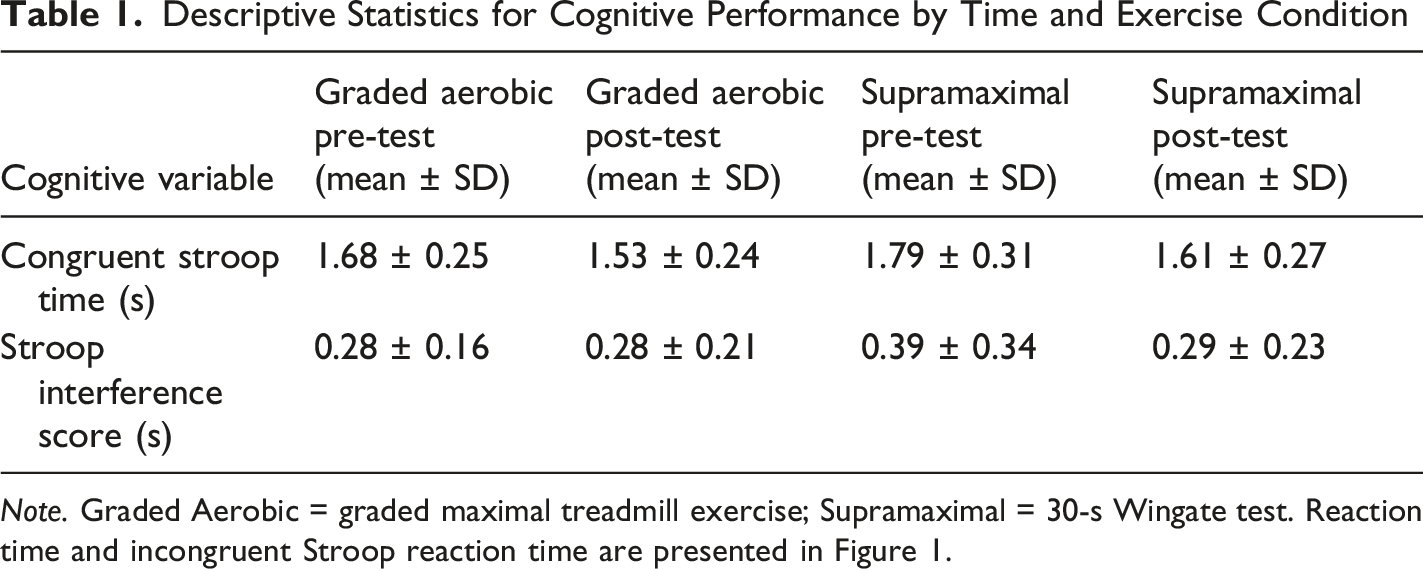
Note. Graded Aerobic = graded maximal treadmill exercise; Supramaximal = 30-s Wingate test. Reaction time and incongruent Stroop reaction time are presented in Figure 1.
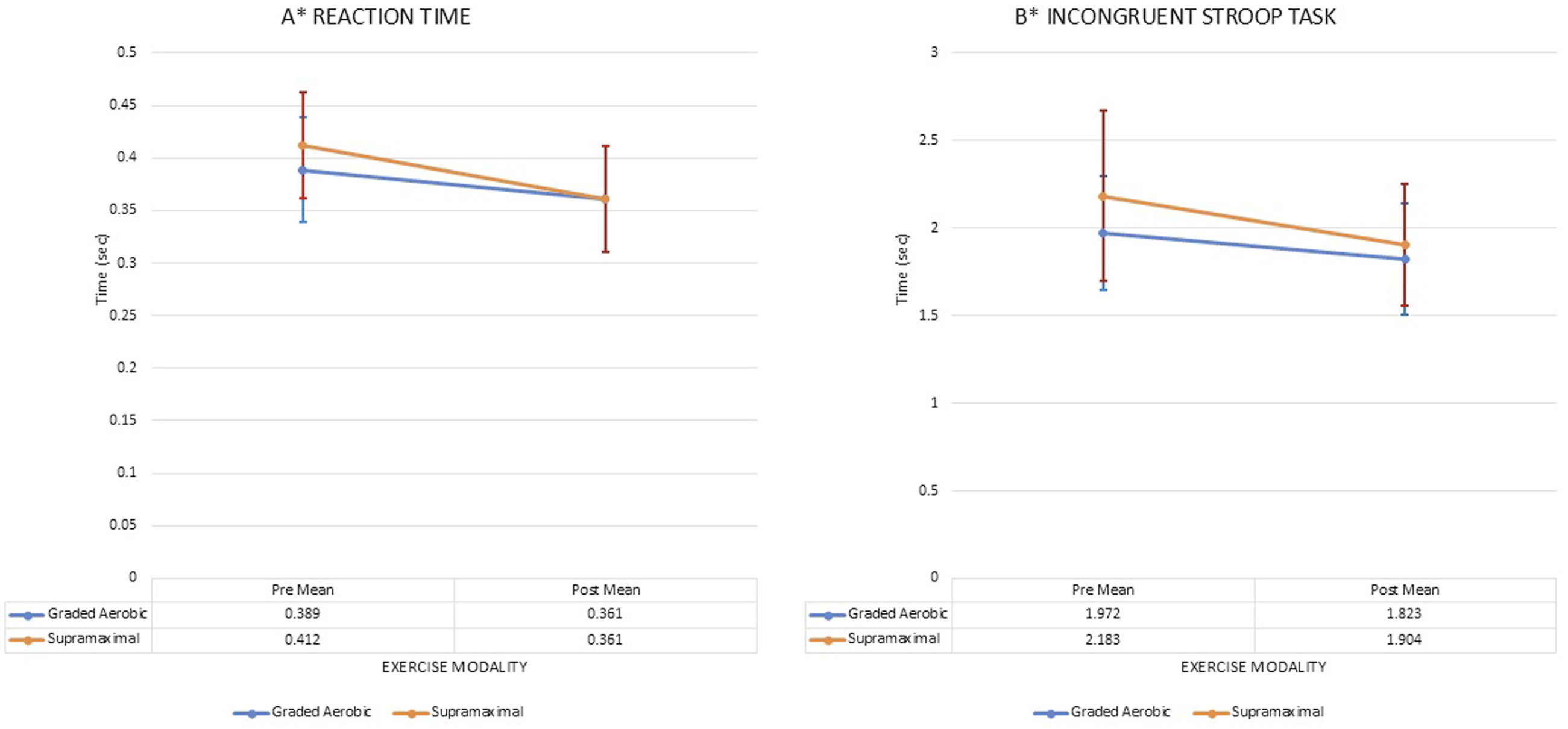
Effects of graded maximal aerobic and supramaximal exercise on cognitive performance. (A) Simple reaction time and (B) Incongruent Stroop reaction time measured before (Pre) and 5 min after (Post) exercise. Data are mean ± SD (n = 42). *Significant Time × Condition interaction (p < .05)
Results of 2 × 2 (Time x Condition) Repeated-Measures ANOVA for Cognitive Performance Measures
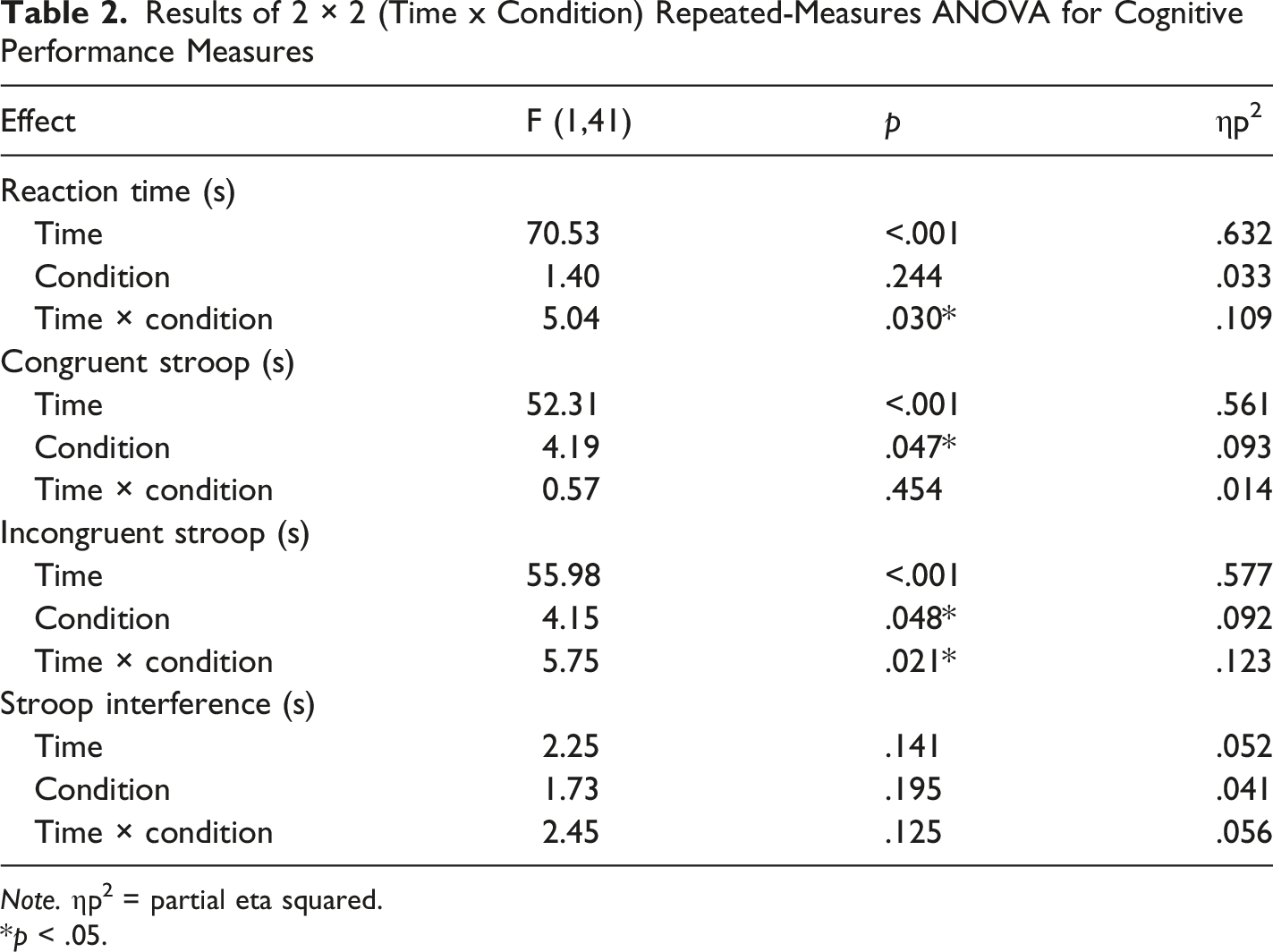
Note. ηp2 = partial eta squared.
*p < .05.
Simple Reaction Time
There was a significant main effect of Time, F (1,41) = 70.53, p < .001, ηp2 = .63, indicating substantial overall improvement from pre-to post-exercise across both conditions. The main effect of Condition was not significant, F (1,41) = 1.40, p = .244, ηp2 = .03. Critically, the Time × Condition interaction was significant, F (1,41) = 5.04, p = .030, ηp2 = .11, indicating that the magnitude of improvement differed between exercise modalities. Post-hoc analyses confirmed that supramaximal exercise produced significantly greater improvement (Mean change = −0.05 ± 0.04 s, 12.4% reduction) than graded aerobic exercise (Mean change = −0.03 ± 0.04 s, 7.2% reduction). This differential effect is illustrated in Figure 1(A).
Stroop Color-Word Task Performance
For the congruent Stroop trials, there were significant main effects of both Time, F (1,41) = 52.31, p < .001, ηp2 = .56, and Condition, F (1,41) = 4.19, p = .047, ηp2 = .09. However, the Time × Condition interaction was not significant, F (1,41) = 0.57, p = .454, ηp2 = .01, indicating comparable improvements across exercise modalities for this lower-demand task.
For the incongruent Stroop trials, there were significant main effects of both Time, F (1,41) = 55.98, p < .001, ηp2 = .58, and Condition, F (1,41) = 4.15, p = .048, ηp2 = .09. The Time × Condition interaction was also significant, F (1,41) = 5.75, p = .021, ηp2 = .12. Supramaximal exercise yielded superior improvement (Mean change = −0.28 ± 0.29 s, 12.8% reduction) compared to graded aerobic exercise (Mean change = −0.15 ± 0.29 s, 7.6% reduction). Figure 1(B) depicts this differential effect on high-demand cognitive control.
For the Stroop Interference Score, neither the main effect of Time, F (1,41) = 2.25, p = .141, ηp2 = .05, nor the main effect of Condition, F (1,41) = 1.73, p = .195, ηp2 = .04, reached significance. The Time × Condition interaction was also not significant, F (1,41) = 2.45, p = .125, ηp2 = .06.
Accuracy Analysis
Stroop Task Accuracy (%) by Time and Exercise Condition
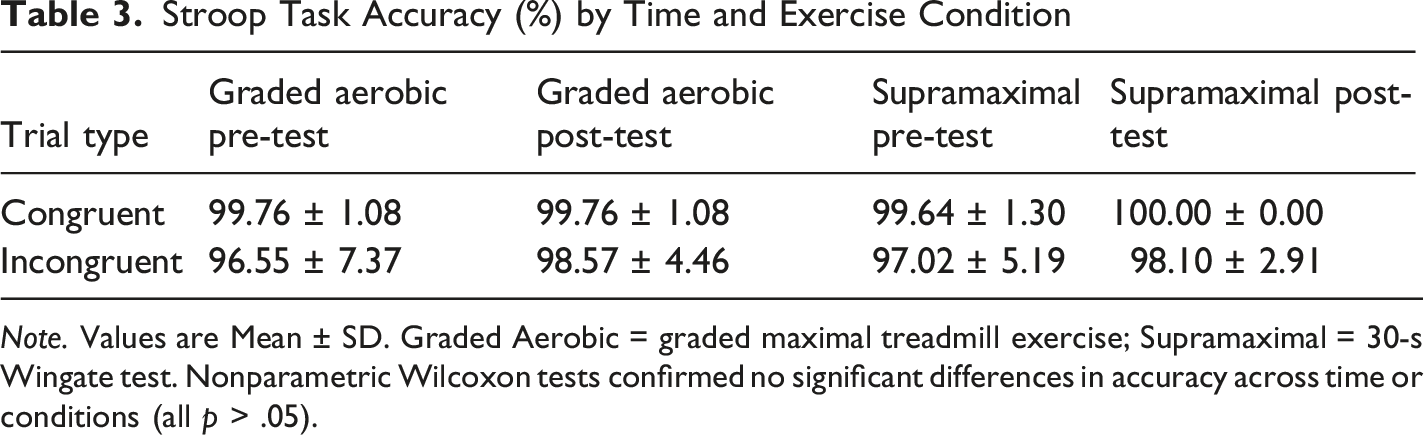
Note. Values are Mean ± SD. Graded Aerobic = graded maximal treadmill exercise; Supramaximal = 30-s Wingate test. Nonparametric Wilcoxon tests confirmed no significant differences in accuracy across time or conditions (all p > .05).
Baseline Reliability
Between-session reliability of baseline cognitive measures was examined using intraclass correlation coefficients (ICC2,1) from the two pre-exercise assessments conducted on separate days. ICCs were 0.24 (95% CI: −0.05 to 0.49) for reaction time, 0.27 (95% CI: −0.01 to 0.52) for congruent Stroop, and 0.06 (95% CI: −0.21 to 0.33) for incongruent Stroop. The corresponding standard errors of measurement (SEM) and minimal detectable differences (MDD95) were 0.047 s and 0.131 s for reaction time, 0.242 s and 0.671 s for congruent Stroop, and 0.394 s and 1.091 s for incongruent Stroop. The observed pre-to-post improvements did not exceed MDD thresholds for individual measures; however, these MDD values are conservative as they reflect between-session (different-day) variability rather than within-session measurement error. The low-to-moderate ICCs likely reflect natural day-to-day fluctuations in cognitive performance and differential anticipatory states before different exercise protocols. Importantly, the significant Time × Condition interactions, testing differential change patterns rather than absolute values, remain valid within the crossover design regardless of between-session baseline variability.
Descriptive cognitive outcomes stratified by sex (22 men, 20 women) are presented in Supplemental Table S1.
Discussion
This randomized crossover trial revealed that brief supramaximal exercise produces superior acute cognitive benefits compared to graded maximal aerobic exercise in physically active young adults. Specifically, supramaximal exercise resulted in significantly greater improvements in both simple reaction time and, more notably, performance on the cognitively demanding incongruent Stroop task. These findings suggest that, even when both protocols are maximal, differences in bout duration and mechanical power output, with downstream effects on metabolic and neuromuscular demands, may influence the magnitude of acute cognitive facilitation.
The superior cognitive enhancement following supramaximal exercise aligns with the catecholamine hypothesis of exercise-induced cognitive facilitation. Brief, high-intensity supramaximal exercise triggers a more pronounced surge in plasma catecholamines, particularly norepinephrine and dopamine, compared to prolonged graded exercise (McMorris et al., 2011; Çınar et al., 2025). These neurotransmitters directly modulate prefrontal cortex activity, enhancing executive control networks responsible for both processing speed and interference resolution (Xing et al., 2016). The 12.4% improvement in reaction time and 12.8% improvement in incongruent Stroop performance following supramaximal exercise, compared to 7.2% and 7.6% respectively after graded aerobic exercise, is consistent with (but does not confirm) a larger catecholaminergic response. Because catecholamines and physiological arousal were not measured, mechanistic interpretations remain speculative. Furthermore, according to the inverted-U hypothesis of arousal (McMorris & Hale, 2015), the higher physiological arousal induced by supramaximal exercise may have positioned participants at a more optimal point on the arousal-performance curve, particularly for tasks requiring focused attention and cognitive control. Importantly, because cognition was assessed during early recovery (5 min post-exercise) rather than at peak exertion, the arousal state at the time of assessment may differ from peak Wingate intensity, potentially placing participants at a more favourable point on the arousal-performance curve during cognitive testing.
Our findings contrast with recent meta-analytic evidence suggesting that exercise intensity may not significantly moderate cognitive effects when pooling across heterogeneous studies (Chang et al., 2025). Several factors may explain this apparent discrepancy. First, the meta-analysis examined set shifting specifically, while we assessed reaction time and Stroop interference; different executive function components that may respond differently to exercise intensity. Second, the ‘vigorous’ exercise in most studies included in that meta-analysis involved submaximal protocols (typically 70-85% HRmax), whereas our supramaximal protocol involved supramaximal intensity (Wingate test). This distinction between vigorous and supramaximal effort may represent a critical threshold for catecholamine release. Third, the timing of cognitive assessment (5 min post-exercise in our study) may capture different recovery dynamics than the varied assessment windows in the meta-analyzed studies.
The differential effects observed across cognitive tasks provide insight into the mechanisms underlying exercise-induced cognitive enhancement. Both exercise modalities improved performance on simple (congruent Stroop) and complex (incongruent Stroop) tasks, but the superiority of supramaximal exercise emerged only for tasks with higher cognitive demands. This pattern suggests that the additional neurophysiological arousal from supramaximal exercise may be particularly beneficial when executive control resources are taxed. The non-significant difference in Stroop Interference Scores (p = .125), despite significant improvements in incongruent trial performance, indicates that supramaximal exercise enhanced overall processing efficiency rather than specifically targeting interference resolution mechanisms. This distinction is theoretically important, suggesting that acute supramaximal exercise may boost general cognitive resources rather than selectively enhancing specific executive functions.
Our findings complement and extend previous research on acute exercise and cognition. While studies such as Dwojaczny et al. (2020) and Chang et al. (2014) reported cognitive benefits favouring aerobic exercise, these investigations typically compared moderate-intensity aerobic exercise with resistance training or used different post-exercise assessment windows. Our use of maximal-intensity protocols (both graded aerobic to volitional exhaustion and supramaximal anaerobic) and standardized 5-min post-exercise assessment may have captured peak catecholaminergic effects that shorter or less intense protocols might miss. The superiority of supramaximal exercise observed here aligns with emerging evidence from high-intensity interval training studies (Tsukamoto et al., 2016) and recent work by Walsh et al. (2018), suggesting that the rapid, intense physiological perturbation characteristic of supramaximal efforts may be particularly effective for acute cognitive enhancement. Importantly, our sample of physically active young adults may show different response patterns than sedentary populations commonly studied, as training adaptations could influence both physiological and cognitive responses to acute exercise (Chang et al., 2014). Notably, being ‘physically active’ is not equivalent to being ‘trained’; using the participant caliber framework (McKay et al., 2022), and consistent with our exercise performance data (Wingate peak power: 5.82 ± 1.96 W/kg; V̇O2peak: ∼39 mL/kg/min), our sample would be best characterised as recreationally/moderately active rather than specifically trained or competitive, which should be considered when generalising findings to other fitness populations.
These findings suggest potential practical implications for optimising cognitive performance, though several caveats warrant consideration. The superior benefits of brief supramaximal exercise suggest that individuals seeking acute cognitive enhancement may benefit from short bursts of high-intensity activity compared to prolonged graded exercise. The 30-s Wingate protocol used here is particularly time-efficient. However, it must be acknowledged that the transfer of laboratory-based cognitive improvements to real-world performance contexts (e.g., academic test-taking, athletic decision-making, occupational tasks) has not been directly demonstrated. Laboratory measures of reaction time and Stroop performance, while well-validated indices of processing speed and executive control, may not directly translate to complex real-world cognitive demands. Furthermore, the feasibility and safety of supramaximal protocols must be considered, particularly for less fit populations or those with cardiovascular risk factors. Future research should examine whether acute cognitive benefits observed in laboratory settings transfer to meaningful real-world outcomes.
Several limitations warrant consideration. The absence of a resting control condition precludes definitive isolation of exercise-specific effects from practice or time-of-day influences; however, the significant Time × Condition interactions confirm true differential effects between modalities. Affective responses (pleasure–displeasure) were not assessed; given that supramaximal exercise induces marked displeasure followed by rapid rebound, affective valence represents a potentially important mediator that future studies should examine (Ekkekakis et al., 2020). The computerised button-click Stroop task produced longer reaction times than traditional vocal versions and captured total response time rather than fractionated components; while this limits direct comparability with some prior literature, it does not compromise the validity of the within-subject comparisons. Sample size was determined pragmatically rather than by a priori power analysis based on exercise-cognition effect sizes, which were not available at the time of study design. Post-hoc analysis confirmed 75–85% power for the observed medium-to-large interaction effects (ηp2 = 0.10–0.12). Finally, the study was conducted in physically active young adults (n = 42) and was not powered to examine sex differences or generalise to sedentary, clinical, or older populations.
Future research should investigate several key questions raised by these findings. The temporal dynamics of cognitive enhancement following different exercise modalities warrant detailed examination through multiple post-exercise assessments. Neurophysiological measurements, including catecholamine levels, cortical activation patterns, and heart rate variability, would help elucidate underlying mechanisms. Additionally, examining how individual factors (baseline fitness, genetic polymorphisms affecting dopamine regulation, and training history) moderate the cognitive response to different exercise modalities could enable personalized exercise prescriptions for cognitive enhancement. Investigation of whether repeated acute sessions produce cumulative benefits or adaptation effects would inform the development of long-term intervention strategies. Critically, future research should examine whether acute cognitive benefits observed in controlled laboratory settings translate to meaningful improvements in real-world performance contexts such as academic achievement, athletic decision-making, or occupational productivity.
Conclusion
This study demonstrates that acute brief supramaximal exercise produces superior cognitive benefits compared to graded maximal aerobic exercise in physically active young adults, particularly for tasks requiring executive control and rapid information processing. These findings challenge traditional assumptions about exercise-cognition relationships and highlight the importance of exercise metabolic characteristics in determining acute cognitive outcomes. While both exercise modalities enhanced cognitive performance, the greater improvements following supramaximal exercise (12.4% for reaction time, 12.8% for complex cognitive tasks) suggest that brief, supramaximal protocols may offer an efficient strategy for acute cognitive enhancement. Although real-world transfer of these laboratory findings remains to be established, these results suggest potential implications for individuals seeking to optimise cognitive performance through targeted exercise interventions. Future research should examine the temporal dynamics of these effects, individual factors that may moderate responses, and whether acute benefits translate to meaningful real-world outcomes.
Supplemental Material
Supplemental material - Effects of Acute Exercise on Cognitive Performance in Active Young Adults: A Randomized Trial Using Online Measures
Supplemental material for Effects of Acute Exercise on Cognitive Performance in Active Young Adults: A Randomized Trial Using Online Measures by Simran Obhrai, Anilendu Pramanik, Sohom Saha, Shweta Shenoy, Nishchay Sadhoo, S. Srinivas in Perceptual and Motor Skills
Footnotes
Acknowledgement
The authors acknowledge the participants for their time and cooperation. This research did not receive any specific grant from funding agencies in the public, commercial, or not-for-profit sectors.

Ethical Considerations
This study was approved by the Ethics Committee of the University (IEC no. 34/HG dated 13/3/2020) and conducted in accordance with the Declaration of Helsinki.
Consent to Participate
Written informed consent was obtained from all individual participants included in the study.
Funding
The authors received no financial support for the research, authorship, and/or publication of this article.
Declaration of Conflicting Interests
The authors declared no potential conflicts of interest with respect to the research, authorship, and/or publication of this article.
Data Availability Statement
The data that support the findings of this study are available from the corresponding author upon reasonable request.
Supplemental Material
Supplemental material for this article is available online.
Author Biographies
References
Supplementary Material
Please find the following supplemental material available below.
For Open Access articles published under a Creative Commons License, all supplemental material carries the same license as the article it is associated with.
For non-Open Access articles published, all supplemental material carries a non-exclusive license, and permission requests for re-use of supplemental material or any part of supplemental material shall be sent directly to the copyright owner as specified in the copyright notice associated with the article.
