







Abstract
Introduction
Over recent years, research has moved beyond traditional cognitive models of decision-making in sport, incorporating concepts from dynamical systems theory. Drawing on principles from mathematics, physics, and psychology, this framework conceptualizes behaviour as emerging from the continuous evolution of complex systems over time (Davids et al., 2003). Within this perspective, action is shaped by the interaction of individual, task, and environmental constraints, as originally proposed by Newell (1986), and grounded in the perception–action coupling tradition (Turvey, 2009).
Constraints can be understood as boundary conditions that regulate the emergence, stability, and transition of coordinated behaviours in complex systems (Kelso, 2013). Accordingly, both intrinsic and extrinsic factors channel decision-making processes in sport, giving rise to adaptive motor solutions that are attuned to the affordances available in the environment (Phillips et al., 2010; Renshaw et al., 2019; Uehara et al., 2020). These constraints shape the landscape of possible actions, guiding how players interact with the game while enabling the discovery of functional movement solutions (Hristovski et al., 2011).
Among such constraints, positional roles impose specific task demands on players. For example, defenders tend to prioritize defensive coverage, whereas midfielders and forwards are more engaged in supportive and offensive actions (Rechenchosky et al., 2017). Midfielders, in particular, frequently centralize play, likely due to the affordances associated with the spatial regions they occupy, which facilitate coordination of offensive transitions and maintenance of team structure (Borges et al., 2022; Praça et al., 2019).
Beyond positional influences, coaches can actively shape player behaviour through the manipulation of task constraints, particularly in small-sided games (SSGs). Adjustments to variables such as pitch dimensions, numerical balance, and rules can promote exploratory behaviour by creating affordances that encourage diverse and adaptive movement solutions (Coito et al., 2022; Ometto et al., 2018). In this context, rule manipulation functions as a means of directing players’ attention towards relevant informational variables, whether physical, tactical, or technical (Clemente et al., 2022; Coutinho et al., 2018). Such practice designs simulate game-like conditions in which players must regulate their actions under dynamic and often unpredictable constraints (McGarry et al., 2013).
Through these manipulations, coaches may foster both exploratory behaviour and creativity, as players are required to continuously adapt to perturbations inherent to performance environments (Hristovski et al., 2012). System properties such as variability, degeneracy, and multistability underpin this process, supporting the emergence of functional and novel solutions through constraint interaction (Seifert et al., 2013, 2016).
From an ecological dynamics perspective, creativity emerges from the continuous coupling between perception and action, manifesting when players generate behaviours that are both functional and novel within a given context (Hristovski et al., 2011; Memmert & Roca, 2019). It has been operationalized through three core dimensions: originality (the production of rare or unconventional responses), fluency (the generation of multiple relevant responses), and flexibility (the ability to produce diverse responses across categories) (Torrance, 1990). In sport-specific observational instruments (e.g., CBATS), flexibility is often expressed as versatility, reflecting the diversity of action solutions exhibited during performance (Santos et al., 2017).
Manipulating the relative playing area in SSGs (e.g. typically by reducing space per player) has been associated with the emergence of novel and creative motor behaviours (Borges et al., 2024; Caso & van der Kamp, 2020; Ueda et al., 2023; Ueda et al., 2025). Increased exploratory behaviour appears to expand the range of action possibilities, thereby enhancing the likelihood of diverse and potentially creative responses (Ric et al., 2017). Such conditions may promote metastable dynamics, allowing players to flexibly transition between behavioural states while searching for effective solutions.
However, exploration does not inherently yield functional or creative outcomes. Players may explore available affordances without successfully converting them into effective actions (Ric et al., 2017). Empirical evidence indicates that exploratory behaviour is influenced by task constraints: for instance, it tends to increase under numerical disadvantage (Torrents et al., 2016), while manipulations such as goal positioning (Canton et al., 2020), ball type (Santos et al., 2020), and instructional constraints (Goes et al., 2025) can differentially affect the originality and versatility of behaviour.
Within this framework, exploration has been proposed as a minimal prerequisite for the emergence of novelty in complex neurobiological systems (Hristovski et al., 2011). Nonetheless, exploration and creativity are distinct constructs. Exploratory behaviour reflects a search process that increases the likelihood of discovering novel solutions, whereas creativity additionally requires functionality and originality (Torrents et al., 2021).
By promoting exploratory behaviour, SSG manipulations may enhance unpredictability and enrich the repertoire of functional synergies that emerge as players adapt to environmental constraints (Hristovski et al., 2011). Building on this rationale, the present study aimed to examine how individual exploratory behaviour contributes to the emergence of on-ball creative actions during gameplay. Given that exploratory behaviour may facilitate attunement to relevant environmental information and expand the perception of affordances in dynamic contexts (Davids et al., 2013), we hypothesized that players exhibiting higher levels of exploration during SSGs would demonstrate greater diversity in creative actions (reflected in higher fluency, flexibility, versatility, and originality) compared to their less exploratory counterparts.
Methods
Participants
A non-probabilistic convenience sample was recruited from the academy of a traditional Brazilian soccer club in Brazil. The initial sample of this study comprised 74 young athletes. Of these, 26 were excluded: one due to injury, 15 for not meeting the inclusion criteria, and 10 because they did not attend one or more scheduled data collection sessions, resulting in incomplete datasets. Consequently, 48 male youth soccer players remained in the study. These athletes were distributed across three age categories: U-14, U-15, and U-16. All participants competed in state and national championships and engaged in regular training, ranging from three times per week (U-14) to five times per week (U-15 and U-16). In addition to the players, the respective coaches and assistant coaching staff of each category also participated in the study.
Given the nature of the analyses, goalkeepers were excluded, as their role imposes restrictions on offensive actions and involves limited ball interactions, which could hinder an adequate evaluation. Players were classified into three positional-status groups: defenders, midfielders, and forwards, to capture broad functional role differences while ensuring adequate sample size per group and statistical interpretability. This three-group approach is commonly adopted in both small-sided game research and match-analysis studies (Praça et al., 2016). The distribution of outfield players by age category was as follows: U-14 (n = 16, mean age 14.46 ± 0.25 years) included 7 defenders, 4 midfielders and 5 forwards, U-15 (n = 21, mean age 15.30 ± 0.38 years) by 7 defenders, 7 midfielders and 7 forwards, and U-16 (n = 11, mean age 16.61 ± 0.38 years) by 4 defenders, 4 midfielders and 3 forwards. All participants attended training sessions at the club facilities at least three times per week, in addition to official competitive matches held on weekends.
The inclusion criteria were: (a) participation in and completion of at least six official matches, and (b) submission of signed informed consent and assent forms. Being a goalkeeper was considered an exclusion criterion, as noted above. Participants were informed of their right to withdraw from the study at any time. The research complied with all applicable national and institutional standards, adhered to the principles of the Declaration of Helsinki, and received approval from the institutional Ethics Committee of the Federal University of Santa Catarina, Brazil (approval number: Proc. 11.501).
Experimental Protocol
Assessments were conducted outside the competitive period, and the sessions were equivalent to a scheduled training session within the weekly microcycle. In the week preceding the interventions for each category, the coach was asked to organize the teams, maintaining balance, and attempting to follow a positional structure of 1 defender, 2 midfielders, and 1 forward.
The GK 4 vs. 4 GK were performed on natural grass, considering a relative area of 175 m2 per player (46.5 m × 30.1 m), divided into two periods of 4 minutes each, with a 2-min interval between them. Before the start of each match, players performed a 10-min warm-up involving progressive intensity exercises with changes of direction, acceleration, and deceleration. Prior to the interventions, all participants were informed of the procedures and provided signed informed consent and assent forms, and were instructed by the researcher about the game objective: to score goals and prevent the opposing team from scoring. The official FIFA rules of soccer were applied during the games, except for the following modifications: (1) the offside rule was not enforced; (2) fouls were allowed, but players were encouraged to take free kicks quickly; and (3) the restarts after a goal, which were taken by the goalkeeper to maximize ball-in-play time.
After the warm-up, players were equipped with GPS devices (WIMU PRO™ RealTrack Systems, Almería, Spain), with a sampling frequency of 10 Hz, and were positioned on the field at predetermined locations, but were free to change positions after the starting whistle. For video recording, a drone (DJI Mini 2 SE Da-Jiang Innovations Science and Technology Co., Shenzen, China) was positioned parallel to the sideline and perpendicular to the halfway line at approximately 34 meters high, allowing the capture of all four corners of the field (Figure 1). Topographical view of the soccer field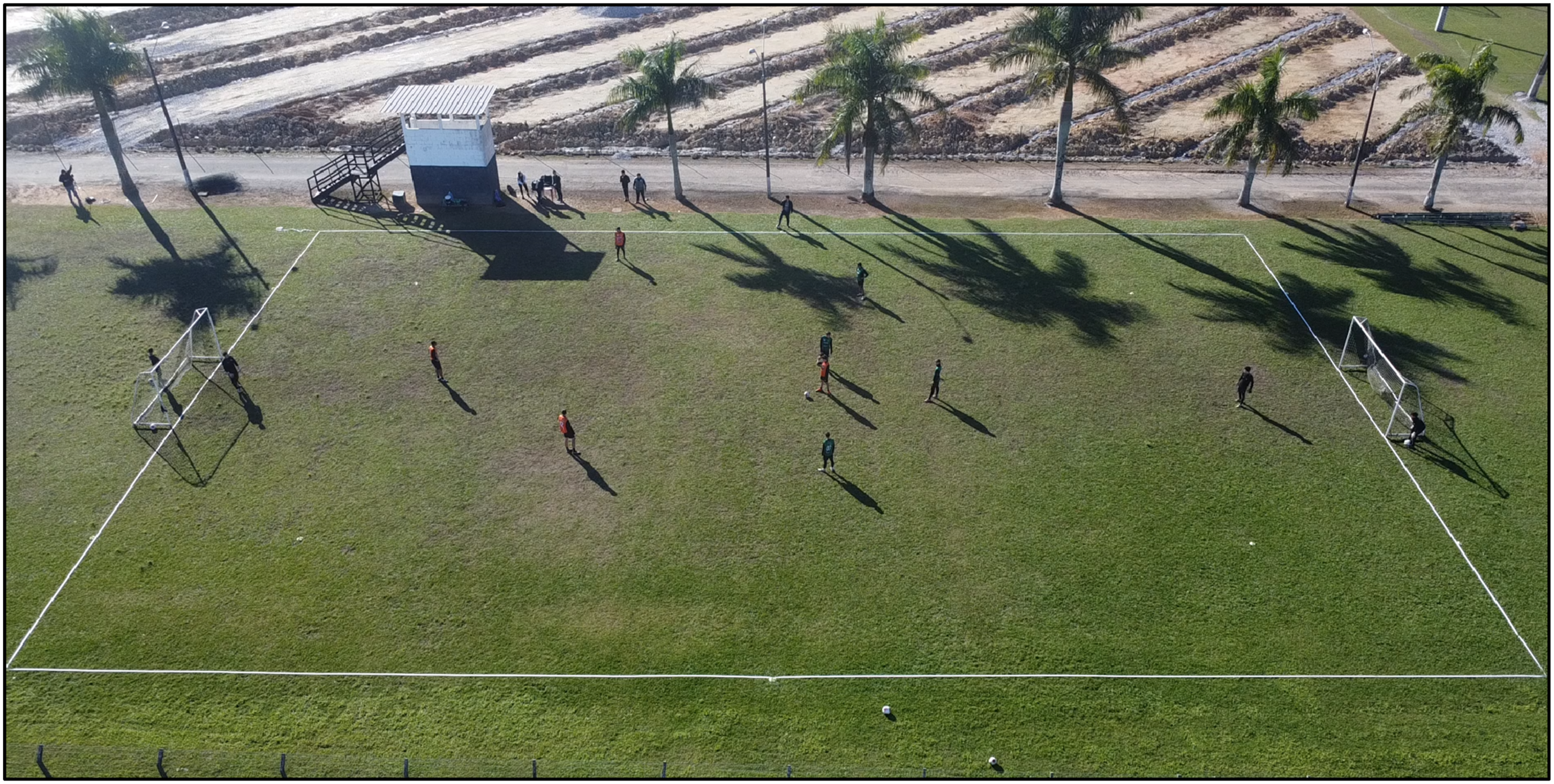
Instruments
Individual On-ball Creativity in Small-Sided Games
To assess players’ creativity during small-sided games, a notational analysis method was employed with the support of Lince® software (Soto-Fernández et al., 2022). Based on notational analysis and guided by the Creative Behavior Assessment in Team Sports (CBATS) observational matrix (Santos et al., 2016; Santos et al., 2017), players’ on-ball actions were classified into four components: attempt (unsuccessful non-standardized actions), fluency (successful standardized actions), versatility (successful non-standardized actions), and originality (versatile actions with a relative frequency below 5%). Standardized actions refer to a stereotyped execution pattern - for instance, passing with the inside of the dominant foot - whereas using the non-dominant foot, the outside of the foot, or a lofted pass to bypass an opponent are examples of non-standardized actions. Originality was defined as successful non-standardized actions that occurred in up to 5% of the total observed actions. In the present study, the originality threshold was calculated considering the complete dataset of 597 on-ball actions. Thus, versatile actions whose relative frequency remained below this threshold were classified as original. Examples of original actions included uncommon passing and finishing solutions, such as chipped passes, toe-poke passes, backheel passes, two-touch passes, non-standard dribbles, and unconventional shooting techniques (e.g., chipped shots, bicycle kicks, and backheel shots), provided that they met the frequency criterion established by the protocol.
Thus, the components of fluency, attempts, and versatility are distinct. However, a versatile action may also be original depending on how frequently it occurs within the specific context and sample considered. A total of 597 actions were analyzed, of which 146 (∼25%) were reassessed by both the primary evaluator and a second evaluator to determine intra- and inter-rater reliability coefficients. The primary evaluator is a PhD student and researcher in sport science, with experience as an assistant coach in youth soccer categories and over four years of experience with notational analysis. The second evaluator is a master’s student and researcher in sport science, also with experience in youth soccer coaching and three years of experience with notational analysis.
Team Exploratory Behavior
Positional data were collected using 10 Hz GPS devices (WIMU PRO™, RealTrack Systems, Almería, Spain). After data collection, the raw positional coordinates were exported and processed using custom routines implemented in MATLAB (MathWorks Inc., Massachusetts, USA). This processing enabled the calculation of positional-derived metrics representing players’ spatial exploratory behavior during gameplay.
Specifically, three variables were computed to characterize players’ exploratory behavior: the Spatial Exploration Index (SEI), which quantifies the average distance of a player’s movements relative to their mean positional location; the Player’s Major Range (PMR), defined as an ellipsoidal area centered on the player’s mean position, with the X and Y axes representing the maximum spatial variation of the player’s movements during the game; and the Stretch Index (SI), which reflects mean distance between each player’s instantaneous position and their individual mean positional location throughout the game, representing the dispersion of the player’s spatial movement over time. All exploratory behavior metrics (SEI, PMR, and SI) were calculated at the individual player level (Clemente et al., 2018; Machado et al., 2022).
Statistical Analysis
The intraclass correlation coefficient (ICC) calculated from the assessed actions indicated good inter-rater reliability (ICC = 0.866; F = 7.240; p = .001) and excellent intra-rater reliability (ICC = 0.952; F = 26.579; p < 0.001), according to the classification proposed by Cicchetti (1994): unacceptable (<0.70); fair (0.70–0.79); good (0.80–0.89); and excellent (≥0.90).
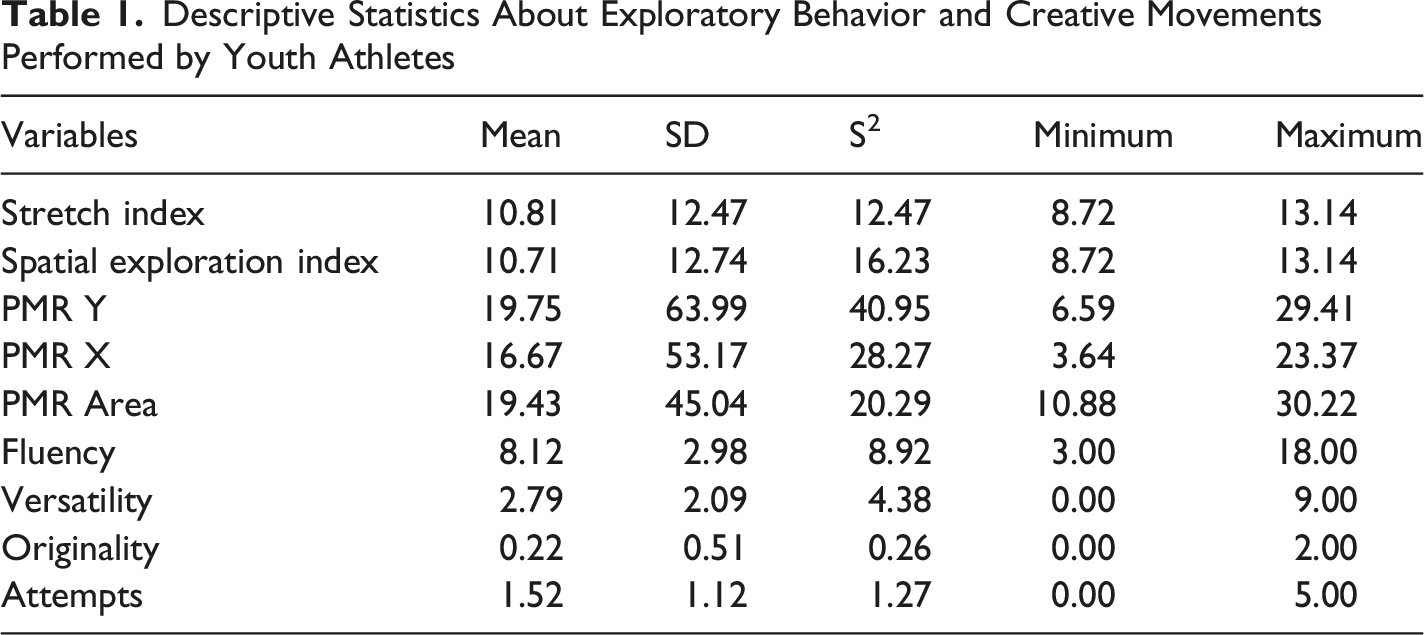
Descriptive statistics were calculated for all variables (mean, standard deviation, variance, minimum, and maximum). The Shapiro-Wilk test was used to assess normality. To reduce dimensionality while preserving relevant variance in the exploratory behavior dataset, a Principal Component Analysis (PCA) with varimax rotation was performed.
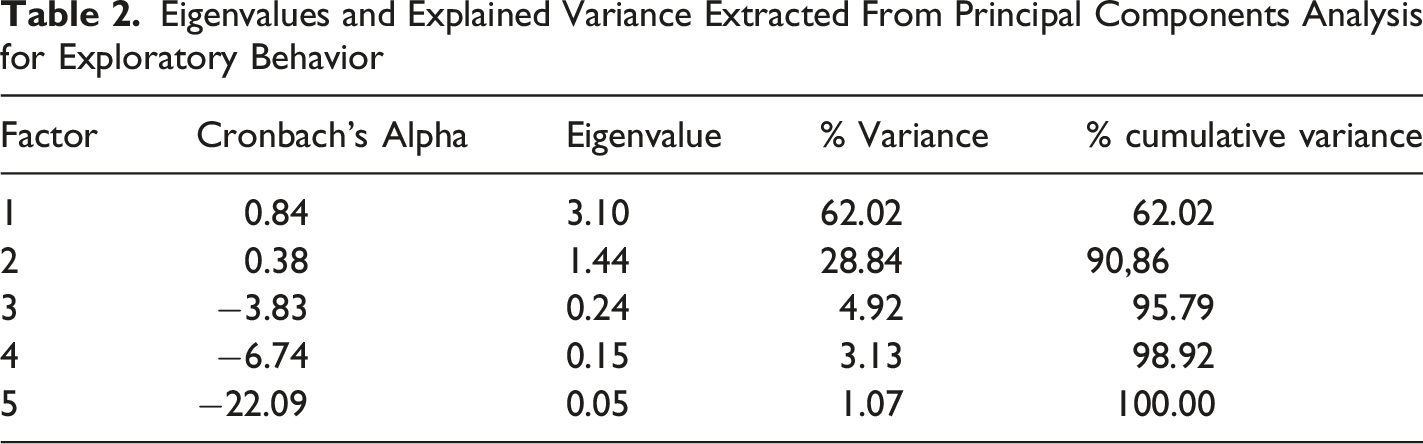
Two components were retained based on eigenvalues greater than 1.0 and visual inspection of the scree plot, accounting for 90.86% of the total variance (Table 2). Although the literature in sport science varies in its criteria for factor loading retention (ranging from 0.40 to 0.70), in this study, we retained the three original variables that showed higher loadings (≥0.80) on the principal components, following the recommendations of Hair et al. (1998) and Rojas-Valverde et al. (2020). This decision was made to preserve the interpretability of domain-specific constructs (e.g., Spatial Exploration Index), as component scores are linear combinations that may lack intuitive meaning in applied contexts. Nevertheless, we acknowledge that components are not equivalent to factors in a strict psychometric sense (De Winter & Dodou, 2012), and future research may benefit from comparing both approaches.
Subsequently, a K-means cluster analysis was performed using the retained variables (Stretch Index, Spatial Exploration Index, PMR Area), creating two relatively homogeneous groups: high and low exploratory behavior. The optimal number of clusters (k = 2) was determined based on the elbow method and inspection of within-cluster sum of squares (Table 3).
To test the effects of game position and exploratory behavior on creative variables (fluency, versatility, originality, and attempts), a Generalized Linear Model (GLM) with interaction terms was applied. Assumptions of GLM were checked, including normality of residuals, absence of multicollinearity, linearity of relationships, and homogeneity of variance-covariance matrices (Box’s M test: F = 1.06; p = .36). Post hoc comparisons were adjusted using the Bonferroni method. Statistical significance was set at p < 0.05. All analyses were conducted using Statistical Package for the Social Sciences (SPSS - version 29 for Windows, IBM Corporation®, New York, USA).
Results
Descriptive Statistics About Exploratory Behavior and Creative Movements Performed by Youth Athletes
Eigenvalues and Explained Variance Extracted From Principal Components Analysis for Exploratory Behavior
Correlations Between Exploratory Behavior Measures and Factors Extracted From Principal Component Analysis
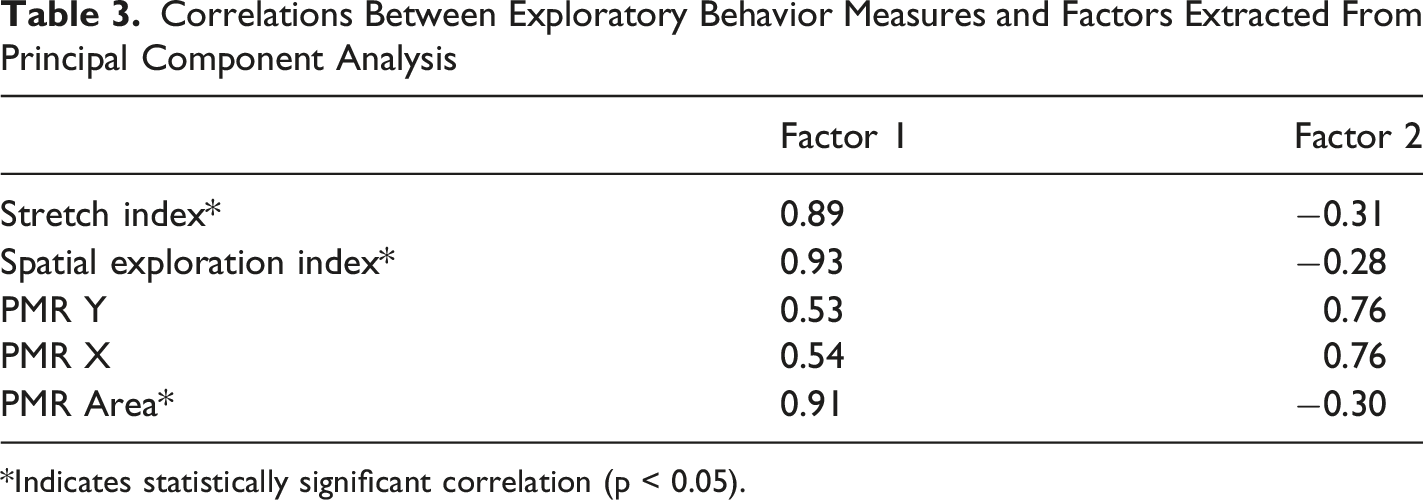
*Indicates statistically significant correlation (p < 0.05).
Comparison of the Creative Actions Performed by Young Players Considering Game Positions and Exploratory Behavior Clusters
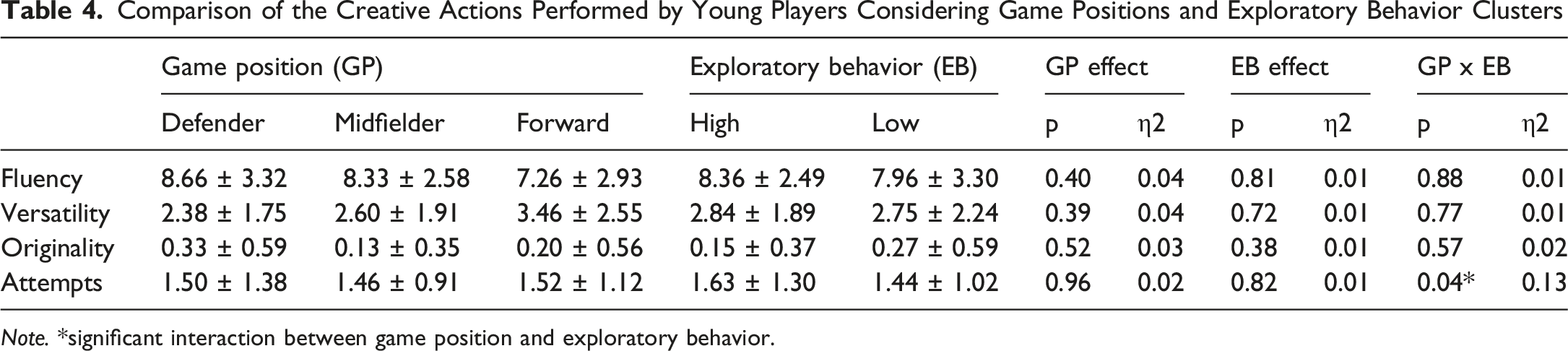
Note. *significant interaction between game position and exploratory behavior.
The inferential analysis showed that neither game position (mean p = .56) nor exploratory behavior (mean p = .68) had a statistically significant effect on players’ fluency, versatility, originality, or number of attempts. However, there was an interaction between both factors (p = .04) for attempts. In this case, high exploratory behavior performed by the defenders increased the number of attempts during the game (p = .02; η2 = 0.11).
Discussion
The aim of this study was to investigate how exploratory behavior supports the emergence of creative actions in small-sided soccer games (SSGs). The main findings revealed that spatial exploratory movement did not directly increase creativity component of on-ball offensive actions overall; however, defenders with higher exploratory behavior performed more unsuccessful, non-standardized plays.
When comparing creative actions among young players across game positions and exploratory behavior clusters, the results showed that, generally, neither game position (GP) nor exploratory behavior (EB) alone significantly influenced most creativity measures, including fluency, versatility, and originality. This suggests that either the specific SSG format used (GK4 vs. 4 GK with 175 m2 per player) or inherent variability in specialized (up to investment) phases (Côté & Vierimaa, 2014) among young players may have attenuated broader effects on these creative dimensions.
However, an interaction effect emerged between game position and exploratory behavior for the variable ‘attempts’. Specifically, defenders with high exploratory behavior exhibited a greater number of attempts compared to other player groups. For defenders, this increased exploratory behavior may reflect a greater willingness to engage in diverse actions, which could be considered an adaptive trait, enabling them to contribute more dynamically beyond their primary defensive role (Silva et al., 2018).
Although offensive roles, such as midfielders and forwards, typically produce more attempts due to their attacking responsibilities (Bloomfield et al., 2007; Clemente et al., 2015), the finding that defenders with high exploratory behavior also increased their number of attempts highlights the potential value of encouraging exploratory tendencies among defensive players. This aligns with contemporary sport pedagogy, which emphasizes nurturing creativity and adaptability throughout youth development (Santos et al., 2023).
Encouraging exploratory behavior, particularly among defenders, may help cultivate more adaptive, flexible, and creative responses to dynamic game scenarios (Hristovski et al., 2011). Practically, this could involve manipulating task constraints in training (e.g., pitch size, numerical relations, or goal positioning) to create contexts where defenders are required to actively participate in offensive phases. Despite these promising findings, the results also highlight the complexity of the relationship between exploratory behavior and creativity. Creativity development in soccer is a long-term process requiring sustained exposure to rich practice environments, supported by well-designed tasks and targeted feedback (Santos et al., 2023).
In this sense, exploratory behavior should not be interpreted as inefficiency or randomness, but rather as a functional process through which players actively engage with and attune to relevant informational variables in the environment, thereby expanding and refining their perception–action repertoire (Van der Kamp et al., 2019). Consistent with this interpretation, studies by Caso & van der Kamp. (2020) demonstrated that creative behaviors emerge through continuous interactions with task demands, in which exploratory actions function as a mechanism for discovering action possibilities rather than as an end in themselves.
To further contextualize these findings within a broader theoretical framework, Torrents et al. (2016) proposed a formal model supporting the idea that exploration is a prerequisite for the system to reach novel functional solutions. Importantly, in team sports, the informational basis for exploration may be expressed through multiple channels. Therefore, while greater locomotor/spatial exploration (e.g., wider displacement ranges and spatial variability) may expand the sampling of affordances, creative actions may also emerge from perceptual-decisional attunement and selection processes (e.g., scanning/observation behaviors, tactical intelligence, and efficient but atypical displacement patterns), even when overall spatial movement variability is not high (Ric et al., 2017). This pattern can be interpreted through the principle of reciprocal compensation within the framework of synergetics, whereby reduced variability in one system component (e.g., locomotor behavior) may be compensated by increased adaptability in others (e.g., perceptual or decisional processes), allowing the system to maintain functional performance.
In the context of the present study, exploration was operationalized exclusively through spatial/locomotor variability metrics (i.e., SI, SEI, and PMR area). Therefore, our measurement captured only one dimension of exploratory behavior considering that the extent to which players varied their spatial displacement patterns during play. Creative performance, however, may depend not only on how much players move across space, but also on how they engage in perceptual–motor attunement processes, detect relevant affordances, and functionally exploit them to generate effective and original solutions.
Thus, while spatial exploration may increase the variability of action possibilities it does not necessarily reflect originality or fluency, nor does it capture how players selectively attune to informational variables in the environment. Accordingly, the present findings should be interpreted in light of this partial operationalization of exploration, which emphasizes movement variability but does not directly assess perceptual–motor exploration.
Regarding methodological aspects, previous research has primarily analyzed exploratory behavior at the collective level, considering team-level measures derived from manipulations of numerical balance (Aguiar et al., 2015; Ueda et al., 2025), pitch dimensions (Folgado et al., 2019; Olthof et al., 2018), or goal positioning (Canton et al., 2020). These studies have shown that modifying task constraints can alter exploratory patterns, yet they focus on team-wide dynamics.
By contrast, the present study adopted an individual-level measure of exploratory behavior, capturing players’ individual spatial exploration and its relationship with creativity. This approach aligns with more recent perspectives that emphasize the importance of individual constraints and perceptual-decisional capacities (Santos et al., 2023). Notably, Santos et al. (2023) found that the presence of more creative players influenced both creativity metrics and the exploratory behavior of those players, highlighting the potential benefit of tailoring training tasks to individual characteristics.
Taken together, our findings suggest several practical implications. First, encouraging higher exploratory behavior among midfielders and forwards during SSGs may not automatically enhance creativity. This observation is consistent with perspectives from ecological dynamics, which suggest that creative actions emerge from the coordination of exploration with perceptual-decisional processes attuned to contextual possibilities, and not from increased movement variability per se (van der Kamp et al., 2019). Instead, promoting exploratory behavior among defenders might be particularly valuable for broadening their tactical contributions. Second, these results reinforce that spatial exploration alone may not suffice; perceptual-decisional capacities are critical for translating exploration into creative and functional game actions, aligning with previous research that highlights the role of decision-making and individual constraints in shaping creative behavior in soccer contexts (Santos et al., 2023; Travassos et al., 2013).
Although the current study employed standardized metrics and validated tools, several statistical limitations must be acknowledged. First, the decision to dichotomize the exploratory behavior variable (via clustering) likely reduced statistical power and increased the probability of Type II errors. With a sample size of 48, the design allowed detection of only large effect sizes (Cohen’s d ≈ 0.80) with acceptable power (β ≈ 0.80), limiting the ability to identify small or moderate associations.
Moreover, the interaction between game position and exploratory behavior, although statistically significant (p = 0.04), may be subject to Type M (magnitude) errors due to small sample size and potential overestimation of the effect (Gelman & Carlin, 2014; Marôco, 2014). Future studies with larger samples and continuous modeling of exploratory behavior are needed to validate and expand upon these findings.
Although GLM assumptions were tested and met, the cross-sectional design and the restricted assessment of creativity (limited to offensive on-ball actions) constrain the generalizability of the findings. Therefore, the results (e.g. particularly the null findings and interaction effects) should be interpreted with caution in light of these methodological limitations.
Future research directions include exploring these dynamics across different age categories, competitive levels, and situational contexts. Moreover, future studies should investigate how high exploratory behavior’ players influence collective tactical dynamics and how these metrics interacts with perceptual-decisional abilities to support creative performance.
To encourage effective defensive actions, it is important to promote exploratory behaviors, even when they do not result in immediate success. Coaches can manipulate task constraints to promote adaptation and decision-making. Small-sided games with numerical imbalances (2v3, 3v4) increase cognitive demands and favor defensive adjustments. Spatial alterations (e.g., smaller or asymmetrical areas) stimulate anticipation and positioning. Rules that value attempts at interception or pressure reinforce exploration. Furthermore, guided discovery approaches, with feedback focused on the decision-making process and not just the outcome, help players improve their perception and transform exploratory attempts into creative and effective defensive actions.
Conclusion
Higher exploratory behavior was not associated with greater creative performance (fluency, versatility, or originality) across playing positions. However, defenders with higher exploratory behavior performed more attempts, suggesting that exploration may increase their involvement in attacking initiatives without immediate gains in effective creativity. From a practical standpoint, coaches should not assume that simply increasing spatial exploration will enhance on-ball creativity; instead, training tasks should couple opportunities to explore with constraints that heighten perceptual–decisional demands and role-specific rules that require defenders to participate in offensive phases, thereby promoting the production of functional and original actions during ball possession.
Footnotes
Acknowledgements
The authors thank the Coordenação de Aperfeiçoamento de Pessoal de Nível Superior–Brazil (CAPES, Finance Code 001) for the master’s and doctoral scholarships conceded to Morais, Bispo and Ueda, respectively. In addition Conselho Nacional de Desenvolvimento Científico e Tecnológico (CNPQ) for the master scholarships conceded to Rodrigues.
Ethical Considerations
The current study was approved by the Human Research Ethics Committee (CEPSH) of the Federal University of Santa Catarina (Proc. 11.501).
Consent to Participate
Before the intervention, all participants were instructed on the procedures and received the Terms of Consent (TCLE) and Assent (TALE). All included participants and their guardians signed the respective terms authorizing participation.
Funding
The authors received no financial support for the research, authorship, and/or publication of this article.
Declaration of conflicting interests
The authors declared no potential conflicts of interest with respect to the research, authorship, and/or publication of this article.
Data Availability Statement
Interested researchers may request access to the data from the corresponding author.