






Abstract
The acquisition of tactical knowledge from static diagrams is common in coaching, yet players may struggle to integrate information when it is processed passively. To address this problem, encouraging mental imagery of unfolding tactical sequences while viewing static diagrams may enhance understanding of the depicted tactical structure. The present study examined whether imagination-based learning, compared with traditional study, improves the acquisition of diagram-based tactical knowledge and whether this effect depends on learners’ expertise. Thirty-six male participants (experts and novices) learned two offensive handball plays presented as four-phase static court diagrams under two within-subject conditions: study (observe and memorize) and imagination (study and mentally simulate player movements). Reconstruction accuracy and time, perceived difficulty, mental effort, and self-efficacy were assessed immediately after learning. Results showed that novices achieved significantly higher reconstruction scores in the imagination condition than in the study condition. Novices also perceived the task as less difficult in the imagination condition, whereas mental effort and self-efficacy did not differ significantly between conditions. Experts showed no significant differences between conditions on any measure. These findings suggest that when tactical information is presented in a visually stable format, imagination may function as a generative learning strategy that supports the learning and recall of diagram-based tactical representations, particularly among novices, without increasing subjective load.
Introduction
In team sports such as handball, players must constantly adapt to complex and rapidly changing tactical situations (Espoz-Lazo & Hinojosa-Torres, 2025). Understanding tactical systems (sets of coordinated movements between teammates designed to exploit defensive weaknesses) requires players to mentally represent spatial and temporal relationships between players, the ball, and the opponents (Espoz-Lazo & Hinojosa-Torres, 2025; Gréhaigne & Godbout, 1995; Vilar et al., 2012). Coaches often communicate such systems through diagrams or verbal explanations. Athletes are then expected to transform these patterns into coherent mental representations that can later be recalled and executed under pressure (Ben Chikha et al., 2024). However, the comprehension and memorization of tactical plays represent a demanding cognitive process, particularly when the material is complex or abstract (Khacharem et al., 2013a). Therefore, researchers in sport pedagogy and cognitive psychology have long sought instructional methods that can optimize the mental acquisition of tactical knowledge while respecting the cognitive limits of the learner (Khacharem, 2017; Peráèek & Peráèková, 2018).
One instructional approach that has received considerable attention is the use of mental imagery, defined as the internal generation or recreation of perceptual experiences in the absence of direct sensory input (Murphy & Martin, 2002). In sport contexts, imagery allows athletes to simulate movements, sequences, or strategies, thereby strengthening the underlying cognitive representations that support performance (Frank & Schack, 2017). Traditionally, imagery has been used to enhance motor skills or confidence (Callow et al., 2001; Cumming & Ste-Marie, 2001), but a growing body of research emphasizes its relevance for tactical learning, that is, the understanding and retention of collective game patterns (Frank et al., 2018; Munroe-Chandler et al., 2005). This form of cognitive general imagery allows players to mentally rehearse complex game situations involving multiple interacting elements, including teammates, opponents, and the ball.
Within the framework of Cognitive Load Theory (CLT; Sweller, 2012, 2019), imagination is conceptualized more specifically as the mental reproduction of procedures or conceptual relations in the absence of continuous external guidance (Cooper et al., 2001; Leahy & Sweller, 2005; Sweller, 2012). In this perspective, imagination constitutes a structured generative learning activity rather than unconstrained or creative ideation. In the present study, imagination is operationalized as the guided internal dynamic rehearsal of tactical sequences depicted in static diagrams. Such processing requires learners to transform externally presented spatial configurations into internally simulated action sequences, a mechanism grounded in visuospatial mental imagery and internal visualization processes (Cohen & Hegarty, 2007). This interpretation aligns with theoretical accounts emphasizing the role of mental simulation in the construction of structured cognitive representations of action (Frank & Schack, 2017; Jeannerod, 2001).
From a cognitive load perspective, the potential benefits of imagination can be understood in terms of schema construction. CLT distinguishes among three types of cognitive load: intrinsic load, which relates to the inherent complexity of the material; extraneous load, which results from ineffective instructional design; and germane load, which refers to the cognitive resources devoted to schema construction (Paas et al., 1994; Sweller, 1994). By encouraging learners to mentally elaborate relationships among informational elements, imagination may promote germane processing and facilitate the integration of tactical structures into long-term memory (Fiorella & Mayer, 2016; Hsu et al., 2014). This phenomenon, commonly referred to as the imagination effect, predicts improved learning outcomes when learners actively generate internal representations rather than passively observe instructional material (Cooper et al., 2001).
However, the effectiveness of imagination is not universal. Numerous studies have shown that its benefits depend critically on the learner’s prior knowledge (Ginns et al., 2003; Leahy & Sweller, 2005; Mguidich et al., 2024a). Novices often struggle to integrate new information because they lack stable schemas to support the generation of mental images (Mguidich et al., 2024a, 2024b). For them, imagination can impose a high intrinsic cognitive load, leading to poorer performance compared with simpler study instructions. In contrast, experts—who possess well-developed domain-specific schemas—can exploit imagination efficiently to elaborate and automate knowledge structures (Mguidich et al., 2024a, 2024b). This shift in effectiveness across levels of expertise is referred to as the expertise-reversal effect (Kalyuga, 2007). In the context of declarative tactical learning, this effect implies that instructional techniques beneficial for novices (e.g., direct observation or study) may become redundant or even counterproductive for experts, and vice versa (Mguidich et al., 2025a).
Empirical research in sports learning has provided substantial support for this notion. Mguidich et al. (2025b) demonstrated that when basketball tactics were delivered through auditory instruction, imagination improved immediate performance among expert players but hindered performance in novices. In addition, subsequent work confirmed that the imagination effect and its reversal are moderated not only by expertise but also by the modality of instructional material. For example, Mguidich et al. (2025b) reported that experts benefited most when imagery scripts were presented aurally, whereas novices improved after a delay particularly when the scripts were presented in written form.
Taken together, these findings indicate that imagination-based learning is a multifaceted cognitive process whose efficiency depends on the interaction between instructional design, expertise, and presentation format. Despite this theoretical and empirical background, several important questions remain unresolved. Most previous studies have used verbal or auditory materials describing game plays, thereby requiring participants to construct the entire spatial configuration mentally (Mguidich et al., 2025a, 2025b). Although this approach ensures ecological relevance, it also imposes high transient information load because the elements of the tactical sequence disappear as the narration proceeds (Khacharem et al., 2020). Under such transient conditions, imagination may overburden working memory, particularly for novices (Leahy & Sweller, 2011). Conversely, when the learning material is visually stable, such as in a static diagram that remains on the screen, learners can process the elements at their own pace, revisit relations between players, and organize the information spatially before simulating the sequence (Khacharem et al., 2020). The availability of a permanent visual support may thus reduce extraneous load and transform imagination into a more accessible and effective learning strategy even for inexperienced learners.
From a spatial cognition perspective, static tactical diagrams constitute forms of external visualization that learners must transform into internal dynamic representations to achieve meaningful understanding (Cohen & Hegarty, 2007). Although experimental research has predominantly focused on dynamic or verbally supported instructional formats (Rekik et al., 2020), static visualizations remain widely used in applied coaching practice across invasion team sports. For example, in football and basketball, coaches routinely rely on tactical boards, schematic diagrams, and printed playbooks to externalize spatial-temporal relations and collective organization during briefings and debriefings (Ben Chikha et al., 2023, 2024; Vorstandlechner et al., 2017). This applied coaching practice is reflected in our own experimental paradigms, which were explicitly designed to reproduce diagram-supported tactical communication (e.g., Ben Chikha et al., 2023; 2024; Khacharem, 2017). Beyond these empirical investigations, pedagogical research on team sports has long emphasized the instructional value of schematic representations of game configurations. In particular, Gréhaigne and colleagues (Gréhaigne et al., 2005; Gréhaigne & Godbout, 1995) describe diagrams of prototypical configurations as key tools for supporting the construction of tactical knowledge through the identification, discussion, and stabilization of meaningful spatial relations. Thus, despite the dominance of dynamic formats in controlled laboratory studies, static tactical representations continue to constitute a core cognitive and communicative scaffold in coaching contexts. Yet, empirical research on how imagination interacts with such static materials remains scarce. From the standpoint of generative learning theory (Fiorella & Mayer, 2016), imagination in this context could function as an active elaboration process. By mentally animating the static representation, learners engage in selection, organization, and integration of information; three processes essential for deep understanding.
Investigating such mechanisms often requires highly controlled experimental settings in which extraneous influences can be minimized. Laboratory-based studies allow researchers to isolate specific instructional processes, such as imagination versus passive study, while controlling presentation format, exposure time, and task demands. Although such conditions inevitably simplify the complexity of real sporting environments, they provide an important first step in identifying underlying cognitive mechanisms before examining their effectiveness in more ecologically valid training contexts. The present study therefore aims to extend previous findings by examining the effects of imagination-based learning compared to a traditional study-based approach in the acquisition of representational tactical knowledge from static diagrams. Specifically, it investigates whether the effectiveness of imagination varies as a function of learners’ expertise level (novice vs. expert). Based on prior research on the imagination effect, cognitive load theory, and expertise reversal effect, two main hypotheses were formulated. Although prior studies often reported greater benefits of imagination for experts in transient verbal or auditory formats, we hypothesized that the stable visual support provided by static diagrams may alter this pattern and make imagination particularly beneficial for novices. In contrast, experts were expected to perform equally well in both conditions, reflecting efficient schema-based processing.
Methods
Participants
An a priori power analysis was conducted using G*Power 3.1 (Faul et al., 2007) for an F test corresponding to a mixed repeated-measures ANOVA examining the within–between interaction. Previous related studies (Khacharem et al., 2013a, 2013b) reported partial η2 values of .18, .20, and .26. As these represent relatively large effects and were derived from a limited number of studies, we adopted a more conservative approach and based our calculation on a medium effect size (Cohen’s f = .25) to reduce the risk of overestimating the true effect. The analysis assumed an alpha level of .05, a desired statistical power (1−β) of .80, two groups (novices vs. experts), two repeated measurements (imagination vs. study), and a correlation among repeated measures of .50. Based on these parameters, the required total sample size was estimated at N = 34. Thirty-eight male participants were initially recruited for the study. Two participants discontinued the experiment before completing all phases of the procedure and were therefore excluded from the analyses. The final analyzed sample consisted of thirty-six participants (N = 36), with a mean age of 22.1 years (SD = 2.9), divided into two groups according to their level of expertise in handball. The expert group (n = 18, M age = 20.0, SD = 1.8) had on average 10.4 years (SD = 2.3) of competitive experience and were all active players competing at national or semi-professional levels. The novice group (n = 18, M age = 24.3, SD = 1.9) were not regular handball players but were familiar with the general principles of team sports and tactical diagrams. All participants reported normal or corrected-to-normal vision and no previous knowledge of the specific tactical plays used in this study. Informed consent was obtained from all participants, and the study adhered to institutional ethical guidelines for research involving human participants.
Material
Two offensive handball plays were designed for the experiment in collaboration with an experienced professional coach, aged 53, who had previously competed at the national level and held a level-4 federal coaching certification. Each play represented a realistic offensive situation in which five attacking players executed coordinated movements, such as passes, screens, and cuts against seven passive defenders, culminating in a shooting opportunity. These tactical sequences were designed to reflect authentic game dynamics while remaining simple enough for experimental control. Each play was divided into four distinct phases, presented as static diagrams on an ASUS Zenbook UX480FD-BE027 T laptop. In the diagrams, offensive players were represented by blue numbered circles, defenders by green triangles, and arrows indicated player movements, passes, or shots (see Figure 1). The segmentation into four phases was a deliberate design choice intended to balance ecological plausibility with cognitive control. This number of diagrams allowed the tactical sequences to retain sufficient structural complexity to require integration of spatial-temporal relations, while remaining manageable within working-memory constraints and avoiding excessive intrinsic cognitive load that could mask instructional effects. Moreover, this level of segmentation is consistent with previous experimental research on tactical learning using static representations (e.g., Ben Chikha et al., 2023, 2024), as well as with short offensive patterns commonly depicted in coaching diagrams. Screenshots of static diagram representations of two offensive handball plays across four phases. (a) Recall reconstruction task for the first handball tactical sequence (17 scorable elements) (b) Recall reconstruction task for the second handball tactical sequence (18 scorable elements)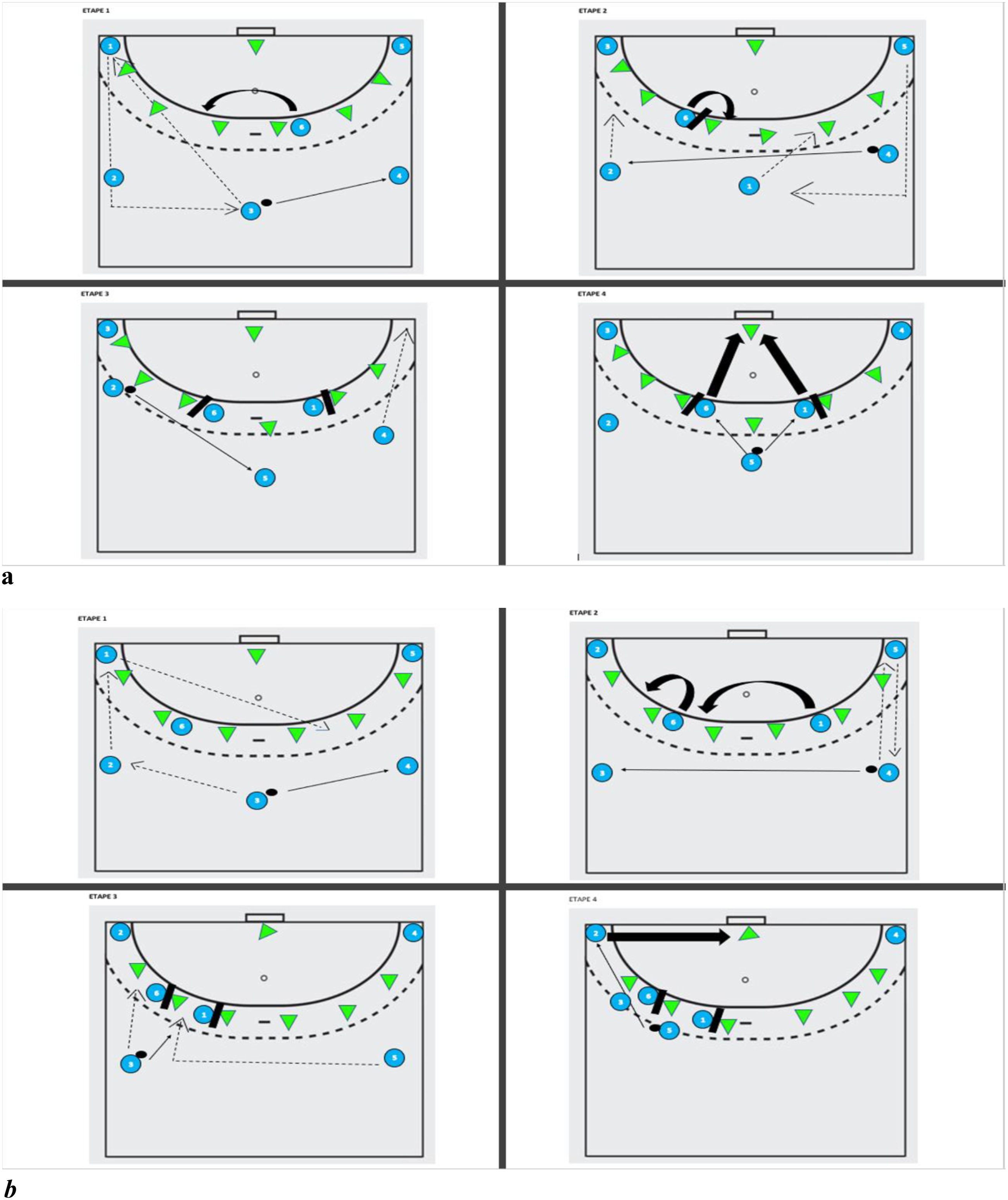
Experimental Conditions
The experiment included two instructional conditions. In the study condition, participants were presented with the four static diagrams representing successive phases of the play. Each phase remained visible for 40 seconds, during which participants were instructed to study and memorize the tactical configuration as accurately as possible. They were told to focus on player positions, movements, and relationships between teammates. The diagrams appeared sequentially, with no possibility of returning to previous images. In the imagination condition, the total exposure time per phase was also 40 seconds, but the task was divided into two parts. For the first 20 seconds, participants observed and memorized the diagram; during the next 20 seconds, following an auditory signal, they closed their eyes and imagined the unfolding of player movements corresponding to that phase. They were encouraged to generate a detailed internal simulation of the action sequence by mentally reproducing each player’s movement, pass, and shot trajectory. Participants could briefly reopen their eyes if they needed to confirm specific details before resuming their imagination. Both conditions contained identical content, duration, and visual presentation. They differed only in the learning strategy encouraged during encoding: passive observation versus active mental simulation. The assignment of tactical plays to instructional conditions and the order of condition presentation were counterbalanced across participants, such that each play appeared equally often in each condition and in each presentation order.
Dependent Variables
Recall Reconstruction Task
The recall reconstruction task evaluated participants’ ability to accurately remember and reproduce tactical sequences. Furthermore, this task was intended to assess representational (declarative) tactical knowledge acquired from the static diagrams rather than functional performance in dynamic play. Participants were instructed to redraw the four phases of each play on a blank handball court diagram, indicating the actions and positions of all players. Two independent raters, who were blind to the experimental conditions (imagination vs. study), scored all reconstruction protocols. Raters evaluated the accuracy of player and ball positions as well as the correctness of tactical actions (e.g., passes, screens, movements, shots). Each correctly reproduced element was awarded one point, whereas incorrect or omitted elements received no points. Inter-rater reliability was assessed using Cohen’s kappa, which indicated almost perfect agreement (κ = 0.91). Any discrepancies between raters were resolved through discussion until consensus was reached. Each correctly recalled element (such as passes, shots, screens, player movements, pivot slides, and ball positions) was awarded one point. However, a score of zero was assigned when a participant reproduced a player’s position inaccurately relative to the reference diagram, misplaced the ball trajectory, or indicated an incorrect tactical action or movement (e.g., wrong direction of movement, incorrect pass sequence, or inappropriate relational configuration between players).
Because the two tactical sequences contained slightly different numbers of scorable actions (17 in the first sequence, Figure 1(a), and 18 in the second, Figure 1(b)), and their order of presentation was counterbalanced, reconstruction performance was calculated as the percentage of correctly recalled elements relative to the total possible score for each play. This normalization ensured that performance scores were directly comparable across both tactical situations and participants.
Recall Reconstruction Time
The drawing time (in seconds) was recorded using a digital chronometer by the first author. Timing began when the participant initiated the reconstruction and ended when the participant indicated completion of the drawing task. As this measure involved a single continuous objective timing recorded with a digital device, additional inter-rater reliability assessment was not considered necessary.
Mental Effort
The cognitive load related to mental effort was assessed using a 9-point subjective rating scale developed by Paas (1992). Participants were asked to respond to the statement: “Please indicate how much mental effort you invested to learn the material.” Ratings were made on a scale from 1 (“very low”) to 9 (“extremely high”). Previous research has demonstrated that this scale constitutes a reliable, valid, and minimally intrusive indicator of cognitive load, capable of detecting subtle variations in mental effort (Paas et al., 2016).
Perceived Difficulty
Perceived task difficulty was measured using a separate 9-point subjective rating scale (Hasler et al., 2007). Participants evaluated the statement: “How difficult was it to learn the material?” Responses were recorded on a scale ranging from 1 (“very low”) to 9 (“extremely high”).
Self-Efficacy
Self-efficacy was assessed after the learning phase. Participants rated the extent to which they believed they had mastered the game system using a 9-point scale adapted from Hoogerheide et al. (2018). The statement presented was: “To what extent do you feel confident that you have mastered learning the game system?” Ratings ranged from 1 (“very, very unconfident”) to 9 (“very, very confident”).
Procedure
The experiment was conducted in a quiet, controlled laboratory setting. Each participant completed the study individually in a session lasting approximately 15 minutes. Upon arrival, participants were reminded of the study’s purpose, signed informed consent, and received standardized instructions. Novices completed a one-minute familiarization phase to learn the meaning of visual symbols (player markers, arrows, and action types) and performed a short practice task to ensure comprehension of the notation. Experts were directly introduced to the experimental tasks, as they were already familiar with tactical schematics. Each session began with a 3-s countdown displayed on the screen before the first diagram appeared. In both conditions, the four diagrams were presented sequentially according to the learning instructions of the assigned condition (study or imagination). After viewing all four phases for each condition, participants completed an immediate recall task. Once this task was completed, participants evaluated the mental effort they invested during learning, the difficulty they perceived in the task, and their self-efficacy (confidence in their performance). The entire experimental procedure was standardized across participants, and the researcher provided no performance feedback during the task.
Statistical Analyses
The data were analyzed using mixed design ANOVAs, in which learning condition (imagination vs. study) was a within-subjects factor and expertise level (expert vs. novice) was a between-subjects factor. These analyses aimed to examine both the main effects of instructional condition and expertise, as well as their interaction effects, on the study’s dependent variables (reconstruction performance, reconstruction time, task difficulty, mental effort, and self-efficacy).
For all statistical tests, the significance threshold was set at p < .05. Partial eta squared (ηp2) values were reported to estimate effect sizes for each main and interaction effect, with benchmarks of 0.01, 0.06, and 0.14 corresponding to small, medium, and large effects, respectively. When significant interactions were identified, Bonferroni post-hoc analyses were carried out to compare groups pairwise. In addition, Cohen’s d was computed to quantify the magnitude of significant mean differences, with 0.20, 0.50, and 0.80 interpreted as small, medium, and large effects, respectively. All data analyses were performed using Statistica software.
Results
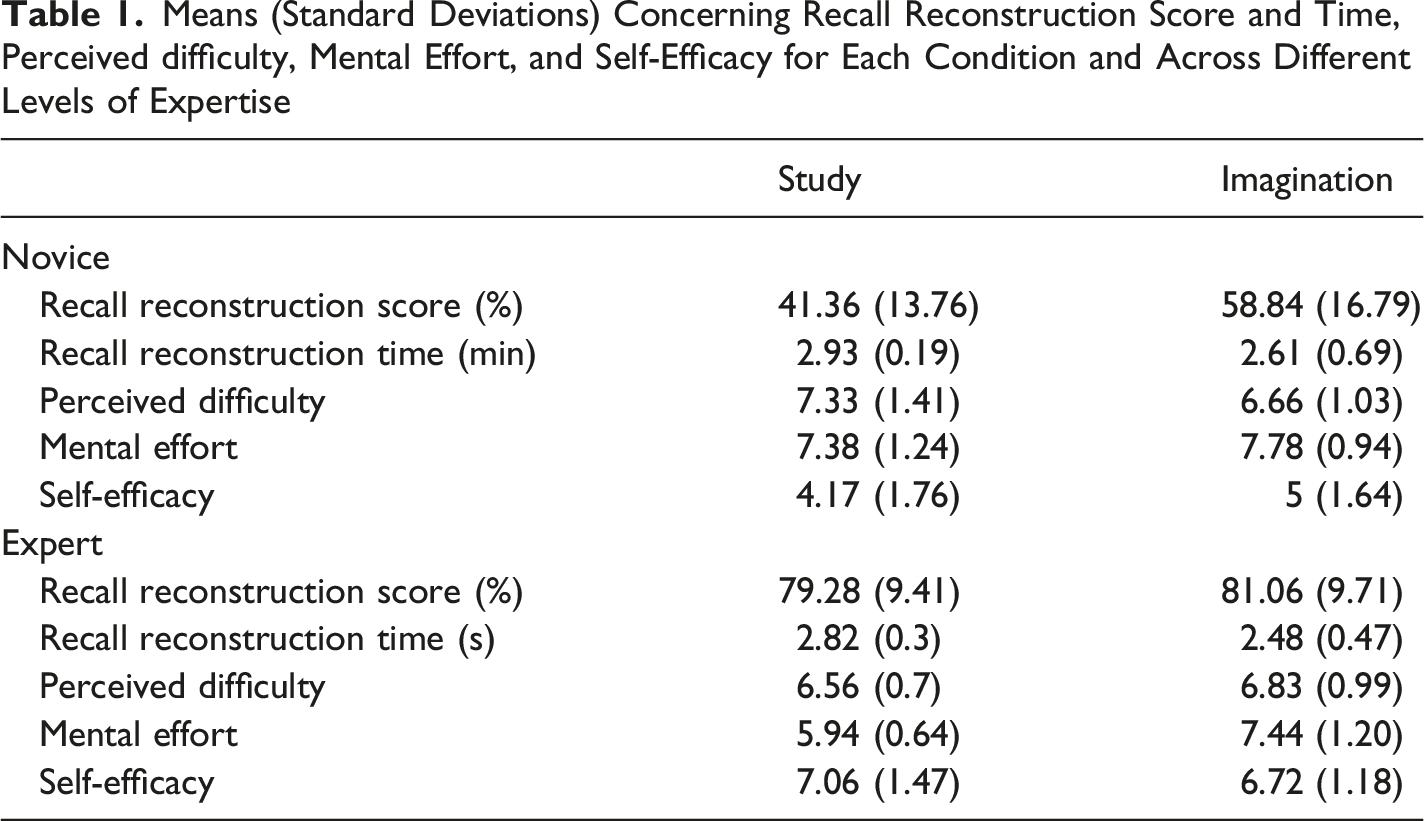
Means (Standard Deviations) Concerning Recall Reconstruction Score and Time, Perceived difficulty, Mental Effort, and Self-Efficacy for Each Condition and Across Different Levels of Expertise
Recall Reconstruction
A 2 (Condition: imagination vs. study; within-subjects) × 2 (Expertise: novice vs. expert; between-subjects) mixed ANOVA revealed a significant main effect of Condition (F(1, 34) = 11.688, p = .002, η p 2 = .256), indicating that overall, participants in the imagination condition (M = 69.95, SD = 17.6) achieved higher reconstruction scores than those in the study condition (M = 60.32, SD = 22.47). There was also a significant main effect of Expertise, F(1, 34) = 88.363, p < .001, η p 2 = .722, indicating that experts showed higher scores (M = 80.17, SD = 9.47) than novices (M = 50.10, SD = 17.54). Finally, the Condition × Expertise interaction reached significance, F(1, 34) = 7.768, p = .009, η p 2 = .186, which suggests that the effect of instructional condition on reconstruction performance varied depending on the level of expertise.
Post-hoc Bonferroni comparisons revealed that for experts, reconstruction accuracy did not differ significantly between the imagination (M = 81.06, SD = 9.71) and study (M = 79.28, SD = 9.41) conditions (p = .97, d = .17). In contrast, novices performed significantly better in the imagination condition (M = 58.84, SD = 16.79) than in the study condition (M = 41.36, SD = 13.76), p < .001, d = 1.14. These findings indicate that imagination instructions substantially improved reconstruction performance among novices, whereas experts’ performance remained stable across instructional conditions (Figure 2). Distribution of recall scores across experimental conditions and levels of expertise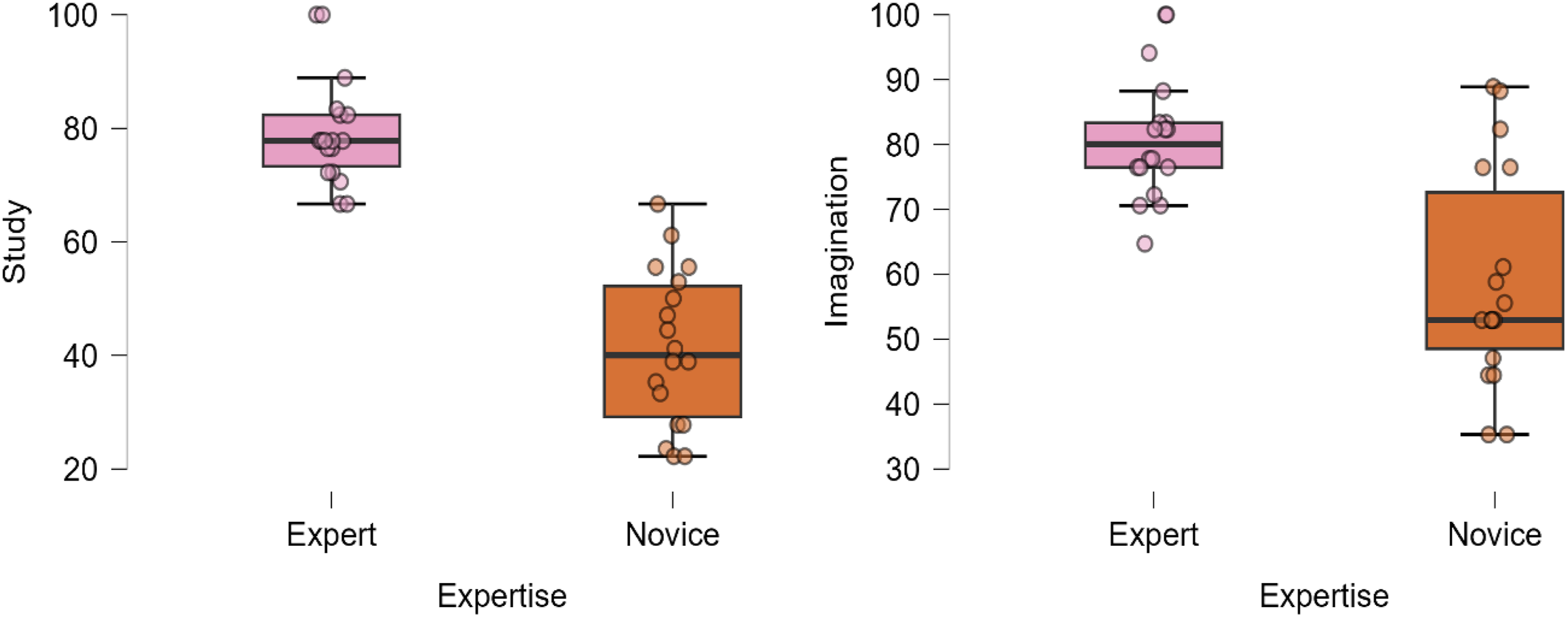
Recall Reconstruction Time
The results revealed a significant main effect of Condition, F(1, 34) = 14.24, p = .001, η p 2 = .295, indicating that participants in the imagination condition (M = 152.4 s, SD = 35.4) completed the reconstruction task significantly faster than those in the study condition (M = 172.8 s, SD = 15). The main effect of Expertise was not significant, F(1, 34) = 0.982, p = .329, η p 2 = .028. Finally, the Condition × Expertise interaction was also non-significant, F(1, 34) = .012, p = .914, η p 2 < .001. This finding indicates that the effect of instructional condition on reconstruction time did not differ by expertise level.
Perceived Difficulty Results
The results revealed no significant main effect of Condition, F(1, 34) = .972, p = .331, η p 2 = .028. The main effect of Expertise was also non-significant, F(1, 34) = 1.075, p = .307, η p 2 = .031. However, the Condition × Expertise interaction was significant, F(1, 34) = 5.733, p = .022, η p 2 = .144, indicating that the effect of instructional condition on perceived difficulty differed as a function of expertise. Post-hoc Bonferroni comparisons revealed that for experts, perceived difficulty did not differ significantly between the imagination (M = 6.56, SD = .70) and study (M = 6.83, SD = .99) conditions (p = 1.00, d = .31). In contrast, novices perceived the task less difficult in the imagination condition (M = 6.67, SD = 1.02) than in the study condition (M = 7.33, SD = 1.14), p < .001, d = .53.
Mental Effort
The results revealed no significant effects of learning condition (F(1, 34) = 3.32, p = .081, η p 2 = .087), expertise (F(1, 34) = 2.615, p = .115, η p 2 = .071), or their interaction (F(1, 34) = .051, p = .823, η p 2 = .001). These results indicate that participants reported a similar level of perceived mental effort regardless of whether they learned through imagination or study, and irrespective of their level of expertise (novice or expert).
Self-Efficacy
The ANOVA results revealed a significant main effect of Expertise, F(1, 34) = 35.05, p < .001, η p 2 = .508, indicating that experts (M = 6.89, SD = 1.33) reported significantly higher self-efficacy than novices (M = 4.58, SD = 1.73). The main effect of Condition was not significant, F(1, 34) = .58, p = .452, η p 2 = .017, and neither was the Condition × Expertise interaction, F(1, 34) = 3.143, p = .085, η p 2 = .084. These results suggest that perceived self-efficacy was primarily influenced by the learners’ level of expertise rather than by the instructional condition.
Discussion
The purpose of the present study was to examine the effect of imagination-based learning, compared with a traditional study-based approach, on the acquisition of representational tactical knowledge from static diagrams. Additionally, the study investigated whether this effect varied as a function of learners’ level of expertise.
The main findings showed that novices achieved significantly higher reconstruction scores in the imagination condition than in the study condition, indicating that imagination instructions improved their reconstruction performance. Contrary to much of the previous literature on imagination and tactical learning, the present findings indicated that novices encoded and recalled the tactical sequences more effectively through imagination than through traditional study (Mguidich et al., 2024a). Previous research in sport contexts, such as in basketball tactical learning, typically reported the opposite pattern, showing that imagery benefits experts more than novices, particularly when materials were presented through text or aurally (Mguidich et al., 2024b, 2025a). These results have generally been explained by the expertise-reversal effect derived from cognitive load theory (Kalyuga, 2007; Sweller, 2012, 2019), suggesting that imagination places excessive demands on novices who lack well-developed schemas to integrate new information (Mguidich et al., 2024b).
The present findings extend this theoretical perspective by indicating that the effectiveness of imagination-based learning is not determined solely by learner expertise but is critically moderated by the representational characteristics of instructional materials. One interpretation of this divergence lies in the representational properties of the instructional format. Static diagrams provide continuous visual access to spatial relations, thereby reducing the need for learners to internally reconstruct transient information (Ng et al., 2013). From a cognitive load perspective, such stability may lower extraneous load and enable imagination processes to function as constructive mechanisms that support schema formation rather than as additional sources of cognitive burden (Sweller, 1994). In this context, imagination may facilitate the organization and integration of tactical elements into coherent mental representations, especially for learners with limited prior knowledge. This interpretation aligns with generative learning theory, which emphasizes the role of active cognitive processing in promoting meaningful learning (Fiorella & Mayer, 2016).
Complementary theoretical perspectives further support this account. Research on long-term working memory suggests that the availability of stable visual structures may facilitate chunking processes, allowing learners to encode complex relational patterns more efficiently (Ericsson & Kintsch, 1995). Similarly, dual-coding theory implies that combining externally presented spatial representations with internally generated dynamic imagery may strengthen multimodal memory traces, thereby enhancing recall accuracy (Paivio, 1991). Taken together, these perspectives suggest that representational stability may transform imagination from a cognitively demanding activity into a generative mechanism that supports learning efficiency.
Subjective measures provide additional insight into the underlying mechanisms. Although novices reported lower perceived task difficulty in the imagination condition, their reported mental effort did not significantly differ between instructional modes. This pattern may reflect changes in processing fluency rather than reductions in overall cognitive resource investment. In other words, imagination may have improved learners’ appraisal of task complexity without substantially altering the cognitive demands of the task (Sweller, 2012). The absence of changes in self-efficacy further suggests that performance gains were primarily driven by cognitive rather than motivational factors (Fiorella & Mayer, 2016).
In contrast, for experts, results showed no significant difference in reconstruction performance between imagination and study conditions, and their reconstruction time, perceived task difficulty, mental effort, and self-efficacy were similarly unaffected by instructional strategy. Experts appear capable of extracting tactical structure efficiently regardless of learning mode. This pattern aligns with cognitive load theory predictions: once learners possess well-developed domain schemas, both imagination and study can activate relevant long-term memory structures with relatively low cognitive demands (Mguidich et al., 2024a, 2024b). Experts’ ability to chunk complex spatial and temporal relations into meaningful units likely reduces the marginal benefits of additional generative prompts (Ericsson & Kintsch, 1995).
Previous studies in sport imagery have often reported stronger benefits of imagination for experts, particularly when materials are presented dynamically or when performance is assessed immediately or after a delay (Mguidich et al., 2025a). The absence of such an advantage in the present study may be attributable to the static diagram format, which may have rendered both learning modes equally compatible with experts’ pre-existing schemas. In structured visual contexts, studying diagrams may spontaneously elicit imagery processes among experts, thereby limiting the additional benefits of explicit imagination instructions. The slightly shorter reconstruction times observed under imagination may nonetheless reflect enhanced retrieval fluency, even when accuracy approaches ceiling levels.
Experts also reported significantly higher self-efficacy than novices, a pattern consistently observed in tactical learning research (Mguidich et al., 2024b). This elevated self-efficacy likely reflects accumulated domain knowledge and experience, enabling experts to approach both instructional conditions with greater confidence and autonomy. Overall, these findings suggest that experts’ performance is governed by efficient schema activation and metacognitive regulation, rendering imagination-based and study-based learning similarly effective under conditions of representational stability.
Limitations and Future Directions
Several limitations should be acknowledged. First, the tactical scenarios used in the present study were relatively simple and limited to static diagram representations. It is possible that more complex or dynamic tactical situations could produce different outcomes. Future research should therefore investigate format × expertise interactions by comparing static, dynamic, auditory, and mixed-media presentations to determine whether the observed imagination advantage for novices extends to richer or more transient contexts. This issue may be particularly relevant for expert participants, whose high baseline performance may have reduced sensitivity to detect additional benefits of imagination-based instruction.
Second, performance was measured immediately after learning, which limits conclusions about long-term retention. Previous work by Mguidich et al. (2025a, 2025b) demonstrated that the imagination effect can evolve over time: while experts often outperform novices on immediate tests, novices sometimes close the gap or even surpass experts on delayed recall, likely due to the consolidation benefits of effortful, generative processing. Thus, incorporating delayed post-tests would help clarify whether the imagination advantage observed for novices in the present study persists, diminishes, or increases after a retention interval.
Third, although the study was conducted under carefully controlled laboratory conditions to isolate cognitive processes, this setting inevitably limits ecological validity. The task required individual learning and immediate reconstruction of static tactical diagrams, which differs substantially from real handball performance involving dynamic interactions, perceptual cues, physical execution, time pressure, and team coordination. Consequently, the present findings should not be interpreted as direct evidence that imagination-based instruction enhances on-court tactical decision-making or competitive performance. At the same time, the use of a highly controlled laboratory environment represents an important first step in isolating the cognitive mechanisms underlying imagination-based learning. The study design allows researchers to examine instructional effects under well-defined conditions before testing their applicability in more ecologically valid training environments by minimizing external variability. Rather, the results demonstrate benefits at the level of declarative tactical knowledge acquisition. It remains an open question to what extent improvements in diagram-based reconstruction transfer to functional tactical behavior in authentic training or match contexts. Future research should therefore examine whether imagination-based learning facilitates transfer to dynamic video-based decision tasks, simulated match scenarios, or on-court execution under time constraints. Such studies would help determine the extent to which representational gains translate into applied tactical competence.
Another limitation concerns the operationalization of expertise. In the present study, expertise was defined primarily based on years of competitive experience and level of competition, which are commonly used indicators in sport research. However, expertise is a multidimensional construct that may also encompass perceptual-cognitive skills, decision-making quality, and domain-specific tactical knowledge. Although competitive experience is strongly associated with skill development, it does not fully capture individual differences in cognitive or tactical proficiency. Future research should consider incorporating additional objective measures of expertise, such as performance-based assessments or decision-making tasks, to provide a more comprehensive characterization of expertise levels (Ericsson et al., 1993; Mann et al., 2007).
Finally, although reconstruction accuracy provides an informative measure of representational (declarative) tactical knowledge acquired from static diagrams, it does not directly assess functional tactical understanding in dynamic, interactive contexts (e.g., decision-making under time pressure, adaptation to defenders, or on-court execution). Therefore, conclusions should be restricted to learning and recall of tactical representations rather than performance-based tactical competence. Future studies should include transfer measures (e.g., video-based decision tasks, recognition tests, or on-court execution) to evaluate whether the benefits of imagination generalize to functional tactical performance.
Conclusion
The present study suggests that imagination-based learning may facilitate the acquisition of declarative tactical knowledge when plays are presented through static diagrams. In contrast to prior research emphasizing advantages for experts, the present findings indicate that novices benefit significantly from imagination-based instruction in this context, whereas experts perform similarly under imagination and study conditions. Importantly, imagination improved reconstruction performance without increasing reported mental effort or self-efficacy concerns, and for novices it was even associated with lower perceived task difficulty.
These results indicate that presentation format, specifically the stability of static diagrams, may moderate the effects of imagination across expertise levels within diagram-based tactical learning. However, given the narrow task, single sport, and single presentation format employed, these findings should be interpreted as context-specific rather than as a general refinement of the expertise reversal effect. Further research across different sports, task types, and dynamic learning environments is necessary to determine the broader applicability of this pattern.
Footnotes
Acknowledgments
We would like to thank all students, players, and coach participating in this study.

Ethical Considerations
The studies involving human participants followed ethical standards set by the institutional and national research committee, as well as the 1964 Helsinki declaration and its subsequent amendments or similar ethical standards. All individual participants included in the study provided informed consent.
Author Contributions
Hajer Mguidich: Data curation, Formal analysis, Investigation, Software, Supervision, Visualization, Writing - review & editing.
Ben Chikha Houssem: Conceptualization, Data curation, Formal analysis, Investigation, Methodology, Software, Supervision, Validation, Visualization, Writing – original draft, Writing - review & editing.
Khacharem Aïmen: Conceptualization, Project administration, Supervision, Validation, Writing - review & editing.
Funding
The authors received no financial support for the research, authorship, and/or publication of this article.
Declaration of Conflicting Interests
The authors declared no potential conflicts of interest with respect to the research, authorship, and/or publication of this article.
Data Availability Statement
Data are available upon request from the first author.