






Abstract
This study examined whether elite Taekwondo athletes invest additional time to make better decisions under uncertainty by using a perception–action coupling task with temporal occlusion. Eighteen elite and 18 amateur Taekwondo athletes completed an embodied choice task in which they observed an opponent’s kicking action and executed a corresponding motor response. Three temporal occlusion levels were used to manipulate the amount of visual information available (T1, T2, and T3). Reaction time, prediction accuracy, and decision confidence were analyzed using linear mixed-effects models. Descriptive results showed that amateurs became slightly faster from T1 to T3, whereas elites were slower at T1 but fastest at T3. Elites also showed substantial improvements in prediction accuracy and decision confidence as visual information increased, whereas amateurs showed only modest changes in accuracy and a gradual decline in confidence. The linear mixed-effects models revealed significant effects of group, occlusion level, and their interaction for reaction time and prediction accuracy, and a significant Group × Occlusion interaction for decision confidence. These findings suggest that elite Taekwondo athletes do not simply react faster; rather, they strategically delay their responses under high uncertainty and respond more efficiently once decisive kinematic cues become available. The results support the applicability of the embodied choice framework to one-to-one combat sports and highlight the importance of training perceptual timing and anticipatory skill in Taekwondo.
Keywords
Introduction
In cognitive psychology in sports, elite athletes tend to make faster and more accurate decisions than do novices (Araújo et al., 2019; Mann et al., 2007; Silva et al., 2020; Travassos et al., 2013). In particular, open-skill sports require decision-making under constant environmental changes, time pressure, and multiple options. Therefore, response accuracy, speed, and confidence are critical factors determining performance outcomes (Chung IL Kim & Kim, 2012; Musculus et al., 2018; Raab, 2012).
To explain the complexity of such decision-making behaviors, Raab (2012) proposed simple heuristic-based rules, which later expanded into the embodied cognition perspective. This perspective posits that cognitive processes and motor execution are closely linked within a perception–action coupling structure. It suggests that measuring these processes through tasks involving actual motor responses, as in real-game situations, ensures higher ecological validity (Lepora & Pezzulo, 2015; Raab, 2017). However, previous studies have often relied on non-motor response methods such as verbal expressions (Bruce et al., 2012; Loiseau Taupin et al., 2023; van Maarseveen et al., 2018), button pressing (Bruce et al., 2012), or fine finger movements using joysticks (Savelsbergh et al., 2005).
Since these traditional methods are limited in their ability to reflect the dynamic perception–action interactions inherent in sports, they may not fully capture an athlete’s realistic decision-making capability (Huesmann et al., 2022; Travassos et al., 2013). As an alternative, the perception–action coupled choice-response paradigm allows athletes to respond via physical movement, revealing clearer differences between elite and novice performers (Hinz et al., 2022a). Recent research on handball players using defensive motor responses found that elite athletes make qualitatively superior decisions and utilize a “wait-and-see” strategy, intentionally delaying responses to ensure better quality (Aglioti et al., 2008; Ranganathan & Carlton, 2007).
However, most studies on embodied choice mechanisms have been limited to team sports like handball, basketball, or soccer (Hepler & Feltz, 2012; Musculus et al., 2018). Decision-making in team sports relies heavily on complex environmental constraints like teammate positions and ball trajectories (Williams & Jackson, 2019). This differs fundamentally from one-to-one combat sports such as Taekwondo (Araújo et al., 2019; Runswick et al., 2020). Specifically, as a one-to-one combat sport, Taekwondo requires athletes to react under extreme time pressure, relying solely on the opponent’s subtle preparatory movements and body segment kinematics (Martínez de Quel & Bennett, 2019; Ripoll et al., 1995). Supporting this, a recent study demonstrated that martial artists rely primarily on global body kinematics rather than localized cues, such as the opponent’s head or facial expressions, to anticipate kick targets (Incognito et al., 2024). In the split-second exchanges of full-body combat, the intentional response delay for information gathering—as observed in sports like handball (Hinz et al., 2022a)— could directly lead to unsuccessful defensive responses and loss of points. Therefore, it is difficult to uncritically generalize decision-making mechanisms identified in team sports to the high-stakes, one-to-one environment of combat sports (Pinder et al., 2011).
Furthermore, existing video-based studies often suffer from outcome bias by showing continuous clips of the attacker’s full movement (Farrow, 2013). While elite athletes can pick up early kinematic cues before a movement fully unfolds (Abernethy & Zawi, 2007; Gredin et al., 2023; Ripoll et al., 1995), novices can correct their predictions if the final form of the strike is exposed. Therefore, integrating a temporal occlusion technique to control the availability of kinematic cues is essential (Müller et al., 2024).
This study examined reaction time, decision confidence, and anticipation accuracy in Taekwondo athletes of different skill levels using an embodied choice task with temporal occlusion. By doing so, it addressed methodological limitations in previous research and tested the applicability of the embodied choice paradigm to Taekwondo.
Materials and Methods
Participants
Amateurs were defined as individuals with no record of athlete registration with the Korea Taekwondo Association or competition experience, no history of elite competitive sparring training, less than 5 years of Taekwondo training, and a rank of 3rd dan or lower. In Taekwondo, an athlete’s proficiency and institutional rank are formally designated by the Dan (black belt) grading system, with higher degrees reflecting advanced technical expertise and extensive training (Kukkiwon, 2020). This definition was established to clearly represent recreational practitioners who train for personal development rather than professional competition, in contrast to the elite athlete group.
Elite athletes were defined as those with a rank of 3rd dan or higher and an award record in national-level competitions within the last 5 years. All participants were selected as those without physical limitations due to neurological or musculoskeletal diseases, no history of eye surgery in the last 3 months, and static visual acuity of 1.0 or higher.
The research was conducted in accordance with the ethical principles regarding human experimentation outlined in the Declaration of Helsinki. The study protocol was reviewed and approved by the Institutional Review Board. Prior to participation, all participants were fully informed about the study’s purpose, experimental procedures, and their right to withdraw at any time, and written informed consent was obtained from all individuals.
Procedure
Experimental Design
This study applied a mixed design of 2 Groups (Elite vs.
Stimuli and Task
To measure participants’ anticipatory ability, an embodied choice task similar to actual Taekwondo sparring was used. Participants were asked to predict two types of kicks from an opponent on a screen and react as quickly as possible. The reaction conditions for the stimuli are as follows:
Reaction Time
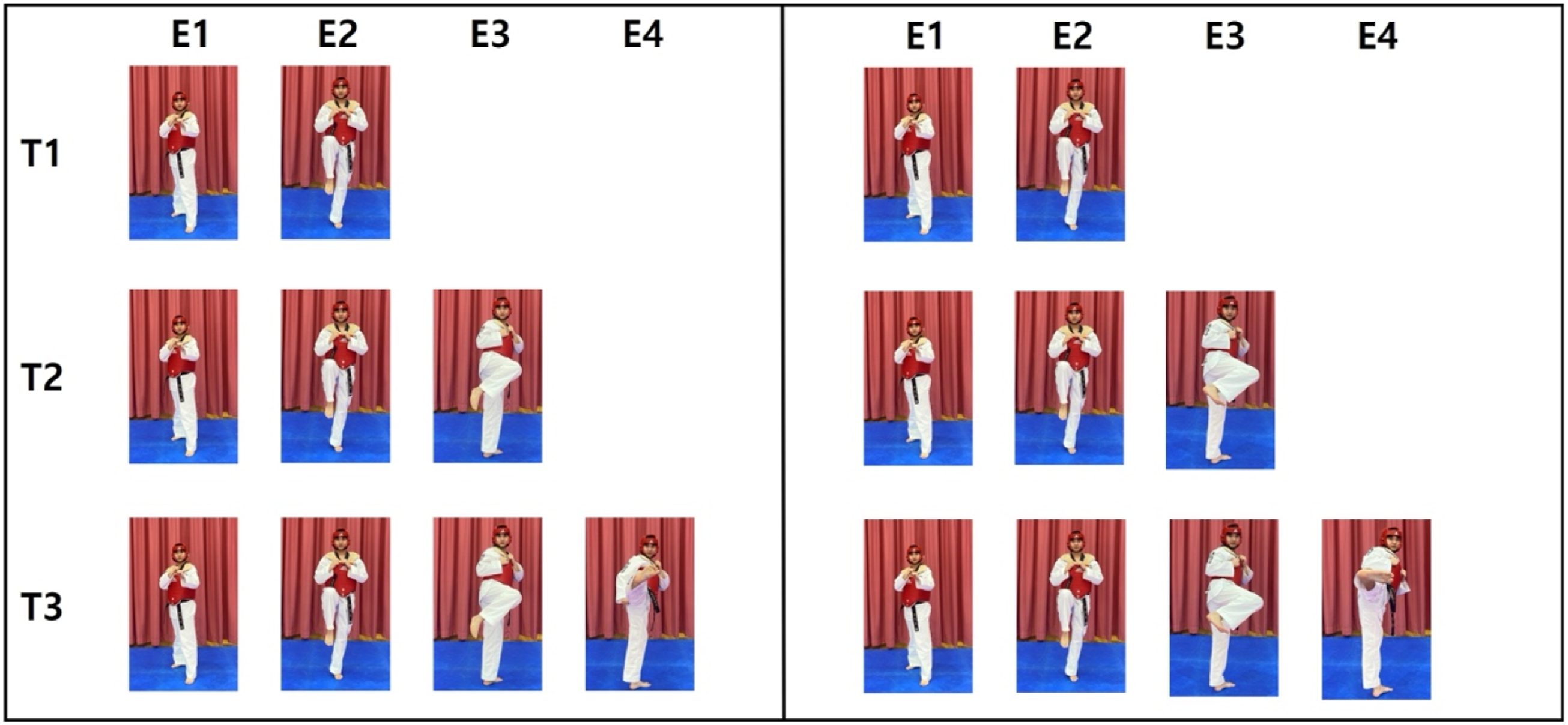
Temporal Occlusion Conditions: Each video clip was edited to cut off at specific points of the attacking motion. As shown in Figure 1, the points were set from Time 1 to 3 to control the amount of information provided. • • • Illustration of the temporal occlusion points based on the opponent’s kicking kinematics
Anticipation Accuracy
For the anticipation accuracy of the perception–action coupled response test, three types of kicks with the highest frequency of use were selected as stimuli, based on a previous analysis of World Championships where the recently revised “Best of Three” rule was applied (Kim & Kang, 2024). These consisted of (1) back-leg roundhouse kick, (2) front-leg roundhouse kick, and (3) side push kick. A pre-defined corresponding response for each stimulus was considered an accurate prediction. Specifically, responding with a counter back-leg roundhouse to a back-leg roundhouse, a back kick to a front-leg roundhouse, and a front-leg side push kick to a back-leg side push kick were defined as correct responses. All other executions were treated as incorrect.
Decision Confidence
Decision confidence was a task where participants evaluated their level of certainty immediately after performing a kick response to each stimulus. This approach directly incorporates the foundational methodology established by Steel et al. (2010), which demonstrated that measuring multi-level certainty ratings immediately following a time-constrained sport response provides a critical context for evaluating how situational constraints affect an athlete’s subjective certainty alongside objective latency.
In this study, measurement items were adapted from recent embodied choice research (Hinz et al., 2022b), and after each trial, the question “How accurate do you think your choice was?” was presented, and participants responded on a 6-point Likert scale (1 = absolutely ambiguous, 2 = ambiguous, 3 = indecisive, 4 = tendentious, 5 = unambiguous, 6 = absolutely unambiguous).
Experimental Procedure
The experiment was conducted individually in a laboratory where sound and lighting could be controlled. Participants were asked to place both feet on ground sensors installed 2 m in front of the screen and assume a sparring ready stance. Once pressure was detected on the sensors, the “Ready for Measurement” signal was confirmed in the program, and final readiness was assumed upon the measurer’s verbal signal “Ready.”
Each trial began after the participant was ready. Considering the possibility of a main testing effect where external variables are not controlled if subjects perform tasks repeatedly, 30 videos (10 each for T1, T2, T3) were presented in random order. Participants were asked to predict the attack type and perform the corresponding kick response. Reaction time and accuracy were measured immediately when the foot defending against the attack left the ground. Following the response, the participant verbally reported their confidence on a 6-point scale. The entire session took approximately 15 min.
Data Analysis
Reaction time (ms)
This was measured from the start of the video (after a random delay) until the moment the participant’s foot left the ground. A trimmed mean was calculated by excluding the maximum and minimum values from the 10 observations per Time interval.

Anticipation Accuracy (%)
Each correct response was given 10 points. Accuracy was calculated as a percentage (%) of the total points earned per Time interval relative to the maximum possible points (100).

Decision Confidence (point)
The 1–6 point Likert scale values were averaged (trimmed mean) per Time interval for final analysis.

Statistical Analysis
The independent variables of this study are the Group (2 levels) and Temporal Occlusion Level (3 levels). The dependent variables were reaction time (ms), decision confidence (points), and anticipation accuracy (%). Sample size was determined based on previous studies (Bruce et al., 2012; Hinz et al., 2022a; Raab & Laborde, 2011). These studies used MANOVA for group comparisons and reported medium-to-large effect sizes (f = 0.48). Additionally, the final effect size was calculated based on the mean and standard deviation (independent t-test results) between elite and Amateurs in a Taekwondo sparring situation provided by a previous study (Chung IL Kim & Kim, 2012) similar to this study.
Based on previous results, with settings of Test family = t-tests, Statistical test = Means: Difference between two independent means (two groups), Type of power analysis = A priori, Tail(s) = Two, Effect size d = 1.342, α = .05, Power (1−β) = 0.95, and Allocation ratio N2/N1 = 1, the minimum required sample size was 16 per group (total 32). Considering a 10% dropout rate, 36 participants were recruited.
To verify differences in the perception–action coupled-task performance between elite and amateur Taekwondo athletes, a 2 (Group: Elite, Amateur) × 3 (Occlusion Level: T1, T2, T3) mixed design was applied. Data preprocessing involved outlier testing using the Median Absolute Deviation (MAD) (Leys et al., 2013). Observations exceeding the median ± 2.5 × MAD were defined as outliers and excluded.
Statistical analysis was performed using a Linear Mixed Model (LMM). Fixed effects included Group, Occlusion Level, and their interaction, tested using Type III Sum of Squares. The repeated measure factor, Occlusion Level, was designated as SUBJECT, and a First-Order Autoregressive (AR (1)) covariance structure was applied. Parameters were estimated using Restricted Maximum Likelihood (REML), with degrees of freedom calculated via the Satterthwaite approximation.
The significance of fixed effects was tested via F-statistics. Significant main effects or interactions were followed by pairwise comparisons using Estimated Marginal Means (EMMEANS) with Bonferroni correction. All analyses were conducted using SPSS 31, with a significance level of α = .05.
Results
Descriptive Statistics
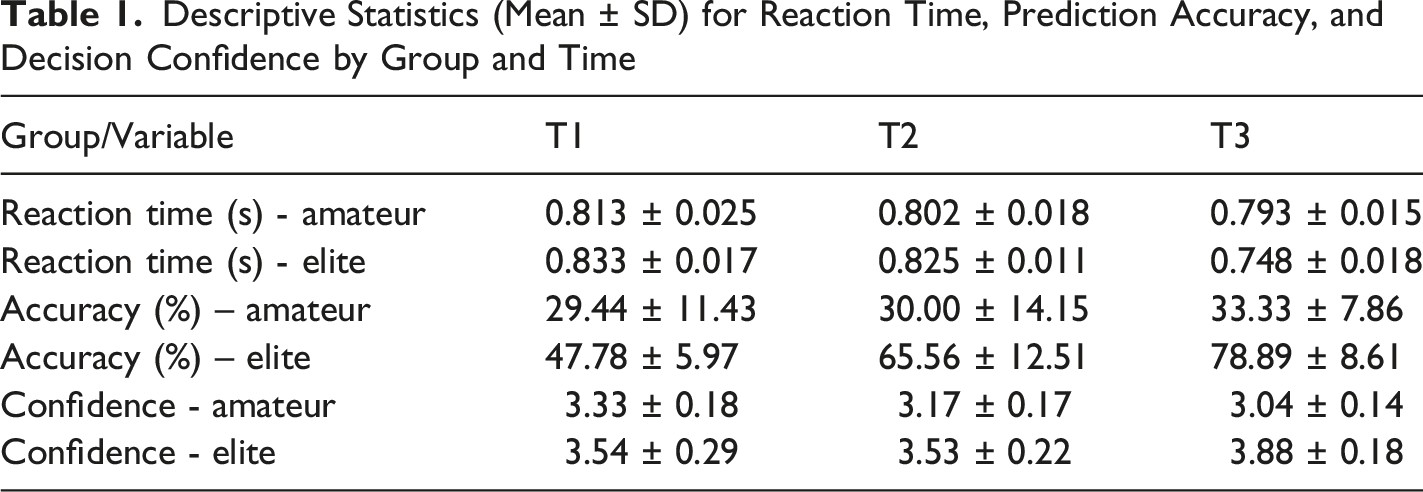
Descriptive Statistics (Mean ± SD) for Reaction Time, Prediction Accuracy, and Decision Confidence by Group and Time
Reaction Time
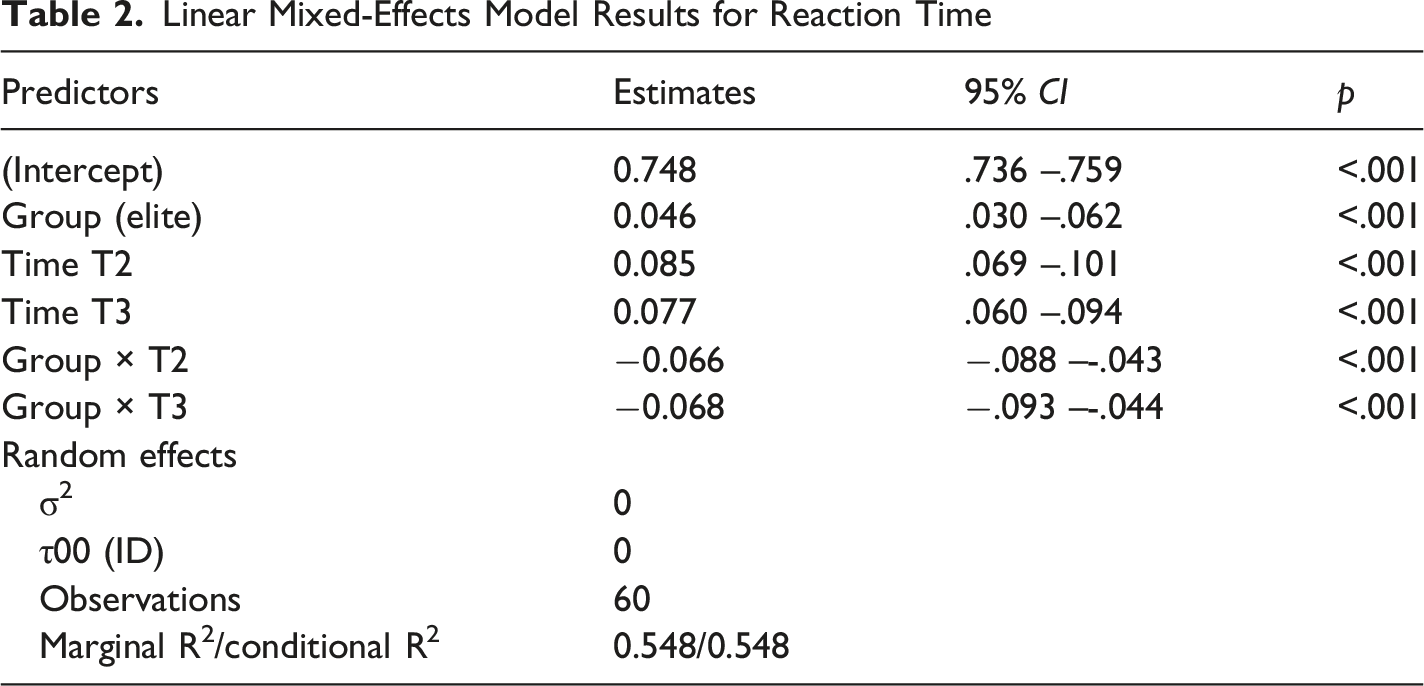
Linear Mixed-Effects Model Results for Reaction Time
Anticipation Accuracy
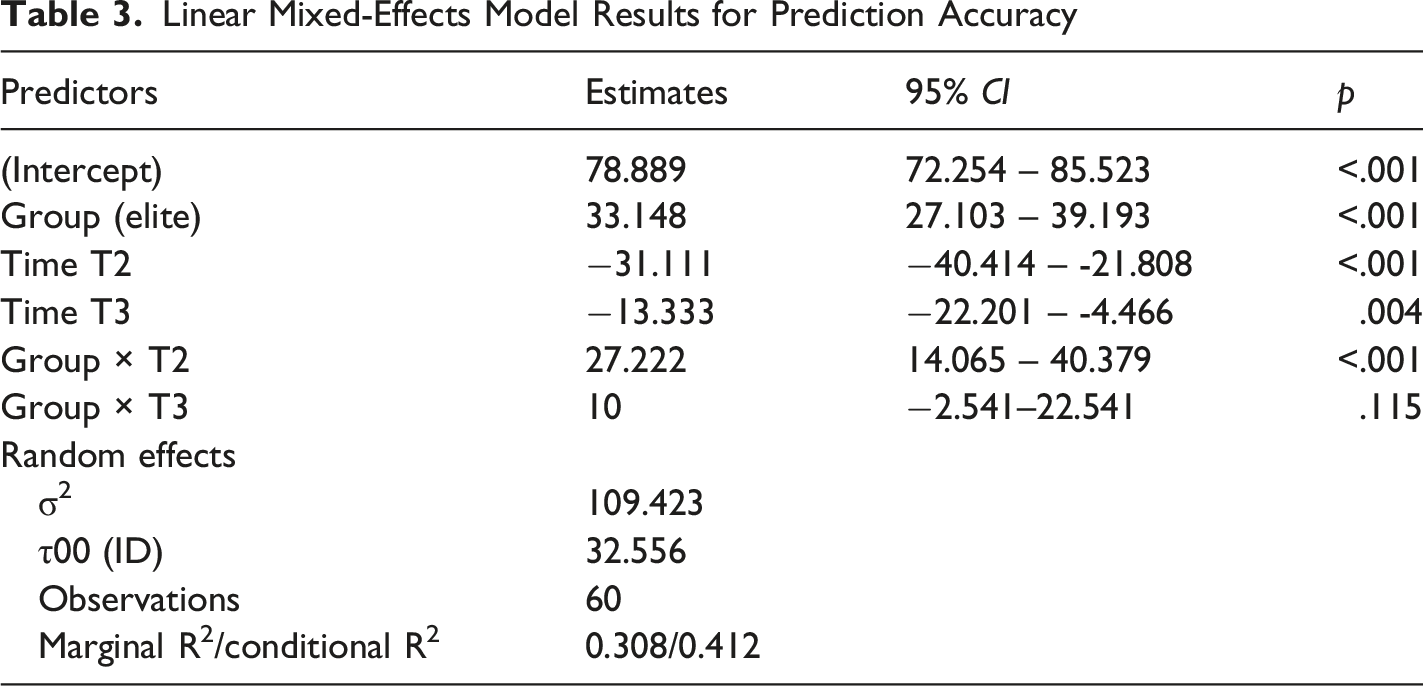
Linear Mixed-Effects Model Results for Prediction Accuracy
Decision Confidence
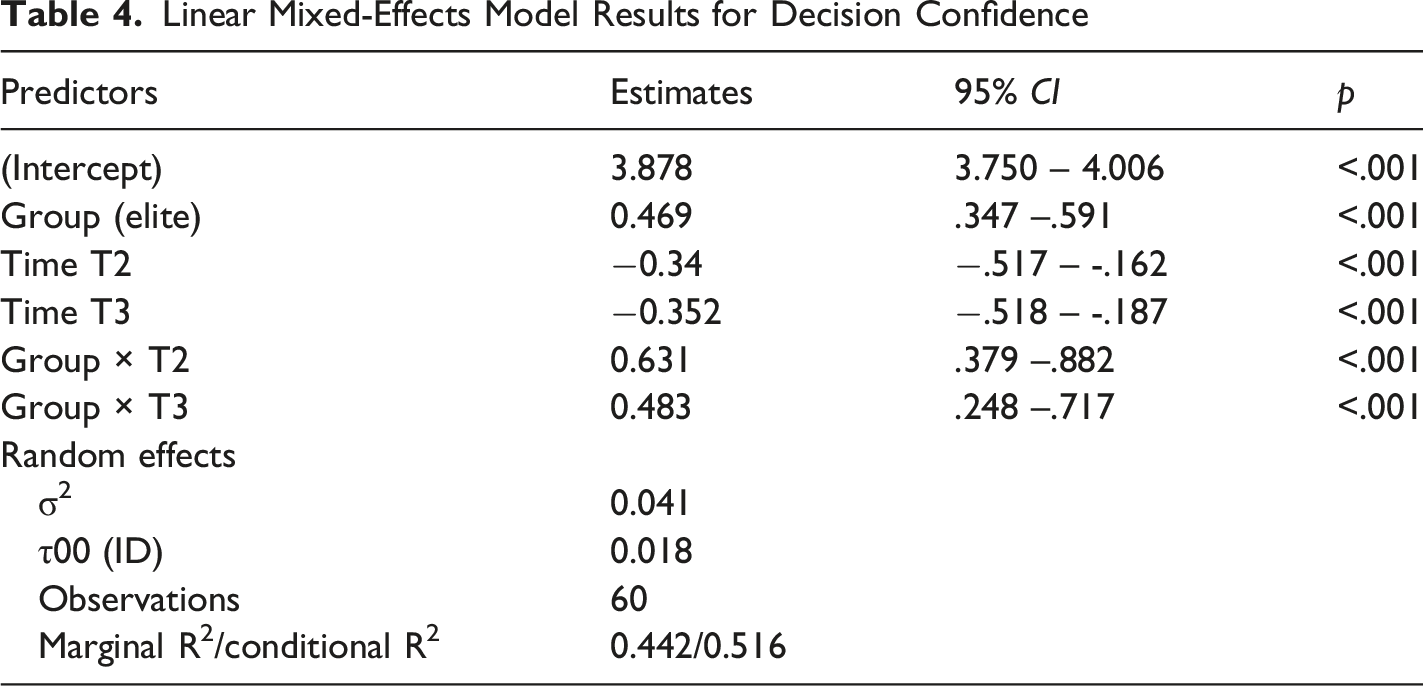
Linear Mixed-Effects Model Results for Decision Confidence
Discussion
This study examined changes in reaction time, accuracy, and confidence across visual occlusion levels in elite and amateur. The results showed that elite athletes responded significantly slower than did amateurs at T1, where information was extremely limited, but recorded the fastest response at T3, showing different timing patterns across occlusion levels. Furthermore, elite accuracy and confidence rose dramatically as information increased, while amateurs showed stagnated accuracy and reduced confidence. Unlike previous studies based on single time points, this study examined how decision-making changed as visual information accumulated.
The most notable finding is the delay in elite response at T1. This contradicts the traditional view that superior athletes consistently make faster decisions (Araújo et al., 2019; Mann et al., 2007; Travassos et al., 2013). This finding supports the view of Müller et al. (2024) that temporal occlusion is useful for capturing decision processes that are not visible in full-action displays.
These results are clearly explained by the “embodied choice” paradigm (Lepora & Pezzulo, 2015; Raab, 2017). Hinz et al. (2022b) reported that elite handball players intentionally invest time in information gathering to ensure higher-quality decisions. Elite athletes likely delayed their responses to reduce errors caused by feints and to select more appropriate defensive actions (Ratcliff & Starns, 2013). This suggests that elite athletes adjust the timing of their responses according to the level of uncertainty.
Whereas Hinz et al. (2022b) focused predominantly on team sports, the present study extends this paradigm to the one-to-one combat context of Taekwondo. In combat sports, this strategic delay may reflect highly focused attention directed toward subtle kinematic cues from the opponent’s body and lower limbs. Perceptual expertise in visual anticipation hinges upon the capacity to accurately extract kinematic cues transitioning from proximal to distal body segments (Morris-Binelli & Müller, 2017; Ripoll et al., 1995). This argument is strongly contextualized by Incognito et al. (2024), who demonstrated that spatial occlusion of the opponent’s head and facial expressions did not significantly degrade performance in martial artists, indicating that action anticipation in combat environments relies on global body kinematics rather than localized facial or head cues. Within this framework, the intentional delay observed in experts at T1 can be interpreted not as a deficit in execution velocity, but as a calculated strategic investment to accumulate macro-level kinematic motion cues from the trunk and limbs, which are critical for deciphering true tactical intent.
Thus, the delayed responses observed at T1 likely signify systematic efforts to detect early kinematic motion patterns that betray the opponent’s true tactical intentions (Morris-Binelli & Müller, 2017; Ripoll et al., 1995). As richer visual information became available at T2 and T3, elite athletes demonstrated a superior capacity to convert these cues into appropriate defensive motor actions compared to amateurs. This finding is consistent with previous literature establishing that elite athletes possess enhanced efficiency in coupling relevant perceptual cues to motor responses (Loiseau Taupin et al., 2023; Silva et al., 2020). The ability of elite athletes to rapidly process unfolding visual cues in such time-constrained environments aligns with the foundational premise of Steel et al. (2010) that subjective certainty is dynamically modulated by situational familiarity and the availability of task-specific kinematic information. Furthermore, their capacity to process these unfolding cues echoes findings that experienced performers can accurately extract familiar kinematic motion patterns within milliseconds to guide subsequent judgments, underscoring the efficiency of expert perceptual-motor coupling under severe time pressure. Conversely, amateurs exhibited a marked reduction in executing motor responses even as information was added, reconfirming a significant decline in accuracy commonly observed in less-skilled individuals during ecological tasks (Bruce et al., 2012; Huesmann et al., 2022; van Maarseveen et al., 2018).
Confidence changed in opposite directions across groups: it increased in elites but decreased in amateurs. Confidence in sports is a key variable predicting the quality and success of decision-making (Hepler & Feltz, 2012; Musculus et al., 2018). As more information became available, elites may have become more confident because later cues confirmed their initial judgments. After making blind guesses under uncertainty, amateurs likely realized their errors through visual feedback as the actual motion unfolded, causing confidence to drop. These findings suggest that decision-making is a dynamic process in which visual information, motor execution, and confidence are continuously updated in real time.
Although this study provides meaningful insights into sports decision-making research, it possesses several limitations. First, as measurements were conducted in a controlled laboratory environment using 2D screens, a limit exists to fully reflect the psychological pressure of an actual arena or three-dimensional spatial perception factors (Kredel et al., 2017). Furthermore, while the process of information acquisition was inferred, the lack of eye-tracking equipment meant that the study could not directly identify on which specific body parts of the opponent the athletes’ gaze was focused (Mann et al., 2007). Future research needs to combine Virtual Reality (VR)-based 3D environments with eye-tracking technology to more precisely analyze the causal relationship between kinematic cue acquisition and motor responses in environments that closely resemble actual competition settings.
In conclusion, Elite Taekwondo athletes do not simply react faster. Instead, they delay their responses under uncertainty and act quickly once decisive cues become available. These results suggest a paradigm shift in Taekwondo coaching—away from merely maximizing reaction time toward situational awareness and timing control training. Simulation training that combines temporal occlusion with actual kicking may help develop anticipatory skill in less experienced athletes.
Footnotes
Acknowledgments
The authors thank all participants for their valuable contribution to this study.

Ethical Considerations
This study received approval from the ethics committee and complied with the Declaration of Helsinki (HYUIRB-202509-029).
Author Contribution
Hyesoo Cho and Ji-Yong Park conceived and designed the study. Hyesoo Cho collected the data and drafted the manuscript. Ji-Yong Park analyzed the data, supervised the study, and critically revised the manuscript. Hong-Suk Kim contributed to interpretation of the findings and revision of the manuscript. Min-woo Jeon contributed to revision of the manuscript. All authors participated in drafting or revising the manuscript, approved the final version, and agreed with the content of the manuscript and the order of authorship.
Funding
The authors received no financial support for the research, authorship, and/or publication of this article.
Declaration of Conflicting Interests
The authors declared no potential conflicts of interest with respect to the research, authorship, and/or publication of this article.
Data Availability Statement
The data that support the findings of this study are available from the corresponding author upon reasonable request.