






Abstract
Accurate quantification of punch force is essential for performance assessment and training optimization in combat sports. This study introduces a Custom-Built Punch Force Dynamometer using two S-type load cells and evaluates its reliability, sensitivity, and partial ecological validity under sport-specific conditions. The device was mounted vertically on a wall and tested under both controlled and sport-specific conditions. Mechanical trials were assessed using a standardized drop-weight protocol with repeated trials. Partial ecological validity involved 11 experienced athletes from striking-based combat sports performing standardized straight punches across two lab visits. Reliability metrics included intraclass correlation coefficients (ICC), standard error of measurement (SEM), and smallest worthwhile change (SWC). The dynamometer demonstrated excellent reliability during mechanical trials (ICC > 0.90) and good to excellent reliability during partial ecological validity (ICC = 0.75–0.90). SEM values were consistently lower than SWC, indicating strong measurement sensitivity. These findings support the reliability and practical utility of this device for assessing punch force in both laboratory-based research and sport-specific applications.
Introduction
Combat sports athletes employ diverse strategies to outperform their opponents and secure victory (Dunn et al., 2022). Performance in these sports is determined by multiple factors, including mechanical, physiological, and cognitive elements such as recovery capacity and perceptual–cognitive processes that influence decision-making and execution (Jebabli et al., 2025). Within this framework, striking performance, especially punch force, is widely recognized as a key determinant of success in both training and competition (Spanias et al., 2019), either through maximizing punch power (Fritsche, 1978) or by accumulating total impact force throughout a match (Pierce et al., 2006).
Performance monitoring constitutes a fundamental aspect across various sports disciplines, with distinct metrics employed to evaluate athletes’ specific capabilities—for instance, time measurements in swimming events (Muniz-Pardos et al., 2019), critical velocity in running (Kachouri et al., 1996; Karsten et al., 2016), and power output in cycling (Driss & Vandewalle, 2013). Analogously, in combat sports, punch impact force represents a pivotal performance indicator (Lenetsky et al., 2013), providing critical information for both coaches and athletes (Uthoff et al., 2023). When measured with precision, this parameter can significantly contribute to talent identification, regulation of training intensity, and ongoing assessment of athletes’ physical condition, among other relevant applications (Akbaş et al., 2021; Finlay et al., 2023).
However, the accurate quantification of punch force has historically posed a challenge for researchers. Over the past three and a half decades (Fritsche, 1978), various instrumentation systems have been developed (Lenetsky et al., 2022). Nevertheless, the absence of a universally adopted gold-standard apparatus persists, largely due to the heterogeneity of device designs and the testing protocols. The wide range of reported impact forces, from 550 to 4890 N (Beattie & Ruddock, 2022), further complicates direct comparisons across studies and devices. Recent perspectives (Dhahbi & Chamari, 2026) underscore the necessity for greater methodological rigor and standardization in data acquisition and analysis to improve the robustness and comparability of findings (Lenetsky et al., 2022). Additionally, many existing systems feature complex user interfaces and require specialized technical expertise, which limits their practical application in field-based settings.
Although numerous studies have introduced various methods for assessing punch force, many fail to adequately address ecological validity, defined as the extent to which findings can be generalized to real-world conditions, or the reliability of their assessments (Lenetsky et al., 2022). This study employed a partial ecological validity approach, conducting tests in a controlled laboratory environment with a fixed dynamometer, while incorporating sport-specific procedures, such as standardized warm-up routines and punches executed according to typical training practices. Nevertheless, these conditions do not fully replicate the dynamic and interactive characteristics of actual combat situations. Furthermore, the absence of a universally accepted gold-standard measurement device complicates agreement across different systems. Therefore, ensuring the robustness and consistency of measurements remains essential (Lenetsky et al., 2022; Uthoff et al., 2023).
A recent review (Lenetsky et al., 2022) emphasized the importance of reporting key reliability metrics when developing punch force measurement devices, including the coefficient of variation (CV), intraclass correlation coefficient (ICC), standard error of measurement (SEM), and smallest worthwhile change (SWC). Comparing SEM and SWC, a process known as sensitivity analysis, allows researchers to distinguish meaningful changes in punch force from equipment noise or natural performance variations (Finlay et al., 2023; Hopkins, 2000, 2004).
Load cells are widely recognized force measurement transducers in sports science research (Bolander et al., 2009; Dunn et al., 2022; Lambert et al., 2018; Lenetsky et al., 2018; Lopez-Laval et al., 2020), demonstrating strong reliability and reproducibility in force assessments. Given their successful application in punch force measurement, this study aimed to develop a practical and straightforward method for measuring punch impact force using S-type load cells and to analyze its measurement properties, including mechanical trials, sensitivity, and partial ecological validity under sport-specific conditions.
Methods
Participants
Eleven participants (age: 25.27 ± 6.1 years; body mass: 82.8 ± 15.9 kg; height: 178.3 ± 7.1 cm; combat sports experience: 4.5 ± 3.3 years) were recruited based on the following inclusion criteria: healthy males aged 18 to 40 years; practitioners of Boxing, Muay Thai or Kickboxing with a minimum of one year of experience and at least two training sessions per week; no musculoskeletal injuries within the previous six months; and no use of medications or anabolic-androgenic steroids (self-reported) that could influence performance. All subjects were informed of the benefits and risks of the investigation and signed a written informed consent before data collection. The Local Human Research Ethics Committee approved the study (No. 6,259,447), and all procedures were conducted following the Declaration of Helsinki.
Customization of the Punch Force Dynamometer
The Custom-Built Punch Force Dynamometer was designed using two S-type load cells (tension/compression dynamometers; 0–2000 N; EMG System, Brazil), positioned 50 cm apart and secured fixed between two iron plates in a compression-based configuration, such that during impact the applied force was transmitted along the primary loading axis of the sensors, ensuring that both load cells operated predominantly under axial compression. The base plate measured 70 × 70 cm, with a thickness of 5 mm, and a weight of 40 kg, while the impact plate measured 55 × 32 cm, with a thickness of 3 mm and weight of 8 kg (Figure 1(A)). The dynamometer was integrated within a metal support structure with dimensions of 200 cm in height, 84 cm in width, and 30 mm in thickness (Figure 1(B)). This structure incorporated ten evenly spaced ½-inch screws on each side, positioned at 5 cm intervals, enabling adjustable height configurations to accommodate various testing conditions. (A) Details of the custom-built punch force dynamometer, (B) dimensions of the vertical platform and the overall device, (C) photographs of the finalized device installed in the laboratory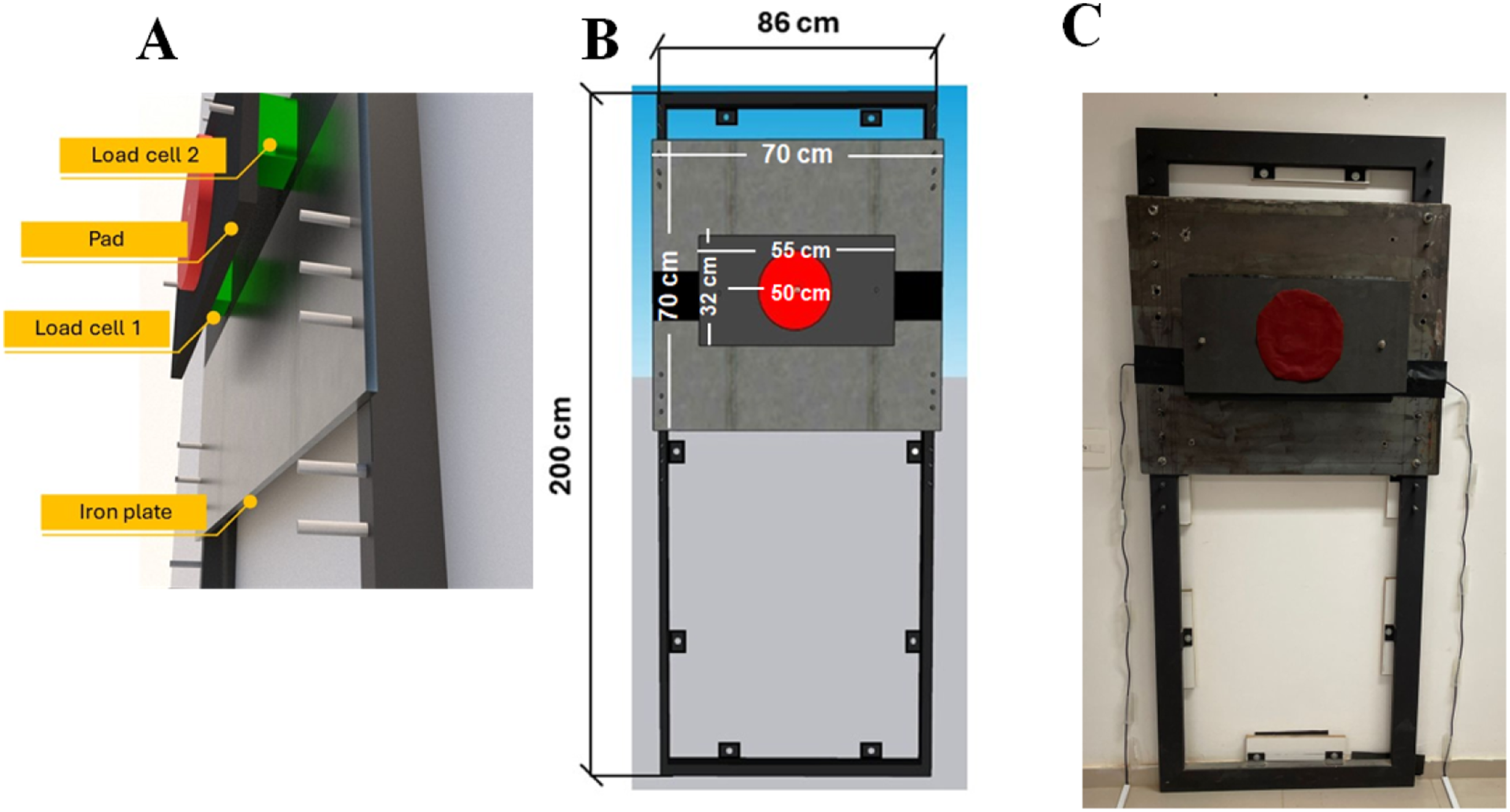
A 20 mm-thick Ethylene Vinyl Acetate (EVA) pad (55 × 32 cm) was affixed to the dynamometer, featuring a centrally marked red target to standardize striking accuracy. Data acquisition was performed using a high-resolution signal acquisition system (EMG System, Brazil) operating at 2000 Hz with communication via USB port, Ethernet (TCP/IP), and radio frequency. The signals were conditioned using a band-pass filter (20–1000 Hz) per device specifications, and digital Butterworth filtering was available in the software environment. Data analysis primarily utilized raw signals to preserve peak force characteristics, without additional smoothing. Signals from the two load cells were synchronously acquired through separate channels and summed at each time point to generate a resultant force–time signal, from which peak force values were extracted. Force measurements were recorded in newtons (N), according to the International System of Units (SI). The S-type load cells, forming the core of the Custom-Built Punch Force Dynamometer, were calibrated before each data collection session following the manufacturer’s guidelines (Finlay et al., 2023). Figure 1(C) presents a photo of the Custom-Built Punch Force Dynamometer.
Procedures
The study consisted of two distinct experimental phases. The First Phase involved controlled mechanical testing, conducted with the load-cell platform positioned on the ground to maintain a stable static configuration during impact assessments. This approach was chosen to evaluate the intrinsic reliability and consistency of the measurement system while removing human-related variables such as movement variability, coordination, and fatigue. Although this setup differed from the wall-mounted configuration used in athlete testing, the applied force followed the same structural pathway and was aligned with the primary loading axis of the sensors, ensuring consistent sensor performance across conditions. Prior to testing, a set of 200 kg weights was placed on the Custom-Built Punch Force Dynamometer, with their total mass checked using a digital scale (Toledo Prix, Model: 9094 Plus, 0–20 kg capacity). It was verified that the weight recorded by the dynamometer corresponded precisely to the value indicated by the scale (Dunn et al., 2019).
In the Second Phase, participants attended two separate visits to the laboratory, with a maximum interval of 48 h between them. During these visits, three distinct tests (Visit 1: test-retest; Visit 2: test) were conducted to assess punch impact force (Finlay et al., 2023) against the Custom-Built Punch Force Dynamometer. This experimental protocol facilitated the assessment of the equipment’s reliability, sensitivity, and partial ecological validity by approximating sport-specific conditions while minimizing potential confounding factors, including fatigue. Before data collection, participants underwent a familiarization session to standardize their punching technique and mitigate learning effects. This session involved executing three strikes with the dominant limb, followed by three strikes with the non-dominant limb against the Custom-Built Punch Force Dynamometer (order randomized).
Experimental Design of the Study Protocol
First Phase
The First Phase of the experimental protocol, designed to evaluate the mechanical trials of the measurement system, consisted of standardized free-fall mechanical trials (Figure 2(A)). The apparatus was fixed to a vertical wall during testing to ensure consistent structural stability. Two standardized test-retest procedures were conducted. For each experimental condition, five drop heights (20 cm, 40 cm, 60 cm, 80 cm, and 100 cm) were examined, with each height tested in five repetitions, resulting in 25 trials per condition. Four experimental conditions were assessed: (i) weight with EVA, (ii) weight without EVA, (iii) weight with Glove and EVA, and (iv) weight with Glove without EVA. This protocol was applied in both test and retest sessions. (A) Experimental setup for impact measurements of mechanical trials. The black rectangle highlights the free-fall trials were conducted from five predetermined heights (20 cm, 40 cm, 60 cm, 80 cm, and 100 cm) under four experimental conditions: (B) weight without Ethylene Vinyl Acetate (EVA), (C) weight with EVA, (D) weight with a glove without EVA, and (E) weight with a glove with EVA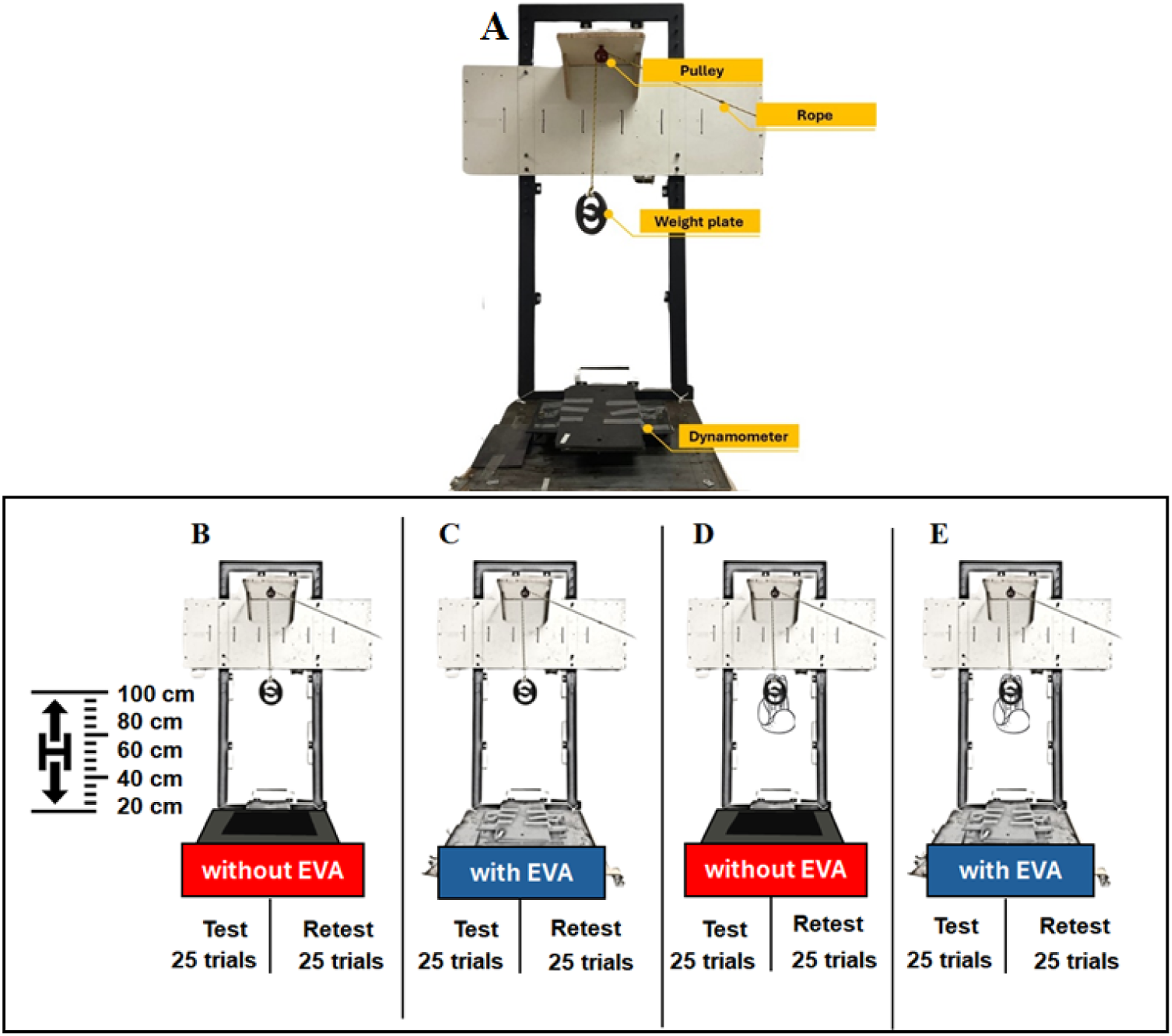
The EVA pad employed in the experiment was 20 mm thick and served to cover the impact surface of the Custom-Built Punch Force Dynamometer (Figure 2(B)–(E)). A 3 kg iron washer and a professional-grade boxing glove (Maximum, 16 oz) were used as standardized impactors to ensure consistency and reproducibility across all trials.
Second Phase
In the Second Phase of the experimental protocol, which aimed to improve the partial ecological validity of the assessment under sport-specific conditions, participants attended two laboratory sessions scheduled on non-consecutive days. At the first visit, procedures were explained to ensure understanding. After a standardized warm-up (3 min shadowboxing, 5 min rest), each participant delivered five maximal-effort rear-hand straight punches to the Custom-Built Punch Force Dynamometer in both orthodox and southpaw stances. For each condition, peak force values were extracted from each trial, and the mean of the five trials was used for analysis. One-minute rest intervals separated punch attempts to minimize fatigue. Punches were classified by stance as representing either the dominant or non-dominant limb. Following a 30-min passive recovery period, the test was repeated under identical conditions as a retest session.
During the second visit, participants completed the standardized warm-up, followed by a single punch force-testing session. The order of punching was randomized using a coin toss, with “heads” indicating the orthodox stance and “tails” indicating the southpaw stance (Kang et al., 2008). To ensure consistent execution and accurate measurement with the Custom-Built Punch Force Dynamometer, all tests were visually monitored and recorded on a smartphone (iPhone 12®, Apple Inc., Cupertino, USA) for validation. The dynamometer height was individually adjusted to each participant’s anthropometric characteristics to maintain the punching motion approximately parallel to the ground (i.e., ∼90° relative to the vertical axis; Figure 3). Participants adopted a sport-specific stance, self-selected their distance from the dynamometer (kept constant across trials), and maintained coordinated trunk and hip rotation throughout the movement. All participants wore the same standardized professional-grade boxing glove (Maximum, 16 oz) and identical hand and wrist wraps (Boxing Bandage, 5 meters – Maximum) to ensure uniform testing conditions. Straight punch and custom-built punch force dynamometer adjustment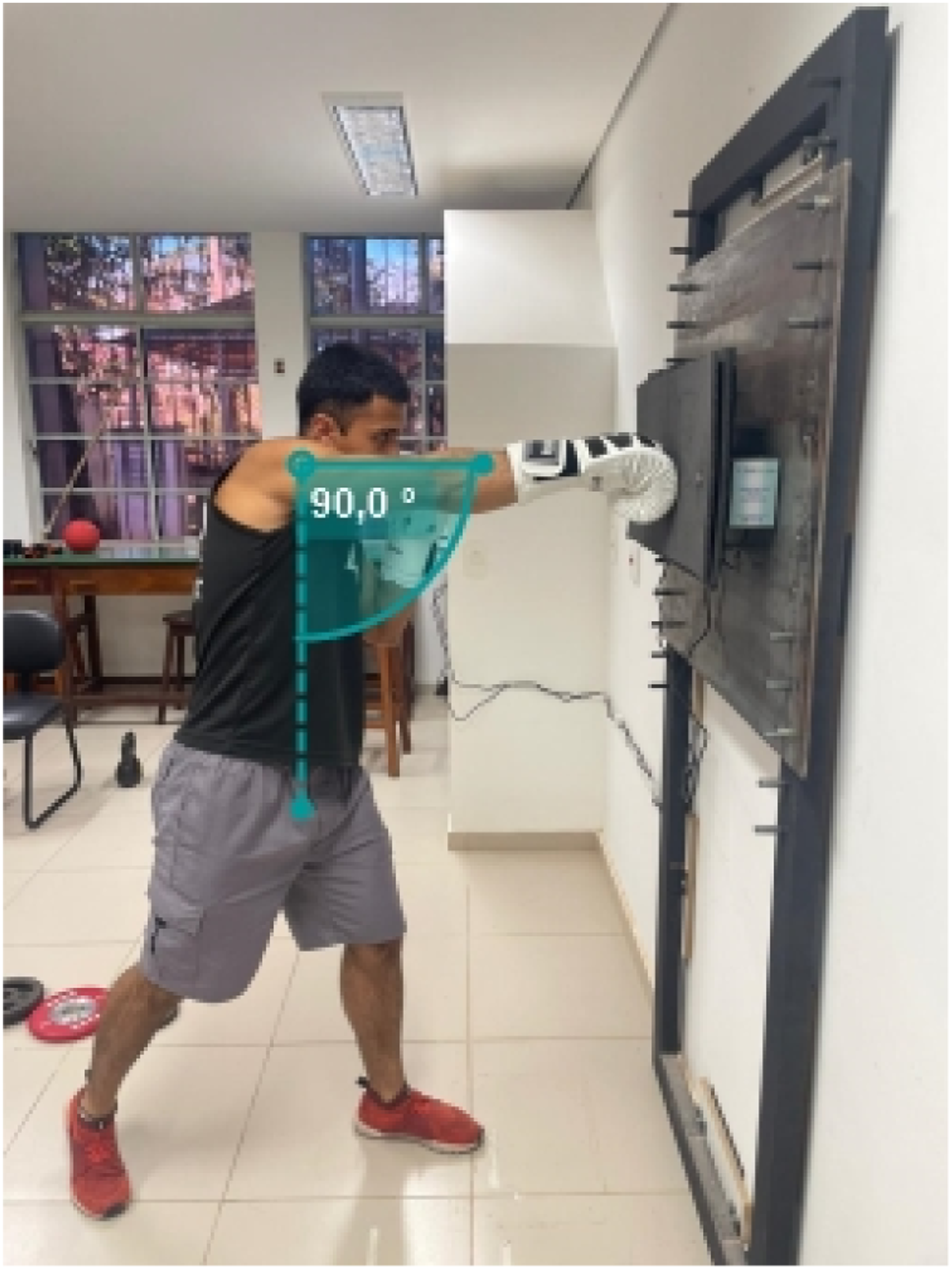
Statistical Analysis
The sample size was calculated based on the following parameters: Test family: t-tests; Statistical Test: Intraclass Correlation Coefficient (ICC); Significance Level (α): 0.05, two-tailed; Minimum acceptable reliability [ρ0]: 0.67, as recommended by Lenetsky et al. (2022); Expected reliability (ICC) [ρ1]: 0.92; Statistical power (1-β err prob): 0.8. The expected ICC value of 0.92 was selected based on previously reported reliability coefficients for punch-force assessments using comparable measurement systems, which have demonstrated ICC values ranging from approximately 0.90 to 0.95 (Dunn et al., 2019; Finlay et al., 2023).
The assumptions of data normality and homoscedasticity were evaluated using the Shapiro-Wilk test and residual plot analysis, respectively. The relative reliability of both mechanical trials and partial ecological validity was assessed using the Intraclass Correlation Coefficient (ICC), calculated via a Two-way mixed-effects model, in accordance with Weir (Weir, 2005). The ICC was classified as follows: <0.50 = poor; 0.50 – 0.75 = moderate; 0.75 – 0.90 = good; and > 0.90 = excellent (Finlay et al., 2023). Test–retest variability was also assessed using the coefficient of variation (CV), calculated as CV = (standard deviation ÷ mean) × 100 (Lenetsky et al., 2022).
To evaluate absolute reliability, the standard error of measurement (SEM) was calculated using the formula: SEM = SD × √(1−ICC) (Weir, 2005), where SD = √(SStotal ÷ (N−1)). All statistical values are reported in real units of measurement, which is useful because the smaller the SEM, the more reliable the measurements. The 95% confidence interval (CI) was also reported, enabling identification of equipment noise. Additionally, the smallest worthwhile change (SWC) was calculated for both mechanical trials and for the subjects, multiplying the standard deviation by the effect sizes: small(0.2), moderate(0.6) and large(1.2), according to Hopkins (Hopkins, 2000).
Responsiveness, defined as the ability of a measurement to detect meaningful changes in performance, was assessed by comparing the SEM with the SWC (Dhahbi et al., 2016; Hopkins, 2000). The SWC for the mechanical trials is understood as the smallest change necessary required to exceed the SEM (Chuang et al., 2015) and, at the for individual level, as the smallest change capable of systematically detecting variations in performance. This comparison, previously referred to as sensitivity analysis (SEM versus SWC0.2–0.6–1.2), served as an indicator of responsiveness rather than reliability (Hopkins, 2000, 2004). A significant level (α) of 5% was adopted for all statistical comparisons. Sample size estimation was performed using Bonett’s formula and implemented via an online calculator (https://wnarifin.github.io/ssc/ssicc.html) (Borg et al., 2022). Statistical analysis was conducted using IBM SPSS Statistics® 25 software (IBM Inc., Chicago, IL), and graphs were created with GraphPad Prism® Software (Version 8.0, San Diego, CA, USA).
Results
Reliability and Sensitivity
Reliability and Sensitivity of Free-Fall Weight Measurements
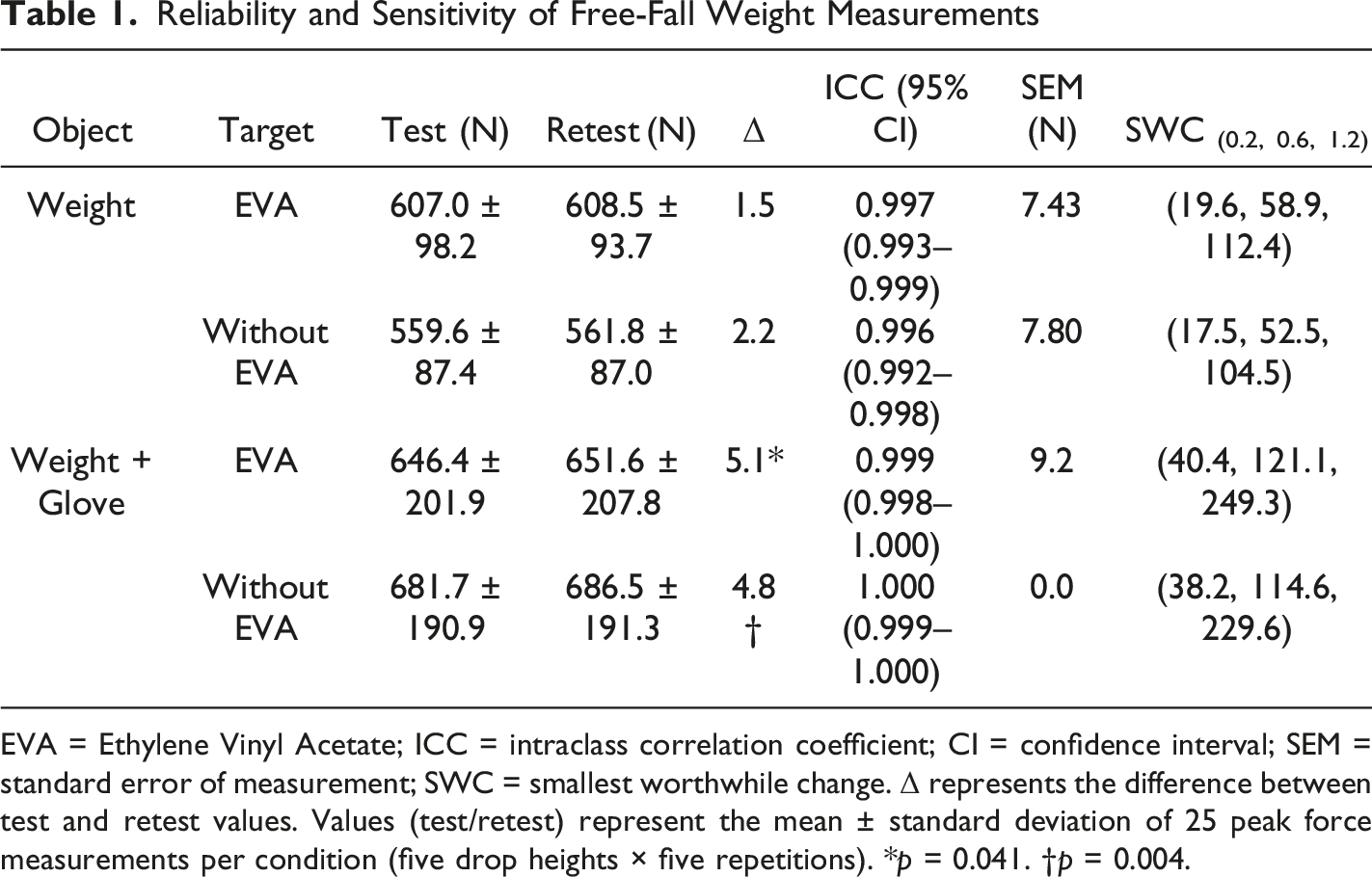
EVA = Ethylene Vinyl Acetate; ICC = intraclass correlation coefficient; CI = confidence interval; SEM = standard error of measurement; SWC = smallest worthwhile change. Δ represents the difference between test and retest values. Values (test/retest) represent the mean ± standard deviation of 25 peak force measurements per condition (five drop heights × five repetitions). *p = 0.041. †p = 0.004.
Reliability and Sensitivity of Punch Force Measurements (N)
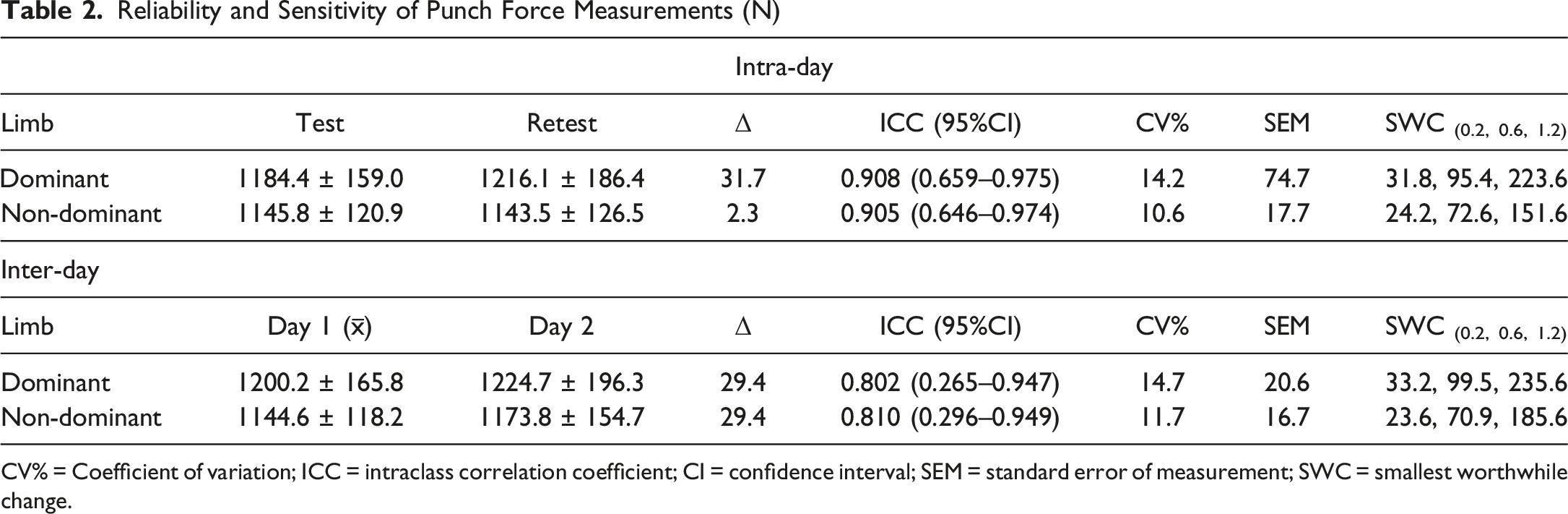
CV% = Coefficient of variation; ICC = intraclass correlation coefficient; CI = confidence interval; SEM = standard error of measurement; SWC = smallest worthwhile change.
The punch force (N), assessed using the Custom-Built Punch Force Dynamometer, demonstrated Excellent intra-day reliability for both the dominant limb (ICC 0.908) and the non-dominant limb (ICC 0.905) between the test and retest. Conversely, inter-day measurements exhibited good reliability for the dominant limb (ICC 0.802) and the non-dominant limb (ICC 0.810). No significant differences were found between test and retest measurements in punch force. The CV% was comparable between intra-day (limb: dominant 14.2% and non-dominant 10.6%) and inter-day (limbs: dominant 14.7% and non-dominant 11.7%) assessments indicating consistency in measurement variability. Regarding sensitivity analysis (Table 2), the SEM remained below the SWC0.2 across all conditions, further supporting the precision and responsiveness of the measurements.
Discussion
This study aimed to design a pragmatic and efficient Custom-Built Punch Force Dynamometer equipped with S-type load cells and to evaluate its reliability, sensitivity, and partial ecological validity under sport-specific conditions. The device demonstrated excellent reliability, as well as good intra-day and moderate inter-day reliability in punch force measurements. Moreover, the dynamometer exhibited robust sensitivity, effectively detecting minute force fluctuations while minimizing measurement noise, thereby enhancing its precision and applicability for impact force assessment.
In mechanical trials, the free-fall weight measurements exhibited excellent relative reliability (Koo & Li, 2016) across all tested conditions: weight with EVA (ICC = 0.997), weight without EVA (ICC = 0.996), weight attached to the boxing glove without EVA (ICC = 0.999) and with EVA (ICC = 1.000). The mechanical trials setup was conducted under highly standardized laboratory conditions, thereby eliminating the influence of intrinsic psychophysiological factors inherent in human-based assessments, such as learning effects, motivation, fatigue, and other variables that could compromise the precision of dynamometer outputs. It is noteworthy that many validation studies report the reliability of mechanical setups without including measurements derived from athlete-based protocols (Lenetsky et al., 2022).
We advocate for the integration of both mechanical trials and partial ecological validity protocols in reliability studies. This dual approach enables a more comprehensive evaluation of equipment-specific characteristics and psychophysiological influences, thereby supporting more robust and generalizable conclusions. In our study, sensitivity analysis revealed that the SEM was consistently lower than the SWC0.2, across all testing conditions, indicating excellent absolute reliability. Additionally, the device exhibited minimal measurement noise, remaining well below acceptable thresholds (Chuang et al., 2015).
Although the attachment of additional weight to the glove resulted in a small yet statistically significant difference between test and retest values, this finding suggests the presence of systematic bias. This effect could be attributed to minor alterations in the mechanical properties of the glove and the EVA interface during repeated impacts, such as material deformation or settling. Despite this, the intraclass correlation coefficients (ICCs) remained excellent, indicating relative reliability. However, ICC does not account for systematic differences between measurements (Atkinson & Nevill, 1998; Weir, 2005). The observed difference was minimal and remained within the measurement error limits, as demonstrated by the standard error of measurement (SEM) and its comparison with the smallest worthwhile change (SWC).
Given that the participants were required to wear protective gloves and impact-cushioning material during testing to ensure safety and partial ecological validity under sport-specific conditions, the results confirmed that the force measurements remained consistent despite this constraint. According to Lenetsky, Uthoff, Coyne, and Cronin (Lenetsky et al., 2022), the use of gloves and protective padding is deemed essential in all investigations aiming to assess impact force, underscoring the necessity of these elements in protocols involving striking actions.
Although several devices have been used to assess punch impact force, no universally accepted gold-standard method has been established (Lenetsky et al., 2022). Furthermore, even widely used measurement systems, such as force plates, present important methodological considerations that must be carefully controlled when assessing ballistic movements (Dhahbi et al., 2017). In the present study, the degree of agreement, defined as the extent to which measurements from the proposed equipment correspond to those of a recognized reference method (Hopkins, 2000), was not evaluated. Alternative devices, including load cells (Bolander et al., 2009; Dunn et al., 2019, 2022) and force platforms (Adamec et al., 2021; Beranek et al., 2020; Finlay et al., 2023; Loturco et al., 2016), have frequently been employed to measure punch impact force. Although these devices have established validity in the context of muscle strength assessment (Lenetsky et al., 2022), evaluating the reliability of impact force measurements remains essential to ensure the consistency and accuracy of the data (Lenetsky et al., 2022; Uthoff et al., 2023).
Our results demonstrate that punch force exhibits excellent intra-day relative reliability for both the dominant (ICC = 0.908) and non-dominant limbs (ICC = 0.905), as well as good inter-day reliability for the dominant (ICC 0.802) and non-dominant limbs (ICC = 0.810), exceeding the commonly accepted minimum reliability threshold of ICC = 0.67 as established in previous literature (Lenetsky et al., 2022). Inter-day measurements demonstrated moderate to good reliability (ICC = 0.802). However, this value should be interpreted with caution, as it likely reflects biological variability and day-to-day fluctuations in movement execution, rather than just device-related consistency. Although no statistically significant differences were detected between test and retest sessions in punch force measurements, the CV ranged from 10.6% to 14.7%, indicating acceptable variability. Moreover, the SEM was lower than the SWC0.2, suggesting that the device is sufficiently sensitive to detect meaningful variations in athlete performance (Hopkins, 2004).
Previous investigations have reported reliability coefficients for similar equipment ranging from good to high, although inter-day reliability values were typically lower (Dunn et al., 2019; Finlay et al., 2023). In comparison, the equipment used in the present study demonstrated reliability comparable to that reported in previous investigations. It is important to highlight that the observed results may partly reflect the influence of inter-individual variability, as discussed by Weir (Weir, 2005). Although the sample included practitioners of boxing, Muay Thai, and kickboxing, this did not appear to contribute to greater variability in performance outcomes. The coefficients of variation (CV) observed in the present study are in line with values reported in the literature (Lenetsky et al., 2022). Nevertheless, it is essential to note that the appropriate interpretation of CV requires that the underlying data follow a normal distribution (Atkinson & Nevill, 1998).
Regarding the relative reliability of the partial ecological validity measures, the dynamometer demonstrated a slight degree of measurement noise. Although previous studies reported higher reliability coefficients than those observed in the present investigation, they also noted that the SEM exceeded the SWC0.2 for certain punches types, while remaining below SWC0.6 for others (Dunn et al., 2019; Finlay et al., 2023). This finding suggests that the equipment employed in those studies may have limited sensitivity to detect variations in punch force, particularly when assessing individuals with high-performance capacity, such as elite athletes in striking sports. However, our study demonstrated that, when measuring punch force, the equipment is sensitive enough to detect slight variations in performance. In practical terms, this indicates that the equipment can be useful for elite athletes, where performance changes are subtle and linked to the principle of trainability (Joyner, 2017).
Limitations and Future Directions
Although we have found suitable results for using the S-Type Load Cells, the dynamometer structure does not accommodate certain punch types such as hooks and uppercuts. In addition, load cells are widely used to measure force in sports science; however, glove padding, intended to reduce injury risk and attenuate impact, likely led to a slight underestimation of the measured force. A further limitation is the relatively small sample size, which resulted in wide confidence intervals for the inter-day ICC estimates and reduced the precision of the reliability outcomes. Even though the point estimates suggested good inter-day reliability (ICC = 0.802–0.810), the lower bounds of the 95% confidence intervals (0.265 and 0.296) fall within the poor reliability range according to established classification criteria. Consequently, the true reliability of the measurements may range from poor to excellent and should be interpreted with caution. The sample size was determined a priori based on recommendations for reliability studies and previously reported ICC values in punch-force assessments. However, future studies with larger samples are necessary to provide more precise reliability estimates and narrower confidence intervals.
No signal saturation was observed, and all recorded forces remained below the nominal capacity of the load cells. However, the absence of a direct assessment of the sensors’ dynamic response under high-impact conditions represents an important limitation. Therefore, extrapolation of these findings to situations involving higher force magnitudes or different force-time characteristics should be made with caution, and future studies should investigate the system’s dynamic behaviour under such conditions.
Future research should also examine other punch types and include approaches to account for the damping effect of glove padding. Importantly, the device’s modular structure allows for the replacement of load cells with higher-capacity sensors, enabling future investigations of higher impact forces without compromising measurement integrity.
Conclusion
In line with the objective of developing and assessing the reliability of a practical and straightforward method for quantifying punch impact force, this study confirms that the Custom-Built Punch Force Dynamometer, based on S-type load cells, exhibits adequate reliability, sensitivity, and partial ecological validity under sport-specific conditions. The device proved to be a consistent and sensitive tool for capturing punch force data in both laboratory-controlled and sport-specific environments. Its ability to detect subtle variations in impact force underscores its relevance for individualized training adjustments and athlete monitoring.
Footnotes
Acknowledgments
The authors used Grammarly (Grammarly Inc., San Francisco, CA, USA) for language editing and grammar correction. All scientific content, interpretations, and final revisions are the sole responsibility of the authors.
ORCID iDs

Ethical Considerations
The Federal University of Juiz de Fora Human Research Ethics Committee approved the study (No. 6,259,447), and all procedures were conducted following the Declaration of Helsinki.
Funding
The authors disclosed receipt of the following financial support for the research, authorship, and/or publication of this article: A.M. is supported by the Coordenação de Aperfeiçoamento de Pessoal de Nível Superior (CAPES), Brazil; G.T.O. and R.A.A. are supported by the Fundação de Amparo à Pesquisa do Estado de Minas Gerais (FAPEMIG); and M.M. is supported by a CAPES/Alexander von Humboldt Foundation research fellowship and by the Conselho Nacional de Desenvolvimento Científico e Tecnológico (CNPq), Brazil (grant no. 308138/2022–8).
Declaration of Conflicting Interests
The authors declared no potential conflicts of interest with respect to the research, authorship, and/or publication of this article.
Data Availability Statement
The data that support the findings of this study are available from the corresponding author, upon reasonable request.