






Abstract
Technology enables university professors to observe and literally whisper in the ear of a teacher during instruction.

Meet Katie …
The end of the school year was fast approaching. Katie couldn't wait. As far as she was concerned, it had been a dreadful year. She was beginning to think she wasn't cut out to be a teacher. She had graduated from her teachers' college with a 3.9 GPA. She had always wanted to be a teacher. But after three years, in three different classrooms, she still hasn't found her niche. She had taught 1st grade, 3rd grade, and 6th grade, but her students were always unruly and seemed uninterested in her lessons. Maybe it was the school — her fellow teachers were all experienced, and it seemed as if everything came so easily to them. She didn't know teaching was going to be so hard.
Across the country, school district personnel are struggling to attract and retain high-quality teachers who can meet the unique academic and behavioral needs of an increasingly diverse student population. Teachers of math, science, English as a second language (ESL), computer science, bilingual education, and special education are particularly hard to find. Although this isn't a new problem, we're only beginning to develop effective and innovative approaches to combat it. Mentoring programs, financial incentives, and reward/recognition plans represent a few of the more popular responses to the recruitment and retention dilemma.
In certain content areas, such as ESL or special education, some states experience greater difficulty in attracting, preparing, and retaining high-quality teachers. One such state is Alabama. When compared with national statistics, Alabama public school students are more likely to be poor, a member of a racial minority, and disabled. Alabama has experienced depressed academic performance, increased dropout rates, and heightened suspension and expulsion rates. Despite the many challenges confronting the state's schools and its students, preservice teachers are often ill prepared for the diversity they face. Elementary and secondary education majors in Alabama are required to take only one course related to exceptional learners (that is, Introduction to Special Education). And the opportunities for and quality of professional development experiences once they enter the profession are very uneven. Yet nationally, and in Alabama as well, the most up-to-date statistics confirm that over 80% of students with disabilities receive all or part of their instruction in the general education classroom (American Institutes for Research 2007). Is it any wonder new teachers like Katie are floundering?
Project TEEACH — which stands for Transforming Elementary Educators into Advocates, Change Agents, and Highly Qualified Special Educators — was developed to address these issues. Project TEEACH enables university-based educators to provide virtual coaching for inservice teachers using bug-in-the-ear technology. We call our technology VBIE.
In our virtual coaching sessions, a professor observes a teacher using a high-definition web cam and Voice over Internet Protocol (VoIP) technology, such as Skype. The teacher being observed wears a Bluetooth-enabled bug in her ear. As the teacher works with students, the professor coaches her. The coach may literally suggest words that the teacher can use with students. The coach may alert the teacher to watch for certain student behaviors. The coach may identify teacher behaviors that are either appropriate or less than ideal in the given instructional situation. Students typically know that someone is observing the instruction, but they are not able to hear what the teacher is hearing.
We've used VBIE to work with 16 practicing teachers in 555 virtual coaching sessions over three years. Another 15 are enrolled as a second cohort. Four of the 16 program finishers moved to positions as special education teachers.
Recruiting Katie…
Katie had the motivation to be a high-quality teacher, but something was lacking. She knew what to do; she just couldn't seem to do it. She was a diamond in the rough, spending her third year of teaching in a university-affiliated Professional Development School. Katie applied to become a Project TEEACH scholar even though she didn't know anything about the technology and couldn't imagine what it would be like to have someone talking in her ear as she was trying to teach. But she was excited by the possibilities the technology held for improving her teaching skill. She was even intrigued about the possibility of being transformed into a special education teacher. Katie was selected for the inaugural cohort.
STRATEGIC ATTRACTION TACTICS
Recruiting high-quality candidates into teaching, especially in areas of critical need, such as special education, can be a daunting task. The professional literature is replete with strategies aimed at recruiting the best and the brightest (Villegas and Davis 2007). Teachers like Katie, who are highly motivated but struggling, represent an untapped resource that shouldn't be discounted prematurely. We believe this innovative VBIE technology can be used effectively to recruit teachers into areas of high need.
We recruited teachers into Project TEEACH in part by using the same video-conferencing capabilities used to provide the virtual coaching. This allowed us to appeal directly to teachers before a faculty meeting in a school located over 70 miles from the university campus and, five minutes later, recruit at another school across town.
ARTICLE AT A GLANCE
To encourage teachers to remain in critical teaching positions, such as special education, we need to provide continuous job-embedded support and high-quality feedback. Virtual bug-in-the-ear technology is one tool that allows university educators to provide unobtrusive coaching for new and struggling teachers without being physically present in the classroom
The experience of Project TEEACH, based at the University of Alabama, suggests that simple technology tools could be used effectively to support teachers through their most challenging instructional situations. Such coaching provides the kind of at-the-elbow support that can be most beneficial to young teachers.
VBIE technology can be used in unprecedented ways in interviews and observations. The technology not only allows us to interview and observe potential recruits from a distance, but also to gauge their responsiveness to receiving immediate feedback during a pilot virtual coaching session that's required as part of the recruitment process.
Preparing Katie…
Katie's virtual coaching sessions began during her first semester in Project TEEACH. Early on, we realized that Katie needed a lot of intensive coaching not only in specialized curriculum and instruction, but also in behavior management and data-informed decision making. Katie struggled during the coaching sessions. Her content knowledge was best described as emerging, her instructional approach was based primarily on poorly designed question-and-answer discussions, her behavior management style was inconsistent and punitive, and her approach to educational decision making was haphazard. Her students were often disengaged, unmotivated, and not learning. Coaching Katie was not easy. We focused on reinforcing Katie's strengths and on setting specific, measurable, and observable goals to address her professional needs. Through it all, Katie kept her end of the bargain, and so did we.
By the final semester of Katie's enrollment in Project TEEACH, Katie had turned the proverbial corner. Her content knowledge was deeper and broader, her instructional approaches were varied, her behavior management style was proactive and positive, and her educational decision making was based on sound data. Her students responded not only with high rates of engagement and enthusiasm, but also with correct and creative responses. We (and she) knew she was on her way to becoming a master teacher. Nonetheless, our weekly virtual coaching sessions continued. Happily, her performance for the remainder of the semester did not waver.
STRATEGIC PREPARATION TACTICS
Preparing “struggling teachers” to become high-quality teachers can be a difficult undertaking. Unfortunately, many teacher training and professional development programs are not up to the task (Darling-Hammond 2005). Innovative VBIE technology offers unique ways to better prepare and support teachers to meet the needs of students who are difficult to serve.
With VBIE technology, the delivery of job-embedded support and high-quality feedback can occur at least 30 minutes a week. The Project TEEACH teachers provided their classroom schedule. Then, we used their schedules to create a VBIE coaching schedule that we sent via e-mail to them each week. Flexibility, however, was paramount. Because the teachers and the coach's schedule were subject to almost daily changes, we had to be respectful and make changes almost constantly. Since no travel time was involved, these constant shifts in the schedule posed only minor inconveniences.
Retaining Katie…
Katie's performance during VBIE sessions improved markedly. She was more confident and more satisfied with her teaching. But we knew Katie would continue to need ongoing job-embedded support and high-quality feedback. So, once a month, we carried out VBIE sessions with her even after she completed her training program. To our delight, Katie continued to thrive, putting the evidence-based instructional and behavioral approaches she learned into daily practice in her classroom. Throughout the past year, Katie has undergone numerous observations and evaluations by her school district administrators, which she has passed with flying colors. More important, Katie looks forward to going into her classroom every day because her teaching brings her joy. Of course, there are still occasions when Katie needs to be coached through a classroom interaction, but such occurrences are less frequent. Also, Katie has expressed a desire to become a peer coach. She will soon use VBIE to coach new Project TEEACH scholars.
What are Virtual BUGs?
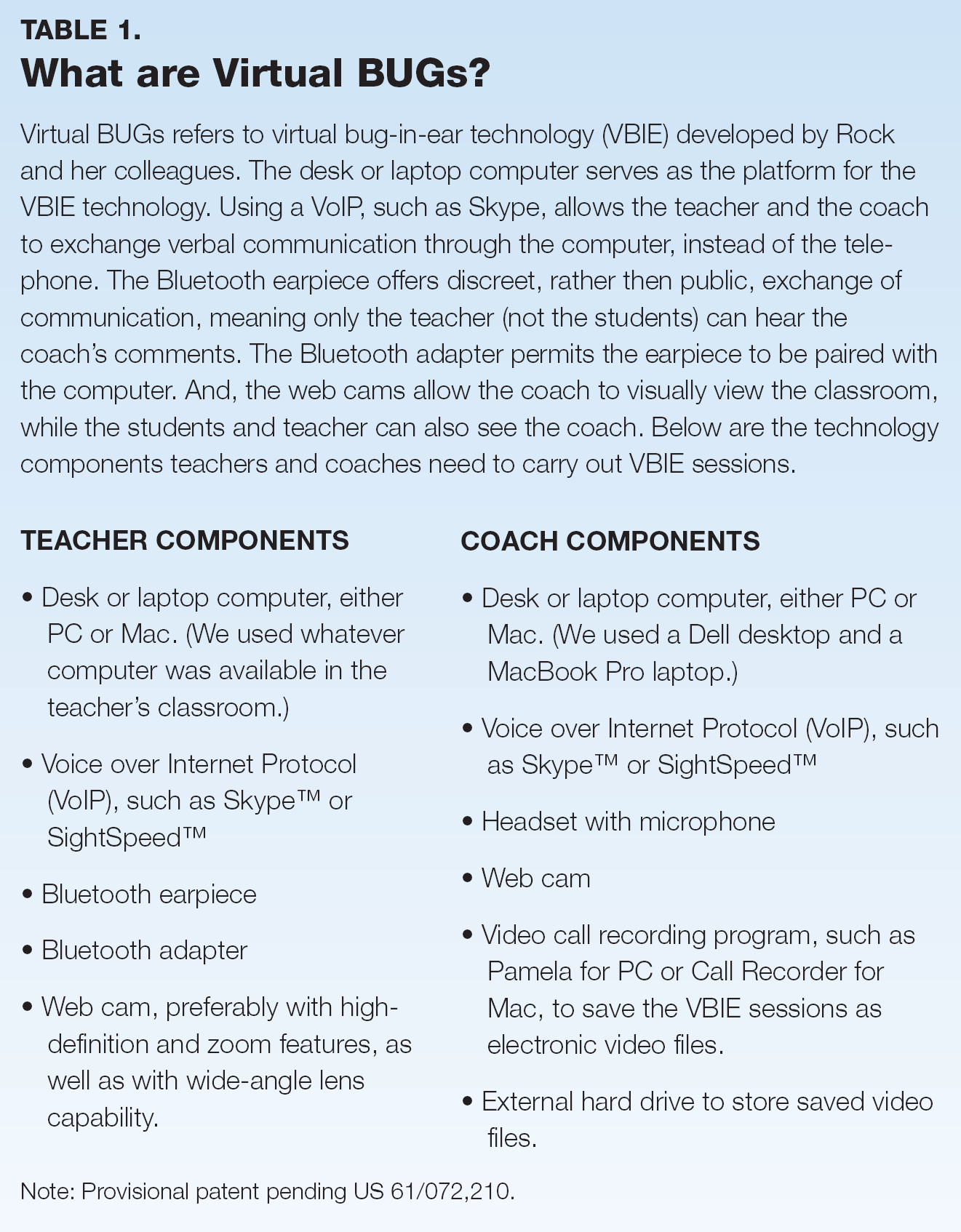
Note: Provisional patent pending US 61/072,210.
STRATEGIC RETENTION TACTICS
While recruiting and preparing high-quality teachers are, indeed, noble pursuits, retaining good teachers is another area that warrants attention. Teaching in areas of high need, such as special education, can be particularly stressful. Again, VBIE technology offers unique opportunities to put into practice effective retention strategies.
The message is clear: To encourage teachers to remain in critical teaching positions, such as special education, we need to provide continuous job-embedded support and high-quality feedback (Grier and Halcombe 2008). VBIE makes that possible by overcoming the once seemingly insurmountable barriers of time and distance.
The rest of the story…
Two years after Katie debated whether to leave the teaching profession, she wondered how she could have ever considered doing so. For the first time in her fledgling career, Katie felt that she had a successful year and was looking forward to another. Her children met their expected academic benchmarks, and her contract had been renewed during tough economic times when teaching positions were being eliminated. Instead of becoming an attrition statistic, Katie had emerged as a high-quality general and special education teacher. While she knows she'll have to continue to work at it, she credits her initial transformation to Project TEEACH and the VBIE technology.
BEYOND PROJECT TEEACH
Obviously, Katie is an “N” of one, and preparing 31 new high-quality special educators in Alabama does not seem impressive, nor substantive in terms of resolving the current national recruitment and retention dilemma. What we have attempted to do in this article is to describe an innovative approach and to offer practical solutions that hold great promise. In so doing, we maintain that using bug-in-ear technology to revolutionize preservice teacher preparation and professional development is desirable not only to achieve improved retention and recruitment outcomes, but also to provide high-quality teachers for all students. If every education professor or school district administrator coached 10 to 20 struggling teachers a week using virtual BUGS, the positive effects that could ensue would, no doubt, prove worthwhile. With that in mind, we think you'll agree this is one “bug” worth catching.