






Abstract
Academic optimism has unlocked and unleashed the aspirations of teachers, parents, and students in an urban district in the Midwest.
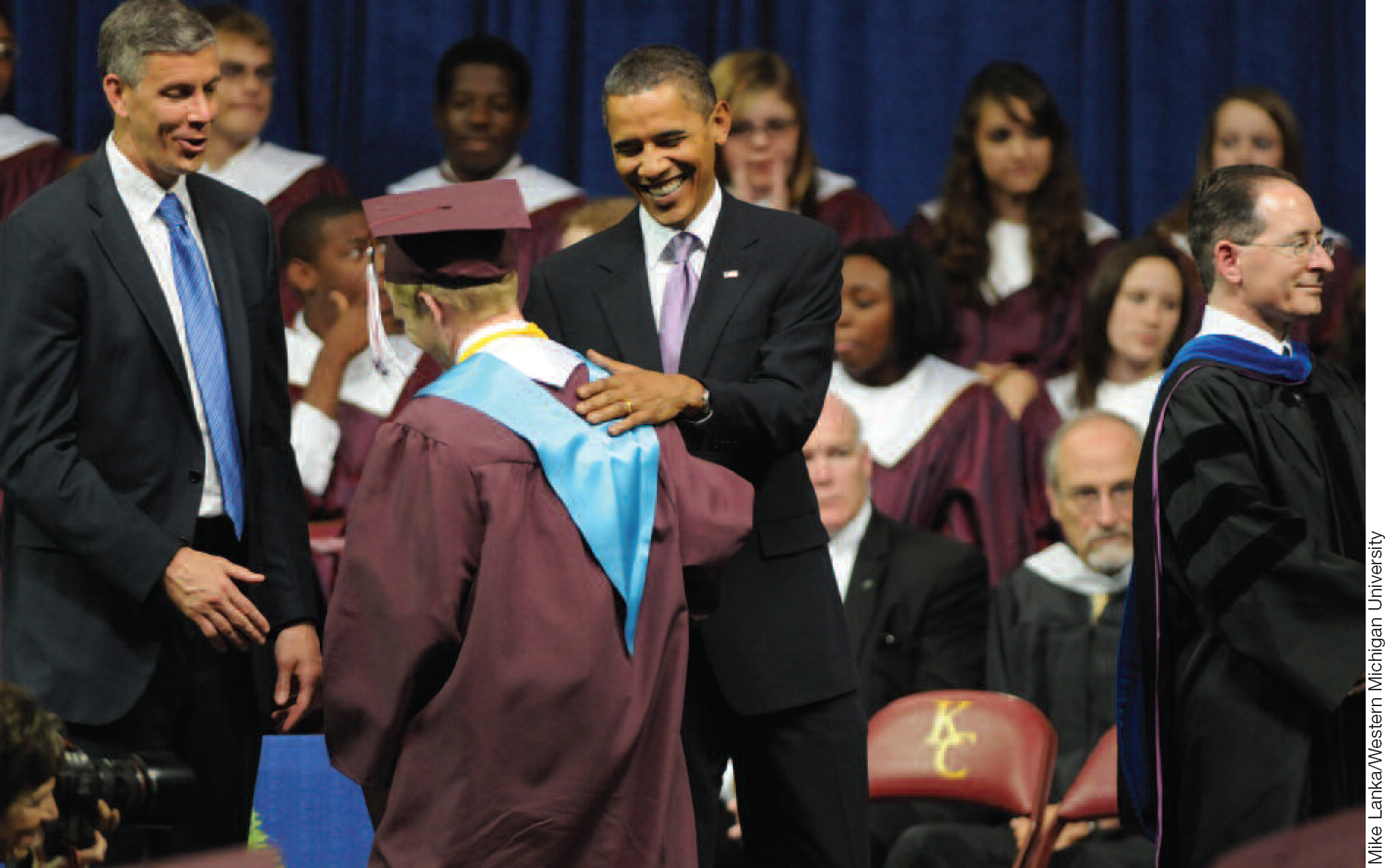
In June, President Obama delivered the first-ever graduation speech by a sitting president to public high school students when he spoke to graduates of Kalamazoo Central High School in Michigan. This was the culmination of the Race to the Top Commencement Challenge in which high schools around the country vied for the opportunity to have the President speak at graduation ceremonies. For an urban high school that once might have been labeled a “dropout factory,” this was a big event.
“America has a lot to learn from Kalamazoo Central about what makes for a successful school in this new century,” the President said. “You've got educators raising standards and then inspiring their students to meet them. You've got community members who are stepping up as tutors and mentors and coaches. You've got parents who are taking an active interest in their child's education.”
And the President noted something else: the Kalamazoo Promise, the community's universal postsecondary scholarship program. Launched in fall 2005 with backing from anonymous donors, the Kalamazoo Promise scholarship provides full tuition for any high school graduate who's been accepted to attend a state-supported Michigan postsecondary institution — whether a community college, trade school, or university. The Promise has made it possible for hundreds of students to continue their education who in the past would probably never have gotten more than a high school diploma. But it's done far more than that. A federally sponsored evaluation has shown that the Promise has been a catalyst for systemic reform, bringing together educators, students, their parents, and the broader community to focus on a common goal: success for all students — not just in high school, but through the college years.
Comprehensive school reform models, or more broadly defined systemic reforms, tend to be highly prescriptive: Outsiders come into a system and tell professionals what they must do to improve school quality and effectiveness. Specific interventions and services, designed for each stakeholder group, are implemented. Typically, these reform models call for professional and leadership development, activities to reach parents and encourage their involvement, and extensive changes to the curriculum. Although many of the packaged reform models are believed to be research based, they get mixed results during implementation. As reformers have learned, creating the synergy needed to bring about and sustain change in struggling urban school districts is difficult and expensive.
The Kalamazoo Promise approached change from an entirely different direction. The Promise pointed to the desired outcomes but did not specify what the district would have to do to achieve them. Instead, it assumed that a strong incentive, such as a universal scholarship program, would prompt diverse stakeholders to work together and figure out what a district needed to do to enable more students to take advantage of the scholarship program. Essentially, what's between the boxes or cells in Figure 1 is what the professionals had to sort out. And they did.
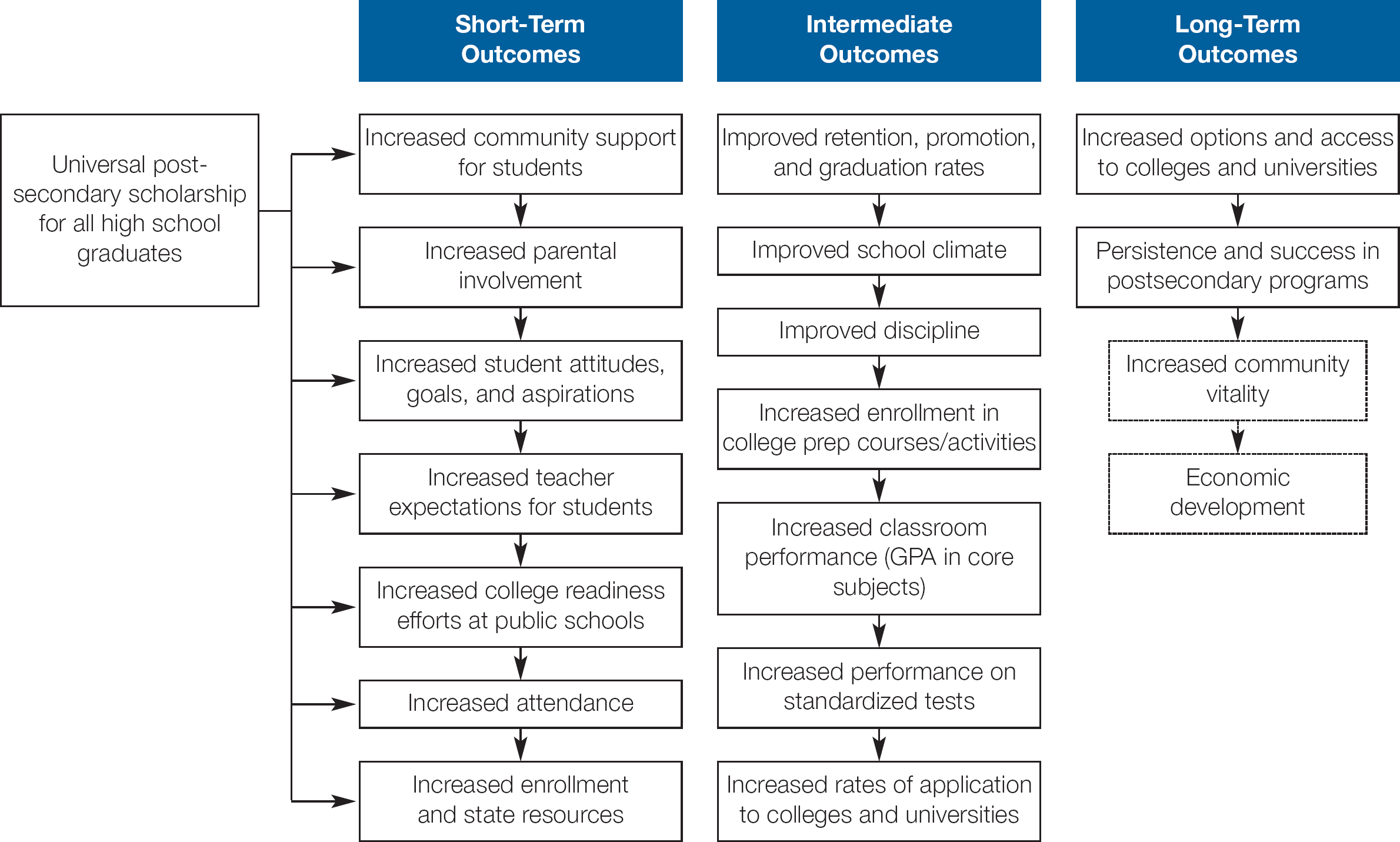
Outcomes Logic Model for the Kalamazoo Promise Scholarship Program
CHANGE BEGINS
The Promise changed the city and the public schools of Kalamazoo from the day it was announced in November 2005. Its first impact was to lift student aspirations and teacher expectations. It also helped motivate the Kalamazoo Public Schools to take necessary steps to assess and modify the school system so that it could serve the broader goal of preparing more students for success in postsecondary education. (See sidebar.) The process of review, assessment, and then the implementation of new programs mirrors what the authors of externally mandated and funded reform initiatives strive to achieve. But, in this instance, the change was driven by internal initiative rather than an intervention driven from the outside.
Surveys of students and teachers helped evaluators determine the effectiveness of district reforms in reaching desired outcomes. Interviews with school administrators, guidance counselors, teachers, students, parents, and representatives of community organizations further put the survey findings in context and gave insight into the Promise scholarship program's influence on the experiences of key stakeholders. School and community indicators have been analyzed and compared with those of similar Michigan schools and districts. The results have been promising — and concrete.
PARENTAL AND COMMUNITY RESPONSE
The community greeted the announcement of the Promise with incredible enthusiasm. Educators reported that parents initially responded more strongly than did students. Parents said they were more focused on their children's school work and were enforcing more social and academic discipline at home.
Community organizations created new or expanded programming for such services as tutoring and providing material aid to families in poverty, all in order to offer more support for students. Tutoring and mentoring programs in particular noted a rapid and marked increase in recruits. Community secular and faith-based organizations reported that the Promise had inspired them to implement changes.
Kalamazoo Public Schools At a Glance
The Kalamazoo Public Schools (KPS) is a medium-sized, urban school district serving 12,300 students in the city of Kalamazoo and three townships. Challenged economically like other post-industrial urban areas, KPS is a majority-minority district: 48% African-American, 39% white, 10% Hispanic/Latino, 2% Asian-American, and 1% Native American. Fully 70% of the district's students are eligible for free or reduced-price lunch.
Since the Kalamazoo Promise was introduced in November 2005, KPS has grown by 2,100 students and is expected to continue growing. Even as it grows, the district's ethnic composition has stayed about the same, but the proportion of students qualifying for free/reduced-priced lunch has risen from 62% in fall 2005 to 70% in fall 2009.
Below are selected reforms and accomplishments, the result of tremendous staff and community dedication and collaboration with many district partners.
Partnered with Kalamazoo County Head Start and other local preschool providers to adopt the nationally recognized OWL curriculum and to provide joint professional development.
Helped to spearhead the drive to create universal preschool in Kalamazoo County.
Expanded full-day kindergarten from 176 to 1,062 students in the last three years.
Reworked the K-3 reading block to include 30 minutes of daily work on writing.
Adopted new math materials for grades K-5 for the first time since 1992.
Wrote curriculum guides in language arts and math for grades K-5.
Opened Prairie Ridge, the first newly constructed school facility in KPS since 1972 and the first K-12 LEED-certified gold school in Michigan.
Began El Sol Elementary, a dual-language (English-Spanish) school.
Consolidated bilingual education/ESL programs from 17 to 10 elementary schools for the purpose of greater program efficiency and effectiveness.
Moved 6th grade to middle school to provide 6th graders with teachers who specialize in their subjects.
Started algebra class for 8th graders, taken by 343 students this year.
Sent all incoming 6th graders a book every 10 days to read over the summer.
Created a program for each middle school grade to get students thinking about college and careers.
Created a middle school alternative learning program for students with behavioral or academic issues.
Opened Linden Grove Middle School, the second newly constructed school in KPS since 1972.
Adopted new math materials for grades 6–8.
Revamped the middle-school schedule for the first time since 1985 — to create longer periods to provide more time for core subjects and to require students to schedule two class periods a day in language arts and mathematics if they are below grade level.
From September 2007 to September 2009, increased the number of distinct Advanced Placement (AP) subjects from 8 to 12. During this time, the number of students taking AP courses increased by 71%, the number of AP courses taken increased by 79%, and the number of low-income, African-American, and Latino students taking AP courses increased by 148%, 166%, and 400%, respectively.
Added pluses and minuses to grades. Weighted AP grades to reflect more challenging content so that an AP “B” is equivalent to a regular class “A” in order to create an incentive for students to enroll in AP programs.
Changed from a four-period block schedule to a five-period trimester system, which provides more continuity for students and more opportunities to meet Michigan Merit Curriculum requirements, to take AP courses, and to make up failed courses. The former schedule dates back to 1999.
Across the district
Increased state reading and math test scores at the elementary, middle, and high school levels.
Contracted for a Phi Delta Kappa curriculum audit to identify issues with the curriculum.
With 250 staff and community volunteers, created strategic plan cognitive/academic and behavior expectations for students at every age of their development, ages 0 to 18, and for the adults that support children: parents, staff, and other community members.
Overhauled and expanded summer school.
Won an array of grants on behalf of the district, including a $9 million federal magnet school grant, a $7.5 million federal 21st Century grant (partnership with Kalamazoo Communities in Schools), and two Kellogg Foundation grants for a summer literacy program and a broad literacy initiative in the community.
Contracted for a complete facilities study.
Adopted a districtwide homework policy that encourages meaningful and engaging homework for all students.
Began to partner with the Woodrow Wilson Foundation, the Kellogg Foundation, and Western Michigan University on a multi-year math and science teacher fellowship program to improve math and science teaching in areas of high need.
Redrew middle and high school boundaries to achieve greater socioeconomic balance.
Began to recognize “turnaround students” at board meetings for substantial changes in academic performance.
Michael F. Rice, superintendent, Kalamazoo Public Schools
Support has also translated to votes to approve bond requests to build two new schools and renovate and expand existing buildings.
The Promise has leveraged increased volunteerism in the community, and the changes the Promise has helped promote have fostered goodwill, generosity, and increased commitment to children. Still, obstacles remain that hinder community response, and addressing them will be important. In particular, it will be critical to communicate and share more information to address misconceptions, build trust, and better coordinate services. Also, new strategies and increased efforts are needed to reach and support Latino families. Community groups have already done a great deal, but most agree that much more still needs to be done to support students and families in poverty.
To read more about the Kalamazoo Promise
Working papers and research results can be obtained from the following web sites:
Provides information about how the Promise operates.
Provides information about the ongoing evaluation of the Promise.
Provides information and research related to the Promise.
PERCEPTIONS OF PSYCHOSOCIAL CHANGES
Soon after the announcement of the Promise, changes began at the school, classroom, and student levels. Perceptions of school climate began to shift. Our findings also revealed increased teacher expectations and student aspirations. These important developments indicate that this program can influence interests and values, school achievement, and future goals.
At least in our building, there's a renewed sense of urgency. And that's not a negative thing. It's not, “Oh my gosh, I've got to do something!” Not a panic. It's “OK, so this is a new day, this is a new battle, and we're getting recharged, we're getting renewed, we're getting invigorated, and we're gonna take it on.” … It renews your excitement.
The excitement and renewal, in turn, has an impact on longstanding, difficult aspects of the school environment, such as behavioral norms and creating a pro-academic culture that values and embraces postsecondary opportunities
Teachers communicate their expectations of students in many ways, verbal and nonverbal. How they instruct students and run their classrooms gives students very clear, albeit implicit, messages about what is, or isn't, expected of them. Teachers reported that the Promise helped trigger changes in their own instructional discourse:
Just saying you're going to need this when you go on past high school. I want to get you well prepared; just that conscious speech both conversational and otherwise. (Middle school teacher)
Overall, teachers reported an increased focus on instructional activities and support for students (Jones, Miron, and Kelaher-Young in press). And students notice these changes in teachers' expectations and report a clear message that teachers are setting higher standards. These include an increased level of challenge, a sense that college is now an option for everyone, increased support from teachers, changes in teachers' encouragement and instruction, a raised level of behavioral expectations, and the desire to see students take full advantage of the collegiate program.
In addition to increased expectations of students, teachers also reported being more motivated and supported. In the words of a high school English teacher:
It [the Promise] told us that people have faith in the school system. They have faith in the teachers… . We were able to say, “Well, we must be doing something right.” It's been a hard decade in education. But we are making a difference. It's nice to get that support. It's encouraging.
It seemed like I saw more people dedicated in school and working and all that stuff. I see a lot more people going to college and taking summer classes and just getting so pumped. More than it was before. (High school student)
Some students never really did their work. Now they work harder and are more successful since the Promise. (High school student)
Educators have seen students taking ownership, reviewing priorities, and raising their own academic expectations. They report increased college-prep conversations, a “willingness to try” postsecondary education, and increased student responsibility in school.
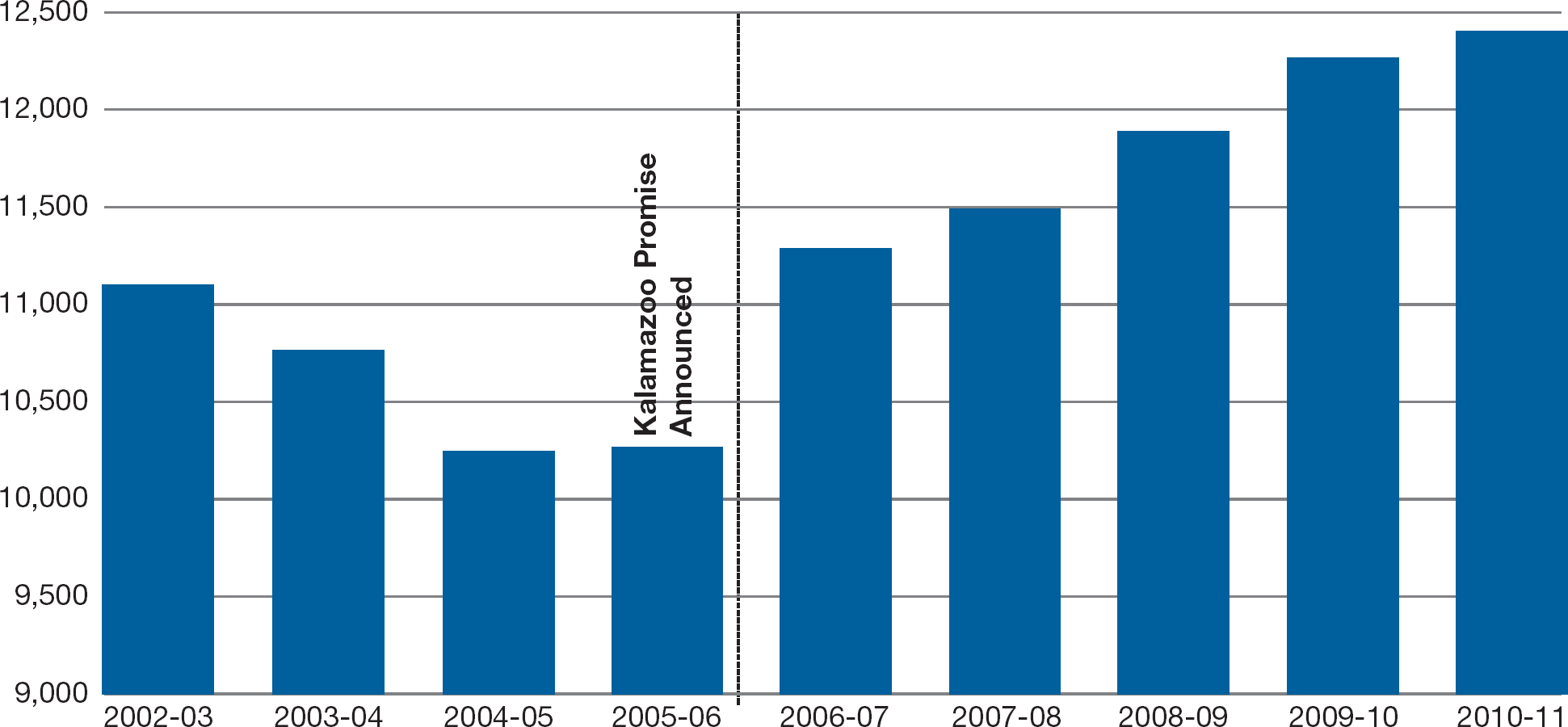
Enrollment in Kalamazoo Public Schools Before and After the Kalamazoo Promise
STUDENT OUTCOMES
Beyond such psychosocial changes in the classroom and across the school, other outcomes show that students are changing their behavior. First and foremost, we know that — depending on the year — between 83% and 85% of the eligible high school graduates are taking advantage of the scholarship, with others enrolling in private or out-of-state public universities. While the initial cohorts experienced lower than average rates of college retention, this indicator has improved over time as students are increasingly better prepared for postsecondary education. Of scholarship recipients, about two-thirds attended a four-year public university in Michigan, with about one-third taking classes at the community college level. To date, more than 1,500 students have applied the Kalamazoo Promise to their education.
Before the announcement of the Promise, the school district — consistent with comparable districts in the region and state — was experiencing declining enrollments. Since the announcement, that trend has reversed, with enrollment in the district increasing 17%. One reason is an influx of new students, especially in the first year. More important, though, is a reduction in dropout or exit rates (Bartik, Eberts, and Huang 2010; Miron and Cullen 2008). This is a dramatic contrast to surrounding and similar school districts, where enrollments generally continue to decline. In addition, the increased Kalamazoo enrollment has yielded a noteworthy fiscal increase in state funding: The 2,100 students that have been retained or attracted to the district represent more than $15 million in state aid to help educate the new students.
In the local schools, there were a large number of changes that aimed to better prepare students for success in college, including a 71% increase in the number of students enrolled in an AP course and substantially larger increases for minority and low-income students. There have also been steady and noteworthy improvements in student achievement as measured by state assessments (Bartik, Eberts, and Huang 2010).
CONCLUSIONS
Over the last four years, we've learned that a key ingredient for successful change is hope. Hope was not something anticipated in the outcomes logic model, but it came up again and again in interviews with stakeholders. This academic optimism has unlocked and unleashed the aspirations of parents and students. Hope has also allowed educators to believe that the new changes being implemented can truly lead to new opportunities for all students.
Substantial attention has been given to comprehensive school reform models as well as models for systemic change. Systemic reforms seek to transform schools, build synergy, and establish change by affecting multiple components or structures of the system at the same time. Systemic change occurs when all parts of the system are aligned and all stakeholder groups are focused on the same outcome. We're witnessing this change through parent involvement and community response and in the increased empowerment, higher expectations, aspirations, and hope at the classroom and school level. Increased enrollment in district schools, increased enrollment in college prep activities, and increased college-going rates and success in postsecondary education are further indicators. To date, more than 1,500 students have taken advantage of this scholarship program, and further study will track the longer-term impacts on individual students and the community.
Across the country, evidence from evaluations of systemic initiatives and the implementation of comprehensive reform models is mixed — in part because of issues related to sustainability and ownership of the reforms. The reform process in Kalamazoo Public Schools differs because the district's changes are initiated from within and have widespread support and a strong sense of ownership. Furthermore, they're not dependent on recurring funding needed to redesign and sustain new programs.
From interviews and survey data, we found that the Kalamazoo Promise has helped to establish a unified focus on improved academic performance and readiness for college. The Promise has also been repeatedly linked to the changes seen in the community and in the schools. Diverse stakeholders are more united in a common goal, and a college-going culture is being established in a struggling urban district. In only three years since high schools in the district were labeled “dropout factories,” President Obama has recognized one of the high schools, the district, and the community for its efforts to prepare students for postsecondary opportunities.
Dozens of other communities, moved by the success of the Kalamazoo Promise, now seek to replicate the idea. Already, districts such as Denver, Colo., Pittsburgh, Pa., and El Dorado, Ark., have implemented similar programs. Although the findings from these communities are preliminary, they're largely positive. The success of the Kalamazoo Promise and other related scholarship programs suggests an alternative tool and focus for urban school reformers to consider more closely: the relevance and cost-effectiveness of universal scholarship programs.