






Abstract
The story of California's history-social science framework, standards, and tests sheds light on how and why education reforms evolve and change, at times become inconsistent, and often produce unintended consequences.
The nation is once again rushing to establish new and improved academic standards. However, unresolved issues remain from the previous wave of standards reform in the 1980s and 1990s. In particular, the California standards-based reforms for history-social science over the past 25 years should provide a cautionary tale for those advocating new standards-based reforms.
California has three primary documents for history education: The History-Social Science Framework for California Public Schools, published in 1988 and revised significantly for the first time in 2009; the History-Social Science Content Standards for California Public Schools, developed between November 1997 and October 1998; and the California Standards Tests for History-Social Science, first fully implemented in 2003.
The California Department of Education intends for the framework, standards, and tests to work in concert and promote the teaching and learning of history-social science. The standards define the content and skills that all students should learn. The framework provides guidance for educators to implement the standards. The tests generate information about student achievement and hold schools accountable for implementing the standards.
These documents established California as a leader in standards-based reforms for history education. Such organizations as the Fordham Foundation, Achieve Inc., and the American Federation of Teachers have continually awarded the framework and standards high marks and ratings. The Fordham report (Finn and Petrilli 2000) refers to them as the “gold standard” for state history curricula. The California Standards Tests, administered at the end of 8th, 10th, and 11th grades, constitute one of the nation's most extensive testing regimes for history-social science.
Unfortunately, instead of working together symbiotically to promote history education, these documents present educators with inconsistent — even antagonistic — content, strategies, and tools to teach and assess history-social science.
A COMPARATIVE CASE STUDY
Between 2008 and 2009, I conducted a comparative case study of the California framework, standards, and tests. I collected detailed accounts of the policy making processes that created these influential curriculum and assessment documents. Drawing on interviews, minutes, and transcripts from meetings and public hearings, memos, sample test questions, technical reports, and various draft documents, I explored the political, institutional, and historical factors that shaped decision making. I wanted to focus on the goals and assumptions that policy makers used to frame the issues, problems, and solutions. I then compared the California case to others to compare the objectives and content of each. What follows are some highlights from this work.
THE 2010 FRAMEWORK
In January 2008, the California Department of Education began revising the History-Social Science Framework. This was the first major revision of the framework since 1987. In 1987, the framework was California's primary document for history education. It featured narrative course descriptions of grade-level content to help align state textbooks, assessments, and instructional materials. In 2001, the department integrated the standards into the framework without fully revising the framework's course descriptions. The primary objectives of the latest adaptation were to align the framework with the standards; to develop new chapters on assessment, instructional strategies, and universal access; and to update course descriptions with current historiography.
PDK 2011 Dissertation Winner
Bradley Fogo, a post-doctoral fellow in the Stanford University Teacher Education Program, has received the 2010–11 PDK International Outstanding Doctoral Dissertation Award. His dissertation examines the creation of history-social science standards, tests, and curriculum frameworks in California over the past two decades.
“This study seeks to contribute to the ongoing conversation about standards-based reform for history education, a topic once again grabbing national headlines,” said Fogo, who worked as a public school history teacher for nine years. “This historical analysis highlights the expansion of state education policy making during this time and provides an example of how and why education reforms evolve and change, at times become inconsistent, and often produce unintended consequences.”
Fogo received a $5,000 award from the PDK Educational Foundation.
Between February and June 2009, the 20-member Curriculum Framework and Evaluation Committee (CFCC), working in conjunction with the California Subject Matter Project — which won the contract to write the new framework — and the California Department of Education, drafted a new framework. This was a relatively harmonious process because members of the CFCC and writers from the subject-matter project were primarily history educators — teachers, administrators, and academics — with similar political and pedagogical views. The work resulted in new chapters on instruction and assessment that synthesize current research on teaching and learning and that detail various best practices for teachers and administrators. It also led to expanded and more diverse course descriptions, along with a completely new, global conception of world history for grades 6, 7, and 10.
While the state has traditionally refrained from mandating “how to teach,” the 2010 framework goes further than previous editions in attempting to guide local decisions about instruction and assessment.
One of the central tensions in the drafting process arose over the framework's relationship to the standards. Various committee members, writers, and public commentators voiced their hopes of using the new framework to change the state's standards. Members of the department of education had to stress that the CFCC lacked authority to alter the scope and sequence detailed in the standards or to edit the standards' content.
This restriction marked the framework's diminished status. Since their adoption, the standards have played the central role in aligning instructional materials and assessments in California. The purpose of the framework is now, as one state department consultant noted, “to provide a blueprint for teachers on how to implement the standards.” However, this objective actually expands the purview of the framework. While the state has traditionally refrained from mandating “how to teach,” the 2010 framework goes further than previous editions in attempting to guide local decisions about instruction and assessment.
Six weeks after the CFCC completed the 2010 draft framework, Gov. Arnold Schwarzenegger postponed all framework and textbook adoptions for five years because of the state's ongoing budget crisis. At present, the new framework draft is posted on the department of education's web site, suspended in mid-adoption. State department officials remain hopeful that the adoption will move forward this year.
THE CONTENT STANDARDS
In 1995, the California Assessment of Academic Achievement Act mandated the creation of a 21-member Academic Standards Commission to develop content and performance standards, first in math and English language arts and then in science and history-social science. The commission split into subcommittees to develop content standards for each subject. The commission's nine-member History-Social Science Committee — which, notably, did not include any historians or secondary history teachers — developed the primary draft of the history standards between November 1997 and June 1998. The California Board of Education officially adopted the California history standards on Oct. 16, 1998. Unlike the state's curriculum frameworks, there is no protocol for revising the standards. They exist, with the exception of a few minor edits, as adopted in 1998.
The few published accounts of this process claim that the history standards were developed by consensus, with little debate and considerable public oversight (see, e.g., McDonnell and Weatherford 1999; Jacobs 2006). Drawing on committee meeting minutes, commission memos, “expert reviews” of draft standards, full transcripts of public hearings, six drafts of the standards, and interviews with commission members, I argue that these characterizations are incomplete at best and misleading at worst.
First, poor attendance restricted the History-Social Science Committee's decision-making power and range of debate. None of the committee's nine meetings was fully attended. In fact, only five or fewer members were present at most meetings. Furthermore, work on the history standards followed a protracted adoption of math standards and was done concurrently with science and performance standards. This left committee members, in the words of one former commissioner, “tired” and “running out of time.” A writing team of three consultants — none of whom had backgrounds in history education — made most of the decisions regarding the standards. Many of these decisions were never discussed in public by the history committee or standards commission.
The writers incorporated a diverse array of suggestions from across the political and religious spectrum when drafting the standards. This facilitated a type of additive consensus and garnered endorsements from a range of individuals and organizations — from WallBuilder's founder David Barton to the Council for Islamic Education and the Jewish Community Relations Council. This consensus is evident throughout the standards. Take, for example, the development of standard 7.10.6 on the Scientific Revolution (Figure 1) and notice its treatment of science (italicized).
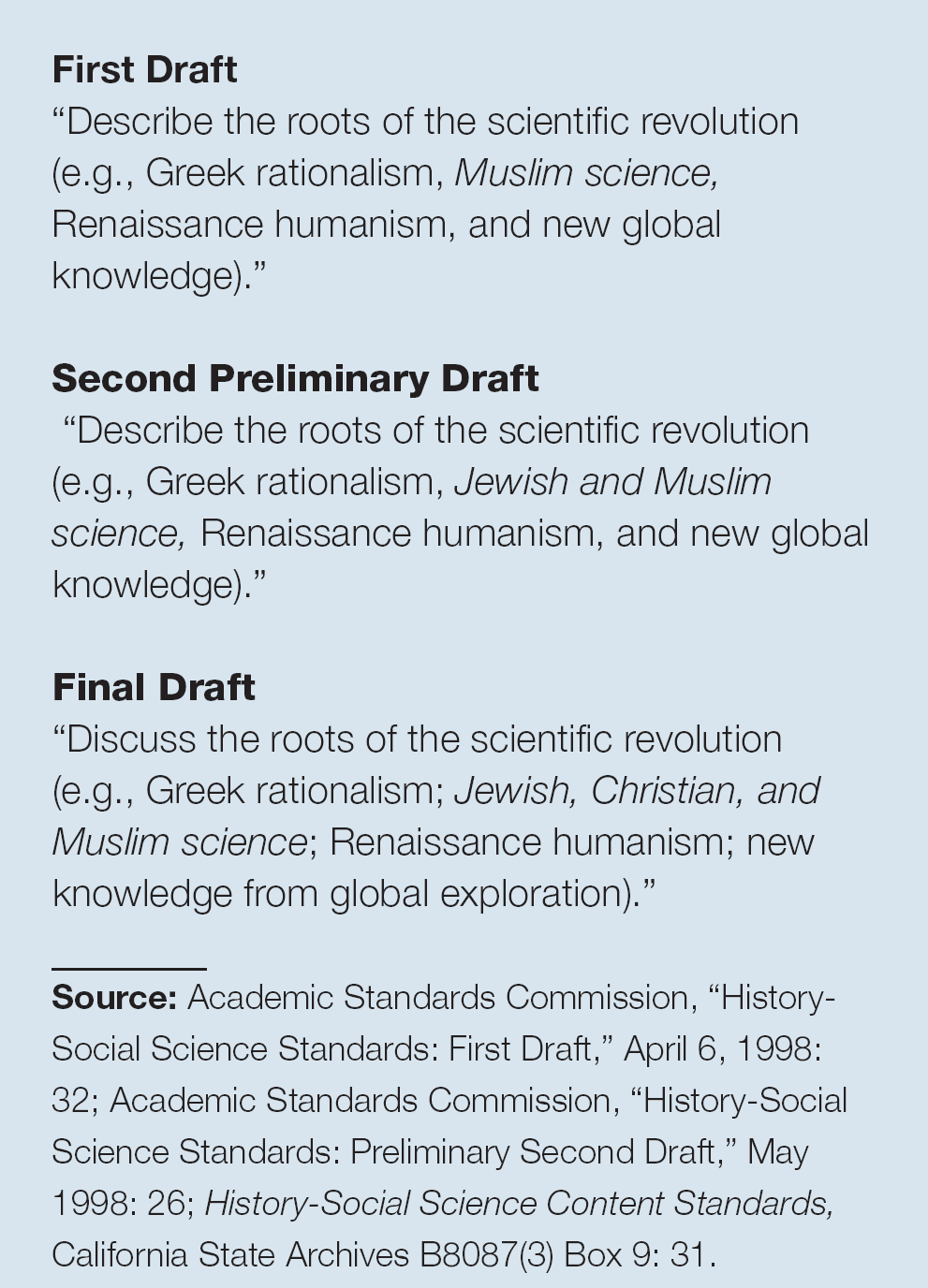
Additive Consensus for Standard 7.10.6 (Scientific Revolution)
However, there is a problem in describing the California history standards as a consensus document. There were clear winners and losers in this process. Conservative advocates for content-heavy, chronological history won the day. Proponents of global and multicultural history and those who favored a thematic, cross-disciplinary approach or flexible skill-centered standards offered alternative visions not incorporated into the California standards.
The Academic Standards Commission presented the final draft of the standards as the “essential core academic content that every student should know” (1998: 1). However, neither the Academic Standards Commission nor the History-Social Science Committee ever adopted a consistent rationale for what constitutes essential historical content, a rigorous standard, or developmentally appropriate material. The lack of overarching criteria for determining content led to several additions and edits that appear more arbitrary than essential. This is particularly evident in the changing list of exemplars included in drafts of the standards (Figure 2).
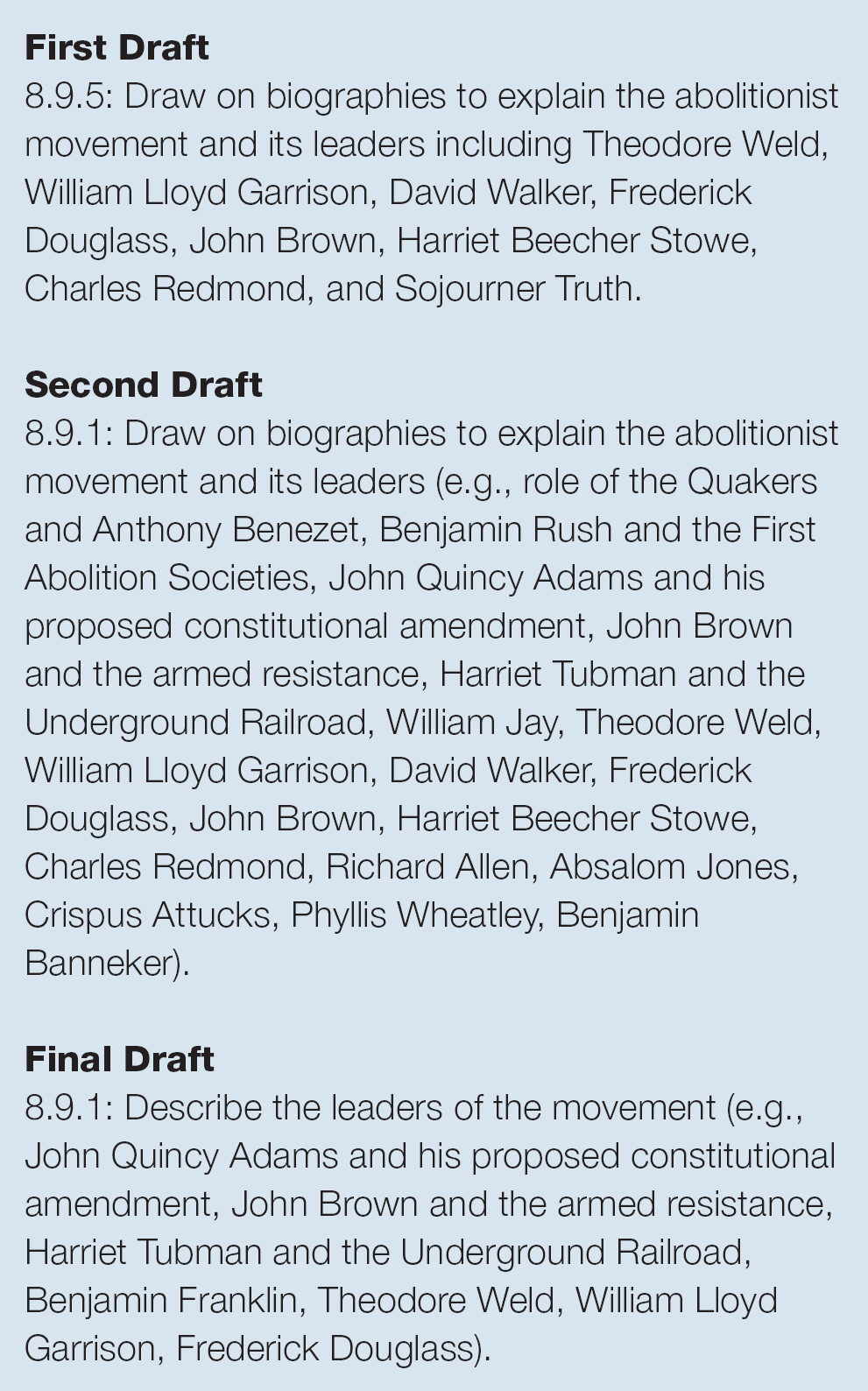
The Evolution of Standard 8.9.1
Throughout the drafting process, several commentators — primarily teachers — questioned the amount and sophistication of the standards. The history committee and the writing team attempted to address this issue with loosely defined typologies of verbs that suggested a trajectory of intellectual rigor and by slightly differentiating the amount of content across grade levels. The committee also decided to include a note in the introduction stating that “The standards include many exemplary lists of historical figures that could be studied. These examples are illustrative. They do not suggest that all of the figures mentioned are required for study” (California Department of Education 1998: vi). By and large, however, this approach resulted in 7th- and 10th-grade world history and 8th- and 11th-grade American history standards with little to distinguish them beyond what chronological slice of history they cover (Figure 3).
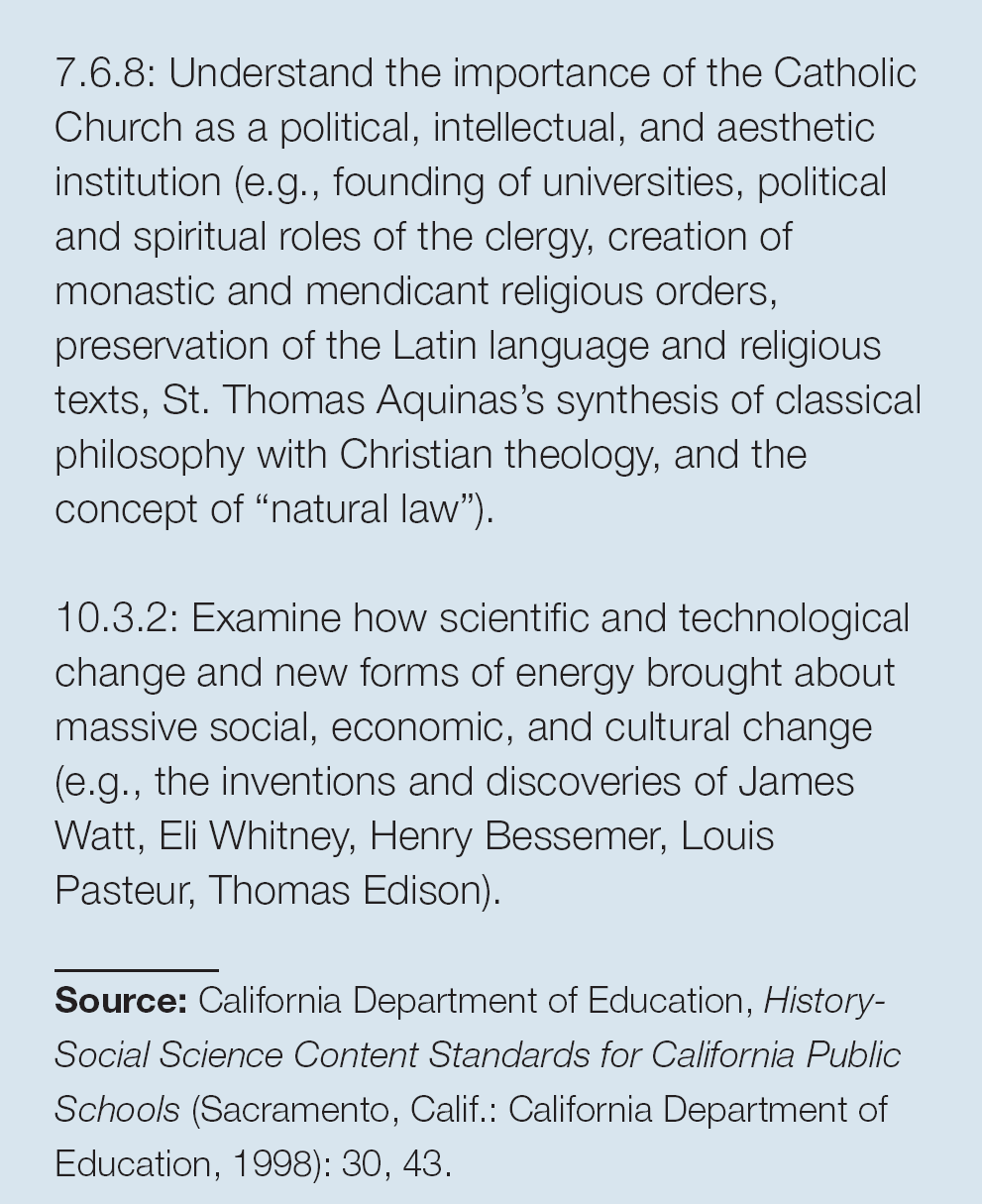
Sample 7th- and 10th-Grade Standards
It is important to note, finally, that the work of the Academic Standards Commission was cut short. Gov. Pete Wilson ended the commission's efforts to create performance standards when, citing time constraints, he suspended the process in May 1998. By not developing performance standards, the Academic Standards Commission ceded its influence on how the content standards would be assessed.
CALIFORNIA STANDARDS TESTS
The criterion-referenced California Standards Tests (CSTs) for History-Social Science consist of three multiple-choice exams. The 8th-grade test includes 75 questions aligned with the standards for grades 6–8, while the 10th-grade end-of-course and 11th-grade exams each include 60 questions. These exams do not figure into a school's Adequate Yearly Progress as required by No Child Left Behind (NCLB). They do account for about 7% to 14% of high schools' Academic Performance Index — California's measure of school achievement.
Proponents characterize these exams as bulwarks against the marginalization of history-social science due to NCLB's high-stakes testing mandates for math and reading. However, this characterization glosses over the shortcomings of the California history tests and their problematic relationship with the standards. As one state department official involved in their development noted, these tests “are very, very limited” and “tend to focus more on recall than anything else.” Indeed, the tests appear poorly aligned with the skills and understandings detailed in the standards. Moreover, though focused primarily on content, test questions tend to sample only slight amounts of the history detailed in the standards.
Beyond questionable construct and content validity, the California history tests fundamentally change the nature of the state standards — from suggested to prescribed content. Many past test questions have featured content drawn from the lists of exemplars that the History-Social Science Standards Committee stressed were “illustrative” (Figure 4).
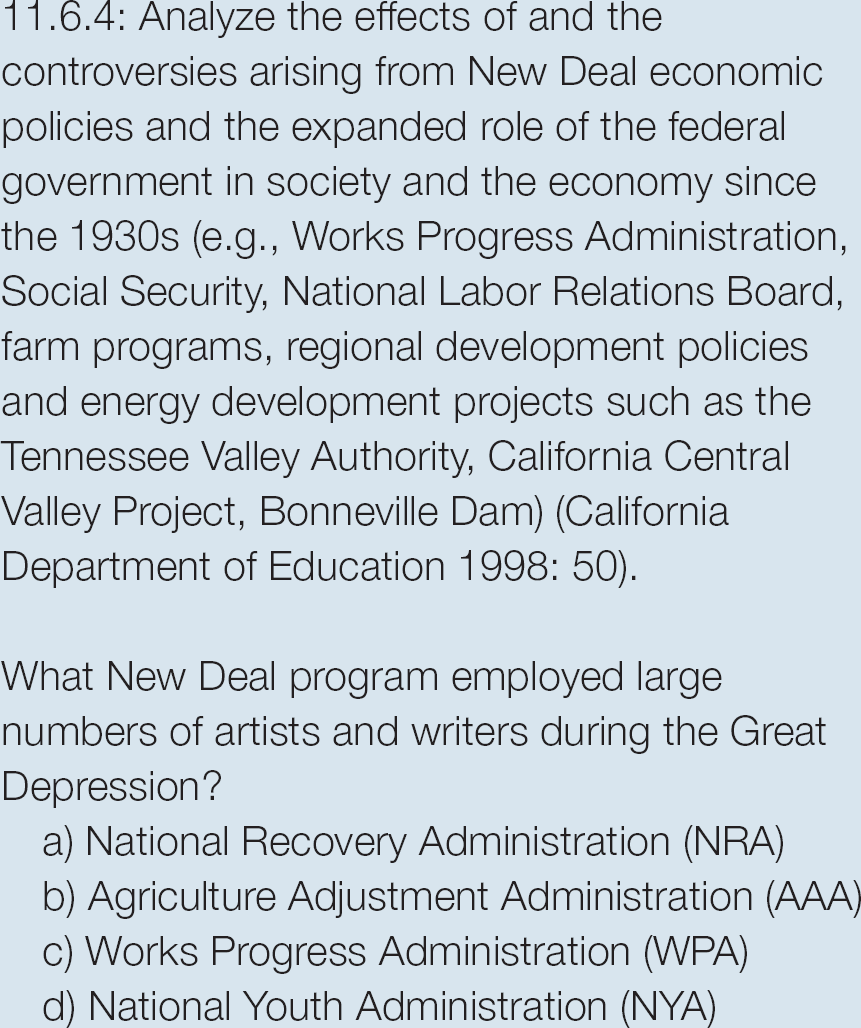
Standard and Question from the 2004 CST
By sampling content across the standards and including material intended to be optional, the CSTs hold teachers and students accountable for hundreds of historical figures, groups, events, and phenomena spread over wide expanses of time. This is particularly problematic in the 8th-grade exam, which covers the 6th-, 7th-, and 8th-grade standards and gauges student knowledge of history from the Paleolithic era to the Progressive period.
The California Standards Tests exacerbate the tensions between the new History-Social Science Framework and the standards, sending educators mixed signals. The framework's new chapters on instruction, assessment, and access, for example, encourage differentiated instruction with flexible, “age-appropriate” content. But the standards contain content largely determined without consideration of developmental appropriateness, and, when combined with incentivized tests, they become fixed and prescriptive. The new framework stresses multiple forms of assessment, historical thinking skills, and the central importance of writing in the history classroom. The CSTs are multiple-choice tests focused on the recall of content. Finally, whereas the framework stresses the “importance of studying major historical events and periods in depth, as opposed to superficial skimming of enormous amounts of material” (California Department of Education 2005: 7), the standards and tests exemplify the mile-wide, inch-deep approach to history.
CONCLUSION
The story of California's history-social science framework, standards, and tests sheds light on how and why education reforms evolve and change, at times become inconsistent, and often produce unintended consequences. This is not a case of policy being misinterpreted, perverted, or ignored as it moves vertically across federal, state, and local levels. Rather, the problematic relationship between the framework, standards, and tests reflects a lack of horizontal integration of policy at the state level. This can be attributed, in large part, to diffuse sets of policy actors with different objectives and assumptions about curriculum and assessment, working in separate institutional and historical contexts.
For a quarter century, California has assumed leadership for history-social science education. Today, dated standards with no recourse for revision, a strict reliance on multiple-choice tests with questionable validity, and overlapping curriculum documents with conflicting pedagogical messages are poor models for emulation. If we're serious about improving history-social studies education, these issues need solutions, not celebration.