





Abstract
One percenters, meet the 2.5 percenters.
You may know one already: He's black, well educated, and could be working in your school or company. He's a minority of a minority.
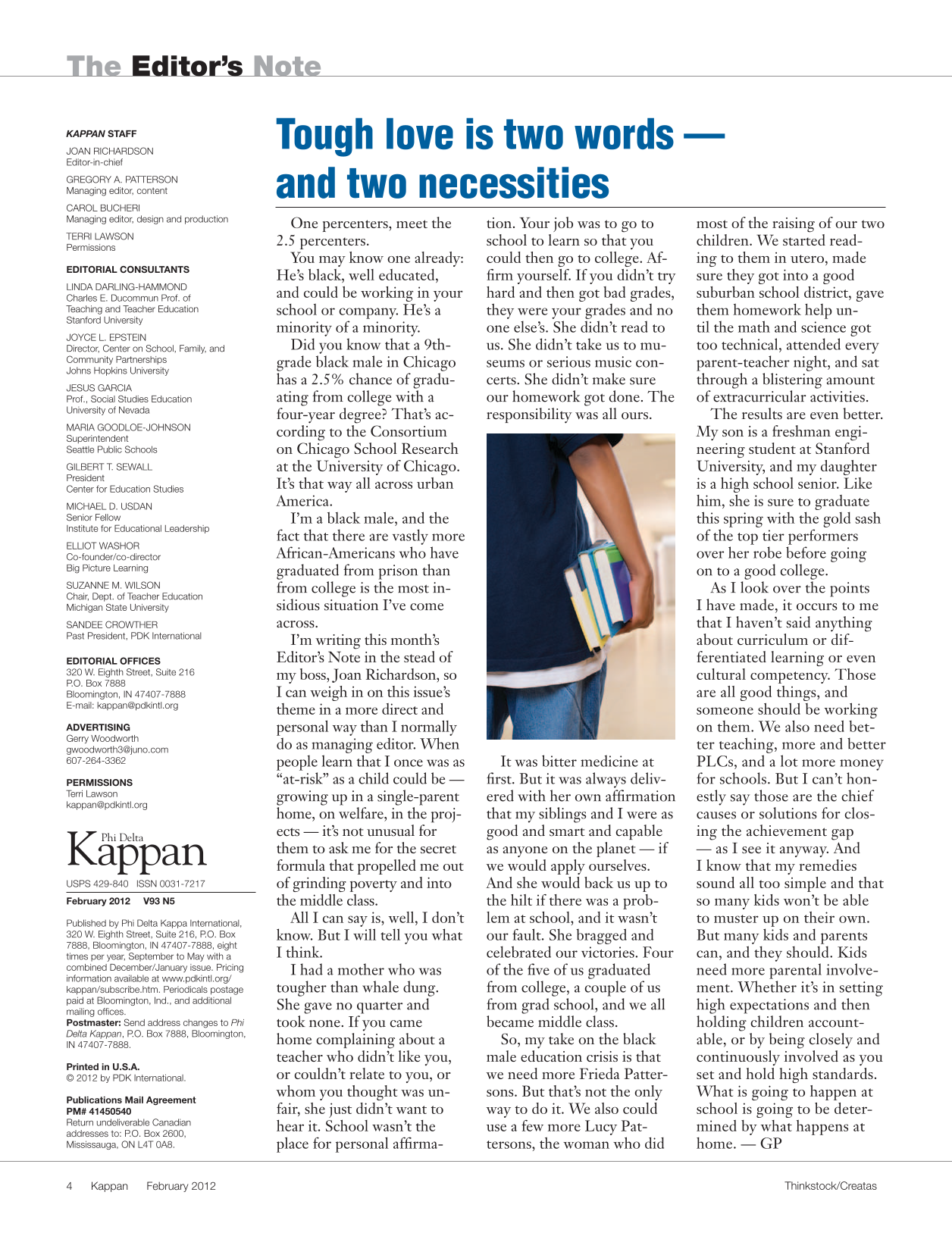
Did you know that a 9th-grade black male in Chicago has a 2.5% chance of graduating from college with a four-year degree? That's according to the Consortium on Chicago School Research at the University of Chicago. It's that way all across urban America.

I'm a black male, and the fact that there are vastly more African-Americans who have graduated from prison than from college is the most insidious situation I've come across.
I'm writing this month's Editor's Note in the stead of my boss, Joan Richardson, so I can weigh in on this issue's theme in a more direct and personal way than I normally do as managing editor. When people learn that I once was as “at-risk” as a child could be — growing up in a single-parent home, on welfare, in the projects — it's not unusual for them to ask me for the secret formula that propelled me out of grinding poverty and into the middle class.
All I can say is, well, I don't know. But I will tell you what I think.
I had a mother who was tougher than whale dung. She gave no quarter and took none. If you came home complaining about a teacher who didn't like you, or couldn't relate to you, or whom you thought was unfair, she just didn't want to hear it. School wasn't the place for personal affirmation. Your job was to go to school to learn so that you could then go to college. Affirm yourself. If you didn't try hard and then got bad grades, they were your grades and no one else's. She didn't read to us. She didn't take us to museums or serious music concerts. She didn't make sure our homework got done. The responsibility was all ours.
It was bitter medicine at first. But it was always delivered with her own affirmation that my siblings and I were as good and smart and capable as anyone on the planet — if we would apply ourselves. And she would back us up to the hilt if there was a problem at school, and it wasn't our fault. She bragged and celebrated our victories. Four of the five of us graduated from college, a couple of us from grad school, and we all became middle class.
So, my take on the black male education crisis is that we need more Frieda Pattersons. But that's not the only way to do it. We also could use a few more Lucy Pattersons, the woman who did most of the raising of our two children. We started reading to them in utero, made sure they got into a good suburban school district, gave them homework help until the math and science got too technical, attended every parent-teacher night, and sat through a blistering amount of extracurricular activities.
The results are even better. My son is a freshman engineering student at Stanford University, and my daughter is a high school senior. Like him, she is sure to graduate this spring with the gold sash of the top tier performers over her robe before going on to a good college.
As I look over the points I have made, it occurs to me that I haven't said anything about curriculum or differentiated learning or even cultural competency. Those are all good things, and someone should be working on them. We also need better teaching, more and better PLCs, and a lot more money for schools. But I can't honestly say those are the chief causes or solutions for closing the achievement gap — as I see it anyway. And I know that my remedies sound all too simple and that so many kids won't be able to muster up on their own. But many kids and parents can, and they should. Kids need more parental involvement. Whether it's in setting high expectations and then holding children accountable, or by being closely and continuously involved as you set and hold high standards. What is going to happen at school is going to be determined by what happens at home.