





Abstract
There's no simple answer why black males struggle with reading, but part of the problem stems from correctable factors that tend to lead to an early disconnect.
Black boys are unique in that they're in two groups that have historically underachieved in reading — boys and blacks. Although black boys are not a homogenous group, understanding what underlies gaps in both arenas can help educators develop responses to reduce the disparities.
Recent data from the National Center for Education Statistics (NCES) indicate two significant reading achievement gaps between black boys and other student groups in 4th grade (2009). First, black boys did not score as high as boys from all other racial/cultural backgrounds on national reading assessments (see Figure 1). NCES data also reveals gender gaps in reading achievement between black boys and girls from various racial/cultural backgrounds (see Figure 2). Not only does this data indicate a profound reading achievement gap between black boys in 4th grade and other groups of girls in 4th grade, it also points out that black boys in 4th grade performed lower than all of the other groups of girls.

Comparison of average composite reading scores of boys in 4th grade
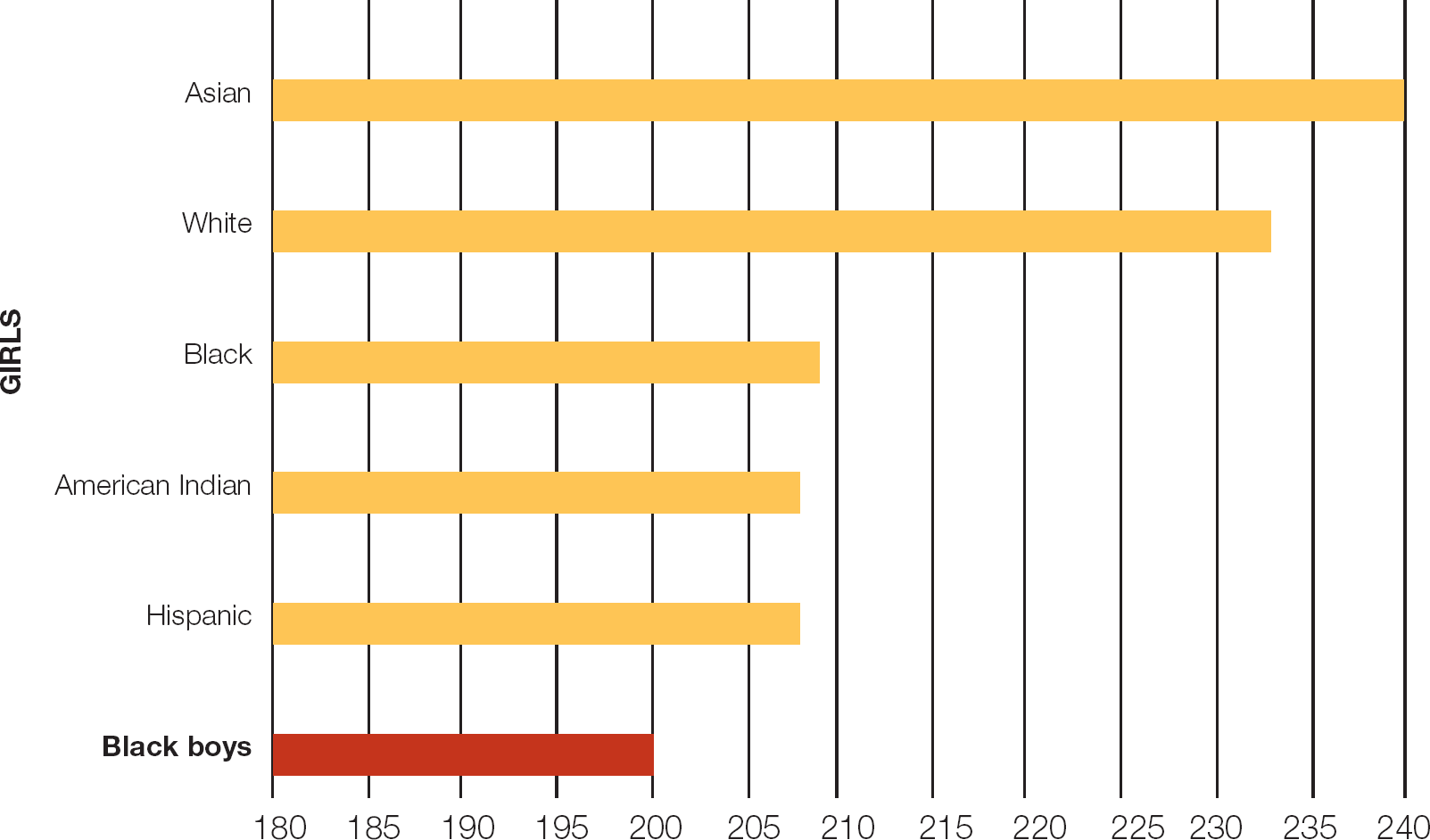
Comparison of average composite reading scores of girls in 4th grade and black boys in 4th grade.
Gender factors
Boys and girls prefer reading different kinds of texts. Boys tend to prefer reading texts based on action, nonfiction, scary fairy tales, super heroes, video games, and humor (Bosacki et al., 2009; Brozo, 2002; Collins-Standley et al., 1996). Boys also prefer reading texts with positive male characters as the main character in the text (Brozo, 2002; Millard, 1997; Smith, 2004). But children's literature used in most early childhood and elementary classrooms doesn't embody the themes and characters that correspond with boys' preferences. Thus, boys are often less motivated to engage with texts in the classroom than girls. Black boys probably aren't reading as much at school or as often as girls because they don't have access to texts that appeal to boys in general. This is one factor contributing to reading underachievement in black boys.
Boys and girls also differ in how they read texts. Boys prefer reading for practical, analytical, informational, and directional purposes, while girls prefer to read in ways that allow and encourage the reader to explain the literary qualities of a work (Clarke, 2006). Boys are drawn toward reading newspapers, how-to manuals, and other short informational texts more often than girls. Most texts in early childhood and elementary classroom settings require “aesthetic” reading skills and center on narrative text structures (Sullivan, 2004). Boys are disadvantaged more often than girls in reading texts that require extensive aesthetic reading skills. Clarke's two-year qualitative investigation of literature circles in a 4th- and 5th-grade classroom documents multiple instances where girls answered questions for boys and/or completely ignored the requests of particular boys in the group (2006). In a particular instance, girls in the literature circle demoted the boy who was assigned (by the teacher) to be the literature circle facilitator from his position in the group. This study suggests that reading instructional methods designed to open up discussions around texts and increase reading engagement may actually work to close down discussions for boys. Thus, the way in which a text is or is not read by black boys may be another factor contributing to reading underachievement.
Racial/cultural factors
Racial/cultural factors contribute as well. Tatum (2006) points out that many adolescent black males don't read texts available for them because most are socially and culturally irrelevant and inauthentic. They fail to reflect black males' social and cultural backgrounds. Preadolescent black boys are likely to be equally disengaged for the same reasons. Ultimately, this reading disengagement can be linked to reading underachievement, as there is a direct relationship between how often students engage in reading and how well they achieve in reading.
Many states and school districts have implemented standardized reading curricula that inadvertently contribute to reading achievement disparities in black males in two ways. They don't consider the individuality of black males as the basis for curriculum design and development, and, second, they don't offer socially and culturally relevant strategies for teachers to differentiate their instructional practices to better meet the needs and interests of black males (Kirkland, 2011). Such uniform standards encourage all teachers to teach all black males in the same ways. They don't consider the varied needs and interests of black males from year to year and context to context. In keeping with Kirkland's assertion, this lack of pedagogical differentiation and consideration for cultural and academic interests may also have contributed to reading disparities in black boys.
To illustrate, let's suppose that a 3rd-grade teacher named Mrs. Reynolds has three black male students who are reading below grade level. Rather than allowing teachers to amend the reading curriculum to respond to their specific and individualized needs and interests — by integrating culturally responsive texts and differentiating instruction to teach reading at their reading levels — the school district requires Mrs. Reynolds to teach a prescribed reading curriculum. As a consequence of participating in reading instruction that is above their reading levels and socially and culturally irresponsive, these three boys fall further and further behind by the end of the academic year. The boys' attitudes toward reading deteriorate as well. What was designed to help these and other black boys who may be having difficulty in reading has worked to exacerbate this issue.
Many researchers have pointed out that black students in general benefit more often from instructional activities that are highly stimulating, active, and arousing than from lectures and teacher-centered activities where they function as passive receptacles of information. Webb-Johnson (2002) points out that black males, in particular, respond better in instructional environments that offer more interaction, movement, and energy. Regrettably, many early childhood and elementary teachers construct learning activities that don't take these specific socially and culturally situated learning styles of black males into consideration. These teaching and learning inconsistencies can be linked to achievement disparities in black boys across various content areas in general and reading in particular (Ladson-Billings, 2011).
Due to pervasive societal stereotypes, teachers often have low expectations for black males and academic achievement. Haddix (2009) informs us that much of the public and research discourse surrounding black males and literacy emphasizes a “failure” perspective. Much of how teachers think about and discuss black males' literacy development positions black males as poor or struggling readers. This deficit perspective affects teachers in two important ways. Black boys are assumed to be solely responsible for the achievement disparities they experience, which means that teachers and schools are excused from being accountable for producing and exacerbating reading achievement disparities. Second, teachers who hold low expectations toward black males are likely to teach in ways consistent with low expectations (Steele & Aronson, 1995). They are likely to rely more often on lower-level texts and instructional strategies (i.e., worksheets, drill and skill, repetition, etc.) than on higher-level texts and instructional strategies during reading instruction. Ultimately, access to or denial of rigorous learning opportunities will lead to reading achievement disparities (Milner, 2010).
A final racial/cultural factor that contributes to reading underachievement in black boys concerns school disciplinary policies. Black males are suspended at disproportionate rates in most schools. This time spent out of school has a direct effect on academic achievement in general and reading achievement in particular (Mendez & Knoff, 2003). For example, Anderson, Howard, and Graham (2007) note a strong relationship between suspension rates and reading achievement in black males in one large urban school district. An analysis of four years of archived reading achievement and disciplinary data found that the black males who were suspended from school had lower levels of reading achievement than other students. This study implies that many of the disciplinary procedures aimed at correcting and eliminating unwanted behavior in and among black boys may be having unintended consequences on reading achievement. The study also implies that black boys removed from class or school on a consistent basis as a disciplinary measure may not acquire the foundational reading skills necessary to become proficient readers. Further, because reading is a developmental process that depends on successful acquisition of a series of previous skills, dismissal from school is likely to have a significant effect on reading achievement in later years (Chall, 1996).
Black boys probably aren't reading as much at school or as often as girls because they don't have access to texts that appeal to boys in general.
Conclusions
Identifying factors that underlie black boys' low reading achievement can point educators to school and classroom changes that might stem the tide of underachievement during the early years of education.
First, teachers and schools should try to increase the number of culturally relevant reading texts available for black boys (Feger, 2006). Teachers and school librarians can assess their classroom and school libraries to ensure that they have sufficient texts that speak to the global and local interests, experiences, and backgrounds of black boys. For example, teachers and school librarians might consider integrating nonfiction texts with black boys that center on other black males in popular culture, sports, and news as the main characters in the text. When teaching across various content areas, teachers and libraries can look for and integrate literature with black boys that present concepts and events from the perspectives of other black people. For example, when teaching black boys about the history of racial injustice in the United States, teachers and libraries might intentionally use Patricia C. McKissack and Fredrick McKissack Jr.'s book, Black Diamond: The Story of the Negro Baseball Leagues (Scholastic, 1994). In the same vein, teachers and libraries might also consider integrating fictional texts with other black males/boys as the main character as well, such as Pat Cummings' book, Clean Your Room, Harvey Moon (Simon & Schuster, 1991). (See “Librarians form a bridge of books to advance literacy,” by Sarah Hughes-Hassell et al., on p. 19 in this issue of Kappan for a lengthy list of recommended books for black male students from elementary through high school.)
Second, teachers should be willing to adopt culturally responsive literacy approaches that center on high expectations, use active teaching methods, and offer positive perceptions of students' cultural backgrounds (Callins, 2006). Further, culturally responsive literacy instruction has a strong potential to produce outcomes in black boys, as it has produced significant achievement gains in literacy in and among other groups of students from culturally diverse backgrounds (Au, 1993). (See “Yes, black males are different, but different is not deficient,” by Christopher Emdin on p. 14 in this issue of Kappan for a deeper discussion on instructional strategies that are most effective with black males.)
Finally, teachers and schools can reconsider current discipline policies. Black boys are disproportionately affected by the suspension and expulsion policies in most schools. Frequently, these discipline policies remove black boys from the classroom and school setting for extended periods of time. Consequently, they often don't receive foundational reading instruction on skills and processes necessary for future reading success. To combat this issue, teachers and schools should develop alternative and creative means of disciplining black boys that respond to undesirable behavior without sacrificing their educational opportunities (Gregory, Skiba, & Noguera, 2010).
As mentioned throughout this article, the reading achievement issue is one that stems from multiple factors along multiple levels within the educational process. In order to address this issue in a robust manner that will lead to effective and sustainable results, teachers, administrators, and other school officials must be willing to work together collaboratively to create new strategies and new structures for reversing and eventually eliminating this dismal trend in reading underachievement. Further, unless we are willing to develop and implement new ways of addressing this issue, black boys will continue to perform far behind other students for many years to come.