Abstract
Two recent initiatives that set new standards for teaching programs are surprising in their singularity and hubris.
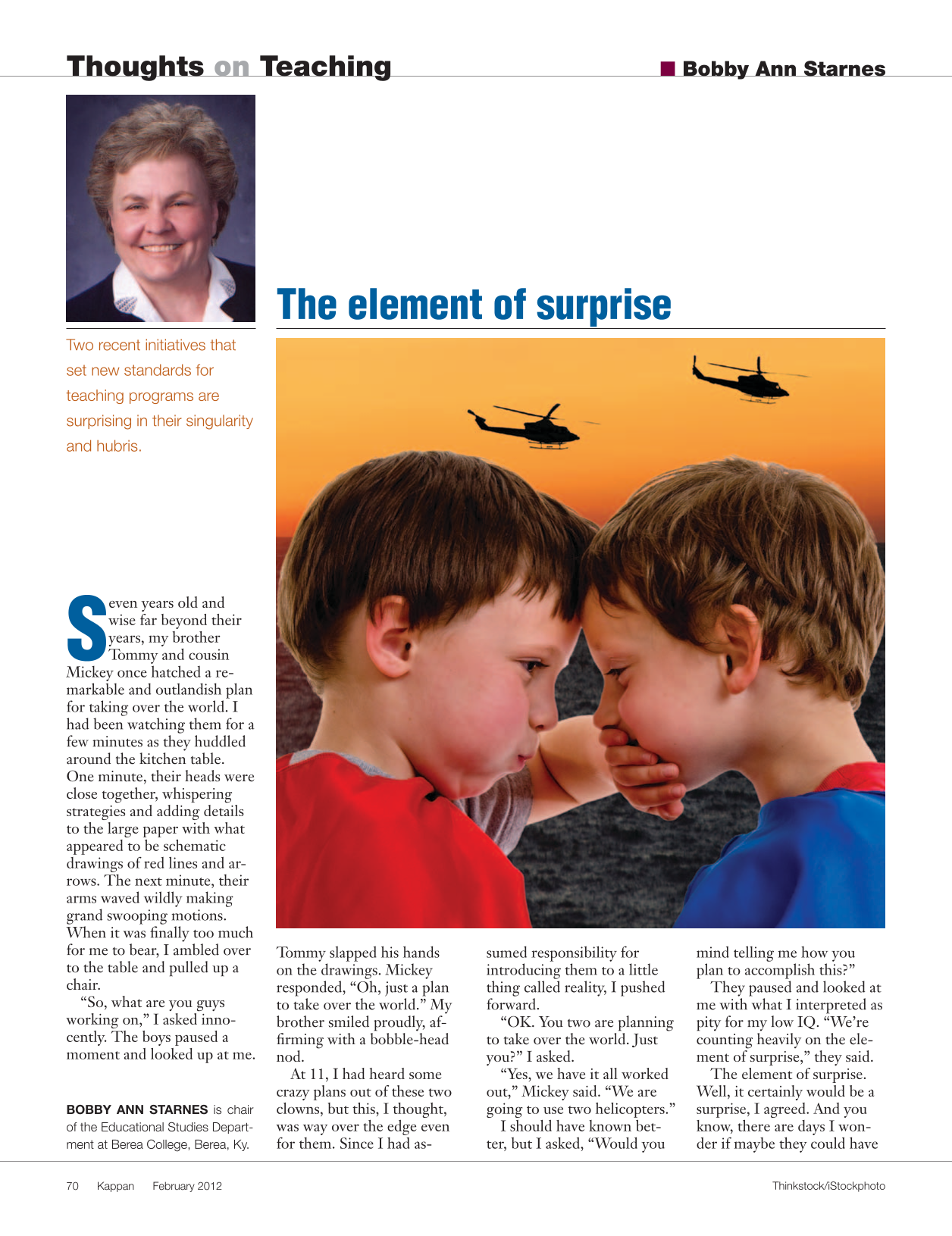
Seven years old and wise far beyond their years, my brother Tommy and cousin Mickey once hatched a remarkable and outlandish plan for taking over the world. I had been watching them for a few minutes as they huddled around the kitchen table. One minute, their heads were close together, whispering strategies and adding details to the large paper with what appeared to be schematic drawings of red lines and arrows. The next minute, their arms waved wildly making grand swooping motions. When it was finally too much for me to bear, I ambled over to the table and pulled up a chair.

“So, what are you guys working on,” I asked innocently. The boys paused a moment and looked up at me. Tommy slapped his hands on the drawings. Mickey responded, “Oh, just a plan to take over the world.” My brother smiled proudly, affirming with a bobble-head nod.
At 11, I had heard some crazy plans out of these two clowns, but this, I thought, was way over the edge even for them. Since I had assumed responsibility for introducing them to a little thing called reality, I pushed forward.
“OK. You two are planning to take over the world. Just you?” I asked.
“Yes, we have it all worked out,” Mickey said. “We are going to use two helicopters.”
I should have known better, but I asked, “Would you mind telling me how you plan to accomplish this?”
They paused and looked at me with what I interpreted as pity for my low IQ. “We're counting heavily on the element of surprise,” they said.
The element of surprise. Well, it certainly would be a surprise, I agreed. And you know, there are days I wonder if maybe they could have pulled it off if they'd actually had access to helicopters, and their feet could have reached the floor pedals.
Surprise as a weapon
This encounter was my introduction to the element of surprise as a strategic weapon. Over time, I've seen this weapon used to create panic and to slide some pretty remarkable craziness into schools — No Child Left Behind being one example. This year, I got two more of these surprises. One from the National Council on Teacher Quality (NCTQ); the other from the Kentucky Education Professional Standards Board.
One day last summer I sat almost comatose working on one of many reports required by the National Council for Accreditation of Teacher Education (NCATE) as part of its upcoming accreditation visit to Berea College. When the little bell announcing a new e-mail chimed, I was grateful for an excuse to escape the mind-numbing reports if only for a second or two. Reading the e-mail, I was surprised I had not heard the steady thwap, thwap, thwap of helicopter blades circling above me.
The e-mail from NCTQ announced it had paired with U.S. News & World Report to rate teacher education programs. NCTQ's purpose was clear, or so the e-mail claimed. The ratings “are meant to help aspiring teachers identify programs that will best prepare them for the classroom, aid school districts in knowing where they should target their new hire efforts, and assist education leaders and policy makers in evaluating best and worst practices.” They offer no definitions of what they mean by best and worst practices or programs or how I might find out what arbitrary standards they've set.
My head dropped into my hands and then onto my keyboard. As it fell, I heard a string of expletives from a voice I later realized was my own. There I sat, giving up my whole summer for the second year in a row to get ready for accreditation only to hear that there would be still another agency to accommodate. I was as surprised to learn that another self-appointed group had decided to evaluate teacher education programs as the Seven Dwarfs must have been to see that Snow White — an uninvited squatter guilty of breaking and entering — had invaded their domicile and set up new house rules.
NCTQ said that colleges that refused to cooperate would be listed in U.S. News & World Report as failing. Wow. They mean business. Perhaps their goal is to replace NCATE, the organization currently responsible for the same task. Perhaps they have other political agendas. But their research methods are faulty, and their approach is threatening and coercive. Our school has decided to exercise a remarkably underused word in response: No. We will not participate. NCATE rates our programs' quality and has the responsibility for ensuring that all accredited programs meet expectations. If NCTQ doesn't think NCATE is doing its job, it should take that up with them rather than attempting what seems a poorly conceived coup. Ah, the hubris.
A new assault
Just as I was recovering from the mayhem created by NCTQ's power grab, there came another surprise attack. This time from the Kentucky Education Professional Standards Board, the group responsible for establishing standards for teacher performance and preparation programs, accrediting college programs, and selecting assessments for teachers and administrators. In another e-mail, I was informed of policy changes that would go into effect over two years. Of course, these changes would require more and more paperwork. I expect that every time I open an e-mail these days. But there was more than red tape this time. In their extreme wisdom, the board had decided that teacher education candidates will be required to complete 200 hours of field work before student teaching — a plan every bit as reasonable as the boys' plan to take over the world. But there was more. For example, elementary student teachers will now be required to split their experiences between two classrooms, half in grades K-3 and half in grades 4-5. Now that's just grand. Another “best practice” — choosing breadth over depth yet again. So, student teachers will be ill prepared to teach in two grade levels rather than focusing all of their time on learning how students learn, how to diversify instruction, how to assess student learning, and all the other things preservice teachers need to experience before writing their names on the chalkboards of their first real classrooms. Offering no “gold standard” research (because there is none!) let alone proving there is a connection between GPA or performance on Praxis tests and teaching quality, there will be more Praxis tests. Good news for ETS, eh? A higher GPA will be required for admission to programs, though only admission; students' grades can drop after they're admitted. There are more, equally illogical requirements I could list here, but I think you get the picture.
Illogical and irrational have become the new normal, and I do believe I've fallen down a rabbit hole. It must be so because I'm finding that Tommy and Mickey's plan to take over the world with their two helicopters makes every bit as much sense and is every bit as logical as the thinking that goes into developing such strategies as these to improve teacher education.