





Abstract
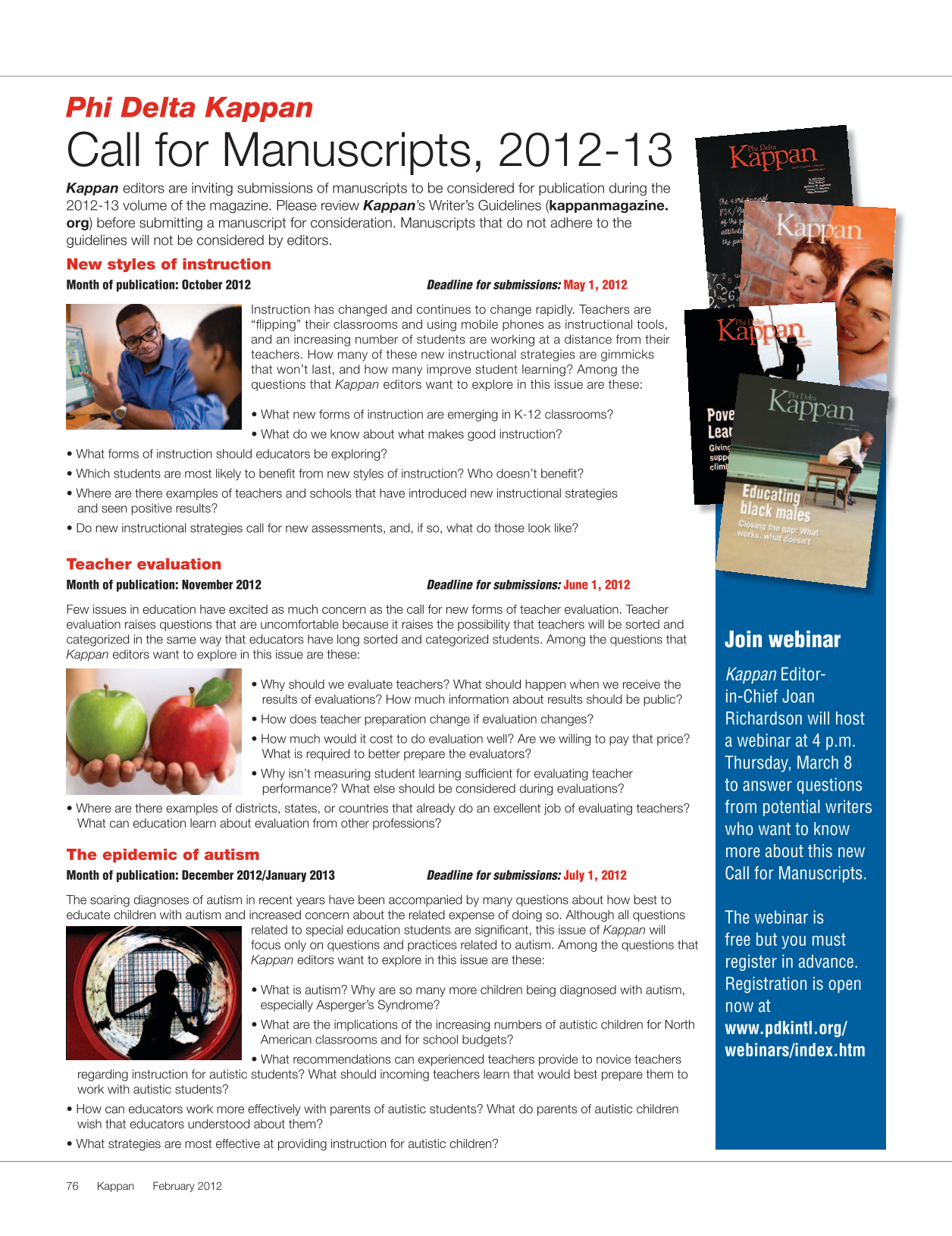
New styles of instruction

Instruction has changed and continues to change rapidly. Teachers are “flipping” their classrooms and using mobile phones as instructional tools, and an increasing number of students are working at a distance from their teachers. How many of these new instructional strategies are gimmicks that won't last, and how many improve student learning? Among the questions that Kappan editors want to explore in this issue are these:
What new forms of instruction are emerging in K-12 classrooms?
What do we know about what makes good instruction?
What forms of instruction should educators be exploring?
Which students are most likely to benefit from new styles of instruction? Who doesn't benefit?
Where are there examples of teachers and schools that have introduced new instructional strategies and seen positive results?
Do new instructional strategies call for new assessments, and, if so, what do those look like?
Teacher evaluation

Few issues in education have excited as much concern as the call for new forms of teacher evaluation. Teacher evaluation raises questions that are uncomfortable because it raises the possibility that teachers will be sorted and categorized in the same way that educators have long sorted and categorized students. Among the questions that Kappan editors want to explore in this issue are these:
Why should we evaluate teachers? What should happen when we receive the results of evaluations? How much information about results should be public?
How does teacher preparation change if evaluation changes?
How much would it cost to do evaluation well? Are we willing to pay that price? What is required to better prepare the evaluators?
Why isn't measuring student learning sufficient for evaluating teacher performance? What else should be considered during evaluations?
Where are there examples of districts, states, or countries that already do an excellent job of evaluating teachers? What can education learn about evaluation from other professions?
The epidemic of autism

The soaring diagnoses of autism in recent years have been accompanied by many questions about how best to educate children with autism and increased concern about the related expense of doing so. Although all questions related to special education students are significant, this issue of Kappan will focus only on questions and practices related to autism. Among the questions that Kappan editors want to explore in this issue are these:
What is autism? Why are so many more children being diagnosed with autism, especially Asperger's Syndrome?
What are the implications of the increasing numbers of autistic children for North American classrooms and for school budgets?
What recommendations can experienced teachers provide to novice teachers regarding instruction for autistic students? What should incoming teachers learn that would best prepare them to work with autistic students?
How can educators work more effectively with parents of autistic students? What do parents of autistic children wish that educators understood about them?
What strategies are most effective at providing instruction for autistic children?
Join webinar
Kappan Editor-in-Chief Joan Richardson will host a webinar at 4 p.m. Thursday, March 8 to answer questions from potential writers who want to know more about this new Call for Manuscripts.
The webinar is free but you must register in advance. Registration is open now at
Sex in schools

Schools used to remove girls from school if they became pregnant, and only boys and girls danced together at the high school prom. Times have changed but sex in schools remains as much of a problematic topic as ever. Sex in schools comes in a variety of packages: sex education, educator sexual misconduct, student sexuality, student gender roles, technology and sex, and more. Among the questions that Kappan editors want to explore in this issue are these:
What do we know about effective sex education in the public schools? What can we learn from how other countries provide sex education?
How can teacher education programs best prepare new teachers for the many challenges of sex in school?
How far outside the classroom does school district jurisdiction extend in cases involving the sex lives of both students and teachers?
When allegations of sexual misconduct occur, what protocols should districts follow for addressing it? Where are there exemplars of policy and practices in this area?
Are school district policies and practices keeping up with changing societal attitudes? Should changing societal attitudes change policies and practices in schools?
Hispanics: The nation's fastest growing “minority”

Hispanic students are already the largest minority group in American schools, and their rapidly growing numbers raise implications for how American schools teach English, adapt to rapidly changing demographics, and redefine the content of education for all students. Among the questions that Kappan editors want to explore in this issue are these:
Which areas of the United States are predicted to experience the most growth of Hispanic students over the next decade?
What are best practices for teaching non-native English speakers to speak English? Should American public schools still expect all students to learn English?
How should teacher education programs prepare new teachers to deal with students — and their parents — who don't speak English fluently or at all?
Where are there examples of districts/states that already have high-performing Hispanic populations?
Are school districts using the bilingual skills of Hispanic students to teach other children to be bilingual?
What do we know about how children internalize external messages from the larger culture (for example, immigration issues) and how that affects their academic learning?
What can the United States learn from how other nations work with students who don't speak the culture's dominant language?
Preparing and recruiting the next generation of teachers

Enhanced scrutiny of the teaching profession has helped refine what we know about skillful instruction that improves student achievement. But has that knowledge been used to improve preparation of new teachers or assisted school districts in making smart hiring decisions? Among the questions that Kappan editors want to explore in this issue are these:
What do we know about the skills, knowledge, attitudes, and dispositions that teachers need to be successful at improving student learning?
How are colleges and universities changing their preparation programs to adapt to the changing needs of the field? What can they learn from nontraditional preparation programs?
What strategies have proven effective at recruiting high-performing students into the profession?
How should we evaluate whether teacher education graduates are prepared for fulltime teaching careers? What tools are available to school districts to evaluate prospective teachers?
What do newly employed young teachers say about what was lacking in their undergraduate preparation programs? What should novice teachers be able to do before they begin teaching? What can wait?
The new principal

Yesterday's principal who focused on discipline and athletics might have a hard time adjusting to today's schools where student learning dominates the principal's agenda. But have we kept pace with changing expectations for the principal's job? Among the questions that Kappan editors want to explore in this issue are these:
What do we know about the skills, knowledge, attitudes, and dispositions that principals need to be successful at improving student learning?
What policies and practices inhibit or encourage effective school leaders?
Is there value in continuing the principal's traditional role in a school? What new models of leadership might be more appropriate for schools that want to improve student learning?
Where are there examples of traditional and nontraditional leadership programs that prepare principals to lead schools where improving student learning is paramount?
How should we evaluate whether principal leadership graduates are prepared to be building principals? What tools are available to school districts to evaluate prospective principals?
Kappan wants even more!
Accountability & assessment
Achievement gaps
Case studies of schools/districts that have experienced a change that provides lessons for other schools and districts, either because the changes were successful or because they were failures
Charters & choice
Curriculum & instruction
Early childhood education
Ethics & legal issues in education
Governance & use of resources in education
Leadership
Policy intended to influence preK-12 practice
Religion & education
School culture & change in schools
Social justice, equity, & diversity
“Sophisticated primers” on topics relevant to preK-12 education
Teacher education