





Abstract
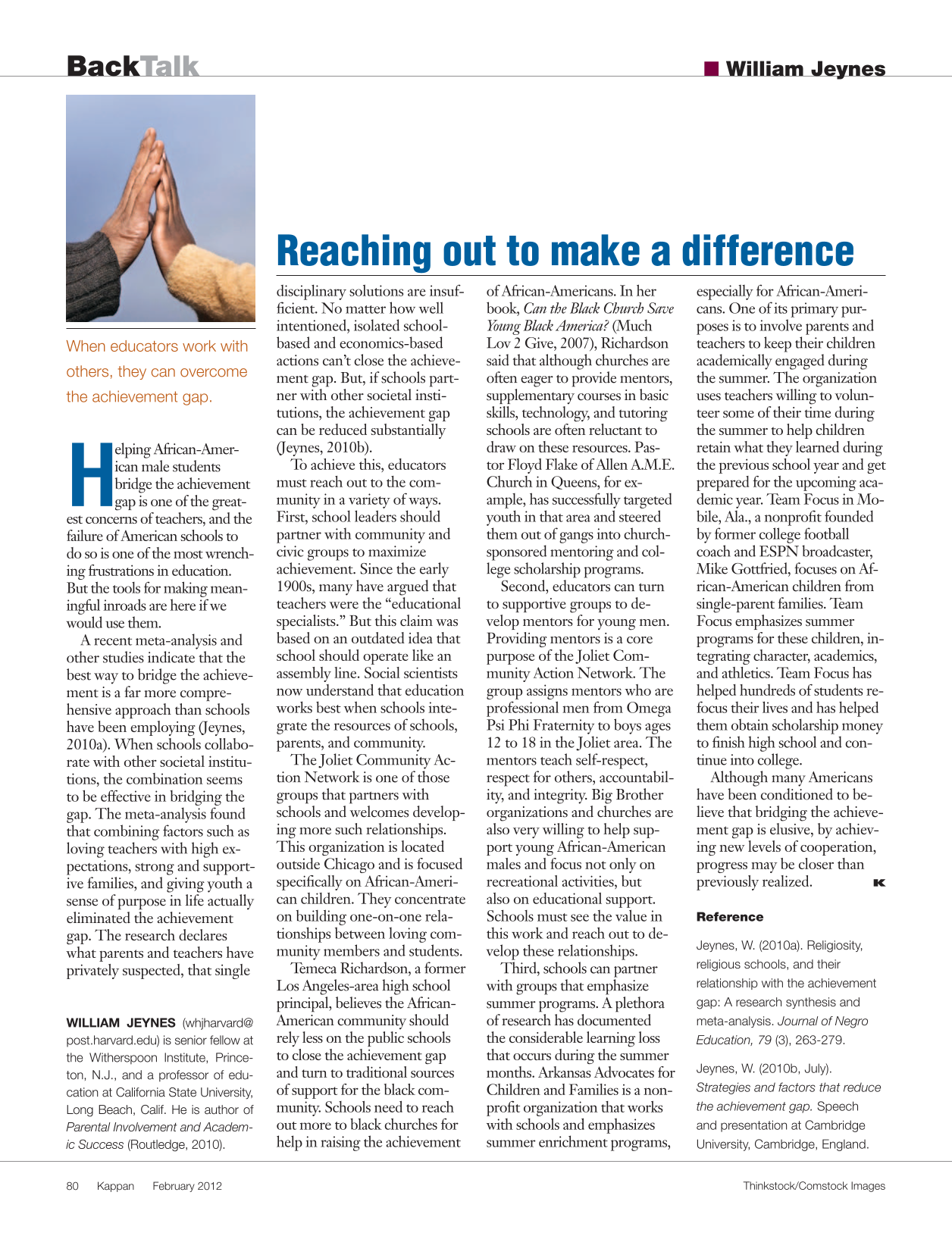

When educators work with others, they can overcome the achievement gap.
Helping African-American male students bridge the achievement gap is one of the greatest concerns of teachers, and the failure of American schools to do so is one of the most wrenching frustrations in education. But the tools for making meaningful inroads are here if we would use them.
A recent meta-analysis and other studies indicate that the best way to bridge the achievement is a far more comprehensive approach than schools have been employing (Jeynes, 2010a). When schools collaborate with other societal institutions, the combination seems to be effective in bridging the gap. The meta-analysis found that combining factors such as loving teachers with high expectations, strong and supportive families, and giving youth a sense of purpose in life actually eliminated the achievement gap. The research declares what parents and teachers have privately suspected, that single disciplinary solutions are insufficient. No matter how well intentioned, isolated school-based and economics-based actions can't close the achievement gap. But, if schools partner with other societal institutions, the achievement gap can be reduced substantially (Jeynes, 2010b).
To achieve this, educators must reach out to the community in a variety of ways. First, school leaders should partner with community and civic groups to maximize achievement. Since the early 1900s, many have argued that teachers were the “educational specialists.” But this claim was based on an outdated idea that school should operate like an assembly line. Social scientists now understand that education works best when schools integrate the resources of schools, parents, and community.
The Joliet Community Action Network is one of those groups that partners with schools and welcomes developing more such relationships. This organization is located outside Chicago and is focused specifically on African-American children. They concentrate on building one-on-one relationships between loving community members and students.
Temeca Richardson, a former Los Angeles-area high school principal, believes the African-American community should rely less on the public schools to close the achievement gap and turn to traditional sources of support for the black community. Schools need to reach out more to black churches for help in raising the achievement of African-Americans. In her book, Can the Black Church Save Young Black America? (Much Lov 2 Give, 2007), Richardson said that although churches are often eager to provide mentors, supplementary courses in basic skills, technology, and tutoring schools are often reluctant to draw on these resources. Pastor Floyd Flake of Allen A.M.E. Church in Queens, for example, has successfully targeted youth in that area and steered them out of gangs into church-sponsored mentoring and college scholarship programs.
Second, educators can turn to supportive groups to develop mentors for young men. Providing mentors is a core purpose of the Joliet Community Action Network. The group assigns mentors who are professional men from Omega Psi Phi Fraternity to boys ages 12 to 18 in the Joliet area. The mentors teach self-respect, respect for others, accountability, and integrity. Big Brother organizations and churches are also very willing to help support young African-American males and focus not only on recreational activities, but also on educational support. Schools must see the value in this work and reach out to develop these relationships.
Third, schools can partner with groups that emphasize summer programs. A plethora of research has documented the considerable learning loss that occurs during the summer months. Arkansas Advocates for Children and Families is a nonprofit organization that works with schools and emphasizes summer enrichment programs, especially for African-Americans. One of its primary purposes is to involve parents and teachers to keep their children academically engaged during the summer. The organization uses teachers willing to volunteer some of their time during the summer to help children retain what they learned during the previous school year and get prepared for the upcoming academic year. Team Focus in Mobile, Ala., a nonprofit founded by former college football coach and ESPN broadcaster, Mike Gottfried, focuses on African-American children from single-parent families. Team Focus emphasizes summer programs for these children, integrating character, academics, and athletics. Team Focus has helped hundreds of students re-focus their lives and has helped them obtain scholarship money to finish high school and continue into college.
Although many Americans have been conditioned to believe that bridging the achievement gap is elusive, by achieving new levels of cooperation, progress may be closer than previously realized.