Abstract
As community schools spread across the country, community school staff need effective approaches to engaging families and community-based partners. Such principles must be broadly applicable, given community schools’ mandate to adapt to different local contexts. Based on recent research on Baltimore City’s community schools, the authors highlight the approaches shared by community school coordinators in schools that have demonstrated comparatively high student attendance and positive school climate.
In Baltimore City Public Schools, where more than 80% of public school students qualify for free or reduced-priced meals, community schooling offers great promise for improving educational outcomes. According to evaluations by the Baltimore Education Research Consortium, the approach, which is growing rapidly in the city, has already led to greater parent engagement and significant growth in attendance among the neediest students, particularly in those community schools that have been in operation for five or more years (Durham & Connolly, 2016; Olson, 2014).
As of the 2015-16 school year, 49 of Baltimore’s elementary, middle, and high schools — serving more than 22,000 students or one-quarter of the district’s student population — were community schools, implementing best practices advocated by the Coalition for Community Schools and Children’s Aid Society (while also adapting those practices to fit the expertise and capacity of the local community and partners).
Baltimore’s community schools are funded by the Maryland Governor’s Office for Children, the Baltimore Mayor’s Office, Baltimore City Schools, and matches from local philanthropic organizations, and the funding is coordinated and routed to schools and partners through the city’s local management board, the Family League of Baltimore. Each school partners with a community organization that, in turn, hires a full-time community school coordinator to manage partnerships and services that support students and their families.
As they’ve scaled up the community school model across the city, what strategies have Baltimore’s educators found most helpful? Through a series of interviews with coordinators at schools that have performed well on school climate and attendance measures, we’ve been able to identify a number of key lessons (Durham & Connolly, 2017):
#1. Deliberately develop relationships.
Coordinators in successful community schools said they had deliberately and systematically reached out to local parents, students, and others. For example, upon starting her new position, one coordinator realized that she couldn’t assume that people would seek her out just because of her job title: “I went to so many functions, fairs, and block parties that kids thought I lived in the same neighborhood as them. I’d be standing there eating deviled eggs with someone’s aunt,” she recalled. “Once we experience all that together, then we have a different kind of relationship.”
#2. Look for authentic shared experiences.
Finding opportunities to share nonschool experiences provided other ways to develop positive relationships among adults in the neighborhood and between adults and students. One site coordinator started a morning walking club with two neighborhood associations, and adults from the neighborhood walked with students and talked together about whatever issues they had on their minds. “You can’t just sit in a room — you have to be out in the world talking about things, connecting with one another,” she said.
#3. Build trust.
Everyday school routines also help form positive relationships with students and family members. “My day starts at 7 a.m., and I’m at the door saying ‘Hi, how’re you doing?’ They know my face, and they know that I care about them and that their concerns are my concerns, too,” said one site coordinator. “So now [the parents] know that if they need me, they can come to me.”
#4. Invest in quality partnerships.
Coordinators in successful community schools are careful to create mutually beneficial partnerships. “[We] let them use our space for meetings, and they give us volunteers. It’s a give-and-take. It’s the little things,” said one coordinator. The partner and the school have to share a vision for supporting students and their families, and both have to be willing to go the extra mile to achieve their mutual goals. “Partnerships are two-way streets,” said another coordinator. “It shouldn’t be just the school standing there with its hand out. There’s lots of two-way communication with the partners I work with. The relationship isn’t just a onetime thing or quid pro quo. There’s a finessing of my interests and your interests to serve one another, and sometimes that means stepping outside the organization’s standard role to do something for a partner that wouldn’t ordinarily get done,” he said.
#5. Support teachers.
Although much of the focus of community schools is on students and their families, coordinators in schools with higher attendance and more positive climate also look for partners who can provide benefits for teachers. For example, one coordinator brought in acupuncture and massage therapists; another partnered with a local university to get teachers-in-training to volunteer in classrooms to help reduce teachers’ workload. In short, creating a positive climate for teachers contributes to a better environment for students.
#6. Model respect.
The community should be the core constituency when choosing priorities and drafting action plans for the school, and community members should be allowed to take on meaningful roles as plans are implemented. School leaders need to model respect and promote a culture where community stakeholders’ participation is actively invited and its value is consistently reinforced. It is also critical that the community school leader promotes respectful mind-sets and helps all staff reset their own expectations and biases.
#7. Plan for sustainability.
Finally, since the continuity of a relationship often depends on a single person, community school staff must work to ensure sustainability by increasing shared ownership. If we know relationships are critical, then the next step to institutionalizing the work is to engage more staff members (i.e. teachers, counselors, and administrators) in building relationships so all the work does not rely on one dynamic coordinator or one extraordinary principal.
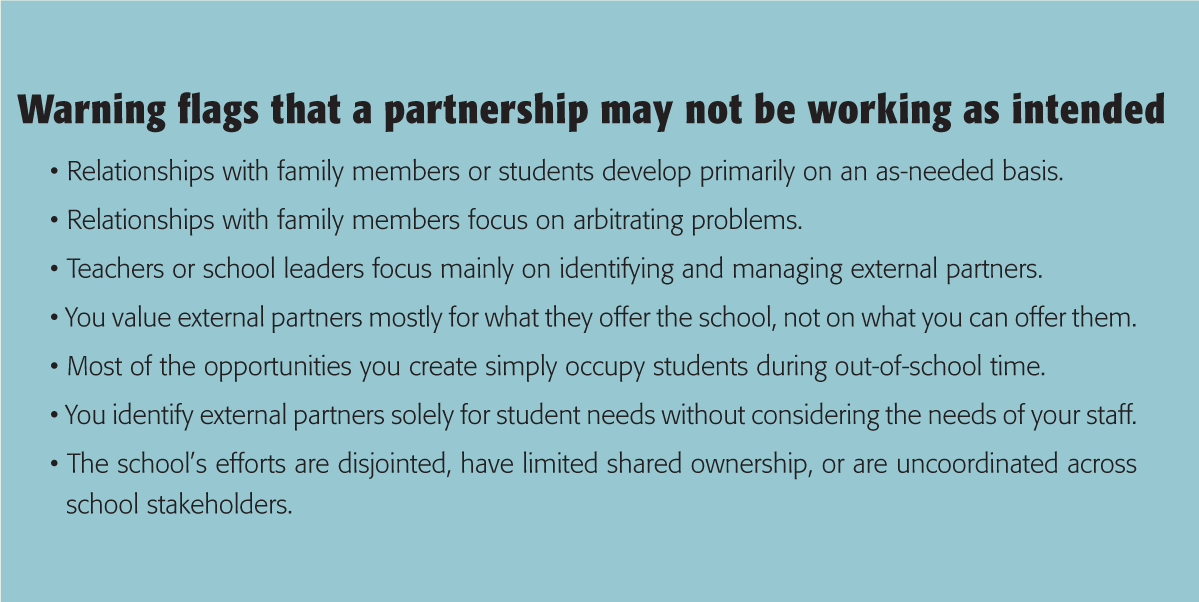
Warning flags that a partnership may not be working as intended