






Abstract
Connie Hamilton shares how teachers can use ChatGPT as a thought partner to generate ideas for lesson planning.
At dinner recently, I asked a friend for advice about talking to my mom, who has dementia. When my mom is confused or locked into an imagined problem, it’s hard to find the right words in the moment. I want to reassure her without reinforcing the loop she’s stuck in. My first instinct is to explain what’s really happening, but experience has taught me that approach is ineffective and even hurtful.
My friend, who also has a family member with dementia, explained why it’s best to roll with the stories. She suggested I have a few go-to phrases ready before each visit. That way, I can enjoy the visit knowing I have words to lean on.
It struck me how similar this situation is to teaching. Teachers face that reality every day. We may walk in with a vision for where a lesson will land, but in the swirl of a real classroom, we need anchors to steady us. Preparation frees up the energy to focus on what matters most. Sometimes we need ideas for questioning, or for a way to differentiate for our students. That’s where we can use artificial intelligence (AI) as a thought partner. AI can help us plan, reflect, and problem solve in ways we rarely have time to do alone.
Inside the why
Lesson planning is essential for student learning (van Diggele et al., 2020). But today’s lesson plans go far beyond a simple objective, activity, and assessment. Teachers juggle a spectrum of learning needs, multilingual learners, and social or behavioral considerations while navigating limited resources and shrinking time.
During instruction, we balance differentiation, assessment, engagement, and classroom management while keeping an eye on timing and giving and getting feedback. It is no wonder the work is exhausting. The fatigue does not come from a lack of commitment but from expectations that outpace the time and information teachers have. Researchers call this time poverty, when more tasks are demanded in less time with increasing pressure (Creagh, 2023).
That is why a seemingly limitless toolbox matters. AI tools like ChatGPT can respond to teacher needs in the blink of an eye.
An inside look
Using AI as a thought partner is not difficult. Choose a platform like ChatGPT and try personalized prompts to make it work for your specific subject and students:
Any prompt that suggests multiple responses works.
I need ideas for…
What options can you share…
Provide four examples…
List choices for…
When you’re provided with choices, you then can refine an idea that’s most likely to work. You’ll also have backup plans to try in small groups, reteaching, or future lessons. Pro tip: If you don’t like any of the initial options, give a reason why the given options don’t work when asking for new ones.
That might work, but what about…
I’ve already tried that, how could I adjust?
That’s close. I need to consider…
Here’s an example of how a ChatGPT exchange can unfold:
Teacher: Give me fresh ideas for lesson closure besides exit tickets.
ChatGPT: Sure thing. Here are a few quick closure moves you can try:
Teacher: I like the Teach in 10, but how could I gather data?
ChatGPT: You could listen in on a few pairs and jot quick notes, but if you want something more systematic, here are options:
Teacher: Create a note-taking document so I can easily record if they hit the target or not.
ChatGPT: Here’s a simple notetaking document you can use for the Teach in 10 closure check.
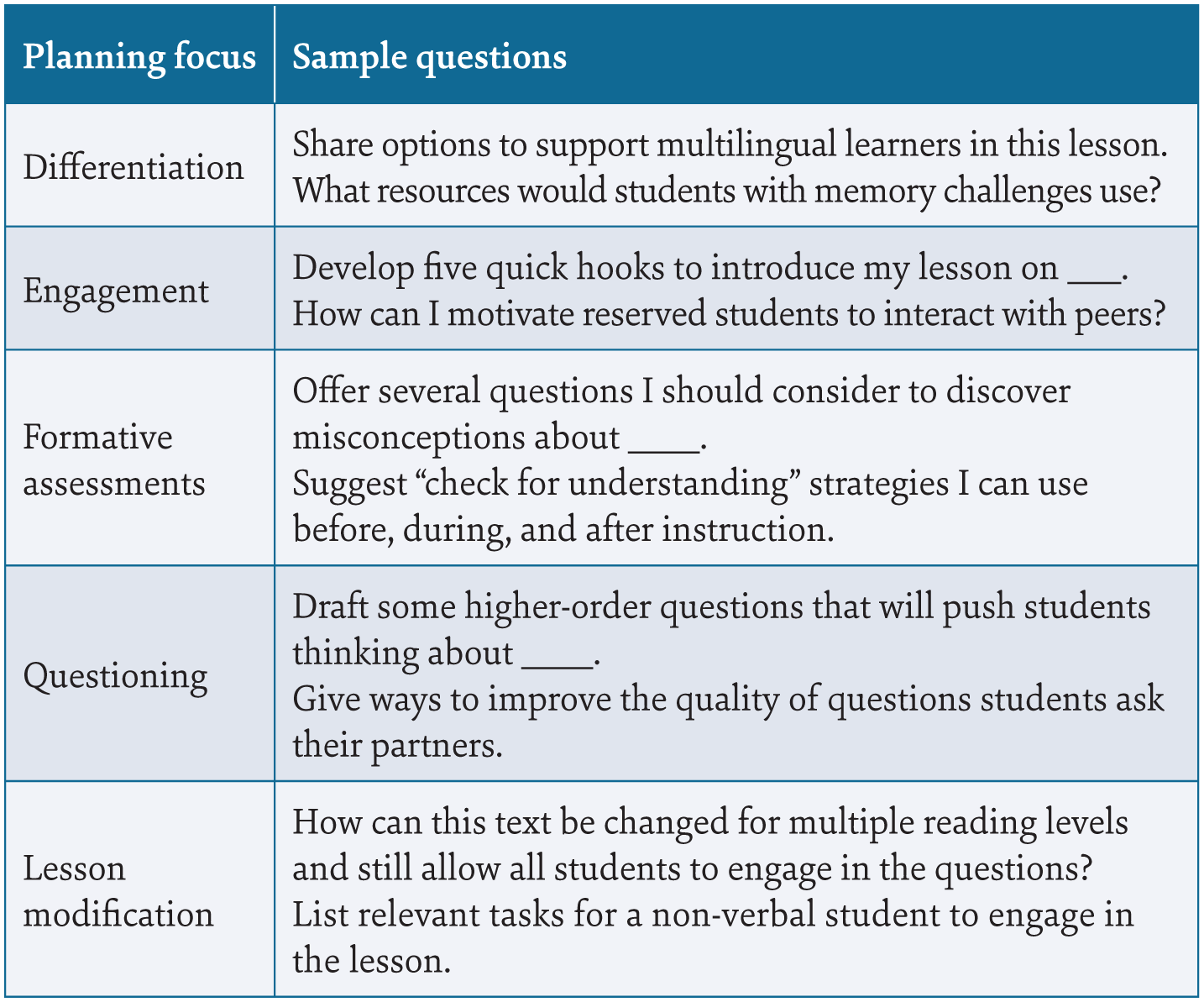
Lesson closure is just one example. The same process works for anything that feels overwhelming. Complex lesson planning can feel overwhelming. Here are questions to start the process. Feel free to adapt them to fit your own challenges.
Whether your AI thought partner helps you brainstorm solutions, develop resources that complement your lessons, or offer fresh strategies to keep instruction engaging, the benefits are many. You save time and preserve energy for what no tool can replace: your connection with students.
Look inside
Consider how a thought partner might lighten your load.
What parts of planning instruction require the most time or energy?
Where do you notice student needs but feel short on ways to respond in the moment?
If you had an extra planning hour, what would you be able to accomplish?
Free teacher resources are available from Hamilton’s site at conniehamilton.org/freeresources. ■